12th September 2017
XVI SBPMAT
Gramado Brazil
1
Kenneth E. Gonsalves
School of Basic Sciences
Indian Institute of Technology (IIT) Mandi,
Himachal Pradesh, India
Extreme Ultraviolet Lithography (EUVL):
Novel Patterning Materials, Progress and Challenges
2
Brief Outline
Semiconductor IC fabrication technology/HVM
 Lithography- prospect and technical challenges for EUVL
Resolution-LWR-sensitivity trade-off/CARs
Process flow layout of resists for NGL/non-CARs
Resist materials challenges for sub-7 nm EUV lithography
Metal oxide resists
Routes to achieve future technological EUVL nodes
 Development of indigenous resist technologies
3
• The semiconductor industry is approaching $400B/yr in sales
The IC Market
Transportation 8%
Autonomous vehicles
(Artificial Intelligence)? Consumer Electronics
16%
Communications 24%
Data networks?
Internet of ”things”?
Computers
42%
Industrial
8%
Military
2%
Medical &Health
4
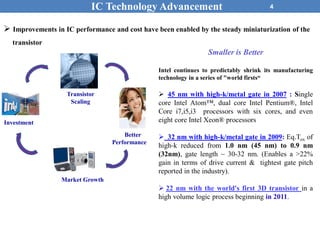
 Improvements in IC performance and cost have been enabled by the steady miniaturization of the
transistor
IC Technology Advancement
Better
Performance
Transistor
Scaling
Market Growth
Investment
Smaller is Better
Intel continues to predictably shrink its manufacturing
technology in a series of "world firsts“
 45 nm with high-k/metal gate in 2007 : Single
core Intel Atom™, dual core Intel Pentium®, Intel
Core i7,i5,i3 processors with six cores, and even
eight core Intel Xeon® processors
 32 nm with high-k/metal gate in 2009: Eq.Tox of
high-k reduced from 1.0 nm (45 nm) to 0.9 nm
(32nm), gate length ~ 30-32 nm. (Enables a >22%
gain in terms of drive current & tightest gate pitch
reported in the industry).
 22 nm with the world's first 3D transistor in a
high volume logic process beginning in 2011.
Ref: https://www.extremetech.com/computing/237781-samsungs-10nm-node-socs-now-in-mass-production
Foundry Futures : TSMC, Samsung , Global Foundry & Intel (Invidia, AMD?)
Gear Up for 7 nm and Beyond tools
 Intel : Launching 10 nm technology node based mobile for market. While desktop & HEDT will
remain on 14 nm technology node.
 TSMC planning a quick transition from 10 to 7 nm technology node in 2018.
 In contrast Samsung planning to hold at 10 nm technology node for multiple product and planning
to introduce 8 nm node with conventional immersion and 7 nm with EUV 2019-2020.
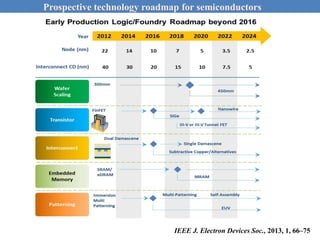
Prospective technology roadmap for semiconductors
IEEE J. Electron Devices Soc., 2013, 1, 66–75
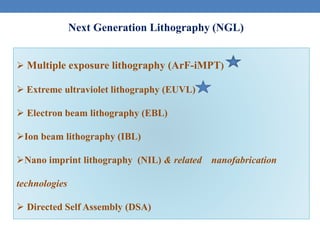
Next Generation Lithography (NGL)
 Multiple exposure lithography (ArF-iMPT)
 Extreme ultraviolet lithography (EUVL)
 Electron beam lithography (EBL)
Ion beam lithography (IBL)
Nano imprint lithography (NIL) & related nanofabrication
technologies
 Directed Self Assembly (DSA)
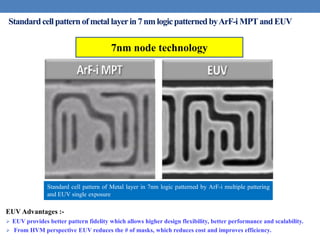
Standardcell pattern ofmetal layerin7nmlogicpatternedbyArF-i MPT andEUV
EUV Advantages :-
 EUV provides better pattern fidelity which allows higher design flexibility, better performance and scalability.
 From HVM perspective EUV reduces the # of masks, which reduces cost and improves efficiency.
Standard cell pattern of Metal layer in 7nm logic patterned by ArF-i multiple pattering
and EUV single exposure
7nm node technology
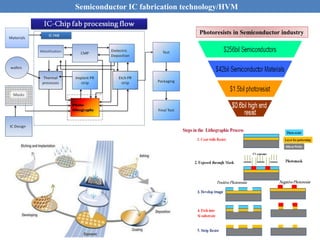
Photoresists in Semiconductor industry
Semiconductor IC fabrication technology/HVM
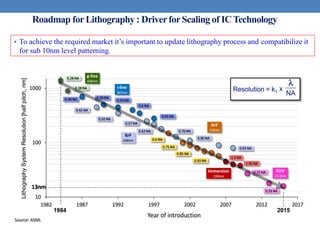
Roadmap forLithography : DriverforScaling of ICTechnology
 To achieve the required market it’s important to update lithography process and compatibilize it
for sub 10nm level patterning.
11
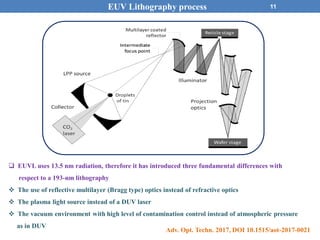
 EUVL uses 13.5 nm radiation, therefore it has introduced three fundamental differences with
respect to a 193-nm lithography
 The use of reflective multilayer (Bragg type) optics instead of refractive optics
 The plasma light source instead of a DUV laser
 The vacuum environment with high level of contamination control instead of atmospheric pressure
as in DUV
EUV Lithography process
Adv. Opt. Techn. 2017, DOI 10.1515/aot-2017-0021
12
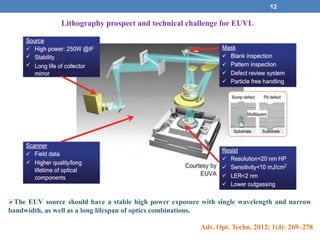
Lithography prospect and technical challenge for EUVL
The EUV source should have a stable high power exposure with single wavelength and narrow
bandwidth, as well as a long lifespan of optics combinations.
Adv. Opt. Techn. 2012; 1(4): 269–278
13
 Light-sensitive:
polymers/macromolecules/molecules/hybrids/inorganics
 Changes in their chemical structure when exposed to
radiation/UV-light.
 Contain light-sensitive chemical functionality - allow image
transfer onto a silicon wafer.
 Two types: positive and negative
Photoresists
15
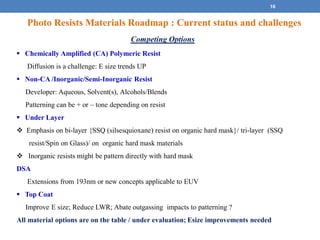
Competing Options
 Chemically Amplified (CA) Polymeric Resist
Diffusion is a challenge: E size trends UP
 Non-CA /Inorganic/Semi-Inorganic Resist
Developer: Aqueous, Solvent(s), Alcohols/Blends
Patterning can be + or – tone depending on resist
 Under Layer
 Emphasis on bi-layer {SSQ (silsesquioxane) resist on organic hard mask}/ tri-layer (SSQ
resist/Spin on Glass)/ on organic hard mask materials
 Inorganic resists might be pattern directly with hard mask
DSA
Extensions from 193nm or new concepts applicable to EUV
 Top Coat
Improve E size; Reduce LWR; Abate outgassing impacts to patterning ?
All material options are on the table / under evaluation; Esize improvements needed
Photo Resists Materials Roadmap : Current status and challenges
16
C O
O
C O
O
C O
O
C O
O
C O
O
C O
O
C O
O
C O
O
C O
O
PAG
PAG
C O
O
PAGPAG
H+
C O
OH
C O
OH
C O
OH
C O
OH
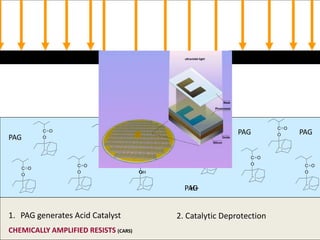
1. PAG generates Acid Catalyst
CHEMICALLY AMPLIFIED RESISTS (CARS)
2. Catalytic Deprotection
PAGH+
C O
O
C O
O
C O
O
C O
O
C O
O
C O
O
PAG
PAGPAGC O
OH
C O
OH
C O
OH
C O
OH
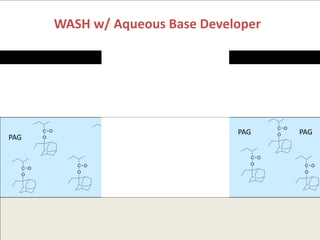
WASH w/ Aqueous Base Developer
18
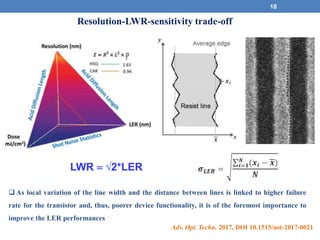
Resolution-LWR-sensitivity trade-off
 As local variation of the line width and the distance between lines is linked to higher failure
rate for the transistor and, thus, poorer device functionality, it is of the foremost importance to
improve the LER performances
Adv. Opt. Techn. 2017, DOI 10.1515/aot-2017-0021
LWR = √2*LER
19
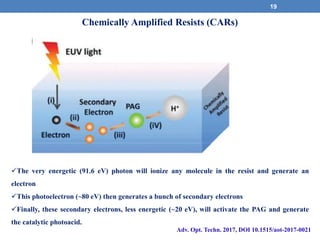
Chemically Amplified Resists (CARs)
The very energetic (91.6 eV) photon will ionize any molecule in the resist and generate an
electron
This photoelectron (~80 eV) then generates a bunch of secondary electrons
Finally, these secondary electrons, less energetic (~20 eV), will activate the PAG and generate
the catalytic photoacid.
Adv. Opt. Techn. 2017, DOI 10.1515/aot-2017-0021
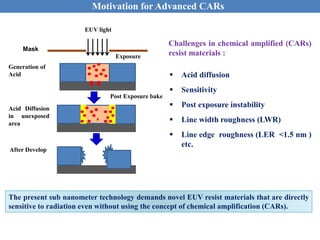
The present sub nanometer technology demands novel EUV resist materials that are directly
sensitive to radiation even without using the concept of chemical amplification (CARs).
Challenges in chemical amplified (CARs)
resist materials :
 Acid diffusion
 Sensitivity
 Post exposure instability
 Line width roughness (LWR)
 Line edge roughness (LER <1.5 nm )
etc.
Motivation for Advanced CARs
EUV light
Mask
Generation of
Acid
Exposure
Acid Diffusion
in unexposed
area
Post Exposure bake
After Develop
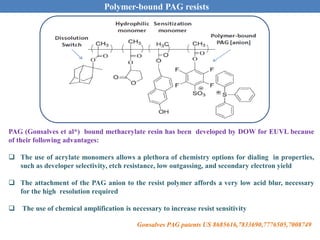
PAG (Gonsalves et al*) bound methacrylate resin has been developed by DOW for EUVL because
of their following advantages:
 The use of acrylate monomers allows a plethora of chemistry options for dialing in properties,
such as developer selectivity, etch resistance, low outgassing, and secondary electron yield
 The attachment of the PAG anion to the resist polymer affords a very low acid blur, necessary
for the high resolution required
 The use of chemical amplification is necessary to increase resist sensitivity
Gonsalves PAG patents US 8685616,7833690,7776505,7008749
Polymer-bound PAG resists
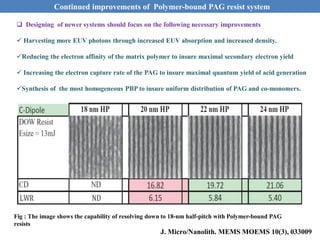
Fig : The image shows the capability of resolving down to 18-nm half-pitch with Polymer-bound PAG
resists
J. Micro/Nanolith. MEMS MOEMS 10(3), 033009
 Designing of newer systems should focus on the following necessary improvements
 Harvesting more EUV photons through increased EUV absorption and increased density.
Reducing the electron affinity of the matrix polymer to insure maximal secondary electron yield
 Increasing the electron capture rate of the PAG to insure maximal quantum yield of acid generation
Synthesis of the most homogeneous PBP to insure uniform distribution of PAG and co-monomers.
Continued improvements of Polymer-bound PAG resist system
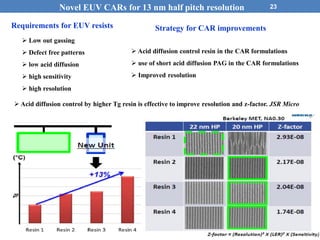
23
Requirements for EUV resists
 Low out gassing
 Defect free patterns
 low acid diffusion
 high sensitivity
 high resolution
Strategy for CAR improvements
 Acid diffusion control resin in the CAR formulations
 use of short acid diffusion PAG in the CAR formulations
 Improved resolution
 Acid diffusion control by higher Tg resin is effective to improve resolution and z-factor. JSR Micro
Novel EUV CARs for 13 nm half pitch resolution
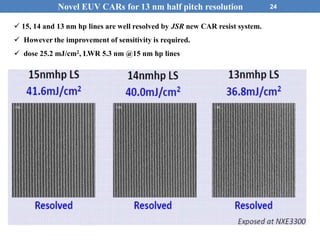
24
 15, 14 and 13 nm hp lines are well resolved by JSR new CAR resist system.
 However the improvement of sensitivity is required.
 dose 25.2 mJ/cm2, LWR 5.3 nm @15 nm hp lines
Novel EUV CARs for 13 nm half pitch resolution
25
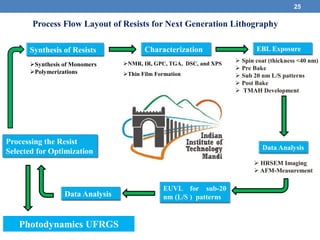
Process Flow Layout of Resists for Next Generation Lithography
Synthesis of Resists Characterization EBL Exposure
EUVL for sub-20
nm (L/S ) patterns
Data Analysis
Data Analysis
Processing the Resist
Selected for Optimization
Photodynamics UFRGS
Synthesis of Monomers
Polymerizations
NMR, IR, GPC, TGA, DSC, and XPS
Thin Film Formation
 Spin coat (thickness <40 nm)
 Pre Bake
 Sub 20 nm L/S patterns
 Post Bake
 TMAH Development
 HRSEM Imaging
 AFM-Measurement
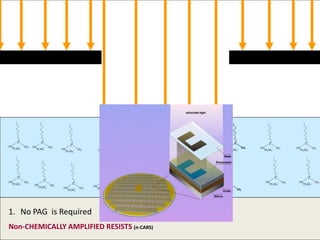
1. No PAG is Required
Non-CHEMICALLY AMPLIFIED RESISTS (n-CARS)
C O
O
C O
O
C O
O
C O
O
C O
O
C O
O
PAG
PAGPAGC O
OH
C O
OH
C O
OH
C O
OH
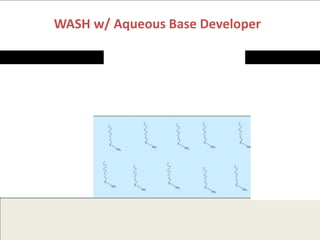
WASH w/ Aqueous Base Developer
28
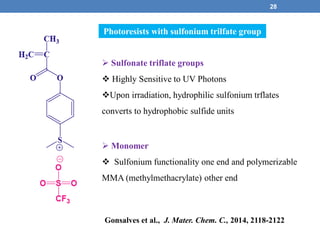
 Sulfonate triflate groups
 Highly Sensitive to UV Photons
Upon irradiation, hydrophilic sulfonium trflates
converts to hydrophobic sulfide units
 Monomer
 Sulfonium functionality one end and polymerizable
MMA (methylmethacrylate) other end
Photoresists with sulfonium trilfate group
Gonsalves et al., J. Mater. Chem. C., 2014, 2118-2122
29
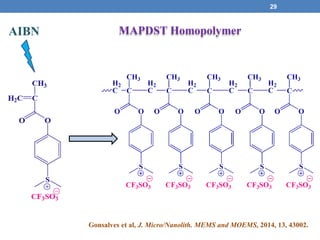
MAPDST Homopolymer
Gonsalves et al, J. Micro/Nanolith. MEMS and MOEMS, 2014, 13, 43002.
AIBN
30
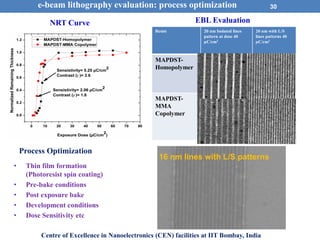
Resist 20 nm Isolated lines
pattern at dose 40
µC/cm2
20 nm with L/S
lines patterns 40
µC/cm2
MAPDST-
Homopolymer
MAPDST-
MMA
Copolymer
NRT Curve EBL Evaluation
16 nm lines with L/S patterns
e-beam lithography evaluation: process optimization
• Thin film formation
(Photoresist spin coating)
• Pre-bake conditions
• Post exposure bake
• Development conditions
• Dose Sensitivity etc
Process Optimization
Centre of Excellence in Nanoelectronics (CEN) facilities at IIT Bombay, India
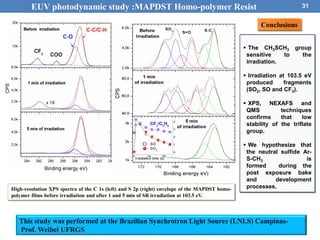
 The CH3SCH3 group
sensitive to the
irradiation.
 Irradiation at 103.5 eV
produced fragments
(SO2, SO and CF3).
 XPS, NEXAFS and
QMS techniques
confirms that low
stability of the triflate
group.
 We hypothesize that
the neutral sulfide Ar-
S-CH3 is
formed during the
post exposure bake
and development
processes.
31
Conclusions
High-resolution XPS spectra of the C 1s (left) and S 2p (right) envelope of the MAPDST homo-
polymer films before irradiation and after 1 and 5 min of SR irradiation at 103.5 eV.
EUV photodynamic study :MAPDST Homo-polymer Resist
This study was performed at the Brazilian Synchrotron Light Source (LNLS) Campinas-
Prof. Weibel UFRGS
32
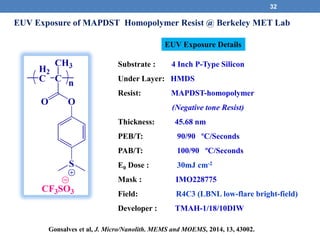
EUV Exposure Details
Substrate : 4 Inch P-Type Silicon
Under Layer: HMDS
Resist: MAPDST-homopolymer
(Negative tone Resist)
Thickness: 45.68 nm
PEB/T: 90/90 ºC/Seconds
PAB/T: 100/90 ºC/Seconds
E0 Dose : 30mJ cm-2
Mask : IMO228775
Field: R4C3 (LBNL low-flare bright-field)
Developer : TMAH-1/18/10DIW
EUV Exposure of MAPDST Homopolymer Resist @ Berkeley MET Lab
Gonsalves et al, J. Micro/Nanolith. MEMS and MOEMS, 2014, 13, 43002.
33
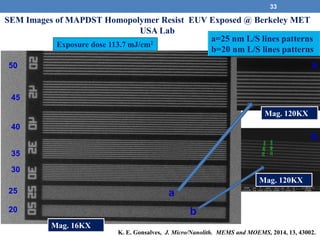
SEM Images of MAPDST Homopolymer Resist EUV Exposed @ Berkeley MET
USA Lab
Exposure dose 113.7 mJ/cm2
20
25
30
35
40
45
50
Mag. 16KX
Mag. 120KX
Mag. 120KX
a
a
b
b
a=25 nm L/S lines patterns
b=20 nm L/S lines patterns
K. E. Gonsalves, J. Micro/Nanolith. MEMS and MOEMS, 2014, 13, 43002.
34
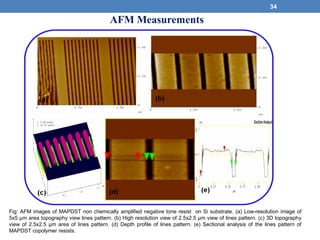
AFM Measurements
Fig: AFM images of MAPDST non chemically amplified negative tone resist on Si substrate. (a) Low-resolution image of
5x5 µm area topography view lines pattern. (b) High resolution view of 2.5x2.5 µm view of lines pattern. (c) 3D topography
view of 2.5x2.5 µm area of lines pattern. (d) Depth profile of lines pattern. (e) Sectional analysis of the lines pattern of
MAPDST copolymer resists.
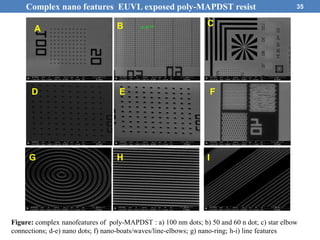
35Complex nano features EUVL exposed poly-MAPDST resist
A B C
F
I
ED
G H
Figure: complex nanofeatures of poly-MAPDST : a) 100 nm dots; b) 50 and 60 n dot; c) star elbow
connections; d-e) nano dots; f) nano-boats/waves/line-elbows; g) nano-ring; h-i) line features
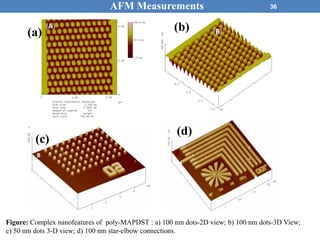
36AFM Measurements
(c)
(d)
(a) (b)
Figure: Complex nanofeatures of poly-MAPDST : a) 100 nm dots-2D view; b) 100 nm dots-3D View;
c) 50 nm dots 3-D view; d) 100 nm star-elbow connections.
37
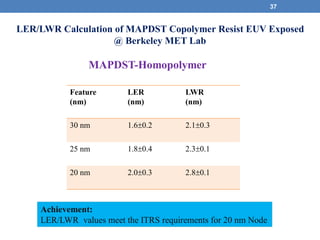
LER/LWR Calculation of MAPDST Copolymer Resist EUV Exposed
@ Berkeley MET Lab
Achievement:
LER/LWR values meet the ITRS requirements for 20 nm Node
Feature
(nm)
LER
(nm)
LWR
(nm)
30 nm 1.60.2 2.10.3
25 nm 1.80.4 2.30.1
20 nm 2.00.3 2.80.1
MAPDST-Homopolymer
38
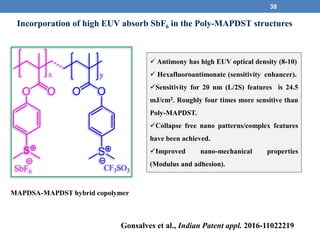
Incorporation of high EUV absorb SbF6 in the Poly-MAPDST structures
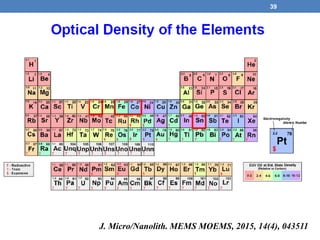
 Antimony has high EUV optical density (8-10)
 Hexafluoroantimonate (sensitivity enhancer).
Sensitivity for 20 nm (L/2S) features is 24.5
mJ/cm2. Roughly four times more sensitive than
Poly-MAPDST.
Collapse free nano patterns/complex features
have been achieved.
Improved nano-mechanical properties
(Modulus and adhesion).
MAPDSA-MAPDST hybrid copolymer
Gonsalves et al., Indian Patent appl. 2016-11022219
39
J. Micro/Nanolith. MEMS MOEMS, 2015, 14(4), 043511
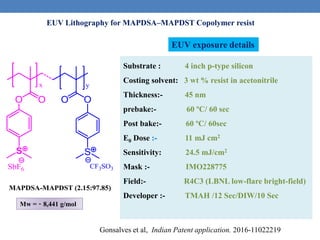
EUV exposure details
Substrate : 4 inch p-type silicon
Costing solvent: 3 wt % resist in acetonitrile
Thickness:- 45 nm
prebake:- 60 ºC/ 60 sec
Post bake:- 60 ºC/ 60sec
E0 Dose :- 11 mJ cm2
Sensitivity: 24.5 mJ/cm2
Mask :- IMO228775
Field:- R4C3 (LBNL low-flare bright-field)
Developer :- TMAH /12 Sec/DIW/10 Sec
Mw = ̴ 8,441 g/mol
Gonsalves et al, Indian Patent application. 2016-11022219
EUV Lithography for MAPDSA–MAPDST Copolymer resist
41
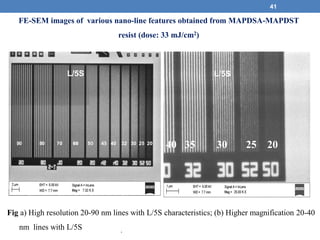
Fig a) High resolution 20-90 nm lines with L/5S characteristics; (b) Higher magnification 20-40
nm lines with L/5S
(a)
(b)
40 35 30 25 20
L/5S
90 80 70 60 50 45 40 32 30 25 20
L/5S
FE-SEM images of various nano-line features obtained from MAPDSA-MAPDST
resist (dose: 33 mJ/cm2)
.
42
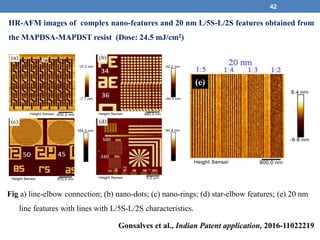
HR-AFM images of complex nano-features and 20 nm L/5S-L/2S features obtained from
the MAPDSA-MAPDST resist (Dose: 24.5 mJ/cm2)
Gonsalves et al., Indian Patent application, 2016-11022219
(e)
Fig a) line-elbow connection; (b) nano-dots; (c) nano-rings; (d) star-elbow features; (e) 20 nm
line features with lines with L/5S-L/2S characteristics.
43
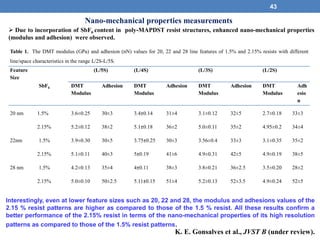
Table 1. The DMT modulus (GPa) and adhesion (nN) values for 20, 22 and 28 line features of 1.5% and 2.15% resists with different
line/space characteristics in the range L/2S-L/5S.
Feature
Size
(L/5S) (L/4S) (L/3S) (L/2S)
SbF6 DMT
Modulus
Adhesion DMT
Modulus
Adhesion DMT
Modulus
Adhesion DMT
Modulus
Adh
esio
n
20 nm 1.5% 3.6±0.25 30±3 3.4±0.14 31±4 3.1±0.12 32±5 2.7±0.18 33±3
2.15% 5.2±0.12 38±2 5.1±0.18 36±2 5.0±0.11 35±2 4.95±0.2 34±4
22nm 1.5% 3.9±0.30 30±5 3.75±0.25 30±3 3.56±0.4 33±3 3.1±0.35 35±2
2.15% 5.1±0.11 40±3 5±0.19 41±6 4.9±0.31 42±5 4.9±0.19 38±5
28 nm 1.5% 4.2±0.13 35±4 4±0.11 38±3 3.8±0.21 36±2.5 3.5±0.20 28±2
2.15% 5.0±0.10 50±2.5 5.11±0.15 51±4 5.2±0.13 52±3.5 4.9±0.24 52±5
 Due to incorporation of SbF6 content in poly-MAPDST resist structures, enhanced nano-mechanical properties
(modulus and adhesion) were observed.
Nano-mechanical properties measurements
K. E. Gonsalves et al., JVST B (under review).
Interestingly, even at lower feature sizes such as 20, 22 and 28, the modulus and adhesions values of the
2.15 % resist patterns are higher as compared to those of the 1.5 % resist. All these results confirm a
better performance of the 2.15% resist in terms of the nano-mechanical properties of its high resolution
patterns as compared to those of the 1.5% resist patterns.
Photodynamics : for MAPDSTA–MAPDST
Copolymer resist (Prof Weibel UFRGS)
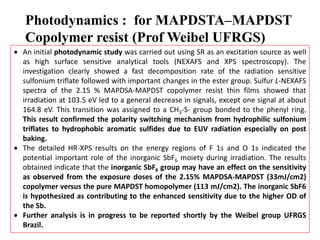
 An initial photodynamic study was carried out using SR as an excitation source as well
as high surface sensitive analytical tools (NEXAFS and XPS spectroscopy). The
investigation clearly showed a fast decomposition rate of the radiation sensitive
sulfonium triflate followed with important changes in the ester group. Sulfur L-NEXAFS
spectra of the 2.15 % MAPDSA-MAPDST copolymer resist thin films showed that
irradiation at 103.5 eV led to a general decrease in signals, except one signal at about
164.8 eV. This transition was assigned to a CH3-S- group bonded to the phenyl ring.
This result confirmed the polarity switching mechanism from hydrophilic sulfonium
triflates to hydrophobic aromatic sulfides due to EUV radiation especially on post
baking.
 The detailed HR-XPS results on the energy regions of F 1s and O 1s indicated the
potential important role of the inorganic SbF6 moiety during irradiation. The results
obtained indicate that the inorganic SbF6 group may have an effect on the sensitivity
as observed from the exposure doses of the 2.15% MAPDSA-MAPDST (33mJ/cm2)
copolymer versus the pure MAPDST homopolymer (113 mJ/cm2). The inorganic SbF6
is hypothesized as contributing to the enhanced sensitivity due to the higher OD of
the Sb.
 Further analysis is in progress to be reported shortly by the Weibel group UFRGS
Brazil.
45
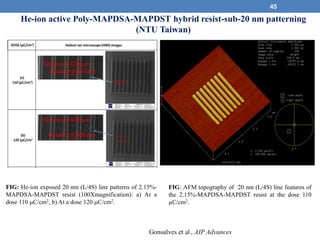
FIG: He-ion exposed 20 nm (L/4S) line patterns of 2.15%-
MAPDSA-MAPDST resist (100Xmagnification): a) At a
dose 110 C/cm2, b) At a dose 120 C/cm2.
FIG: AFM topography of 20 nm (L/4S) line features of
the 2.15%-MAPDSA-MAPDST resist at the dose 110
µC/cm2.
He-ion active Poly-MAPDSA-MAPDST hybrid resist-sub-20 nm patterning
(NTU Taiwan)
Gonsalves et al , AIP Advances
46
(a) (b)
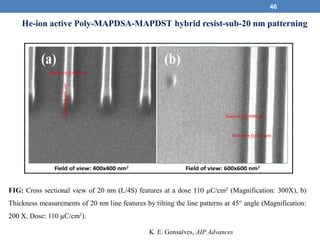
FIG: Cross sectional view of 20 nm (L/4S) features at a dose 110 µC/cm2 (Magnification: 300X), b)
Thickness measurements of 20 nm line features by tilting the line patterns at 45° angle (Magnification:
200 X, Dose: 110 µC/cm2).
He-ion active Poly-MAPDSA-MAPDST hybrid resist-sub-20 nm patterning
K. E. Gonsalves, AIP Advances
47
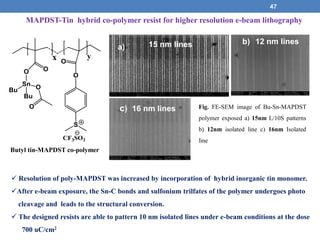
Butyl tin-MAPDST co-polymer
 Resolution of poly-MAPDST was increased by incorporation of hybrid inorganic tin monomer.
After e-beam exposure, the Sn-C bonds and sulfonium trilfates of the polymer undergoes photo
cleavage and leads to the structural conversion.
 The designed resists are able to pattern 10 nm isolated lines under e-beam conditions at the dose
700 uC/cm2
MAPDST-Tin hybrid co-polymer resist for higher resolution e-beam lithography
a)
b)
c) Fig. FE-SEM image of Bu-Sn-MAPDST
polymer exposed a) 15nm L/10S patterns
b) 12nm isolated line c) 16nm Isolated
line
15 nm lines 12 nm lines
16 nm lines
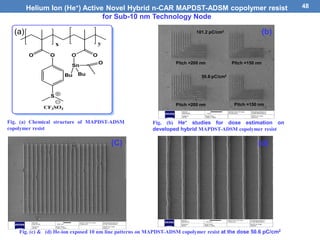
48Helium Ion (He+) Active Novel Hybrid n-CAR MAPDST-ADSM copolymer resist
for Sub-10 nm Technology Node
Fig. (a) Chemical structure of MAPDST-ADSM
copolymer resist
Fig. (c) & (d) He-ion exposed 10 nm line patterns on MAPDST-ADSM copolymer resist at the dose 50.6 pC/cm2
(a)
(C) (d)
Fig. (b) He+ studies for dose estimation on
developed hybrid MAPDST-ADSM copolymer resist
101.2 pC/cm2
Pitch =200 nm
Pitch =200 nm
Pitch =150 nm
Pitch =150 nm
50.6 pC/cm2
(b)
49
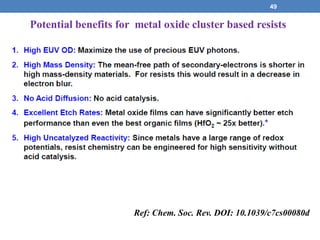
Potential benefits for metal oxide cluster based resists
Ref: Chem. Soc. Rev. DOI: 10.1039/c7cs00080d
50
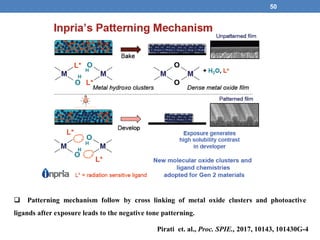
Pirati et. al., Proc. SPIE., 2017, 10143, 101430G-4
 Patterning mechanism follow by cross linking of metal oxide clusters and photoactive
ligands after exposure leads to the negative tone patterning.
51
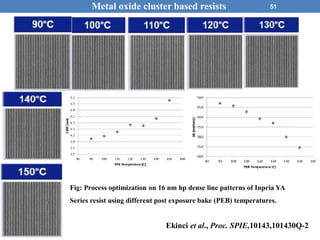
Fig: Process optimization on 16 nm hp dense line patterns of Inpria YA
Series resist using different post exposure bake (PEB) temperatures.
Ekinci et al., Proc. SPIE,10143,101430Q-2
Metal oxide cluster based resists
52
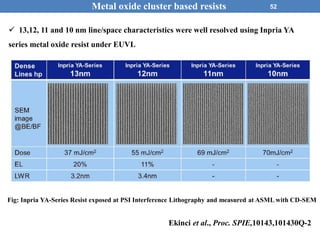
Fig: Inpria YA-Series Resist exposed at PSI Interference Lithography and measured at ASML with CD-SEM
Ekinci et al., Proc. SPIE,10143,101430Q-2
Metal oxide cluster based resists
 13,12, 11 and 10 nm line/space characteristics were well resolved using Inpria YA
series metal oxide resist under EUVL
53
 The high EUV harvesting metal oxide nano particles such as HfO2, In2O3, SnO2, Sb2O3, ZrO2,TiO2
and Ag2O etc., capped with photosensitive capping agents : photoactive sulfonium triflates.
 During EUV exposure, highly sensitive aromatic sulfonium triflates undergo structural changes
from hydrophilic sulfonium triflates (polar) into hydrophobic aromatic sulfide entities (non-polar)
which leads to the nano patterning.
Nanoscale resists for EUVL (I) [Nano non-CARS]
54
 High EUV harvesting nanoparticles modified by introducing two different functional
capping agents: 1) Capping agents with photosensitive sulfonium triflates 2) capping
structures with acid labile functional groups
Nanoscale resists for EUVL (II) [Nano-CARs]
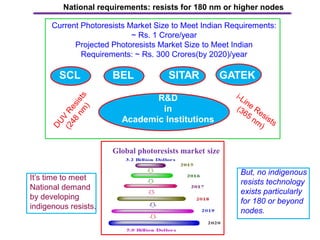
Current Photoresists Market Size to Meet Indian Requirements:
~ Rs. 1 Crore/year
Projected Photoresists Market Size to Meet Indian
Requirements: ~ Rs. 300 Crores(by 2020)/year
SCL BEL SITAR GATEK
R&D
in
Academic Institutions
Global photoresists market size
But, no indigenous
resists technology
exists particularly
for 180 or beyond
nodes.
It’s time to meet
National demand
by developing
indigenous resists.
National requirements: resists for 180 nm or higher nodes
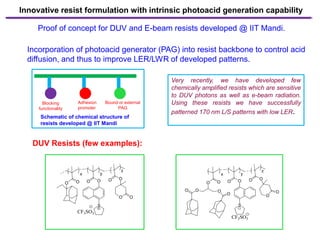
Incorporation of photoacid generator (PAG) into resist backbone to control acid
diffusion, and thus to improve LER/LWR of developed patterns.
Innovative resist formulation with intrinsic photoacid generation capability
Proof of concept for DUV and E-beam resists developed @ IIT Mandi.
DUV Resists (few examples):
O OO
yx
O O
O
z
S
CF3SO3
O
O O OO
yx
O O
O
z
OO
O
O
O
S
CF3SO3
O
Adhesion
promoter
Blocking
functionality
Bound or external
PAG
Very recently, we have developed few
chemically amplified resists which are sensitive
to DUV photons as well as e-beam radiation.
Using these resists we have successfully
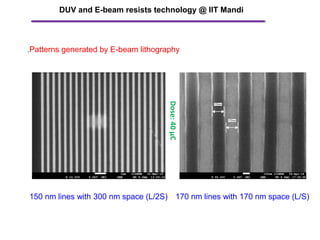
patterned 170 nm L/S patterns with low LER.
Schematic of chemical structure of
resists developed @ IIT Mandi
.
DUV and E-beam resists technology @ IIT Mandi
150 nm lines with 300 nm space (L/2S)
Dose:40μC
170 nm lines with 170 nm space (L/S)
Patterns generated by E-beam lithography
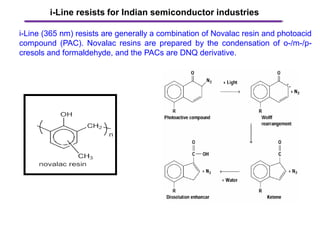
i-Line resists for Indian semiconductor industries
i-Line (365 nm) resists are generally a combination of Novalac resin and photoacid
compound (PAC). Novalac resins are prepared by the condensation of o-/m-/p-
cresols and formaldehyde, and the PACs are DNQ derivative.
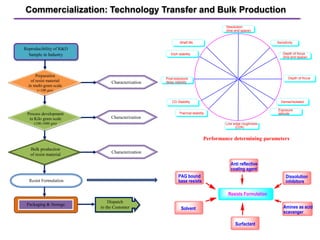
Commercialization: Technology Transfer and Bulk Production
Resists Formulation
PAG bound
base resists
Solvent Amines as acid
scavanger
Dissolution
inhibitors
Anti reflective
coating agent
Surfactant
Resolution
(line and space)
Sensitivity
Depth of focus
(line and space)
Depth of focus
Dense/Isolated
Exposure
latitude
Line edge roughness
(LER)
Thermal stability
CD Stability
Post-exposure
delay stability
Etch stability
Shelf life
Performance determining parameters
Conclusion
 Polymeric resists for 20 nm node or beyond technology with low LER/LWR
 Molecular resists for 16 nm or beyond node
 Enhancing sensitivity by incorporating inorganic materials with high EUV
absorption cross section
 DUV and i-line resists for Indian semiconductor industries
 Bulk scale production, formulation and commercialization of indigenous resists to
meet national requirements
61Acknowledgments
Co-PIs IIT Mandi
Dr Subrata Ghosh (organic chem)
Dr. Pradeep Parameswaren (inorganic)
Dr. Satinder Sharma (electrical engg)
Postdoctoral Researchers
Dr. Jyoti Shankar Borah
Dr. Mingxing Wang
Dr. V. S. V. Satyanarayana
Dr. Vikram Singh
Dr. Viswanath Kalyani
Dr. Narshima Mamidi
Dr. Paritosh Dubey
Dr. Satyendra Prakash Pal
 Prof. Daniel E. Weibel
Chemical Institutes, UFRGS,
Porto Alegre, Brazil
 Prof. Nikola Batina
UAM Mexico
 Prof Rubem Sommers
CBPF Rio de Janeiro
 Prof. Tsai, NTU
Taiwan
 Indian Nanoelectronics Users Program
(INUP), IIT Bombay for e-beam facility
 LBNL Berkeley USA, and IMEC Belgium for
EUV exposures
 Intel Corp USA /SRC
USA
 DOW Corp USA
 The Department of Science
and Technology (DST) &
Semiconductor Lab/ISRO
MHRD (UAY scheme), India
Funding agencies
Doctoral students
Mr. G. Reddy
Ms. Neha Thakur
Mr. Santu Nandi
Mr. M. Yogesh
Mr. Pravind Yadav
Ms. Reetu Yadav
Collaborators
Facilities
Obrigado!
Backup Slides
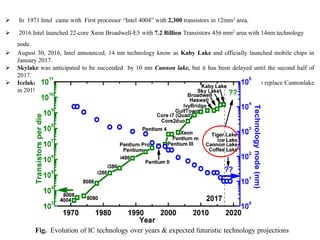
 In 1971 Intel came with First processor “Intel 4004” with 2,300 transistors in 12mm2 area.
 2016 Intel launched 22-core Xeon Broadwell-E5 with 7.2 Billion Transistors 456 mm2 area with 14nm technology
node.
 August 30, 2016, Intel announced, 14 nm technology know as Kaby Lake and officially launched mobile chips in
January 2017.
 Skylake was anticipated to be succeeded by 10 nm Cannon lake, but it has been delayed until the second half of
2017.
 Icelake, is Intel's, 400 Series chipsets, 2nd 10 nm node CPU microarchitecture that is expected to replace Cannonlake
in 2019.
Evolution of Semiconductor Technology
Fig. Evolution of IC technology over years & expected futuristic technology projections
65
Resist materials challenges for sub-7 nm EUV lithography
 Pure organic resist limitations
Low etch resistance
Low Resolution
Poor EUV absorbance
Low thermal stability
 Metal oxide nano particle resists can improve stability, etch resistance, sensitivity,
resolutions , LER with high EUV absorption cross section profiles
Examples: HfO2, TiO2, ZrO2, SnO2, Sb2O3 and In2O3 based resists
 The present EUV resist material should posses following characteristics
Resolution = sub- 7 nm
Sensitivity = < 20 mJ/cm2
LER = < 1-2 nm
Low outgassing
High etch resistance
J. Vac. Sci. Technol., B 2007, 25, 2481–2485
66
Metal oxide cluster based resists
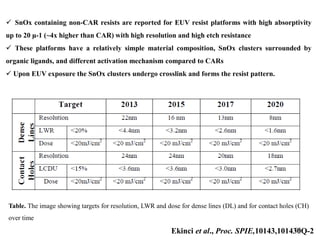
 SnOx containing non-CAR resists are reported for EUV resist platforms with high absorptivity
up to 20 μ-1 (~4x higher than CAR) with high resolution and high etch resistance
 These platforms have a relatively simple material composition, SnOx clusters surrounded by
organic ligands, and different activation mechanism compared to CARs
 Upon EUV exposure the SnOx clusters undergo crosslink and forms the resist pattern.
Ekinci et al., Proc. SPIE,10143,101430Q-2
Table. The image showing targets for resolution, LWR and dose for dense lines (DL) and for contact holes (CH)
over time
67
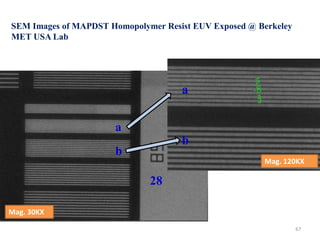
SEM Images of MAPDST Homopolymer Resist EUV Exposed @ Berkeley
MET USA Lab
28
Mag. 30KX
Mag. 120KX
a
a
b
b
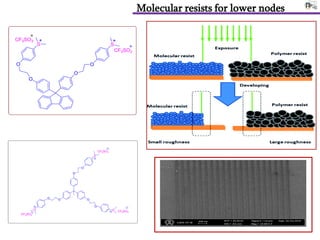
Molecular resists for lower nodes
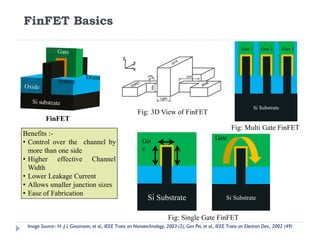
FinFET Basics
Benefits :-
• Control over the channel by
more than one side
• Higher effective Channel
Width
• Lower Leakage Current
• Allows smaller junction sizes
• Ease of Fabrication
FinFET
Si Substrate
Gat
e
Si Substrate
Gate
Si Substrate
Gate 1 Gate 2 Gate 3
Fig: 3D View of FinFET
Fig: Single Gate FinFET
Fig: Multi Gate FinFET
Image Source:- H -J L Gossmann, et al., IEEE Trans on Nanotechnology, 2003 (2), Gen Pei, et al., IEEE Trans on Electron Dev., 2002 (49)
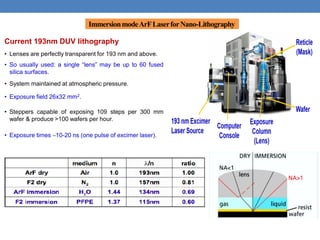
ImmersionmodeArFLaserforNano-Lithography
Current 193nm DUV lithography
• Lenses are perfectly transparent for 193 nm and above.
• So usually used: a single “lens” may be up to 60 fused
silica surfaces.
• System maintained at atmospheric pressure.
• Exposure field 26x32 mm2.
• Steppers capable of exposing 109 steps per 300 mm
wafer & produce >100 wafers per hour.
• Exposure times 10-20 ns (one pulse of excimer laser).
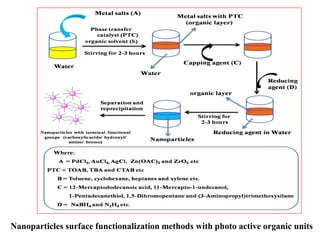
Nanoparticles surface functionalization methods with photo active organic units.
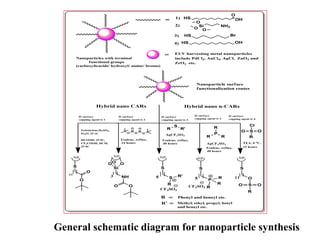
General schematic diagram for nanoparticle synthesis
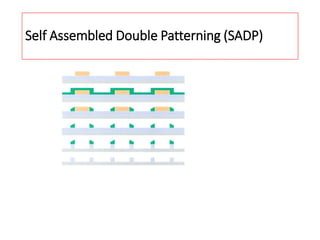
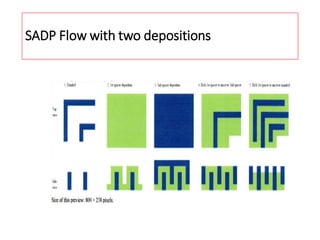
Self Assembled Double Patterning (SADP)
SADP Flow with two depositions
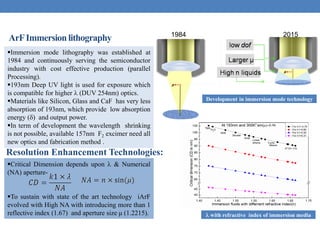
Critical Dimension depends upon  & Numerical
(NA) aperture-
To sustain with state of the art technology iArF
evolved with High NA with introducing more than 1
reflective index (1.67) and aperture size μ (1.2215).
ArFImmersion lithography
Immersion mode lithography was established at
1984 and continuously serving the semiconductor
industry with cost effective production (parallel
Processing).
193nm Deep UV light is used for exposure which
is compatible for higher  (DUV 254nm) optics.
Materials like Silicon, Glass and CaF has very less
absorption of 193nm, which provide low absorption
energy () and output power.
In term of development the wavelength shrinking
is not possible, available 157nm F2 excimer need all
new optics and fabrication method .
1984 2015
Development in immersion mode technology
 with refractive index of immersion media
Resolution Enhancement Technologies:
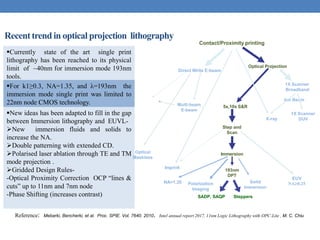
Recenttrendin optical projection lithography
Currently state of the art single print
lithography has been reached to its physical
limit of ~40nm for immersion mode 193nm
tools.
For k1≥0.3, NA=1.35, and λ=193nm the
immersion mode single print was limited to
22nm node CMOS technology.
New ideas has been adapted to fill in the gap
between Immersion lithography and EUVL-
New immersion fluids and solids to
increase the NA.
Double patterning with extended CD.
Polarised laser ablation through TE and TM
mode projection .
Gridded Design Rules-
-Optical Proximity Correction OCP “lines &
cuts” up to 11nm and 7nm node
-Phase Shifting (increases contrast)
Reference: Mebarki, Bencherki, et al. Proc. SPIE. Vol. 7640. 2010. Intel annual report 2017, 11nm Logic Lithography with OPC-Lite , M. C. Chiu
Direct Write E-beam
NA>1.35
EUV
Solid
Immersion
193nm
DPT
Multi-beam
E-beam
X-ray
1X Scanner
Broadband
Ion Beam
5x,10x S&R
Step and
Scan
Optical
Maskless
Contact/Proximity printing
Optical Projection
1X Scanner
DUV
Immersion
Imprint
Polarization
Imaging
NA0.25
Direct Write E-beam
NA>1.35
EUV
Solid
Immersion
193nm
DPT
Multi-beam
E-beam
X-ray
1X Scanner
Broadband
Ion Beam
5x,10x S&R
Step and
Scan
Optical
Maskless
Contact/Proximity printing
Optical Projection
1X Scanner
DUV
Immersion
Imprint
Polarization
Imaging
NA0.25
SADP, SAQP Steppers
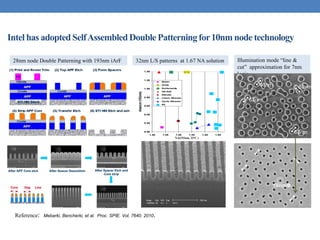
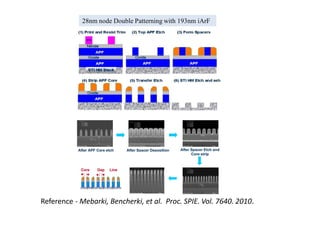
Intel has adopted SelfAssembledDouble Patterningfor10nm node technology
Reference: Mebarki, Bencherki, et al. Proc. SPIE. Vol. 7640. 2010.
NA(193nm, 22oC )
28nm node Double Patterning with 193nm iArF 32nm L/S patterns at 1.67 NA solution Illumination mode “line &
cut” approximation for 7nm
logic
28nm node Double Patterning with 193nm iArF
Reference - Mebarki, Bencherki, et al. Proc. SPIE. Vol. 7640. 2010.

Extreme Ultraviolet Litography (EUVL): novel patterning materials, progress and challenges.

  • 1.
    12th September 2017 XVISBPMAT Gramado Brazil 1 Kenneth E. Gonsalves School of Basic Sciences Indian Institute of Technology (IIT) Mandi, Himachal Pradesh, India Extreme Ultraviolet Lithography (EUVL): Novel Patterning Materials, Progress and Challenges
  • 2.
    2 Brief Outline Semiconductor ICfabrication technology/HVM  Lithography- prospect and technical challenges for EUVL Resolution-LWR-sensitivity trade-off/CARs Process flow layout of resists for NGL/non-CARs Resist materials challenges for sub-7 nm EUV lithography Metal oxide resists Routes to achieve future technological EUVL nodes  Development of indigenous resist technologies
  • 3.
    3 • The semiconductorindustry is approaching $400B/yr in sales The IC Market Transportation 8% Autonomous vehicles (Artificial Intelligence)? Consumer Electronics 16% Communications 24% Data networks? Internet of ”things”? Computers 42% Industrial 8% Military 2% Medical &Health
  • 4.
    4  Improvements inIC performance and cost have been enabled by the steady miniaturization of the transistor IC Technology Advancement Better Performance Transistor Scaling Market Growth Investment Smaller is Better Intel continues to predictably shrink its manufacturing technology in a series of "world firsts“  45 nm with high-k/metal gate in 2007 : Single core Intel Atom™, dual core Intel Pentium®, Intel Core i7,i5,i3 processors with six cores, and even eight core Intel Xeon® processors  32 nm with high-k/metal gate in 2009: Eq.Tox of high-k reduced from 1.0 nm (45 nm) to 0.9 nm (32nm), gate length ~ 30-32 nm. (Enables a >22% gain in terms of drive current & tightest gate pitch reported in the industry).  22 nm with the world's first 3D transistor in a high volume logic process beginning in 2011.
  • 5.
    Ref: https://www.extremetech.com/computing/237781-samsungs-10nm-node-socs-now-in-mass-production Foundry Futures: TSMC, Samsung , Global Foundry & Intel (Invidia, AMD?) Gear Up for 7 nm and Beyond tools  Intel : Launching 10 nm technology node based mobile for market. While desktop & HEDT will remain on 14 nm technology node.  TSMC planning a quick transition from 10 to 7 nm technology node in 2018.  In contrast Samsung planning to hold at 10 nm technology node for multiple product and planning to introduce 8 nm node with conventional immersion and 7 nm with EUV 2019-2020.
  • 6.
    Prospective technology roadmapfor semiconductors IEEE J. Electron Devices Soc., 2013, 1, 66–75
  • 7.
    Next Generation Lithography(NGL)  Multiple exposure lithography (ArF-iMPT)  Extreme ultraviolet lithography (EUVL)  Electron beam lithography (EBL) Ion beam lithography (IBL) Nano imprint lithography (NIL) & related nanofabrication technologies  Directed Self Assembly (DSA)
  • 8.
    Standardcell pattern ofmetallayerin7nmlogicpatternedbyArF-i MPT andEUV EUV Advantages :-  EUV provides better pattern fidelity which allows higher design flexibility, better performance and scalability.  From HVM perspective EUV reduces the # of masks, which reduces cost and improves efficiency. Standard cell pattern of Metal layer in 7nm logic patterned by ArF-i multiple pattering and EUV single exposure 7nm node technology
  • 9.
    Photoresists in Semiconductorindustry Semiconductor IC fabrication technology/HVM
  • 10.
    Roadmap forLithography :DriverforScaling of ICTechnology  To achieve the required market it’s important to update lithography process and compatibilize it for sub 10nm level patterning.
  • 11.
    11  EUVL uses13.5 nm radiation, therefore it has introduced three fundamental differences with respect to a 193-nm lithography  The use of reflective multilayer (Bragg type) optics instead of refractive optics  The plasma light source instead of a DUV laser  The vacuum environment with high level of contamination control instead of atmospheric pressure as in DUV EUV Lithography process Adv. Opt. Techn. 2017, DOI 10.1515/aot-2017-0021
  • 12.
    12 Lithography prospect andtechnical challenge for EUVL The EUV source should have a stable high power exposure with single wavelength and narrow bandwidth, as well as a long lifespan of optics combinations. Adv. Opt. Techn. 2012; 1(4): 269–278
  • 13.
  • 14.
     Light-sensitive: polymers/macromolecules/molecules/hybrids/inorganics  Changesin their chemical structure when exposed to radiation/UV-light.  Contain light-sensitive chemical functionality - allow image transfer onto a silicon wafer.  Two types: positive and negative Photoresists 15
  • 15.
    Competing Options  ChemicallyAmplified (CA) Polymeric Resist Diffusion is a challenge: E size trends UP  Non-CA /Inorganic/Semi-Inorganic Resist Developer: Aqueous, Solvent(s), Alcohols/Blends Patterning can be + or – tone depending on resist  Under Layer  Emphasis on bi-layer {SSQ (silsesquioxane) resist on organic hard mask}/ tri-layer (SSQ resist/Spin on Glass)/ on organic hard mask materials  Inorganic resists might be pattern directly with hard mask DSA Extensions from 193nm or new concepts applicable to EUV  Top Coat Improve E size; Reduce LWR; Abate outgassing impacts to patterning ? All material options are on the table / under evaluation; Esize improvements needed Photo Resists Materials Roadmap : Current status and challenges 16
  • 16.
    C O O C O O CO O C O O C O O C O O C O O C O O C O O PAG PAG C O O PAGPAG H+ C O OH C O OH C O OH C O OH 1. PAG generates Acid Catalyst CHEMICALLY AMPLIFIED RESISTS (CARS) 2. Catalytic Deprotection PAGH+
  • 17.
    C O O C O O CO O C O O C O O C O O PAG PAGPAGC O OH C O OH C O OH C O OH WASH w/ Aqueous Base Developer
  • 18.
    18 Resolution-LWR-sensitivity trade-off  Aslocal variation of the line width and the distance between lines is linked to higher failure rate for the transistor and, thus, poorer device functionality, it is of the foremost importance to improve the LER performances Adv. Opt. Techn. 2017, DOI 10.1515/aot-2017-0021 LWR = √2*LER
  • 19.
    19 Chemically Amplified Resists(CARs) The very energetic (91.6 eV) photon will ionize any molecule in the resist and generate an electron This photoelectron (~80 eV) then generates a bunch of secondary electrons Finally, these secondary electrons, less energetic (~20 eV), will activate the PAG and generate the catalytic photoacid. Adv. Opt. Techn. 2017, DOI 10.1515/aot-2017-0021
  • 20.
    The present subnanometer technology demands novel EUV resist materials that are directly sensitive to radiation even without using the concept of chemical amplification (CARs). Challenges in chemical amplified (CARs) resist materials :  Acid diffusion  Sensitivity  Post exposure instability  Line width roughness (LWR)  Line edge roughness (LER <1.5 nm ) etc. Motivation for Advanced CARs EUV light Mask Generation of Acid Exposure Acid Diffusion in unexposed area Post Exposure bake After Develop
  • 21.
    PAG (Gonsalves etal*) bound methacrylate resin has been developed by DOW for EUVL because of their following advantages:  The use of acrylate monomers allows a plethora of chemistry options for dialing in properties, such as developer selectivity, etch resistance, low outgassing, and secondary electron yield  The attachment of the PAG anion to the resist polymer affords a very low acid blur, necessary for the high resolution required  The use of chemical amplification is necessary to increase resist sensitivity Gonsalves PAG patents US 8685616,7833690,7776505,7008749 Polymer-bound PAG resists
  • 22.
    Fig : Theimage shows the capability of resolving down to 18-nm half-pitch with Polymer-bound PAG resists J. Micro/Nanolith. MEMS MOEMS 10(3), 033009  Designing of newer systems should focus on the following necessary improvements  Harvesting more EUV photons through increased EUV absorption and increased density. Reducing the electron affinity of the matrix polymer to insure maximal secondary electron yield  Increasing the electron capture rate of the PAG to insure maximal quantum yield of acid generation Synthesis of the most homogeneous PBP to insure uniform distribution of PAG and co-monomers. Continued improvements of Polymer-bound PAG resist system
  • 23.
    23 Requirements for EUVresists  Low out gassing  Defect free patterns  low acid diffusion  high sensitivity  high resolution Strategy for CAR improvements  Acid diffusion control resin in the CAR formulations  use of short acid diffusion PAG in the CAR formulations  Improved resolution  Acid diffusion control by higher Tg resin is effective to improve resolution and z-factor. JSR Micro Novel EUV CARs for 13 nm half pitch resolution
  • 24.
    24  15, 14and 13 nm hp lines are well resolved by JSR new CAR resist system.  However the improvement of sensitivity is required.  dose 25.2 mJ/cm2, LWR 5.3 nm @15 nm hp lines Novel EUV CARs for 13 nm half pitch resolution
  • 25.
    25 Process Flow Layoutof Resists for Next Generation Lithography Synthesis of Resists Characterization EBL Exposure EUVL for sub-20 nm (L/S ) patterns Data Analysis Data Analysis Processing the Resist Selected for Optimization Photodynamics UFRGS Synthesis of Monomers Polymerizations NMR, IR, GPC, TGA, DSC, and XPS Thin Film Formation  Spin coat (thickness <40 nm)  Pre Bake  Sub 20 nm L/S patterns  Post Bake  TMAH Development  HRSEM Imaging  AFM-Measurement
  • 26.
    1. No PAGis Required Non-CHEMICALLY AMPLIFIED RESISTS (n-CARS)
  • 27.
    C O O C O O CO O C O O C O O C O O PAG PAGPAGC O OH C O OH C O OH C O OH WASH w/ Aqueous Base Developer
  • 28.
    28  Sulfonate triflategroups  Highly Sensitive to UV Photons Upon irradiation, hydrophilic sulfonium trflates converts to hydrophobic sulfide units  Monomer  Sulfonium functionality one end and polymerizable MMA (methylmethacrylate) other end Photoresists with sulfonium trilfate group Gonsalves et al., J. Mater. Chem. C., 2014, 2118-2122
  • 29.
    29 MAPDST Homopolymer Gonsalves etal, J. Micro/Nanolith. MEMS and MOEMS, 2014, 13, 43002. AIBN
  • 30.
    30 Resist 20 nmIsolated lines pattern at dose 40 µC/cm2 20 nm with L/S lines patterns 40 µC/cm2 MAPDST- Homopolymer MAPDST- MMA Copolymer NRT Curve EBL Evaluation 16 nm lines with L/S patterns e-beam lithography evaluation: process optimization • Thin film formation (Photoresist spin coating) • Pre-bake conditions • Post exposure bake • Development conditions • Dose Sensitivity etc Process Optimization Centre of Excellence in Nanoelectronics (CEN) facilities at IIT Bombay, India
  • 31.
     The CH3SCH3group sensitive to the irradiation.  Irradiation at 103.5 eV produced fragments (SO2, SO and CF3).  XPS, NEXAFS and QMS techniques confirms that low stability of the triflate group.  We hypothesize that the neutral sulfide Ar- S-CH3 is formed during the post exposure bake and development processes. 31 Conclusions High-resolution XPS spectra of the C 1s (left) and S 2p (right) envelope of the MAPDST homo- polymer films before irradiation and after 1 and 5 min of SR irradiation at 103.5 eV. EUV photodynamic study :MAPDST Homo-polymer Resist This study was performed at the Brazilian Synchrotron Light Source (LNLS) Campinas- Prof. Weibel UFRGS
  • 32.
    32 EUV Exposure Details Substrate: 4 Inch P-Type Silicon Under Layer: HMDS Resist: MAPDST-homopolymer (Negative tone Resist) Thickness: 45.68 nm PEB/T: 90/90 ºC/Seconds PAB/T: 100/90 ºC/Seconds E0 Dose : 30mJ cm-2 Mask : IMO228775 Field: R4C3 (LBNL low-flare bright-field) Developer : TMAH-1/18/10DIW EUV Exposure of MAPDST Homopolymer Resist @ Berkeley MET Lab Gonsalves et al, J. Micro/Nanolith. MEMS and MOEMS, 2014, 13, 43002.
  • 33.
    33 SEM Images ofMAPDST Homopolymer Resist EUV Exposed @ Berkeley MET USA Lab Exposure dose 113.7 mJ/cm2 20 25 30 35 40 45 50 Mag. 16KX Mag. 120KX Mag. 120KX a a b b a=25 nm L/S lines patterns b=20 nm L/S lines patterns K. E. Gonsalves, J. Micro/Nanolith. MEMS and MOEMS, 2014, 13, 43002.
  • 34.
    34 AFM Measurements Fig: AFMimages of MAPDST non chemically amplified negative tone resist on Si substrate. (a) Low-resolution image of 5x5 µm area topography view lines pattern. (b) High resolution view of 2.5x2.5 µm view of lines pattern. (c) 3D topography view of 2.5x2.5 µm area of lines pattern. (d) Depth profile of lines pattern. (e) Sectional analysis of the lines pattern of MAPDST copolymer resists.
  • 35.
    35Complex nano featuresEUVL exposed poly-MAPDST resist A B C F I ED G H Figure: complex nanofeatures of poly-MAPDST : a) 100 nm dots; b) 50 and 60 n dot; c) star elbow connections; d-e) nano dots; f) nano-boats/waves/line-elbows; g) nano-ring; h-i) line features
  • 36.
    36AFM Measurements (c) (d) (a) (b) Figure:Complex nanofeatures of poly-MAPDST : a) 100 nm dots-2D view; b) 100 nm dots-3D View; c) 50 nm dots 3-D view; d) 100 nm star-elbow connections.
  • 37.
    37 LER/LWR Calculation ofMAPDST Copolymer Resist EUV Exposed @ Berkeley MET Lab Achievement: LER/LWR values meet the ITRS requirements for 20 nm Node Feature (nm) LER (nm) LWR (nm) 30 nm 1.60.2 2.10.3 25 nm 1.80.4 2.30.1 20 nm 2.00.3 2.80.1 MAPDST-Homopolymer
  • 38.
    38 Incorporation of highEUV absorb SbF6 in the Poly-MAPDST structures  Antimony has high EUV optical density (8-10)  Hexafluoroantimonate (sensitivity enhancer). Sensitivity for 20 nm (L/2S) features is 24.5 mJ/cm2. Roughly four times more sensitive than Poly-MAPDST. Collapse free nano patterns/complex features have been achieved. Improved nano-mechanical properties (Modulus and adhesion). MAPDSA-MAPDST hybrid copolymer Gonsalves et al., Indian Patent appl. 2016-11022219
  • 39.
    39 J. Micro/Nanolith. MEMSMOEMS, 2015, 14(4), 043511
  • 40.
    EUV exposure details Substrate: 4 inch p-type silicon Costing solvent: 3 wt % resist in acetonitrile Thickness:- 45 nm prebake:- 60 ºC/ 60 sec Post bake:- 60 ºC/ 60sec E0 Dose :- 11 mJ cm2 Sensitivity: 24.5 mJ/cm2 Mask :- IMO228775 Field:- R4C3 (LBNL low-flare bright-field) Developer :- TMAH /12 Sec/DIW/10 Sec Mw = ̴ 8,441 g/mol Gonsalves et al, Indian Patent application. 2016-11022219 EUV Lithography for MAPDSA–MAPDST Copolymer resist
  • 41.
    41 Fig a) Highresolution 20-90 nm lines with L/5S characteristics; (b) Higher magnification 20-40 nm lines with L/5S (a) (b) 40 35 30 25 20 L/5S 90 80 70 60 50 45 40 32 30 25 20 L/5S FE-SEM images of various nano-line features obtained from MAPDSA-MAPDST resist (dose: 33 mJ/cm2) .
  • 42.
    42 HR-AFM images ofcomplex nano-features and 20 nm L/5S-L/2S features obtained from the MAPDSA-MAPDST resist (Dose: 24.5 mJ/cm2) Gonsalves et al., Indian Patent application, 2016-11022219 (e) Fig a) line-elbow connection; (b) nano-dots; (c) nano-rings; (d) star-elbow features; (e) 20 nm line features with lines with L/5S-L/2S characteristics.
  • 43.
    43 Table 1. TheDMT modulus (GPa) and adhesion (nN) values for 20, 22 and 28 line features of 1.5% and 2.15% resists with different line/space characteristics in the range L/2S-L/5S. Feature Size (L/5S) (L/4S) (L/3S) (L/2S) SbF6 DMT Modulus Adhesion DMT Modulus Adhesion DMT Modulus Adhesion DMT Modulus Adh esio n 20 nm 1.5% 3.6±0.25 30±3 3.4±0.14 31±4 3.1±0.12 32±5 2.7±0.18 33±3 2.15% 5.2±0.12 38±2 5.1±0.18 36±2 5.0±0.11 35±2 4.95±0.2 34±4 22nm 1.5% 3.9±0.30 30±5 3.75±0.25 30±3 3.56±0.4 33±3 3.1±0.35 35±2 2.15% 5.1±0.11 40±3 5±0.19 41±6 4.9±0.31 42±5 4.9±0.19 38±5 28 nm 1.5% 4.2±0.13 35±4 4±0.11 38±3 3.8±0.21 36±2.5 3.5±0.20 28±2 2.15% 5.0±0.10 50±2.5 5.11±0.15 51±4 5.2±0.13 52±3.5 4.9±0.24 52±5  Due to incorporation of SbF6 content in poly-MAPDST resist structures, enhanced nano-mechanical properties (modulus and adhesion) were observed. Nano-mechanical properties measurements K. E. Gonsalves et al., JVST B (under review). Interestingly, even at lower feature sizes such as 20, 22 and 28, the modulus and adhesions values of the 2.15 % resist patterns are higher as compared to those of the 1.5 % resist. All these results confirm a better performance of the 2.15% resist in terms of the nano-mechanical properties of its high resolution patterns as compared to those of the 1.5% resist patterns.
  • 44.
    Photodynamics : forMAPDSTA–MAPDST Copolymer resist (Prof Weibel UFRGS)  An initial photodynamic study was carried out using SR as an excitation source as well as high surface sensitive analytical tools (NEXAFS and XPS spectroscopy). The investigation clearly showed a fast decomposition rate of the radiation sensitive sulfonium triflate followed with important changes in the ester group. Sulfur L-NEXAFS spectra of the 2.15 % MAPDSA-MAPDST copolymer resist thin films showed that irradiation at 103.5 eV led to a general decrease in signals, except one signal at about 164.8 eV. This transition was assigned to a CH3-S- group bonded to the phenyl ring. This result confirmed the polarity switching mechanism from hydrophilic sulfonium triflates to hydrophobic aromatic sulfides due to EUV radiation especially on post baking.  The detailed HR-XPS results on the energy regions of F 1s and O 1s indicated the potential important role of the inorganic SbF6 moiety during irradiation. The results obtained indicate that the inorganic SbF6 group may have an effect on the sensitivity as observed from the exposure doses of the 2.15% MAPDSA-MAPDST (33mJ/cm2) copolymer versus the pure MAPDST homopolymer (113 mJ/cm2). The inorganic SbF6 is hypothesized as contributing to the enhanced sensitivity due to the higher OD of the Sb.  Further analysis is in progress to be reported shortly by the Weibel group UFRGS Brazil.
  • 45.
    45 FIG: He-ion exposed20 nm (L/4S) line patterns of 2.15%- MAPDSA-MAPDST resist (100Xmagnification): a) At a dose 110 C/cm2, b) At a dose 120 C/cm2. FIG: AFM topography of 20 nm (L/4S) line features of the 2.15%-MAPDSA-MAPDST resist at the dose 110 µC/cm2. He-ion active Poly-MAPDSA-MAPDST hybrid resist-sub-20 nm patterning (NTU Taiwan) Gonsalves et al , AIP Advances
  • 46.
    46 (a) (b) FIG: Crosssectional view of 20 nm (L/4S) features at a dose 110 µC/cm2 (Magnification: 300X), b) Thickness measurements of 20 nm line features by tilting the line patterns at 45° angle (Magnification: 200 X, Dose: 110 µC/cm2). He-ion active Poly-MAPDSA-MAPDST hybrid resist-sub-20 nm patterning K. E. Gonsalves, AIP Advances
  • 47.
    47 Butyl tin-MAPDST co-polymer Resolution of poly-MAPDST was increased by incorporation of hybrid inorganic tin monomer. After e-beam exposure, the Sn-C bonds and sulfonium trilfates of the polymer undergoes photo cleavage and leads to the structural conversion.  The designed resists are able to pattern 10 nm isolated lines under e-beam conditions at the dose 700 uC/cm2 MAPDST-Tin hybrid co-polymer resist for higher resolution e-beam lithography a) b) c) Fig. FE-SEM image of Bu-Sn-MAPDST polymer exposed a) 15nm L/10S patterns b) 12nm isolated line c) 16nm Isolated line 15 nm lines 12 nm lines 16 nm lines
  • 48.
    48Helium Ion (He+)Active Novel Hybrid n-CAR MAPDST-ADSM copolymer resist for Sub-10 nm Technology Node Fig. (a) Chemical structure of MAPDST-ADSM copolymer resist Fig. (c) & (d) He-ion exposed 10 nm line patterns on MAPDST-ADSM copolymer resist at the dose 50.6 pC/cm2 (a) (C) (d) Fig. (b) He+ studies for dose estimation on developed hybrid MAPDST-ADSM copolymer resist 101.2 pC/cm2 Pitch =200 nm Pitch =200 nm Pitch =150 nm Pitch =150 nm 50.6 pC/cm2 (b)
  • 49.
    49 Potential benefits formetal oxide cluster based resists Ref: Chem. Soc. Rev. DOI: 10.1039/c7cs00080d
  • 50.
    50 Pirati et. al.,Proc. SPIE., 2017, 10143, 101430G-4  Patterning mechanism follow by cross linking of metal oxide clusters and photoactive ligands after exposure leads to the negative tone patterning.
  • 51.
    51 Fig: Process optimizationon 16 nm hp dense line patterns of Inpria YA Series resist using different post exposure bake (PEB) temperatures. Ekinci et al., Proc. SPIE,10143,101430Q-2 Metal oxide cluster based resists
  • 52.
    52 Fig: Inpria YA-SeriesResist exposed at PSI Interference Lithography and measured at ASML with CD-SEM Ekinci et al., Proc. SPIE,10143,101430Q-2 Metal oxide cluster based resists  13,12, 11 and 10 nm line/space characteristics were well resolved using Inpria YA series metal oxide resist under EUVL
  • 53.
    53  The highEUV harvesting metal oxide nano particles such as HfO2, In2O3, SnO2, Sb2O3, ZrO2,TiO2 and Ag2O etc., capped with photosensitive capping agents : photoactive sulfonium triflates.  During EUV exposure, highly sensitive aromatic sulfonium triflates undergo structural changes from hydrophilic sulfonium triflates (polar) into hydrophobic aromatic sulfide entities (non-polar) which leads to the nano patterning. Nanoscale resists for EUVL (I) [Nano non-CARS]
  • 54.
    54  High EUVharvesting nanoparticles modified by introducing two different functional capping agents: 1) Capping agents with photosensitive sulfonium triflates 2) capping structures with acid labile functional groups Nanoscale resists for EUVL (II) [Nano-CARs]
  • 55.
    Current Photoresists MarketSize to Meet Indian Requirements: ~ Rs. 1 Crore/year Projected Photoresists Market Size to Meet Indian Requirements: ~ Rs. 300 Crores(by 2020)/year SCL BEL SITAR GATEK R&D in Academic Institutions Global photoresists market size But, no indigenous resists technology exists particularly for 180 or beyond nodes. It’s time to meet National demand by developing indigenous resists. National requirements: resists for 180 nm or higher nodes
  • 56.
    Incorporation of photoacidgenerator (PAG) into resist backbone to control acid diffusion, and thus to improve LER/LWR of developed patterns. Innovative resist formulation with intrinsic photoacid generation capability Proof of concept for DUV and E-beam resists developed @ IIT Mandi. DUV Resists (few examples): O OO yx O O O z S CF3SO3 O O O OO yx O O O z OO O O O S CF3SO3 O Adhesion promoter Blocking functionality Bound or external PAG Very recently, we have developed few chemically amplified resists which are sensitive to DUV photons as well as e-beam radiation. Using these resists we have successfully patterned 170 nm L/S patterns with low LER. Schematic of chemical structure of resists developed @ IIT Mandi
  • 57.
    . DUV and E-beamresists technology @ IIT Mandi 150 nm lines with 300 nm space (L/2S) Dose:40μC 170 nm lines with 170 nm space (L/S) Patterns generated by E-beam lithography
  • 58.
    i-Line resists forIndian semiconductor industries i-Line (365 nm) resists are generally a combination of Novalac resin and photoacid compound (PAC). Novalac resins are prepared by the condensation of o-/m-/p- cresols and formaldehyde, and the PACs are DNQ derivative.
  • 59.
    Commercialization: Technology Transferand Bulk Production Resists Formulation PAG bound base resists Solvent Amines as acid scavanger Dissolution inhibitors Anti reflective coating agent Surfactant Resolution (line and space) Sensitivity Depth of focus (line and space) Depth of focus Dense/Isolated Exposure latitude Line edge roughness (LER) Thermal stability CD Stability Post-exposure delay stability Etch stability Shelf life Performance determining parameters
  • 60.
    Conclusion  Polymeric resistsfor 20 nm node or beyond technology with low LER/LWR  Molecular resists for 16 nm or beyond node  Enhancing sensitivity by incorporating inorganic materials with high EUV absorption cross section  DUV and i-line resists for Indian semiconductor industries  Bulk scale production, formulation and commercialization of indigenous resists to meet national requirements
  • 61.
    61Acknowledgments Co-PIs IIT Mandi DrSubrata Ghosh (organic chem) Dr. Pradeep Parameswaren (inorganic) Dr. Satinder Sharma (electrical engg) Postdoctoral Researchers Dr. Jyoti Shankar Borah Dr. Mingxing Wang Dr. V. S. V. Satyanarayana Dr. Vikram Singh Dr. Viswanath Kalyani Dr. Narshima Mamidi Dr. Paritosh Dubey Dr. Satyendra Prakash Pal  Prof. Daniel E. Weibel Chemical Institutes, UFRGS, Porto Alegre, Brazil  Prof. Nikola Batina UAM Mexico  Prof Rubem Sommers CBPF Rio de Janeiro  Prof. Tsai, NTU Taiwan  Indian Nanoelectronics Users Program (INUP), IIT Bombay for e-beam facility  LBNL Berkeley USA, and IMEC Belgium for EUV exposures  Intel Corp USA /SRC USA  DOW Corp USA  The Department of Science and Technology (DST) & Semiconductor Lab/ISRO MHRD (UAY scheme), India Funding agencies Doctoral students Mr. G. Reddy Ms. Neha Thakur Mr. Santu Nandi Mr. M. Yogesh Mr. Pravind Yadav Ms. Reetu Yadav Collaborators Facilities
  • 62.
  • 63.
  • 64.
     In 1971Intel came with First processor “Intel 4004” with 2,300 transistors in 12mm2 area.  2016 Intel launched 22-core Xeon Broadwell-E5 with 7.2 Billion Transistors 456 mm2 area with 14nm technology node.  August 30, 2016, Intel announced, 14 nm technology know as Kaby Lake and officially launched mobile chips in January 2017.  Skylake was anticipated to be succeeded by 10 nm Cannon lake, but it has been delayed until the second half of 2017.  Icelake, is Intel's, 400 Series chipsets, 2nd 10 nm node CPU microarchitecture that is expected to replace Cannonlake in 2019. Evolution of Semiconductor Technology Fig. Evolution of IC technology over years & expected futuristic technology projections
  • 65.
    65 Resist materials challengesfor sub-7 nm EUV lithography  Pure organic resist limitations Low etch resistance Low Resolution Poor EUV absorbance Low thermal stability  Metal oxide nano particle resists can improve stability, etch resistance, sensitivity, resolutions , LER with high EUV absorption cross section profiles Examples: HfO2, TiO2, ZrO2, SnO2, Sb2O3 and In2O3 based resists  The present EUV resist material should posses following characteristics Resolution = sub- 7 nm Sensitivity = < 20 mJ/cm2 LER = < 1-2 nm Low outgassing High etch resistance J. Vac. Sci. Technol., B 2007, 25, 2481–2485
  • 66.
    66 Metal oxide clusterbased resists  SnOx containing non-CAR resists are reported for EUV resist platforms with high absorptivity up to 20 μ-1 (~4x higher than CAR) with high resolution and high etch resistance  These platforms have a relatively simple material composition, SnOx clusters surrounded by organic ligands, and different activation mechanism compared to CARs  Upon EUV exposure the SnOx clusters undergo crosslink and forms the resist pattern. Ekinci et al., Proc. SPIE,10143,101430Q-2 Table. The image showing targets for resolution, LWR and dose for dense lines (DL) and for contact holes (CH) over time
  • 67.
    67 SEM Images ofMAPDST Homopolymer Resist EUV Exposed @ Berkeley MET USA Lab 28 Mag. 30KX Mag. 120KX a a b b
  • 68.
  • 69.
    FinFET Basics Benefits :- •Control over the channel by more than one side • Higher effective Channel Width • Lower Leakage Current • Allows smaller junction sizes • Ease of Fabrication FinFET Si Substrate Gat e Si Substrate Gate Si Substrate Gate 1 Gate 2 Gate 3 Fig: 3D View of FinFET Fig: Single Gate FinFET Fig: Multi Gate FinFET Image Source:- H -J L Gossmann, et al., IEEE Trans on Nanotechnology, 2003 (2), Gen Pei, et al., IEEE Trans on Electron Dev., 2002 (49)
  • 70.
    ImmersionmodeArFLaserforNano-Lithography Current 193nm DUVlithography • Lenses are perfectly transparent for 193 nm and above. • So usually used: a single “lens” may be up to 60 fused silica surfaces. • System maintained at atmospheric pressure. • Exposure field 26x32 mm2. • Steppers capable of exposing 109 steps per 300 mm wafer & produce >100 wafers per hour. • Exposure times 10-20 ns (one pulse of excimer laser).
  • 71.
    Nanoparticles surface functionalizationmethods with photo active organic units.
  • 72.
    General schematic diagramfor nanoparticle synthesis
  • 73.
    Self Assembled DoublePatterning (SADP)
  • 74.
    SADP Flow withtwo depositions
  • 75.
    Critical Dimension dependsupon  & Numerical (NA) aperture- To sustain with state of the art technology iArF evolved with High NA with introducing more than 1 reflective index (1.67) and aperture size μ (1.2215). ArFImmersion lithography Immersion mode lithography was established at 1984 and continuously serving the semiconductor industry with cost effective production (parallel Processing). 193nm Deep UV light is used for exposure which is compatible for higher  (DUV 254nm) optics. Materials like Silicon, Glass and CaF has very less absorption of 193nm, which provide low absorption energy () and output power. In term of development the wavelength shrinking is not possible, available 157nm F2 excimer need all new optics and fabrication method . 1984 2015 Development in immersion mode technology  with refractive index of immersion media Resolution Enhancement Technologies:
  • 76.
    Recenttrendin optical projectionlithography Currently state of the art single print lithography has been reached to its physical limit of ~40nm for immersion mode 193nm tools. For k1≥0.3, NA=1.35, and λ=193nm the immersion mode single print was limited to 22nm node CMOS technology. New ideas has been adapted to fill in the gap between Immersion lithography and EUVL- New immersion fluids and solids to increase the NA. Double patterning with extended CD. Polarised laser ablation through TE and TM mode projection . Gridded Design Rules- -Optical Proximity Correction OCP “lines & cuts” up to 11nm and 7nm node -Phase Shifting (increases contrast) Reference: Mebarki, Bencherki, et al. Proc. SPIE. Vol. 7640. 2010. Intel annual report 2017, 11nm Logic Lithography with OPC-Lite , M. C. Chiu Direct Write E-beam NA>1.35 EUV Solid Immersion 193nm DPT Multi-beam E-beam X-ray 1X Scanner Broadband Ion Beam 5x,10x S&R Step and Scan Optical Maskless Contact/Proximity printing Optical Projection 1X Scanner DUV Immersion Imprint Polarization Imaging NA0.25 Direct Write E-beam NA>1.35 EUV Solid Immersion 193nm DPT Multi-beam E-beam X-ray 1X Scanner Broadband Ion Beam 5x,10x S&R Step and Scan Optical Maskless Contact/Proximity printing Optical Projection 1X Scanner DUV Immersion Imprint Polarization Imaging NA0.25 SADP, SAQP Steppers
  • 77.
    Intel has adoptedSelfAssembledDouble Patterningfor10nm node technology Reference: Mebarki, Bencherki, et al. Proc. SPIE. Vol. 7640. 2010. NA(193nm, 22oC ) 28nm node Double Patterning with 193nm iArF 32nm L/S patterns at 1.67 NA solution Illumination mode “line & cut” approximation for 7nm logic
  • 78.
    28nm node DoublePatterning with 193nm iArF Reference - Mebarki, Bencherki, et al. Proc. SPIE. Vol. 7640. 2010.