SHRI SHANKARACHARYA MAHAVIDYALAYA
Junwani ,BHILAI (C.G.)
PLASMID & PHAGE VECTOR
Dr. Rachana Choudhary
Dept. of Microbiology
SYNOPSIS
• INTRODUCTION
• VECTOR
• PROPERTIES OF VECTOR
• TYPES OF VECTOR
•PLASMIDAS VECTOR
• CLASSIFICATION
• TYPES OF PLASMIDS
• PROPERTIES OF PLASMID VECTOR
• USES OF PLASMID VECTOR
•BACTERIOPHAGE AS VECTOR
• TYPES OF BACTERIOPHAGE AS A
VECTOR
• λ PHAGE
• M13 PHAGE
• MACHENISM OF GENE CLONING
• APPLICATION
• CONCLUSION
• REFERENCE
INTRODUCTION
•Genetic engineering is the manipulation of genetic
material of an organism to give altered expresion of
our choice.
•It involves construction of recombinant DNA contain
DNA from different organisms.
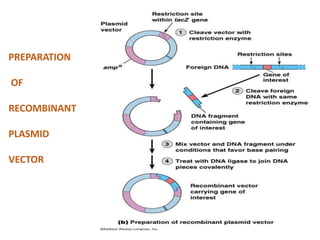
PREPARATION
OF
RECOMBINANT
PLASMID
VECTOR
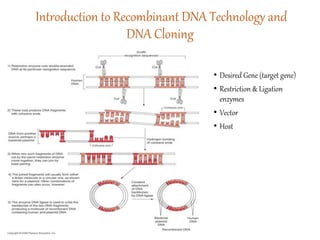
Introduction to Recombinant DNA Technology and
DNA Cloning
• Desired Gene (target gene)
• Restriction & Ligation
enzymes
• Vector
• Host
VECTOR
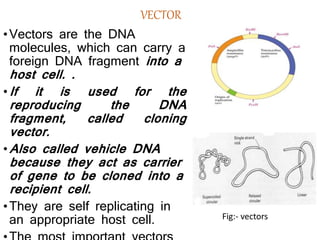
•Vectors are the DNA
molecules, which can carry a
foreign DNA fragment into a
host cell. .
•If it is used for the
reproducing the DNA
fragment, called cloning
vector.
•Also called vehicle DNA
because they act as carrier
of gene to be cloned into a
recipient cell.
•They are self replicating in
an appropriate host cell. Fig:- vectors
PROPERTIES OF VECTOR
•Small DNA molecules
•Origin of replication
•Unique restriction enzyme are able to replicate
autonomously
•Be non toxic to host cell
•Have space for foreign insert
•The vector shouldhave suitable marker genes that allow
easy selection of the transformed host cell.
•Unique recognition site
TYPES OF VECTOR
•There are three commonly used types of vectors:
1) plasmidvectors (e.g., pUC plasmids);
2) bacteriophage vectors (e.g., phage λ); and
3) phagemidvectors (e.g., pBlueScriptTM).
PLASMID vector
The term plasmid was first introduced by the American
molecular biologists Joshua Lederberg in 1952.
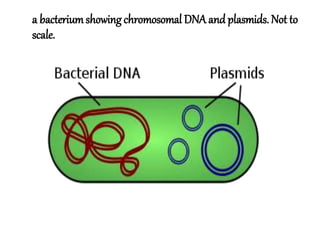
A plasmid is also known as replicon and extra
chromosomal DNA.
They are double stranded DNA molecule mostly occur in
circular forms.
They are naturally found in prokaryotes but some times found
in lower eukaryotes organisms.
Ex. Psc101,pBR322,& pUC18/19 etc.
a bacteriumshowing chromosomal DNA and plasmids. Not to
scale.
Classifications
Plasmids can be broadly classified into conjugative
plasmids and non-conjugative plasmids.
 Conjugative plasmids contain a set of transfer or tra
genes which promote sexual conjugation between
different cell.
 Non-conjugative plasmids are incapable of initiating
conjugation, hence they can be transferred only with
the assistance of conjugative plasmids.
Types Of Plasmids
1.Fertility [ F-plasmids ].
2. Resistance [ R-plasmids ].
3. Col plasmids.
4. Degradative plasmids.
5. Virulence plasmids.
PROPERTIES OF PLASMIDS
The size of plasmid ranges from 1 to 1000Kb.
Plasmid have their own origin of replication and
they have several unique restriction sites.
They can replicate independently of the host cells.
Plasmids have low molecular weight and high copy
number.
Easily isolated and integrated.
Used as a vectors.
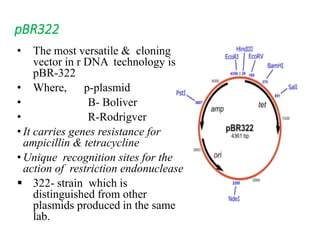
pBR322
• The most versatile & cloning
vector in r DNA technology is
pBR-322
• Where, p-plasmid
• B- Boliver
• R-Rodrigver
• It carries genes resistance for
ampicillin & tetracycline
• Unique recognition sites for the
action of restriction endonuclease
 322- strain which is
distinguished from other
plasmids produced in the same
lab.
USES OF PLASMID VECTOR
1. Gene expression, i.e. production of gene products.
e.g. The first mammalian product produced in bacteria
was somatostatin (1977).
e.g. Gene expression using the pET system.
2. Gene cloning.
3. Cloning of complementary DNA (cDNA), i.e. DNA
synthesized using mRNA as a template and reverse
transcriptase.
BACTERIOPHAGE AS VECTOR
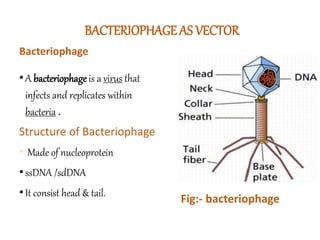
Bacteriophage
•A bacteriophage is a virus that
infects and replicates within
bacteria .
Structure of Bacteriophage
• Made of nucleoprotein
•ssDNA /sdDNA
•It consist head & tail.
Fig:- bacteriophage
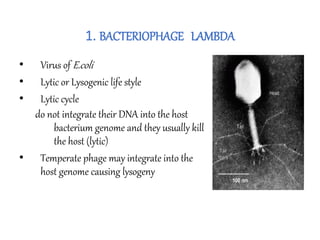
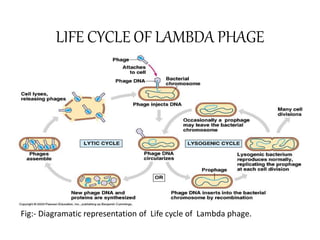
1. BACTERIOPHAGE LAMBDA
• Virus of E.coli
• Lytic or Lysogenic life style
• Lytic cycle
do not integrate their DNA into the host
bacterium genome and they usually kill
the host (lytic)
• Temperate phage may integrate into the
host genome causing lysogeny
LIFE CYCLE OF LAMBDA PHAGE
Fig:- Diagramatic representation of Life cycle of Lambda phage.
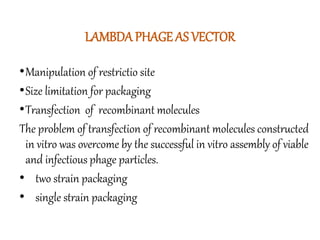
LAMBDA PHAGE AS VECTOR
•Manipulation of restrictio site
•Size limitation for packaging
•Transfection of recombinant molecules
The problem of transfection of recombinant molecules constructed
in vitro was overcome by the successful in vitro assembly of viable
and infectious phage particles.
• two strain packaging
• single strain packaging
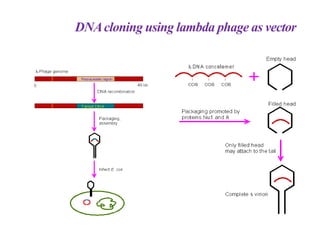
DNAcloning using lambda phage as vector
Fig:- Generalized transuding phage life cycle.
Phage adsorption
to donor Phage DNA injection
Phage DNA replication
Phage Lytic Cycle
Host lysis
Virion assembly
Transducing particle
adsorption to recipient
Donor DNA
injection
Homologous recombination
with recipient DNA
Transductant
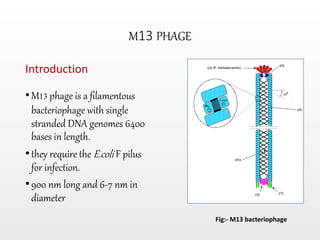
M13 PHAGE
Introduction
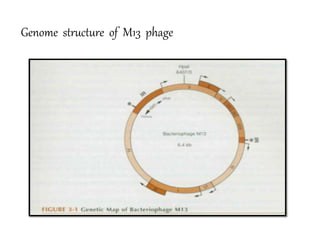
•M13 phage is a filamentous
bacteriophage with single
stranded DNA genomes 6400
bases in length.
•they require the E.coli F pilus
for infection.
•900 nm long and 6-7 nm in
diameter
Fig:- M13 bacteriophage
Genome structure of M13 phage
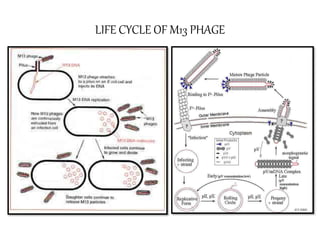
LIFE CYCLE OF M13 PHAGE
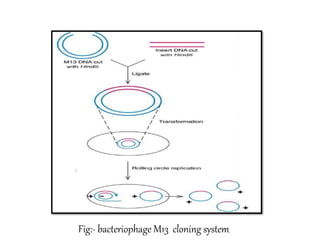
Fig:- bacteriophage M13 cloning system
APPLICATION OF PHAGE
• Cloning
• Ss DNA for probes, sequencing
• Phage display technology, M13 will produce foreign
protein on surface as part of its protein coat, can use to
generate specific antibodies
•Cloning pieces too big for plasmids
•Generation of ds DNA
CONCLUSION
•Bacteriophages are good vector as compare to plasmid
•A bacteriophage vector is a virus that infects a
bacterium and inserts its DNA or RNA into the host to
provide new genes coding for new proteins.
•However, bacteriophages frequently destroy its host
whereas plasmids don't.
Reference
•Biotechnology by B.D. Singh
•Genetics by P.K. Gupta
•Genetics by T.A. Brown
•Biotechnology by U. Satyanarayana
•Google Search
THANKS

Plasmid and phage vector

  • 1.
    SHRI SHANKARACHARYA MAHAVIDYALAYA Junwani,BHILAI (C.G.) PLASMID & PHAGE VECTOR Dr. Rachana Choudhary Dept. of Microbiology
  • 2.
    SYNOPSIS • INTRODUCTION • VECTOR •PROPERTIES OF VECTOR • TYPES OF VECTOR •PLASMIDAS VECTOR • CLASSIFICATION • TYPES OF PLASMIDS • PROPERTIES OF PLASMID VECTOR • USES OF PLASMID VECTOR •BACTERIOPHAGE AS VECTOR • TYPES OF BACTERIOPHAGE AS A VECTOR • λ PHAGE • M13 PHAGE • MACHENISM OF GENE CLONING • APPLICATION • CONCLUSION • REFERENCE
  • 3.
    INTRODUCTION •Genetic engineering isthe manipulation of genetic material of an organism to give altered expresion of our choice. •It involves construction of recombinant DNA contain DNA from different organisms.
  • 4.
  • 5.
    Introduction to RecombinantDNA Technology and DNA Cloning • Desired Gene (target gene) • Restriction & Ligation enzymes • Vector • Host
  • 6.
    VECTOR •Vectors are theDNA molecules, which can carry a foreign DNA fragment into a host cell. . •If it is used for the reproducing the DNA fragment, called cloning vector. •Also called vehicle DNA because they act as carrier of gene to be cloned into a recipient cell. •They are self replicating in an appropriate host cell. Fig:- vectors
  • 7.
    PROPERTIES OF VECTOR •SmallDNA molecules •Origin of replication •Unique restriction enzyme are able to replicate autonomously •Be non toxic to host cell •Have space for foreign insert •The vector shouldhave suitable marker genes that allow easy selection of the transformed host cell. •Unique recognition site
  • 8.
    TYPES OF VECTOR •Thereare three commonly used types of vectors: 1) plasmidvectors (e.g., pUC plasmids); 2) bacteriophage vectors (e.g., phage λ); and 3) phagemidvectors (e.g., pBlueScriptTM).
  • 9.
    PLASMID vector The termplasmid was first introduced by the American molecular biologists Joshua Lederberg in 1952. A plasmid is also known as replicon and extra chromosomal DNA. They are double stranded DNA molecule mostly occur in circular forms. They are naturally found in prokaryotes but some times found in lower eukaryotes organisms. Ex. Psc101,pBR322,& pUC18/19 etc.
  • 10.
    a bacteriumshowing chromosomalDNA and plasmids. Not to scale.
  • 11.
    Classifications Plasmids can bebroadly classified into conjugative plasmids and non-conjugative plasmids.  Conjugative plasmids contain a set of transfer or tra genes which promote sexual conjugation between different cell.  Non-conjugative plasmids are incapable of initiating conjugation, hence they can be transferred only with the assistance of conjugative plasmids.
  • 12.
    Types Of Plasmids 1.Fertility[ F-plasmids ]. 2. Resistance [ R-plasmids ]. 3. Col plasmids. 4. Degradative plasmids. 5. Virulence plasmids.
  • 13.
    PROPERTIES OF PLASMIDS Thesize of plasmid ranges from 1 to 1000Kb. Plasmid have their own origin of replication and they have several unique restriction sites. They can replicate independently of the host cells. Plasmids have low molecular weight and high copy number. Easily isolated and integrated. Used as a vectors.
  • 14.
    pBR322 • The mostversatile & cloning vector in r DNA technology is pBR-322 • Where, p-plasmid • B- Boliver • R-Rodrigver • It carries genes resistance for ampicillin & tetracycline • Unique recognition sites for the action of restriction endonuclease  322- strain which is distinguished from other plasmids produced in the same lab.
  • 15.
    USES OF PLASMIDVECTOR 1. Gene expression, i.e. production of gene products. e.g. The first mammalian product produced in bacteria was somatostatin (1977). e.g. Gene expression using the pET system. 2. Gene cloning. 3. Cloning of complementary DNA (cDNA), i.e. DNA synthesized using mRNA as a template and reverse transcriptase.
  • 16.
    BACTERIOPHAGE AS VECTOR Bacteriophage •Abacteriophage is a virus that infects and replicates within bacteria . Structure of Bacteriophage • Made of nucleoprotein •ssDNA /sdDNA •It consist head & tail. Fig:- bacteriophage
  • 17.
    1. BACTERIOPHAGE LAMBDA •Virus of E.coli • Lytic or Lysogenic life style • Lytic cycle do not integrate their DNA into the host bacterium genome and they usually kill the host (lytic) • Temperate phage may integrate into the host genome causing lysogeny
  • 18.
    LIFE CYCLE OFLAMBDA PHAGE Fig:- Diagramatic representation of Life cycle of Lambda phage.
  • 19.
    LAMBDA PHAGE ASVECTOR •Manipulation of restrictio site •Size limitation for packaging •Transfection of recombinant molecules The problem of transfection of recombinant molecules constructed in vitro was overcome by the successful in vitro assembly of viable and infectious phage particles. • two strain packaging • single strain packaging
  • 20.
    DNAcloning using lambdaphage as vector
  • 21.
    Fig:- Generalized transudingphage life cycle. Phage adsorption to donor Phage DNA injection Phage DNA replication Phage Lytic Cycle Host lysis Virion assembly Transducing particle adsorption to recipient Donor DNA injection Homologous recombination with recipient DNA Transductant
  • 22.
    M13 PHAGE Introduction •M13 phageis a filamentous bacteriophage with single stranded DNA genomes 6400 bases in length. •they require the E.coli F pilus for infection. •900 nm long and 6-7 nm in diameter Fig:- M13 bacteriophage
  • 23.
  • 24.
    LIFE CYCLE OFM13 PHAGE
  • 25.
  • 26.
    APPLICATION OF PHAGE •Cloning • Ss DNA for probes, sequencing • Phage display technology, M13 will produce foreign protein on surface as part of its protein coat, can use to generate specific antibodies •Cloning pieces too big for plasmids •Generation of ds DNA
  • 27.
    CONCLUSION •Bacteriophages are goodvector as compare to plasmid •A bacteriophage vector is a virus that infects a bacterium and inserts its DNA or RNA into the host to provide new genes coding for new proteins. •However, bacteriophages frequently destroy its host whereas plasmids don't.
  • 28.
    Reference •Biotechnology by B.D.Singh •Genetics by P.K. Gupta •Genetics by T.A. Brown •Biotechnology by U. Satyanarayana •Google Search
  • 29.