Presentor:-
Dr.Pushkar Dhir
Moderator :-
Dr. Jyoti Puri
O
P
D
-
E
X
P
E
R
I
E
N
C
E
• Far Point (FP) is the farthest point at which objects can be
seen clearly by the eye.
• So in this patient d farthest point came out to be approx .4
mtrs.
• i.e she can see all d things vch r <4metres.
• To avoid this arbitrary n cumbersome method of finding
refractive power ---> illumination reflexes were studeid in
emmetropic and eye n correlated with the refraction power.
• Power= Diopteric power – cycloplegic – 1/working distance
ASTIGMATIC
FAN
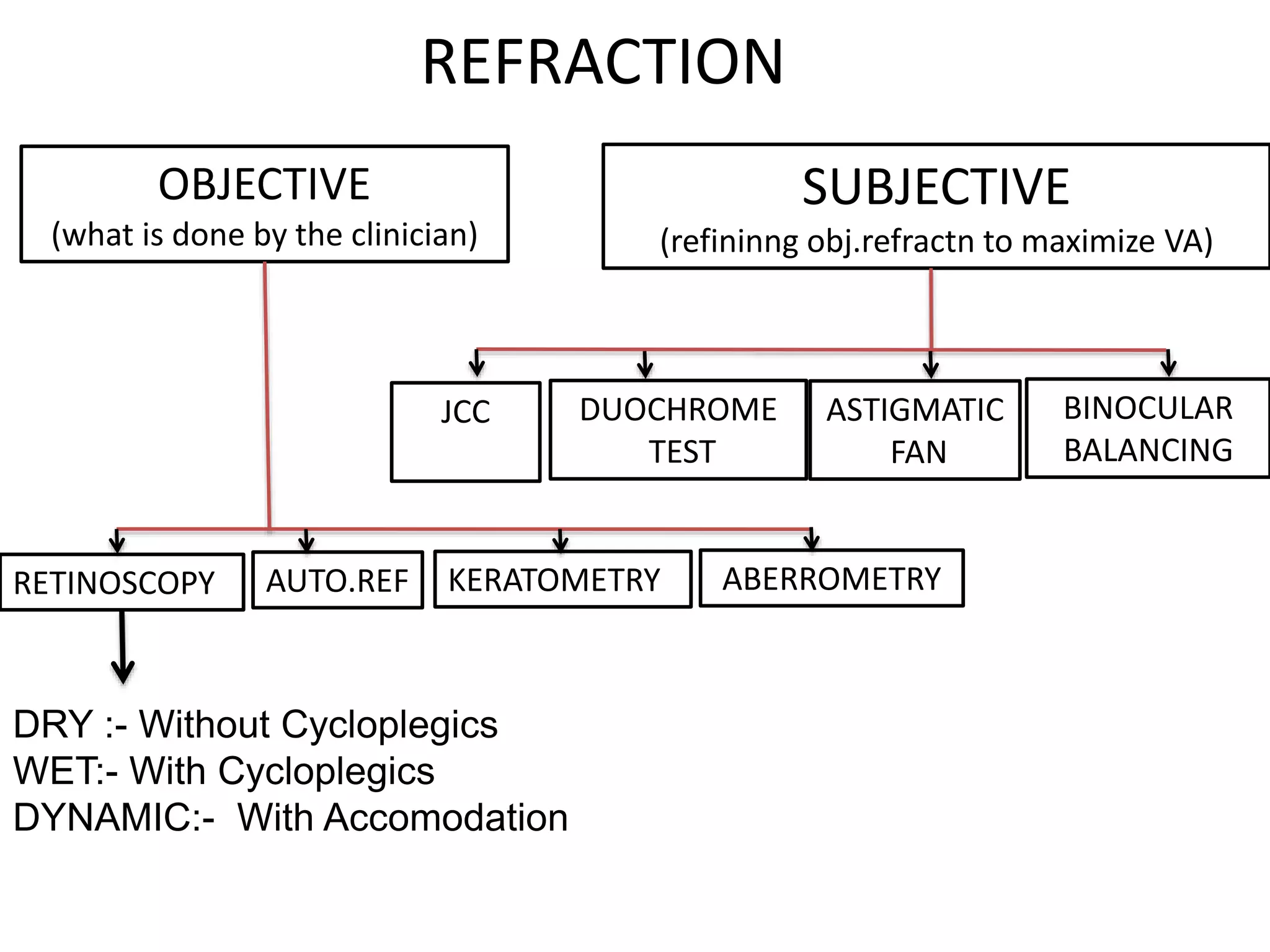
OBJECTIVE
(what is done by the clinician)
SUBJECTIVE
(refininng obj.refractn to maximize VA)
AUTO.REF
DUOCHROME
TEST
ABERROMETRYKERATOMETRYRETINOSCOPY
REFRACTION
BINOCULAR
BALANCING
JCC
DRY :- Without Cycloplegics
WET:- With Cycloplegics
DYNAMIC:- With Accomodation
• Started by Bownman in 1859
• Also known as:-
 Shadow test
 Skiascopy
 Pupilloscopy
 Korescopy
• The only way to assess the refractive error
 in infants, small children, illiterates, uncooperative
 patients with speech loss
 patients who speak a different language.
•Introduced quantitative
refraction test.
•Made possible to measure
exact amount of refractive
error using lenses.
•Termed retinoscopie.
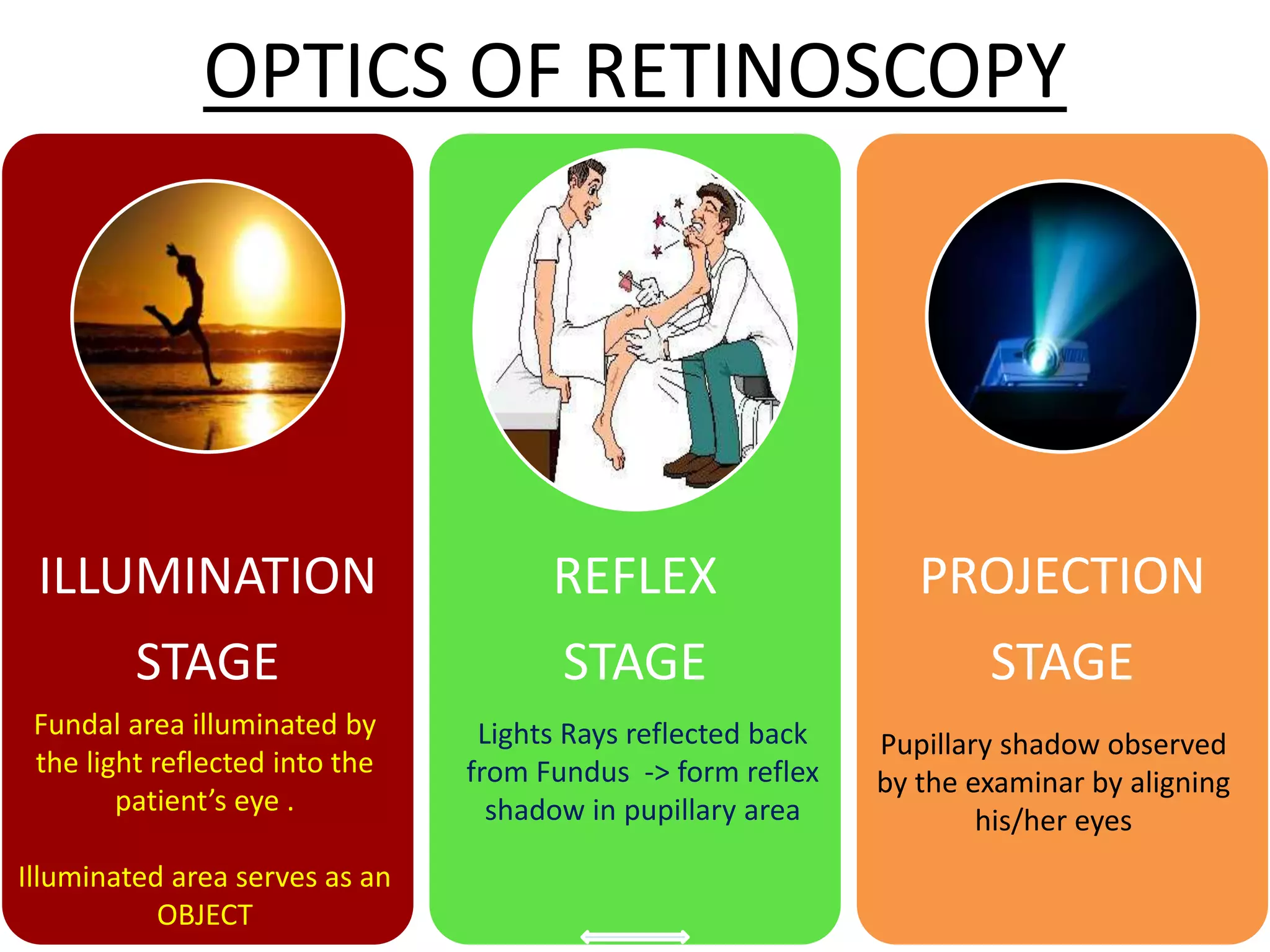
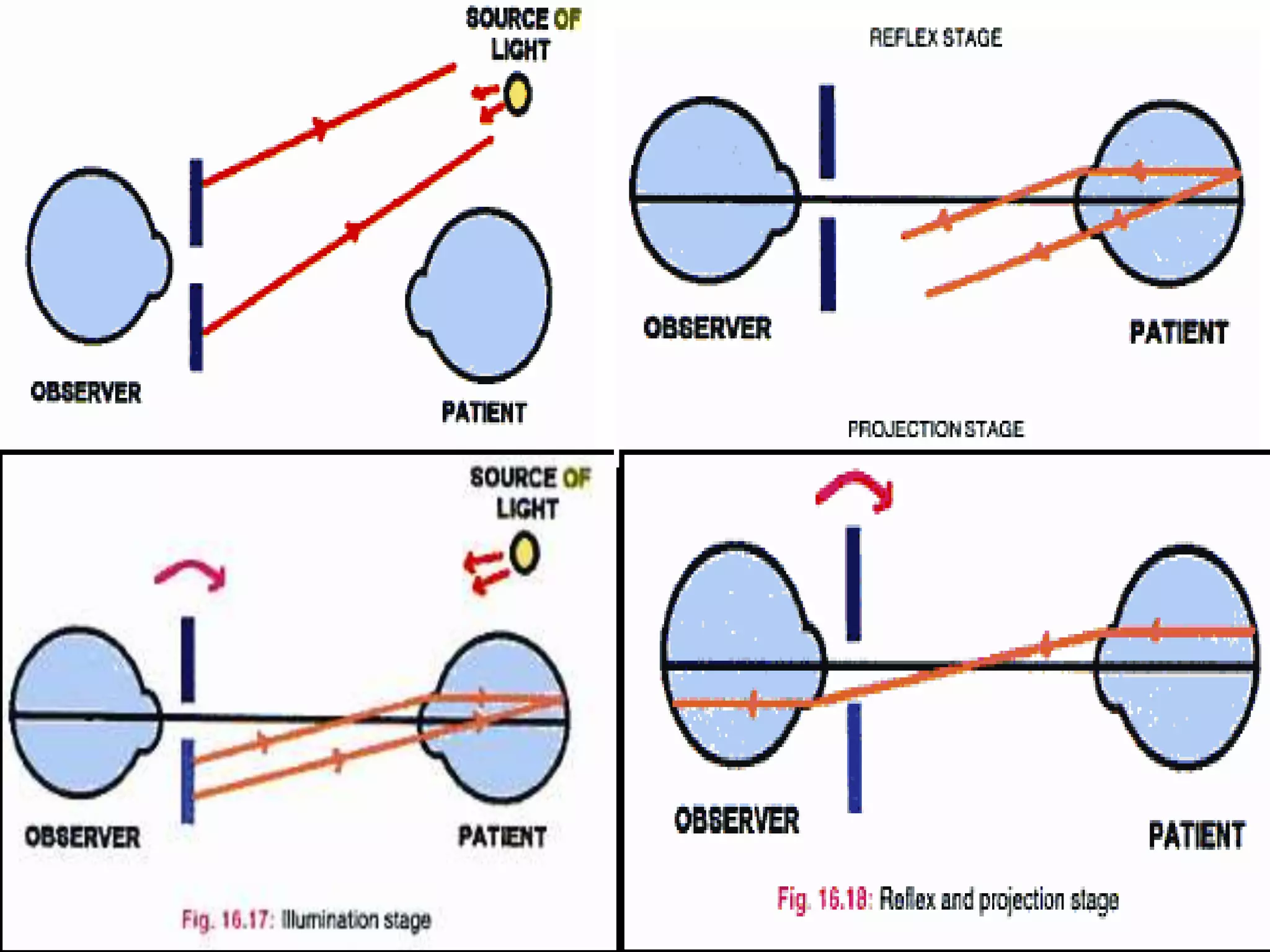
OPTICS OF RETINOSCOPY
ILLUMINATION
STAGE
REFLEX
STAGE
PROJECTION
STAGE
Fundal area illuminated by
the light reflected into the
patient’s eye .
Illuminated area serves as an
OBJECT
Lights Rays reflected back
from Fundus -> form reflex
shadow in pupillary area
Pupillary shadow observed
by the examinar by aligning
his/her eyes
Advantages of streak -
Undilated pupil
More accurate
Astigmatism
Axis of the astigmatism
D GOOD OLD
DAYZZ
DR.SHASHI
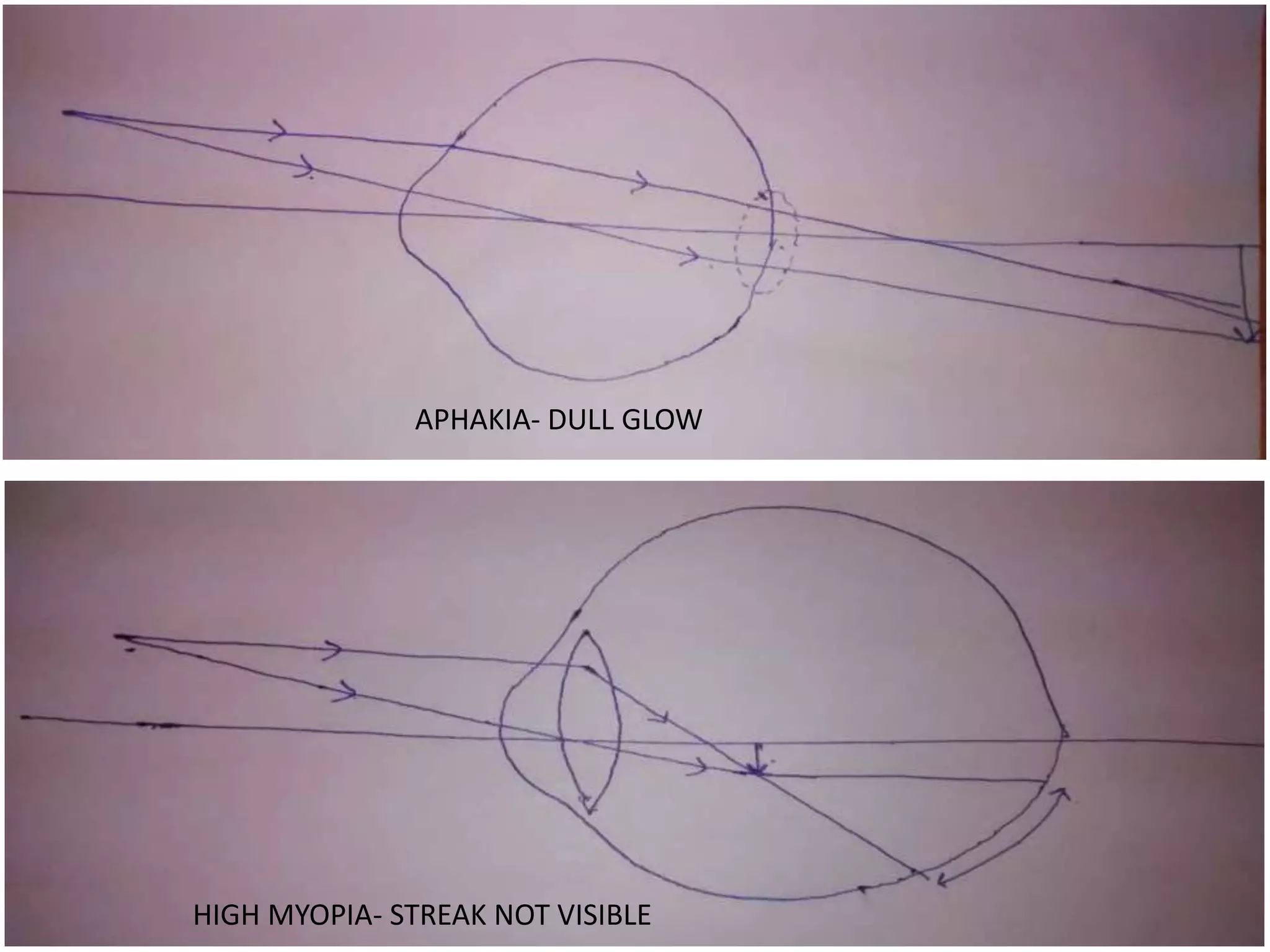
APHAKIA- DULL GLOW
HIGH MYOPIA- STREAK NOT VISIBLE
VIDEO
(on u tube)
TYPES OF RETINOSCOPES
Lister Reflecting
Retinoscope
Priestley Smith Reflecting
Retinoscope
Self Illuminating
Retinoscope
Spot Retinoscope
Streak retinoscope
• Time to charge ur
laptop
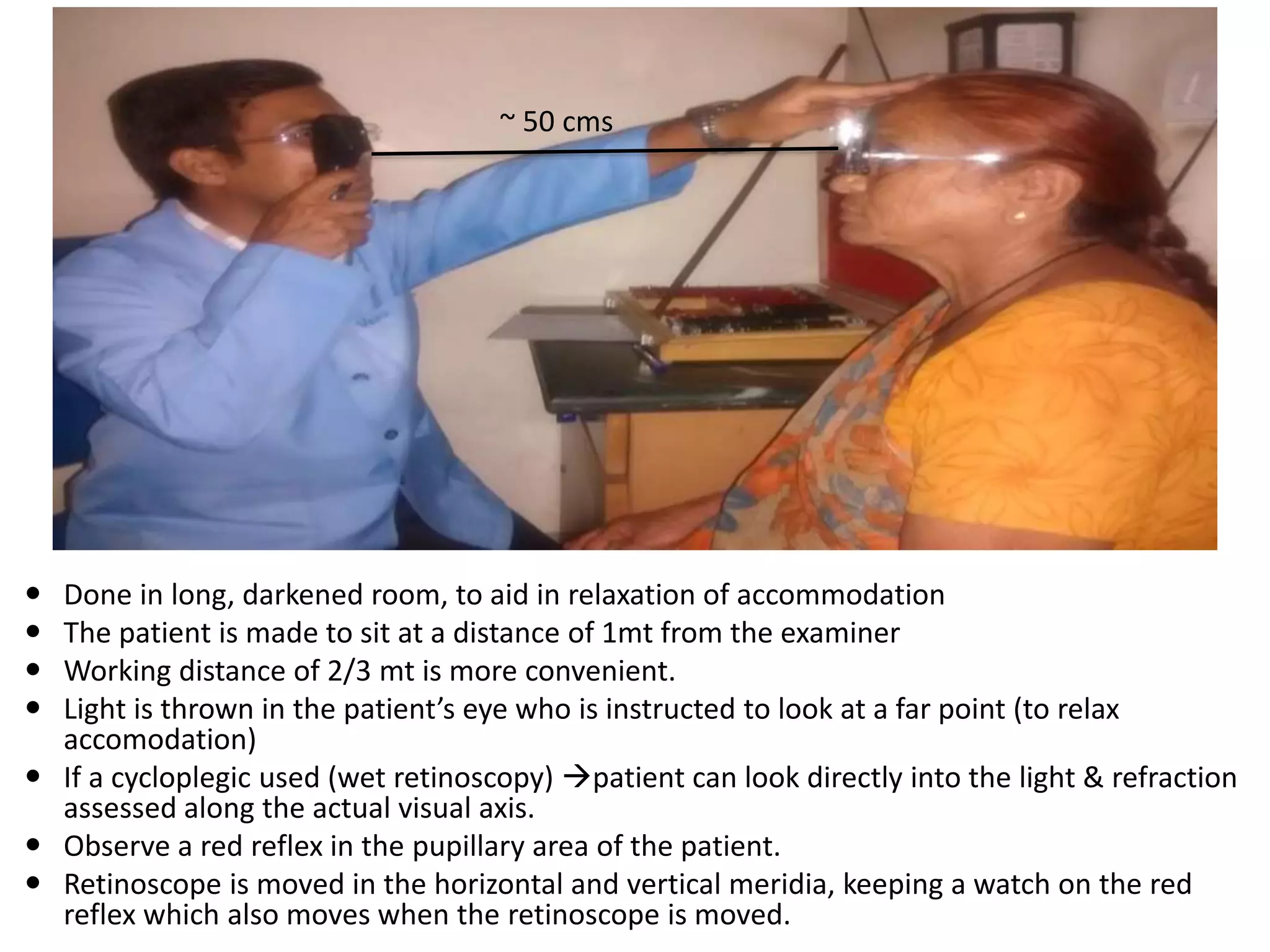
 Done in long, darkened room, to aid in relaxation of accommodation
 The patient is made to sit at a distance of 1mt from the examiner
 Working distance of 2/3 mt is more convenient.
 Light is thrown in the patient’s eye who is instructed to look at a far point (to relax
accomodation)
 If a cycloplegic used (wet retinoscopy) patient can look directly into the light & refraction
assessed along the actual visual axis.
 Observe a red reflex in the pupillary area of the patient.
 Retinoscope is moved in the horizontal and vertical meridia, keeping a watch on the red
reflex which also moves when the retinoscope is moved.
~ 50 cms
Movement
(with working
distance at 1 metre)
Against
Myopia >1D
With
Emmetropia
Hypermetro
pia
Myopia <1D
No
movement
Myopia =1D
WHAT TO ASSES?
Size, Speed &
Brilliance
Small (Narrow)
Fast &
Brighter
Low Refractive Error
Large (Wide)
Slow & Dim
(Faint Glow)
High Refractive Error
Hazy Media
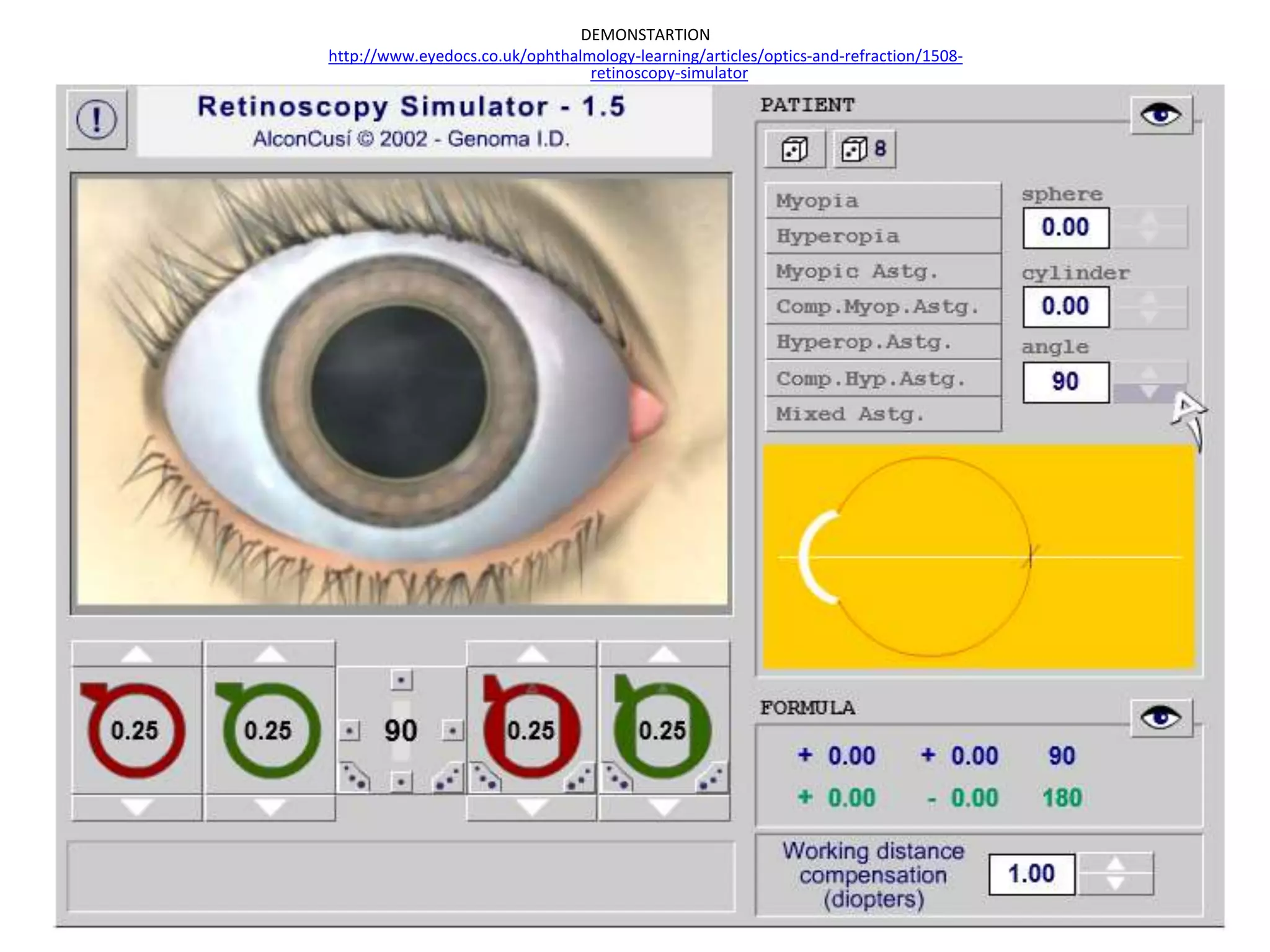
DEMONSTARTION
http://www.eyedocs.co.uk/ophthalmology-learning/articles/optics-and-refraction/1508-
retinoscopy-simulator
Neutralization of red
reflex :
in Streak Retinoscope
a. Neutralization
- the band of red reflex moves
‘with’ or ‘against’ the
movement of the band of light
from retinoscope
- in simple spherical errors, at
neutralization the band shaped
reflex disappears and pupil
appears completely
illuminated.
Finding the cylindrical
axis
i) - break in alignment is observed when
the streak is not parallel to one of the
principal meridia(horizontal and
vertical).
- the axis, can be determined by
rotating the streak until the
break disappears.
(ii) - width of the streak varies as it is rotated around the
correct axis. It appears narrowest when the streak aligns
with the true axis.
(iii)- Intensity of reflex is brighter when streak
aligns with true axis.
(iv)- Skewing (oblique motion of the streak
reflex)
f. End point of neutralization
- width of reflex widens progressively as the
neutralization is achieved, and at the end point,
streak disappears and the pupil appears
completely illuminated or completely dark
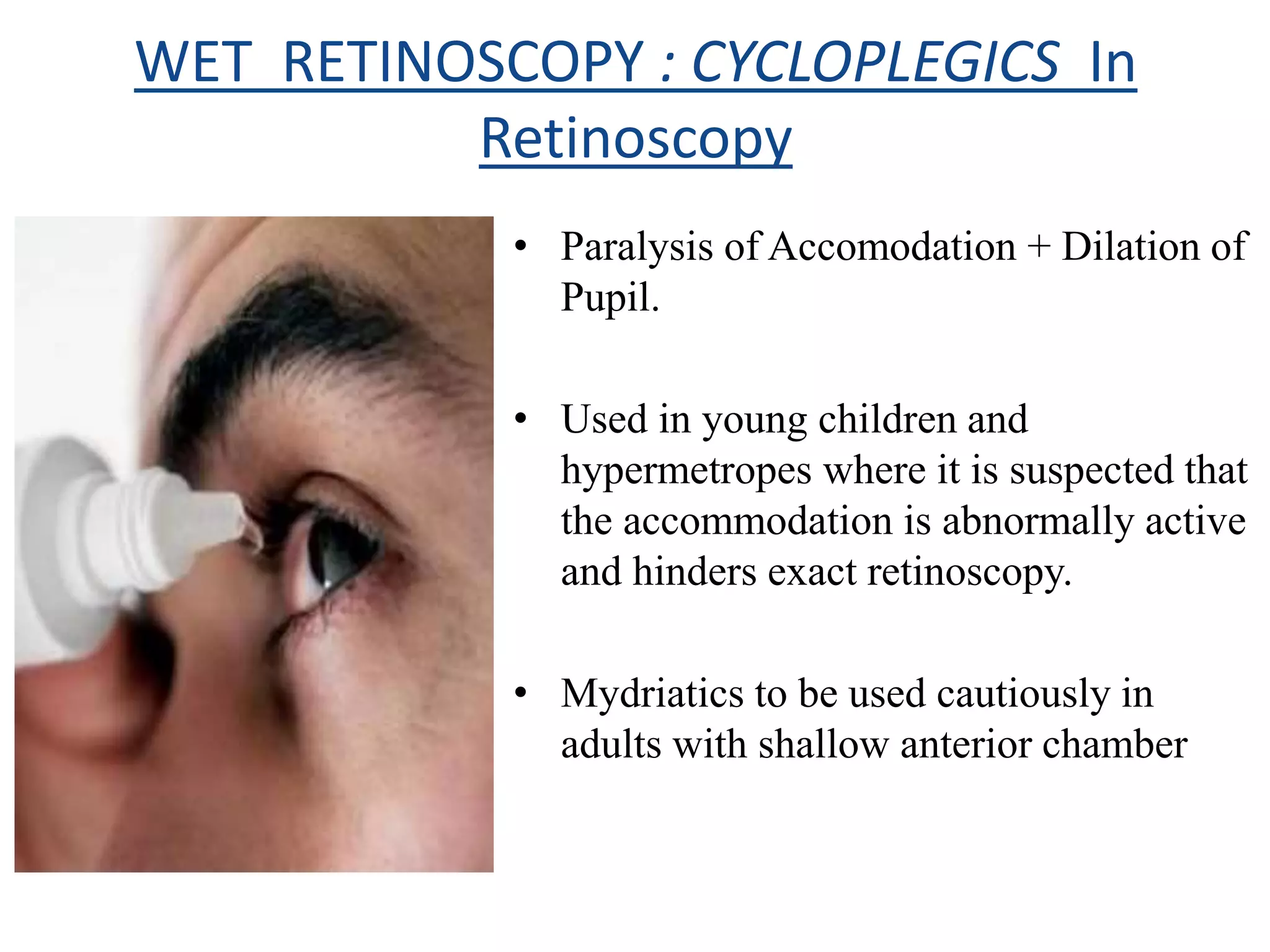
WET RETINOSCOPY : CYCLOPLEGICS In
Retinoscopy
• Paralysis of Accomodation + Dilation of
Pupil.
• Used in young children and
hypermetropes where it is suspected that
the accommodation is abnormally active
and hinders exact retinoscopy.
• Mydriatics to be used cautiously in
adults with shallow anterior chamber
W
E
T
R
E
T
I
N
s
c
P
Y
<5 yrs
5-8 yrs 8-20 yrs
MYDRIATIC
>CYCLOPLEGIC
-do-
DOSE-
TDS X
3DAYS
1DROP X 10
MIN X6
TIMES
1 DROP X
15 MIN X 6
TIMEES
1DROP X15MIN
X3 TIMES
-do-
PEAK
EFFECT
2/3 DAYS
60-90MINS 80-90 MINS 20-40 MINS -do-
RETINO
TIME-
4TH DAY
AFTER 90
MIN OF 1ST
DROP
AFTER 90
MIN OF 1ST
DROP
AFTER 40 MINS -do-
EFFECT 10-20DAYS
48-72 HRS 6-18 HRS 4-6 HRS -do-
0.5%,1%
2%
1%1%
Beta Kitne
Der
Lagegi!!!
NEED DR LIKH
KAR BHEJ
DETA HUN
PROBLEMS IN
RETINOSCOPY
PROBLEMS CAUSE SOULTION
RED REFLEX NOT VISIBLE
1.SMALL PUPIL
2.HAZY MEDIA
3.APHAKIA/HIGH MYOPIA
1.TRY MYDRIATICS +CYCLOPLEGICS
COMBINATION
2.REDUCE WORKING DISTANCE +
BRIGHT SOURCE OF LIGHT
3.TRY LENSES OF HIGH POWER+/-
7D, IF STILL NOT ,GO HIGHER.
CHANGING
RETINOSCOPIC FINDINGS
ACCOMODATION USED BY
PATIENTS
FOGGING- -- PLACE A LENS SUCH
THAT VISION BECOMES 6/60 &
THEN START NEUTRALISING.
V R ACTUALLY TYRING D CILIARY
MUSCLES BY DOING DIS.
SCISSOR
SHADOWS
MIXED ABERRATION E.G
KERATOCONUS
OPT FOR ONE SLIT & ADD LENSES ,
SLOWLY SLIT BECOMES
EQUAL,THAT’S IT.
(DIRTY REFRACTION)
POSITIVE
SPHERICAL
ABERRATIONS
NEGATIVE
SPHERICAL
ABERRATION
Uneven wavefront (aKA“optical aberrations”) can be because of aspherical
corneal, lens & retina or uneven thickness of tear film
MEASURING OPTICAL ABERRATIONS
• Shack-Hartmann (SH)
aberrometer measures
wavefront objectivel
Subjective Refraction
• Power of spherical and cylindrical
refraction refined based on patient
response
• General rule: Maximum Plus for
Maximum Visual Acuity.
• Duochrome test:
Based on chromatic aberration; red is
focused more hyperopically than
green; yellow is focused on retina
• Letters on both red and green
background should appear equally
clear
SUBJECTIVE REFRACTION
1. Subjective verification of refraction
 By Trial & Error technqiue
 Astigmatic Dial technique
2. Subjective refinement of refraction
 JCC
 Astigmatic Fan test
• Combination of two sphero-cylinders:
-0.25D sphere & +0.50D cylinders
with axes at right angles.
• Combination of two sphero-cylinders:
-0.25D sphere & +0.50D cylinders
with axes at right angles.
• To determine end-point of
magnitude, place JCC with axis
parallel to the axis of the cylindrical
prescription.
Jacksons Cross Cylinder
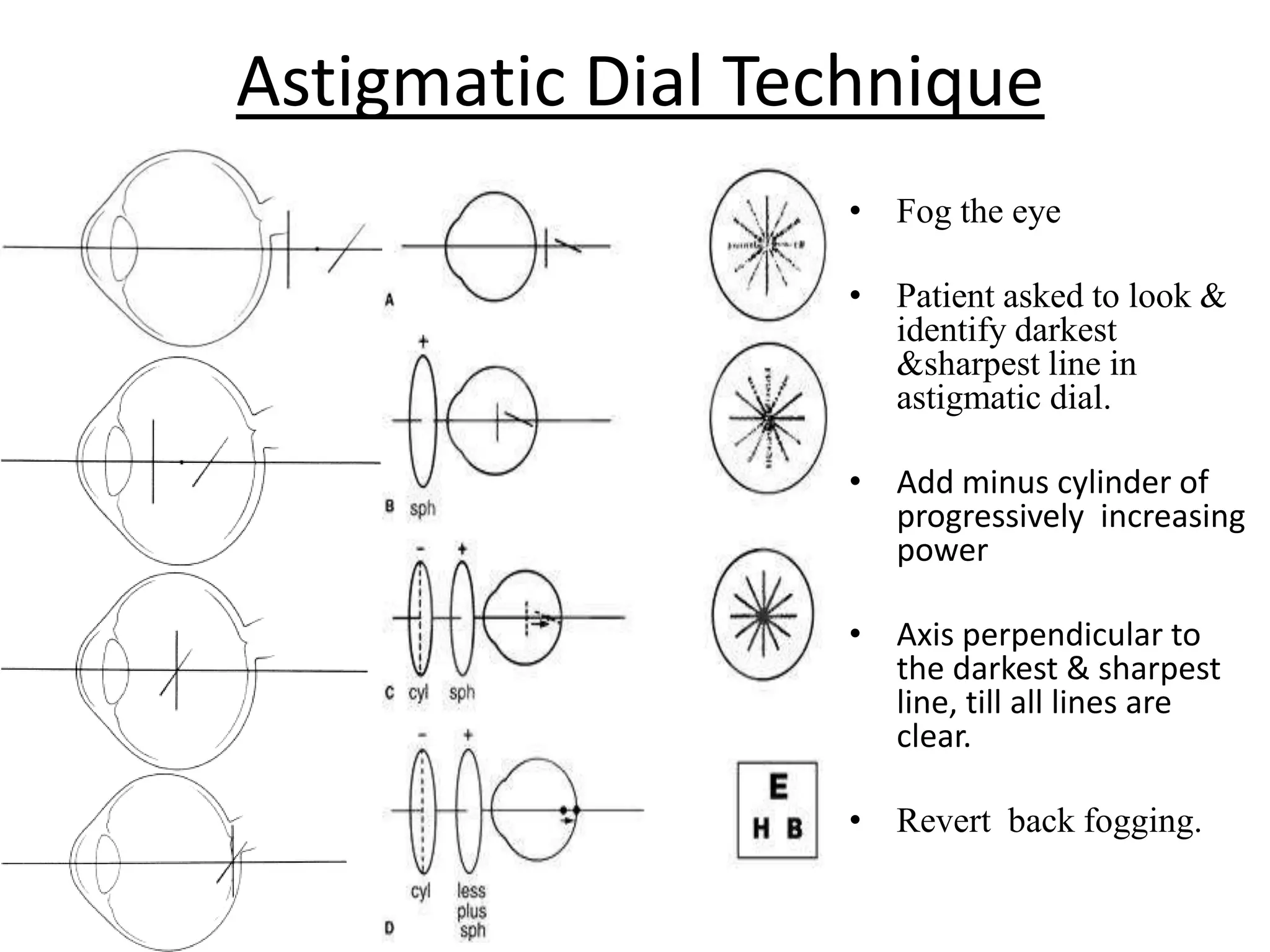
Astigmatic Dial Technique
• Fog the eye
• Patient asked to look &
identify darkest
&sharpest line in
astigmatic dial.
• Add minus cylinder of
progressively increasing
power
• Axis perpendicular to
the darkest & sharpest
line, till all lines are
clear.
• Revert back fogging.
REFERENCES
• http://www.slideshare.net/meikocat/Refraction
• http://www.eyedocs.co.uk/ophthalmology-learning/articles/optics-
and-refraction/1508-retinoscopy-simulator
• http://retinoscopy.blogspot.in/
• http://books.google.co.in/books?id=6I6JeDWonhQC&pg=PA2&lpg=
PA2&dq=RETINOSCOPY+WITH+PLANE+MIRROR&source=bl&ots=o
wV9UpZtAO&sig=ku6SiYptvYp_qlEbBi-g2YW7izM&hl=en&sa=X&ei=-
mypU8K5MdeUuASBi4HIDw&ved=0CEkQ6AEwCg#v=onepage&q=R
ETINOSCOPY%20WITH%20PLANE%20MIRROR&f=false
• http://www.college-
optometrists.org/en/college/museyeum/online_exhibitions/optical
_instruments/retinoscopes.cfm
Had dat Referee had 6/6 refined vision , Argentina would
never hav won 1986 FIFA WORLD CUP!!!!!
• THANK YOU EVERYONE FOR PATIENTLY LISTENING TO THIS SEMINAR.
• For feedbacks & brickbats plz mail at
• ykush@yahoo.co.in./drdhir2014@gmail.com
HAND OF
GOD

Retinoscopy

  • 1.
  • 2.
  • 3.
    • Far Point(FP) is the farthest point at which objects can be seen clearly by the eye. • So in this patient d farthest point came out to be approx .4 mtrs. • i.e she can see all d things vch r <4metres. • To avoid this arbitrary n cumbersome method of finding refractive power ---> illumination reflexes were studeid in emmetropic and eye n correlated with the refraction power. • Power= Diopteric power – cycloplegic – 1/working distance
  • 5.
    ASTIGMATIC FAN OBJECTIVE (what is doneby the clinician) SUBJECTIVE (refininng obj.refractn to maximize VA) AUTO.REF DUOCHROME TEST ABERROMETRYKERATOMETRYRETINOSCOPY REFRACTION BINOCULAR BALANCING JCC DRY :- Without Cycloplegics WET:- With Cycloplegics DYNAMIC:- With Accomodation
  • 6.
    • Started byBownman in 1859 • Also known as:-  Shadow test  Skiascopy  Pupilloscopy  Korescopy • The only way to assess the refractive error  in infants, small children, illiterates, uncooperative  patients with speech loss  patients who speak a different language. •Introduced quantitative refraction test. •Made possible to measure exact amount of refractive error using lenses. •Termed retinoscopie.
  • 7.
    OPTICS OF RETINOSCOPY ILLUMINATION STAGE REFLEX STAGE PROJECTION STAGE Fundalarea illuminated by the light reflected into the patient’s eye . Illuminated area serves as an OBJECT Lights Rays reflected back from Fundus -> form reflex shadow in pupillary area Pupillary shadow observed by the examinar by aligning his/her eyes
  • 9.
    Advantages of streak- Undilated pupil More accurate Astigmatism Axis of the astigmatism D GOOD OLD DAYZZ DR.SHASHI
  • 10.
    APHAKIA- DULL GLOW HIGHMYOPIA- STREAK NOT VISIBLE
  • 11.
  • 12.
    TYPES OF RETINOSCOPES ListerReflecting Retinoscope Priestley Smith Reflecting Retinoscope Self Illuminating Retinoscope Spot Retinoscope Streak retinoscope
  • 13.
    • Time tocharge ur laptop
  • 14.
     Done inlong, darkened room, to aid in relaxation of accommodation  The patient is made to sit at a distance of 1mt from the examiner  Working distance of 2/3 mt is more convenient.  Light is thrown in the patient’s eye who is instructed to look at a far point (to relax accomodation)  If a cycloplegic used (wet retinoscopy) patient can look directly into the light & refraction assessed along the actual visual axis.  Observe a red reflex in the pupillary area of the patient.  Retinoscope is moved in the horizontal and vertical meridia, keeping a watch on the red reflex which also moves when the retinoscope is moved. ~ 50 cms
  • 15.
    Movement (with working distance at1 metre) Against Myopia >1D With Emmetropia Hypermetro pia Myopia <1D No movement Myopia =1D
  • 16.
    WHAT TO ASSES? Size,Speed & Brilliance Small (Narrow) Fast & Brighter Low Refractive Error Large (Wide) Slow & Dim (Faint Glow) High Refractive Error Hazy Media
  • 17.
  • 18.
    Neutralization of red reflex: in Streak Retinoscope a. Neutralization - the band of red reflex moves ‘with’ or ‘against’ the movement of the band of light from retinoscope - in simple spherical errors, at neutralization the band shaped reflex disappears and pupil appears completely illuminated. Finding the cylindrical axis i) - break in alignment is observed when the streak is not parallel to one of the principal meridia(horizontal and vertical). - the axis, can be determined by rotating the streak until the break disappears.
  • 19.
    (ii) - widthof the streak varies as it is rotated around the correct axis. It appears narrowest when the streak aligns with the true axis. (iii)- Intensity of reflex is brighter when streak aligns with true axis. (iv)- Skewing (oblique motion of the streak reflex)
  • 20.
    f. End pointof neutralization - width of reflex widens progressively as the neutralization is achieved, and at the end point, streak disappears and the pupil appears completely illuminated or completely dark
  • 21.
    WET RETINOSCOPY :CYCLOPLEGICS In Retinoscopy • Paralysis of Accomodation + Dilation of Pupil. • Used in young children and hypermetropes where it is suspected that the accommodation is abnormally active and hinders exact retinoscopy. • Mydriatics to be used cautiously in adults with shallow anterior chamber
  • 22.
    W E T R E T I N s c P Y <5 yrs 5-8 yrs8-20 yrs MYDRIATIC >CYCLOPLEGIC -do- DOSE- TDS X 3DAYS 1DROP X 10 MIN X6 TIMES 1 DROP X 15 MIN X 6 TIMEES 1DROP X15MIN X3 TIMES -do- PEAK EFFECT 2/3 DAYS 60-90MINS 80-90 MINS 20-40 MINS -do- RETINO TIME- 4TH DAY AFTER 90 MIN OF 1ST DROP AFTER 90 MIN OF 1ST DROP AFTER 40 MINS -do- EFFECT 10-20DAYS 48-72 HRS 6-18 HRS 4-6 HRS -do- 0.5%,1% 2% 1%1%
  • 23.
    Beta Kitne Der Lagegi!!! NEED DRLIKH KAR BHEJ DETA HUN PROBLEMS IN RETINOSCOPY
  • 24.
    PROBLEMS CAUSE SOULTION REDREFLEX NOT VISIBLE 1.SMALL PUPIL 2.HAZY MEDIA 3.APHAKIA/HIGH MYOPIA 1.TRY MYDRIATICS +CYCLOPLEGICS COMBINATION 2.REDUCE WORKING DISTANCE + BRIGHT SOURCE OF LIGHT 3.TRY LENSES OF HIGH POWER+/- 7D, IF STILL NOT ,GO HIGHER. CHANGING RETINOSCOPIC FINDINGS ACCOMODATION USED BY PATIENTS FOGGING- -- PLACE A LENS SUCH THAT VISION BECOMES 6/60 & THEN START NEUTRALISING. V R ACTUALLY TYRING D CILIARY MUSCLES BY DOING DIS. SCISSOR SHADOWS MIXED ABERRATION E.G KERATOCONUS OPT FOR ONE SLIT & ADD LENSES , SLOWLY SLIT BECOMES EQUAL,THAT’S IT. (DIRTY REFRACTION) POSITIVE SPHERICAL ABERRATIONS NEGATIVE SPHERICAL ABERRATION
  • 25.
    Uneven wavefront (aKA“opticalaberrations”) can be because of aspherical corneal, lens & retina or uneven thickness of tear film
  • 26.
    MEASURING OPTICAL ABERRATIONS •Shack-Hartmann (SH) aberrometer measures wavefront objectivel
  • 27.
    Subjective Refraction • Powerof spherical and cylindrical refraction refined based on patient response • General rule: Maximum Plus for Maximum Visual Acuity. • Duochrome test: Based on chromatic aberration; red is focused more hyperopically than green; yellow is focused on retina • Letters on both red and green background should appear equally clear
  • 28.
    SUBJECTIVE REFRACTION 1. Subjectiveverification of refraction  By Trial & Error technqiue  Astigmatic Dial technique 2. Subjective refinement of refraction  JCC  Astigmatic Fan test
  • 29.
    • Combination oftwo sphero-cylinders: -0.25D sphere & +0.50D cylinders with axes at right angles. • Combination of two sphero-cylinders: -0.25D sphere & +0.50D cylinders with axes at right angles. • To determine end-point of magnitude, place JCC with axis parallel to the axis of the cylindrical prescription. Jacksons Cross Cylinder
  • 31.
    Astigmatic Dial Technique •Fog the eye • Patient asked to look & identify darkest &sharpest line in astigmatic dial. • Add minus cylinder of progressively increasing power • Axis perpendicular to the darkest & sharpest line, till all lines are clear. • Revert back fogging.
  • 32.
    REFERENCES • http://www.slideshare.net/meikocat/Refraction • http://www.eyedocs.co.uk/ophthalmology-learning/articles/optics- and-refraction/1508-retinoscopy-simulator •http://retinoscopy.blogspot.in/ • http://books.google.co.in/books?id=6I6JeDWonhQC&pg=PA2&lpg= PA2&dq=RETINOSCOPY+WITH+PLANE+MIRROR&source=bl&ots=o wV9UpZtAO&sig=ku6SiYptvYp_qlEbBi-g2YW7izM&hl=en&sa=X&ei=- mypU8K5MdeUuASBi4HIDw&ved=0CEkQ6AEwCg#v=onepage&q=R ETINOSCOPY%20WITH%20PLANE%20MIRROR&f=false • http://www.college- optometrists.org/en/college/museyeum/online_exhibitions/optical _instruments/retinoscopes.cfm
  • 33.
    Had dat Refereehad 6/6 refined vision , Argentina would never hav won 1986 FIFA WORLD CUP!!!!! • THANK YOU EVERYONE FOR PATIENTLY LISTENING TO THIS SEMINAR. • For feedbacks & brickbats plz mail at • ykush@yahoo.co.in./drdhir2014@gmail.com HAND OF GOD