B SCAN 
Moderator :- Dr. Supreet Juneja Presentor:- Dr.Pushkar Dhir
D 4 CONCEPTS 
1. How Bscan came into existence? 
2. Concept of Frequency. 
3. Concept of Gain.
ULTRASONOGRAPHY 
• Non-invasive, efficient and inexpensive diagnostic tool. 
• Examiner- dependent 
• Expertise 
• A correlation with clinical findings is essential to make a 
diagnosis. 
.
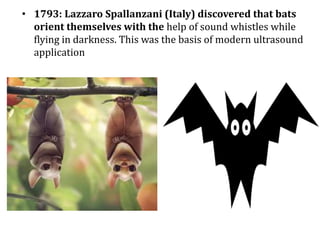
• 1793: Lazzaro Spallanzani (Italy) discovered that bats 
orient themselves with the help of sound whistles while 
flying in darkness. This was the basis of modern ultrasound 
application
• 1956: Mundt and Hughes - 
first used the A-scan technique. 
• 1958: Baum and Greenwood 
- B-scan (immersion method) 
• 1962:Oksala and Lehtinen 
further refined the technique 
• In the sixties, imaging of the 
eyeball and 
orbit using ultrasound was 
popularised by Ossoining.
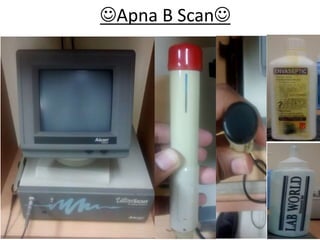
Apna B Scan
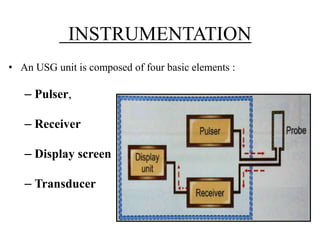
INSTRUMENTATION 
• An USG unit is composed of four basic elements : 
– Pulser, 
– Receiver 
– Display screen 
– Transducer
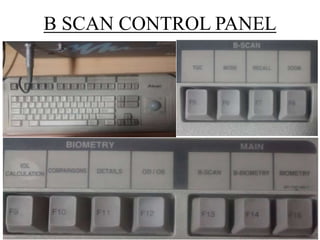
B SCAN CONTROL PANEL
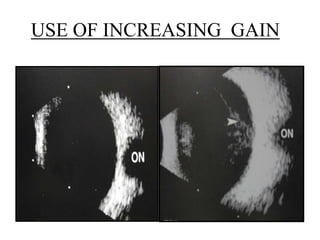
USE OF INCREASING GAIN
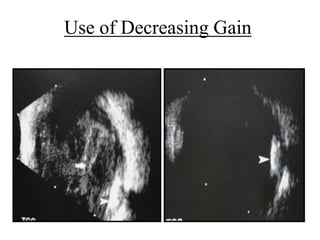
Use of Decreasing Gain
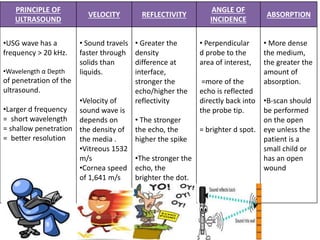
PRINCIPLE OF 
ULTRASOUND 
VELOCITY REFLECTIVITY 
ANGLE OF 
INCIDENCE 
ABSORPTION 
•USG wave has a 
frequency > 20 kHz. 
•Wavelength α Depth 
of penetration of the 
ultrasound. 
•Larger d frequency 
= short wavelength 
= shallow penetration 
= better resolution 
• Sound travels 
faster through 
solids than 
liquids. 
•Velocity of 
sound wave is 
depends on 
the density of 
the media . 
•Vitreous 1532 
m/s 
•Cornea speed 
of 1,641 m/s 
• Greater the 
density 
difference at 
interface, 
stronger the 
echo/higher the 
reflectivity 
• The stronger 
the echo, the 
higher the spike 
•The stronger the 
echo, the 
brighter the dot. 
• Perpendicular 
d probe to the 
area of interest, 
=more of the 
echo is reflected 
directly back into 
the probe tip. 
= brighter d spot. 
• More dense 
the medium, 
the greater the 
amount of 
absorption. 
•B-scan should 
be performed 
on the open 
eye unless the 
patient is a 
small child or 
has an open 
wound
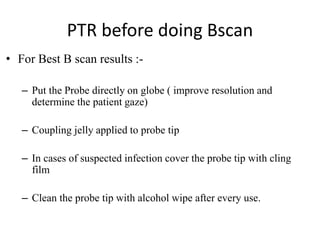
PTR before doing Bscan 
• For Best B scan results :- 
– Put the Probe directly on globe ( improve resolution and 
determine the patient gaze) 
– Coupling jelly applied to probe tip 
– In cases of suspected infection cover the probe tip with cling 
film 
– Clean the probe tip with alcohol wipe after every use.
REQUISITE 4 HIGH QUALITY 
BSCAN 
1. Lesion Must be Placed in the centre 
2. Beam must be directed perpendicular to the surface 
of interest 
3. Lowest Possible decibel gain that is consistent with 
adequate mantainence of intensity and resolution of 
lesion.
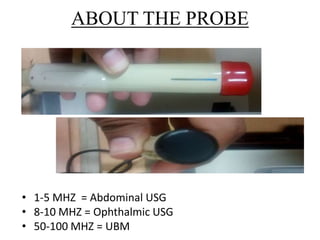
ABOUT THE PROBE 
• 1-5 MHZ = Abdominal USG 
• 8-10 MHZ = Ophthalmic USG 
• 50-100 MHZ = UBM
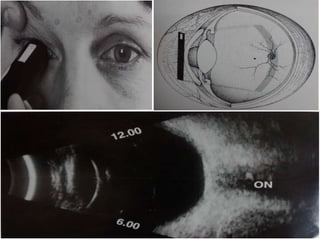
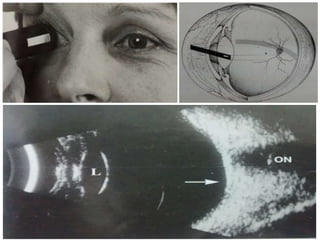
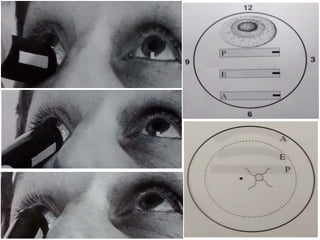
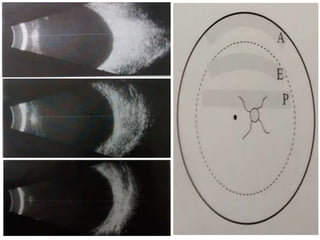
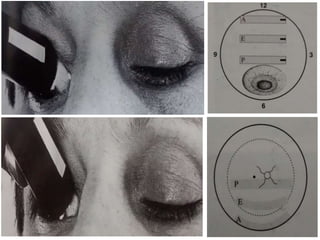
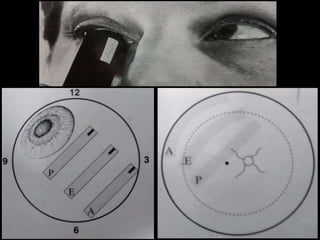
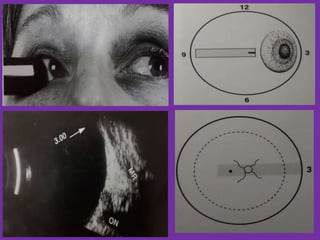
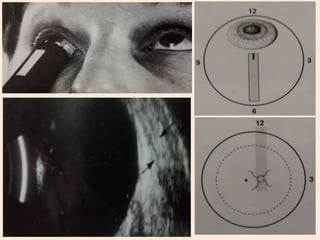
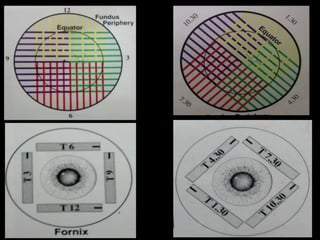
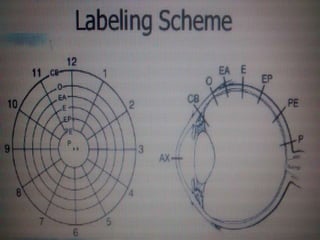
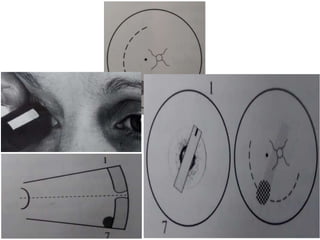
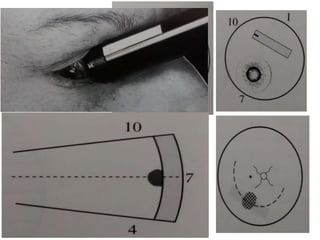
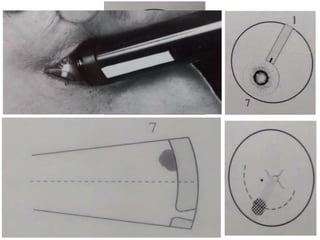
B Scan : Orientation & Labeling 
1. Axial Section 
2. Transverse Section 
3. Longitudinal Section
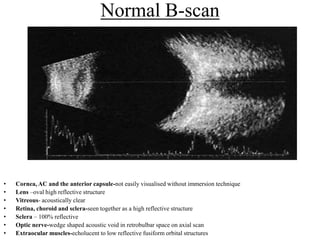
Normal B-scan 
• Cornea, AC and the anterior capsule-not easily visualised without immersion technique 
• Lens –oval high reflective structure 
• Vitreous- acoustically clear 
• Retina, choroid and sclera-seen together as a high reflective structure 
• Sclera – 100% reflective 
• Optic nerve-wedge shaped acoustic void in retrobulbar space on axial scan 
• Extraocular muscles-echolucent to low reflective fusiform orbital structures
Bscan in Various Pathologies
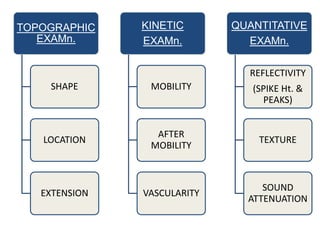
TOPOGRAPHIC 
EXAMn. 
SHAPE 
LOCATION 
EXTENSION 
KINETIC 
EXAMn. 
MOBILITY 
AFTER 
MOBILITY 
VASCULARITY 
QUANTITATIVE 
EXAMn. 
REFLECTIVITY 
(SPIKE Ht. & 
PEAKS) 
TEXTURE 
SOUND 
ATTENUATION
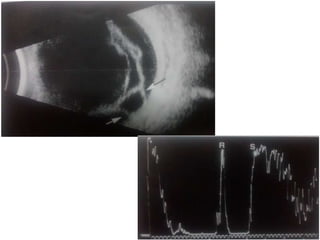
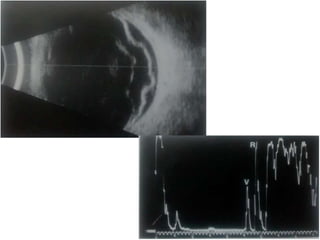
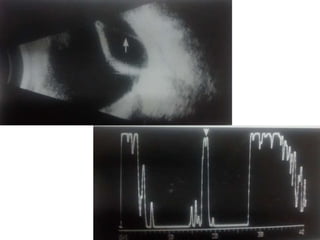
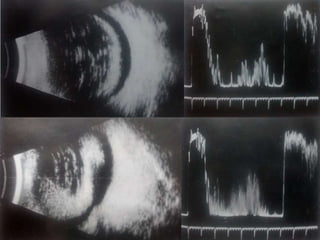
PVD 
RETINA 
DETACHMENT 
CHOROID 
DETACHMENT 
SHAPE Linear 
LOCATION 
ATTCH. TO ON Variable Yes No 
OTHER Thicker inferiorly Folds/Breaks Vortex Vein 
SPIKE HT. 40-90% 80-100% 90-100% 
SPIKE PEAKS Single Single 
Double / M shape 
peak 
MOBILITY 
Marked (Hammock 
like) 
Moderate Minimal 
AFTER MOVMT. Marked 
Moderate to 
severe 
Absent
References 
• Most of the photographs and pics hav been 
taken from Textbook of Ophthalmic 
Ultrasound by Hatem R. Aata WITHOUT 
PRIOR PERMISSION.
Correlation with clinical findings is 
essential to make a diagnosis 
“ Thank you for listening B scan” 
• THANK YOU EVERYONE FOR PATIENTLY LISTENING TO THIS SEMINAR. 
• For feedbacks & brickbats plz mail at 
• ykush@yahoo.co.in./drdhir2014@gmail.com

B scan by Pushkar Dhir

  • 1.
    B SCAN Moderator:- Dr. Supreet Juneja Presentor:- Dr.Pushkar Dhir
  • 2.
    D 4 CONCEPTS 1. How Bscan came into existence? 2. Concept of Frequency. 3. Concept of Gain.
  • 3.
    ULTRASONOGRAPHY • Non-invasive,efficient and inexpensive diagnostic tool. • Examiner- dependent • Expertise • A correlation with clinical findings is essential to make a diagnosis. .
  • 4.
    • 1793: LazzaroSpallanzani (Italy) discovered that bats orient themselves with the help of sound whistles while flying in darkness. This was the basis of modern ultrasound application
  • 5.
    • 1956: Mundtand Hughes - first used the A-scan technique. • 1958: Baum and Greenwood - B-scan (immersion method) • 1962:Oksala and Lehtinen further refined the technique • In the sixties, imaging of the eyeball and orbit using ultrasound was popularised by Ossoining.
  • 6.
  • 7.
    INSTRUMENTATION • AnUSG unit is composed of four basic elements : – Pulser, – Receiver – Display screen – Transducer
  • 8.
  • 9.
  • 10.
  • 11.
    PRINCIPLE OF ULTRASOUND VELOCITY REFLECTIVITY ANGLE OF INCIDENCE ABSORPTION •USG wave has a frequency > 20 kHz. •Wavelength α Depth of penetration of the ultrasound. •Larger d frequency = short wavelength = shallow penetration = better resolution • Sound travels faster through solids than liquids. •Velocity of sound wave is depends on the density of the media . •Vitreous 1532 m/s •Cornea speed of 1,641 m/s • Greater the density difference at interface, stronger the echo/higher the reflectivity • The stronger the echo, the higher the spike •The stronger the echo, the brighter the dot. • Perpendicular d probe to the area of interest, =more of the echo is reflected directly back into the probe tip. = brighter d spot. • More dense the medium, the greater the amount of absorption. •B-scan should be performed on the open eye unless the patient is a small child or has an open wound
  • 12.
    PTR before doingBscan • For Best B scan results :- – Put the Probe directly on globe ( improve resolution and determine the patient gaze) – Coupling jelly applied to probe tip – In cases of suspected infection cover the probe tip with cling film – Clean the probe tip with alcohol wipe after every use.
  • 13.
    REQUISITE 4 HIGHQUALITY BSCAN 1. Lesion Must be Placed in the centre 2. Beam must be directed perpendicular to the surface of interest 3. Lowest Possible decibel gain that is consistent with adequate mantainence of intensity and resolution of lesion.
  • 14.
    ABOUT THE PROBE • 1-5 MHZ = Abdominal USG • 8-10 MHZ = Ophthalmic USG • 50-100 MHZ = UBM
  • 15.
    B Scan :Orientation & Labeling 1. Axial Section 2. Transverse Section 3. Longitudinal Section
  • 29.
    Normal B-scan •Cornea, AC and the anterior capsule-not easily visualised without immersion technique • Lens –oval high reflective structure • Vitreous- acoustically clear • Retina, choroid and sclera-seen together as a high reflective structure • Sclera – 100% reflective • Optic nerve-wedge shaped acoustic void in retrobulbar space on axial scan • Extraocular muscles-echolucent to low reflective fusiform orbital structures
  • 30.
    Bscan in VariousPathologies
  • 31.
    TOPOGRAPHIC EXAMn. SHAPE LOCATION EXTENSION KINETIC EXAMn. MOBILITY AFTER MOBILITY VASCULARITY QUANTITATIVE EXAMn. REFLECTIVITY (SPIKE Ht. & PEAKS) TEXTURE SOUND ATTENUATION
  • 32.
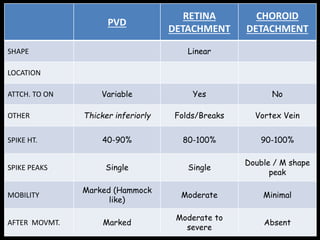
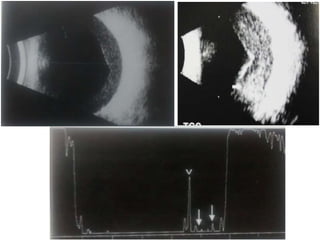
    PVD RETINA DETACHMENT CHOROID DETACHMENT SHAPE Linear LOCATION ATTCH. TO ON Variable Yes No OTHER Thicker inferiorly Folds/Breaks Vortex Vein SPIKE HT. 40-90% 80-100% 90-100% SPIKE PEAKS Single Single Double / M shape peak MOBILITY Marked (Hammock like) Moderate Minimal AFTER MOVMT. Marked Moderate to severe Absent
  • 44.
    References • Mostof the photographs and pics hav been taken from Textbook of Ophthalmic Ultrasound by Hatem R. Aata WITHOUT PRIOR PERMISSION.
  • 45.
    Correlation with clinicalfindings is essential to make a diagnosis 
  • 46.
    “ Thank youfor listening B scan” • THANK YOU EVERYONE FOR PATIENTLY LISTENING TO THIS SEMINAR. • For feedbacks & brickbats plz mail at • ykush@yahoo.co.in./drdhir2014@gmail.com