HISTORY,
MATERIAL,
NOMENCLATURE
Of Contact Lenses
Presentor:- Dr.Pushkar Dhir
Moderator :- Dr.OP Gupta
Moderator:- Ms Sheeba
D VINCI CODE
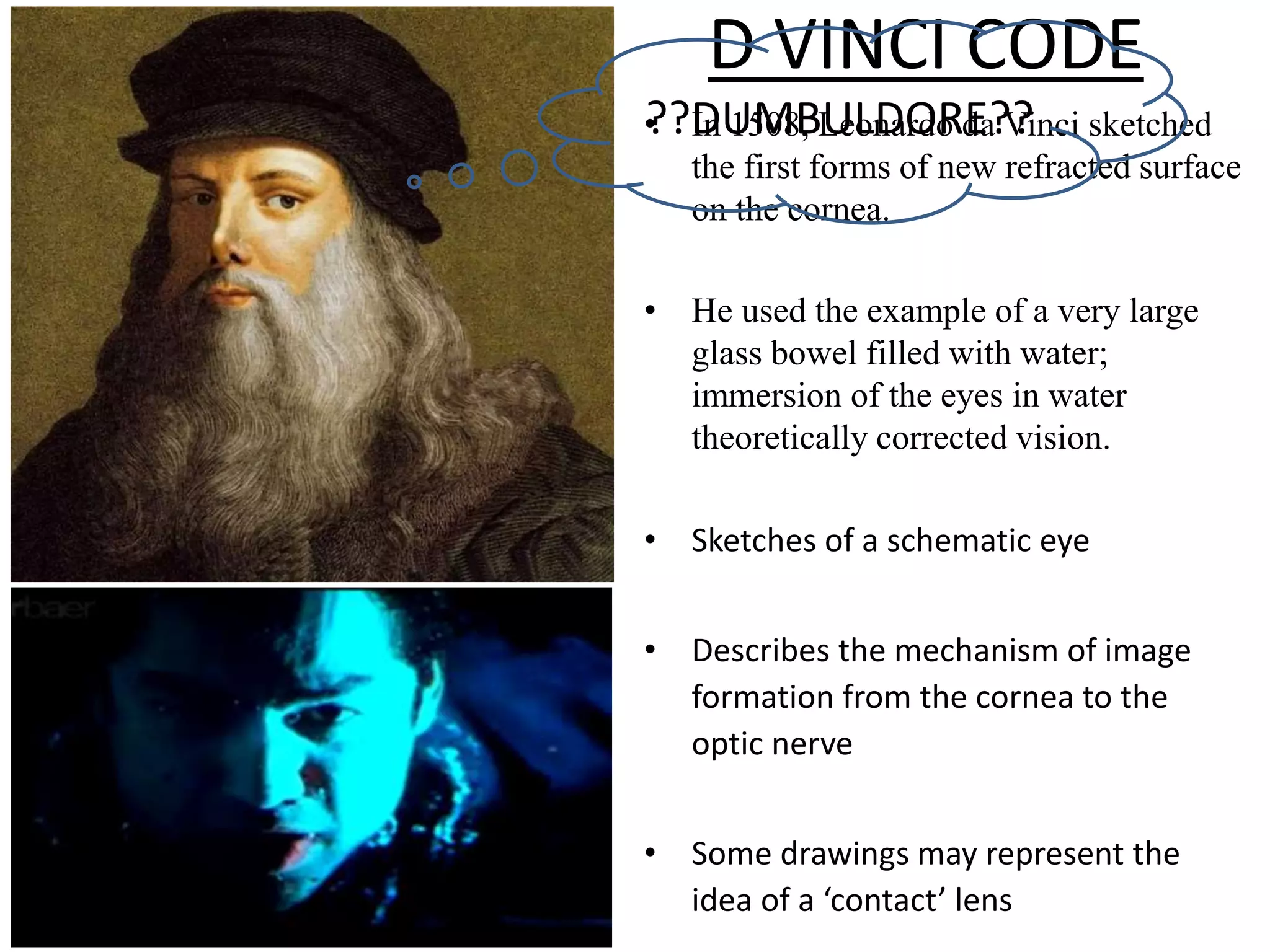
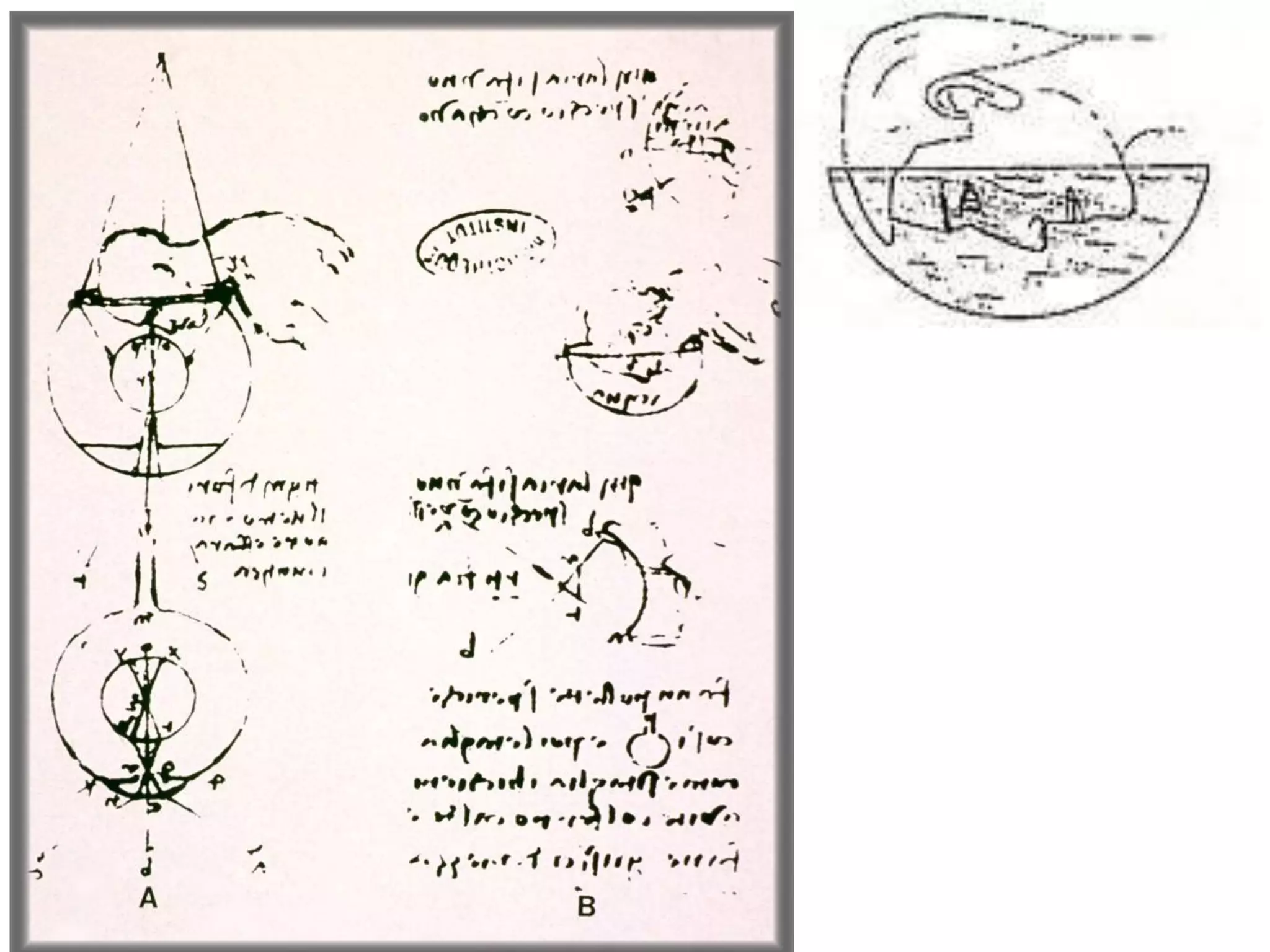
• In 1508, Leonardo da Vinci sketched
the first forms of new refracted surface
on the cornea.
• He used the example of a very large
glass bowel filled with water;
immersion of the eyes in water
theoretically corrected vision.
• Sketches of a schematic eye
• Describes the mechanism of image
formation from the cornea to the
optic nerve
• Some drawings may represent the
idea of a ‘contact’ lens
??DUMBULDORE??
RENÉ DESCARTES
(1637)
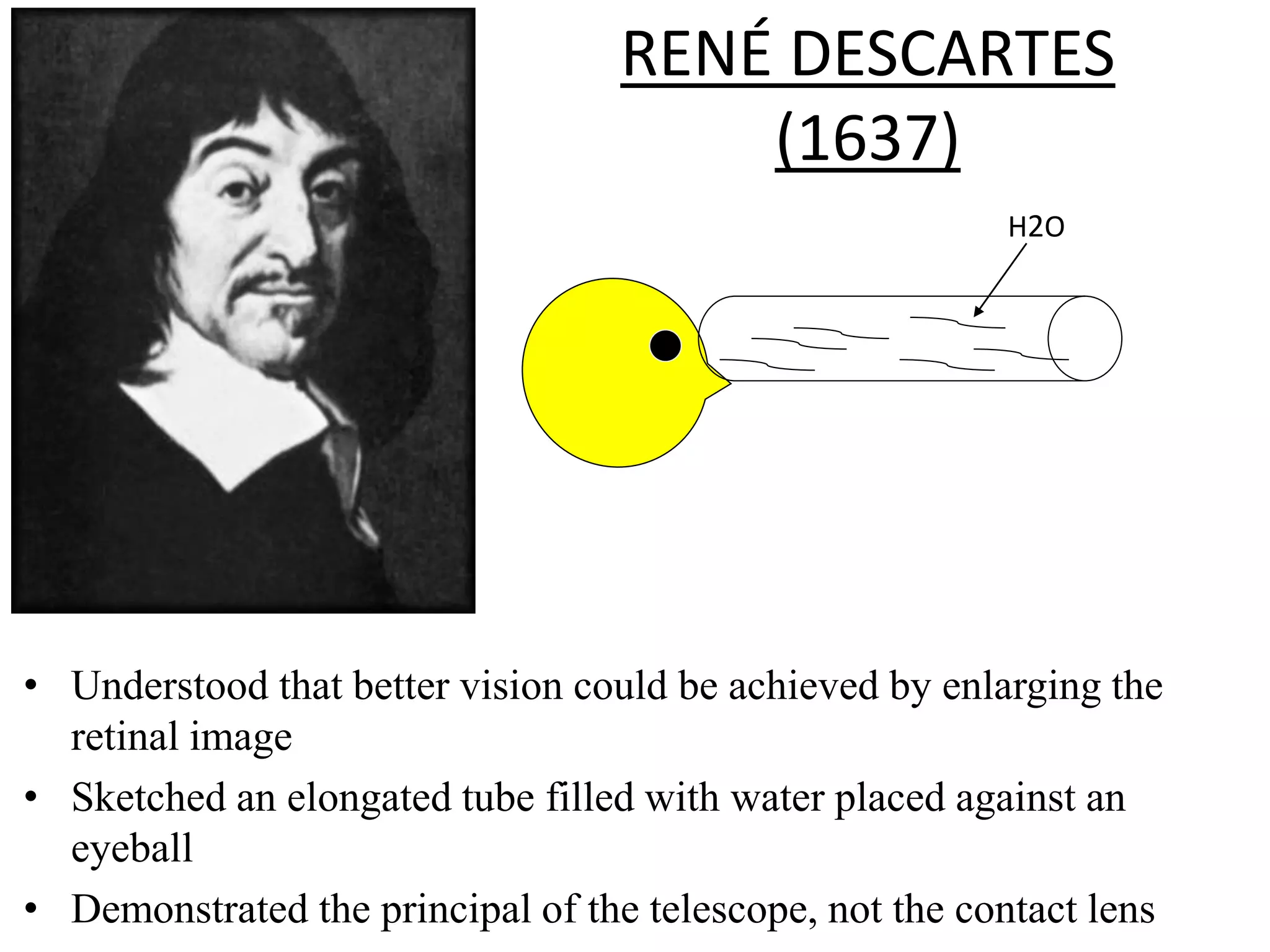
• Understood that better vision could be achieved by enlarging the
retinal image
• Sketched an elongated tube filled with water placed against an
eyeball
• Demonstrated the principal of the telescope, not the contact lens
H2O
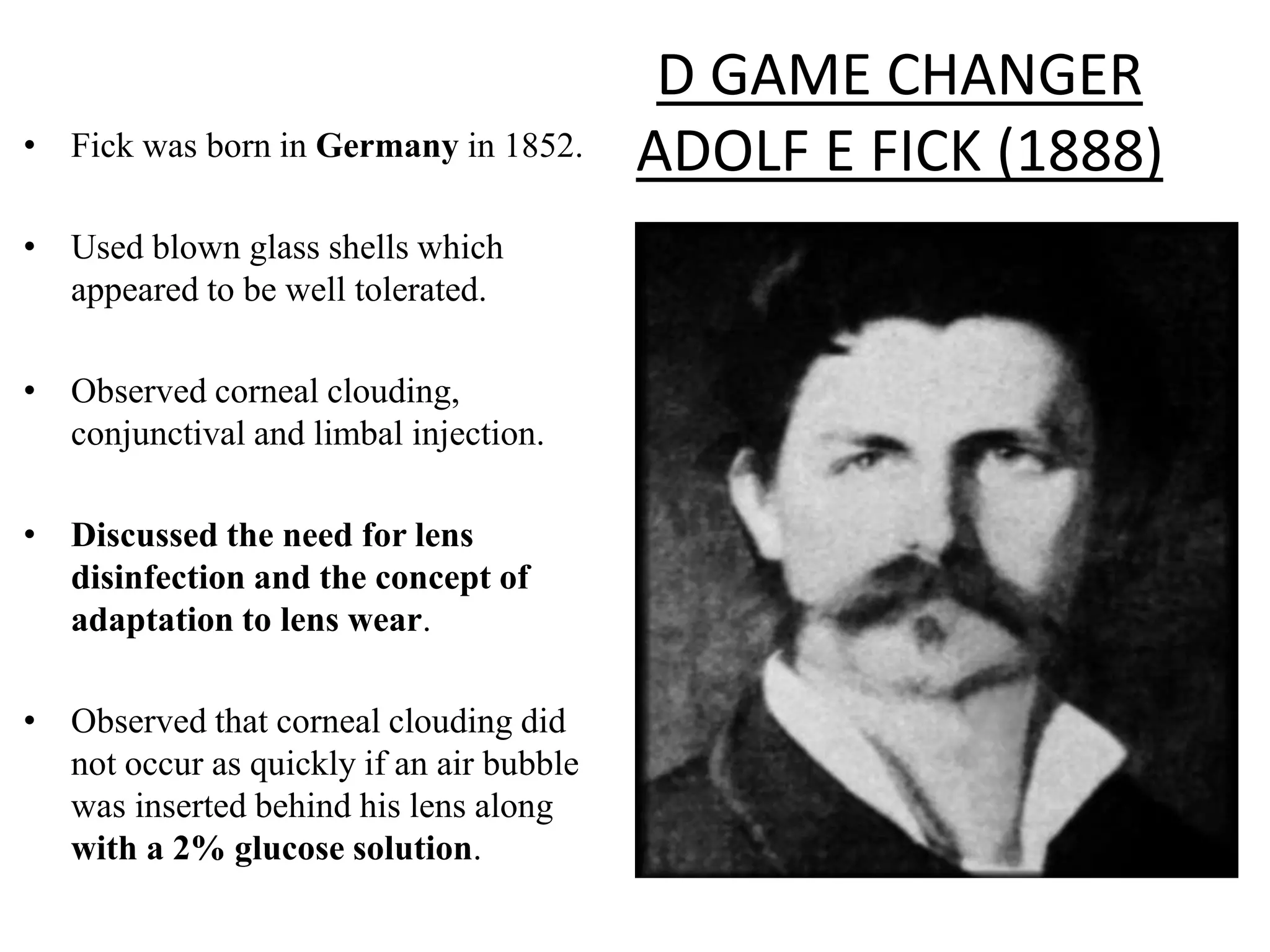
D GAME CHANGER
ADOLF E FICK (1888)• Fick was born in Germany in 1852.
• Used blown glass shells which
appeared to be well tolerated.
• Observed corneal clouding,
conjunctival and limbal injection.
• Discussed the need for lens
disinfection and the concept of
adaptation to lens wear.
• Observed that corneal clouding did
not occur as quickly if an air bubble
was inserted behind his lens along
with a 2% glucose solution.
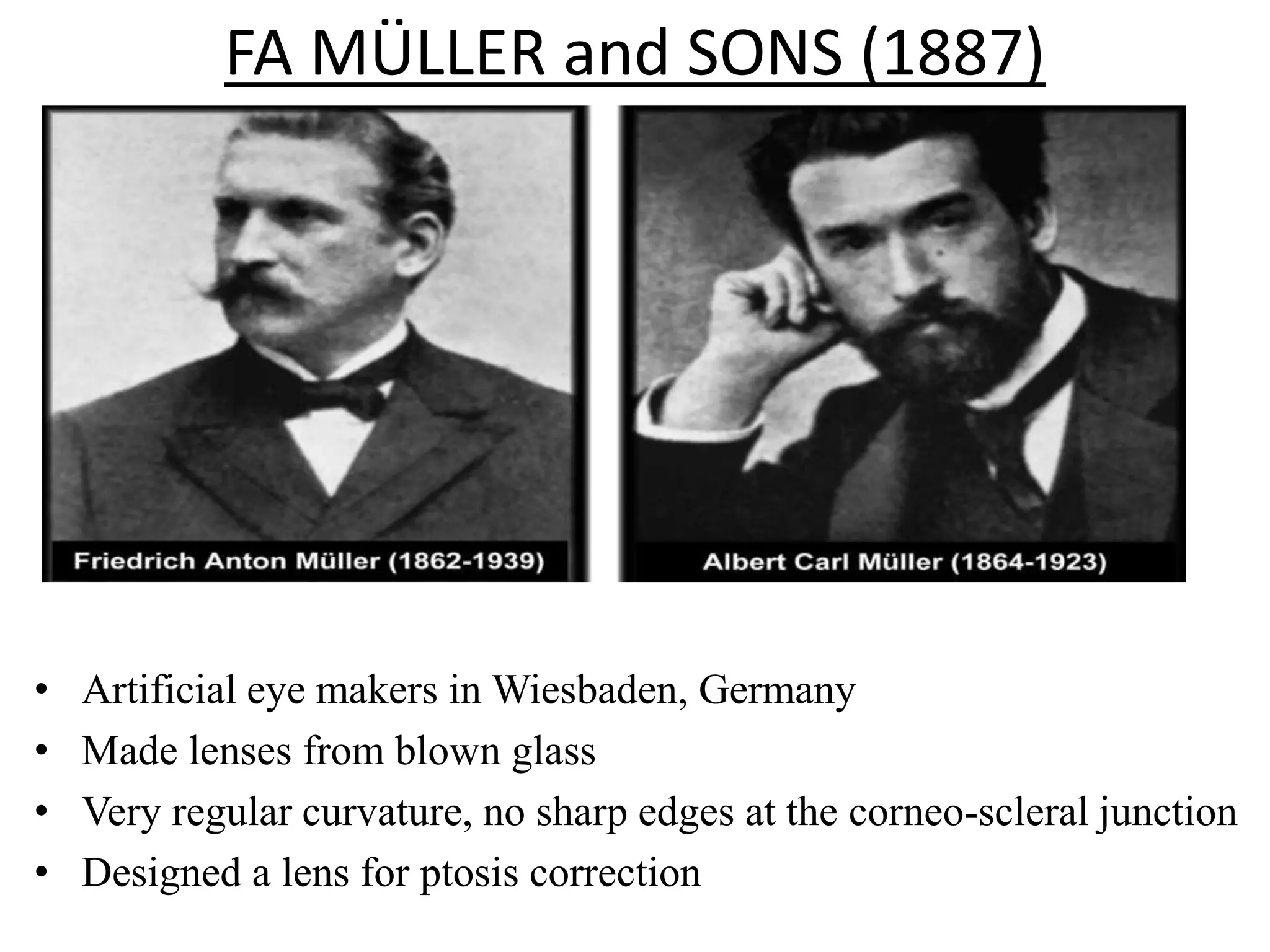
FA MÜLLER and SONS (1887)
• Artificial eye makers in Wiesbaden, Germany
• Made lenses from blown glass
• Very regular curvature, no sharp edges at the corneo-scleral junction
• Designed a lens for ptosis correction
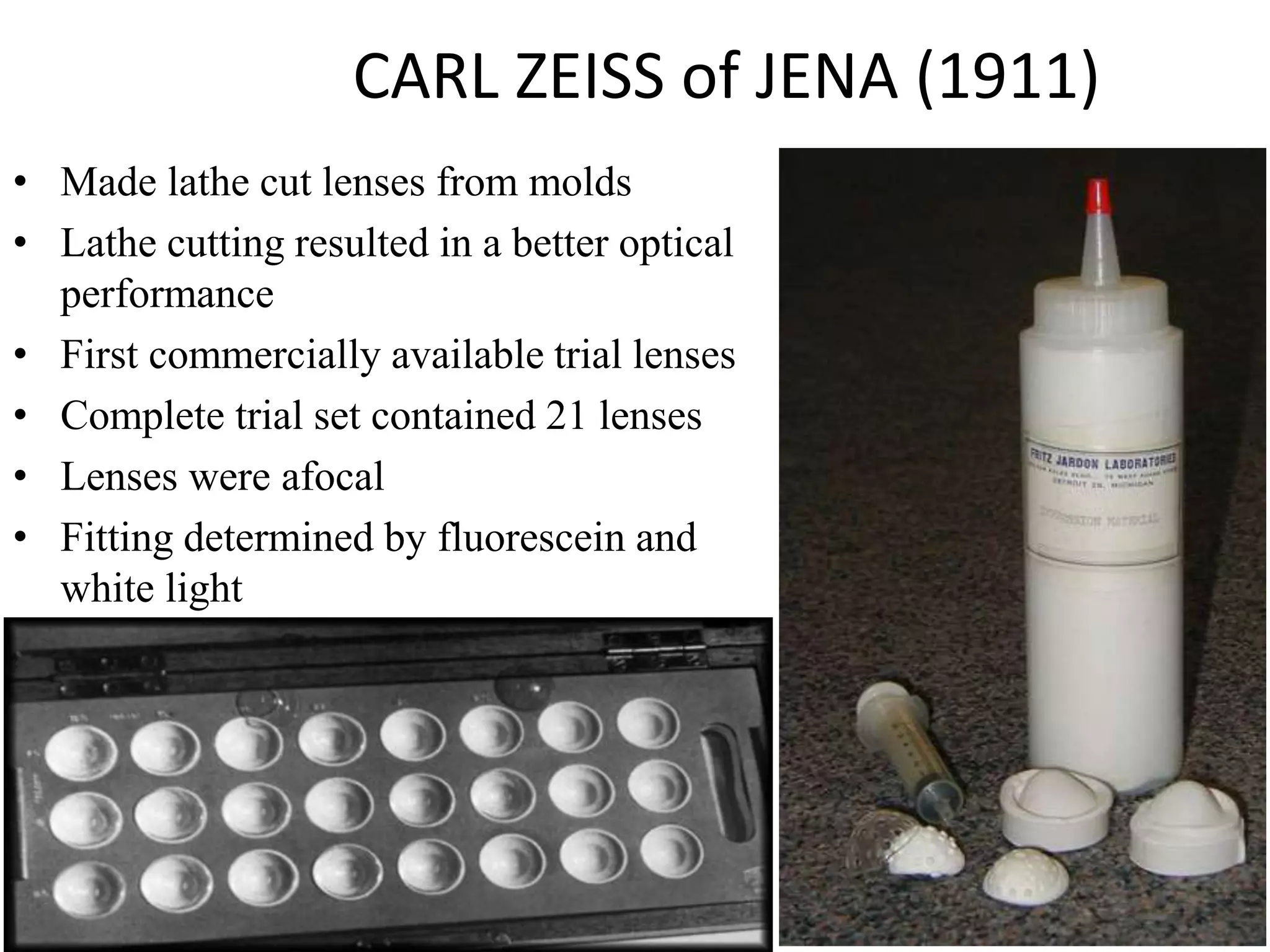
CARL ZEISS of JENA (1911)
• Made lathe cut lenses from molds
• Lathe cutting resulted in a better optical
performance
• First commercially available trial lenses
• Complete trial set contained 21 lenses
• Lenses were afocal
• Fitting determined by fluorescein and
white light
8
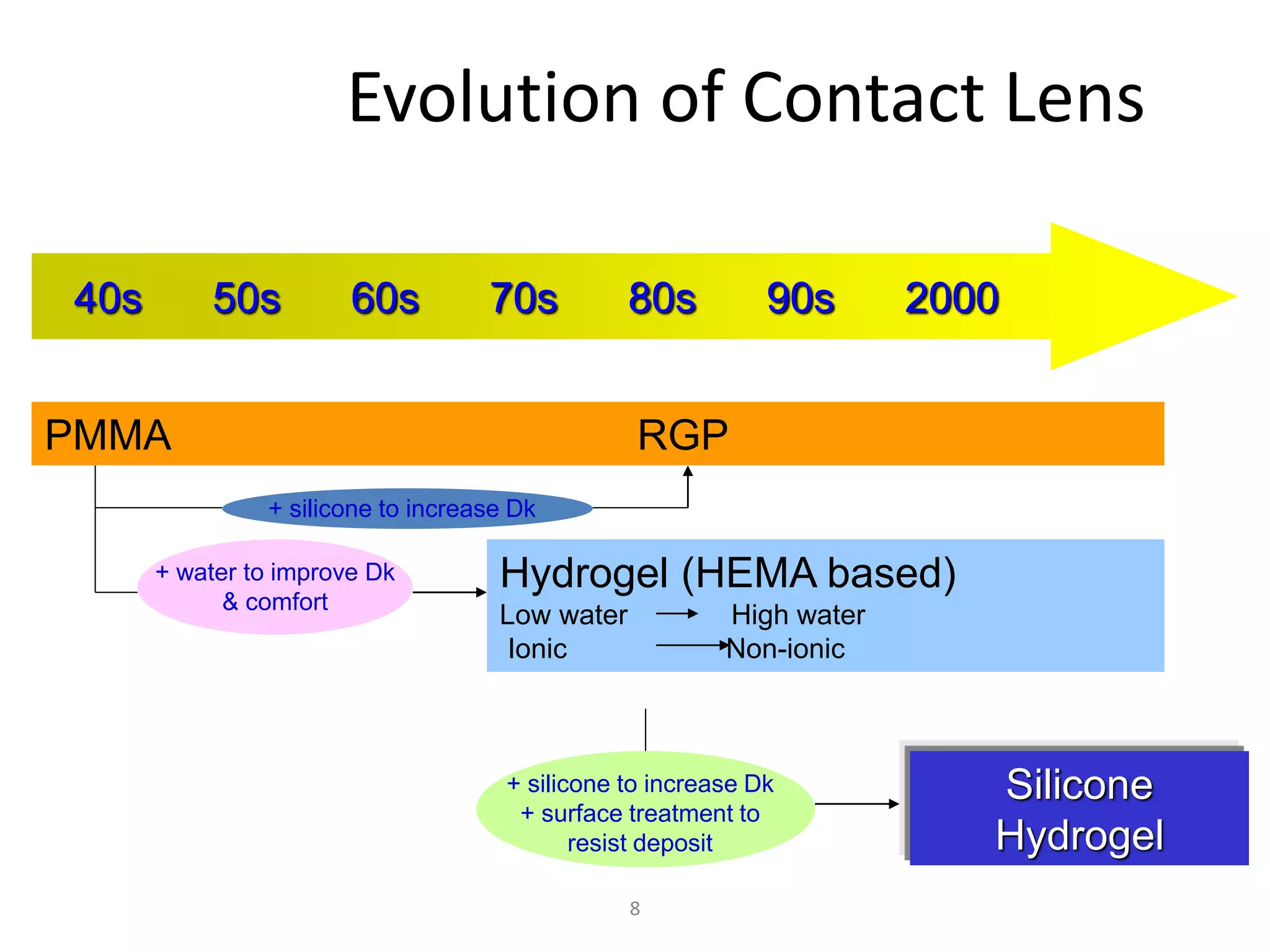
Evolution of Contact Lens
PMMA
40s 50s 60s 70s 80s 90s 2000
Silicone
Hydrogel
+ silicone to increase Dk
+ surface treatment to
resist deposit
+ water to improve Dk
& comfort
Hydrogel (HEMA based)
Low water High water
Ionic Non-ionic
+ silicone to increase Dk
RGP
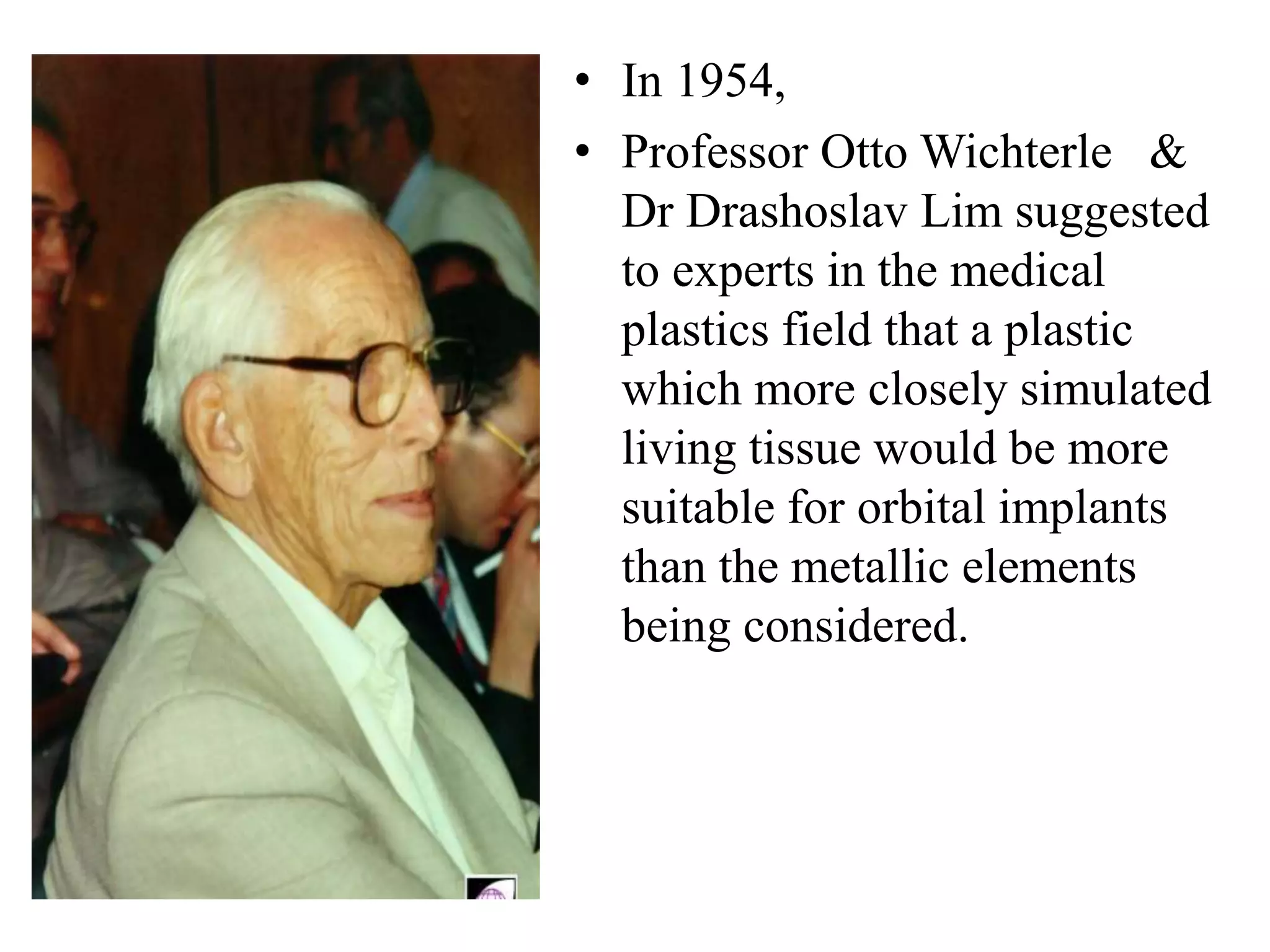
• In 1954,
• Professor Otto Wichterle &
Dr Drashoslav Lim suggested
to experts in the medical
plastics field that a plastic
which more closely simulated
living tissue would be more
suitable for orbital implants
than the metallic elements
being considered.
IDEAL MATERIAL
 BIOCOMPATIBILITY- should not harmful
 OPTICAL PROPERTIES- transparent
 GAS PERMEABILITY – wearing time
 TOLERANCE –gas permeability and design.
 MOULDING
 STERILITY
 STABILITY - in all dimentions
 SURFACE CHEMISTRY - easily wettable
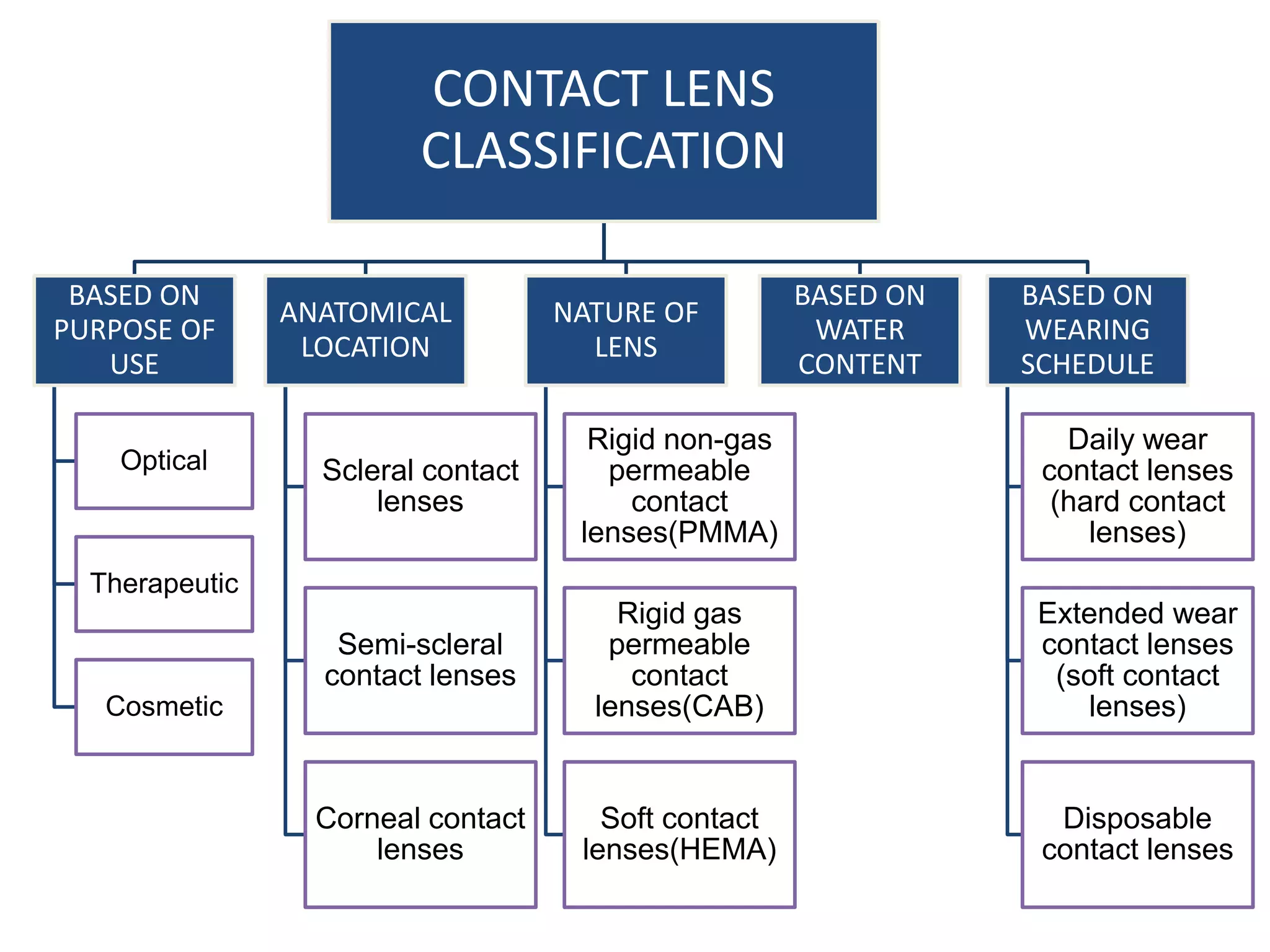
CONTACT LENS
CLASSIFICATION
BASED ON
PURPOSE OF
USE
Optical
Therapeutic
Cosmetic
ANATOMICAL
LOCATION
Scleral contact
lenses
Semi-scleral
contact lenses
Corneal contact
lenses
NATURE OF
LENS
Rigid non-gas
permeable
contact
lenses(PMMA)
Rigid gas
permeable
contact
lenses(CAB)
Soft contact
lenses(HEMA)
BASED ON
WATER
CONTENT
BASED ON
WEARING
SCHEDULE
Daily wear
contact lenses
(hard contact
lenses)
Extended wear
contact lenses
(soft contact
lenses)
Disposable
contact lenses
12
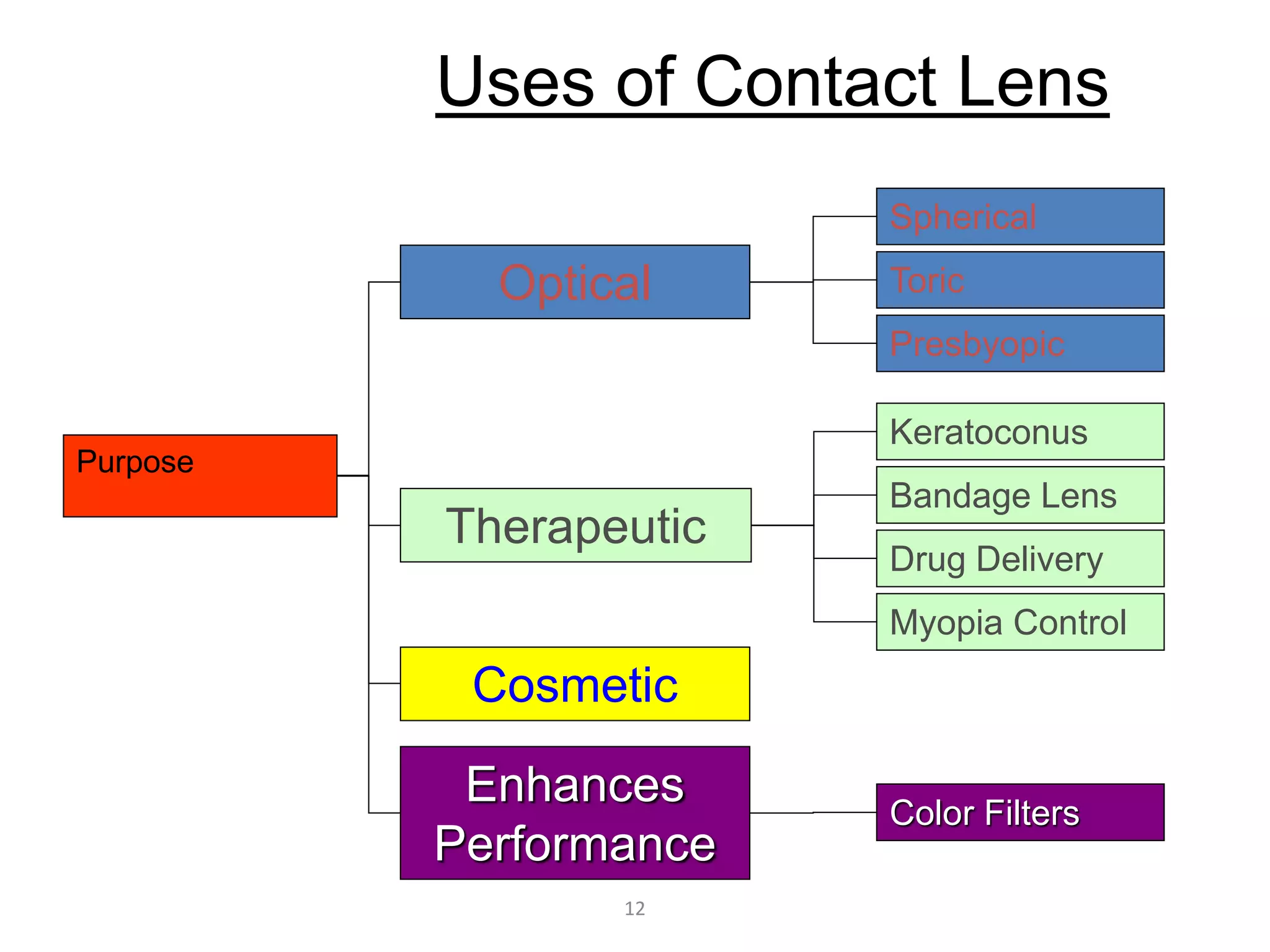
Uses of Contact Lens
Purpose
Cosmetic
Spherical
Toric
Presbyopic
Optical
Keratoconus
Bandage Lens
Drug Delivery
Myopia Control
Therapeutic
Enhances
Performance
Color Filters
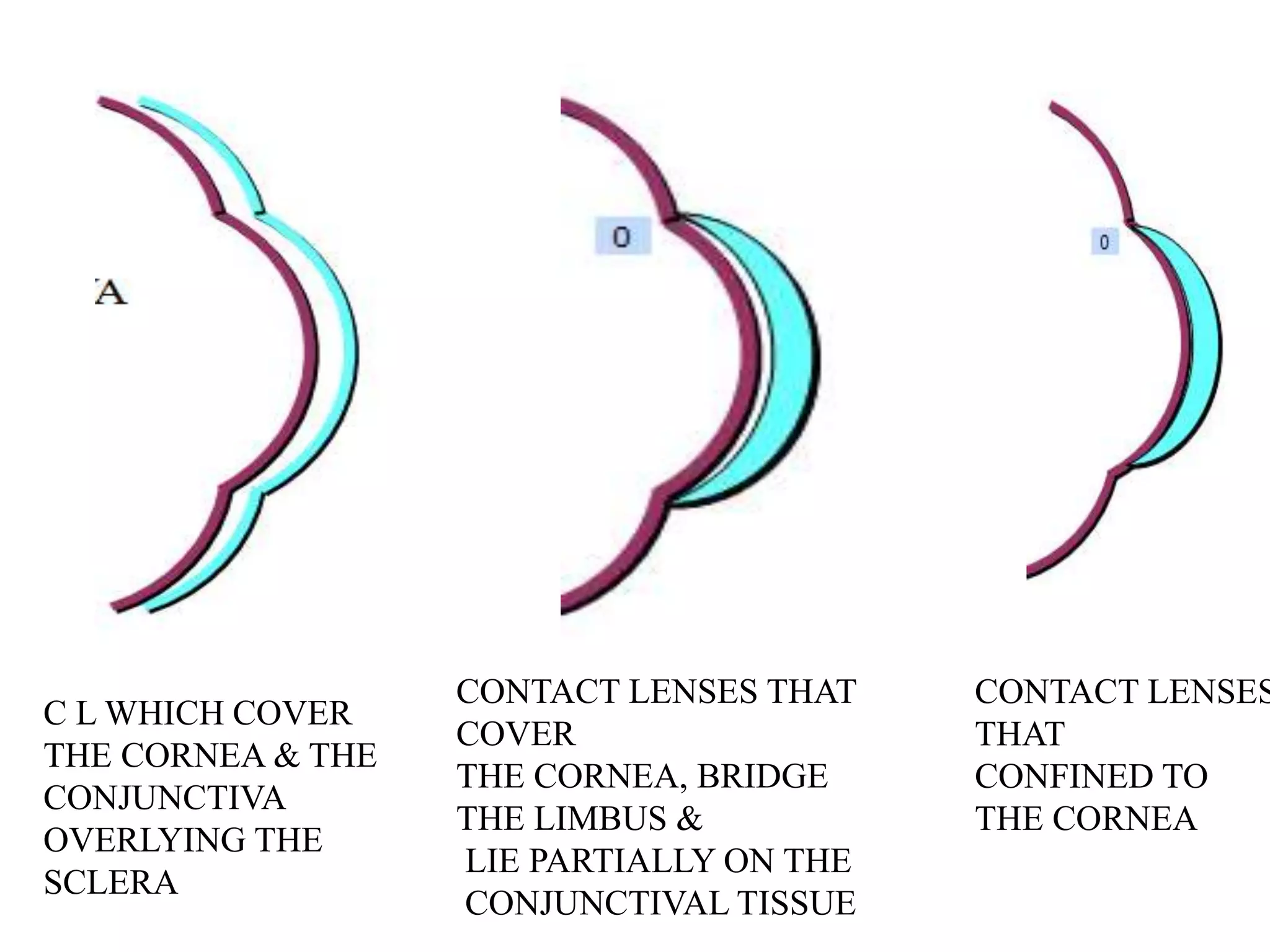
C L WHICH COVER
THE CORNEA & THE
CONJUNCTIVA
OVERLYING THE
SCLERA
CONTACT LENSES THAT
COVER
THE CORNEA, BRIDGE
THE LIMBUS &
LIE PARTIALLY ON THE
CONJUNCTIVAL TISSUE
CONTACT LENSES
THAT
CONFINED TO
THE CORNEA
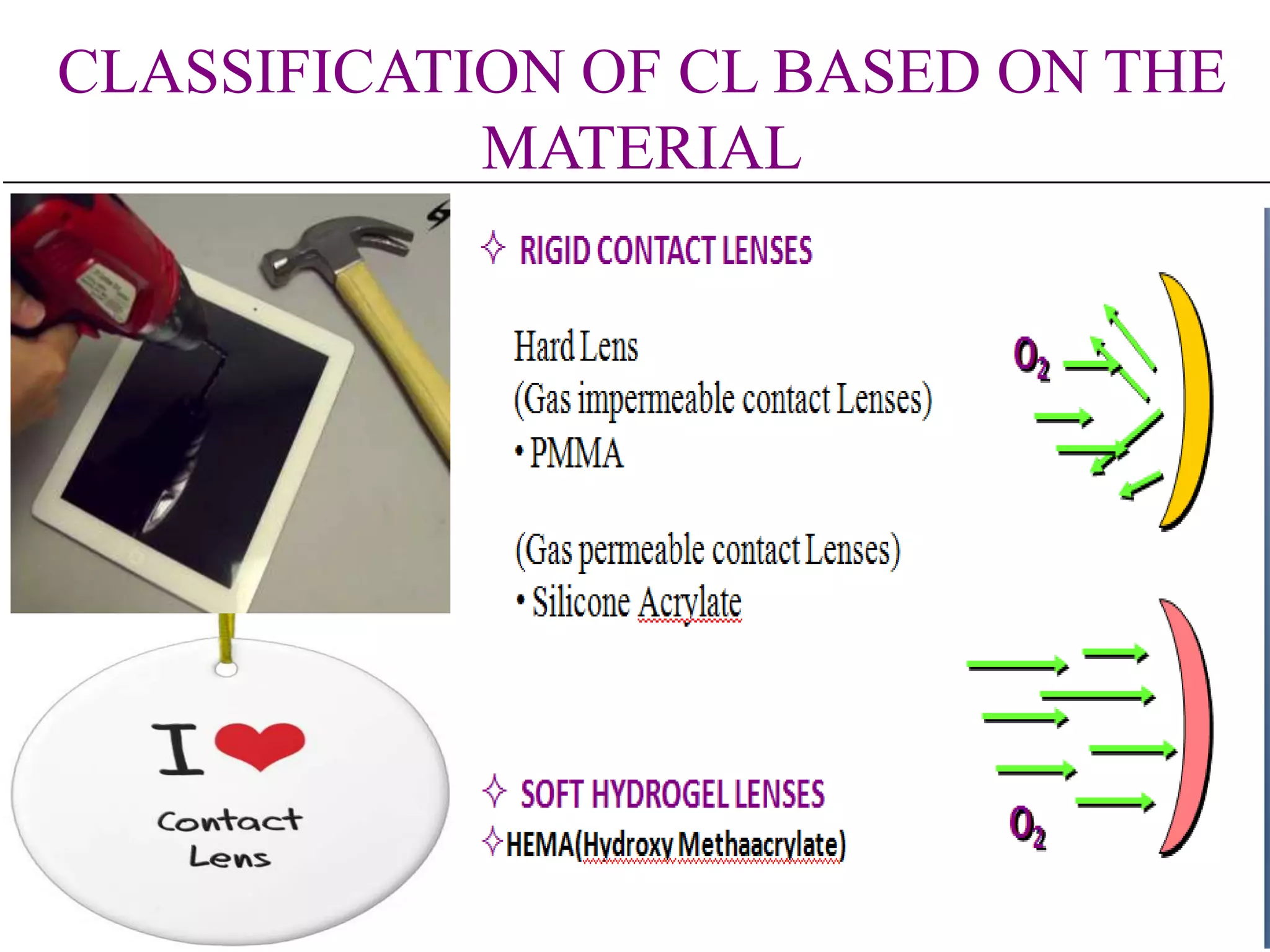
CLASSIFICATION OF CL BASED ON THE
MATERIAL
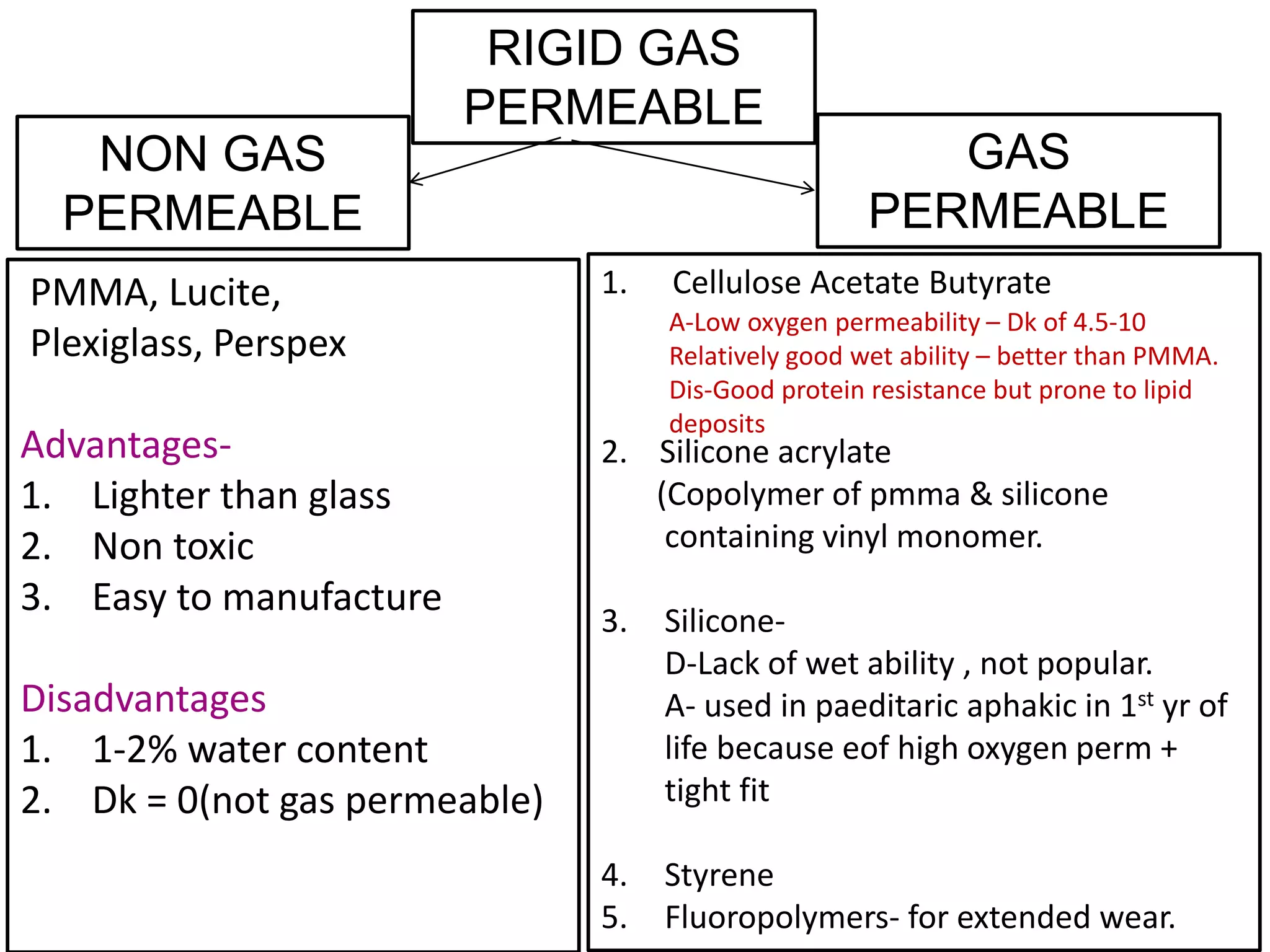
NON GAS
PERMEABLE
GAS
PERMEABLE
PMMA, Lucite,
Plexiglass, Perspex
Advantages-
1. Lighter than glass
2. Non toxic
3. Easy to manufacture
Disadvantages
1. 1-2% water content
2. Dk = 0(not gas permeable)
1. Cellulose Acetate Butyrate
2. Silicone acrylate
(Copolymer of pmma & silicone
containing vinyl monomer.
3. Silicone-
D-Lack of wet ability , not popular.
A- used in paeditaric aphakic in 1st yr of
life because eof high oxygen perm +
tight fit
4. Styrene
5. Fluoropolymers- for extended wear.
RIGID GAS
PERMEABLE
A-Low oxygen permeability – Dk of 4.5-10
Relatively good wet ability – better than PMMA.
Dis-Good protein resistance but prone to lipid
deposits
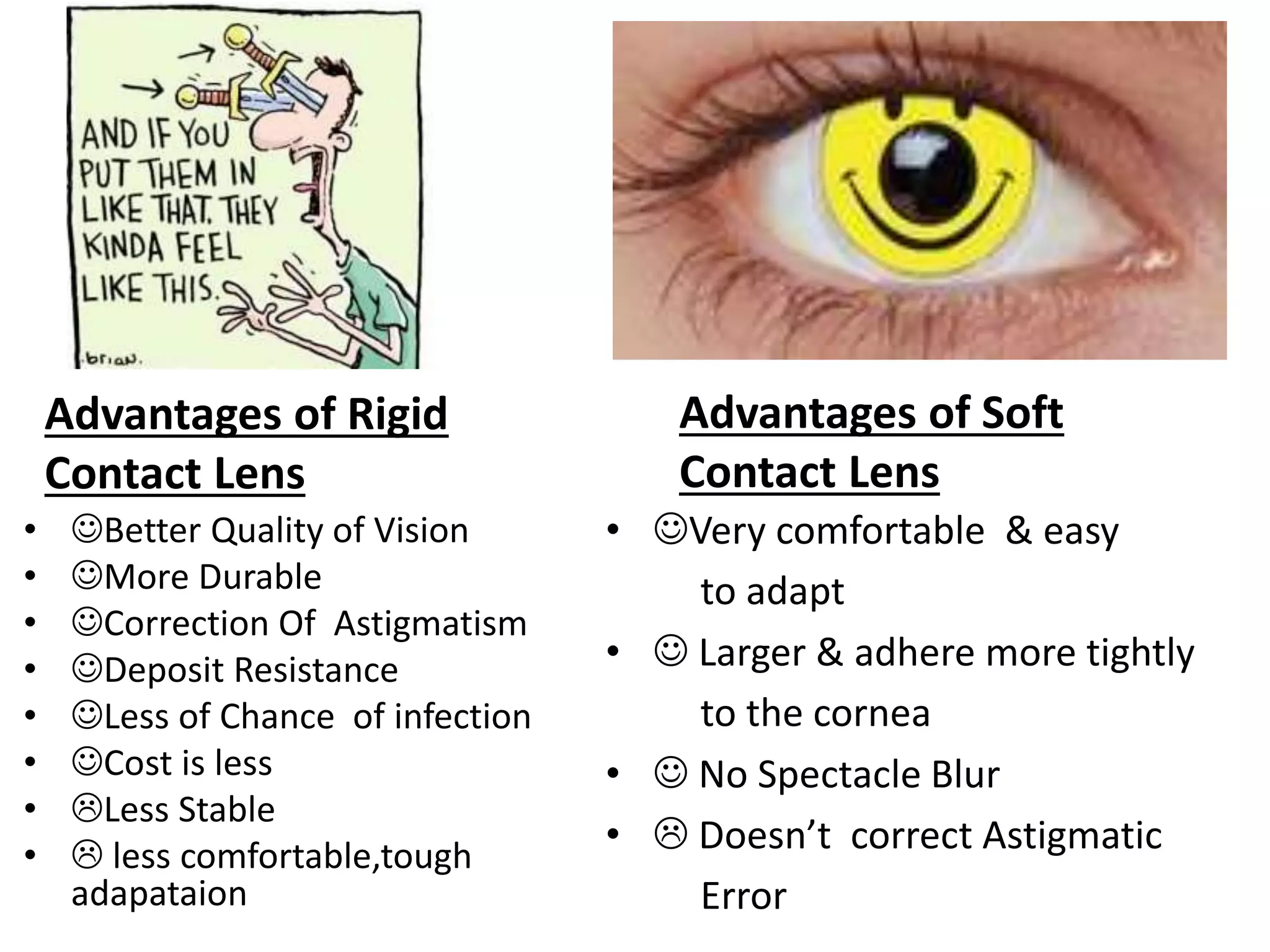
Advantages of Rigid
Contact Lens
• Better Quality of Vision
• More Durable
• Correction Of Astigmatism
• Deposit Resistance
• Less of Chance of infection
• Cost is less
• Less Stable
•  less comfortable,tough
adapataion
Advantages of Soft
Contact Lens
• Very comfortable & easy
to adapt
•  Larger & adhere more tightly
to the cornea
•  No Spectacle Blur
•  Doesn’t correct Astigmatic
Error
CLASSIFICATION OF CL BASED ON
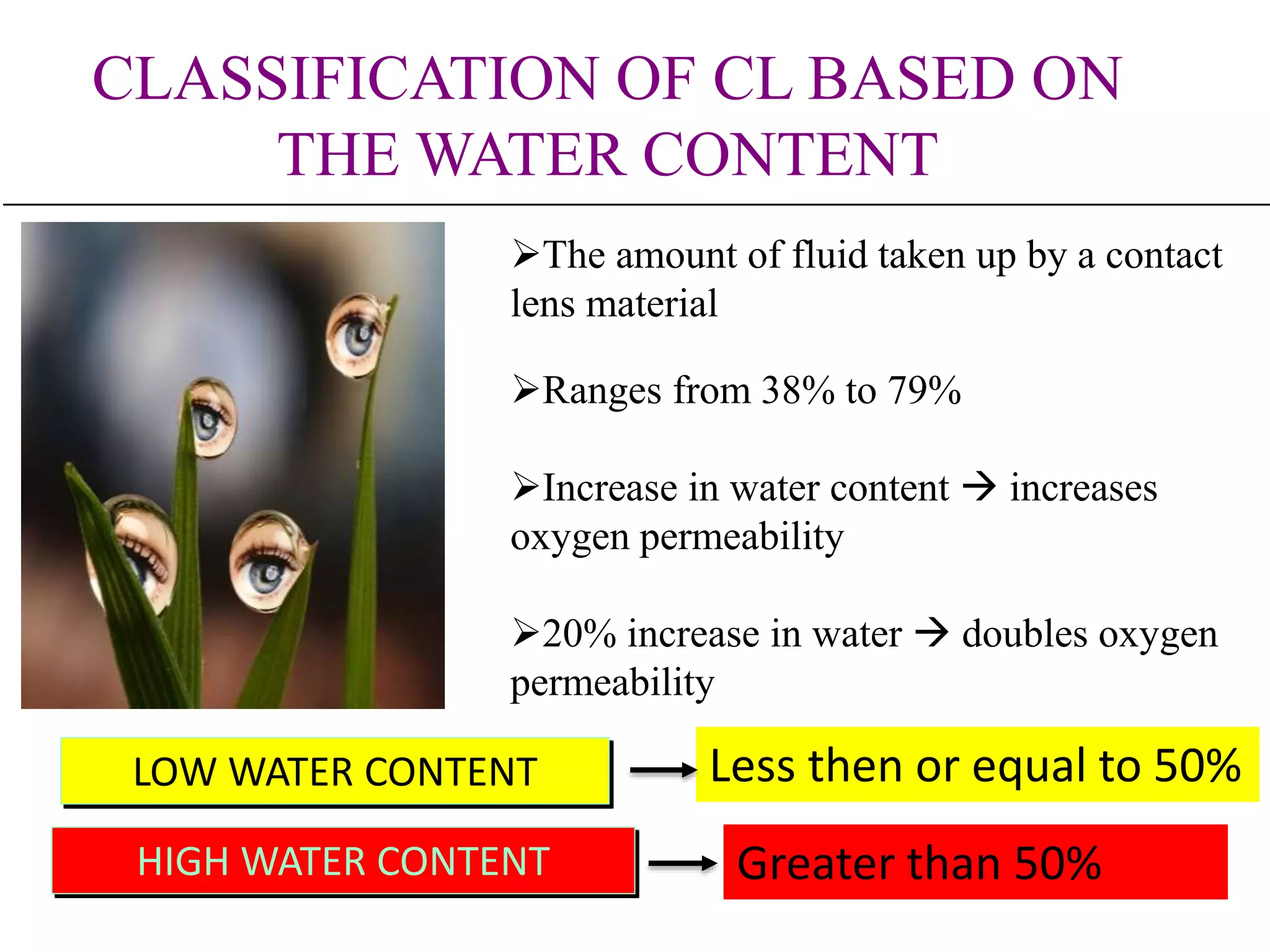
THE WATER CONTENT
LOW WATER CONTENT Less then or equal to 50%
HIGH WATER CONTENT Greater than 50%
The amount of fluid taken up by a contact
lens material
Ranges from 38% to 79%
Increase in water content  increases
oxygen permeability
20% increase in water  doubles oxygen
permeability
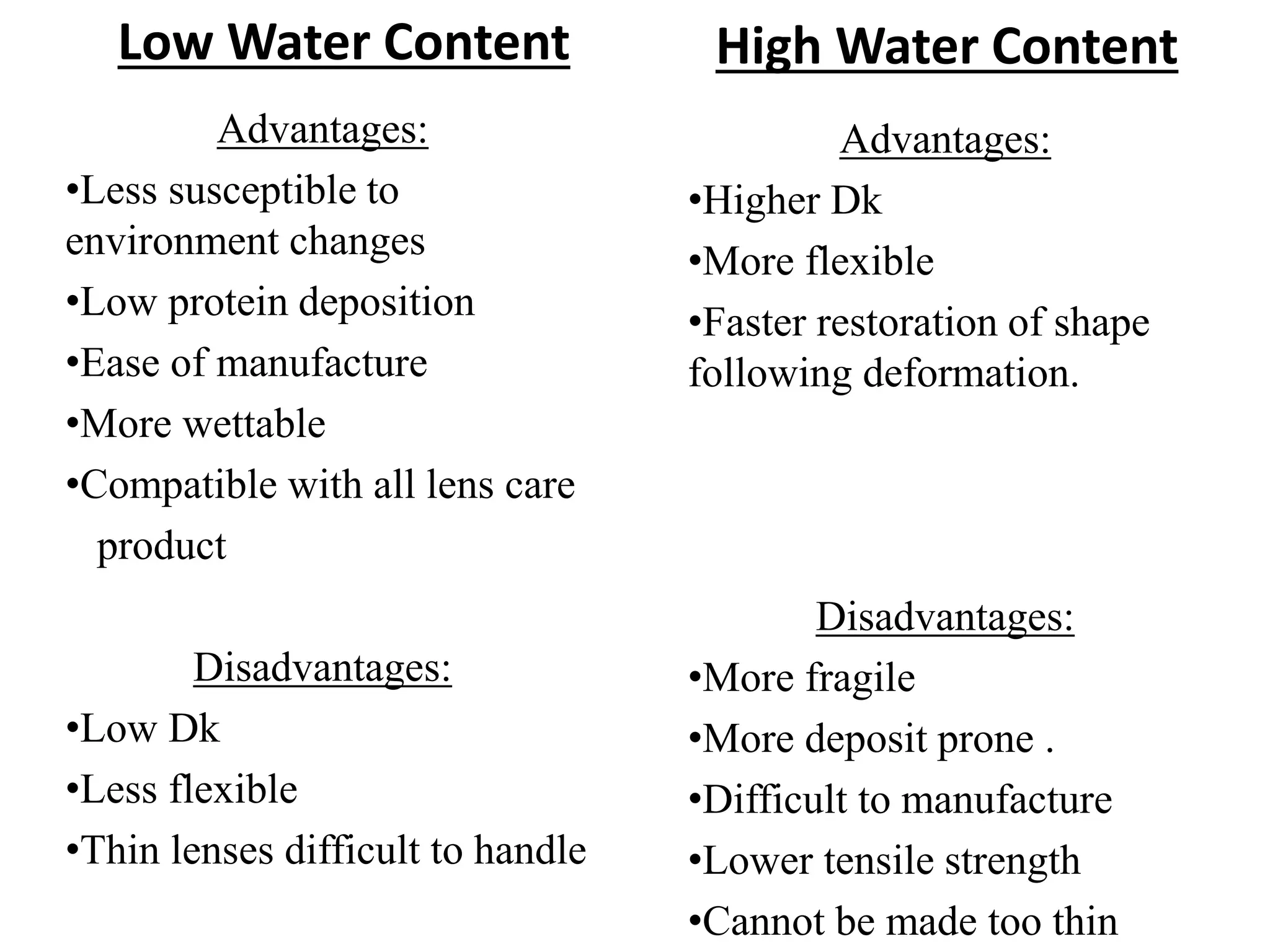
Low Water Content
Advantages:
•Less susceptible to
environment changes
•Low protein deposition
•Ease of manufacture
•More wettable
•Compatible with all lens care
product
Disadvantages:
•Low Dk
•Less flexible
•Thin lenses difficult to handle
High Water Content
Advantages:
•Higher Dk
•More flexible
•Faster restoration of shape
following deformation.
Disadvantages:
•More fragile
•More deposit prone .
•Difficult to manufacture
•Lower tensile strength
•Cannot be made too thin
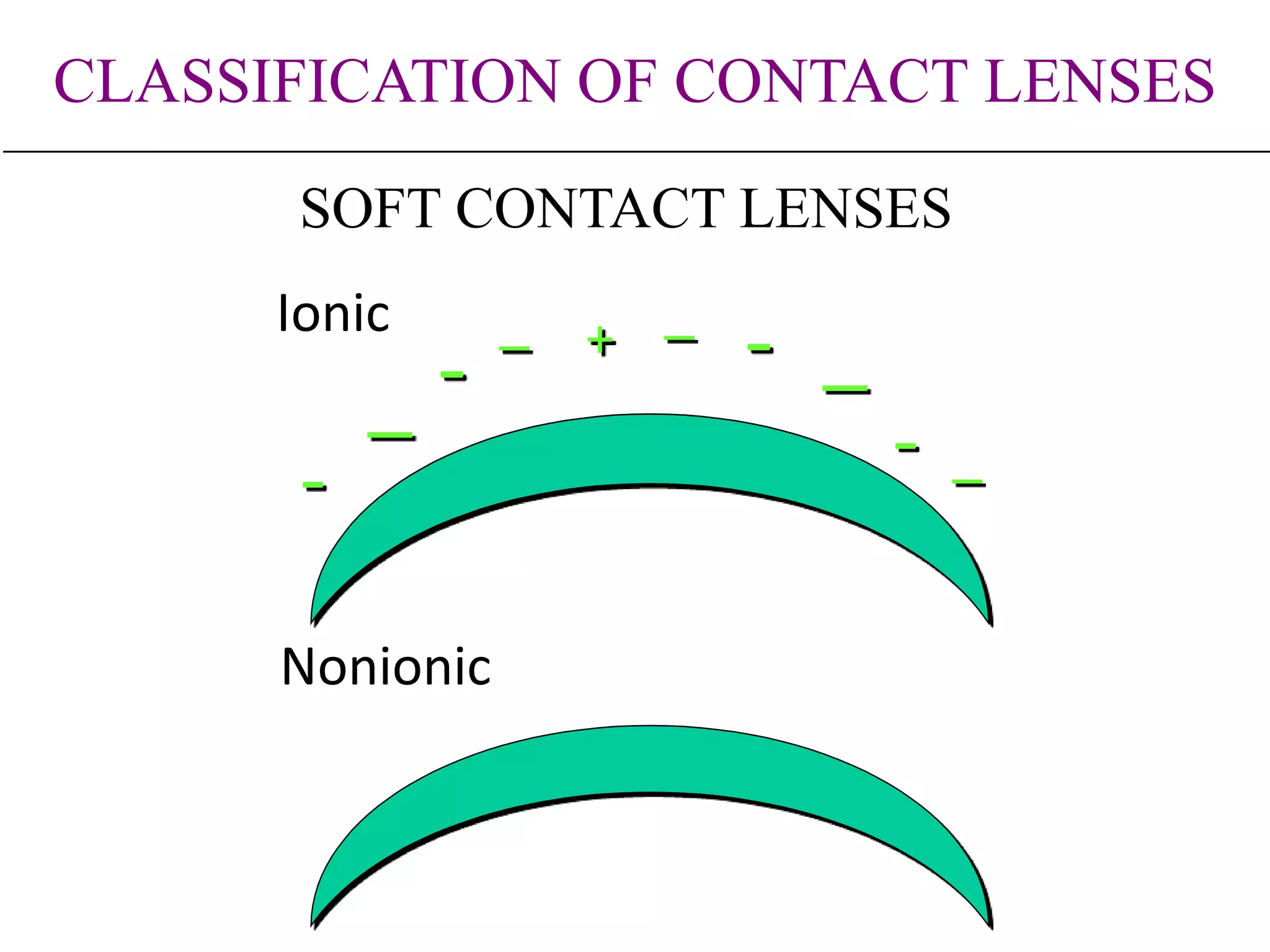
CLASSIFICATION OF CONTACT LENSES
SOFT CONTACT LENSES
Ionic
Nonionic
-
- + -
-
_
_
_
_
_
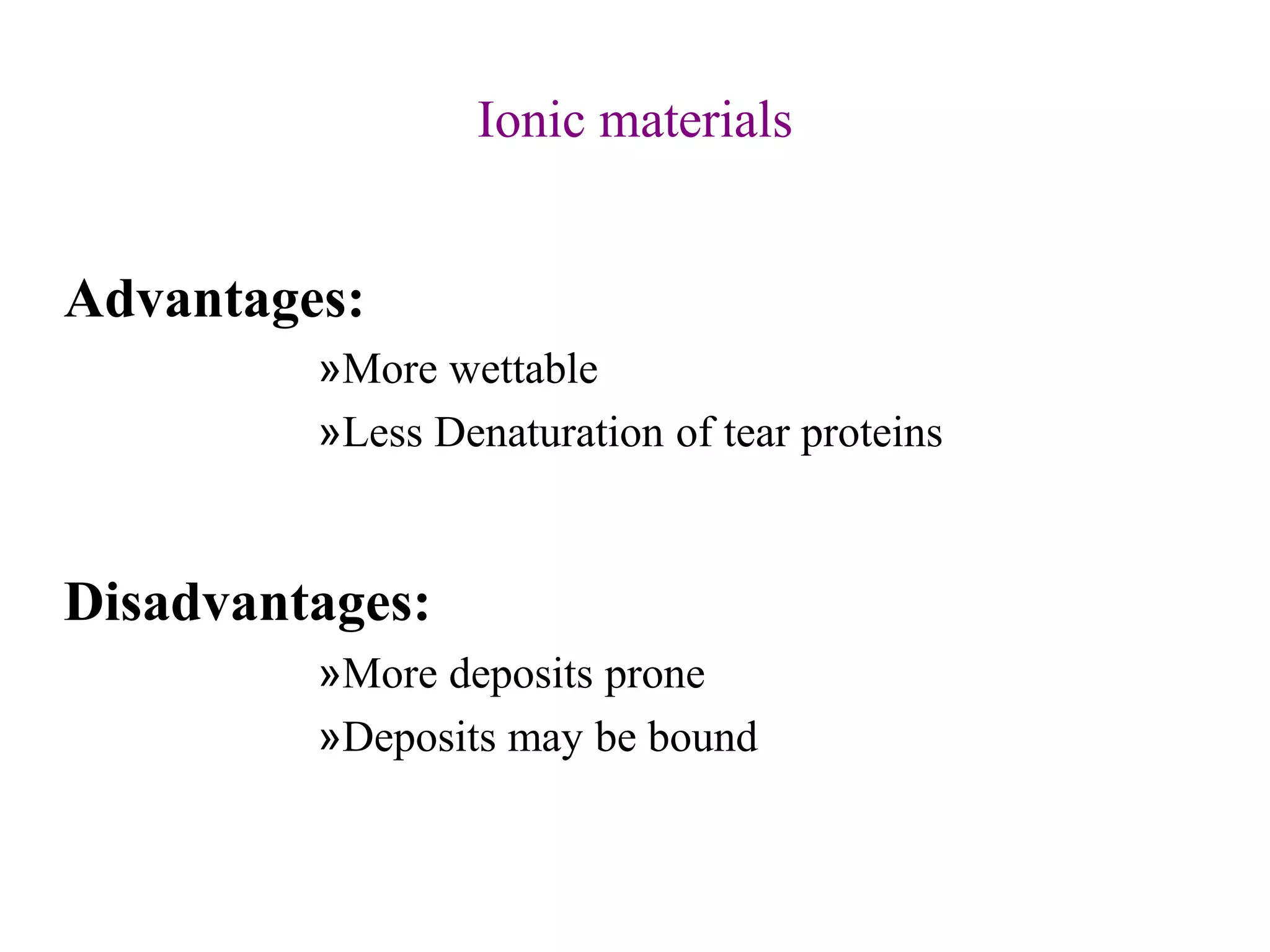
Ionic materials
Advantages:
»More wettable
»Less Denaturation of tear proteins
Disadvantages:
»More deposits prone
»Deposits may be bound
CLASSIFICATION OF CONTACT LENSES
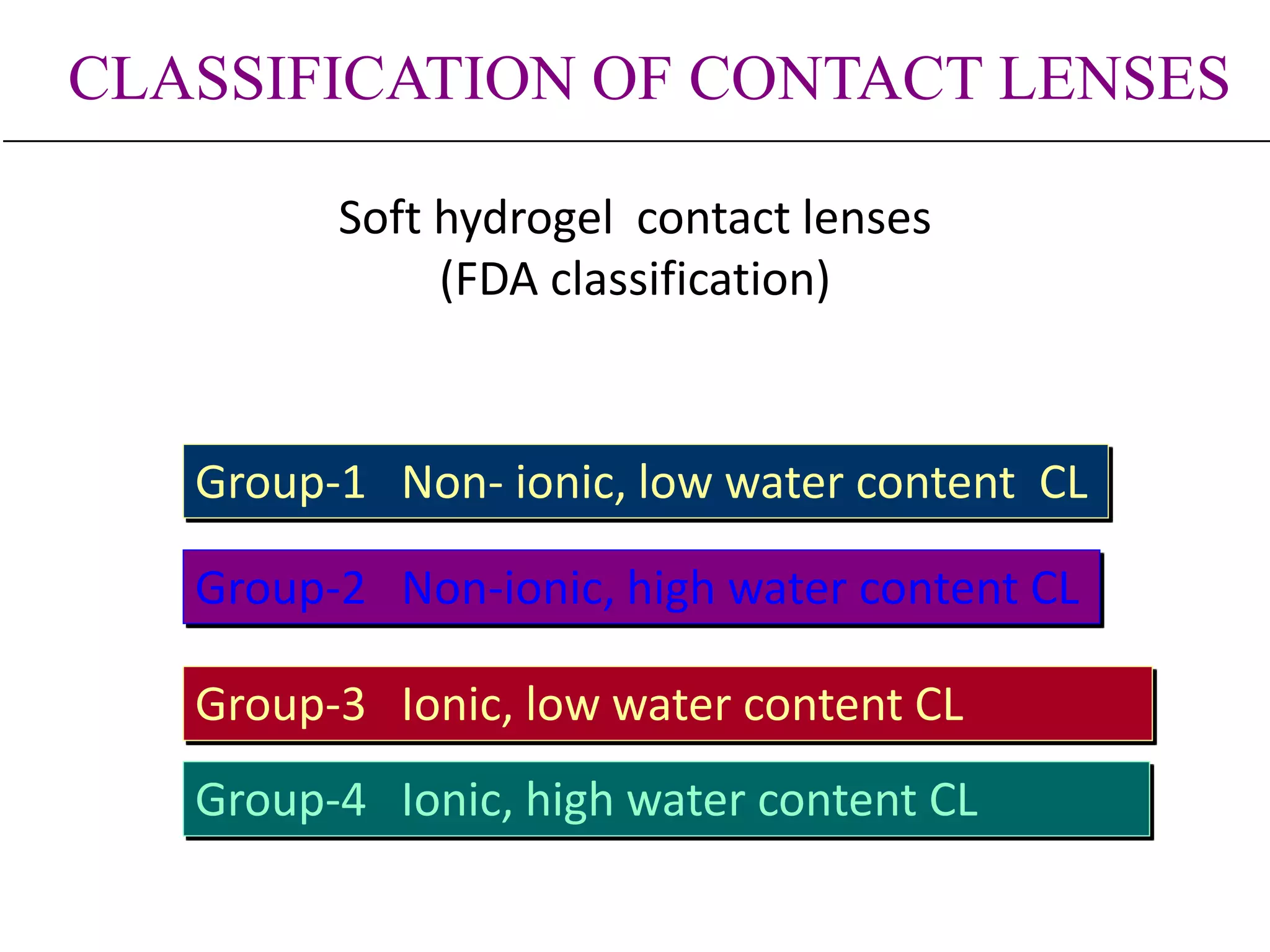
Soft hydrogel contact lenses
(FDA classification)
Group-1 Non- ionic, low water content CL
Group-2 Non-ionic, high water content CL
Group-3 Ionic, low water content CL
Group-4 Ionic, high water content CL
Contact Lens Parameters
• Base Curve
• Diameter
• Power
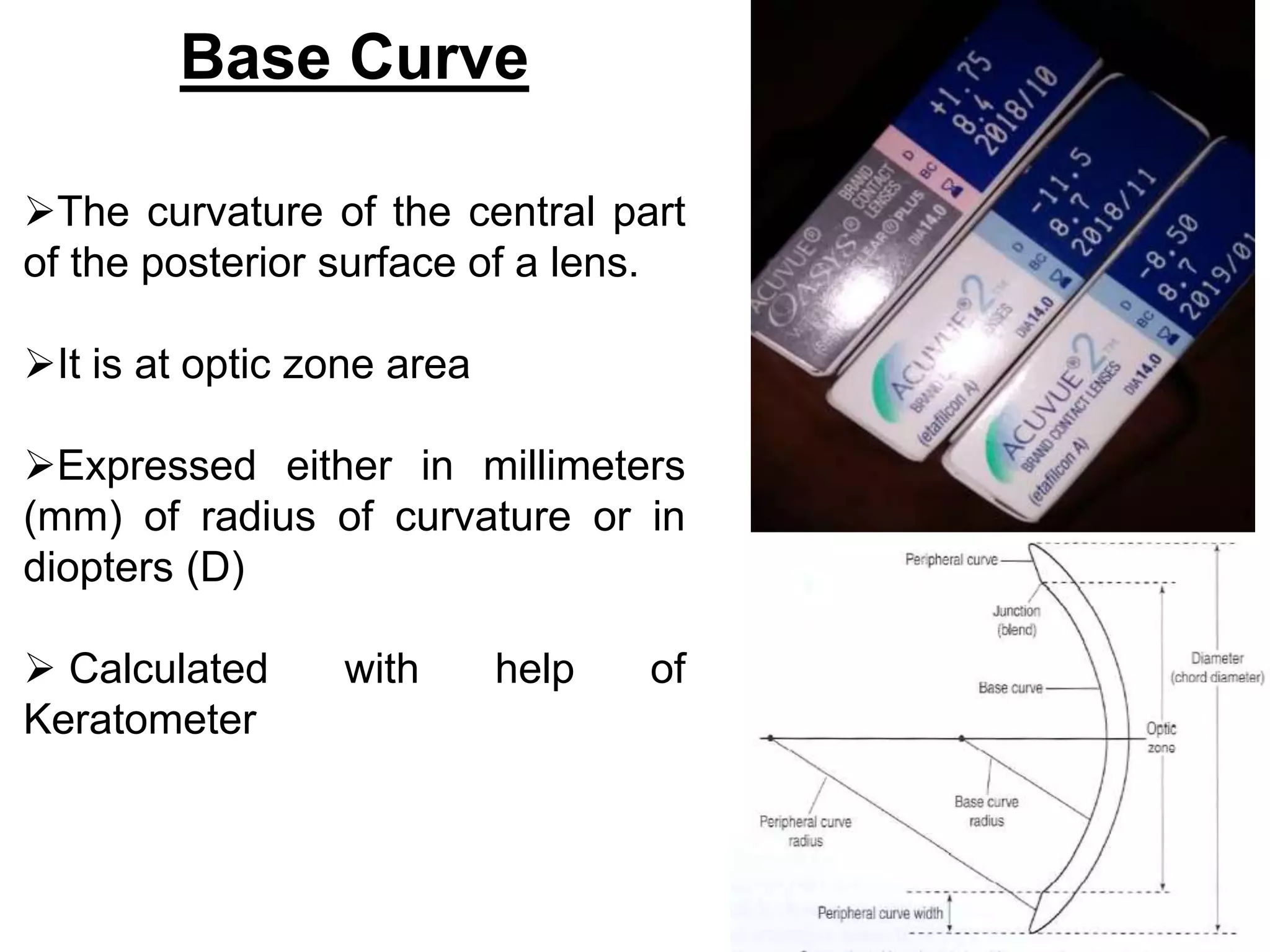
Base Curve
The curvature of the central part
of the posterior surface of a lens.
It is at optic zone area
Expressed either in millimeters
(mm) of radius of curvature or in
diopters (D)
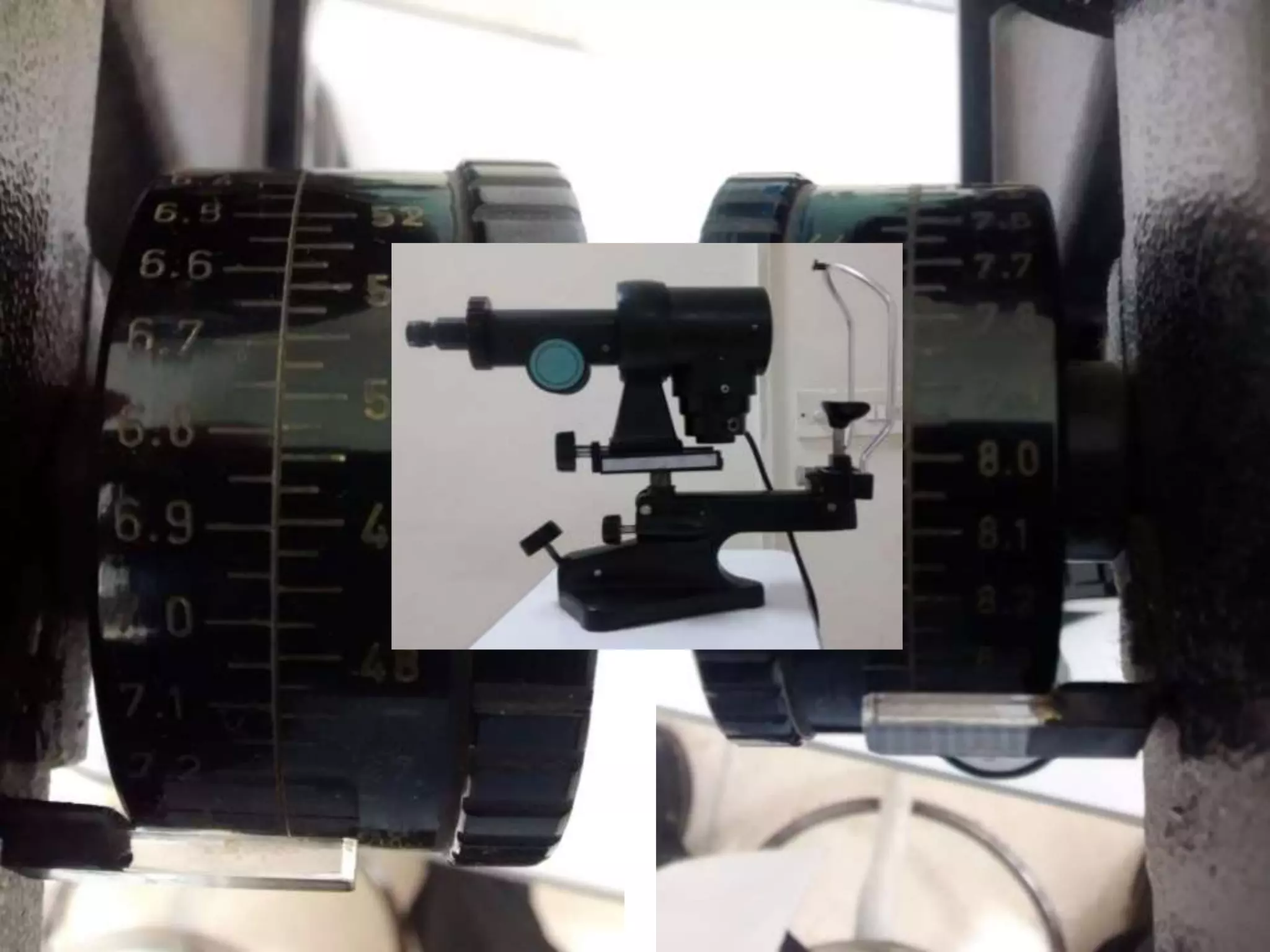
 Calculated with help of
Keratometer
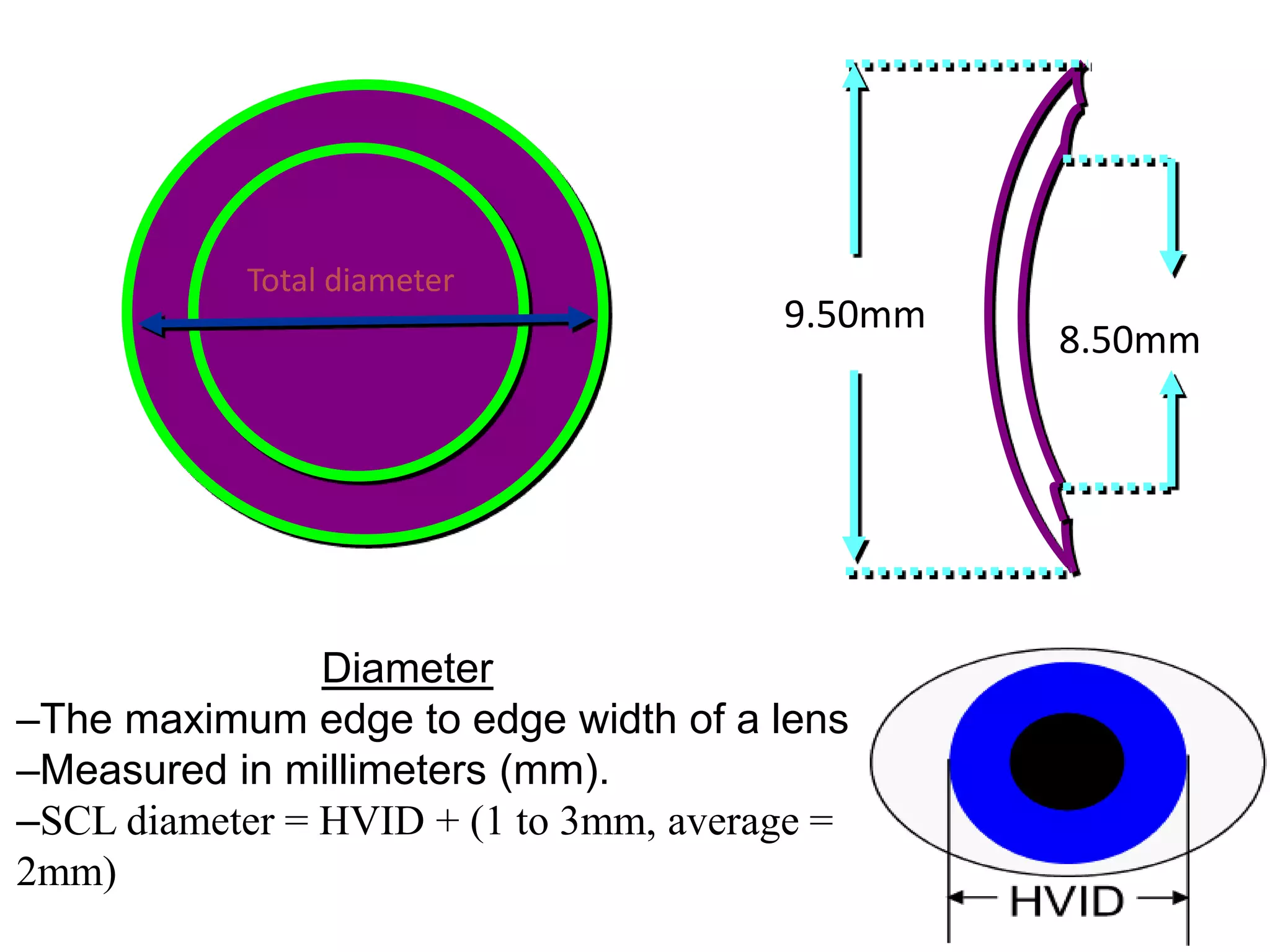
Diameter
–The maximum edge to edge width of a lens
–Measured in millimeters (mm).
–SCL diameter = HVID + (1 to 3mm, average =
2mm)
9.50mm
8.50mm
Total diameter
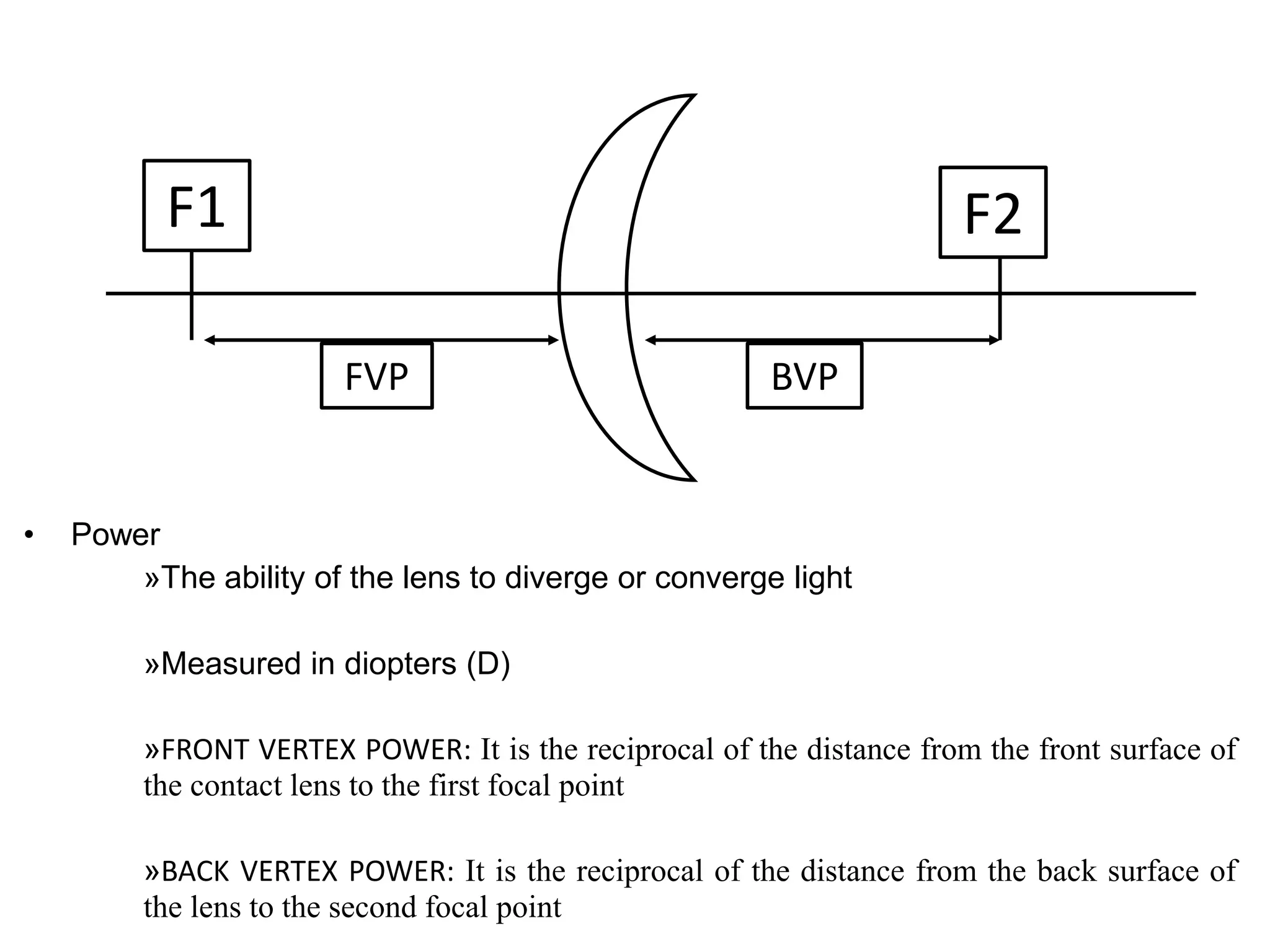
• Power
»The ability of the lens to diverge or converge light
»Measured in diopters (D)
»FRONT VERTEX POWER: It is the reciprocal of the distance from the front surface of
the contact lens to the first focal point
»BACK VERTEX POWER: It is the reciprocal of the distance from the back surface of
the lens to the second focal point
FVP BVP
F1 F2
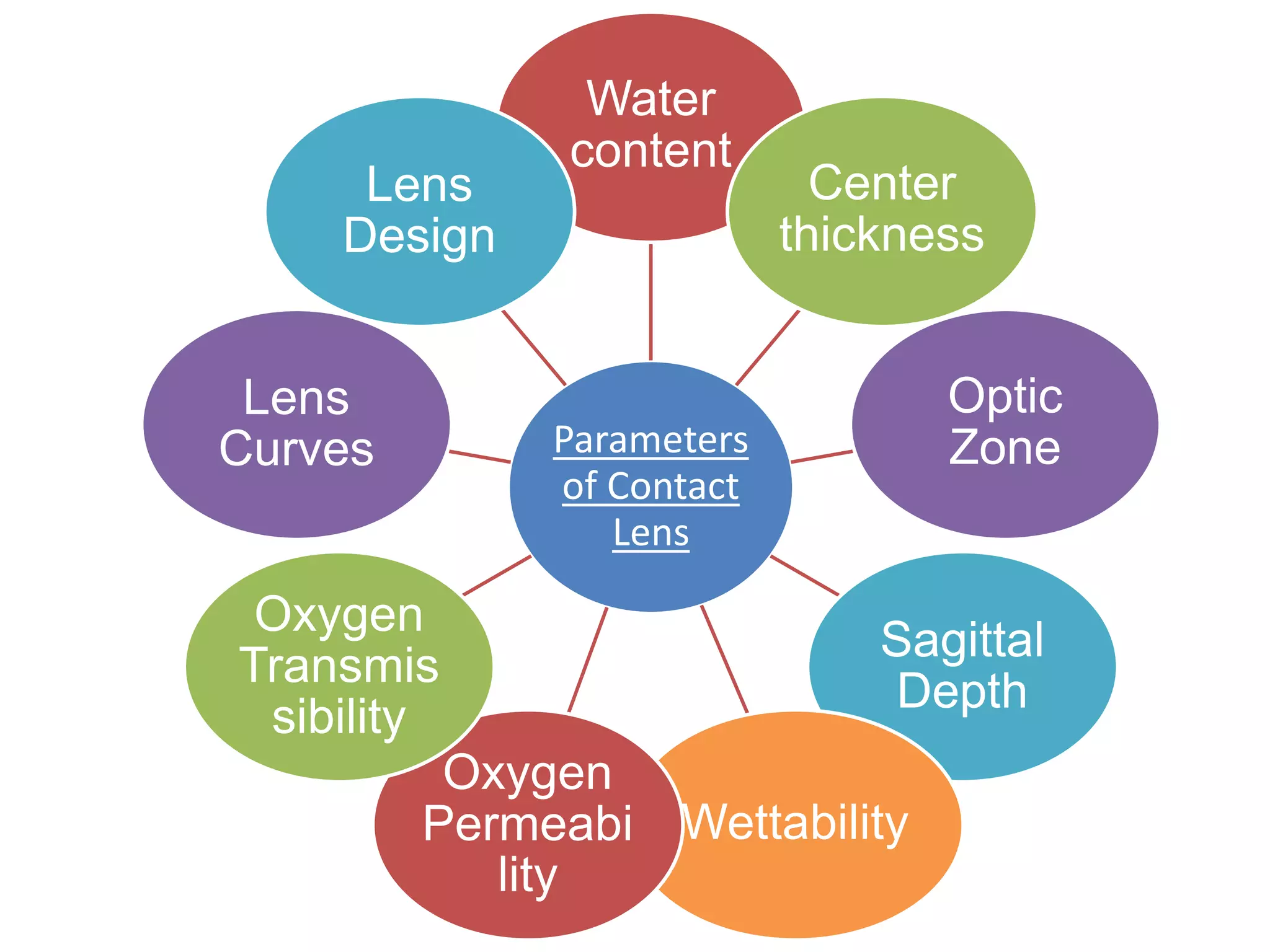
Parameters
of Contact
Lens
Water
content
Center
thickness
Optic
Zone
Sagittal
Depth
Wettability
Oxygen
Permeabi
lity
Oxygen
Transmis
sibility
Lens
Curves
Lens
Design
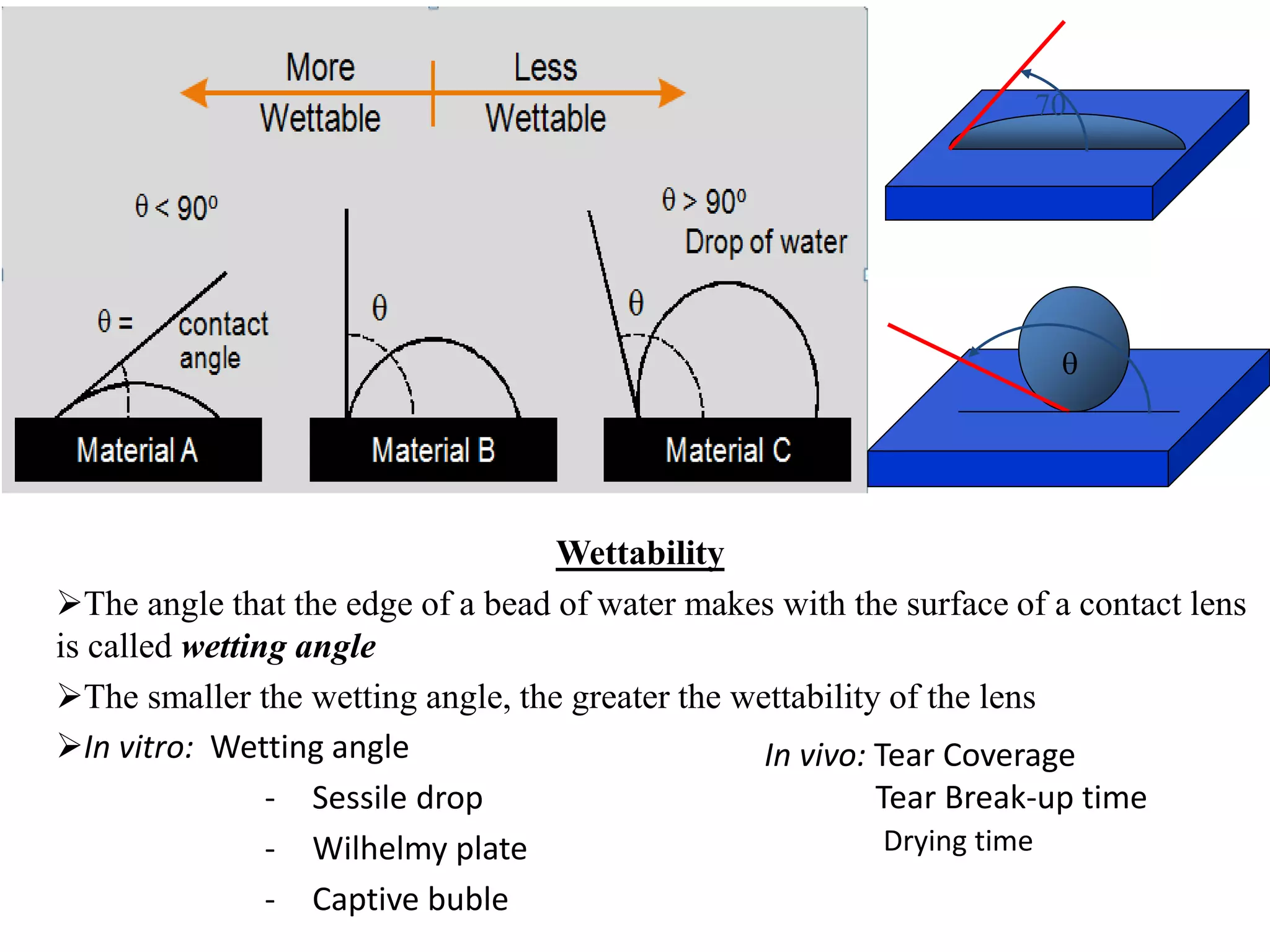
Wettability
The angle that the edge of a bead of water makes with the surface of a contact lens
is called wetting angle
The smaller the wetting angle, the greater the wettability of the lens
In vitro: Wetting angle
- Sessile drop
- Wilhelmy plate
- Captive buble
In vivo: Tear Coverage
Tear Break-up time
Drying time
70

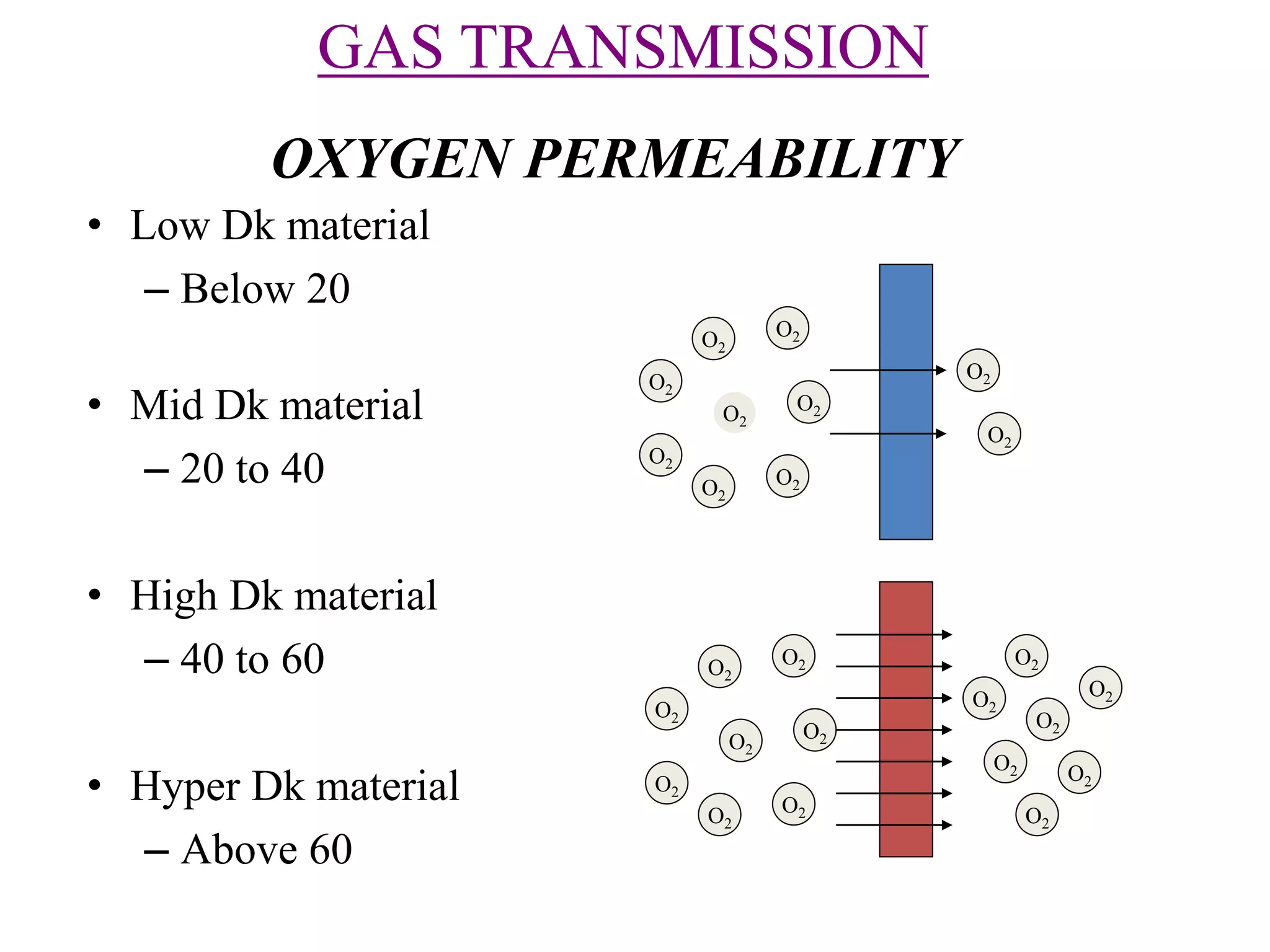
• Low Dk material
– Below 20
• Mid Dk material
– 20 to 40
• High Dk material
– 40 to 60
• Hyper Dk material
– Above 60
O2
O2
O2
O2
O2
O2O2
O2
O2
O2
O2
O2
O2
O2
O2
O2O2
O2
O2
O2
O2
O2
O2
O2
O2
OXYGEN PERMEABILITY
GAS TRANSMISSION
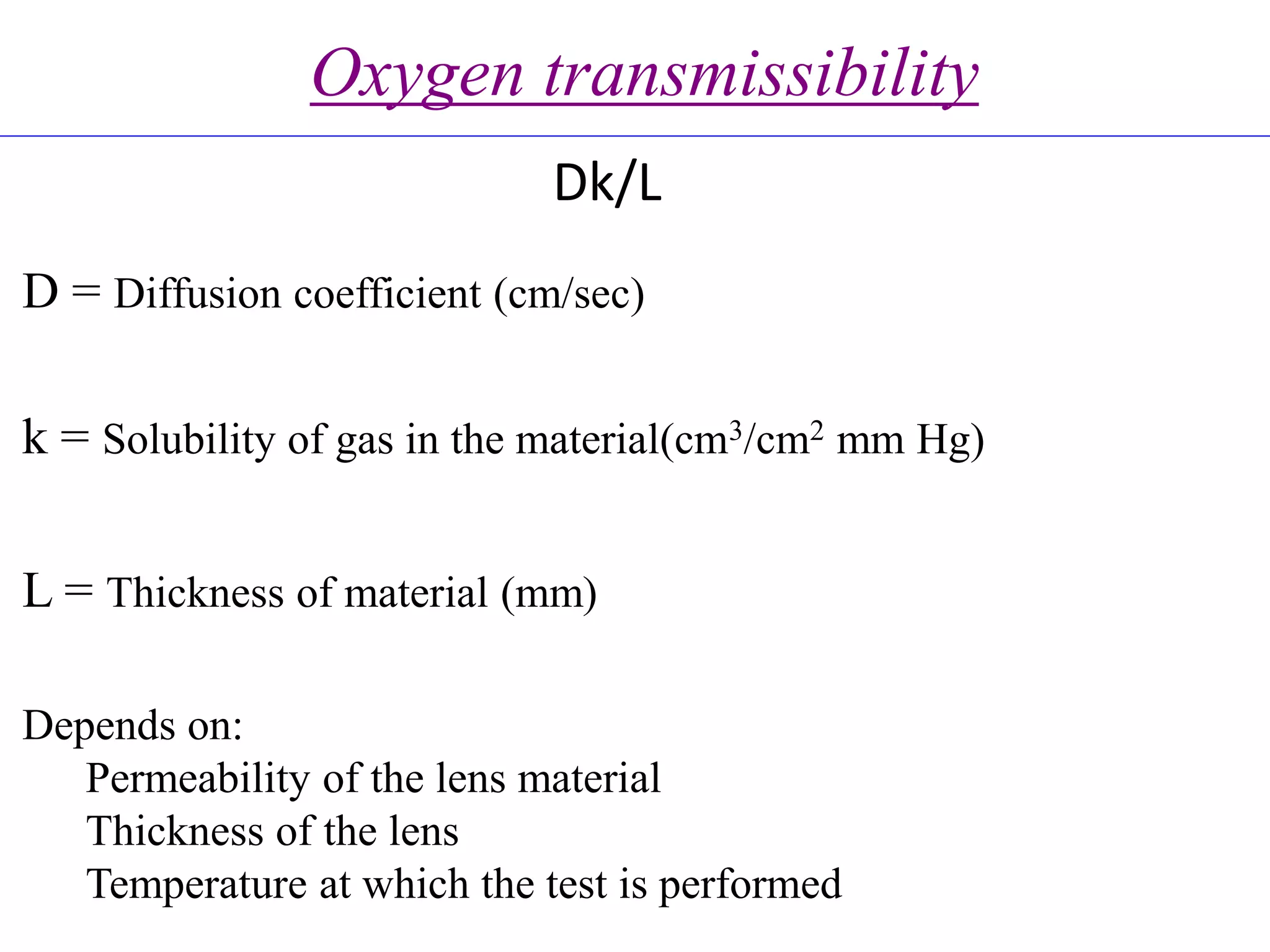
Oxygen transmissibility
Dk/L
D = Diffusion coefficient (cm/sec)
k = Solubility of gas in the material(cm3/cm2 mm Hg)
L = Thickness of material (mm)
Depends on:
Permeability of the lens material
Thickness of the lens
Temperature at which the test is performed
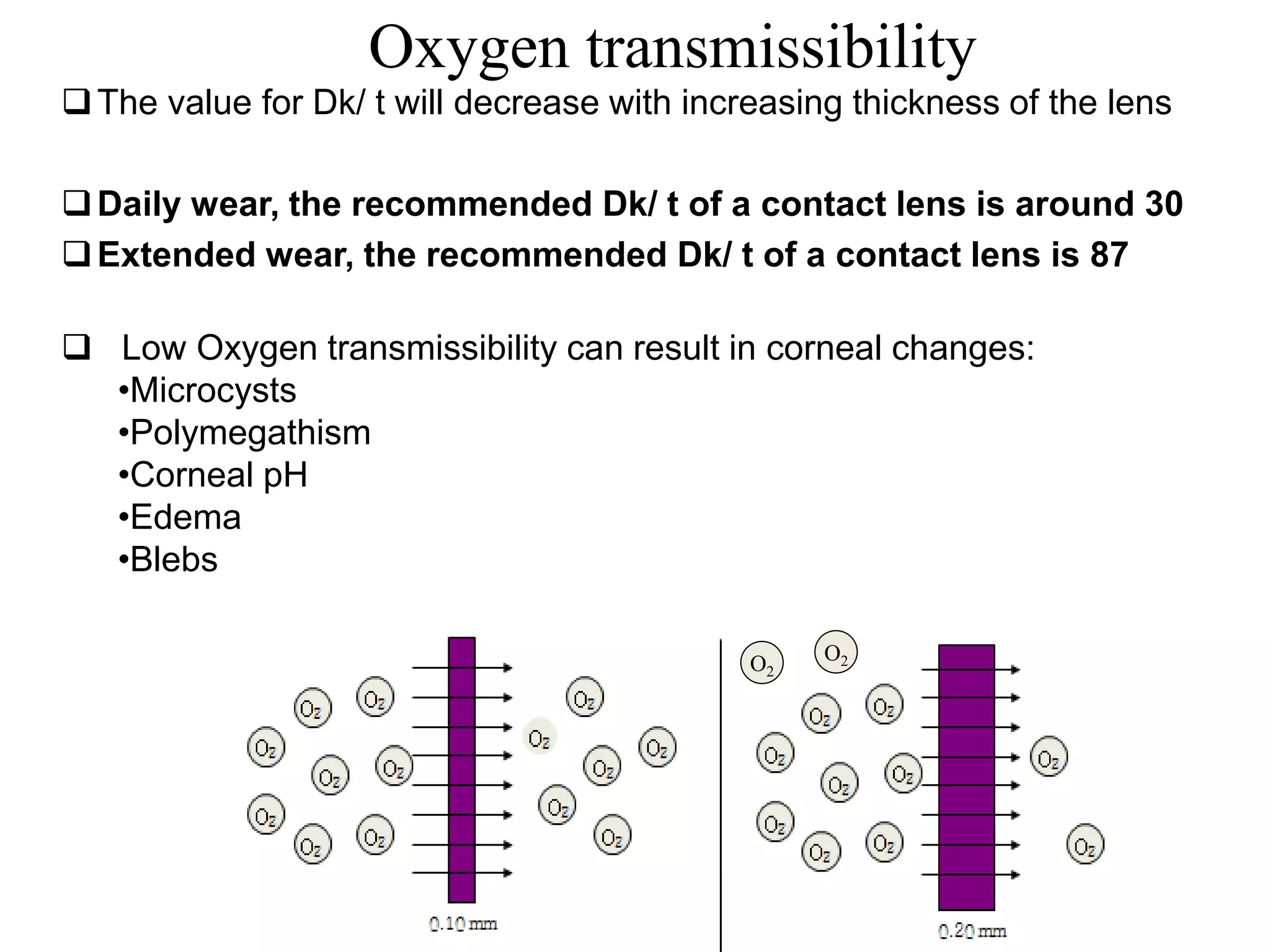
Oxygen transmissibility
The value for Dk/ t will decrease with increasing thickness of the lens
Daily wear, the recommended Dk/ t of a contact lens is around 30
Extended wear, the recommended Dk/ t of a contact lens is 87
 Low Oxygen transmissibility can result in corneal changes:
•Microcysts
•Polymegathism
•Corneal pH
•Edema
•Blebs
O2
O2
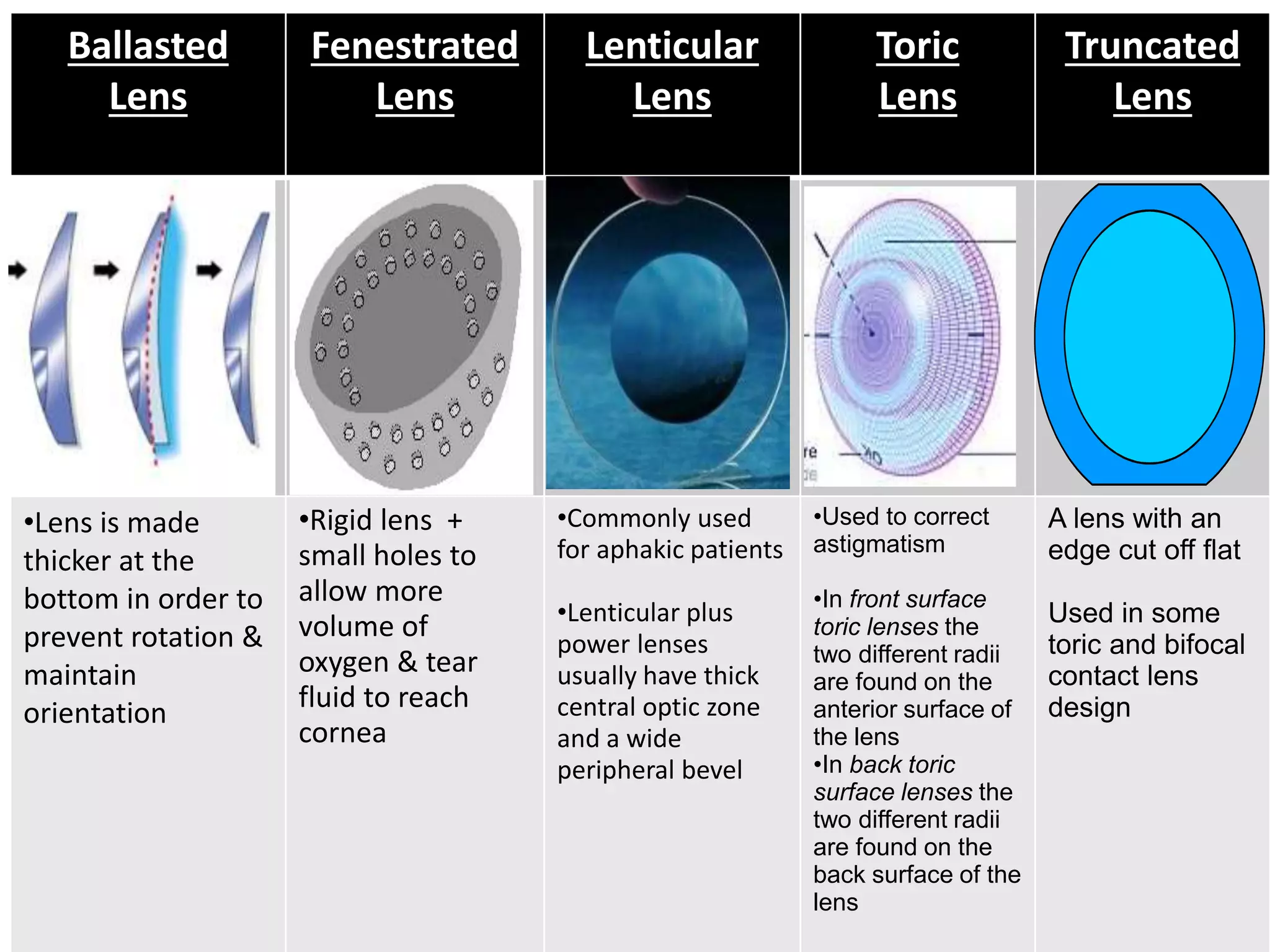
Ballasted
Lens
Fenestrated
Lens
Lenticular
Lens
Toric
Lens
Truncated
Lens
•Lens is made
thicker at the
bottom in order to
prevent rotation &
maintain
orientation
•Rigid lens +
small holes to
allow more
volume of
oxygen & tear
fluid to reach
cornea
•Commonly used
for aphakic patients
•Lenticular plus
power lenses
usually have thick
central optic zone
and a wide
peripheral bevel
•Used to correct
astigmatism
•In front surface
toric lenses the
two different radii
are found on the
anterior surface of
the lens
•In back toric
surface lenses the
two different radii
are found on the
back surface of the
lens
A lens with an
edge cut off flat
Used in some
toric and bifocal
contact lens
design
References
• Introduction: FREE download of the
'IACLE Contact Lens Course'
complete survey to access
• Download the 'IACLE Contact Lens
Course'
• ICLC PPT Contact Lens Fitting
• Making Contacts: Contact Lenses in History -
Insight Optometrists
• contact lens: Definition from Answers.com
• THANK YOU EVERYONE FOR PATIENTLY LISTENING TO THIS SEMINAR & enjoy ur weekend
• For feedbacks & brickbats plz mail at
• ykush@yahoo.co.in./drdhir2014@gmail.com
Kyunki ABKI BAR ?????
NO MORE SEMI--NAR
KYUNKI ABKI BAR ……..  

History & materials of conatct lens by pushkar dhir

  • 1.
    HISTORY, MATERIAL, NOMENCLATURE Of Contact Lenses Presentor:-Dr.Pushkar Dhir Moderator :- Dr.OP Gupta Moderator:- Ms Sheeba
  • 2.
    D VINCI CODE •In 1508, Leonardo da Vinci sketched the first forms of new refracted surface on the cornea. • He used the example of a very large glass bowel filled with water; immersion of the eyes in water theoretically corrected vision. • Sketches of a schematic eye • Describes the mechanism of image formation from the cornea to the optic nerve • Some drawings may represent the idea of a ‘contact’ lens ??DUMBULDORE??
  • 4.
    RENÉ DESCARTES (1637) • Understoodthat better vision could be achieved by enlarging the retinal image • Sketched an elongated tube filled with water placed against an eyeball • Demonstrated the principal of the telescope, not the contact lens H2O
  • 5.
    D GAME CHANGER ADOLFE FICK (1888)• Fick was born in Germany in 1852. • Used blown glass shells which appeared to be well tolerated. • Observed corneal clouding, conjunctival and limbal injection. • Discussed the need for lens disinfection and the concept of adaptation to lens wear. • Observed that corneal clouding did not occur as quickly if an air bubble was inserted behind his lens along with a 2% glucose solution.
  • 6.
    FA MÜLLER andSONS (1887) • Artificial eye makers in Wiesbaden, Germany • Made lenses from blown glass • Very regular curvature, no sharp edges at the corneo-scleral junction • Designed a lens for ptosis correction
  • 7.
    CARL ZEISS ofJENA (1911) • Made lathe cut lenses from molds • Lathe cutting resulted in a better optical performance • First commercially available trial lenses • Complete trial set contained 21 lenses • Lenses were afocal • Fitting determined by fluorescein and white light
  • 8.
    8 Evolution of ContactLens PMMA 40s 50s 60s 70s 80s 90s 2000 Silicone Hydrogel + silicone to increase Dk + surface treatment to resist deposit + water to improve Dk & comfort Hydrogel (HEMA based) Low water High water Ionic Non-ionic + silicone to increase Dk RGP
  • 9.
    • In 1954, •Professor Otto Wichterle & Dr Drashoslav Lim suggested to experts in the medical plastics field that a plastic which more closely simulated living tissue would be more suitable for orbital implants than the metallic elements being considered.
  • 10.
    IDEAL MATERIAL  BIOCOMPATIBILITY-should not harmful  OPTICAL PROPERTIES- transparent  GAS PERMEABILITY – wearing time  TOLERANCE –gas permeability and design.  MOULDING  STERILITY  STABILITY - in all dimentions  SURFACE CHEMISTRY - easily wettable
  • 11.
    CONTACT LENS CLASSIFICATION BASED ON PURPOSEOF USE Optical Therapeutic Cosmetic ANATOMICAL LOCATION Scleral contact lenses Semi-scleral contact lenses Corneal contact lenses NATURE OF LENS Rigid non-gas permeable contact lenses(PMMA) Rigid gas permeable contact lenses(CAB) Soft contact lenses(HEMA) BASED ON WATER CONTENT BASED ON WEARING SCHEDULE Daily wear contact lenses (hard contact lenses) Extended wear contact lenses (soft contact lenses) Disposable contact lenses
  • 12.
    12 Uses of ContactLens Purpose Cosmetic Spherical Toric Presbyopic Optical Keratoconus Bandage Lens Drug Delivery Myopia Control Therapeutic Enhances Performance Color Filters
  • 13.
    C L WHICHCOVER THE CORNEA & THE CONJUNCTIVA OVERLYING THE SCLERA CONTACT LENSES THAT COVER THE CORNEA, BRIDGE THE LIMBUS & LIE PARTIALLY ON THE CONJUNCTIVAL TISSUE CONTACT LENSES THAT CONFINED TO THE CORNEA
  • 14.
    CLASSIFICATION OF CLBASED ON THE MATERIAL
  • 15.
    NON GAS PERMEABLE GAS PERMEABLE PMMA, Lucite, Plexiglass,Perspex Advantages- 1. Lighter than glass 2. Non toxic 3. Easy to manufacture Disadvantages 1. 1-2% water content 2. Dk = 0(not gas permeable) 1. Cellulose Acetate Butyrate 2. Silicone acrylate (Copolymer of pmma & silicone containing vinyl monomer. 3. Silicone- D-Lack of wet ability , not popular. A- used in paeditaric aphakic in 1st yr of life because eof high oxygen perm + tight fit 4. Styrene 5. Fluoropolymers- for extended wear. RIGID GAS PERMEABLE A-Low oxygen permeability – Dk of 4.5-10 Relatively good wet ability – better than PMMA. Dis-Good protein resistance but prone to lipid deposits
  • 16.
    Advantages of Rigid ContactLens • Better Quality of Vision • More Durable • Correction Of Astigmatism • Deposit Resistance • Less of Chance of infection • Cost is less • Less Stable •  less comfortable,tough adapataion Advantages of Soft Contact Lens • Very comfortable & easy to adapt •  Larger & adhere more tightly to the cornea •  No Spectacle Blur •  Doesn’t correct Astigmatic Error
  • 17.
    CLASSIFICATION OF CLBASED ON THE WATER CONTENT LOW WATER CONTENT Less then or equal to 50% HIGH WATER CONTENT Greater than 50% The amount of fluid taken up by a contact lens material Ranges from 38% to 79% Increase in water content  increases oxygen permeability 20% increase in water  doubles oxygen permeability
  • 18.
    Low Water Content Advantages: •Lesssusceptible to environment changes •Low protein deposition •Ease of manufacture •More wettable •Compatible with all lens care product Disadvantages: •Low Dk •Less flexible •Thin lenses difficult to handle High Water Content Advantages: •Higher Dk •More flexible •Faster restoration of shape following deformation. Disadvantages: •More fragile •More deposit prone . •Difficult to manufacture •Lower tensile strength •Cannot be made too thin
  • 19.
    CLASSIFICATION OF CONTACTLENSES SOFT CONTACT LENSES Ionic Nonionic - - + - - _ _ _ _ _
  • 20.
    Ionic materials Advantages: »More wettable »LessDenaturation of tear proteins Disadvantages: »More deposits prone »Deposits may be bound
  • 21.
    CLASSIFICATION OF CONTACTLENSES Soft hydrogel contact lenses (FDA classification) Group-1 Non- ionic, low water content CL Group-2 Non-ionic, high water content CL Group-3 Ionic, low water content CL Group-4 Ionic, high water content CL
  • 22.
    Contact Lens Parameters •Base Curve • Diameter • Power
  • 23.
    Base Curve The curvatureof the central part of the posterior surface of a lens. It is at optic zone area Expressed either in millimeters (mm) of radius of curvature or in diopters (D)  Calculated with help of Keratometer
  • 25.
    Diameter –The maximum edgeto edge width of a lens –Measured in millimeters (mm). –SCL diameter = HVID + (1 to 3mm, average = 2mm) 9.50mm 8.50mm Total diameter
  • 26.
    • Power »The abilityof the lens to diverge or converge light »Measured in diopters (D) »FRONT VERTEX POWER: It is the reciprocal of the distance from the front surface of the contact lens to the first focal point »BACK VERTEX POWER: It is the reciprocal of the distance from the back surface of the lens to the second focal point FVP BVP F1 F2
  • 27.
  • 28.
    Wettability The angle thatthe edge of a bead of water makes with the surface of a contact lens is called wetting angle The smaller the wetting angle, the greater the wettability of the lens In vitro: Wetting angle - Sessile drop - Wilhelmy plate - Captive buble In vivo: Tear Coverage Tear Break-up time Drying time 70 
  • 29.
    • Low Dkmaterial – Below 20 • Mid Dk material – 20 to 40 • High Dk material – 40 to 60 • Hyper Dk material – Above 60 O2 O2 O2 O2 O2 O2O2 O2 O2 O2 O2 O2 O2 O2 O2 O2O2 O2 O2 O2 O2 O2 O2 O2 O2 OXYGEN PERMEABILITY GAS TRANSMISSION
  • 30.
    Oxygen transmissibility Dk/L D =Diffusion coefficient (cm/sec) k = Solubility of gas in the material(cm3/cm2 mm Hg) L = Thickness of material (mm) Depends on: Permeability of the lens material Thickness of the lens Temperature at which the test is performed
  • 31.
    Oxygen transmissibility The valuefor Dk/ t will decrease with increasing thickness of the lens Daily wear, the recommended Dk/ t of a contact lens is around 30 Extended wear, the recommended Dk/ t of a contact lens is 87  Low Oxygen transmissibility can result in corneal changes: •Microcysts •Polymegathism •Corneal pH •Edema •Blebs O2 O2
  • 32.
    Ballasted Lens Fenestrated Lens Lenticular Lens Toric Lens Truncated Lens •Lens is made thickerat the bottom in order to prevent rotation & maintain orientation •Rigid lens + small holes to allow more volume of oxygen & tear fluid to reach cornea •Commonly used for aphakic patients •Lenticular plus power lenses usually have thick central optic zone and a wide peripheral bevel •Used to correct astigmatism •In front surface toric lenses the two different radii are found on the anterior surface of the lens •In back toric surface lenses the two different radii are found on the back surface of the lens A lens with an edge cut off flat Used in some toric and bifocal contact lens design
  • 33.
    References • Introduction: FREEdownload of the 'IACLE Contact Lens Course' complete survey to access • Download the 'IACLE Contact Lens Course' • ICLC PPT Contact Lens Fitting • Making Contacts: Contact Lenses in History - Insight Optometrists • contact lens: Definition from Answers.com
  • 34.
    • THANK YOUEVERYONE FOR PATIENTLY LISTENING TO THIS SEMINAR & enjoy ur weekend • For feedbacks & brickbats plz mail at • ykush@yahoo.co.in./drdhir2014@gmail.com Kyunki ABKI BAR ????? NO MORE SEMI--NAR KYUNKI ABKI BAR ……..  