Accelerated reconstruction of a compressively
sampled data stream
Pantelis Sopasakis∗,
Nikolaos Freris†, Panos Patrinos
∗ IMT School for Advanced Studies Lucca, Italy,
† NYU, Abu Dhabi, United Arab Emirates,
ESAT, KU Leuven, Belgium.
August 31, 2016
Contribution
The proposed methodology is an order of magnitude faster compared to
all state-of-the-art methods for recursive compressed sensing.
1 / 22
I. Recursive Compressed Sensing
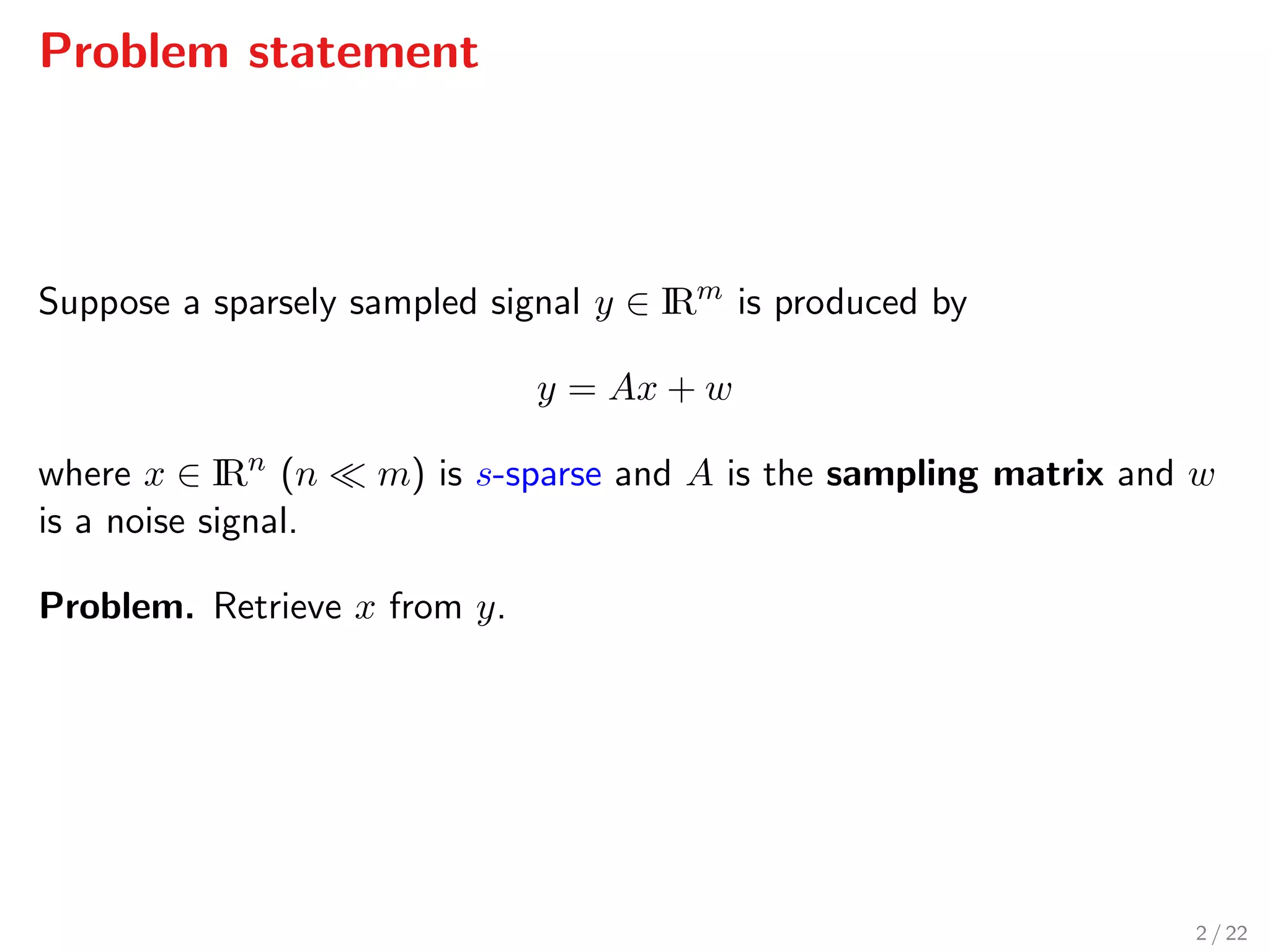
Problem statement
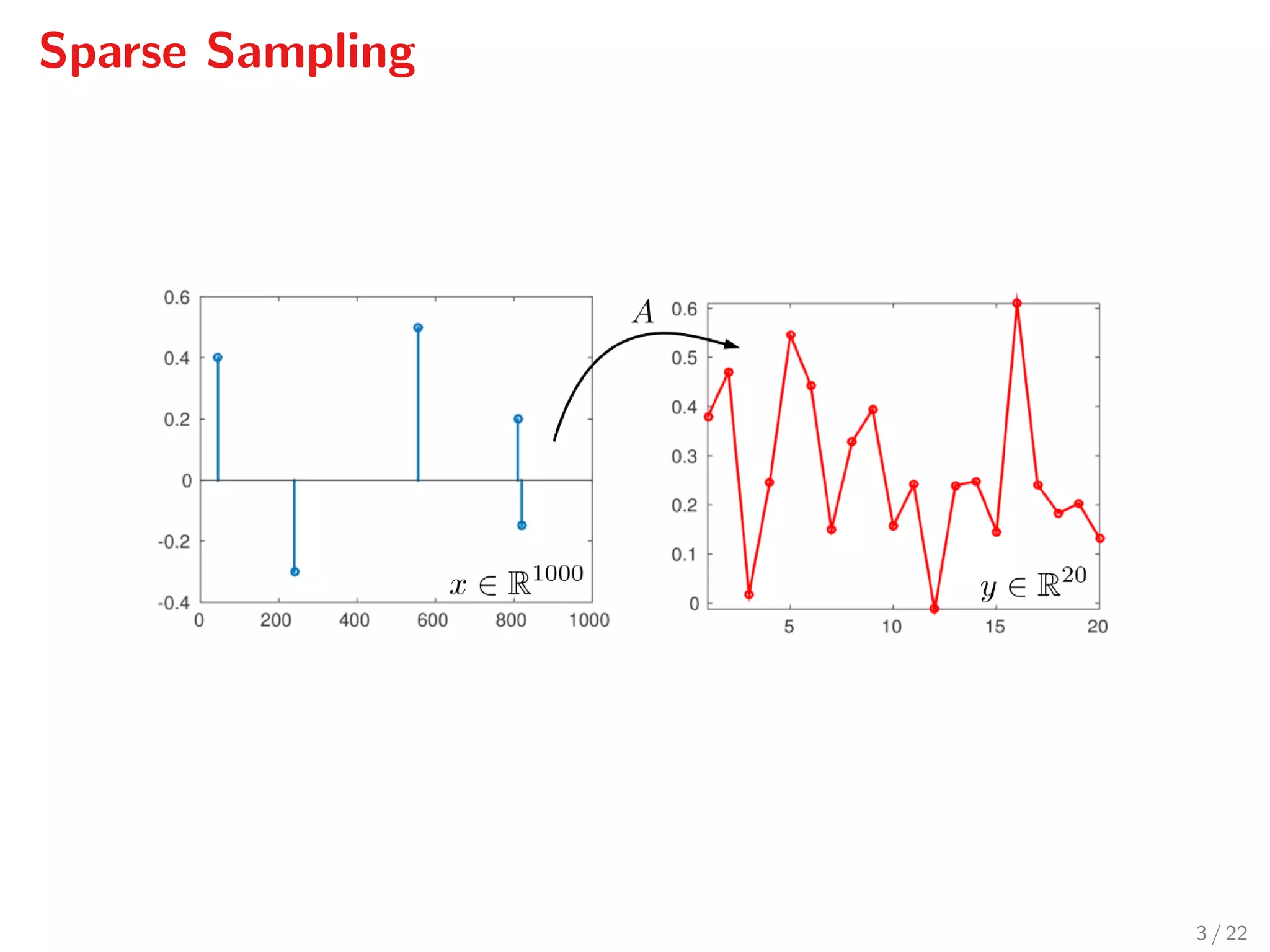
Suppose a sparsely sampled signal y ∈ IRm
is produced by
y = Ax + w
where x ∈ IRn
(n m) is s-sparse and A is the sampling matrix and w
is a noise signal.
Problem. Retrieve x from y.
2 / 22
Sparse Sampling
3 / 22
Requirement
Matrix A must satisfy the restricted isometry property
(1 − δs) x 2
≤ Ax 2
≤ (1 + δs) x 2
,
for all x. A typical choice is a random A with entries drawn from
N(0, 1
m ) with m = 4s.
4 / 22
Decompression
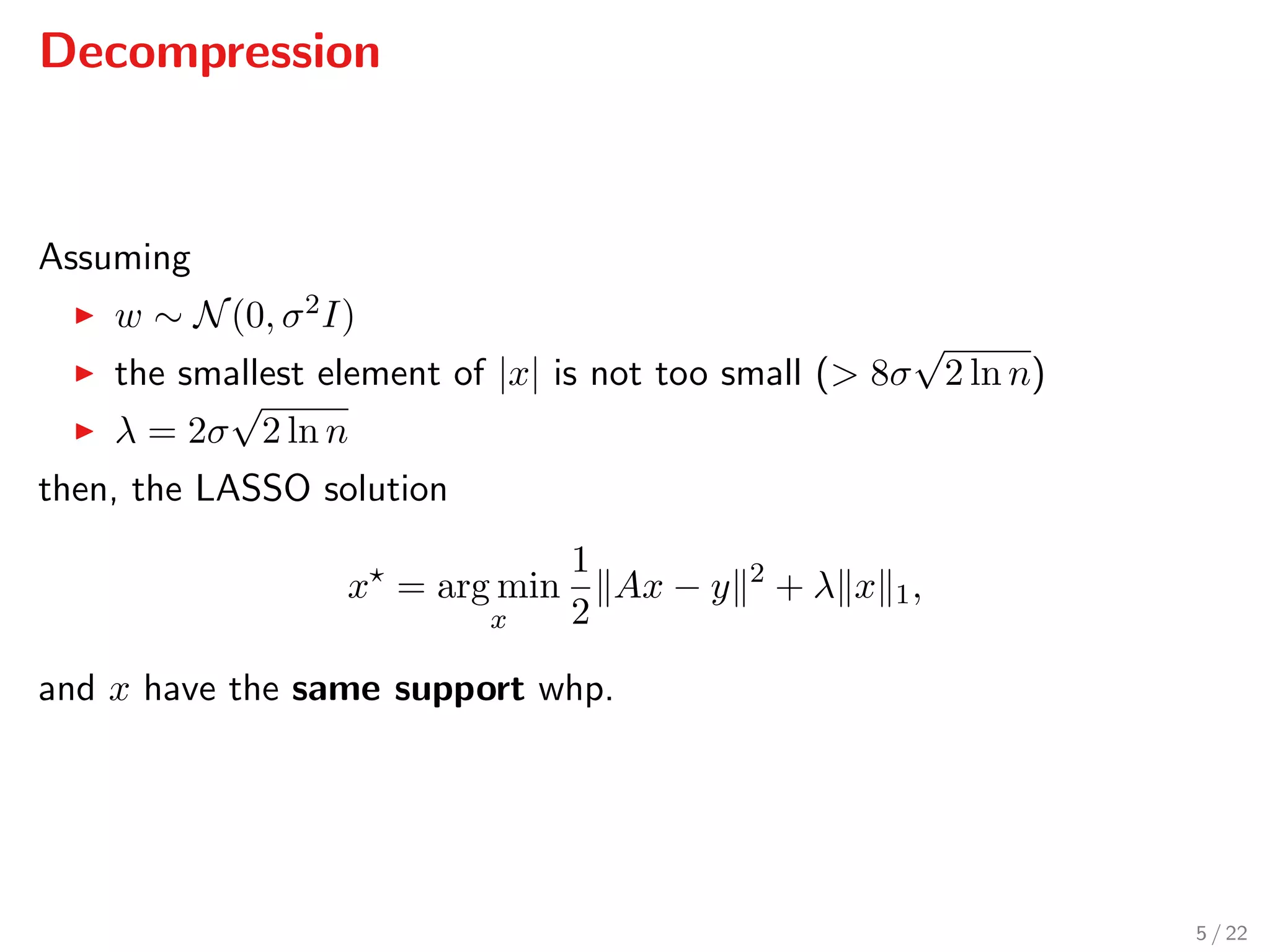
Assuming
w ∼ N(0, σ2I)
the smallest element of |x| is not too small (> 8σ
√
2 ln n)
λ = 2σ
√
2 ln n
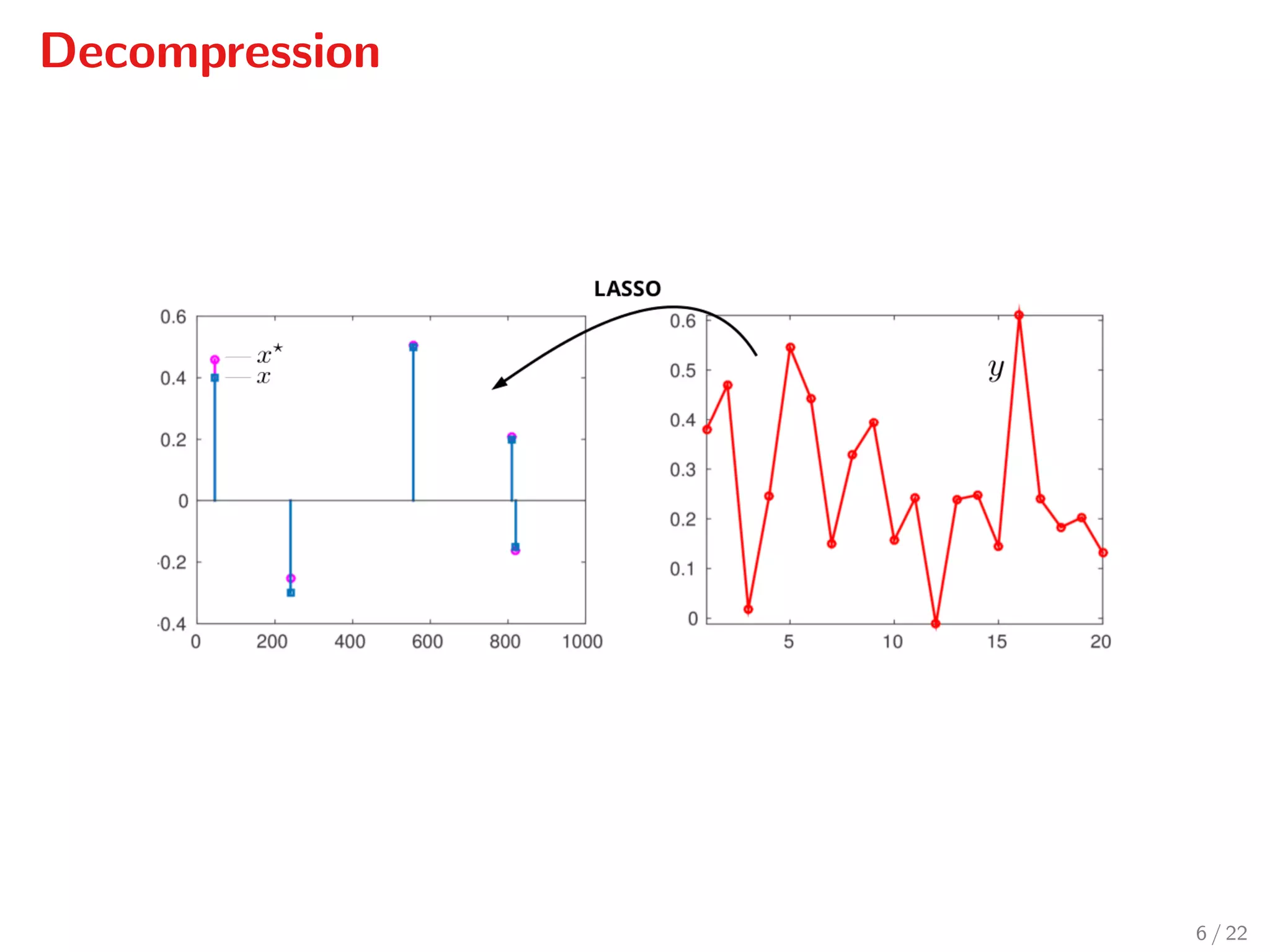
then, the LASSO solution
x = arg min
x
1
2
Ax − y 2
+ λ x 1,
and x have the same support whp.
5 / 22
Decompression
6 / 22
Recursive Compressed Sensing
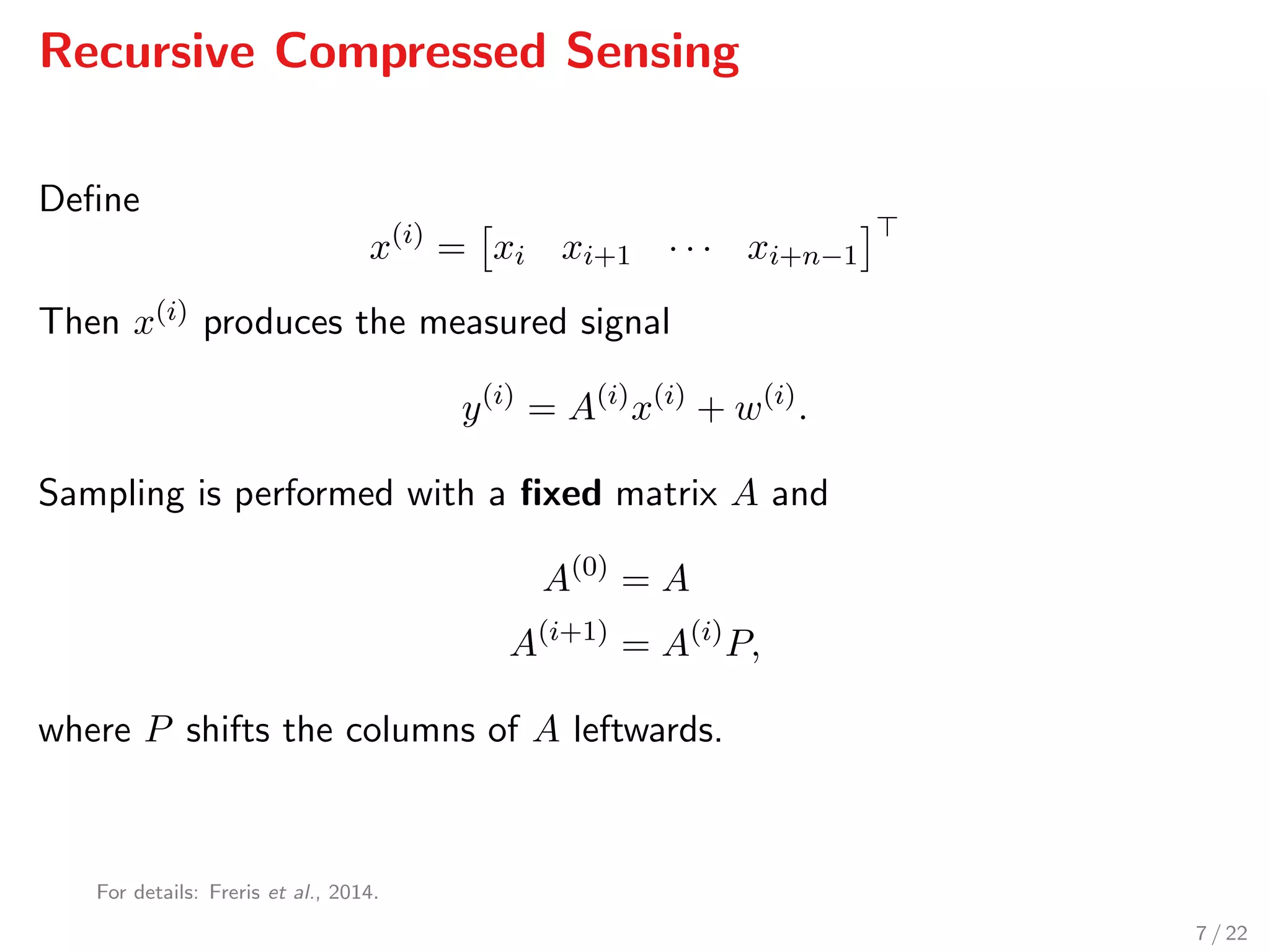
Define
x(i)
= xi xi+1 · · · xi+n−1
Then x(i) produces the measured signal
y(i)
= A(i)
x(i)
+ w(i)
.
Sampling is performed with a fixed matrix A and
A(0)
= A
A(i+1)
= A(i)
P,
where P shifts the columns of A leftwards.
For details: Freris et al., 2014.
7 / 22
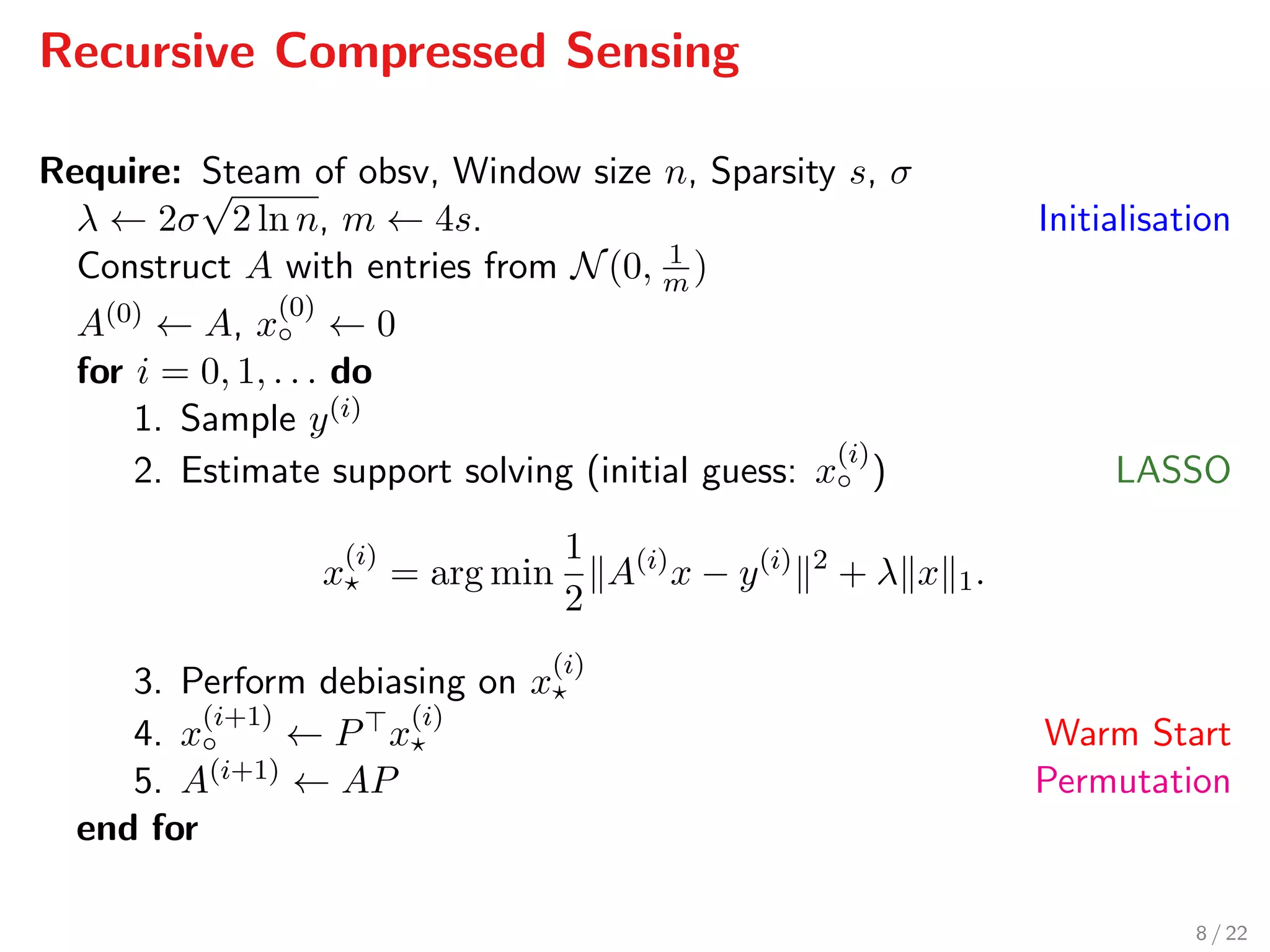
Recursive Compressed Sensing
Require: Steam of obsv, Window size n, Sparsity s, σ
λ ← 2σ
√
2 ln n, m ← 4s. Initialisation
Construct A with entries from N(0, 1
m )
A(0) ← A, x
(0)
◦ ← 0
for i = 0, 1, . . . do
1. Sample y(i)
2. Estimate support solving (initial guess: x
(i)
◦ ) LASSO
x
(i)
= arg min
1
2
A(i)
x − y(i) 2
+ λ x 1.
3. Perform debiasing on x
(i)
4. x
(i+1)
◦ ← P x
(i)
Warm Start
5. A(i+1) ← AP Permutation
end for
8 / 22
II. Forward-Backward Newton
Optimality Conditions
LASSO problem
minimise 1
2 Ax − y 2
f
+ λ x 1
g
Optimality conditions:
− f(x ) ∈ ∂g(x ),
with f(x) = A (Ax − y) and ∂g(x)i = λ sign(xi) for xi = 0,
∂g(x)i = [−λ, λ] for xi = 0, so
− if(x ) = λ sign(xi ), for xi = 0,
| jf(x )| ≤ λ, for xj = 0
9 / 22
Optimality Conditions
If we knew
α = {i : xi = 0},
β = {i : xi = 0}
then
Aα Aαxα = Aα y + λ sign(xα).
Goal. Devise a method to determine α efficiently.
10 / 22
Optimality Conditions
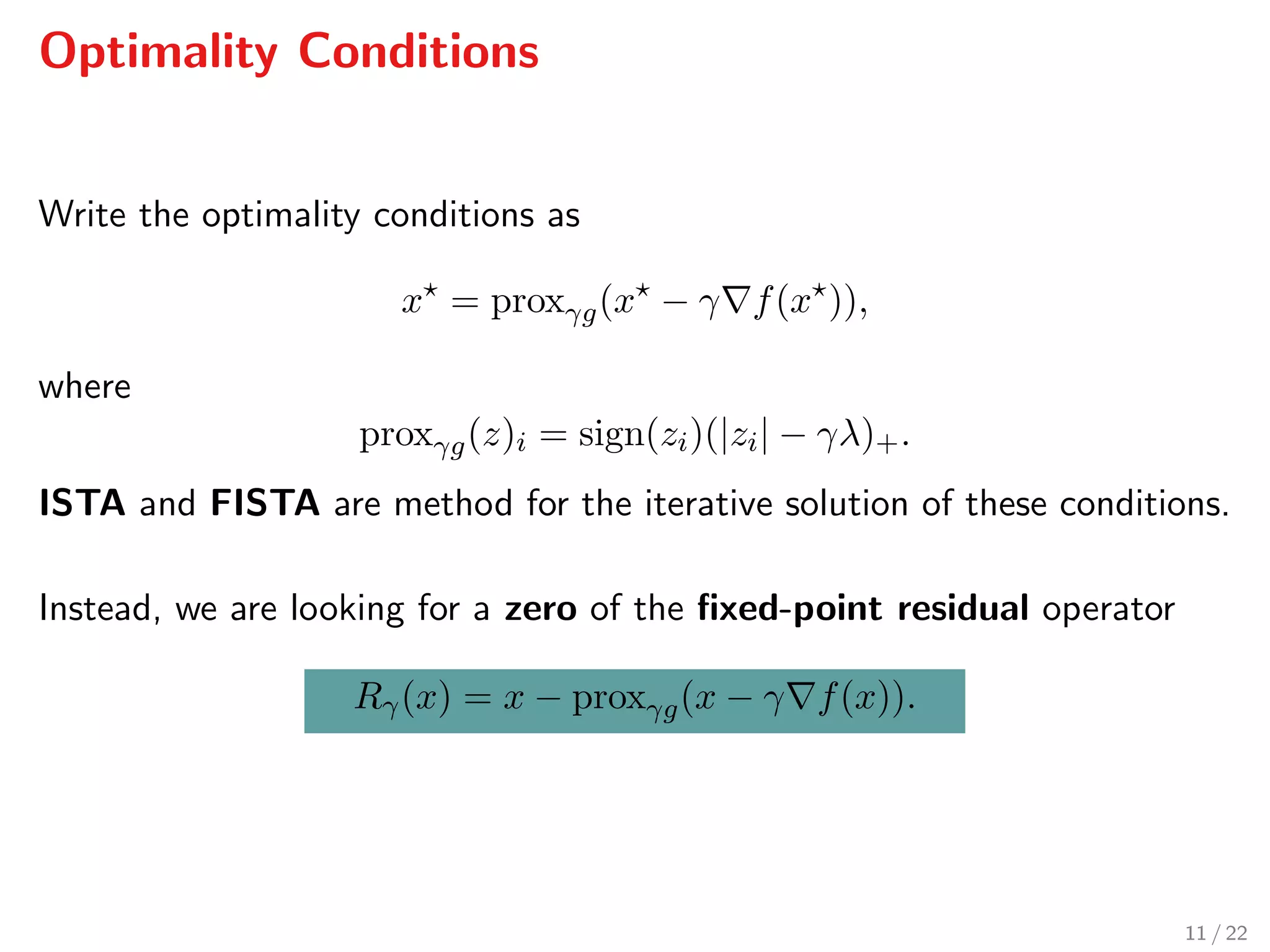
Write the optimality conditions as
x = proxγg(x − γ f(x )),
where
proxγg(z)i = sign(zi)(|zi| − γλ)+.
ISTA and FISTA are method for the iterative solution of these conditions.
Instead, we are looking for a zero of the fixed-point residual operator
Rγ(x) = x − proxγg(x − γ f(x)).
11 / 22
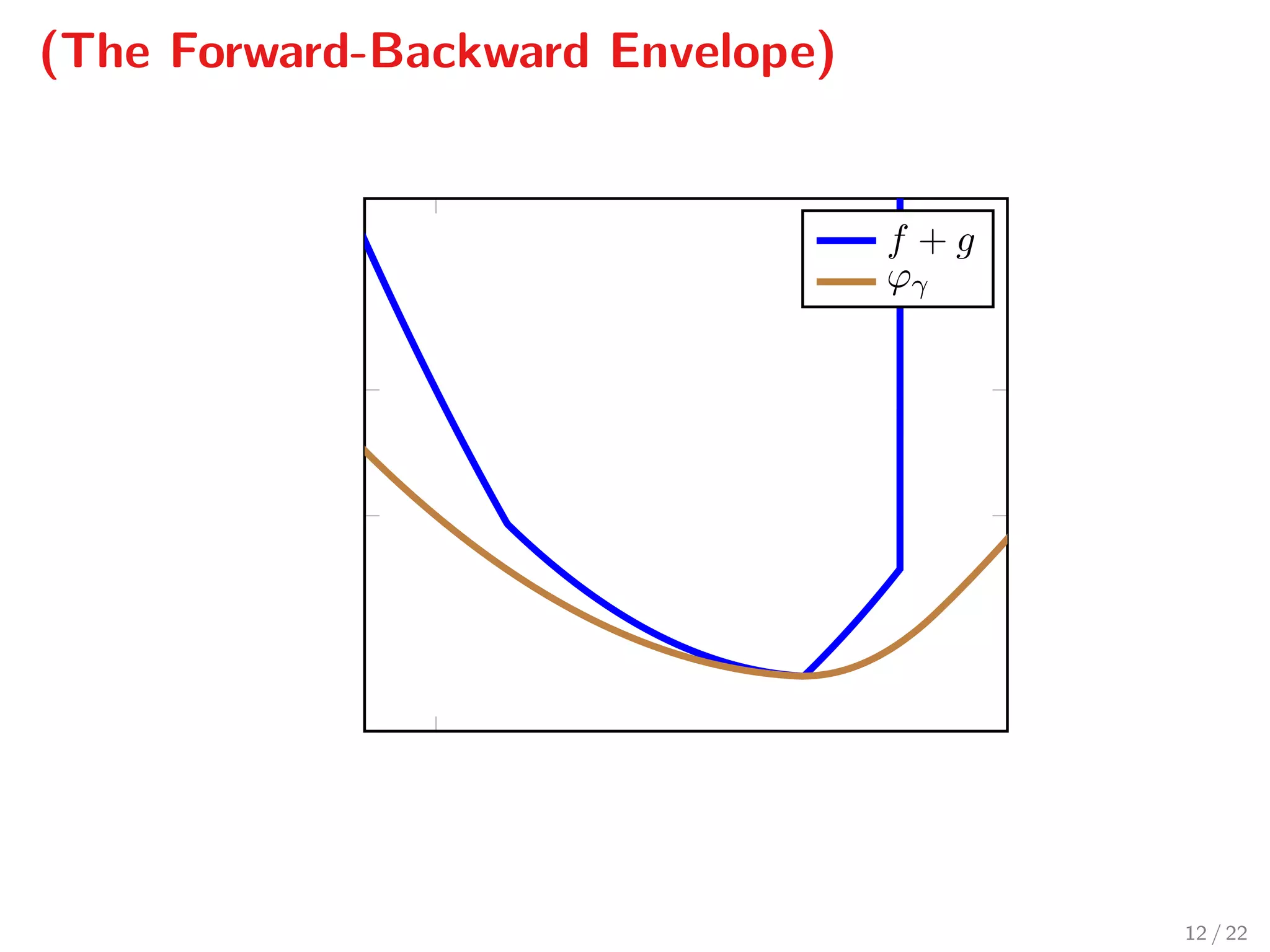
(The Forward-Backward Envelope)
x
ϕ(x)
ϕγ
f + g
ϕγ
12 / 22
(The Forward-Backward Envelope)
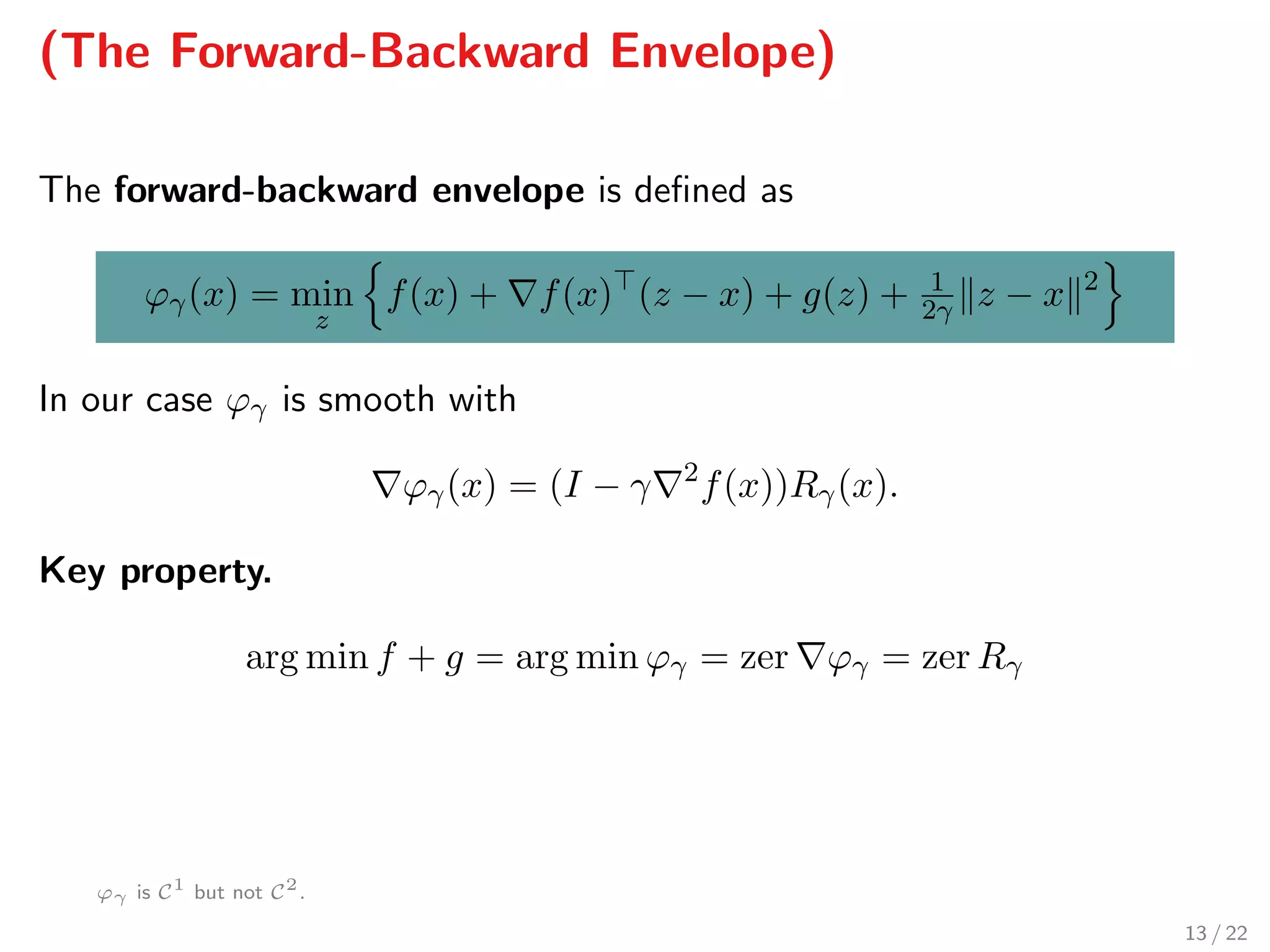
The forward-backward envelope is defined as
ϕγ(x) = min
z
f(x) + f(x) (z − x) + g(z) + 1
2γ z − x 2
In our case ϕγ is smooth with
ϕγ(x) = (I − γ 2
f(x))Rγ(x).
Key property.
arg min f + g = arg min ϕγ = zer ϕγ = zer Rγ
ϕγ is C1
but not C2
.
13 / 22
B-subdifferential
For a mapping F : IRn
→ IRn
which is almost-everywhere diff/ble, we
define its B-subdifferential to be
∂BF(x) := B ∈ IRn×n ∃{xν}ν : xν → x,
F (xν) exists, F (xν) → B
Facchinei & Pang, 2004.
14 / 22
Forward-Backward Newton
The proposed algorithm is
xk+1
= xk
− τkH−1
k Rγ(xk
),
Hk ∈ ∂BRγ(xk
).
When close to the solution all Hk are nonsingular. Take
Hk = I − Pk(I − γA A),
where P is diagonal with Pii = 1 iff i ∈ αk := {i : |xk
i − γ if(xk
i )| > γλ}.
The scalars τk are chosen by a simple line search algorithm to ensure global convergence.
15 / 22
The algorithm
... can be concisely written as
xk+1
= xk
+ τkdk
,
where dk is the solution of
dk
βk
= −(Rγ(xk
))βk
γAαk
Aαk
dk
αk
= −(Rγ(xk
))αk
− γAαk
Aβk
dk
βk
.
For global convergence we require
ϕγ(xk+1
) ≤ ϕγ(xk
) + ζτk ϕγ(xk) dk.
Converges locally quadratically; i.e., like exp(−ck2
).
16 / 22
Further acceleration
The algorithm can be further accelerated by
1. A continuation strategy (changing λ while solving)
2. Updating the Cholesky factorisation of Aα Aα
Please, see our paper for details.
17 / 22
III. Numerical Results
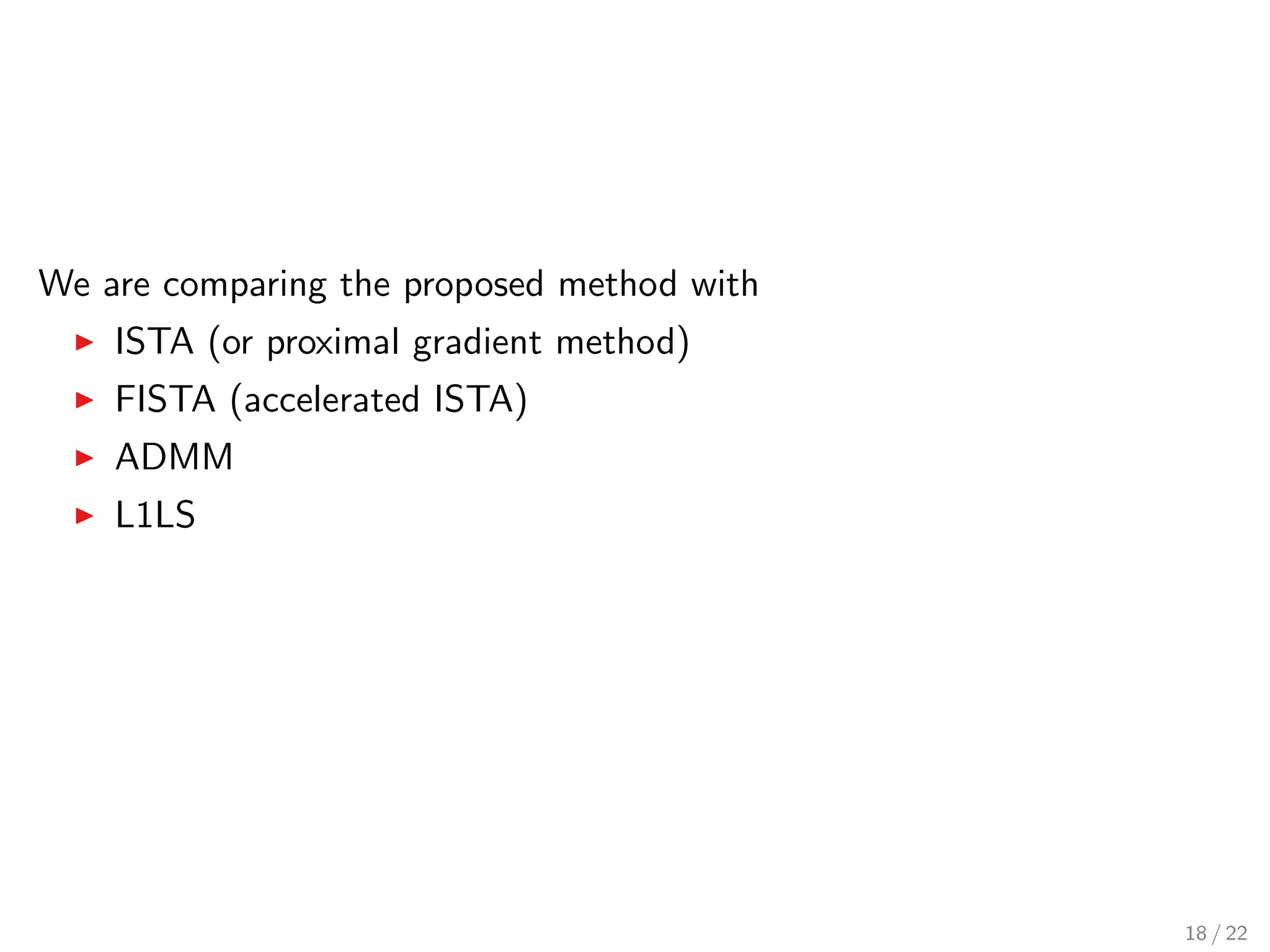
We are comparing the proposed method with
ISTA (or proximal gradient method)
FISTA (accelerated ISTA)
ADMM
L1LS
18 / 22
Simulations
For a 10%-sparse stream
Window size ×10 4
0.5 1 1.5 2
Averageruntime[s]
10 -1
10 0
10 1
FBN
FISTA
ADMM
L1LS
19 / 22
Simulations
For n = 5000 and different sparsities
Sparsity [%]
0 5 10 15
Averageruntime[s]
10 -1
10 0
FBN
FISTA
ADMM
L1LS
20 / 22
Conclusions
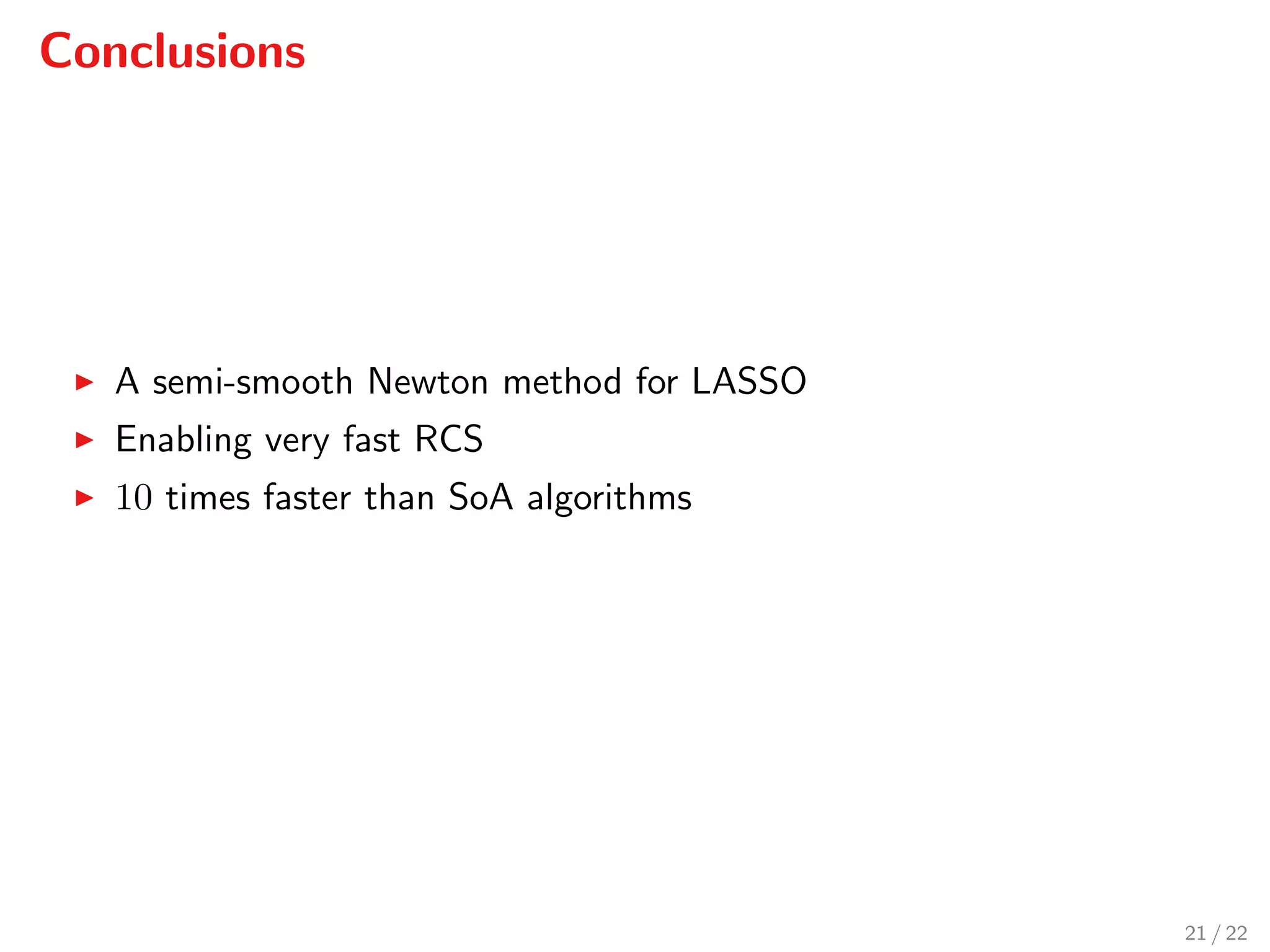
A semi-smooth Newton method for LASSO
Enabling very fast RCS
10 times faster than SoA algorithms
21 / 22
Thank you for your attention.
22 / 22

Accelerated reconstruction of a compressively sampled data stream

  • 1.
    Accelerated reconstruction ofa compressively sampled data stream Pantelis Sopasakis∗, Nikolaos Freris†, Panos Patrinos ∗ IMT School for Advanced Studies Lucca, Italy, † NYU, Abu Dhabi, United Arab Emirates, ESAT, KU Leuven, Belgium. August 31, 2016
  • 2.
    Contribution The proposed methodologyis an order of magnitude faster compared to all state-of-the-art methods for recursive compressed sensing. 1 / 22
  • 3.
  • 4.
    Problem statement Suppose asparsely sampled signal y ∈ IRm is produced by y = Ax + w where x ∈ IRn (n m) is s-sparse and A is the sampling matrix and w is a noise signal. Problem. Retrieve x from y. 2 / 22
  • 5.
  • 6.
    Requirement Matrix A mustsatisfy the restricted isometry property (1 − δs) x 2 ≤ Ax 2 ≤ (1 + δs) x 2 , for all x. A typical choice is a random A with entries drawn from N(0, 1 m ) with m = 4s. 4 / 22
  • 7.
    Decompression Assuming w ∼ N(0,σ2I) the smallest element of |x| is not too small (> 8σ √ 2 ln n) λ = 2σ √ 2 ln n then, the LASSO solution x = arg min x 1 2 Ax − y 2 + λ x 1, and x have the same support whp. 5 / 22
  • 8.
  • 9.
    Recursive Compressed Sensing Define x(i) =xi xi+1 · · · xi+n−1 Then x(i) produces the measured signal y(i) = A(i) x(i) + w(i) . Sampling is performed with a fixed matrix A and A(0) = A A(i+1) = A(i) P, where P shifts the columns of A leftwards. For details: Freris et al., 2014. 7 / 22
  • 10.
    Recursive Compressed Sensing Require:Steam of obsv, Window size n, Sparsity s, σ λ ← 2σ √ 2 ln n, m ← 4s. Initialisation Construct A with entries from N(0, 1 m ) A(0) ← A, x (0) ◦ ← 0 for i = 0, 1, . . . do 1. Sample y(i) 2. Estimate support solving (initial guess: x (i) ◦ ) LASSO x (i) = arg min 1 2 A(i) x − y(i) 2 + λ x 1. 3. Perform debiasing on x (i) 4. x (i+1) ◦ ← P x (i) Warm Start 5. A(i+1) ← AP Permutation end for 8 / 22
  • 11.
  • 12.
    Optimality Conditions LASSO problem minimise1 2 Ax − y 2 f + λ x 1 g Optimality conditions: − f(x ) ∈ ∂g(x ), with f(x) = A (Ax − y) and ∂g(x)i = λ sign(xi) for xi = 0, ∂g(x)i = [−λ, λ] for xi = 0, so − if(x ) = λ sign(xi ), for xi = 0, | jf(x )| ≤ λ, for xj = 0 9 / 22
  • 13.
    Optimality Conditions If weknew α = {i : xi = 0}, β = {i : xi = 0} then Aα Aαxα = Aα y + λ sign(xα). Goal. Devise a method to determine α efficiently. 10 / 22
  • 14.
    Optimality Conditions Write theoptimality conditions as x = proxγg(x − γ f(x )), where proxγg(z)i = sign(zi)(|zi| − γλ)+. ISTA and FISTA are method for the iterative solution of these conditions. Instead, we are looking for a zero of the fixed-point residual operator Rγ(x) = x − proxγg(x − γ f(x)). 11 / 22
  • 15.
  • 16.
    (The Forward-Backward Envelope) Theforward-backward envelope is defined as ϕγ(x) = min z f(x) + f(x) (z − x) + g(z) + 1 2γ z − x 2 In our case ϕγ is smooth with ϕγ(x) = (I − γ 2 f(x))Rγ(x). Key property. arg min f + g = arg min ϕγ = zer ϕγ = zer Rγ ϕγ is C1 but not C2 . 13 / 22
  • 17.
    B-subdifferential For a mappingF : IRn → IRn which is almost-everywhere diff/ble, we define its B-subdifferential to be ∂BF(x) := B ∈ IRn×n ∃{xν}ν : xν → x, F (xν) exists, F (xν) → B Facchinei & Pang, 2004. 14 / 22
  • 18.
    Forward-Backward Newton The proposedalgorithm is xk+1 = xk − τkH−1 k Rγ(xk ), Hk ∈ ∂BRγ(xk ). When close to the solution all Hk are nonsingular. Take Hk = I − Pk(I − γA A), where P is diagonal with Pii = 1 iff i ∈ αk := {i : |xk i − γ if(xk i )| > γλ}. The scalars τk are chosen by a simple line search algorithm to ensure global convergence. 15 / 22
  • 19.
    The algorithm ... canbe concisely written as xk+1 = xk + τkdk , where dk is the solution of dk βk = −(Rγ(xk ))βk γAαk Aαk dk αk = −(Rγ(xk ))αk − γAαk Aβk dk βk . For global convergence we require ϕγ(xk+1 ) ≤ ϕγ(xk ) + ζτk ϕγ(xk) dk. Converges locally quadratically; i.e., like exp(−ck2 ). 16 / 22
  • 20.
    Further acceleration The algorithmcan be further accelerated by 1. A continuation strategy (changing λ while solving) 2. Updating the Cholesky factorisation of Aα Aα Please, see our paper for details. 17 / 22
  • 21.
  • 22.
    We are comparingthe proposed method with ISTA (or proximal gradient method) FISTA (accelerated ISTA) ADMM L1LS 18 / 22
  • 23.
    Simulations For a 10%-sparsestream Window size ×10 4 0.5 1 1.5 2 Averageruntime[s] 10 -1 10 0 10 1 FBN FISTA ADMM L1LS 19 / 22
  • 24.
    Simulations For n =5000 and different sparsities Sparsity [%] 0 5 10 15 Averageruntime[s] 10 -1 10 0 FBN FISTA ADMM L1LS 20 / 22
  • 25.
    Conclusions A semi-smooth Newtonmethod for LASSO Enabling very fast RCS 10 times faster than SoA algorithms 21 / 22
  • 26.
    Thank you foryour attention. 22 / 22