Recursive Compressed Sensing
Pantelis Sopasakis∗
Presentation at ICTEAM – UC Louvain, Belgium
joint work with N. Freris† and P. Patrinos‡
∗ IMT Institute for advanced studies Lucca, Italy
† NYU, Abu Dhabi, United Arab Emirates
‡ ESAT, KU Leuven, Belgium
April 7, 2016
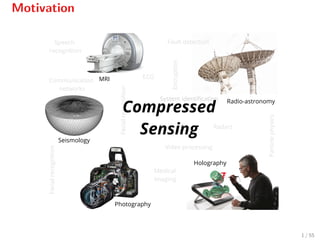
Motivation
MRI
Radio-astronomy
Holography
Seismology
Photography
Radars
Facialrecognition
Speech
recognition
Fault detection
Medical
imaging
Facialrecognition
Particlephysics
Video processing
ECG
Encryption
Communication
networks
System identification
Compressed
Sensing
1 / 55
Spoiler alert!
The proposed method is an order of magnitude faster compared to
other reported methods for recursive compressed sensing.
2 / 55
Outline
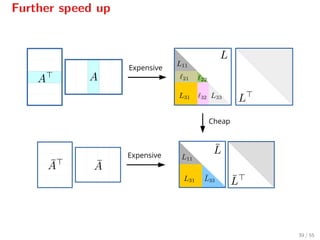
1. Forward-Backward Splitting
2. The Forward-Backward envelope function
3. The Forward-Backward Newton method
4. Recursive compressed sensing
5. Simulations
3 / 55
I. Forward-Backward Splitting
Forward-Backward Splitting
Problem structure
minimize ϕ(x) = f(x) + g(x)
where
1. f, g : Rn → ¯R are proper, closed, convex
2. f has L-Lipschitz gradient
3. g is prox-friendly, i.e., its proximal operator
proxγg(v) := arg min
z
g(z) + 1
2 v − z 2
is easily computable[1]
.
[1]
Parikh & Boyd 2014; Combettes & Pesquette, 2010.
4 / 55
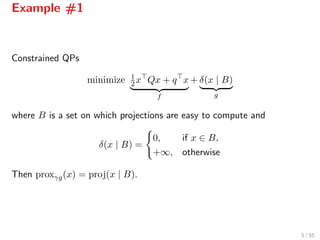
Example #1
Constrained QPs
minimize 1
2x Qx + q x
f
+ δ(x | B)
g
where B is a set on which projections are easy to compute and
δ(x | B) =
0, if x ∈ B,
+∞, otherwise
Then proxγg(x) = proj(x | B).
5 / 55
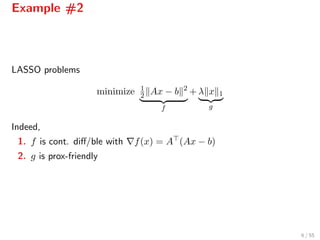
Example #2
LASSO problems
minimize 1
2 Ax − b 2
f
+ λ x 1
g
Indeed,
1. f is cont. diff/ble with f(x) = A (Ax − b)
2. g is prox-friendly
6 / 55
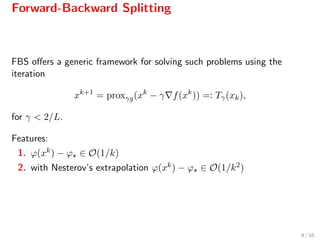
Other examples
Constrained optimal control
Elastic net
Sparse log-logistic regression
Matrix completion
Subspace identification
Support vector machines
7 / 55
Forward-Backward Splitting
FBS offers a generic framework for solving such problems using the
iteration
xk+1
= proxγg(xk
− γ f(xk
)) =: Tγ(xk),
for γ < 2/L.
Features:
1. ϕ(xk) − ϕ ∈ O(1/k)
2. with Nesterov’s extrapolation ϕ(xk) − ϕ ∈ O(1/k2)
8 / 55
Forward-Backward Splitting
The iteration
xk+1
= proxγg(xk
− γ f(xk
)),
can be written as[2]
xk+1
= arg min
z
f(xk
) + f(xk
), z − xk
+ 1
2γ z − xk 2
Qf
γ(z,xk)
+g(z) ,
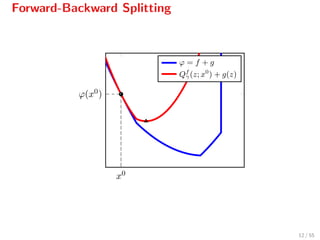
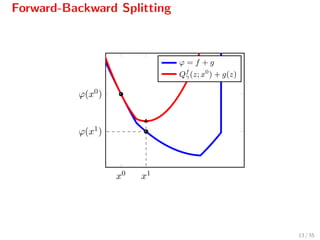
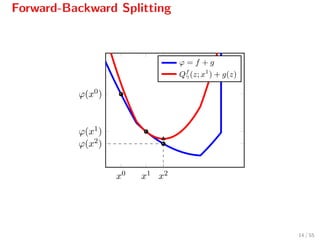
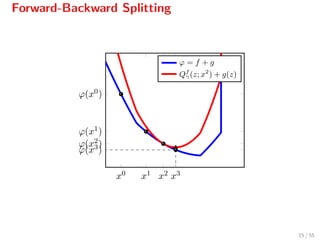
where Qf
γ(z, xk) serves as a quadratic model for f[3]
.
[2]
Beck and Teboulle, 2010.
[3]
Qf
γ (·, xk
) is the linearization of f at xk
plus a quadratic term; moreover, Qf
γ (z, xk
) ≥ f(x) and Qf
γ (z, z) = f(z).
9 / 55
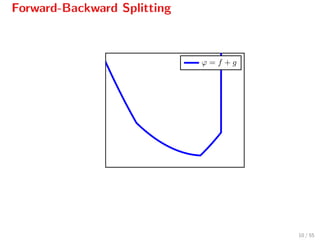
Forward-Backward Splitting
x0
ϕ(x0)
ϕ = f + g
10 / 55
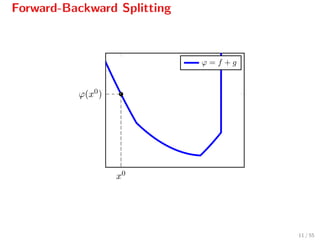
Forward-Backward Splitting
x0
ϕ(x0)
ϕ = f + g
11 / 55
Forward-Backward Splitting
x0
ϕ(x0)
ϕ = f + g
Qf
γ(z; x0
) + g(z)
12 / 55
Forward-Backward Splitting
x0 x1
ϕ(x0)
ϕ(x1)
ϕ = f + g
Qf
γ(z; x0
) + g(z)
13 / 55
Forward-Backward Splitting
x0 x1 x2
ϕ(x0)
ϕ(x1)
ϕ(x2)
ϕ = f + g
Qf
γ(z; x1
) + g(z)
14 / 55
Forward-Backward Splitting
x0 x1 x2 x3
ϕ(x0)
ϕ(x1)
ϕ(x2)
ϕ(x3)
ϕ = f + g
Qf
γ(z; x2
) + g(z)
15 / 55
Overview
Generic convex optimization problem
minimize f(x) + g(x).
The generic iteration
xk+1
= proxγg(xk
− γ f(xk
))
is a fixed-point iteration for the optimality condition
x = proxγg(x − γ f(x ))
16 / 55
Overview
It generalizes several other methods
xk+1
=



xk − γ f(xk) gradient method, g = 0
ΠC(xk − γ f(xk)) gradient projection, g = δ(· | C)
proxγg(xk) proximal point algorithm, f = 0
There are several flavors of proximal gradient algorithms[4]
.
[4]
Nesterov’s accelerated method, FISTA (Beck & Teboulle), etc.
17 / 55
Shortcomings
FBS are first-order methods, therefore, they can be slow!
Overhaul. Use a better quadratic model for f[5]
:
Qf
γ,B(z, xk
) = f(xk
) + f(xk
), z − xk
+ 1
2γ z − xk 2
Bk ,
where Bk is (an approximation of) 2f(x).
Drawback. No closed form solution of the inner problem.
[5]
As in Becker & Fadili 2012; Lee et al. 2012; Tran-Dinh et al. 2013.
18 / 55
II. Forward-Backward Envelope
Forward-Backward Envelope
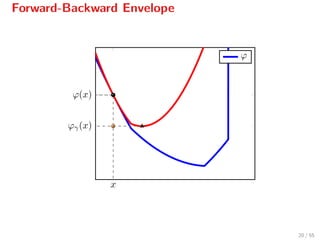
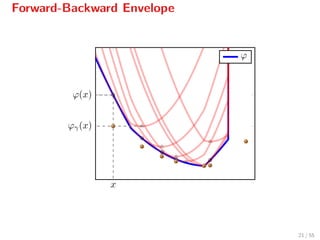
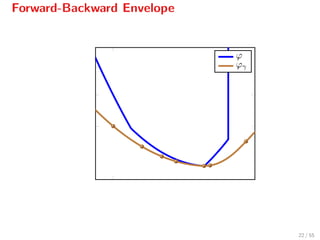
The Forward-Backward envelope of ϕ is defined as
ϕγ(x) = min
z
f(x) + f(x), z − x + g(z) + 1
2γ z − x 2
,
with γ ≤ 1/L. Let’s see how it looks...
19 / 55
Forward-Backward Envelope
x
ϕ(x)
ϕγ(x)
ϕ
20 / 55
Forward-Backward Envelope
x
ϕ(x)
ϕγ(x)
ϕ
21 / 55
Forward-Backward Envelope
x
ϕ(x)
ϕγ(x)
ϕ
ϕγ
22 / 55
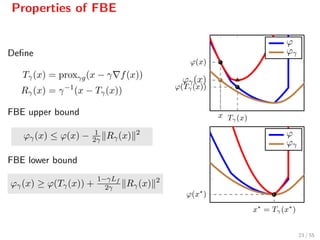
Properties of FBE
Define
Tγ(x) = proxγg(x − γ f(x))
Rγ(x) = γ−1
(x − Tγ(x))
FBE upper bound
ϕγ(x) ≤ ϕ(x) − 1
2γ Rγ(x) 2
FBE lower bound
ϕγ(x) ≥ ϕ(Tγ(x)) +
1−γLf
2γ Rγ(x) 2
x Tγ(x)
ϕ(x)
ϕ(Tγ(x))
ϕγ(x)
ϕ
ϕγ
x = Tγ(x )
ϕ(x )
ϕ
ϕγ
23 / 55
Properties of FBE
Ergo: Minimizing ϕ is equivalent to minimizing its FBE ϕγ.
inf ϕ = inf ϕγ
arg min ϕ = arg min ϕγ
However, ϕγ is continuously diff/able[6]
whenever f ∈ C2.
[6]
More about the FBE: P. Patrinos, L. Stella and A. Bemporad, 2014.
24 / 55
FBE is C2
FBE can be written as
ϕγ(x) = f(x) − γ
2 f(x) 2
+ gγ
(x − f(x)),
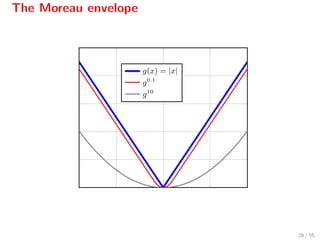
where gγ is the Moreau envelope of g,
gγ
(v) = min
z
{g(z) + 1
2γ z − v 2
}
gγ is a smooth approximation of g with gγ(x) = γ−1(x − proxγg(x)). If
f ∈ C2, then
ϕγ(x) = (I − γ 2
f(x))Rγ(x).
Therefore,
arg min ϕ = arg min ϕγ = zer ϕγ.
25 / 55
The Moreau envelope
g(x) = |x|
g0.1
g10
26 / 55
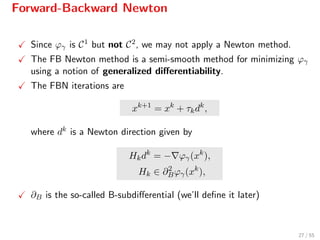
Forward-Backward Newton
Since ϕγ is C1 but not C2, we may not apply a Newton method.
The FB Newton method is a semi-smooth method for minimizing ϕγ
using a notion of generalized differentiability.
The FBN iterations are
xk+1
= xk
+ τkdk
,
where dk is a Newton direction given by
Hkdk
= − ϕγ(xk
),
Hk ∈ ∂2
Bϕγ(xk
),
∂B is the so-called B-subdifferential (we’ll define it later)
27 / 55
III. Forward-Backward Newton
Optimality conditions
LASSO problem
minimize 1
2 Ax − b 2
f
+ λ x 1
g
.
Optimality conditions
− f(x ) ∈ ∂g(x ).
where f(x) = A (Ax − b) and ∂g(x)i = λ sign(xi) for xi = 0 and
∂g(x)i = [−λ, λ] otherwise, so
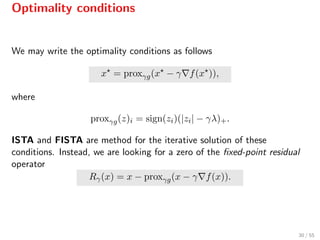
− if(x ) = λ sign(xi ), if xi = 0,
| if(x )| ≤ λ, otherwise
28 / 55
Optimality conditions
If we knew the set
α = {i : xi = 0},
β = {j : xj = 0},
we would be able to write down the optimality conditions as
Aα Aαxα = Aα b + λ sign(xα)
Goal. Devise a method to determine α efficiently.
29 / 55
Optimality conditions
We may write the optimality conditions as follows
x = proxγg(x − γ f(x )),
where
proxγg(z)i = sign(zi)(|zi| − γλ)+.
ISTA and FISTA are method for the iterative solution of these
conditions. Instead, we are looking for a zero of the fixed-point residual
operator
Rγ(x) = x − proxγg(x − γ f(x)).
30 / 55
B-subdifferential
For a function F : Rn → Rn which is almost everywhere differentiable, we
define its B-subdifferential to be[7]
∂BF(x) := B ∈ Rn×n ∃{xn}n : xn → x,
Rγ(xn) exists and Rγ(xn) → B
.
[7]
See Facchinei & Pang, 2004
31 / 55
Forward-Backward Newton
Rγ(x) is nonexpansive ⇒ Lipschitz ⇒ Differentiable a.e. ⇒ B-sub-
differentiable (∂BRγ(x)). The proposed algorithm takes the form
xk+1
= xk
− τkH−1
k Rγ(xk
), with Hk ∈ ∂BRγ(xk
).
When close to the solution, all Hk are nonsingular. Take
Hk = I − Pk(I − γA A),
where Pk is diagonal with (Pk)ii = 1 iff i ∈ αk, where
αk = {i : |xk
i − γ if(xk
i )| > γλ}
The scalar τk is computed by a simple line search method to ensure
global convergence of the algorithm.
32 / 55
Forward-Backward Newton
The Forward-Backward Newton method can be concisely written as
xk+1
= xk
+ τkdk
.
The Newton direction dk is determined as follows without the need to
formulate Hk
dk
βk
= −(Rγ(xk
))βk
,
γAαk
Aαk
dk
αk
= −(Rγ(xk
))αk
− γAαk
Aβk
dk
βk
.
For the method to converge globally, we compute τk so that the Armijo
condition is satisfied for ϕγ
ϕγ(xk
+ τkdk
) ≤ ϕγ(xk
) + ζτk ϕγ(xk
) dk
.
33 / 55
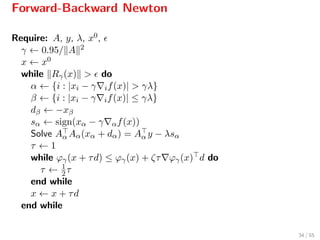
Forward-Backward Newton
Require: A, y, λ, x0,
γ ← 0.95/ A 2
x ← x0
while Rγ(x) > do
α ← {i : |xi − γ if(x)| > γλ}
β ← {i : |xi − γ if(x)| ≤ γλ}
dβ ← −xβ
sα ← sign(xα − γ αf(x))
Solve Aα Aα(xα + dα) = Aα y − λsα
τ ← 1
while ϕγ(x + τd) ≤ ϕγ(x) + ζτ ϕγ(x) d do
τ ← 1
2τ
end while
x ← x + τd
end while
34 / 55
Speeding up FBN by Continuation
1. In applications of LASSO we have x 0 ≤ m n[8]
[8]
The zero-norm of x, x 0, is the number of its nonzeroes.
35 / 55
Speeding up FBN by Continuation
1. In applications of LASSO we have x 0 ≤ m n[8]
2. If λ ≥ λ0 := f(x0) ∞, then supp(x) = ∅
[8]
The zero-norm of x, x 0, is the number of its nonzeroes.
35 / 55
Speeding up FBN by Continuation
1. In applications of LASSO we have x 0 ≤ m n[8]
2. If λ ≥ λ0 := f(x0) ∞, then supp(x) = ∅
3. We relax the optimization problem solving
P(¯λ) : minimize 1
2 Ax − y 2
+ ¯λ x 1
[8]
The zero-norm of x, x 0, is the number of its nonzeroes.
35 / 55
Speeding up FBN by Continuation
1. In applications of LASSO we have x 0 ≤ m n[8]
2. If λ ≥ λ0 := f(x0) ∞, then supp(x) = ∅
3. We relax the optimization problem solving
P(¯λ) : minimize 1
2 Ax − y 2
+ ¯λ x 1
4. Once we have approximately solved P(¯λ) we update ¯λ as
¯λ ← max{η¯λ, λ},
until eventually ¯λ = λ.
[8]
The zero-norm of x, x 0, is the number of its nonzeroes.
35 / 55
Speeding up FBN by Continuation
1. In applications of LASSO we have x 0 ≤ m n[8]
2. If λ ≥ λ0 := f(x0) ∞, then supp(x) = ∅
3. We relax the optimization problem solving
P(¯λ) : minimize 1
2 Ax − y 2
+ ¯λ x 1
4. Once we have approximately solved P(¯λ) we update ¯λ as
¯λ ← max{η¯λ, λ},
until eventually ¯λ = λ.
5. This way we enforce that (i) |αk| increases smoothly, (ii) |αk| < m,
(iii) Aαk
Aαk
remains always positive definite.
[8]
The zero-norm of x, x 0, is the number of its nonzeroes.
35 / 55
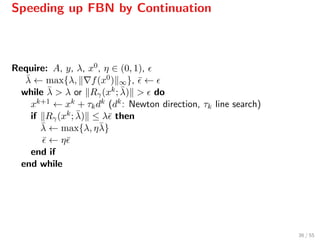
Speeding up FBN by Continuation
Require: A, y, λ, x0, η ∈ (0, 1),
¯λ ← max{λ, f(x0) ∞}, ¯ ←
while ¯λ > λ or Rγ(xk; ¯λ) > do
xk+1 ← xk + τkdk (dk: Newton direction, τk line search)
if Rγ(xk; ¯λ) ≤ λ¯ then
¯λ ← max{λ, η¯λ}
¯ ← η¯
end if
end while
36 / 55
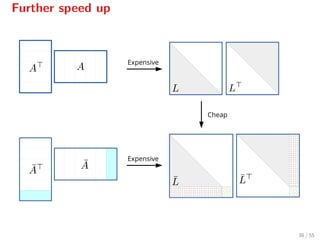
Further speed up
When Aα is positive definite[9]
, we may compute a Cholesky factorization
of Aα0
Aα0 and then update the Cholesky factorization of Aαk+1
Aαk+1
using the factorization of Aαk
Aαk
.
[9]
In practice, always (when the continuation heuristic is used). Furthermore, α0 = ∅.
37 / 55
Further speed up
Cheap
Expensive
Expensive
38 / 55
Further speed up
Cheap
Expensive
Expensive
39 / 55
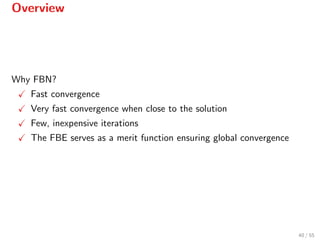
Overview
Why FBN?
Fast convergence
Very fast convergence when close to the solution
Few, inexpensive iterations
The FBE serves as a merit function ensuring global convergence
40 / 55
IV. Recursive Compressed Sensing
Introduction
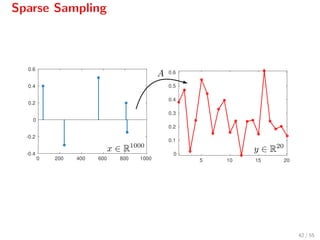
We say that a vector x ∈ Rn is s-sparse if it has at most s nonzeroes.
Assume that a sparsely-sampled signal y ∈ Rm (m n) is produced by
y = Ax,
by an s-sparse vector x and a sampling matrix A. In reality, however,
measurements will be noisy
y = Ax + w.
41 / 55
Sparse Sampling
42 / 55
Sparse Sampling
We require that A satisfies the restricted isometry property[10]
, that is
(1 − δs) x 2
≤ Ax 2
≤ (1 + δs) x 2
A typical choice is a random matrix A with entries drawn from N(0, 1
m )
with m = 4s.
[10]
This can be established using the Johnson-Lindenstrauss lemma.
43 / 55
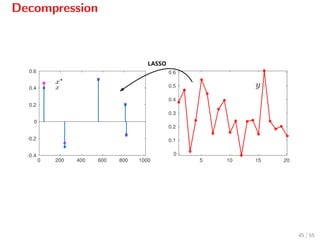
Decompression
Assuming that
w ∼ N(0, σ2I),
the smallest element of |x| is not too small (> 8σ
√
2 ln n),
λ = 4σ
√
2 ln n,
the LASSO recovers the support of x[11]
, that is
x = arg min 1
2 Ax − y 2
+ λ x 1,
has the same support as the actual x.
[11]
Cand`es & Plan, 2009.
44 / 55
Decompression
LASSO
45 / 55
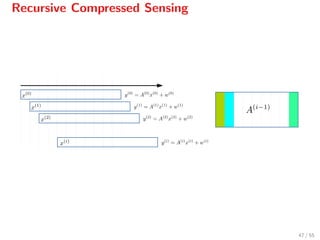
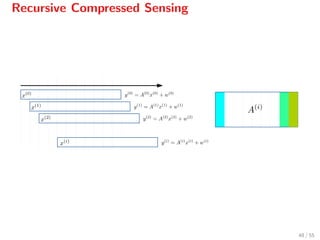
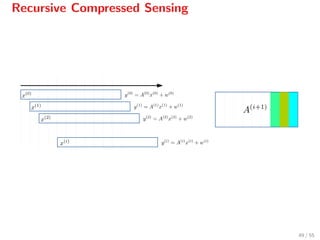
Recursive Compressed Sensing
Define
x(i)
:= xi xi+1 · · · xi+n−1
Then x(i) produces the measured signal
y(i)
= A(i)
x(i)
+ w(i)
.
Sampling is performed with a constant matrix A[12]
and
A(0)
= A,
A(i+1)
= A(i)
P,
where P is a permutation matrix which shifts the columns of A leftwards.
[12]
For details see: N. Freris, O. ¨O¸cal and M. Vetterli, 2014.
46 / 55
Recursive Compressed Sensing
47 / 55
Recursive Compressed Sensing
48 / 55
Recursive Compressed Sensing
49 / 55
Recursive Compressed Sensing
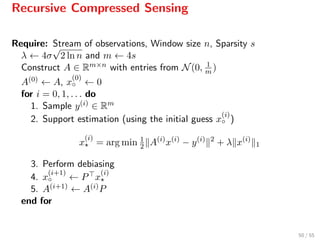
Require: Stream of observations, Window size n, Sparsity s
λ ← 4σ
√
2 ln n and m ← 4s
Construct A ∈ Rm×n with entries from N(0, 1
m )
A(0) ← A, x
(0)
◦ ← 0
for i = 0, 1, . . . do
1. Sample y(i) ∈ Rm
2. Support estimation (using the initial guess x
(i)
◦ )
x
(i)
= arg min 1
2 A(i)
x(i)
− y(i) 2
+ λ x(i)
1
3. Perform debiasing
4. x
(i+1)
◦ ← P x
(i)
5. A(i+1) ← A(i)P
end for
50 / 55
V. Simulations
Simulations
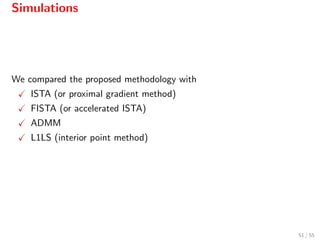
We compared the proposed methodology with
ISTA (or proximal gradient method)
FISTA (or accelerated ISTA)
ADMM
L1LS (interior point method)
51 / 55
Simulations
For a 10%-sparse stream
Window size ×10 4
0.5 1 1.5 2
Averageruntime[s]
10 -1
10 0
10 1
FBN
FISTA
ADMM
L1LS
52 / 55
Simulations
For n = 5000 varying the stream sparsity
Sparsity [%]
0 5 10 15
Averageruntime[s]
10 -1
10 0
FBN
FISTA
ADMM
L1LS
53 / 55
References
1. S.-J. Kim, K. Koh, M. Lustig, S. Boyd, and D. Gorinevsky, “An interior- point
method for large-scale 1 -regularized least squares,” IEEE J Select Top Sign Proc,
1(4), pp. 606–617, 2007.
2. A. Beck and M. Teboulle, “A fast iterative shrinkage-thresholding algo- rithm for
linear inverse problems,” SIAM J Imag Sci, 2(1), pp. 183–202, 2009.
3. S. Becker and M. J. Fadili, “A quasi-Newton proximal splitting method,” in
Advances in Neural Information Processing Systems, vol. 1, pp. 2618–2626, 2012.
4. A. Beck and M. Teboulle, “A fast iterative shrinkage-thresholding algorithm for
linear inverse problems,” SIAM J Imag Sci, 2(1), pp. 183–202, 2009.
5. P. Patrinos, L. Stella and A. Bemporad, “Forward-backward truncated Newton
methods for convex composite optimization,” arXiv:1402.6655, 2014.
6. P. Sopasakis, N. Freris and P. Patrinos, “Accelerated reconstruction of a
compressively sampled data stream,” 24th European Signal Processing
conference, submitted, 2016.
7. N. Freris, O. ¨O¸cal and M. Vetterli, “Recursive Compressed Sensing,”
arXiv:1312.4895, 2013.
54 / 55
Thank you for your attention.
55 / 55

Recursive Compressed Sensing

  • 1.
    Recursive Compressed Sensing PantelisSopasakis∗ Presentation at ICTEAM – UC Louvain, Belgium joint work with N. Freris† and P. Patrinos‡ ∗ IMT Institute for advanced studies Lucca, Italy † NYU, Abu Dhabi, United Arab Emirates ‡ ESAT, KU Leuven, Belgium April 7, 2016
  • 2.
  • 3.
    Spoiler alert! The proposedmethod is an order of magnitude faster compared to other reported methods for recursive compressed sensing. 2 / 55
  • 4.
    Outline 1. Forward-Backward Splitting 2.The Forward-Backward envelope function 3. The Forward-Backward Newton method 4. Recursive compressed sensing 5. Simulations 3 / 55
  • 5.
  • 6.
    Forward-Backward Splitting Problem structure minimizeϕ(x) = f(x) + g(x) where 1. f, g : Rn → ¯R are proper, closed, convex 2. f has L-Lipschitz gradient 3. g is prox-friendly, i.e., its proximal operator proxγg(v) := arg min z g(z) + 1 2 v − z 2 is easily computable[1] . [1] Parikh & Boyd 2014; Combettes & Pesquette, 2010. 4 / 55
  • 7.
    Example #1 Constrained QPs minimize1 2x Qx + q x f + δ(x | B) g where B is a set on which projections are easy to compute and δ(x | B) = 0, if x ∈ B, +∞, otherwise Then proxγg(x) = proj(x | B). 5 / 55
  • 8.
    Example #2 LASSO problems minimize1 2 Ax − b 2 f + λ x 1 g Indeed, 1. f is cont. diff/ble with f(x) = A (Ax − b) 2. g is prox-friendly 6 / 55
  • 9.
    Other examples Constrained optimalcontrol Elastic net Sparse log-logistic regression Matrix completion Subspace identification Support vector machines 7 / 55
  • 10.
    Forward-Backward Splitting FBS offersa generic framework for solving such problems using the iteration xk+1 = proxγg(xk − γ f(xk )) =: Tγ(xk), for γ < 2/L. Features: 1. ϕ(xk) − ϕ ∈ O(1/k) 2. with Nesterov’s extrapolation ϕ(xk) − ϕ ∈ O(1/k2) 8 / 55
  • 11.
    Forward-Backward Splitting The iteration xk+1 =proxγg(xk − γ f(xk )), can be written as[2] xk+1 = arg min z f(xk ) + f(xk ), z − xk + 1 2γ z − xk 2 Qf γ(z,xk) +g(z) , where Qf γ(z, xk) serves as a quadratic model for f[3] . [2] Beck and Teboulle, 2010. [3] Qf γ (·, xk ) is the linearization of f at xk plus a quadratic term; moreover, Qf γ (z, xk ) ≥ f(x) and Qf γ (z, z) = f(z). 9 / 55
  • 12.
  • 13.
  • 14.
    Forward-Backward Splitting x0 ϕ(x0) ϕ =f + g Qf γ(z; x0 ) + g(z) 12 / 55
  • 15.
    Forward-Backward Splitting x0 x1 ϕ(x0) ϕ(x1) ϕ= f + g Qf γ(z; x0 ) + g(z) 13 / 55
  • 16.
    Forward-Backward Splitting x0 x1x2 ϕ(x0) ϕ(x1) ϕ(x2) ϕ = f + g Qf γ(z; x1 ) + g(z) 14 / 55
  • 17.
    Forward-Backward Splitting x0 x1x2 x3 ϕ(x0) ϕ(x1) ϕ(x2) ϕ(x3) ϕ = f + g Qf γ(z; x2 ) + g(z) 15 / 55
  • 18.
    Overview Generic convex optimizationproblem minimize f(x) + g(x). The generic iteration xk+1 = proxγg(xk − γ f(xk )) is a fixed-point iteration for the optimality condition x = proxγg(x − γ f(x )) 16 / 55
  • 19.
    Overview It generalizes severalother methods xk+1 =    xk − γ f(xk) gradient method, g = 0 ΠC(xk − γ f(xk)) gradient projection, g = δ(· | C) proxγg(xk) proximal point algorithm, f = 0 There are several flavors of proximal gradient algorithms[4] . [4] Nesterov’s accelerated method, FISTA (Beck & Teboulle), etc. 17 / 55
  • 20.
    Shortcomings FBS are first-ordermethods, therefore, they can be slow! Overhaul. Use a better quadratic model for f[5] : Qf γ,B(z, xk ) = f(xk ) + f(xk ), z − xk + 1 2γ z − xk 2 Bk , where Bk is (an approximation of) 2f(x). Drawback. No closed form solution of the inner problem. [5] As in Becker & Fadili 2012; Lee et al. 2012; Tran-Dinh et al. 2013. 18 / 55
  • 21.
  • 22.
    Forward-Backward Envelope The Forward-Backwardenvelope of ϕ is defined as ϕγ(x) = min z f(x) + f(x), z − x + g(z) + 1 2γ z − x 2 , with γ ≤ 1/L. Let’s see how it looks... 19 / 55
  • 23.
  • 24.
  • 25.
  • 26.
    Properties of FBE Define Tγ(x)= proxγg(x − γ f(x)) Rγ(x) = γ−1 (x − Tγ(x)) FBE upper bound ϕγ(x) ≤ ϕ(x) − 1 2γ Rγ(x) 2 FBE lower bound ϕγ(x) ≥ ϕ(Tγ(x)) + 1−γLf 2γ Rγ(x) 2 x Tγ(x) ϕ(x) ϕ(Tγ(x)) ϕγ(x) ϕ ϕγ x = Tγ(x ) ϕ(x ) ϕ ϕγ 23 / 55
  • 27.
    Properties of FBE Ergo:Minimizing ϕ is equivalent to minimizing its FBE ϕγ. inf ϕ = inf ϕγ arg min ϕ = arg min ϕγ However, ϕγ is continuously diff/able[6] whenever f ∈ C2. [6] More about the FBE: P. Patrinos, L. Stella and A. Bemporad, 2014. 24 / 55
  • 28.
    FBE is C2 FBEcan be written as ϕγ(x) = f(x) − γ 2 f(x) 2 + gγ (x − f(x)), where gγ is the Moreau envelope of g, gγ (v) = min z {g(z) + 1 2γ z − v 2 } gγ is a smooth approximation of g with gγ(x) = γ−1(x − proxγg(x)). If f ∈ C2, then ϕγ(x) = (I − γ 2 f(x))Rγ(x). Therefore, arg min ϕ = arg min ϕγ = zer ϕγ. 25 / 55
  • 29.
    The Moreau envelope g(x)= |x| g0.1 g10 26 / 55
  • 30.
    Forward-Backward Newton Since ϕγis C1 but not C2, we may not apply a Newton method. The FB Newton method is a semi-smooth method for minimizing ϕγ using a notion of generalized differentiability. The FBN iterations are xk+1 = xk + τkdk , where dk is a Newton direction given by Hkdk = − ϕγ(xk ), Hk ∈ ∂2 Bϕγ(xk ), ∂B is the so-called B-subdifferential (we’ll define it later) 27 / 55
  • 31.
  • 32.
    Optimality conditions LASSO problem minimize1 2 Ax − b 2 f + λ x 1 g . Optimality conditions − f(x ) ∈ ∂g(x ). where f(x) = A (Ax − b) and ∂g(x)i = λ sign(xi) for xi = 0 and ∂g(x)i = [−λ, λ] otherwise, so − if(x ) = λ sign(xi ), if xi = 0, | if(x )| ≤ λ, otherwise 28 / 55
  • 33.
    Optimality conditions If weknew the set α = {i : xi = 0}, β = {j : xj = 0}, we would be able to write down the optimality conditions as Aα Aαxα = Aα b + λ sign(xα) Goal. Devise a method to determine α efficiently. 29 / 55
  • 34.
    Optimality conditions We maywrite the optimality conditions as follows x = proxγg(x − γ f(x )), where proxγg(z)i = sign(zi)(|zi| − γλ)+. ISTA and FISTA are method for the iterative solution of these conditions. Instead, we are looking for a zero of the fixed-point residual operator Rγ(x) = x − proxγg(x − γ f(x)). 30 / 55
  • 35.
    B-subdifferential For a functionF : Rn → Rn which is almost everywhere differentiable, we define its B-subdifferential to be[7] ∂BF(x) := B ∈ Rn×n ∃{xn}n : xn → x, Rγ(xn) exists and Rγ(xn) → B . [7] See Facchinei & Pang, 2004 31 / 55
  • 36.
    Forward-Backward Newton Rγ(x) isnonexpansive ⇒ Lipschitz ⇒ Differentiable a.e. ⇒ B-sub- differentiable (∂BRγ(x)). The proposed algorithm takes the form xk+1 = xk − τkH−1 k Rγ(xk ), with Hk ∈ ∂BRγ(xk ). When close to the solution, all Hk are nonsingular. Take Hk = I − Pk(I − γA A), where Pk is diagonal with (Pk)ii = 1 iff i ∈ αk, where αk = {i : |xk i − γ if(xk i )| > γλ} The scalar τk is computed by a simple line search method to ensure global convergence of the algorithm. 32 / 55
  • 37.
    Forward-Backward Newton The Forward-BackwardNewton method can be concisely written as xk+1 = xk + τkdk . The Newton direction dk is determined as follows without the need to formulate Hk dk βk = −(Rγ(xk ))βk , γAαk Aαk dk αk = −(Rγ(xk ))αk − γAαk Aβk dk βk . For the method to converge globally, we compute τk so that the Armijo condition is satisfied for ϕγ ϕγ(xk + τkdk ) ≤ ϕγ(xk ) + ζτk ϕγ(xk ) dk . 33 / 55
  • 38.
    Forward-Backward Newton Require: A,y, λ, x0, γ ← 0.95/ A 2 x ← x0 while Rγ(x) > do α ← {i : |xi − γ if(x)| > γλ} β ← {i : |xi − γ if(x)| ≤ γλ} dβ ← −xβ sα ← sign(xα − γ αf(x)) Solve Aα Aα(xα + dα) = Aα y − λsα τ ← 1 while ϕγ(x + τd) ≤ ϕγ(x) + ζτ ϕγ(x) d do τ ← 1 2τ end while x ← x + τd end while 34 / 55
  • 39.
    Speeding up FBNby Continuation 1. In applications of LASSO we have x 0 ≤ m n[8] [8] The zero-norm of x, x 0, is the number of its nonzeroes. 35 / 55
  • 40.
    Speeding up FBNby Continuation 1. In applications of LASSO we have x 0 ≤ m n[8] 2. If λ ≥ λ0 := f(x0) ∞, then supp(x) = ∅ [8] The zero-norm of x, x 0, is the number of its nonzeroes. 35 / 55
  • 41.
    Speeding up FBNby Continuation 1. In applications of LASSO we have x 0 ≤ m n[8] 2. If λ ≥ λ0 := f(x0) ∞, then supp(x) = ∅ 3. We relax the optimization problem solving P(¯λ) : minimize 1 2 Ax − y 2 + ¯λ x 1 [8] The zero-norm of x, x 0, is the number of its nonzeroes. 35 / 55
  • 42.
    Speeding up FBNby Continuation 1. In applications of LASSO we have x 0 ≤ m n[8] 2. If λ ≥ λ0 := f(x0) ∞, then supp(x) = ∅ 3. We relax the optimization problem solving P(¯λ) : minimize 1 2 Ax − y 2 + ¯λ x 1 4. Once we have approximately solved P(¯λ) we update ¯λ as ¯λ ← max{η¯λ, λ}, until eventually ¯λ = λ. [8] The zero-norm of x, x 0, is the number of its nonzeroes. 35 / 55
  • 43.
    Speeding up FBNby Continuation 1. In applications of LASSO we have x 0 ≤ m n[8] 2. If λ ≥ λ0 := f(x0) ∞, then supp(x) = ∅ 3. We relax the optimization problem solving P(¯λ) : minimize 1 2 Ax − y 2 + ¯λ x 1 4. Once we have approximately solved P(¯λ) we update ¯λ as ¯λ ← max{η¯λ, λ}, until eventually ¯λ = λ. 5. This way we enforce that (i) |αk| increases smoothly, (ii) |αk| < m, (iii) Aαk Aαk remains always positive definite. [8] The zero-norm of x, x 0, is the number of its nonzeroes. 35 / 55
  • 44.
    Speeding up FBNby Continuation Require: A, y, λ, x0, η ∈ (0, 1), ¯λ ← max{λ, f(x0) ∞}, ¯ ← while ¯λ > λ or Rγ(xk; ¯λ) > do xk+1 ← xk + τkdk (dk: Newton direction, τk line search) if Rγ(xk; ¯λ) ≤ λ¯ then ¯λ ← max{λ, η¯λ} ¯ ← η¯ end if end while 36 / 55
  • 45.
    Further speed up WhenAα is positive definite[9] , we may compute a Cholesky factorization of Aα0 Aα0 and then update the Cholesky factorization of Aαk+1 Aαk+1 using the factorization of Aαk Aαk . [9] In practice, always (when the continuation heuristic is used). Furthermore, α0 = ∅. 37 / 55
  • 46.
  • 47.
  • 48.
    Overview Why FBN? Fast convergence Veryfast convergence when close to the solution Few, inexpensive iterations The FBE serves as a merit function ensuring global convergence 40 / 55
  • 49.
  • 50.
    Introduction We say thata vector x ∈ Rn is s-sparse if it has at most s nonzeroes. Assume that a sparsely-sampled signal y ∈ Rm (m n) is produced by y = Ax, by an s-sparse vector x and a sampling matrix A. In reality, however, measurements will be noisy y = Ax + w. 41 / 55
  • 51.
  • 52.
    Sparse Sampling We requirethat A satisfies the restricted isometry property[10] , that is (1 − δs) x 2 ≤ Ax 2 ≤ (1 + δs) x 2 A typical choice is a random matrix A with entries drawn from N(0, 1 m ) with m = 4s. [10] This can be established using the Johnson-Lindenstrauss lemma. 43 / 55
  • 53.
    Decompression Assuming that w ∼N(0, σ2I), the smallest element of |x| is not too small (> 8σ √ 2 ln n), λ = 4σ √ 2 ln n, the LASSO recovers the support of x[11] , that is x = arg min 1 2 Ax − y 2 + λ x 1, has the same support as the actual x. [11] Cand`es & Plan, 2009. 44 / 55
  • 54.
  • 55.
    Recursive Compressed Sensing Define x(i) :=xi xi+1 · · · xi+n−1 Then x(i) produces the measured signal y(i) = A(i) x(i) + w(i) . Sampling is performed with a constant matrix A[12] and A(0) = A, A(i+1) = A(i) P, where P is a permutation matrix which shifts the columns of A leftwards. [12] For details see: N. Freris, O. ¨O¸cal and M. Vetterli, 2014. 46 / 55
  • 56.
  • 57.
  • 58.
  • 59.
    Recursive Compressed Sensing Require:Stream of observations, Window size n, Sparsity s λ ← 4σ √ 2 ln n and m ← 4s Construct A ∈ Rm×n with entries from N(0, 1 m ) A(0) ← A, x (0) ◦ ← 0 for i = 0, 1, . . . do 1. Sample y(i) ∈ Rm 2. Support estimation (using the initial guess x (i) ◦ ) x (i) = arg min 1 2 A(i) x(i) − y(i) 2 + λ x(i) 1 3. Perform debiasing 4. x (i+1) ◦ ← P x (i) 5. A(i+1) ← A(i)P end for 50 / 55
  • 60.
  • 61.
    Simulations We compared theproposed methodology with ISTA (or proximal gradient method) FISTA (or accelerated ISTA) ADMM L1LS (interior point method) 51 / 55
  • 62.
    Simulations For a 10%-sparsestream Window size ×10 4 0.5 1 1.5 2 Averageruntime[s] 10 -1 10 0 10 1 FBN FISTA ADMM L1LS 52 / 55
  • 63.
    Simulations For n =5000 varying the stream sparsity Sparsity [%] 0 5 10 15 Averageruntime[s] 10 -1 10 0 FBN FISTA ADMM L1LS 53 / 55
  • 64.
    References 1. S.-J. Kim,K. Koh, M. Lustig, S. Boyd, and D. Gorinevsky, “An interior- point method for large-scale 1 -regularized least squares,” IEEE J Select Top Sign Proc, 1(4), pp. 606–617, 2007. 2. A. Beck and M. Teboulle, “A fast iterative shrinkage-thresholding algo- rithm for linear inverse problems,” SIAM J Imag Sci, 2(1), pp. 183–202, 2009. 3. S. Becker and M. J. Fadili, “A quasi-Newton proximal splitting method,” in Advances in Neural Information Processing Systems, vol. 1, pp. 2618–2626, 2012. 4. A. Beck and M. Teboulle, “A fast iterative shrinkage-thresholding algorithm for linear inverse problems,” SIAM J Imag Sci, 2(1), pp. 183–202, 2009. 5. P. Patrinos, L. Stella and A. Bemporad, “Forward-backward truncated Newton methods for convex composite optimization,” arXiv:1402.6655, 2014. 6. P. Sopasakis, N. Freris and P. Patrinos, “Accelerated reconstruction of a compressively sampled data stream,” 24th European Signal Processing conference, submitted, 2016. 7. N. Freris, O. ¨O¸cal and M. Vetterli, “Recursive Compressed Sensing,” arXiv:1312.4895, 2013. 54 / 55
  • 65.
    Thank you foryour attention. 55 / 55