The dual Voronoi diagrams with respect to
representational Bregman divergences
Frank Nielsen and Richard Nock
frank.nielsen@polytechnique.edu

´
Ecole Polytechnique, LIX, France
Sony Computer Science Laboratories Inc, FRL, Japan

International Symposium on Voronoi Diagrams (ISVD)
June 2009

c 2009, Frank Nielsen — p. 1/32
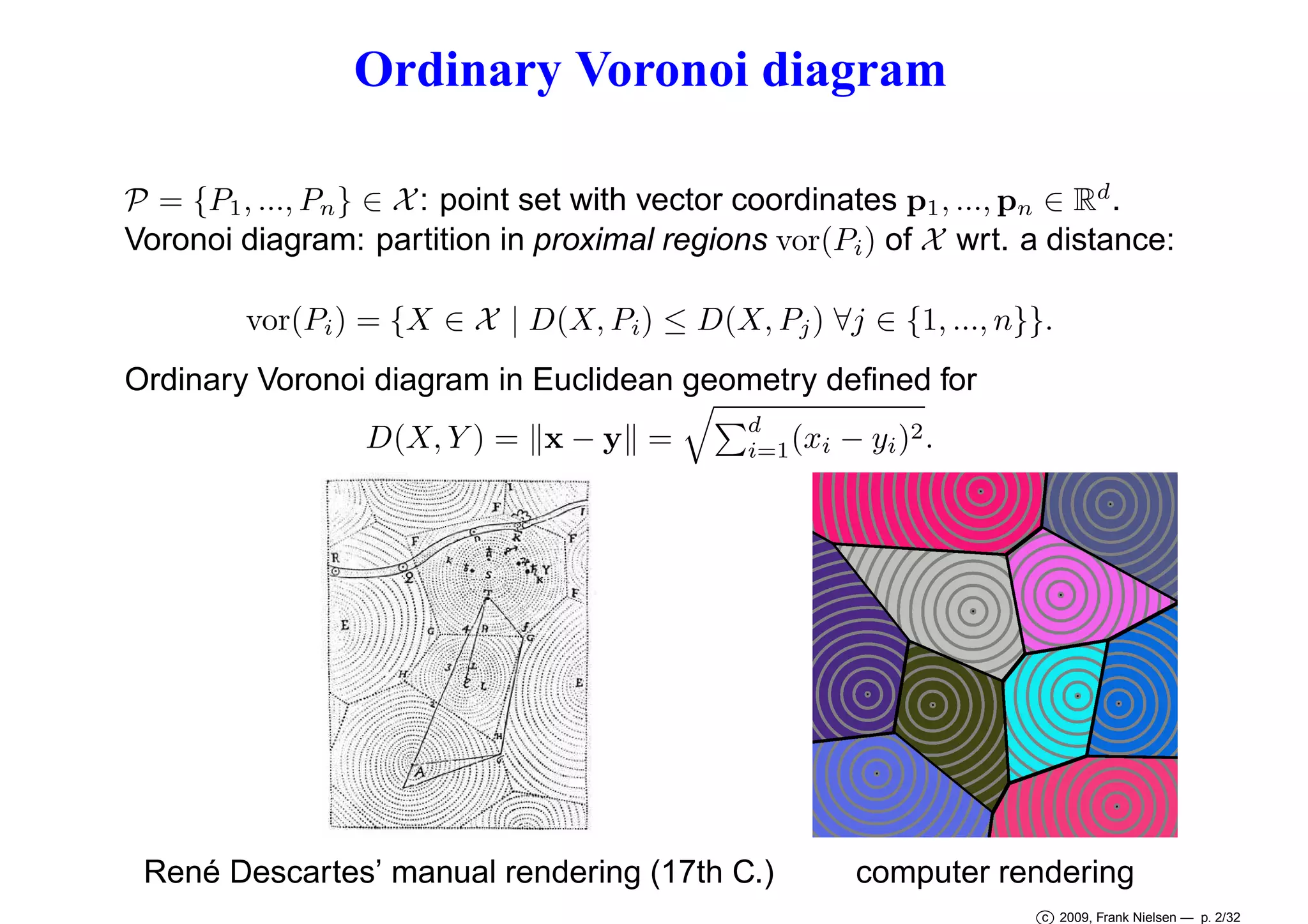
Ordinary Voronoi diagram
P = {P1 , ..., Pn } ∈ X : point set with vector coordinates p1 , ..., pn ∈ Rd .
Voronoi diagram: partition in proximal regions vor(Pi ) of X wrt. a distance:
vor(Pi ) = {X ∈ X | D(X, Pi ) ≤ D(X, Pj ) ∀j ∈ {1, ..., n}}.
Ordinary Voronoi diagram in Euclidean geometry defined for
D(X, Y ) = x − y =

d
i=1 (xi

René Descartes’ manual rendering (17th C.)

− yi )2 .

computer rendering
c 2009, Frank Nielsen — p. 2/32
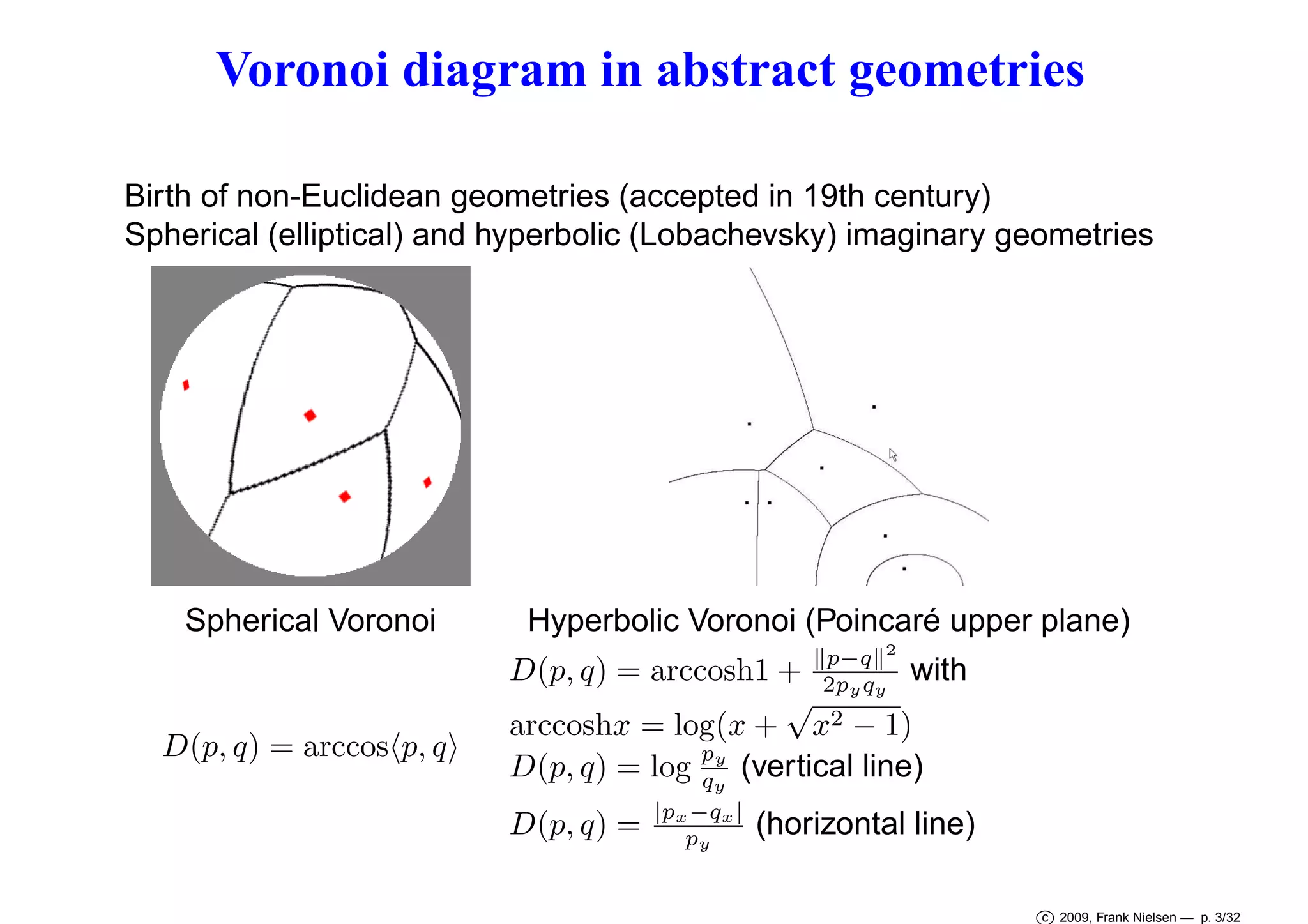
Voronoi diagram in abstract geometries
Birth of non-Euclidean geometries (accepted in 19th century)
Spherical (elliptical) and hyperbolic (Lobachevsky) imaginary geometries

Spherical Voronoi

Hyperbolic Voronoi (Poincaré upper plane)
p−q 2
2py qy

D(p, q) = arccos p, q

with
D(p, q) = arccosh1 +
√
arccoshx = log(x + x2 − 1)
py
D(p, q) = log qy (vertical line)
D(p, q) =

|px −qx |
py

(horizontal line)
c 2009, Frank Nielsen — p. 3/32
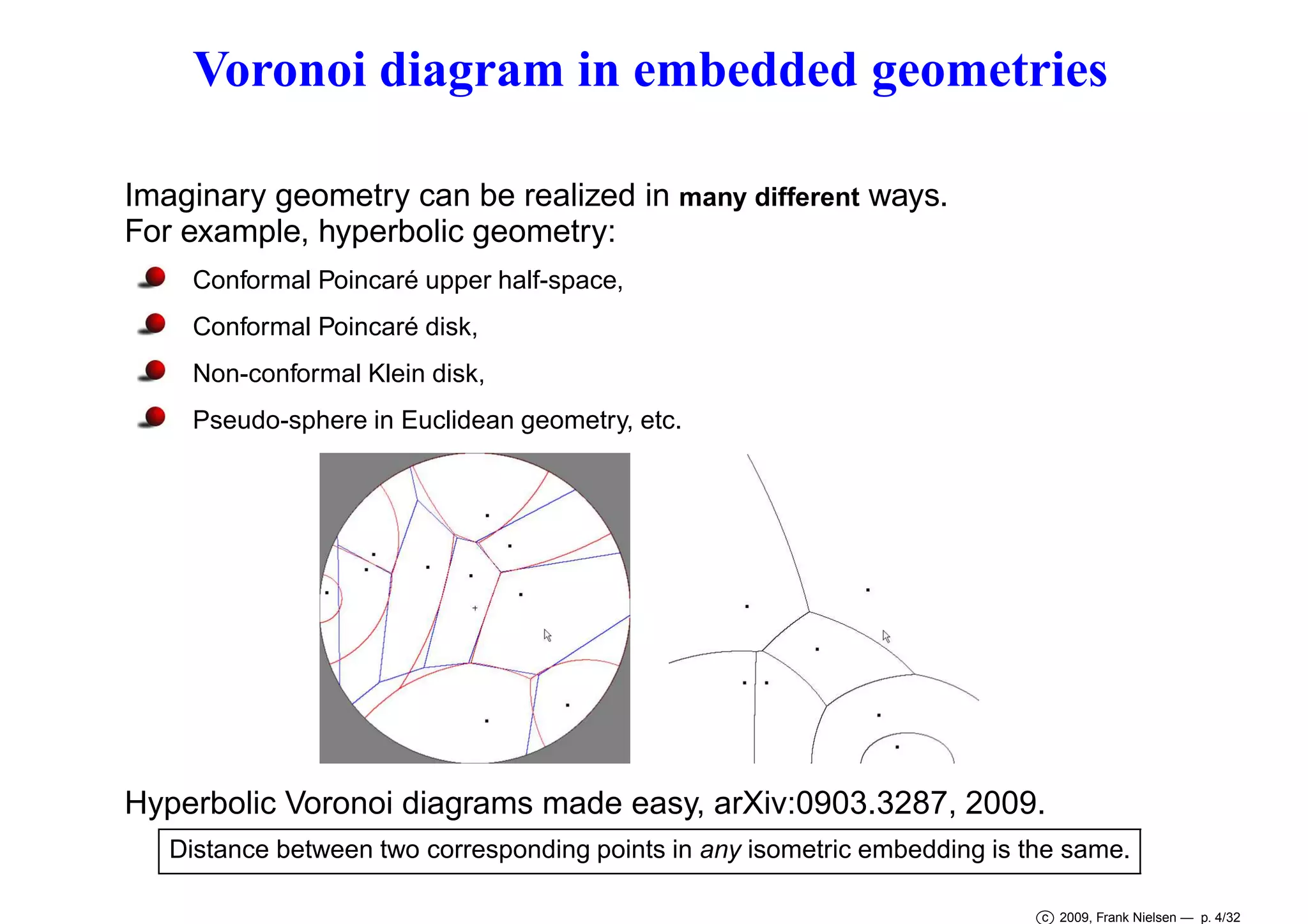
Voronoi diagram in embedded geometries
Imaginary geometry can be realized in many different ways.
For example, hyperbolic geometry:
Conformal Poincaré upper half-space,
Conformal Poincaré disk,
Non-conformal Klein disk,
Pseudo-sphere in Euclidean geometry, etc.

Hyperbolic Voronoi diagrams made easy, arXiv:0903.3287, 2009.
Distance between two corresponding points in any isometric embedding is the same.
c 2009, Frank Nielsen — p. 4/32
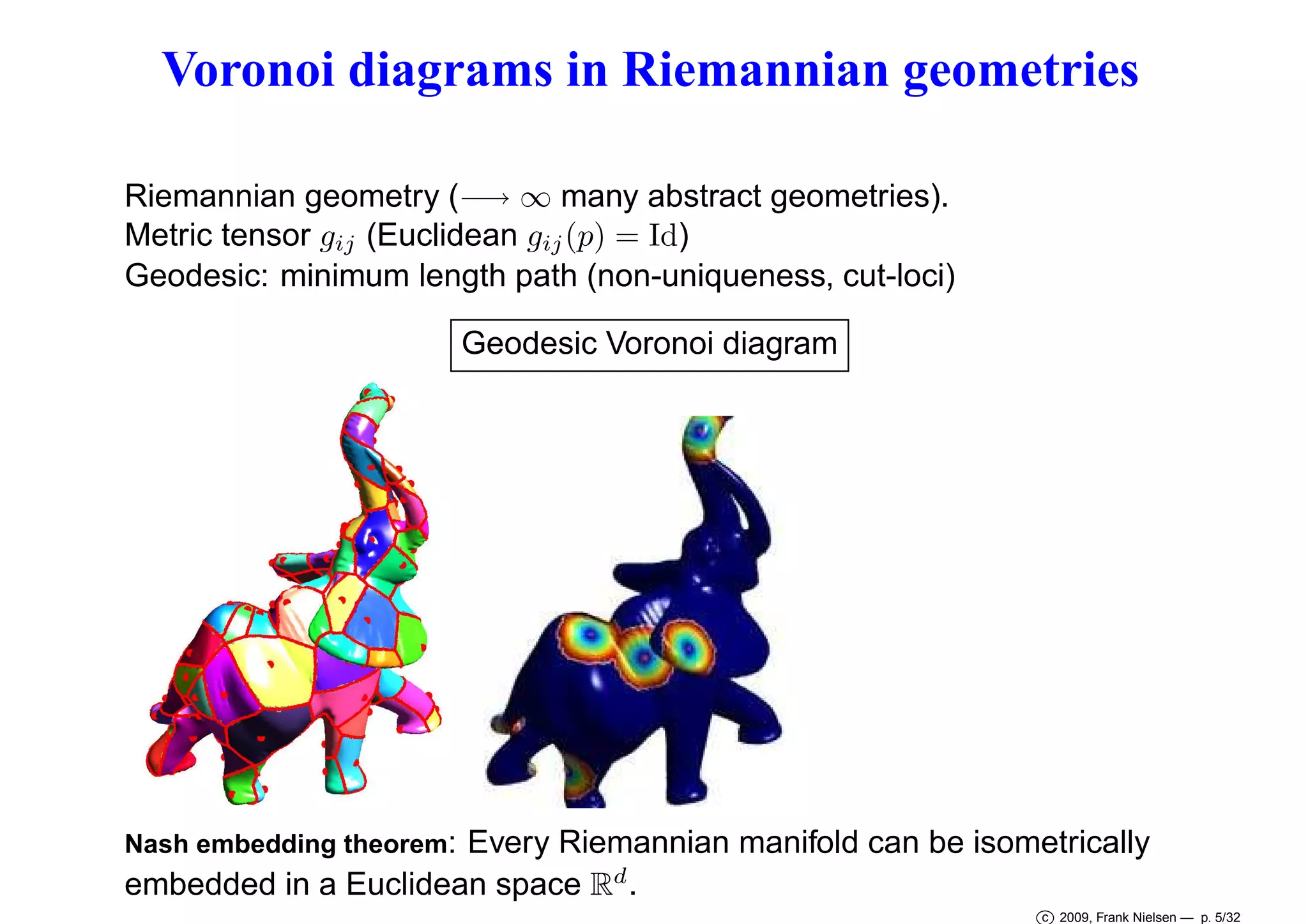
Voronoi diagrams in Riemannian geometries
Riemannian geometry (−→ ∞ many abstract geometries).
Metric tensor gij (Euclidean gij (p) = Id)
Geodesic: minimum length path (non-uniqueness, cut-loci)
Geodesic Voronoi diagram

Nash embedding theorem:

Every Riemannian manifold can be isometrically
embedded in a Euclidean space Rd .
c 2009, Frank Nielsen — p. 5/32
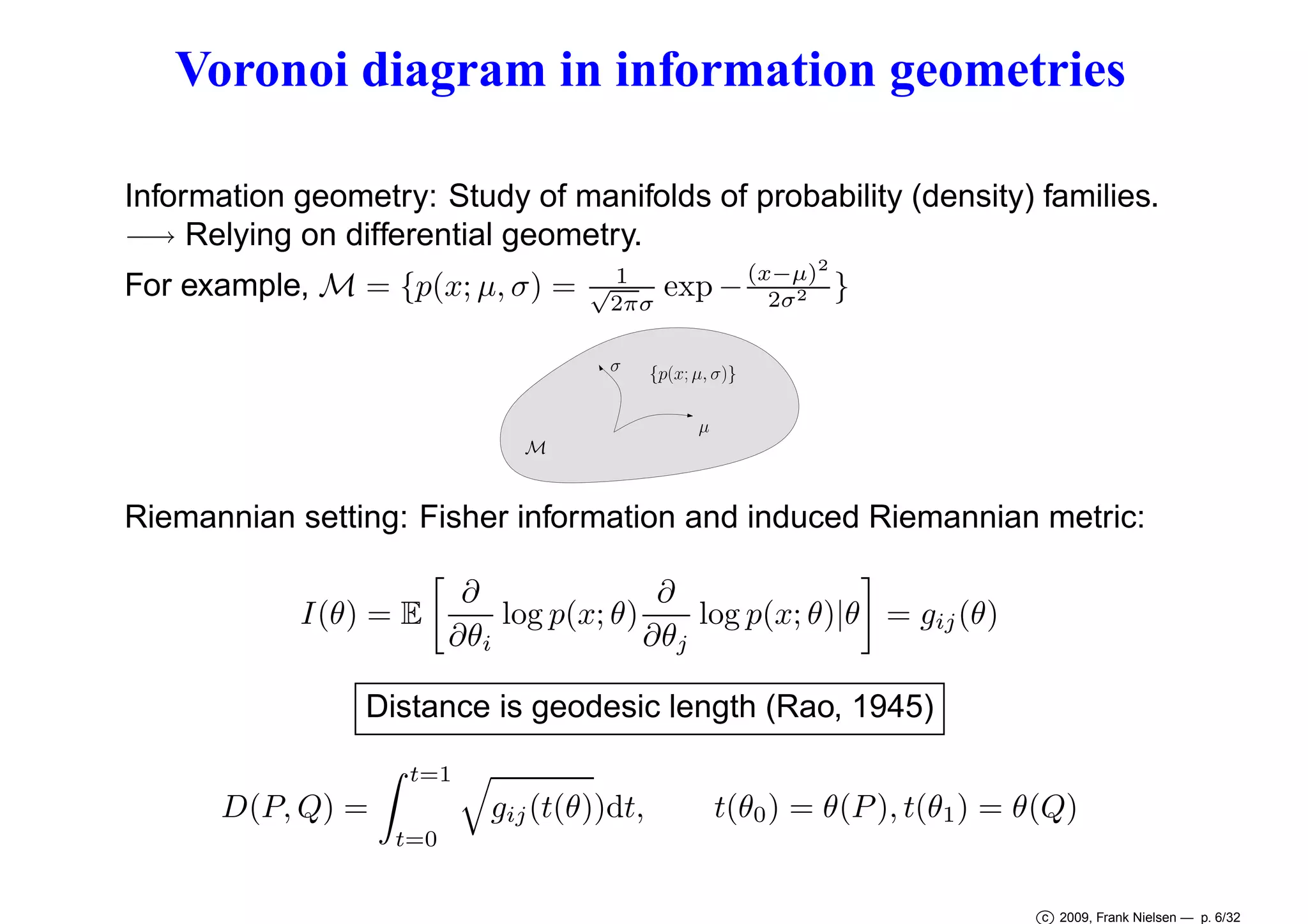
Voronoi diagram in information geometries
Information geometry: Study of manifolds of probability (density) families.
−→ Relying on differential geometry.
For example, M = {p(x; µ, σ) =

√1
2πσ
σ

(x−µ)2
exp − 2σ2 }

{p(x; µ, σ)}
µ

M

Riemannian setting: Fisher information and induced Riemannian metric:
∂
∂
log p(x; θ)
log p(x; θ)|θ = gij (θ)
I(θ) = E
∂θi
∂θj
Distance is geodesic length (Rao, 1945)
t=1

D(P, Q) =

gij (t(θ))dt,

t(θ0 ) = θ(P ), t(θ1 ) = θ(Q)

t=0

c 2009, Frank Nielsen — p. 6/32
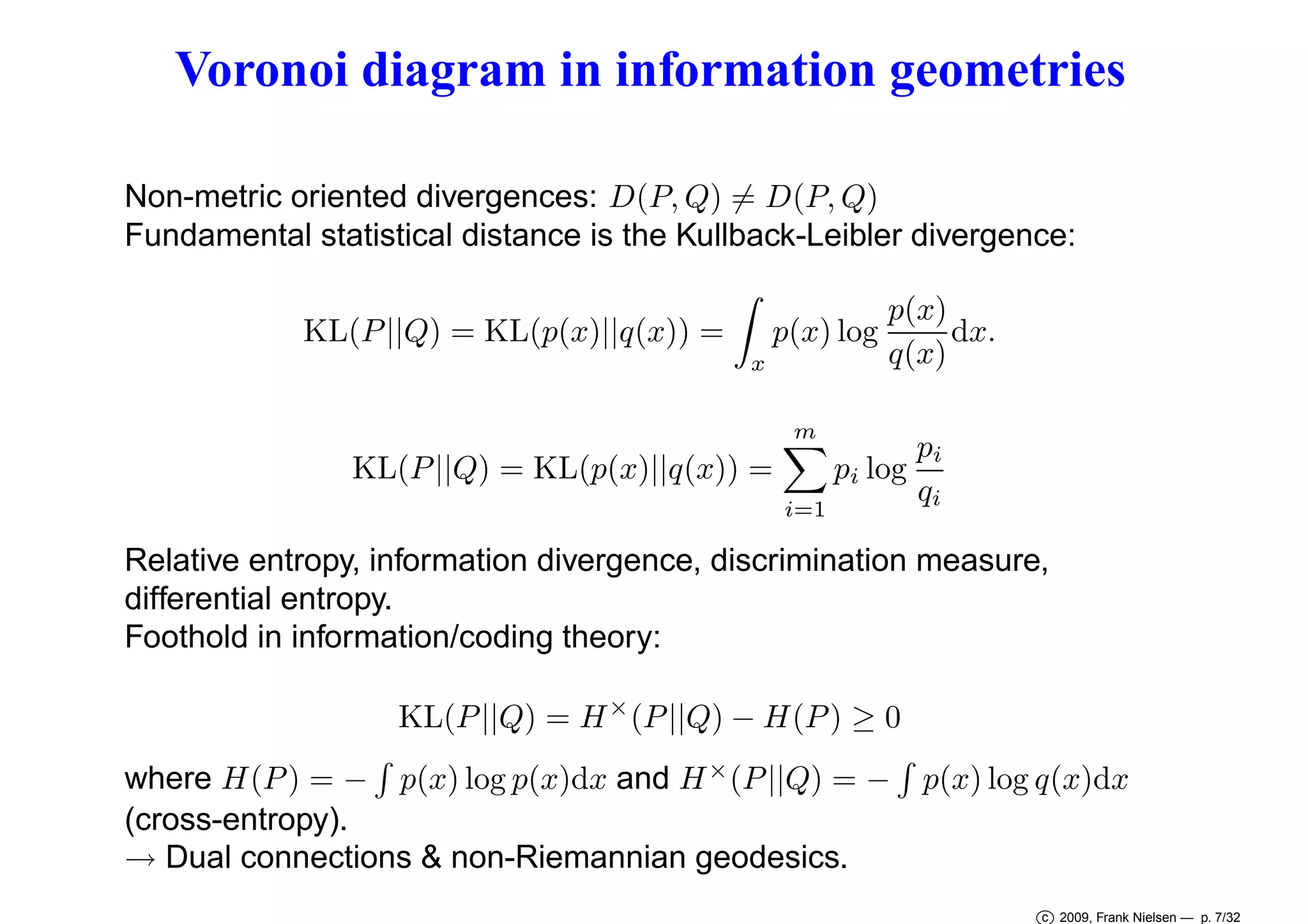
Voronoi diagram in information geometries
Non-metric oriented divergences: D(P, Q) = D(P, Q)
Fundamental statistical distance is the Kullback-Leibler divergence:
KL(P ||Q) = KL(p(x)||q(x)) =

p(x) log
x

p(x)
dx.
q(x)

m

pi
pi log
KL(P ||Q) = KL(p(x)||q(x)) =
qi
i=1
Relative entropy, information divergence, discrimination measure,
differential entropy.
Foothold in information/coding theory:
KL(P ||Q) = H × (P ||Q) − H(P ) ≥ 0
where H(P ) = − p(x) log p(x)dx and H × (P ||Q) = − p(x) log q(x)dx
(cross-entropy).
→ Dual connections & non-Riemannian geodesics.
c 2009, Frank Nielsen — p. 7/32
Dually flat spaces: Canonical Bregman divergences
Strictly convex and differentiable generator F : Rd → R.
Bregman divergence between any two vector points p and q :
DF (p||q) = F (p) − F (q) − p − q, ∇F (q) ,
where ∇F (x) denote the gradient of F at x = [x1 ... xd ]T .
F

ˆ
p

DF (p||q)

ˆ
q
Hq
X

F (x) = xT x =
F (x) =
i pi log

d
i=1
pi
qi

d
i=1

q

p

x2 −→ squared Euclidean distance: p − q
i

2.

xi log xi (Shannon’s negative entropy) −→ Kullback-Leibler divergence:
c 2009, Frank Nielsen — p. 8/32
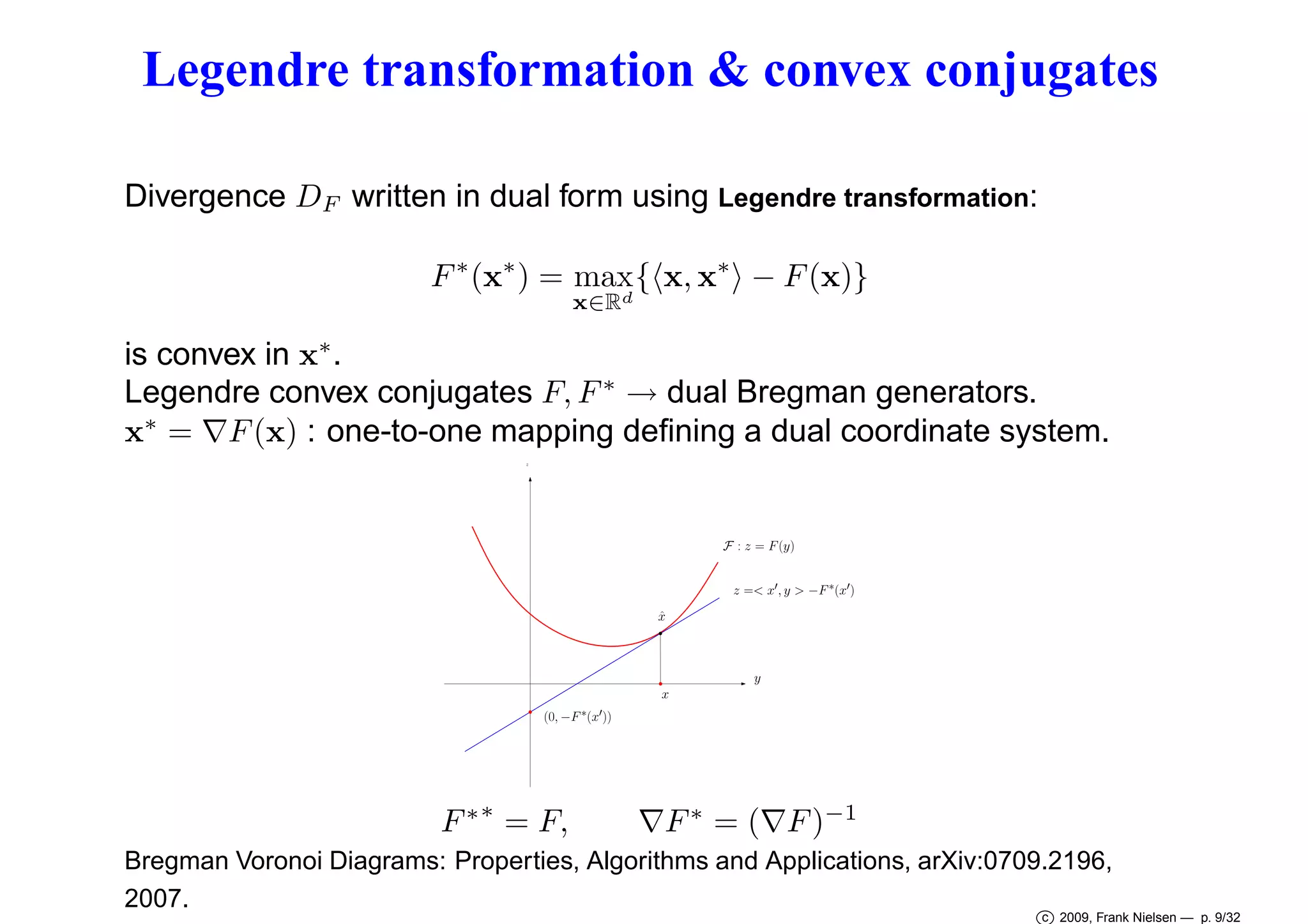
Legendre transformation & convex conjugates
Divergence DF written in dual form using Legendre transformation:
F ∗ (x∗ ) = max { x, x∗ − F (x)}
x∈Rd

is convex in x∗ .
Legendre convex conjugates F, F ∗ → dual Bregman generators.
x∗ = ∇F (x) : one-to-one mapping defining a dual coordinate system.
z

F : z = F (y)
z =< x′, y > −F ∗(x′)
ˆ
x

y
x
(0, −F ∗(x′))

F ∗ ∗ = F,

∇F ∗ = (∇F )−1

Bregman Voronoi Diagrams: Properties, Algorithms and Applications, arXiv:0709.2196,
2007.

c 2009, Frank Nielsen — p. 9/32
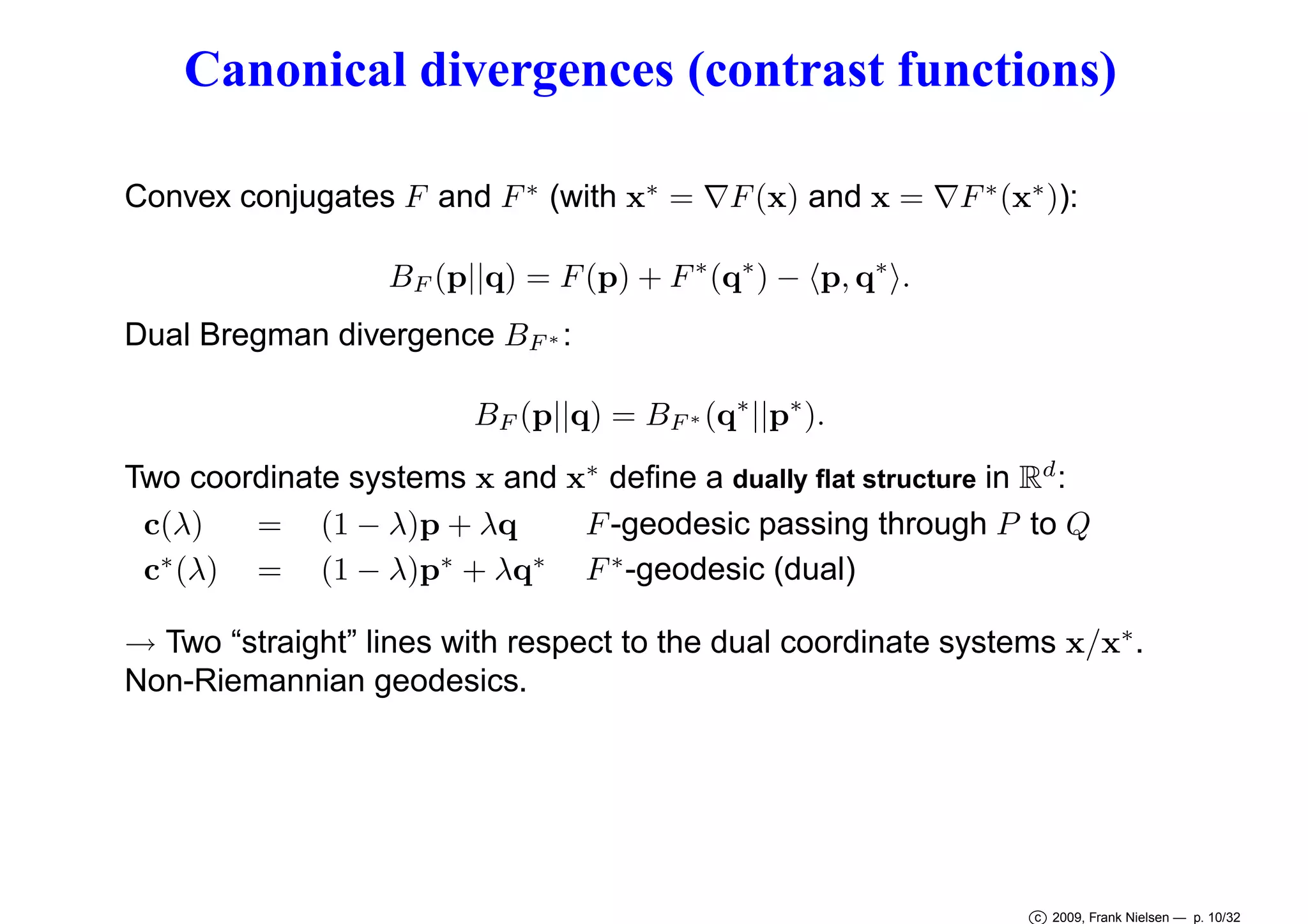
Canonical divergences (contrast functions)
Convex conjugates F and F ∗ (with x∗ = ∇F (x) and x = ∇F ∗ (x∗ )):
BF (p||q) = F (p) + F ∗ (q∗ ) − p, q∗ .
Dual Bregman divergence BF ∗ :
BF (p||q) = BF ∗ (q∗ ||p∗ ).
Two coordinate systems x and x∗ define a dually flat structure in Rd :
c(λ)
= (1 − λ)p + λq
F -geodesic passing through P to Q
c∗ (λ) = (1 − λ)p∗ + λq∗ F ∗ -geodesic (dual)
→ Two “straight” lines with respect to the dual coordinate systems x/x∗ .
Non-Riemannian geodesics.

c 2009, Frank Nielsen — p. 10/32
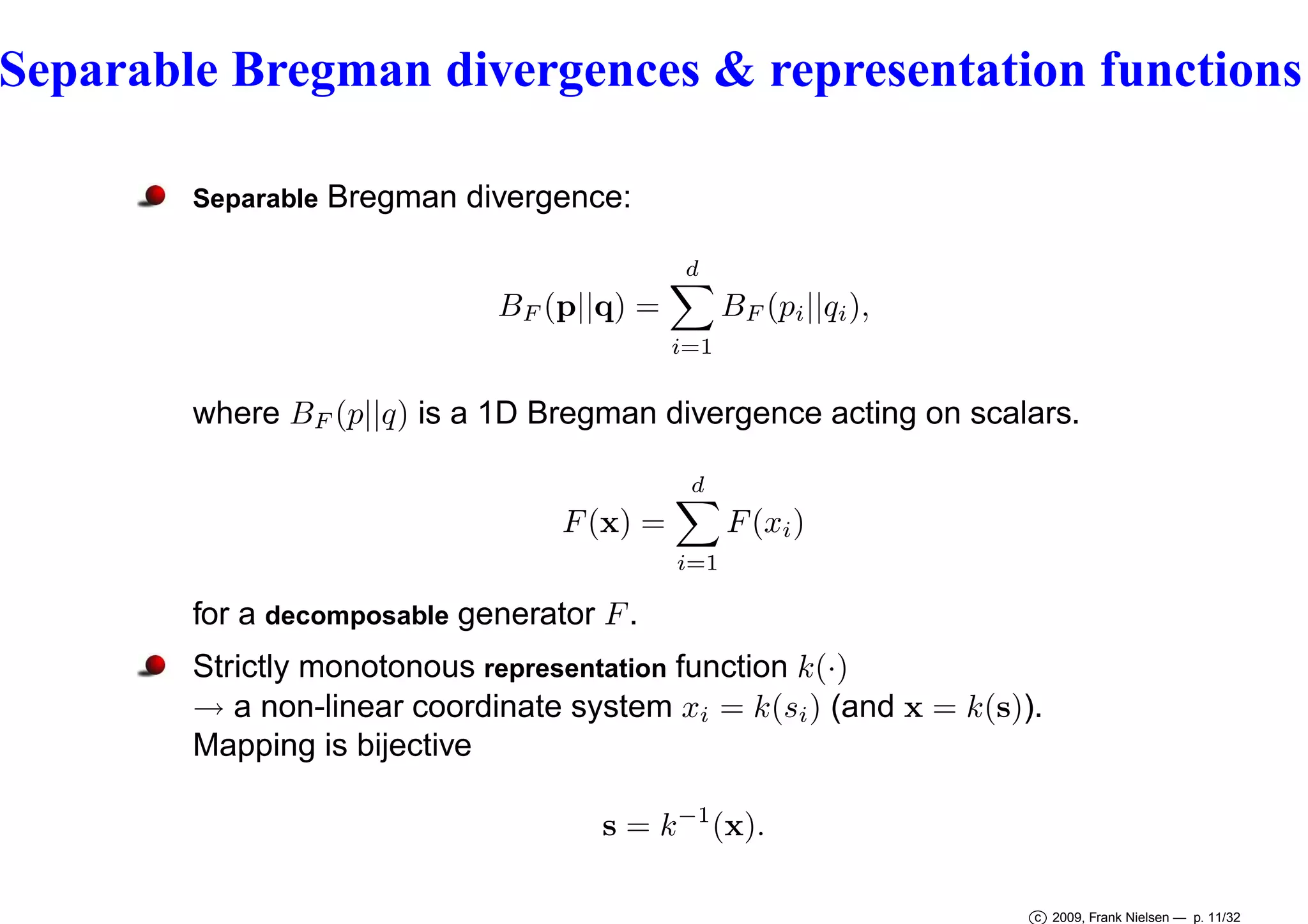
Separable Bregman divergences & representation functions
Separable

Bregman divergence:
d

BF (p||q) =
i=1

BF (pi ||qi ),

where BF (p||q) is a 1D Bregman divergence acting on scalars.
d

F (xi )

F (x) =
i=1

for a decomposable generator F .
Strictly monotonous representation function k(·)
→ a non-linear coordinate system xi = k(si ) (and x = k(s)).
Mapping is bijective
s = k −1 (x).
c 2009, Frank Nielsen — p. 11/32
Representational Bregman divergences
Bregman generator
d

d

U (k(si )) = F (s)

U (xi ) =

U (x) =
i=1

i=1

with F = U ◦ k.

Dual 1D generator U ∗ (x∗ ) = maxx {xx∗ − U (x)} induces dual
coordinate system x∗ = U ′ (xi ), where U ′ denotes the derivative of U .
i
′
∇U (x) = [U (x1 ) ... U ′ (xd )]T .
Canonical separable representational Bregman divergence:
BU,k (p||q) = U (k(p)) + U ∗ (k ∗ (q∗ )) − k(p), k ∗ (q∗ ) ,
with k ∗ (x∗ ) = U ′ (k(x)).
Often, a Bregman by setting F = U ◦ k. But although U is a strictly convex and differentiable
function and k a strictly monotonous function, F = U ◦ k may not be strictly convex.
c 2009, Frank Nielsen — p. 12/32
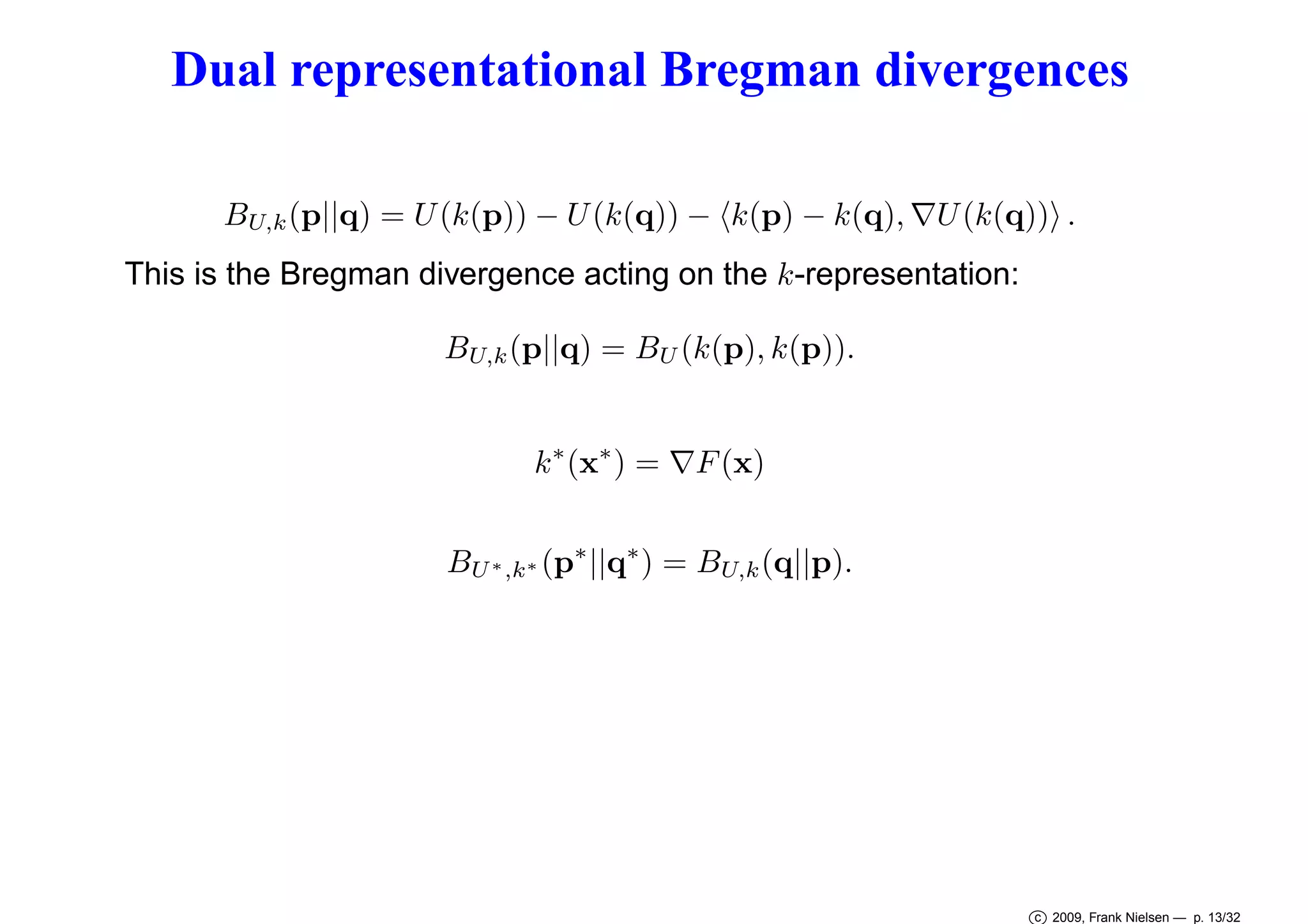
Dual representational Bregman divergences
BU,k (p||q) = U (k(p)) − U (k(q)) − k(p) − k(q), ∇U (k(q)) .
This is the Bregman divergence acting on the k-representation:
BU,k (p||q) = BU (k(p), k(p)).
k ∗ (x∗ ) = ∇F (x)
BU ∗ ,k∗ (p∗ ||q∗ ) = BU,k (q||p).

c 2009, Frank Nielsen — p. 13/32
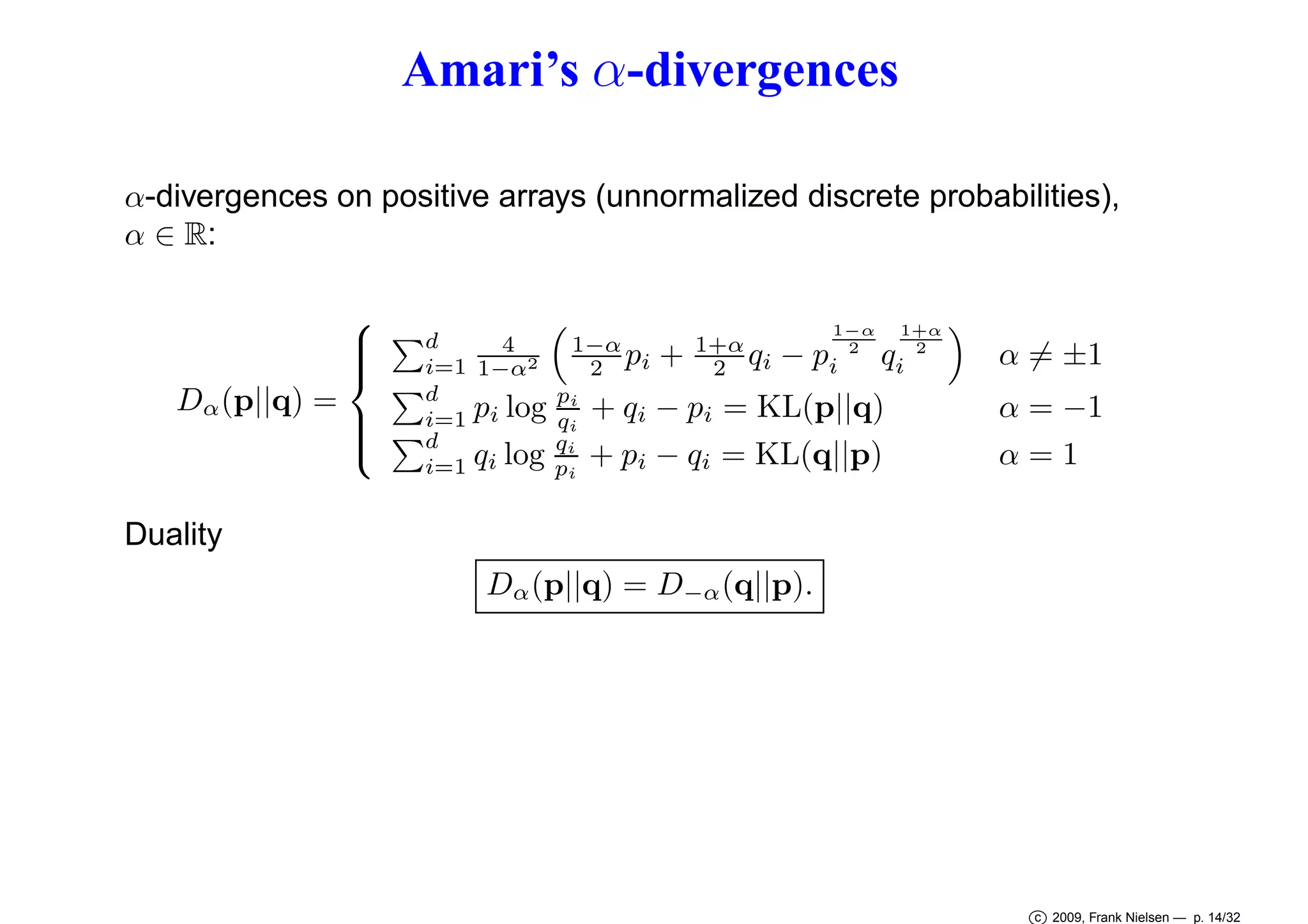
Amari’s α-divergences
α-divergences on positive arrays (unnormalized discrete probabilities),
α ∈ R:

Dα (p||q) =

Duality









d
4
i=1 1−α2
d
i=1 pi log
d
i=1 qi log

1−α
2 pi
pi
qi
qi
pi

+

1+α
2 qi

1−α
2

− pi

1+α
2

qi

+ qi − pi = KL(p||q)
+ pi − qi = KL(q||p)

α = ±1

α = −1
α=1

Dα (p||q) = D−α (q||p).

c 2009, Frank Nielsen — p. 14/32
α-divergences: Special cases of Csiszár f -divergences
Special case of Csiszár f -divergences associated with any convex
function f satisfying f (1) = f ′ (1) = 0:
d

pi f

Cf (p||q) =
i=1

qi
pi

.

For statistical measures, Cf (p||q) = EP [f (Q/P )], function of the ’likelihood
ratio’.
For α = 0, take
fα (x) =

4
1 − α2

1+α
1−α 1+α
+
x−x 2
2
2

Dα (p||q) = Cfα (p||q)
α-divergences are canonical divergences of constant-curvature
geometries.
α-divergences are representational Bregman divergences in disguise.
c 2009, Frank Nielsen — p. 15/32
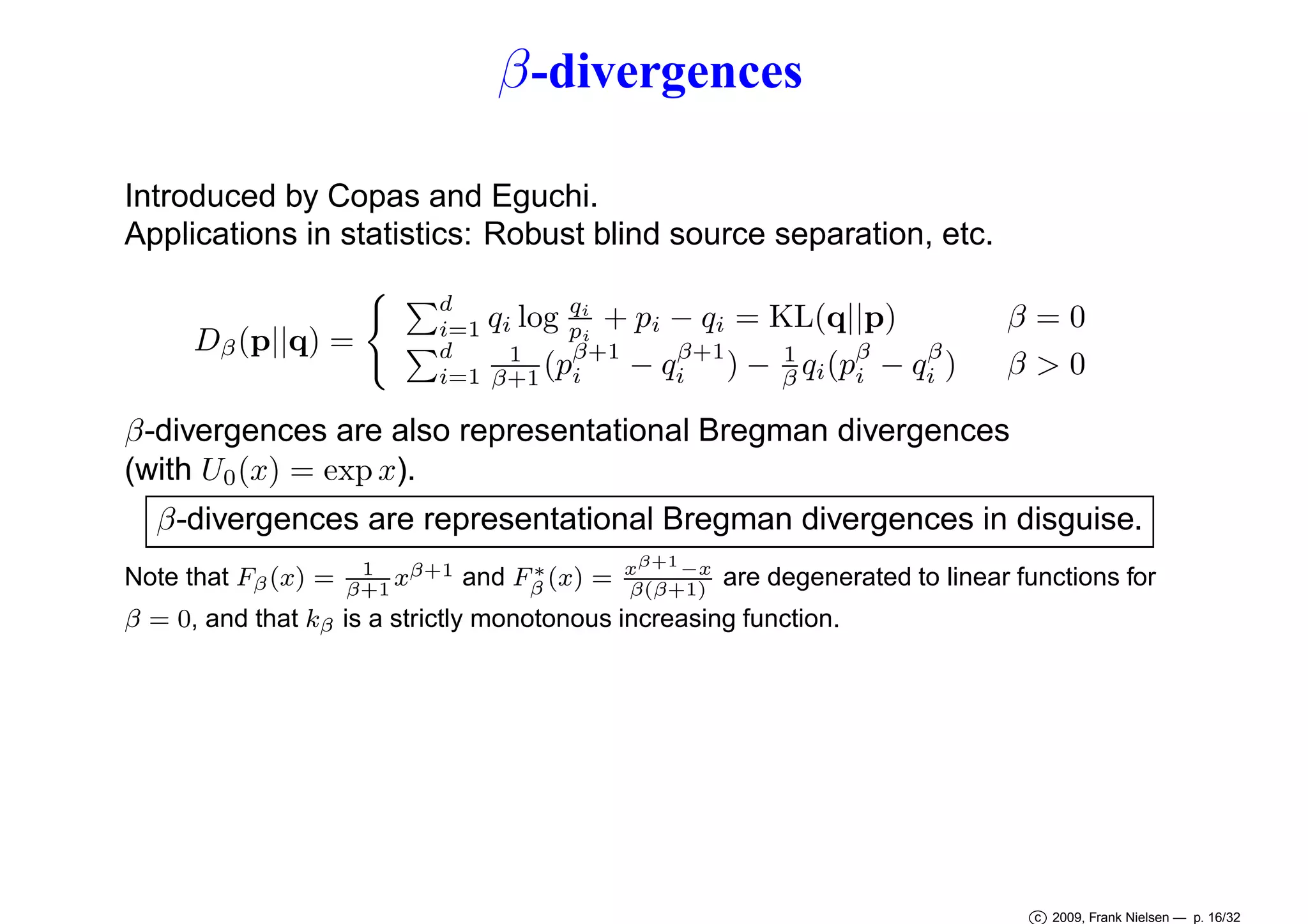
β -divergences
Introduced by Copas and Eguchi.
Applications in statistics: Robust blind source separation, etc.
Dβ (p||q) =

d
q
qi log pi + pi − qi = KL(q||p)
i=1
i
d
β+1
β
β+1
1
1
(pi − qi ) − β qi (pβ − qi )
i
i=1 β+1

β=0
β>0

β-divergences are also representational Bregman divergences
(with U0 (x) = exp x).
β-divergences are representational Bregman divergences in disguise.
Note that Fβ (x) =

1
xβ+1
β+1

∗
and Fβ (x) =

xβ+1 −x
β(β+1)

are degenerated to linear functions for

β = 0, and that kβ is a strictly monotonous increasing function.

c 2009, Frank Nielsen — p. 16/32
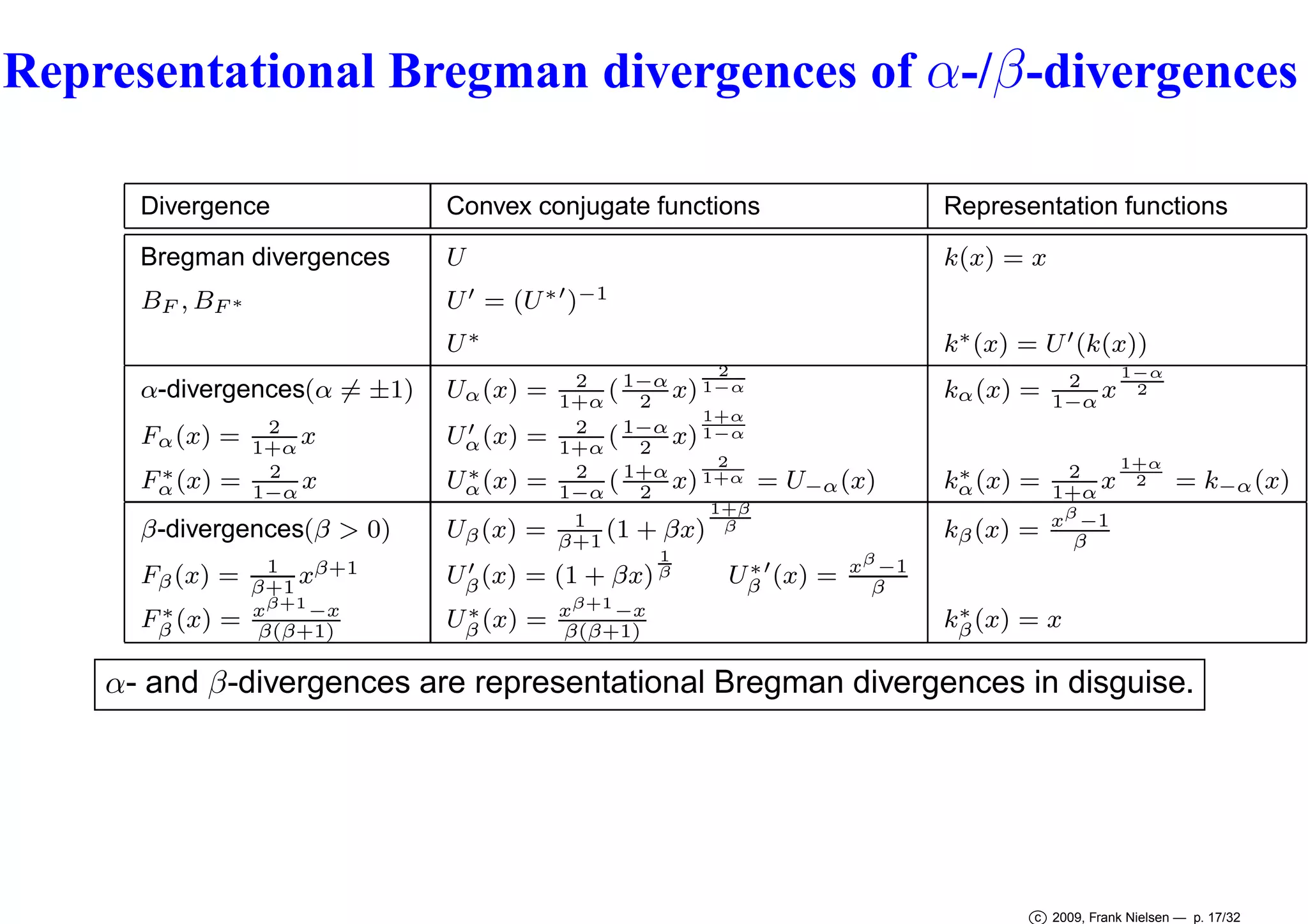
Representational Bregman divergences of α-/β -divergences
Divergence

Convex conjugate functions

Representation functions

Bregman divergences

U

k(x) = x

BF , BF ∗

U ′ = (U ∗ ′ )−1
U∗

α-divergences(α = ±1)
Fα (x) =
∗
Fα (x) =

2
x
1+α
2
x
1−α

β-divergences(β > 0)
Fβ (x) =
∗
Fβ (x) =

1
xβ+1
β+1
xβ+1 −x
β(β+1)

Uα (x) =
′
Uα (x) =
∗
Uα (x) =

Uβ (x) =
′
Uβ (x) =
∗
Uβ (x) =

k∗ (x) = U ′ (k(x))
2

2
( 1−α x) 1−α
1+α
2
1+α
1−α
2
1−α
( 2 x)
1+α
2
2
( 1+α x) 1+α = U−α (x)
1−α
2
1+β
1
(1 + βx) β
β+1
1
β
−1
∗
(1 + βx) β
Uβ ′ (x) = x β
xβ+1 −x
β(β+1)

kα (x) =
∗
kα (x) =

kβ (x) =

1−α
2
x 2
1−α

1+α
2
x 2
1+α
xβ −1
β

= k−α (x)

∗
kβ (x) = x

α- and β-divergences are representational Bregman divergences in disguise.

c 2009, Frank Nielsen — p. 17/32
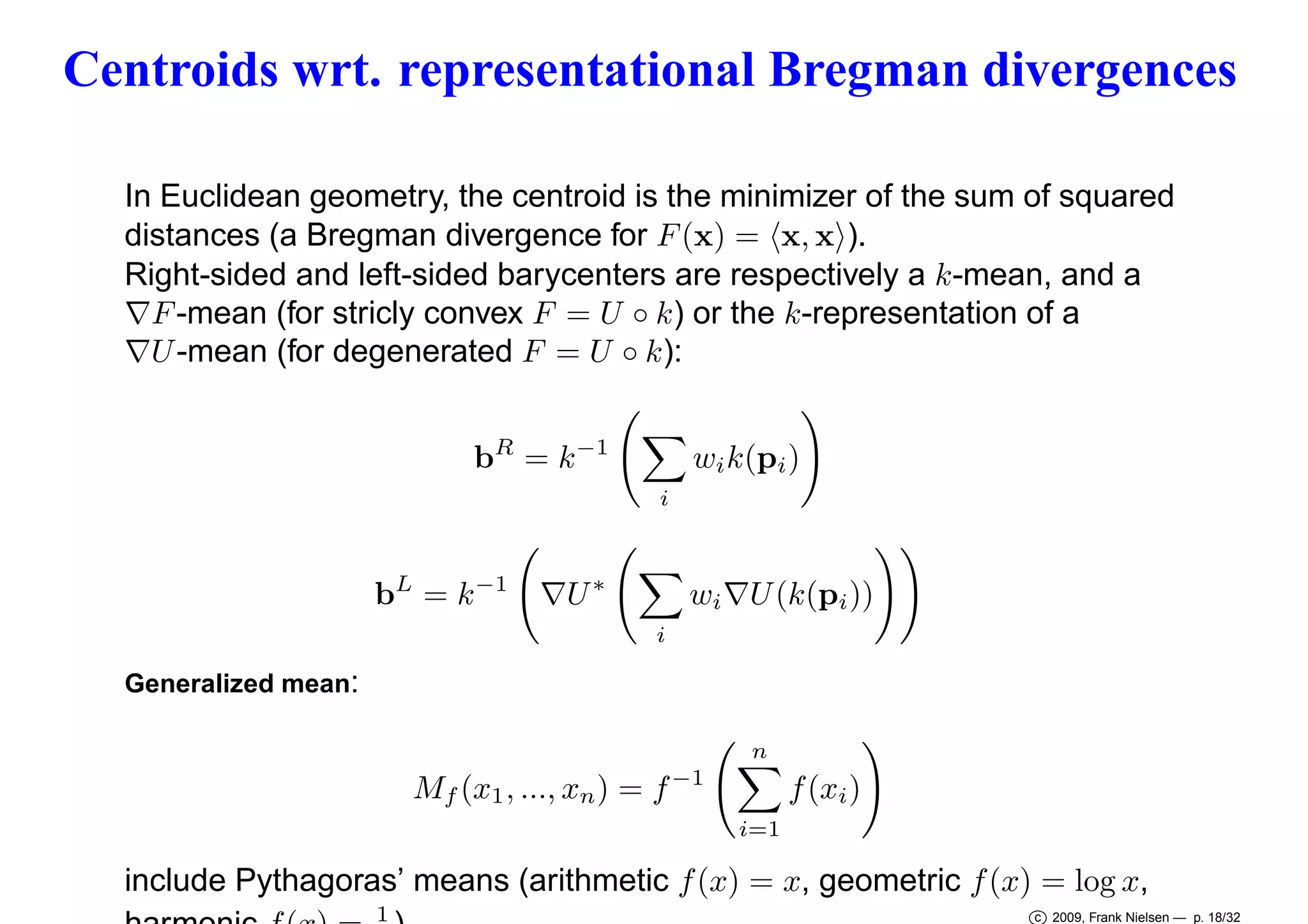
Centroids wrt. representational Bregman divergences
In Euclidean geometry, the centroid is the minimizer of the sum of squared
distances (a Bregman divergence for F (x) = x, x ).
Right-sided and left-sided barycenters are respectively a k-mean, and a
∇F -mean (for stricly convex F = U ◦ k) or the k-representation of a
∇U -mean (for degenerated F = U ◦ k):
bR = k −1

wi k(pi )
i

bL = k −1

∇U ∗

i

wi ∇U (k(pi ))

Generalized mean:
n

Mf (x1 , ..., xn ) = f −1

f (xi )
i=1

include Pythagoras’ means (arithmetic f (x) = x, geometric f (x) = log x,
1

c 2009, Frank Nielsen — p. 18/32
Centroids (proof)
1
min
c n
≡

min
c

i

1
n

BU,k (pi ||c)

i

U (k(pi )) − U (k(c)) −

mod. constants
≡
min −U (k(c)) −
c

Legendre
≡

min BU,k
c

1
n

1
n

i

k(pi ) − k(c), ∇U (k(c))

k(pi )||k(c)
i

i

k(pi ) − k(c), ∇U (k(c))

≥0

1
It follows that this is minimized for k(c) = n i k(pi ) since BU,k (p||q) = 0
1
iff. p = q. Since k is strictly monotonous, we get c = k −1 ( n i k(pi )).
Note that k −1 ◦ U −1 = (U ◦ k)−1 so that bL is merely usually a U ◦ k-mean.

c 2009, Frank Nielsen — p. 19/32
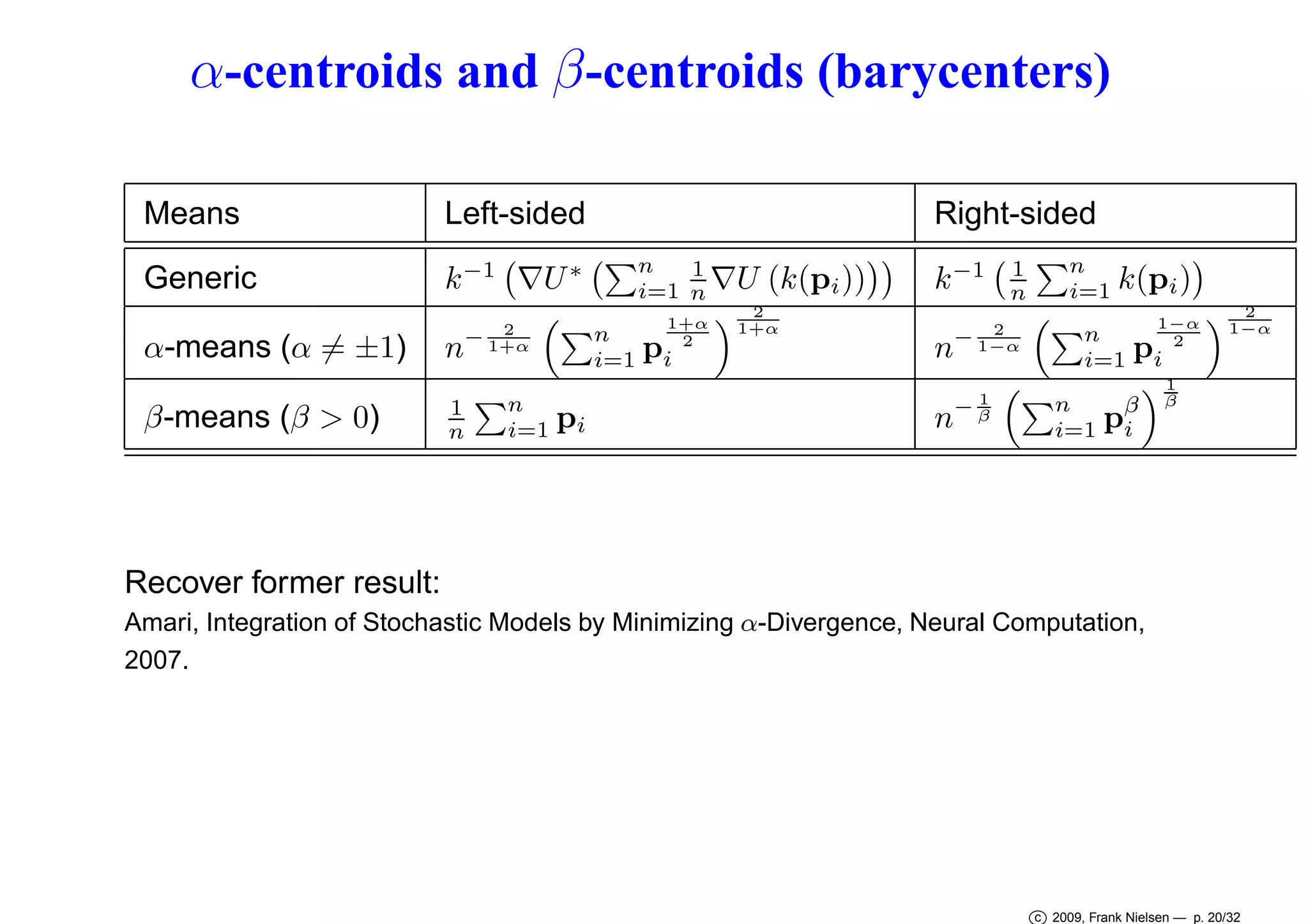
α-centroids and β -centroids (barycenters)
Means

Left-sided

Generic

k −1 ∇U ∗

α-means (α = ±1)
β-means (β > 0)

2
− 1+α

n
i=1

n
1
i=1 n ∇U
n
i=1

n

1
n

Right-sided

pi

1+α
2

pi

(k(pi ))

2
1+α

k −1

1
n

2
− 1−α

n

1
−β

n

n
i=1

k(pi )

n
i=1
n
i=1

1−α
2

pi

pβ
i

2
1−α

1
β

Recover former result:
Amari, Integration of Stochastic Models by Minimizing α-Divergence, Neural Computation,
2007.

c 2009, Frank Nielsen — p. 20/32
Generalized Bregman Voronoi diagrams as lower envelopes
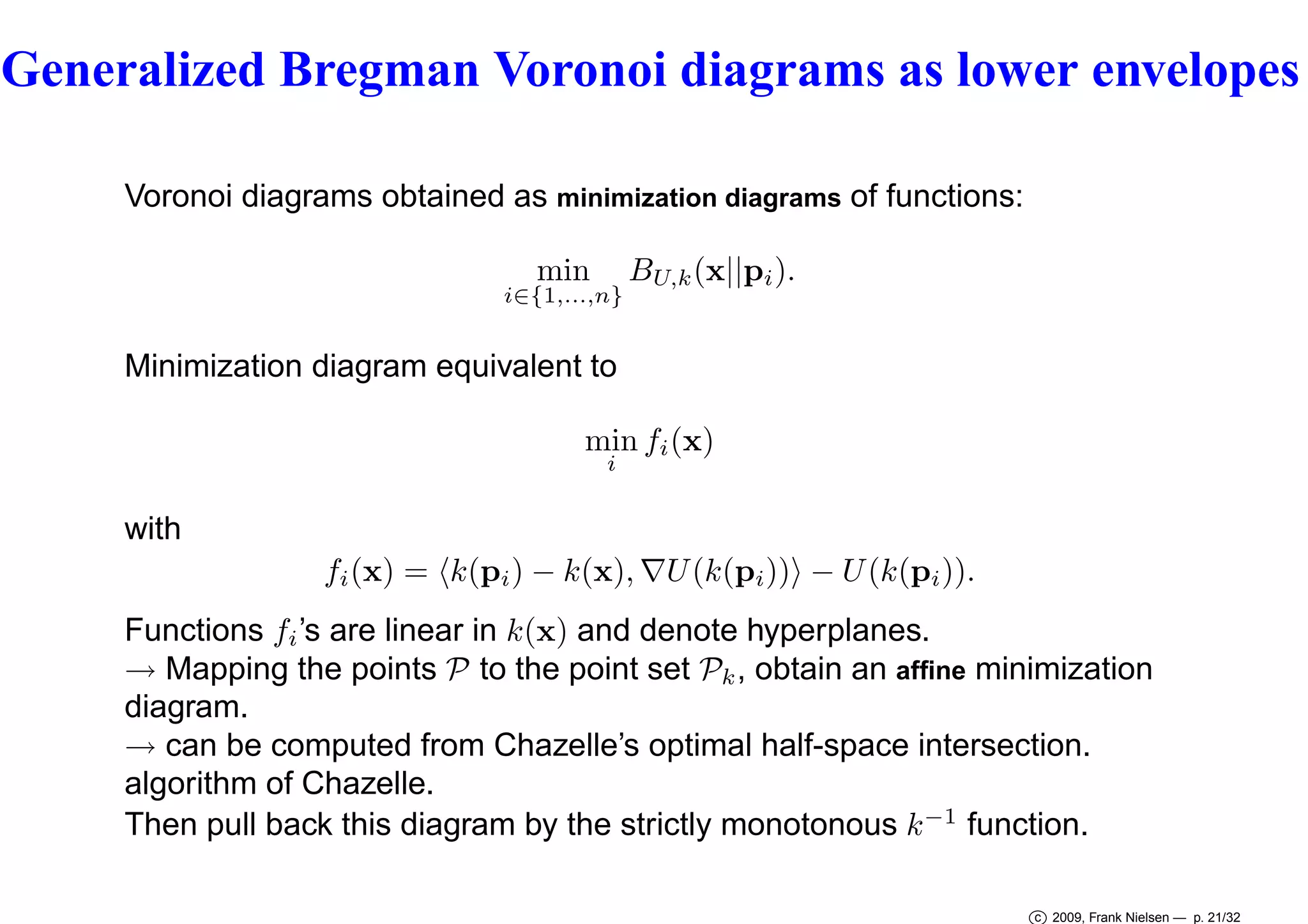
Voronoi diagrams obtained as minimization diagrams of functions:
min

i∈{1,...,n}

BU,k (x||pi ).

Minimization diagram equivalent to
min fi (x)
i

with
fi (x) = k(pi ) − k(x), ∇U (k(pi )) − U (k(pi )).
Functions fi ’s are linear in k(x) and denote hyperplanes.
→ Mapping the points P to the point set Pk , obtain an affine minimization
diagram.
→ can be computed from Chazelle’s optimal half-space intersection.
algorithm of Chazelle.
Then pull back this diagram by the strictly monotonous k −1 function.
c 2009, Frank Nielsen — p. 21/32
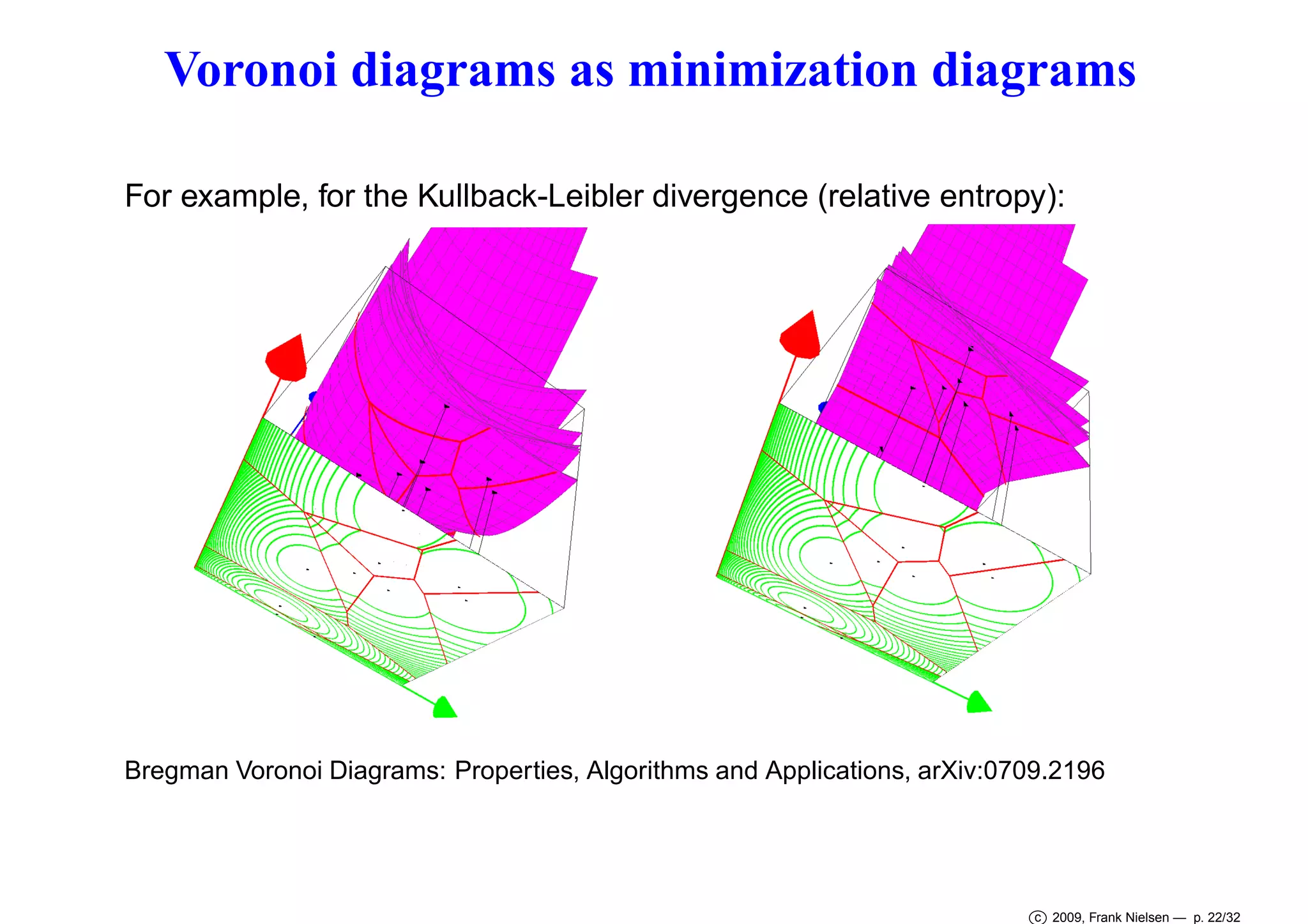
Voronoi diagrams as minimization diagrams
For example, for the Kullback-Leibler divergence (relative entropy):

Bregman Voronoi Diagrams: Properties, Algorithms and Applications, arXiv:0709.2196

c 2009, Frank Nielsen — p. 22/32
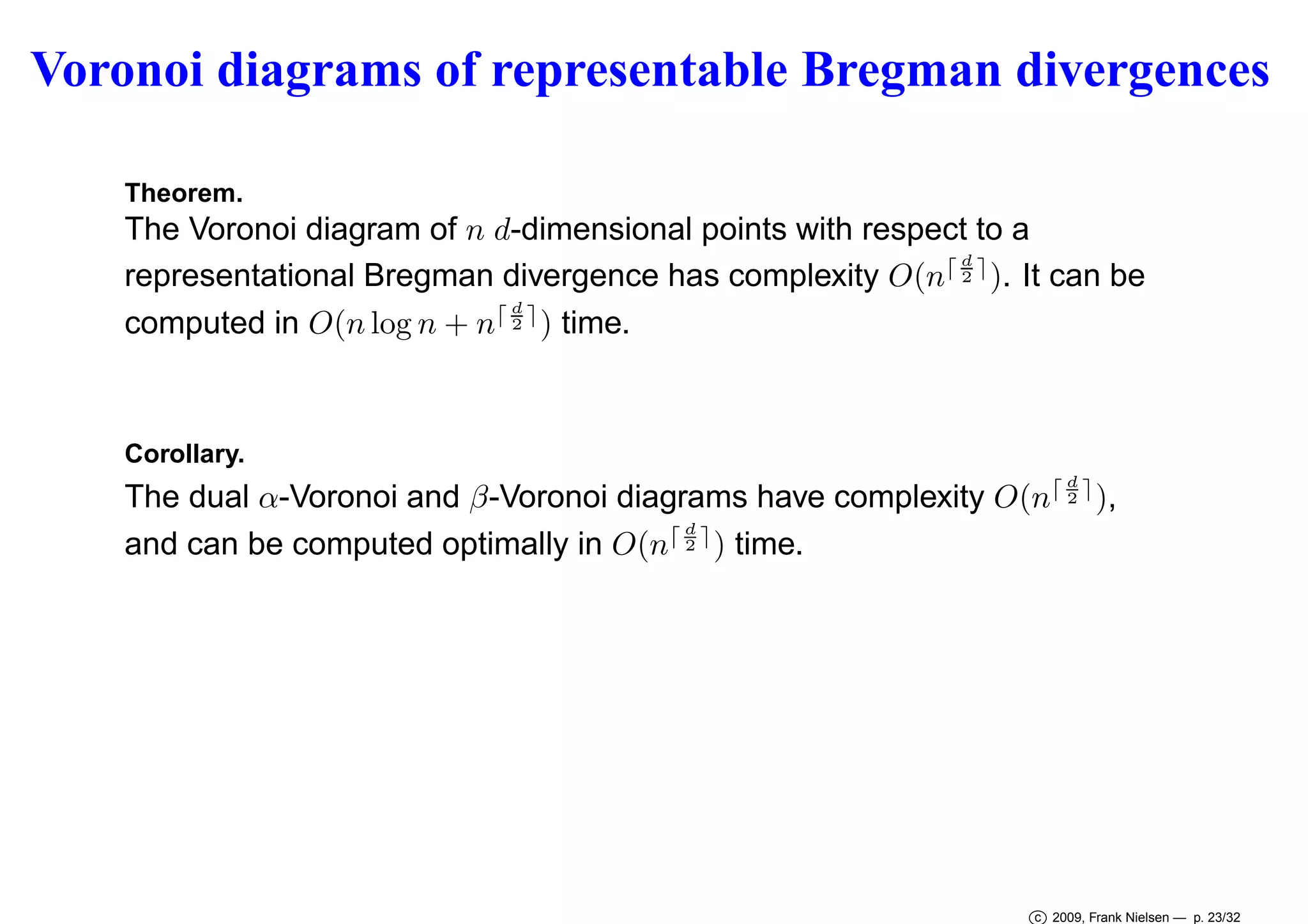
Voronoi diagrams of representable Bregman divergences
Theorem.

The Voronoi diagram of n d-dimensional points with respect to a
⌈d⌉
representational Bregman divergence has complexity O(n 2 ). It can be
d
computed in O(n log n + n⌈ 2 ⌉ ) time.

Corollary.
d

The dual α-Voronoi and β-Voronoi diagrams have complexity O(n⌈ 2 ⌉ ),
⌈d⌉
and can be computed optimally in O(n 2 ) time.

c 2009, Frank Nielsen — p. 23/32
α-Voronoi diagrams
Right-sided α-bisectors
Hα (p, q) : {x ∈ X |Dα (p|| x ) = Dα (q|| x )}
for α = ±1.
=⇒ Hα (p, q) :
i
1+α
2

Letting X = [x1

1+α
2

... xd

1−α
1−α
1+α
1−α
2 (q 2
− p 2 ) = 0.
(pi − qi ) + x
2

]T , we get hyperplane bisectors:

Xi (q

Hα (p, q) :
i

1−α
2

−p

1−α
2

)+
i

1−α
(pi − qi ) = 0.
2

Right-sided α-Voronoi diagram is affine in the k(x) = x
d
with complexity O(n⌈ 2 ⌉ ).

1+α
2

-representation

Indeed, D(X||Pi ) = BU,k (x||pi ) ≤ D(X||Pj ) = BU,k (x||pj ) ⇐⇒ BU (k(x)||k(pi )) ≤
BU (k(x)||k(pj )).
c 2009, Frank Nielsen — p. 24/32
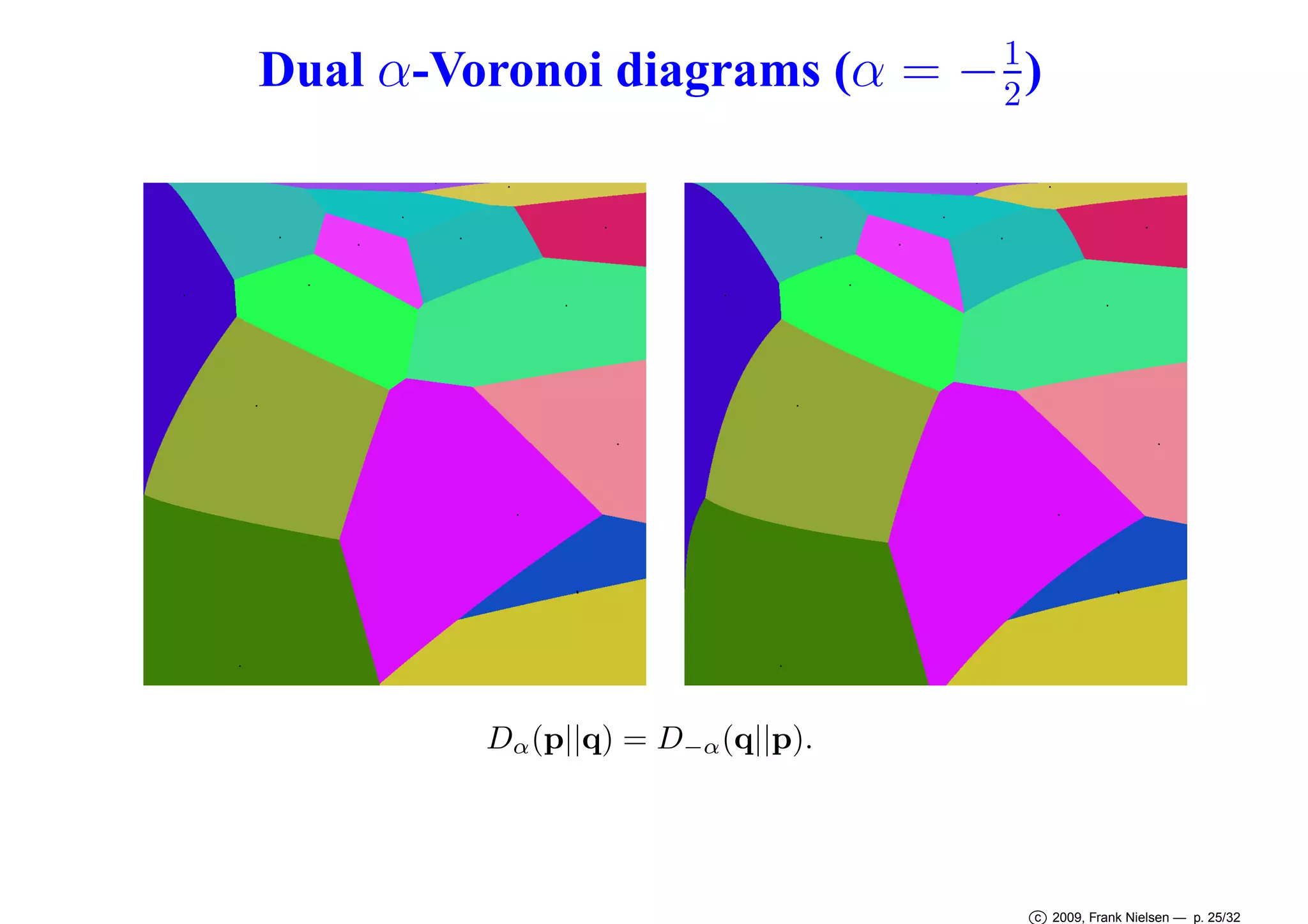
1
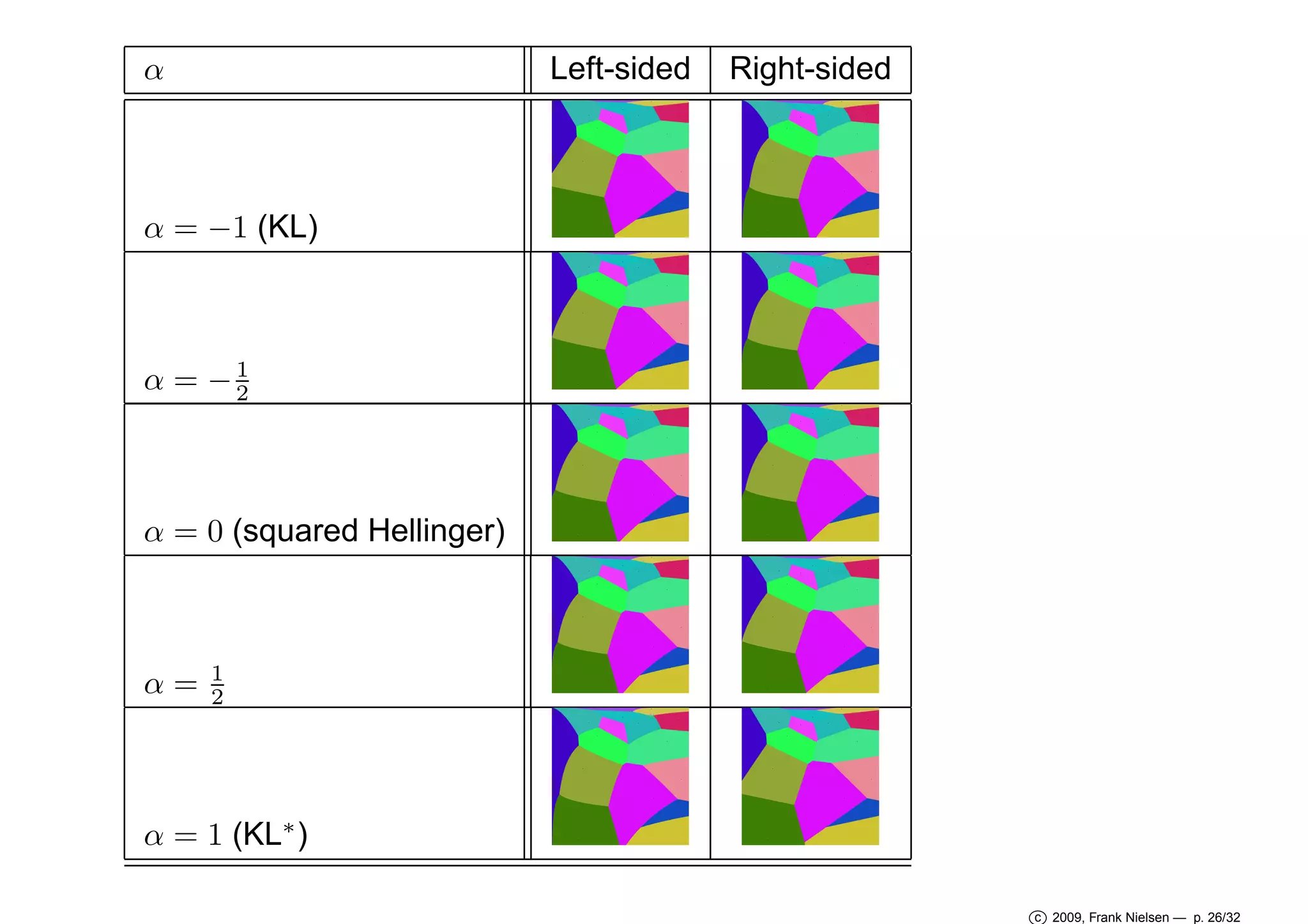
Dual α-Voronoi diagrams (α = − 2 )

Dα (p||q) = D−α (q||p).

c 2009, Frank Nielsen — p. 25/32
α

Left-sided

Right-sided

α = −1 (KL)

1
α = −2

α = 0 (squared Hellinger)

α=

1
2

α = 1 (KL∗ )
c 2009, Frank Nielsen — p. 26/32
Dual β -Voronoi diagrams
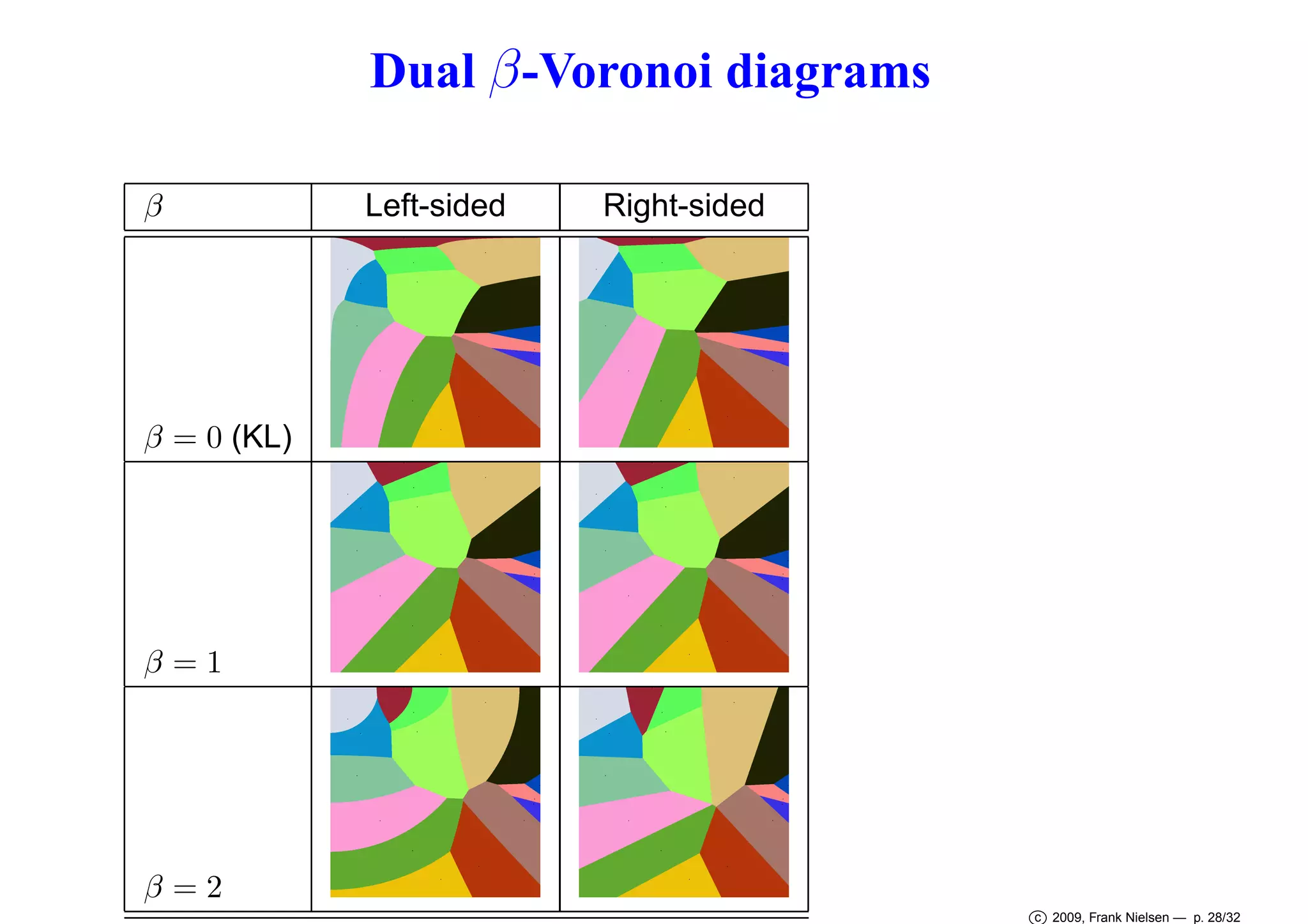
Right-sided β-Voronoi diagrams are affine for β > 0. Indeed, the
β-bisector
Hβ (p, q) : {x ∈ X |Dβ (p||x) = Dβ (q||x)}
yields a linear equation:
d

Hβ (p, q) :
i=1

1
1
β+1
β
β+1
(pi − qi ) − xi (pβ − qi ) = 0.
i
β+1
β

c 2009, Frank Nielsen — p. 27/32
Dual β -Voronoi diagrams
β

Left-sided

Right-sided

β = 0 (KL)

β=1

β=2
c 2009, Frank Nielsen — p. 28/32
Power diagrams in Laguerre geometry
Power distance of x to a ball B = B(p, r):
D(x, Ball(p, r)) = ||p − x||2 − r 2
Radical hyperplane:
2
2
2 x, pj − pi + ||pi ||2 − ||pj ||2 + rj − ri = 0

Power diagrams are affine diagrams

Universal construction theorem:

Any affine diagram is identical to the power diagram of a set of
corresponding balls. (Aurenhammer’87)
c 2009, Frank Nielsen — p. 29/32
Rep. Bregman Voronoi diagrams as power diagrams
Seek for transformations to match representable Bregman/power bisector
equations:
2
2
2 x, pj − pi + ||pi ||2 − ||pj ||2 + rj − ri = 0

fi (x) = fj (x)
with
fl (x) = k(pl ) − k(x), ∇U (k(pl )) − U (k(pl )).
We get
pi → ∇U (k(pi ))
ri = U (k(pi )), U (k(pi )) + 2U (k(pi )) − pi , U (k(pi )) .
Representational Bregman Voronoi diagrams can be built from power diagrans

c 2009, Frank Nielsen — p. 30/32
Concluding remarks
Geometries and embeddings
Representable Bregman Voronoi diagrams
Dual α- and β-Voronoi diagrams
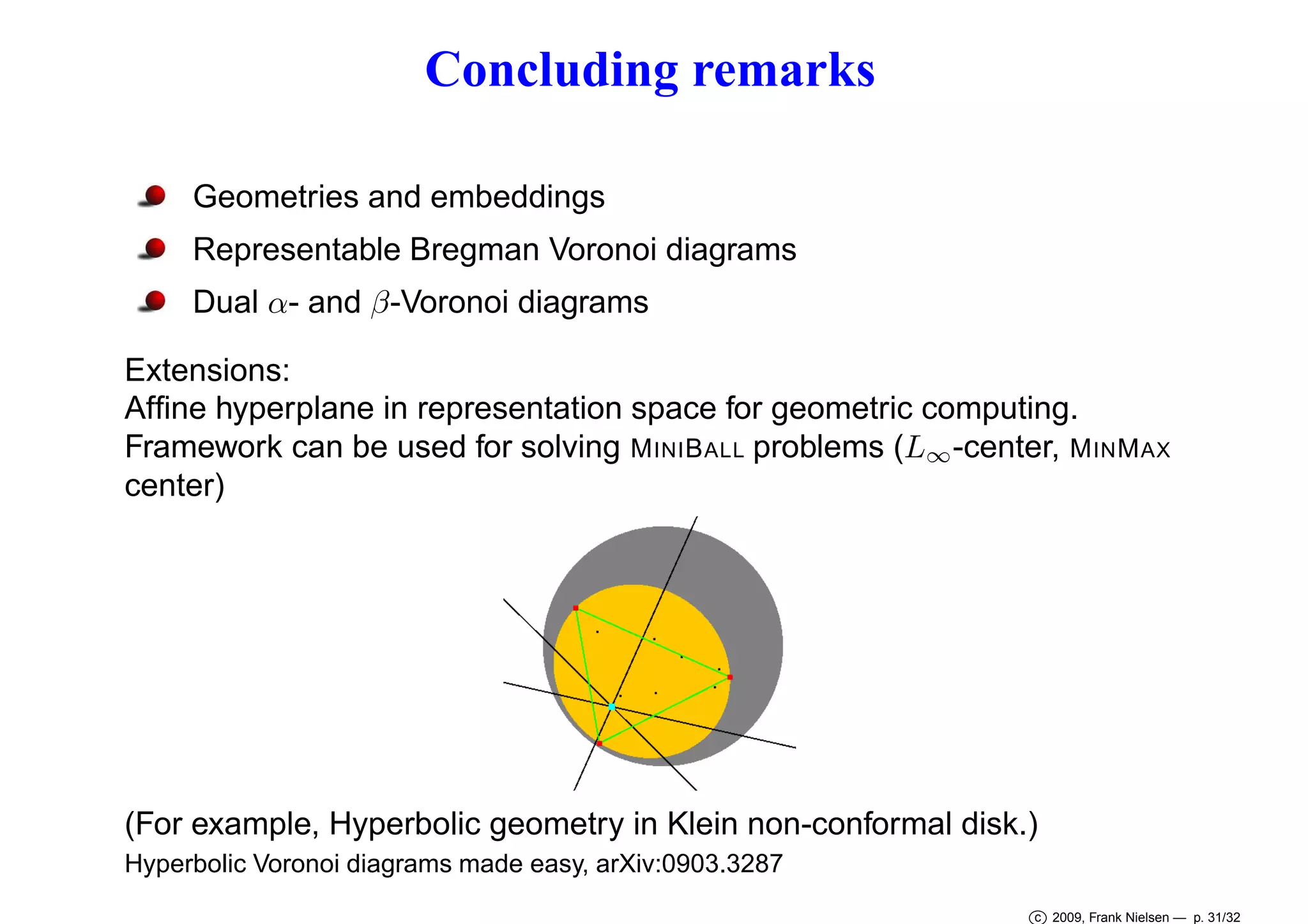
Extensions:
Affine hyperplane in representation space for geometric computing.
Framework can be used for solving M INI B ALL problems (L∞ -center, M IN M AX
center)

(For example, Hyperbolic geometry in Klein non-conformal disk.)
Hyperbolic Voronoi diagrams made easy, arXiv:0903.3287
c 2009, Frank Nielsen — p. 31/32
Thank you very much
References:
co-authors: Jean-Daniel Boissonnat, Richard Nock.
On Bregman Voronoi diagrams. In Proceedings of the Eighteenth Annual
ACM-SIAM Symposium on Discrete Algorithms (New Orleans, Louisiana,

January 07 - 09, 2007). pp. 746-755.
Visualizing Bregman Voronoi diagrams. In Proceedings of the Twenty-Third
Annual Symposium on Computational Geometry (Gyeongju, South Korea,

June 06 - 08, 2007). pp. 121-122.
Bregman Voronoi Diagrams: Properties, Algorithms and Applications,
arXiv:0709.2196

c 2009, Frank Nielsen — p. 32/32

Slides: The dual Voronoi diagrams with respect to representational Bregman divergences (ISVD 2009)

  • 1.
    The dual Voronoidiagrams with respect to representational Bregman divergences Frank Nielsen and Richard Nock frank.nielsen@polytechnique.edu ´ Ecole Polytechnique, LIX, France Sony Computer Science Laboratories Inc, FRL, Japan International Symposium on Voronoi Diagrams (ISVD) June 2009 c 2009, Frank Nielsen — p. 1/32
  • 2.
    Ordinary Voronoi diagram P= {P1 , ..., Pn } ∈ X : point set with vector coordinates p1 , ..., pn ∈ Rd . Voronoi diagram: partition in proximal regions vor(Pi ) of X wrt. a distance: vor(Pi ) = {X ∈ X | D(X, Pi ) ≤ D(X, Pj ) ∀j ∈ {1, ..., n}}. Ordinary Voronoi diagram in Euclidean geometry defined for D(X, Y ) = x − y = d i=1 (xi René Descartes’ manual rendering (17th C.) − yi )2 . computer rendering c 2009, Frank Nielsen — p. 2/32
  • 3.
    Voronoi diagram inabstract geometries Birth of non-Euclidean geometries (accepted in 19th century) Spherical (elliptical) and hyperbolic (Lobachevsky) imaginary geometries Spherical Voronoi Hyperbolic Voronoi (Poincaré upper plane) p−q 2 2py qy D(p, q) = arccos p, q with D(p, q) = arccosh1 + √ arccoshx = log(x + x2 − 1) py D(p, q) = log qy (vertical line) D(p, q) = |px −qx | py (horizontal line) c 2009, Frank Nielsen — p. 3/32
  • 4.
    Voronoi diagram inembedded geometries Imaginary geometry can be realized in many different ways. For example, hyperbolic geometry: Conformal Poincaré upper half-space, Conformal Poincaré disk, Non-conformal Klein disk, Pseudo-sphere in Euclidean geometry, etc. Hyperbolic Voronoi diagrams made easy, arXiv:0903.3287, 2009. Distance between two corresponding points in any isometric embedding is the same. c 2009, Frank Nielsen — p. 4/32
  • 5.
    Voronoi diagrams inRiemannian geometries Riemannian geometry (−→ ∞ many abstract geometries). Metric tensor gij (Euclidean gij (p) = Id) Geodesic: minimum length path (non-uniqueness, cut-loci) Geodesic Voronoi diagram Nash embedding theorem: Every Riemannian manifold can be isometrically embedded in a Euclidean space Rd . c 2009, Frank Nielsen — p. 5/32
  • 6.
    Voronoi diagram ininformation geometries Information geometry: Study of manifolds of probability (density) families. −→ Relying on differential geometry. For example, M = {p(x; µ, σ) = √1 2πσ σ (x−µ)2 exp − 2σ2 } {p(x; µ, σ)} µ M Riemannian setting: Fisher information and induced Riemannian metric: ∂ ∂ log p(x; θ) log p(x; θ)|θ = gij (θ) I(θ) = E ∂θi ∂θj Distance is geodesic length (Rao, 1945) t=1 D(P, Q) = gij (t(θ))dt, t(θ0 ) = θ(P ), t(θ1 ) = θ(Q) t=0 c 2009, Frank Nielsen — p. 6/32
  • 7.
    Voronoi diagram ininformation geometries Non-metric oriented divergences: D(P, Q) = D(P, Q) Fundamental statistical distance is the Kullback-Leibler divergence: KL(P ||Q) = KL(p(x)||q(x)) = p(x) log x p(x) dx. q(x) m pi pi log KL(P ||Q) = KL(p(x)||q(x)) = qi i=1 Relative entropy, information divergence, discrimination measure, differential entropy. Foothold in information/coding theory: KL(P ||Q) = H × (P ||Q) − H(P ) ≥ 0 where H(P ) = − p(x) log p(x)dx and H × (P ||Q) = − p(x) log q(x)dx (cross-entropy). → Dual connections & non-Riemannian geodesics. c 2009, Frank Nielsen — p. 7/32
  • 8.
    Dually flat spaces:Canonical Bregman divergences Strictly convex and differentiable generator F : Rd → R. Bregman divergence between any two vector points p and q : DF (p||q) = F (p) − F (q) − p − q, ∇F (q) , where ∇F (x) denote the gradient of F at x = [x1 ... xd ]T . F ˆ p DF (p||q) ˆ q Hq X F (x) = xT x = F (x) = i pi log d i=1 pi qi d i=1 q p x2 −→ squared Euclidean distance: p − q i 2. xi log xi (Shannon’s negative entropy) −→ Kullback-Leibler divergence: c 2009, Frank Nielsen — p. 8/32
  • 9.
    Legendre transformation &convex conjugates Divergence DF written in dual form using Legendre transformation: F ∗ (x∗ ) = max { x, x∗ − F (x)} x∈Rd is convex in x∗ . Legendre convex conjugates F, F ∗ → dual Bregman generators. x∗ = ∇F (x) : one-to-one mapping defining a dual coordinate system. z F : z = F (y) z =< x′, y > −F ∗(x′) ˆ x y x (0, −F ∗(x′)) F ∗ ∗ = F, ∇F ∗ = (∇F )−1 Bregman Voronoi Diagrams: Properties, Algorithms and Applications, arXiv:0709.2196, 2007. c 2009, Frank Nielsen — p. 9/32
  • 10.
    Canonical divergences (contrastfunctions) Convex conjugates F and F ∗ (with x∗ = ∇F (x) and x = ∇F ∗ (x∗ )): BF (p||q) = F (p) + F ∗ (q∗ ) − p, q∗ . Dual Bregman divergence BF ∗ : BF (p||q) = BF ∗ (q∗ ||p∗ ). Two coordinate systems x and x∗ define a dually flat structure in Rd : c(λ) = (1 − λ)p + λq F -geodesic passing through P to Q c∗ (λ) = (1 − λ)p∗ + λq∗ F ∗ -geodesic (dual) → Two “straight” lines with respect to the dual coordinate systems x/x∗ . Non-Riemannian geodesics. c 2009, Frank Nielsen — p. 10/32
  • 11.
    Separable Bregman divergences& representation functions Separable Bregman divergence: d BF (p||q) = i=1 BF (pi ||qi ), where BF (p||q) is a 1D Bregman divergence acting on scalars. d F (xi ) F (x) = i=1 for a decomposable generator F . Strictly monotonous representation function k(·) → a non-linear coordinate system xi = k(si ) (and x = k(s)). Mapping is bijective s = k −1 (x). c 2009, Frank Nielsen — p. 11/32
  • 12.
    Representational Bregman divergences Bregmangenerator d d U (k(si )) = F (s) U (xi ) = U (x) = i=1 i=1 with F = U ◦ k. Dual 1D generator U ∗ (x∗ ) = maxx {xx∗ − U (x)} induces dual coordinate system x∗ = U ′ (xi ), where U ′ denotes the derivative of U . i ′ ∇U (x) = [U (x1 ) ... U ′ (xd )]T . Canonical separable representational Bregman divergence: BU,k (p||q) = U (k(p)) + U ∗ (k ∗ (q∗ )) − k(p), k ∗ (q∗ ) , with k ∗ (x∗ ) = U ′ (k(x)). Often, a Bregman by setting F = U ◦ k. But although U is a strictly convex and differentiable function and k a strictly monotonous function, F = U ◦ k may not be strictly convex. c 2009, Frank Nielsen — p. 12/32
  • 13.
    Dual representational Bregmandivergences BU,k (p||q) = U (k(p)) − U (k(q)) − k(p) − k(q), ∇U (k(q)) . This is the Bregman divergence acting on the k-representation: BU,k (p||q) = BU (k(p), k(p)). k ∗ (x∗ ) = ∇F (x) BU ∗ ,k∗ (p∗ ||q∗ ) = BU,k (q||p). c 2009, Frank Nielsen — p. 13/32
  • 14.
    Amari’s α-divergences α-divergences onpositive arrays (unnormalized discrete probabilities), α ∈ R: Dα (p||q) = Duality        d 4 i=1 1−α2 d i=1 pi log d i=1 qi log 1−α 2 pi pi qi qi pi + 1+α 2 qi 1−α 2 − pi 1+α 2 qi + qi − pi = KL(p||q) + pi − qi = KL(q||p) α = ±1 α = −1 α=1 Dα (p||q) = D−α (q||p). c 2009, Frank Nielsen — p. 14/32
  • 15.
    α-divergences: Special casesof Csiszár f -divergences Special case of Csiszár f -divergences associated with any convex function f satisfying f (1) = f ′ (1) = 0: d pi f Cf (p||q) = i=1 qi pi . For statistical measures, Cf (p||q) = EP [f (Q/P )], function of the ’likelihood ratio’. For α = 0, take fα (x) = 4 1 − α2 1+α 1−α 1+α + x−x 2 2 2 Dα (p||q) = Cfα (p||q) α-divergences are canonical divergences of constant-curvature geometries. α-divergences are representational Bregman divergences in disguise. c 2009, Frank Nielsen — p. 15/32
  • 16.
    β -divergences Introduced byCopas and Eguchi. Applications in statistics: Robust blind source separation, etc. Dβ (p||q) = d q qi log pi + pi − qi = KL(q||p) i=1 i d β+1 β β+1 1 1 (pi − qi ) − β qi (pβ − qi ) i i=1 β+1 β=0 β>0 β-divergences are also representational Bregman divergences (with U0 (x) = exp x). β-divergences are representational Bregman divergences in disguise. Note that Fβ (x) = 1 xβ+1 β+1 ∗ and Fβ (x) = xβ+1 −x β(β+1) are degenerated to linear functions for β = 0, and that kβ is a strictly monotonous increasing function. c 2009, Frank Nielsen — p. 16/32
  • 17.
    Representational Bregman divergencesof α-/β -divergences Divergence Convex conjugate functions Representation functions Bregman divergences U k(x) = x BF , BF ∗ U ′ = (U ∗ ′ )−1 U∗ α-divergences(α = ±1) Fα (x) = ∗ Fα (x) = 2 x 1+α 2 x 1−α β-divergences(β > 0) Fβ (x) = ∗ Fβ (x) = 1 xβ+1 β+1 xβ+1 −x β(β+1) Uα (x) = ′ Uα (x) = ∗ Uα (x) = Uβ (x) = ′ Uβ (x) = ∗ Uβ (x) = k∗ (x) = U ′ (k(x)) 2 2 ( 1−α x) 1−α 1+α 2 1+α 1−α 2 1−α ( 2 x) 1+α 2 2 ( 1+α x) 1+α = U−α (x) 1−α 2 1+β 1 (1 + βx) β β+1 1 β −1 ∗ (1 + βx) β Uβ ′ (x) = x β xβ+1 −x β(β+1) kα (x) = ∗ kα (x) = kβ (x) = 1−α 2 x 2 1−α 1+α 2 x 2 1+α xβ −1 β = k−α (x) ∗ kβ (x) = x α- and β-divergences are representational Bregman divergences in disguise. c 2009, Frank Nielsen — p. 17/32
  • 18.
    Centroids wrt. representationalBregman divergences In Euclidean geometry, the centroid is the minimizer of the sum of squared distances (a Bregman divergence for F (x) = x, x ). Right-sided and left-sided barycenters are respectively a k-mean, and a ∇F -mean (for stricly convex F = U ◦ k) or the k-representation of a ∇U -mean (for degenerated F = U ◦ k): bR = k −1 wi k(pi ) i bL = k −1 ∇U ∗ i wi ∇U (k(pi )) Generalized mean: n Mf (x1 , ..., xn ) = f −1 f (xi ) i=1 include Pythagoras’ means (arithmetic f (x) = x, geometric f (x) = log x, 1 c 2009, Frank Nielsen — p. 18/32
  • 19.
    Centroids (proof) 1 min c n ≡ min c i 1 n BU,k(pi ||c) i U (k(pi )) − U (k(c)) − mod. constants ≡ min −U (k(c)) − c Legendre ≡ min BU,k c 1 n 1 n i k(pi ) − k(c), ∇U (k(c)) k(pi )||k(c) i i k(pi ) − k(c), ∇U (k(c)) ≥0 1 It follows that this is minimized for k(c) = n i k(pi ) since BU,k (p||q) = 0 1 iff. p = q. Since k is strictly monotonous, we get c = k −1 ( n i k(pi )). Note that k −1 ◦ U −1 = (U ◦ k)−1 so that bL is merely usually a U ◦ k-mean. c 2009, Frank Nielsen — p. 19/32
  • 20.
    α-centroids and β-centroids (barycenters) Means Left-sided Generic k −1 ∇U ∗ α-means (α = ±1) β-means (β > 0) 2 − 1+α n i=1 n 1 i=1 n ∇U n i=1 n 1 n Right-sided pi 1+α 2 pi (k(pi )) 2 1+α k −1 1 n 2 − 1−α n 1 −β n n i=1 k(pi ) n i=1 n i=1 1−α 2 pi pβ i 2 1−α 1 β Recover former result: Amari, Integration of Stochastic Models by Minimizing α-Divergence, Neural Computation, 2007. c 2009, Frank Nielsen — p. 20/32
  • 21.
    Generalized Bregman Voronoidiagrams as lower envelopes Voronoi diagrams obtained as minimization diagrams of functions: min i∈{1,...,n} BU,k (x||pi ). Minimization diagram equivalent to min fi (x) i with fi (x) = k(pi ) − k(x), ∇U (k(pi )) − U (k(pi )). Functions fi ’s are linear in k(x) and denote hyperplanes. → Mapping the points P to the point set Pk , obtain an affine minimization diagram. → can be computed from Chazelle’s optimal half-space intersection. algorithm of Chazelle. Then pull back this diagram by the strictly monotonous k −1 function. c 2009, Frank Nielsen — p. 21/32
  • 22.
    Voronoi diagrams asminimization diagrams For example, for the Kullback-Leibler divergence (relative entropy): Bregman Voronoi Diagrams: Properties, Algorithms and Applications, arXiv:0709.2196 c 2009, Frank Nielsen — p. 22/32
  • 23.
    Voronoi diagrams ofrepresentable Bregman divergences Theorem. The Voronoi diagram of n d-dimensional points with respect to a ⌈d⌉ representational Bregman divergence has complexity O(n 2 ). It can be d computed in O(n log n + n⌈ 2 ⌉ ) time. Corollary. d The dual α-Voronoi and β-Voronoi diagrams have complexity O(n⌈ 2 ⌉ ), ⌈d⌉ and can be computed optimally in O(n 2 ) time. c 2009, Frank Nielsen — p. 23/32
  • 24.
    α-Voronoi diagrams Right-sided α-bisectors Hα(p, q) : {x ∈ X |Dα (p|| x ) = Dα (q|| x )} for α = ±1. =⇒ Hα (p, q) : i 1+α 2 Letting X = [x1 1+α 2 ... xd 1−α 1−α 1+α 1−α 2 (q 2 − p 2 ) = 0. (pi − qi ) + x 2 ]T , we get hyperplane bisectors: Xi (q Hα (p, q) : i 1−α 2 −p 1−α 2 )+ i 1−α (pi − qi ) = 0. 2 Right-sided α-Voronoi diagram is affine in the k(x) = x d with complexity O(n⌈ 2 ⌉ ). 1+α 2 -representation Indeed, D(X||Pi ) = BU,k (x||pi ) ≤ D(X||Pj ) = BU,k (x||pj ) ⇐⇒ BU (k(x)||k(pi )) ≤ BU (k(x)||k(pj )). c 2009, Frank Nielsen — p. 24/32
  • 25.
    1 Dual α-Voronoi diagrams(α = − 2 ) Dα (p||q) = D−α (q||p). c 2009, Frank Nielsen — p. 25/32
  • 26.
    α Left-sided Right-sided α = −1(KL) 1 α = −2 α = 0 (squared Hellinger) α= 1 2 α = 1 (KL∗ ) c 2009, Frank Nielsen — p. 26/32
  • 27.
    Dual β -Voronoidiagrams Right-sided β-Voronoi diagrams are affine for β > 0. Indeed, the β-bisector Hβ (p, q) : {x ∈ X |Dβ (p||x) = Dβ (q||x)} yields a linear equation: d Hβ (p, q) : i=1 1 1 β+1 β β+1 (pi − qi ) − xi (pβ − qi ) = 0. i β+1 β c 2009, Frank Nielsen — p. 27/32
  • 28.
    Dual β -Voronoidiagrams β Left-sided Right-sided β = 0 (KL) β=1 β=2 c 2009, Frank Nielsen — p. 28/32
  • 29.
    Power diagrams inLaguerre geometry Power distance of x to a ball B = B(p, r): D(x, Ball(p, r)) = ||p − x||2 − r 2 Radical hyperplane: 2 2 2 x, pj − pi + ||pi ||2 − ||pj ||2 + rj − ri = 0 Power diagrams are affine diagrams Universal construction theorem: Any affine diagram is identical to the power diagram of a set of corresponding balls. (Aurenhammer’87) c 2009, Frank Nielsen — p. 29/32
  • 30.
    Rep. Bregman Voronoidiagrams as power diagrams Seek for transformations to match representable Bregman/power bisector equations: 2 2 2 x, pj − pi + ||pi ||2 − ||pj ||2 + rj − ri = 0 fi (x) = fj (x) with fl (x) = k(pl ) − k(x), ∇U (k(pl )) − U (k(pl )). We get pi → ∇U (k(pi )) ri = U (k(pi )), U (k(pi )) + 2U (k(pi )) − pi , U (k(pi )) . Representational Bregman Voronoi diagrams can be built from power diagrans c 2009, Frank Nielsen — p. 30/32
  • 31.
    Concluding remarks Geometries andembeddings Representable Bregman Voronoi diagrams Dual α- and β-Voronoi diagrams Extensions: Affine hyperplane in representation space for geometric computing. Framework can be used for solving M INI B ALL problems (L∞ -center, M IN M AX center) (For example, Hyperbolic geometry in Klein non-conformal disk.) Hyperbolic Voronoi diagrams made easy, arXiv:0903.3287 c 2009, Frank Nielsen — p. 31/32
  • 32.
    Thank you verymuch References: co-authors: Jean-Daniel Boissonnat, Richard Nock. On Bregman Voronoi diagrams. In Proceedings of the Eighteenth Annual ACM-SIAM Symposium on Discrete Algorithms (New Orleans, Louisiana, January 07 - 09, 2007). pp. 746-755. Visualizing Bregman Voronoi diagrams. In Proceedings of the Twenty-Third Annual Symposium on Computational Geometry (Gyeongju, South Korea, June 06 - 08, 2007). pp. 121-122. Bregman Voronoi Diagrams: Properties, Algorithms and Applications, arXiv:0709.2196 c 2009, Frank Nielsen — p. 32/32