Physiologically Based
    Pharmacokinetic Modeling and
         Predictive Control
An integrated approach for optimal drug administration


     P. Sopasakis, P. Patrinos, S. Giannikou, H.
                      Sarimveis.

     Presented in the 21 European Symposium on
        Computer-Aided Process Engineering
Drug administration strategies

                                                          Open loop drug
                                                      administration based on
                                                        average population
                                                      pharmacokinetic studies


 Evaluation:                                                                             Toxicity Alert!
 • No feedback
 • Suboptimal drug administration
 • The therapy is not individualized
 • High probability for side effects!


W. E. Stumpf, 2006, The dose makes the medicine, Drug Disc. Today, 11 (11,12), 550-555
Drug administration strategies

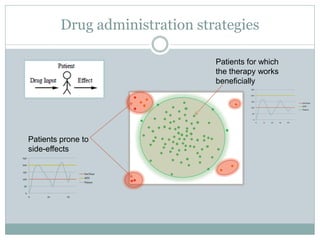
                                Patients for which
                                the therapy works
                                beneficially


Patients prone to
side-effects
Drug administration strategies

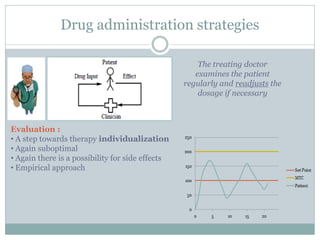
                                                      The treating doctor
                                                     examines the patient
                                                  regularly and readjusts the
                                                      dosage if necessary


Evaluation :
• A step towards therapy individualization
• Again suboptimal
• Again there is a possibility for side effects
• Empirical approach
Drug administration strategies


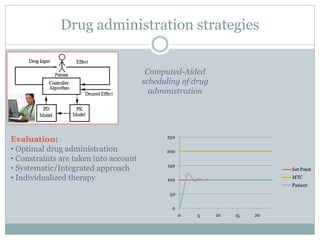
                                        Computed-Aided
                                       scheduling of drug
                                         administration


Evaluation:
• Optimal drug administration
• Constraints are taken into account
• Systematic/Integrated approach
• Individualized therapy
What renders the problem so interesting?


 Input (administered dose) & State (tissue conce-
  ntration) constraints (toxicity).
 Only plasma concentration is available (need to
  design observer).
 The set-point value might be different among patients
  and might not be constant.
Problem Formulation


Problem: Control the concentration of DMA in the
kidneys of mice (set point: 0.5μg/lt) while the i.v. influx
rate does not exceed 0.2μg/hr and the concentration in the
liver does not exceed 1.4μg/lt.
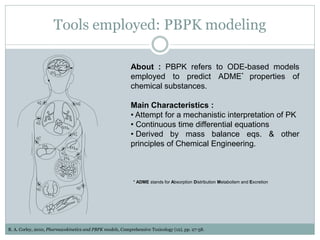
Tools employed: PBPK modeling

                                                           About : PBPK refers to ODE-based models
                                                           employed to predict ADME* properties of
                                                           chemical substances.

                                                           Main Characteristics :
                                                           • Attempt for a mechanistic interpretation of PK
                                                           • Continuous time differential equations
                                                           • Derived by mass balance eqs. & other
                                                           principles of Chemical Engineering.


                                                            * ADME stands for Absorption Distribution Metabolism and Excretion


R. A. Corley, 2010, Pharmacokinetics and PBPK models, Comprehensive Toxicology (12), pp. 27-58.
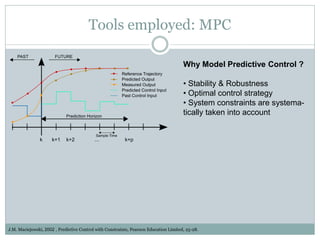
Tools employed: MPC

                                                                                       Why Model Predictive Control ?

                                                                                       • Stability & Robustness
                                                                                       • Optimal control strategy
                                                                                       • System constraints are systema-
                                                                                       tically taken into account


J.M. Maciejowski, 2002 , Predictive Control with Constraints, Pearson Education Limited, 25-28.
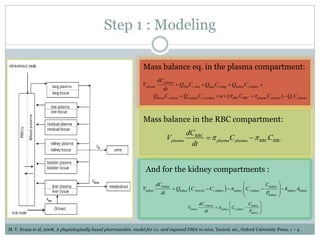
Step 1 : Modeling

                                                                     Mass balance eq. in the plasma compartment:
                                                                              dC plasma
                                                                    Vplasma               QskinCv , skin  Qlung Cv ,lung  Qkidney Cv ,kidney 
                                                                               dt
                                                                          Qblood Cv ,blood  Qresidual Cv ,residual  u  ( RBC CRBC   plasma C plasma )  QC C plasma


                                                                     Mass balance in the RBC compartment:
                                                                                                  dCRBC
                                                                                     Vplasma              plasmaC plasma   RBC CRBC
                                                                                                   dt


                                                                      And for the kidney compartments :
                                                                                                                                                                  
                                                                                          Qkidney  C Arterial  Cv ,kidney    kidney  Cv ,kidney 
                                                                              dCkidney                                                                   Ckidney
                                                                    Vkidney
                                                                                                                                                                    kkidney Akidney
                                                                                                                                                                   
                                                                                dt                                                                      Pkidney   
                                                                                                             dCv ,kidney                            Ckidney   
                                                                                                   Vkidney                   kidney  Cv ,kidney            
                                                                                                                 dt                                 Pkidney   
                                                                                                                                                              


M. V. Evans et al, 2008, A physiologically based pharmacokin. model for i.v. and ingested DMA in mice, Toxicol. sci., Oxford University Press, 1 – 4 .
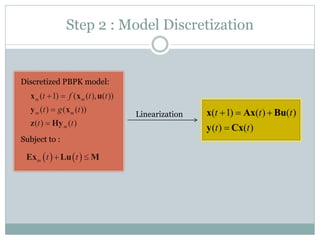
Step 2 : Model Discretization


Discretized PBPK model:
  x m (t  1)  f (x m (t ), u(t ))
  y m (t )  g (x m (t ))                             x(t  1)  Ax(t )  Bu(t )
                                      Linearization
  z (t )  Hy m (t )
                                                      y (t )  Cx(t )
Subject to :

 Exm  t   Lu  t   M
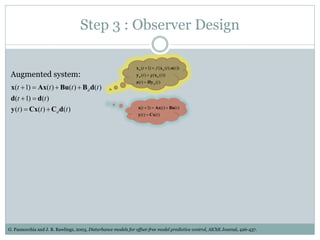
Step 3 : Observer Design

                                                               x m (t  1)  f (x m (t ), u(t ))
 Augmented system:                                             y m (t )  g (x m (t ))
                                                               z (t )  Hy m (t )
 x(t  1)  Ax(t )  Bu(t )  B d d(t )
 d(t  1)  d(t )
 y (t )  Cx(t )  Cd d(t )                                     x(t  1)  Ax(t )  Bu(t )
                                                                y (t )  Cx(t )


G. Pannocchia and J. B. Rawlings, 2003, Disturbance models for offset-free model predictive control, AlChE Journal, 426-437.
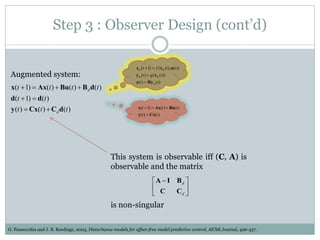
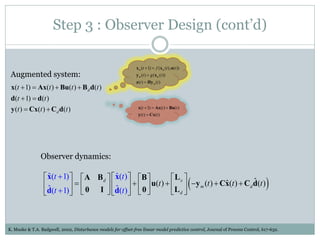
Step 3 : Observer Design (cont’d)

                                                               x m (t  1)  f (x m (t ), u(t ))
 Augmented system:                                             y m (t )  g (x m (t ))
                                                               z (t )  Hy m (t )
 x(t  1)  Ax(t )  Bu(t )  B d d(t )
 d(t  1)  d(t )
 y (t )  Cx(t )  Cd d(t )                                     x(t  1)  Ax(t )  Bu(t )
                                                                y (t )  Cx(t )


                                                   This system is observable iff (C, A) is
                                                   observable and the matrix
                                                                            A  I Bd 
                                                                            C     Cd 
                                                                                     
                                                   is non-singular

G. Pannocchia and J. B. Rawlings, 2003, Disturbance models for offset-free model predictive control, AlChE Journal, 426-437.
Step 3 : Observer Design (cont’d)

                                                                x m (t  1)  f (x m (t ), u(t ))
 Augmented system:                                              y m (t )  g (x m (t ))
                                                                z (t )  Hy m (t )
 x(t  1)  Ax(t )  Bu(t )  B d d(t )
 d(t  1)  d(t )
 y (t )  Cx(t )  Cd d(t )                                      x(t  1)  Ax(t )  Bu(t )
                                                                 y (t )  Cx(t )


                Observer dynamics:

                  x(t  1)   A Bd   x(t )  B 
                   ˆ                     ˆ                    L 
                 ˆ                ˆ  0
                                                                                            ˆ
                                                   u(t )   x  y m (t )  Cx(t )  Cd d(t )
                                                                                 ˆ                                              
                 d(t  1)   0 I  d(t )                L d 


K. Muske & T.A. Badgwell, 2002, Disturbance models for offset-free linear model predictive control, Journal of Process Control, 617-632.
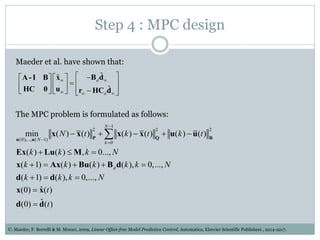
Step 4 : MPC design

   Maeder et al. have shown that:
                                ˆ
      A - I B   x    B d d  
                   ˆ
      HC 0  u                  
                                   ˆ 
                  r  HCd d 
                         

   The MPC problem is formulated as follows:
                                                 N 1
                          x( N )  x (t ) P   x(k )  x (t )                u(k )  u(t )
                                           2                               2                          2
         min                                                               Q                          R
    u (0),...,u ( N 1)
                                                 k 0

    Ex(k )  Lu(k )  M, k  0..., N
    x(k  1)  Ax(k )  Bu(k )  B d d(k ), k  0,..., N
   d(k  1)  d(k ), k  0,..., N
   x(0)  x(t )
          ˆ
           ˆ
   d(0)  d(t )

U. Maeder, F. Borrelli & M. Morari, 2009, Linear Offset-free Model Predictive Control, Automatica, Elsevier Scientific Publishers , 2214-2217.
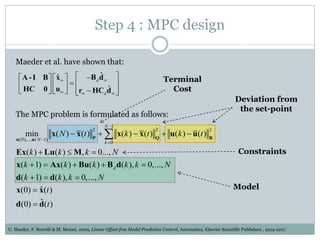
Step 4 : MPC design

   Maeder et al. have shown that:
                                ˆ
      A - I B   x    B d d  
                   ˆ                                                           Terminal
      HC 0  u                  
                                   ˆ                                            Cost
                  r  HCd d 
                         
                                                                                                                   Deviation from
                                                                                                                    the set-point
   The MPC problem is formulated as follows:
                                                 N 1
                          x( N )  x (t ) P   x(k )  x (t )                u(k )  u(t )
                                           2                               2                          2
         min                                                               Q                          R
    u (0),...,u ( N 1)
                                                 k 0

    Ex(k )  Lu(k )  M, k  0..., N                                                                                 Constraints
    x(k  1)  Ax(k )  Bu(k )  B d d(k ), k  0,..., N
   d(k  1)  d(k ), k  0,..., N
   x(0)  x(t )
          ˆ                                                                                                       Model
           ˆ
   d(0)  d(t )

U. Maeder, F. Borrelli & M. Morari, 2009, Linear Offset-free Model Predictive Control, Automatica, Elsevier Scientific Publishers , 2214-2217.
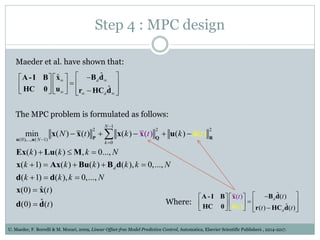
Step 4 : MPC design

   Maeder et al. have shown that:
                                ˆ
      A - I B   x    B d d  
                   ˆ
      HC 0  u                  
                                   ˆ 
                  r  HCd d 
                         

   The MPC problem is formulated as follows:
                                                 N 1
                          x( N )  x (t ) P   x(k )  x (t )                u(k )  u(t )
                                           2                               2                          2
         min                                                               Q                          R
    u (0),...,u ( N 1)
                                                 k 0

    Ex(k )  Lu(k )  M, k  0..., N
    x(k  1)  Ax(k )  Bu(k )  B d d(k ), k  0,..., N
   d(k  1)  d(k ), k  0,..., N
   x(0)  x(t )
          ˆ
                                                                                                                                  ˆ
                                                                                                  A - I B   x(t )   B d d(t ) 
           ˆ
   d(0)  d(t )                                                                 Where:            HC 0  u(t )                         
                                                                                                                                     ˆ (t ) 
                                                                                                                   r (t )  HCd d 
                                                                                                                       

U. Maeder, F. Borrelli & M. Morari, 2009, Linear Offset-free Model Predictive Control, Automatica, Elsevier Scientific Publishers , 2214-2217.
Step 4 : MPC design


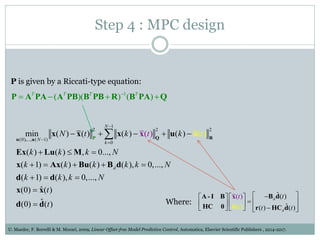
 P is given by a Riccati-type equation:
 P  AT PA  (AT PB)(BT PB  R)1 (BT PA)  Q


                                                 N 1
                          x( N )  x (t ) P   x(k )  x (t )                u(k )  u(t )
                                           2                               2                          2
         min                                                               Q                          R
    u (0),...,u ( N 1)
                                                 k 0

    Ex(k )  Lu(k )  M, k  0..., N
    x(k  1)  Ax(k )  Bu(k )  B d d(k ), k  0,..., N
   d(k  1)  d(k ), k  0,..., N
   x(0)  x(t )
          ˆ
                                                                                                                                  ˆ
                                                                                                  A - I B   x(t )   B d d(t ) 
           ˆ
   d(0)  d(t )                                                                 Where:            HC 0  u(t )                         
                                                                                                                                     ˆ (t ) 
                                                                                                                   r (t )  HCd d 
                                                                                                                       

U. Maeder, F. Borrelli & M. Morari, 2009, Linear Offset-free Model Predictive Control, Automatica, Elsevier Scientific Publishers , 2214-2217.
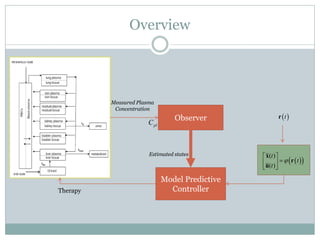
Overview


          Measured Plasma
           Concentration
                                 Observer                 r t 
                       C pl


                       Estimated states           x(t ) 
                                                 u(t )     r  t  
                                                        
                              Model Predictive
Therapy                         Controller
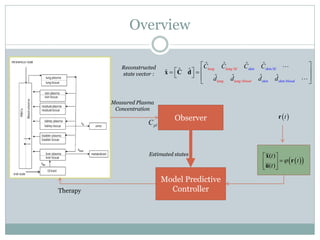
Overview

             Reconstructed                   Cˆ       ˆ          ˆ      ˆ
                                                      Clung / bl Cskin Cskin / bl                      
                                     ˆ d    lung
                               x  C 
                               ˆ       ˆ                                                               
             state vector :                       ˆ      ˆ           ˆ          ˆ                    
                                                 dlung dlung / blood d skin d skin / blood            


          Measured Plasma
           Concentration
                                   Observer                                          r t 
                       C pl


                        Estimated states                                     x(t ) 
                                                                            u(t )     r  t  
                                                                                   
                              Model Predictive
Therapy                         Controller
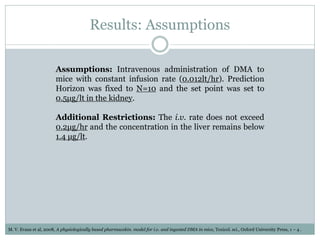
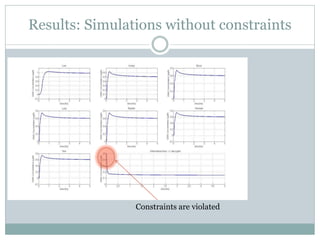
Results: Assumptions

                        Assumptions: Intravenous administration of DMA to
                        mice with constant infusion rate (0.012lt/hr). Prediction
                        Horizon was fixed to N=10 and the set point was set to
                        0.5μg/lt in the kidney.

                        Additional Restrictions: The i.v. rate does not exceed
                        0.2μg/hr and the concentration in the liver remains below
                        1.4 μg/lt.


M. V. Evans et al, 2008, A physiologically based pharmacokin. model for i.v. and ingested DMA in mice, Toxicol. sci., Oxford University Press, 1 – 4 .
Results: Simulations without constraints


                Constraints are violated
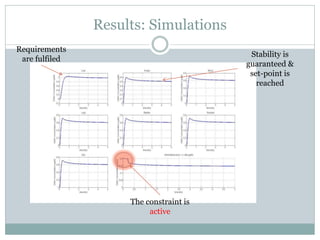
Results: Simulations
Requirements
                                          Stability is
 are fulfiled
                                         guaranteed &
                                          set-point is
                                            reached


                     The constraint is
                          active
Conclusions

 Linear offset-free MPC was used to tackle the optimal drug dose
    administration problem.
   The controller was coupled with a state observer so that drug
    concentration can be controlled at any organ using only blood
    samples.
   Constraints are satisfied minimizing the appearance of adverse
    effects & keeping drug dosages between recommended bounds.
   Allometry studies can extend the results from mice to humans.
   Individualization of the therapy by customizing the PBPK model
    parameters to each particular patient.
   Next step: Extension of the proposed approach to oral
    administration.
References

1. R. A. Corley, 2010, Pharmacokinetics and PBPK models, Comprehensive Toxicology (12), pp. 27-58.
2. M. V. Evans, S. M. Dowd, E. M. Kenyon, M. F. Hughes & H. A. El-Masri, 2008, A physiologically based pharmacokinetic
   model for intravenous and ingested Dimethylarsinic acid in mice, Toxicol. sci., Oxford University Press, 1 – 4 .
3. J.M. Maciejowski, Predictive Control with Constraints, Pearson Education Limited 2002, pp. 25-28.
4. Urban Maeder, Francesco Borrelli & Manfred Morari, 2009, Linear Offset-free Model Predictive Control, Automatica,
   Elsevier Scientific Publishers , 2214-2217.
5. D. Q. Mayne, J. B. Rawlings, C.V. Rao and P.O.M. Scokaert, 2000, Constrained model predictive control:Stability and
   optimality. Automatica, 36(6):789–814.
6. M. Morari & G. Stephanopoulos, 1980, Minimizing unobservability in inferential control schemes, International Journal
   of Control, 367-377.
7. K. Muske & T.A. Badgwell, 2002, Disturbance models for offset-free linear model predictive control, Journal of Process
   Control, 617-632.
8. G. Pannocchia and J. B. Rawlings, 2003, Disturbance models for offset-free model predictive control, AlChE Journal,
   426-437.
9. L. Shargel, S. Wu-Pong and A. B. C. Yu, 2005, Applied biopharmaceutics & pharmacokinetics, Fifth Edition, McGraw-
   Hill Medical Publishing Divison,pp. 717-720.

Physiologically Based Modelling and Predictive Control

  • 1.
    Physiologically Based Pharmacokinetic Modeling and Predictive Control An integrated approach for optimal drug administration P. Sopasakis, P. Patrinos, S. Giannikou, H. Sarimveis. Presented in the 21 European Symposium on Computer-Aided Process Engineering
  • 2.
    Drug administration strategies Open loop drug administration based on average population pharmacokinetic studies Evaluation: Toxicity Alert! • No feedback • Suboptimal drug administration • The therapy is not individualized • High probability for side effects! W. E. Stumpf, 2006, The dose makes the medicine, Drug Disc. Today, 11 (11,12), 550-555
  • 3.
    Drug administration strategies Patients for which the therapy works beneficially Patients prone to side-effects
  • 4.
    Drug administration strategies The treating doctor examines the patient regularly and readjusts the dosage if necessary Evaluation : • A step towards therapy individualization • Again suboptimal • Again there is a possibility for side effects • Empirical approach
  • 5.
    Drug administration strategies Computed-Aided scheduling of drug administration Evaluation: • Optimal drug administration • Constraints are taken into account • Systematic/Integrated approach • Individualized therapy
  • 6.
    What renders theproblem so interesting?  Input (administered dose) & State (tissue conce- ntration) constraints (toxicity).  Only plasma concentration is available (need to design observer).  The set-point value might be different among patients and might not be constant.
  • 7.
    Problem Formulation Problem: Controlthe concentration of DMA in the kidneys of mice (set point: 0.5μg/lt) while the i.v. influx rate does not exceed 0.2μg/hr and the concentration in the liver does not exceed 1.4μg/lt.
  • 8.
    Tools employed: PBPKmodeling About : PBPK refers to ODE-based models employed to predict ADME* properties of chemical substances. Main Characteristics : • Attempt for a mechanistic interpretation of PK • Continuous time differential equations • Derived by mass balance eqs. & other principles of Chemical Engineering. * ADME stands for Absorption Distribution Metabolism and Excretion R. A. Corley, 2010, Pharmacokinetics and PBPK models, Comprehensive Toxicology (12), pp. 27-58.
  • 9.
    Tools employed: MPC Why Model Predictive Control ? • Stability & Robustness • Optimal control strategy • System constraints are systema- tically taken into account J.M. Maciejowski, 2002 , Predictive Control with Constraints, Pearson Education Limited, 25-28.
  • 10.
    Step 1 :Modeling Mass balance eq. in the plasma compartment: dC plasma Vplasma  QskinCv , skin  Qlung Cv ,lung  Qkidney Cv ,kidney  dt Qblood Cv ,blood  Qresidual Cv ,residual  u  ( RBC CRBC   plasma C plasma )  QC C plasma Mass balance in the RBC compartment: dCRBC Vplasma   plasmaC plasma   RBC CRBC dt And for the kidney compartments :    Qkidney  C Arterial  Cv ,kidney    kidney  Cv ,kidney  dCkidney Ckidney Vkidney    kkidney Akidney  dt  Pkidney  dCv ,kidney  Ckidney  Vkidney   kidney  Cv ,kidney   dt  Pkidney    M. V. Evans et al, 2008, A physiologically based pharmacokin. model for i.v. and ingested DMA in mice, Toxicol. sci., Oxford University Press, 1 – 4 .
  • 11.
    Step 2 :Model Discretization Discretized PBPK model: x m (t  1)  f (x m (t ), u(t )) y m (t )  g (x m (t )) x(t  1)  Ax(t )  Bu(t ) Linearization z (t )  Hy m (t ) y (t )  Cx(t ) Subject to : Exm  t   Lu  t   M
  • 12.
    Step 3 :Observer Design x m (t  1)  f (x m (t ), u(t )) Augmented system: y m (t )  g (x m (t )) z (t )  Hy m (t ) x(t  1)  Ax(t )  Bu(t )  B d d(t ) d(t  1)  d(t ) y (t )  Cx(t )  Cd d(t ) x(t  1)  Ax(t )  Bu(t ) y (t )  Cx(t ) G. Pannocchia and J. B. Rawlings, 2003, Disturbance models for offset-free model predictive control, AlChE Journal, 426-437.
  • 13.
    Step 3 :Observer Design (cont’d) x m (t  1)  f (x m (t ), u(t )) Augmented system: y m (t )  g (x m (t )) z (t )  Hy m (t ) x(t  1)  Ax(t )  Bu(t )  B d d(t ) d(t  1)  d(t ) y (t )  Cx(t )  Cd d(t ) x(t  1)  Ax(t )  Bu(t ) y (t )  Cx(t ) This system is observable iff (C, A) is observable and the matrix  A  I Bd   C Cd    is non-singular G. Pannocchia and J. B. Rawlings, 2003, Disturbance models for offset-free model predictive control, AlChE Journal, 426-437.
  • 14.
    Step 3 :Observer Design (cont’d) x m (t  1)  f (x m (t ), u(t )) Augmented system: y m (t )  g (x m (t )) z (t )  Hy m (t ) x(t  1)  Ax(t )  Bu(t )  B d d(t ) d(t  1)  d(t ) y (t )  Cx(t )  Cd d(t ) x(t  1)  Ax(t )  Bu(t ) y (t )  Cx(t ) Observer dynamics:  x(t  1)   A Bd   x(t )  B  ˆ ˆ L  ˆ    ˆ  0 ˆ    u(t )   x  y m (t )  Cx(t )  Cd d(t ) ˆ   d(t  1)   0 I  d(t )    L d  K. Muske & T.A. Badgwell, 2002, Disturbance models for offset-free linear model predictive control, Journal of Process Control, 617-632.
  • 15.
    Step 4 :MPC design Maeder et al. have shown that: ˆ  A - I B   x    B d d   ˆ  HC 0  u     ˆ       r  HCd d   The MPC problem is formulated as follows: N 1 x( N )  x (t ) P   x(k )  x (t )  u(k )  u(t ) 2 2 2 min Q R u (0),...,u ( N 1) k 0 Ex(k )  Lu(k )  M, k  0..., N x(k  1)  Ax(k )  Bu(k )  B d d(k ), k  0,..., N d(k  1)  d(k ), k  0,..., N x(0)  x(t ) ˆ ˆ d(0)  d(t ) U. Maeder, F. Borrelli & M. Morari, 2009, Linear Offset-free Model Predictive Control, Automatica, Elsevier Scientific Publishers , 2214-2217.
  • 16.
    Step 4 :MPC design Maeder et al. have shown that: ˆ  A - I B   x    B d d   ˆ Terminal  HC 0  u     ˆ  Cost      r  HCd d   Deviation from the set-point The MPC problem is formulated as follows: N 1 x( N )  x (t ) P   x(k )  x (t )  u(k )  u(t ) 2 2 2 min Q R u (0),...,u ( N 1) k 0 Ex(k )  Lu(k )  M, k  0..., N Constraints x(k  1)  Ax(k )  Bu(k )  B d d(k ), k  0,..., N d(k  1)  d(k ), k  0,..., N x(0)  x(t ) ˆ Model ˆ d(0)  d(t ) U. Maeder, F. Borrelli & M. Morari, 2009, Linear Offset-free Model Predictive Control, Automatica, Elsevier Scientific Publishers , 2214-2217.
  • 17.
    Step 4 :MPC design Maeder et al. have shown that: ˆ  A - I B   x    B d d   ˆ  HC 0  u     ˆ       r  HCd d   The MPC problem is formulated as follows: N 1 x( N )  x (t ) P   x(k )  x (t )  u(k )  u(t ) 2 2 2 min Q R u (0),...,u ( N 1) k 0 Ex(k )  Lu(k )  M, k  0..., N x(k  1)  Ax(k )  Bu(k )  B d d(k ), k  0,..., N d(k  1)  d(k ), k  0,..., N x(0)  x(t ) ˆ ˆ  A - I B   x(t )   B d d(t )  ˆ d(0)  d(t ) Where:  HC 0  u(t )     ˆ (t )     r (t )  HCd d   U. Maeder, F. Borrelli & M. Morari, 2009, Linear Offset-free Model Predictive Control, Automatica, Elsevier Scientific Publishers , 2214-2217.
  • 18.
    Step 4 :MPC design P is given by a Riccati-type equation: P  AT PA  (AT PB)(BT PB  R)1 (BT PA)  Q N 1 x( N )  x (t ) P   x(k )  x (t )  u(k )  u(t ) 2 2 2 min Q R u (0),...,u ( N 1) k 0 Ex(k )  Lu(k )  M, k  0..., N x(k  1)  Ax(k )  Bu(k )  B d d(k ), k  0,..., N d(k  1)  d(k ), k  0,..., N x(0)  x(t ) ˆ ˆ  A - I B   x(t )   B d d(t )  ˆ d(0)  d(t ) Where:  HC 0  u(t )     ˆ (t )     r (t )  HCd d   U. Maeder, F. Borrelli & M. Morari, 2009, Linear Offset-free Model Predictive Control, Automatica, Elsevier Scientific Publishers , 2214-2217.
  • 19.
    Overview Measured Plasma Concentration Observer r t  C pl Estimated states  x(t )  u(t )     r  t     Model Predictive Therapy Controller
  • 20.
    Overview Reconstructed Cˆ ˆ ˆ ˆ Clung / bl Cskin Cskin / bl  ˆ d    lung x  C  ˆ ˆ  state vector :   ˆ ˆ ˆ ˆ   dlung dlung / blood d skin d skin / blood  Measured Plasma Concentration Observer r t  C pl Estimated states  x(t )  u(t )     r  t     Model Predictive Therapy Controller
  • 21.
    Results: Assumptions Assumptions: Intravenous administration of DMA to mice with constant infusion rate (0.012lt/hr). Prediction Horizon was fixed to N=10 and the set point was set to 0.5μg/lt in the kidney. Additional Restrictions: The i.v. rate does not exceed 0.2μg/hr and the concentration in the liver remains below 1.4 μg/lt. M. V. Evans et al, 2008, A physiologically based pharmacokin. model for i.v. and ingested DMA in mice, Toxicol. sci., Oxford University Press, 1 – 4 .
  • 22.
    Results: Simulations withoutconstraints Constraints are violated
  • 23.
    Results: Simulations Requirements Stability is are fulfiled guaranteed & set-point is reached The constraint is active
  • 24.
    Conclusions  Linear offset-freeMPC was used to tackle the optimal drug dose administration problem.  The controller was coupled with a state observer so that drug concentration can be controlled at any organ using only blood samples.  Constraints are satisfied minimizing the appearance of adverse effects & keeping drug dosages between recommended bounds.  Allometry studies can extend the results from mice to humans.  Individualization of the therapy by customizing the PBPK model parameters to each particular patient.  Next step: Extension of the proposed approach to oral administration.
  • 25.
    References 1. R. A.Corley, 2010, Pharmacokinetics and PBPK models, Comprehensive Toxicology (12), pp. 27-58. 2. M. V. Evans, S. M. Dowd, E. M. Kenyon, M. F. Hughes & H. A. El-Masri, 2008, A physiologically based pharmacokinetic model for intravenous and ingested Dimethylarsinic acid in mice, Toxicol. sci., Oxford University Press, 1 – 4 . 3. J.M. Maciejowski, Predictive Control with Constraints, Pearson Education Limited 2002, pp. 25-28. 4. Urban Maeder, Francesco Borrelli & Manfred Morari, 2009, Linear Offset-free Model Predictive Control, Automatica, Elsevier Scientific Publishers , 2214-2217. 5. D. Q. Mayne, J. B. Rawlings, C.V. Rao and P.O.M. Scokaert, 2000, Constrained model predictive control:Stability and optimality. Automatica, 36(6):789–814. 6. M. Morari & G. Stephanopoulos, 1980, Minimizing unobservability in inferential control schemes, International Journal of Control, 367-377. 7. K. Muske & T.A. Badgwell, 2002, Disturbance models for offset-free linear model predictive control, Journal of Process Control, 617-632. 8. G. Pannocchia and J. B. Rawlings, 2003, Disturbance models for offset-free model predictive control, AlChE Journal, 426-437. 9. L. Shargel, S. Wu-Pong and A. B. C. Yu, 2005, Applied biopharmaceutics & pharmacokinetics, Fifth Edition, McGraw- Hill Medical Publishing Divison,pp. 717-720.