Some recent advances in Markov chain and
sequential Monte Carlo methods
St´ephane S´en´ecal
The Institute of Statistical Mathematics,
Research Organization of Information and Systems
15/12/2004
thanks to the Japan Society for the Promotion of Science
1
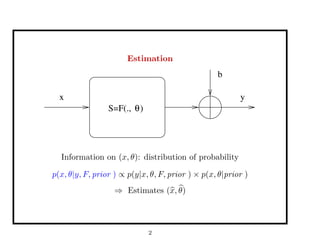
Estimation
x
S=F(., )
b
y
θ
Information on (x, θ): distribution of probability
p(x, θ|y, F, prior ) ∝ p(y|x, θ, F, prior ) × p(x, θ|prior )
⇒ Estimates (x, θ)
2
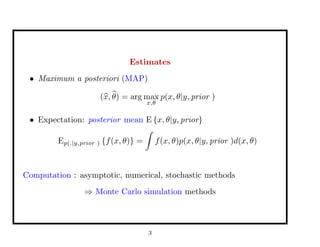
Estimates
• Maximum a posteriori (MAP)
(x, θ) = arg max
x,θ
p(x, θ|y, prior )
• Expectation: posterior mean E {x, θ|y, prior}
Ep(.|y,prior ) {f(x, θ)} = f(x, θ)p(x, θ|y, prior )d(x, θ)
Computation : asymptotic, numerical, stochastic methods
⇒ Monte Carlo simulation methods
3
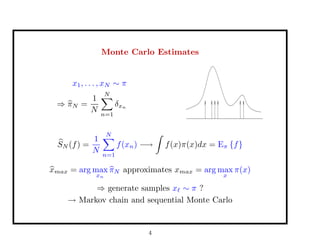
Monte Carlo Estimates
x1, . . . , xN ∼ π
⇒ πN =
1
N
N
n=1
δxn
SN (f) =
1
N
N
n=1
f(xn) −→ f(x)π(x)dx = Eπ {f}
xmax = arg max
xn
πN approximates xmax = arg max
x
π(x)
⇒ generate samples x ∼ π ?
→ Markov chain and sequential Monte Carlo
4
Overview
• Introduction to Markov chain Monte Carlo (MCMC)
Space alternating techniques
Estimation of Gaussian mixture models
• Introduction to Sequential Monte Carlo (SMC)
Fixed-lag sampling techniques
Recursive estimation of time series models
5
Simulation Techniques
• Classical distributions : cumulated density function
→ transformation of uniform random variable
• Non-standard distributions, Rn
, known up to a normalizing
constant → usage of instrumental distribution:
Accept-reject, importance sampling → sequential/recursive
⇒ SMC aka particle filtering, condensation algorithm
⇒ MCMC : distribution = fixed point of an operator
π = Kπ
→ simulation schemes with Markov chain: Hastings-Metropolis,
Gibbs sampling
6
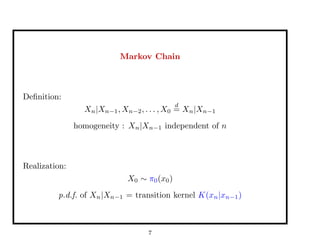
Markov Chain
Definition:
Xn|Xn−1, Xn−2, . . . , X0
d
= Xn|Xn−1
homogeneity : Xn|Xn−1 independent of n
Realization:
X0 ∼ π0(x0)
p.d.f. of Xn|Xn−1 = transition kernel K(xn|xn−1)
7
Simulation of Markov chain
Convergence: Xn ∼ π asymptotically ?
π-invariance : π(.) = Kπ(.)
A
π(x)dx =
y∈A
K(y|x)π(x)dxdy
⇐ π-reversibility : Pr(A → B) = Pr(B → A)
y∈B x∈A
K(y|x)π(x)dxdy =
y∈A x∈B
K(y|x)π(x)dxdy
Construct kernels K(.|.) such that the chain is π-invariant
• Hastings-Metropolis algorithm
• Gibbs sampling
8
Hastings-Metropolis
Draw x from π(.)
1. initialize x0 ∼ π0(x)
2. Iteration
• propose candidate x for x +1 → x ∼ q(x|x )
• accept it with prob α = min{1, r}
3. ← + 1 and go to (2)
r =
π(x )q(x |x )
q(x |x )π(x )
→ π(x)K(y|x) = π(y)K(x|y)
π(x)q(y|x) min 1,
π(y)q(x|y)
q(y|x)π(x)
= min {π(x)q(y|x), π(y)q(x|y)}
q(x |x ) = q(x ) q(x |x ) = q(|x − x |)
9
Example
sample x ∼ p(x) ∝ 1
1+x2 20,000 iterations
x ∼ N(x , 0.12
)
0 0.2 0.4 0.6 0.8 1 1.2 1.4 1.6 1.8 2
x 10
4
−5
0
5
10
15
−6 −4 −2 0 2 4 6 8 10 12 14
0
0.1
0.2
0.3
0.4
0.5
0.6
0.7
acc. rate = 97%
x ∼ U[a,b]
0 0.2 0.4 0.6 0.8 1 1.2 1.4 1.6 1.8 2
x 10
4
−15
−10
−5
0
5
10
15
−15 −10 −5 0 5 10 15
0
0.1
0.2
0.3
0.4
0.5
0.6
0.7
acc. rate = 26%
10
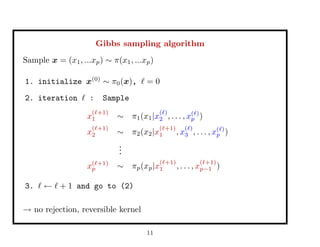
Gibbs sampling algorithm
Sample x = (x1, ...xp) ∼ π(x1, ...xp)
1. initialize x(0)
∼ π0(x), = 0
2. iteration : Sample
x
( +1)
1 ∼ π1(x1|x
( )
2 , . . . , x( )
p )
x
( +1)
2 ∼ π2(x2|x
( +1)
1 , x
( )
3 , . . . , x( )
p )
...
x( +1)
p ∼ πp(xp|x
( +1)
1 , . . . , x
( +1)
p−1 )
3. ← + 1 and go to (2)
→ no rejection, reversible kernel
11
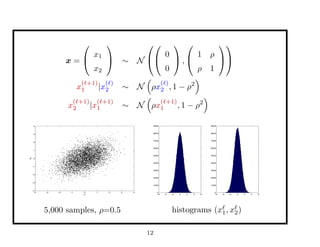
x =


x1
x2

 ∼ N




0
0

 ,


1 ρ
ρ 1




x
( +1)
1 |x
( )
2 ∼ N ρx
( )
2 , 1 − ρ2
x
( +1)
2 |x
( +1)
1 ∼ N ρx
( +1)
1 , 1 − ρ2
−4 −3 −2 −1 0 1 2 3 4
−4
−3
−2
−1
0
1
2
3
4
x1
x2
5,000 samples, ρ=0.5
−6 −4 −2 0 2 4 6
0
1000
2000
3000
4000
5000
6000
7000
8000
9000
−6 −4 −2 0 2 4 6
0
1000
2000
3000
4000
5000
6000
7000
8000
9000
histograms (x1, x2)
12
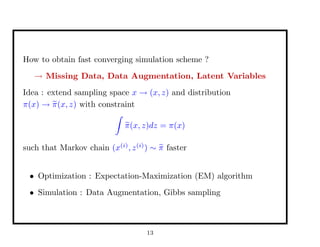
How to obtain fast converging simulation scheme ?
→ Missing Data, Data Augmentation, Latent Variables
Idea : extend sampling space x → (x, z) and distribution
π(x) → π(x, z) with constraint
π(x, z)dz = π(x)
such that Markov chain (x(i)
, z(i)
) ∼ π faster
• Optimization : Expectation-Maximization (EM) algorithm
• Simulation : Data Augmentation, Gibbs sampling
13
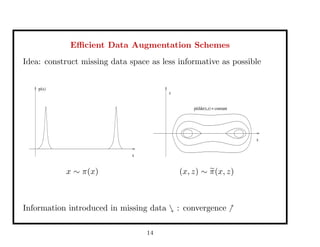
Efficient Data Augmentation Schemes
Idea: construct missing data space as less informative as possible
x
pi(x)
x ∼ π(x)
x
pitilde(x,z) = constant
z
(x, z) ∼ π(x, z)
Information introduced in missing data : convergence
14
Efficient Data Augmentation Schemes
EM algorithm → Space Alternating Generalized EM
SAGE algorithm, Hero and Fessler 1994:
• update parameter components by subblocks
• specific missing data space associated with each subblock
• complete data spaces less informative → convergence rate
15
Efficient Data Augmentation Sampling Schemes
SAGE Idea → MCMC algorithm:
• sample parameter components by subblocks
• each subblock of parameters is sampled conditionaly on a specific
missing data set
⇒ Space Alternating Data Augmentation (SADA)
A. Doucet, T. Matsui, S. S´en´ecal 2004
• Optimization : EM algorithm → SAGE algorithm
• Simulation : DA, Gibbs sampling → SADA
16
Overview - Space alternating techniques
• → Introduction to EM and SAGE algorithms
• Introduction to Data Augmentation and SADA algorithms
• Application to Finite Mixture of Gaussians
17
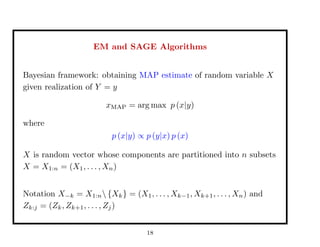
EM and SAGE Algorithms
Bayesian framework: obtaining MAP estimate of random variable X
given realization of Y = y
xMAP = arg max p (x|y)
where
p (x|y) ∝ p (y|x) p (x)
X is random vector whose components are partitioned into n subsets
X = X1:n = (X1, . . . , Xn)
Notation X−k = X1:n {Xk} = (X1, . . . , Xk−1, Xk+1, . . . , Xn) and
Zk:j = (Zk, Zk+1, . . . , Zj)
18
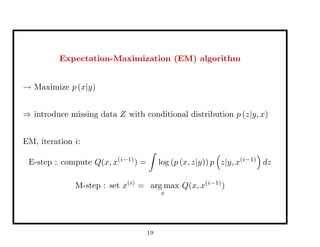
Expectation-Maximization (EM) algorithm
→ Maximize p (x|y)
⇒ introduce missing data Z with conditional distribution p (z|y, x)
EM, iteration i:
E-step : compute Q(x, x(i−1)
) = log (p (x, z|y)) p z|y, x(i−1)
dz
M-step : set x(i)
= arg max
x
Q(x, x(i−1)
)
19
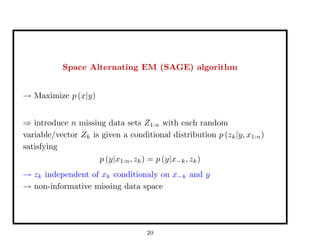
Space Alternating EM (SAGE) algorithm
→ Maximize p (x|y)
⇒ introduce n missing data sets Z1:n with each random
variable/vector Zk is given a conditional distribution p (zk|y, x1:n)
satisfying
p (y|x1:n, zk) = p (y|x−k, zk)
→ zk independent of xk conditionaly on x−k and y
→ non-informative missing data space
20
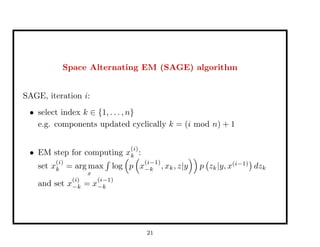
Space Alternating EM (SAGE) algorithm
SAGE, iteration i:
• select index k ∈ {1, . . . , n}
e.g. components updated cyclically k = (i mod n) + 1
• EM step for computing x
(i)
k :
set x
(i)
k = arg max
x
log p x
(i−1)
−k , xk, z|y p zk|y, x(i−1)
dzk
and set x
(i)
−k = x
(i−1)
−k
21
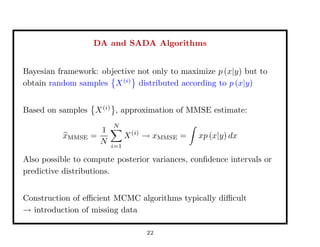
DA and SADA Algorithms
Bayesian framework: objective not only to maximize p (x|y) but to
obtain random samples X(i)
distributed according to p (x|y)
Based on samples X(i)
, approximation of MMSE estimate:
xMMSE =
1
N
N
i=1
X(i)
→ xMMSE = xp (x|y) dx
Also possible to compute posterior variances, confidence intervals or
predictive distributions.
Construction of efficient MCMC algorithms typically difficult
→ introduction of missing data
22
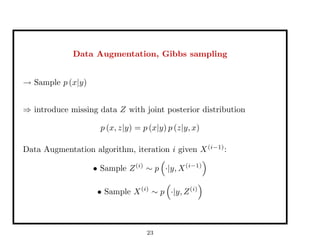
Data Augmentation, Gibbs sampling
→ Sample p (x|y)
⇒ introduce missing data Z with joint posterior distribution
p (x, z|y) = p (x|y) p (z|y, x)
Data Augmentation algorithm, iteration i given X(i−1)
:
• Sample Z(i)
∼ p ·|y, X(i−1)
• Sample X(i)
∼ p ·|y, Z(i)
23
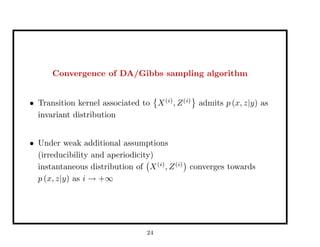
Convergence of DA/Gibbs sampling algorithm
• Transition kernel associated to X(i)
, Z(i)
admits p (x, z|y) as
invariant distribution
• Under weak additional assumptions
(irreducibility and aperiodicity)
instantaneous distribution of X(i)
, Z(i)
converges towards
p (x, z|y) as i → +∞
24
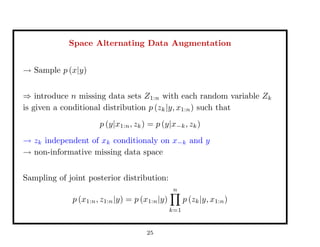
Space Alternating Data Augmentation
→ Sample p (x|y)
⇒ introduce n missing data sets Z1:n with each random variable Zk
is given a conditional distribution p (zk|y, x1:n) such that
p (y|x1:n, zk) = p (y|x−k, zk)
→ zk independent of xk conditionaly on x−k and y
→ non-informative missing data space
Sampling of joint posterior distribution:
p (x1:n, z1:n|y) = p (x1:n|y)
n
k=1
p (zk|y, x1:n)
25
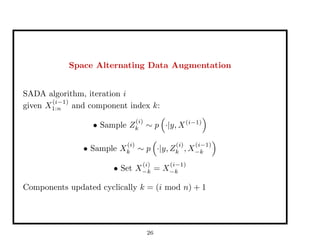
Space Alternating Data Augmentation
SADA algorithm, iteration i
given X
(i−1)
1:n and component index k:
• Sample Z
(i)
k ∼ p ·|y, X(i−1)
• Sample X
(i)
k ∼ p ·|y, Z
(i)
k , X
(i−1)
−k
• Set X
(i)
−k = X
(i−1)
−k
Components updated cyclically k = (i mod n) + 1
26
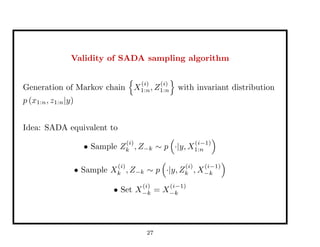
Validity of SADA sampling algorithm
Generation of Markov chain X
(i)
1:n, Z
(i)
1:n with invariant distribution
p (x1:n, z1:n|y)
Idea: SADA equivalent to
• Sample Z
(i)
k , Z−k ∼ p ·|y, X
(i−1)
1:n
• Sample X
(i)
k , Z−k ∼ p ·|y, Z
(i)
k , X
(i−1)
−k
• Set X
(i)
−k = X
(i−1)
−k
27
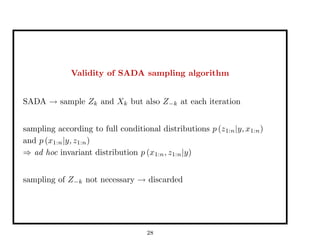
Validity of SADA sampling algorithm
SADA → sample Zk and Xk but also Z−k at each iteration
sampling according to full conditional distributions p (z1:n|y, x1:n)
and p (x1:n|y, z1:n)
⇒ ad hoc invariant distribution p (x1:n, z1:n|y)
sampling of Z−k not necessary → discarded
28
Overview - Space alternating techniques
• Introduction to EM and SAGE algorithms
• Introduction to Data Augmentation and SADA algorithms
• ⇒ Application to Finite Mixture of Gaussians
29
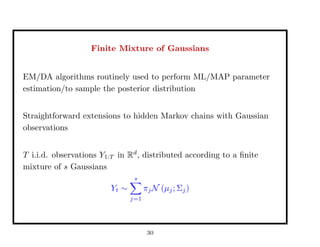
Finite Mixture of Gaussians
EM/DA algorithms routinely used to perform ML/MAP parameter
estimation/to sample the posterior distribution
Straightforward extensions to hidden Markov chains with Gaussian
observations
T i.i.d. observations Y1:T in Rd
, distributed according to a finite
mixture of s Gaussians
Yt ∼
s
j=1
πjN (µj; Σj)
30
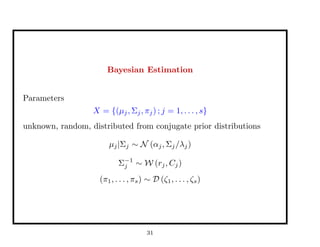
Bayesian Estimation
Parameters
X = {(µj, Σj, πj) ; j = 1, . . . , s}
unknown, random, distributed from conjugate prior distributions
µj|Σj ∼ N (αj, Σj/λj)
Σ−1
j ∼ W (rj, Cj)
(π1, . . . , πs) ∼ D (ζ1, . . . , ζs)
31
Bayesian Estimation
Σ−1
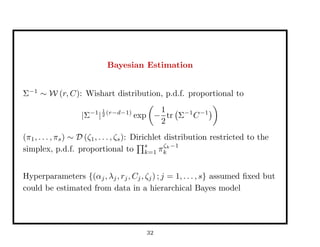
∼ W (r, C): Wishart distribution, p.d.f. proportional to
|Σ−1
|
1
2 (r−d−1)
exp −
1
2
tr Σ−1
C−1
(π1, . . . , πs) ∼ D (ζ1, . . . , ζs): Dirichlet distribution restricted to the
simplex, p.d.f. proportional to
s
k=1 πζk−1
k
Hyperparameters {(αj, λj, rj, Cj, ζj) ; j = 1, . . . , s} assumed fixed but
could be estimated from data in a hierarchical Bayes model
32
Missing Data for Finite Mixture of Gaussians
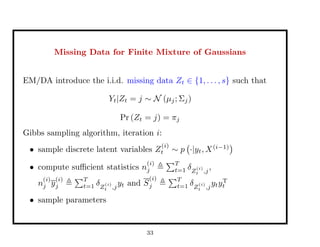
EM/DA introduce the i.i.d. missing data Zt ∈ {1, . . . , s} such that
Yt|Zt = j ∼ N (µj; Σj)
Pr (Zt = j) = πj
Gibbs sampling algorithm, iteration i:
• sample discrete latent variables Z
(i)
t ∼ p ·|yt, X(i−1)
• compute sufficient statistics n
(i)
j
T
t=1 δZ
(i)
t ,j
,
n
(i)
j y
(i)
j
T
t=1 δZ
(i)
t ,j
yt and S
(i)
j
T
t=1 δZ
(i)
t ,j
ytyT
t
• sample parameters
33
Gibbs sampling for Finite Mixture of Gaussians
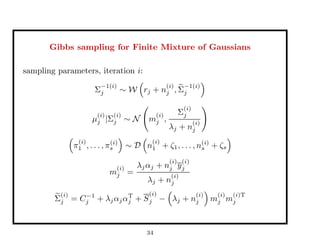
sampling parameters, iteration i:
Σ
−1(i)
j ∼ W rj + n
(i)
j , Σ
−1(i)
j
µ
(i)
j |Σ
(i)
j ∼ N m
(i)
j ,
Σ
(i)
j
λj + n
(i)
j
π
(i)
1 , . . . , π(i)
s ∼ D n
(i)
1 + ζ1, . . . , n(i)
s + ζs
m
(i)
j =
λjαj + n
(i)
j y
(i)
j
λj + n
(i)
j
Σ
(i)
j = C−1
j + λjαjαT
j + S
(i)
j − λj + n
(i)
j m
(i)
j m
(i)T
j
34
Less Informative Missing Data
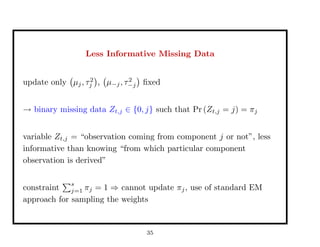
update only µj, τ2
j , µ−j, τ2
−j fixed
→ binary missing data Zt,j ∈ {0, j} such that Pr (Zt,j = j) = πj
variable Zt,j = “observation coming from component j or not”, less
informative than knowing “from which particular component
observation is derived”
constraint
s
j=1 πj = 1 ⇒ cannot update πj, use of standard EM
approach for sampling the weights
35
Less Informative Missing Data
→ updating jointly the parameters of two components j and k
(A. Doucet, T. Matsui and S. S´en´ecal, 2004)
→ missing data Zt,j,k ∈ {0, j, k} such that
Pr (Zt,j,k = j) = πj, Pr (Zt,j,k = k) = πk
and
Yt|Zt,j,k = j ∼ N (µj; Σj)
Yt|Zt,j,k = k ∼ N (µk; Σk)
Yt|Zt,j,k = 0 ∼
l=j,l=k πlN (µl; Σl)
l=j,l=k πl
36
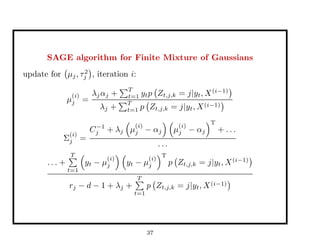
SAGE algorithm for Finite Mixture of Gaussians
update for µj, τ2
j , iteration i:
µ
(i)
j =
λjαj +
T
t=1 ytp Zt,j,k = j|yt, X(i−1)
λj +
T
t=1 p Zt,j,k = j|yt, X(i−1)
Σ
(i)
j =
C−1
j + λj µ
(i)
j − αj µ
(i)
j − αj
T
+ . . .
. . .
. . . +
T
t=1
yt − µ
(i)
j yt − µ
(i)
j
T
p Zt,j,k = j|yt, X(i−1)
rj − d − 1 + λj +
T
t=1
p Zt,j,k = j|yt, X(i−1)
37
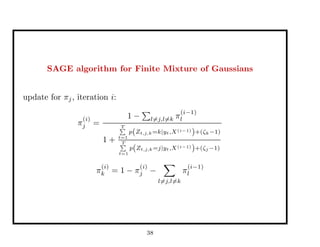
SAGE algorithm for Finite Mixture of Gaussians
update for πj, iteration i:
π
(i)
j =
1 − l=j,l=k π
(i−1)
l
1 +
T
t=1
p(Zt,j,k=k|yt,X(i−1)
)+(ζk−1)
T
t=1
p(Zt,j,k=j|yt,X(i−1)
)+(ζj −1)
π
(i)
k = 1 − π
(i)
j −
l=j,l=k
π
(i−1)
l
38
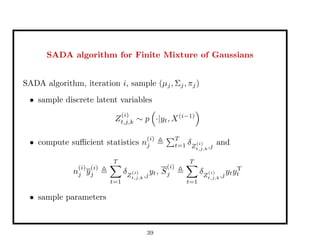
SADA algorithm for Finite Mixture of Gaussians
SADA algorithm, iteration i, sample (µj, Σj, πj)
• sample discrete latent variables
Z
(i)
t,j,k ∼ p ·|yt, X(i−1)
• compute sufficient statistics n
(i)
j
T
t=1 δZ
(i)
t,j,k,j
and
n
(i)
j y
(i)
j
T
t=1
δZ
(i)
t,j,k,j
yt, S
(i)
j
T
t=1
δZ
(i)
t,j,k,j
ytyT
t
• sample parameters
39
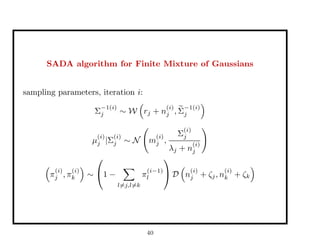
SADA algorithm for Finite Mixture of Gaussians
sampling parameters, iteration i:
Σ
−1(i)
j ∼ W rj + n
(i)
j , Σ
−1(i)
j
µ
(i)
j |Σ
(i)
j ∼ N m
(i)
j ,
Σ
(i)
j
λj + n
(i)
j
π
(i)
j , π
(i)
k ∼

1 −
l=j,l=k
π
(i−1)
l

 D n
(i)
j + ζj, n
(i)
k + ζk
40
Numerical experiments
Mixture of s = 8 d = 10-dimensional Gaussians
T = 100 samples
Parameters of components sampled from prior with parameters
ζj = 1, αj = 0, λj = 0.01, rj = d + 1 and Cj = 0.01I
100 iterations of EM and SAGE algorithms
41
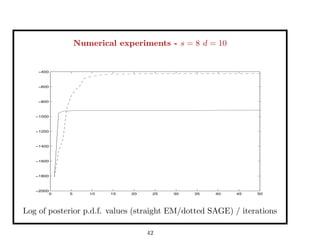
Numerical experiments - s = 8 d = 10
0 5 10 15 20 25 30 35 40 45 50
−2000
−1800
−1600
−1400
−1200
−1000
−800
−600
−400
Log of posterior p.d.f. values (straight EM/dotted SAGE) / iterations
42
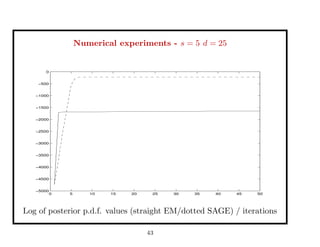
Numerical experiments - s = 5 d = 25
0 5 10 15 20 25 30 35 40 45 50
−5000
−4500
−4000
−3500
−3000
−2500
−2000
−1500
−1000
−500
0
Log of posterior p.d.f. values (straight EM/dotted SAGE) / iterations
43
Simulations
Mixture of s = 5 d = 10-dimensional Gaussians T = 100, parameters
of components sampled from prior with parameters ζj = 1, αj = 0,
λj = 0.01, rj = d + 1 and Cj = 0.01I
200 iterations of EM and SAGE 50 times
5000 iterations of DA and SADA 10 times
Results:
• EM/SAGE: mean of log-posterior values at final iteration
• SA/SADA: mean of average log-posterior values of last 1000
iterations
44
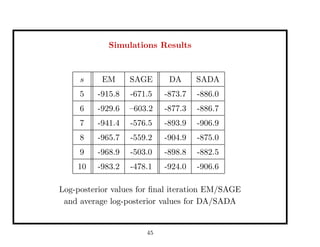
Simulations Results
s EM SAGE DA SADA
5 -915.8 -671.5 -873.7 -886.0
6 -929.6 –603.2 -877.3 -886.7
7 -941.4 -576.5 -893.9 -906.9
8 -965.7 -559.2 -904.9 -875.0
9 -968.9 -503.0 -898.8 -882.5
10 -983.2 -478.1 -924.0 -906.6
Log-posterior values for final iteration EM/SAGE
and average log-posterior values for DA/SADA
45
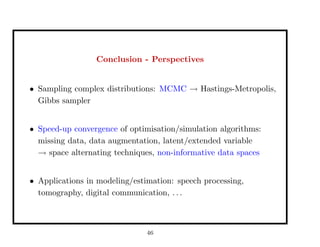
Conclusion - Perspectives
• Sampling complex distributions: MCMC → Hastings-Metropolis,
Gibbs sampler
• Speed-up convergence of optimisation/simulation algorithms:
missing data, data augmentation, latent/extended variable
→ space alternating techniques, non-informative data spaces
• Applications in modeling/estimation: speech processing,
tomography, digital communication, . . .
46
References - EM/SAGE/MCMC
• G. J. McLachlan and T. Krishnan, The EM Algorithm and
Extensions, Wiley Series in Probability and Statistics, 1997
• J. A. Fessler and A. O. Hero, Space-alternating generalized
expectation-maximization algorithm, IEEE Trans. Sig. Proc.,
42:2664–2677, 1994
• C. P. Robert and G. Casella, Monte Carlo Statistical Methods,
Springer-Verlag, 1999
• A. Doucet, T. Matsui and S. S´en´ecal, Space Alternating Data
Augmentation, ICASSP’05, 2005
47
Overview - MCMC and SMC methods
• Introduction to Markov chain Monte Carlo (MCMC)
Space alternating techniques
Estimation of Gaussian mixture models
• Introduction to Sequential Monte Carlo (SMC)
Fixed-lag sampling techniques
Recursive estimation of time series models
48
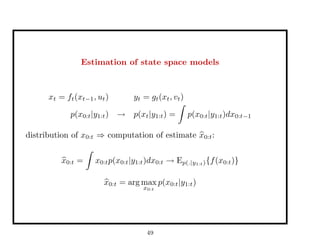
Estimation of state space models
xt = ft(xt−1, ut) yt = gt(xt, vt)
p(x0:t|y1:t) → p(xt|y1:t) = p(x0:t|y1:t)dx0:t−1
distribution of x0:t ⇒ computation of estimate x0:t:
x0:t = x0:tp(x0:t|y1:t)dx0:t → Ep(.|y1:t){f(x0:t)}
x0:t = arg max
x0:t
p(x0:t|y1:t)
49
Computation of the estimates
p(x0:t|y1:t) ⇒ multidimensionnal, non-standard distributions:
→ analytical, numerical approximations
→ integration, optimisation methods
⇒ Monte Carlo techniques
50
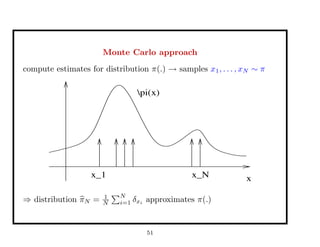
Monte Carlo approach
compute estimates for distribution π(.) → samples x1, . . . , xN ∼ π
x
pi(x)
x_1 x_N
⇒ distribution πN = 1
N
N
i=1 δxi approximates π(.)
51
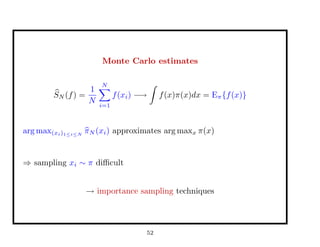
Monte Carlo estimates
SN (f) =
1
N
N
i=1
f(xi) −→ f(x)π(x)dx = Eπ{f(x)}
arg max(xi)1≤i≤N
πN (xi) approximates arg maxx π(x)
⇒ sampling xi ∼ π difficult
→ importance sampling techniques
52
Simulation Techniques
• Classical distributions : cumulated density function
→ transformation of uniform random variable
• Non-standard distributions, Rn
, known up to a normalizing
constant → usage of instrumental distribution:
Accept-reject, importance sampling → sequential/recursive
⇒ SMC aka particle filtering, condensation algorithm
⇒ MCMC : distribution = fixed point of an operator, Markov
chain → simulation schemes: Hastings-Metropolis, Gibbs
sampling
53
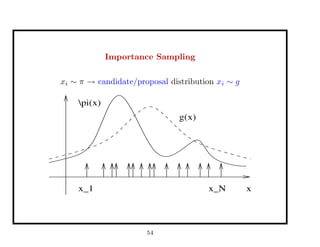
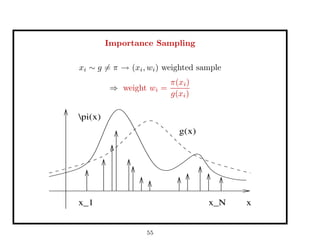
Importance Sampling
xi ∼ π → candidate/proposal distribution xi ∼ g
x
g(x)
pi(x)
x_Nx_1
54
Importance Sampling
xi ∼ g = π → (xi, wi) weighted sample
⇒ weight wi =
π(xi)
g(xi)
x
g(x)
pi(x)
x_Nx_1
55
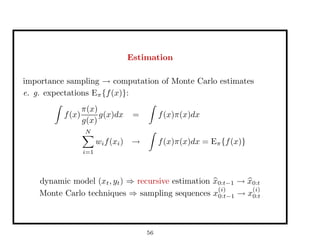
Estimation
importance sampling → computation of Monte Carlo estimates
e. g. expectations Eπ{f(x)}:
f(x)
π(x)
g(x)
g(x)dx = f(x)π(x)dx
N
i=1
wif(xi) → f(x)π(x)dx = Eπ{f(x)}
dynamic model (xt, yt) ⇒ recursive estimation x0:t−1 → x0:t
Monte Carlo techniques ⇒ sampling sequences x
(i)
0:t−1 → x
(i)
0:t
56
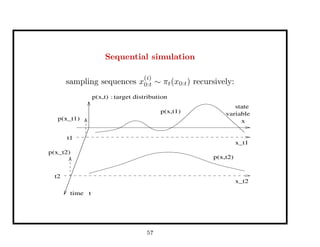
Sequential simulation
sampling sequences x
(i)
0:t ∼ πt(x0:t) recursively:
time
variable
state
x
p(x,t) target distribution:
t
t2
t1
p(x,t2)
x_t1
x_t2
p(x_t1)
p(x_t2)
p(x,t1)
57
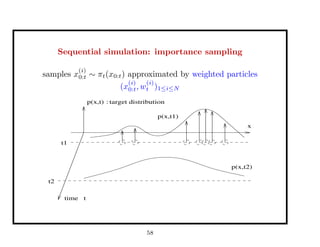
Sequential simulation: importance sampling
samples x
(i)
0:t ∼ πt(x0:t) approximated by weighted particles
(x
(i)
0:t, w
(i)
t )1≤i≤N
time
p(x,t) target distribution:
p(x,t2)
t
t2
t1
x
p(x,t1)
58
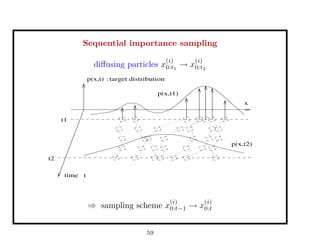
Sequential importance sampling
diffusing particles x
(i)
0:t1
→ x
(i)
0:t2
time
p(x,t) target distribution:
p(x,t2)
t
x
p(x,t1)
t2
t1
⇒ sampling scheme x
(i)
0:t−1 → x
(i)
0:t
59
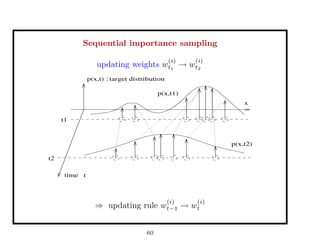
Sequential importance sampling
updating weights w
(i)
t1
→ w
(i)
t2
time
p(x,t) target distribution:
p(x,t2)
t
p(x,t1)
x
t2
t1
⇒ updating rule w
(i)
t−1 → w
(i)
t
60
Sequential Importance Sampling
x0:t ∼ πt(x0:t) ⇒ (x
(i)
0:t, w
(i)
t )1≤i≤N
Simulation scheme t − 1 → t:
• Sampling step x
(i)
t ∼ qt(xt|x
(i)
0:t−1)
• Updating weights
w
(i)
t ∝ w
(i)
t−1 ×
πt(x
(i)
0:t−1, x
(i)
t )
πt−1(x
(i)
0:t−1)qt(x
(i)
t |x
(i)
0:t−1)
incremental weight (iw)
normalizing
N
i=1 w
(i)
t = 1
61
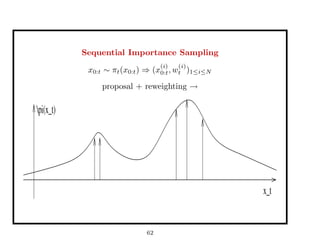
Sequential Importance Sampling
x0:t ∼ πt(x0:t) ⇒ (x
(i)
0:t, w
(i)
t )1≤i≤N
proposal + reweighting →
pi(x_t)
x_t
62
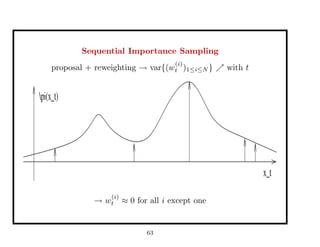
Sequential Importance Sampling
proposal + reweighting → var{(w
(i)
t )1≤i≤N } with t
x_t
pi(x_t)
→ w
(i)
t ≈ 0 for all i except one
63
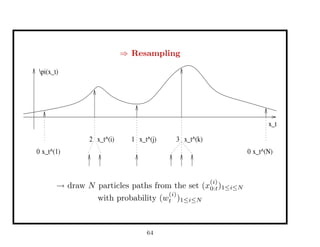
⇒ Resampling
x_t
pi(x_t)
0 x_t^(1)
x_t^(j)1x_t^(i)2 x_t^(k)3
x_t^(N)0
→ draw N particles paths from the set (x
(i)
0:t)1≤i≤N
with probability (w
(i)
t )1≤i≤N
64
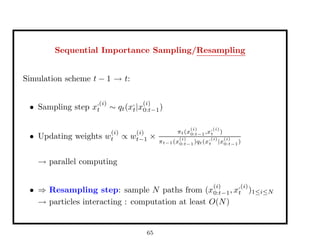
Sequential Importance Sampling/Resampling
Simulation scheme t − 1 → t:
• Sampling step x
,(i)
t ∼ qt(x,
t|x
(i)
0:t−1)
• Updating weights w
(i)
t ∝ w
(i)
t−1 ×
πt(x
(i)
0:t−1,x
,(i)
t )
πt−1(x
(i)
0:t−1)qt(x
,(i)
t |x
(i)
0:t−1)
→ parallel computing
• ⇒ Resampling step: sample N paths from (x
(i)
0:t−1, x
,(i)
t )1≤i≤N
→ particles interacting : computation at least O(N)
65
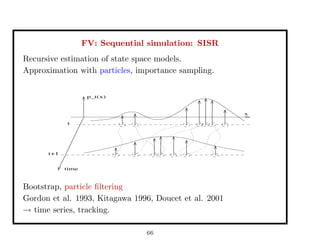
FV: Sequential simulation: SISR
Recursive estimation of state space models.
Approximation with particles, importance sampling.
time
x
p_t(x)
t
t+1
Bootstrap, particle filtering
Gordon et al. 1993, Kitagawa 1996, Doucet et al. 2001
→ time series, tracking.
66
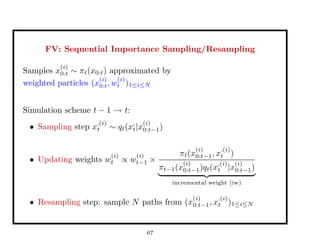
FV: Sequential Importance Sampling/Resampling
Samples x
(i)
0:t ∼ πt(x0:t) approximated by
weighted particles (x
(i)
0:t, w
(i)
t )1≤i≤N
Simulation scheme t − 1 → t:
• Sampling step x
,(i)
t ∼ qt(x,
t|x
(i)
0:t−1)
• Updating weights w
(i)
t ∝ w
(i)
t−1 ×
πt(x
(i)
0:t−1, x
,(i)
t )
πt−1(x
(i)
0:t−1)qt(x
,(i)
t |x
(i)
0:t−1)
incremental weight (iw)
• Resampling step: sample N paths from (x
(i)
0:t−1, x
,(i)
t )1≤i≤N
67
SISR for recursive estimation of state space models
xt = ft(xt−1, ut) → p(xt|xt−1)
yt = gt(xt, vt) → p(yt|xt)
Usual SISR: Bootstrap filter (Gordon et al. 93, Kitagawa 96):
• Sampling step x
(i)
t ∼ p(xt|x
(i)
t−1)
• Updating weights : incremental weight w
(i)
t ∝ w
(i)
t−1 × iw
iw ∝ p(yt|x
(i)
t )
• Stratified/Deterministic resampling
efficient, easy, fast for a wide class of models
tracking, time series → nonlinear non-Gaussian state spaces
68
Improving simulation
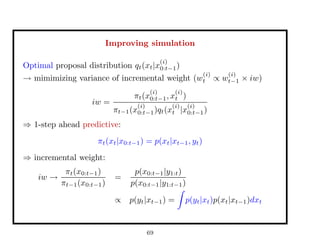
Optimal proposal distribution qt(xt|x
(i)
0:t−1)
→ mimimizing variance of incremental weight (w
(i)
t ∝ w
(i)
t−1 × iw)
iw =
πt(x
(i)
0:t−1, x
(i)
t )
πt−1(x
(i)
0:t−1)qt(x
(i)
t |x
(i)
0:t−1)
⇒ 1-step ahead predictive:
πt(xt|x0:t−1) = p(xt|xt−1, yt)
⇒ incremental weight:
iw →
πt(x0:t−1)
πt−1(x0:t−1)
=
p(x0:t−1|y1:t)
p(x0:t−1|y1:t−1)
∝ p(yt|xt−1) = p(yt|xt)p(xt|xt−1)dxt
69
Improving simulation
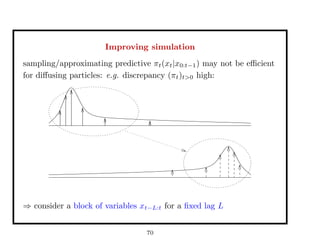
sampling/approximating predictive πt(xt|x0:t−1) may not be efficient
for diffusing particles: e.g. discrepancy (πt)t>0 high:
⇒ consider a block of variables xt−L:t for a fixed lag L
70
Approaches using a block of variables
• discrete distributions, Meirovitch 1985
• auxiliary variables, Pitt and Shephard 1999
• reweighting before resampling, Wang et al. 2002
⇒ discrete distribution → analytical form for
xt ∼ πt+L(xt|x0:t−1) = πt+L(xt:t+L|x0:t−1)dxt+1:t+L
Meirovitch 1985: random walk in discrete space (growing a polymer)
→ complexity X L
for lag L
71
Reweighting + resampling
2
1
01
0
0
0
0
1 1
72
Reweighting
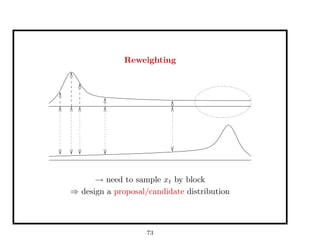
→ need to sample xt by block
⇒ design a proposal/candidate distribution
73
Sampling recursively a block of variables
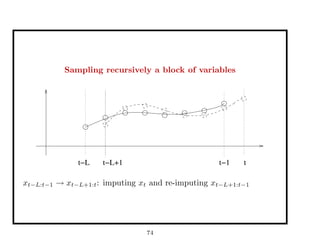
t−L t−L+1 tt−1
xt−L:t−1 → xt−L+1:t: imputing xt and re-imputing xt−L+1:t−1
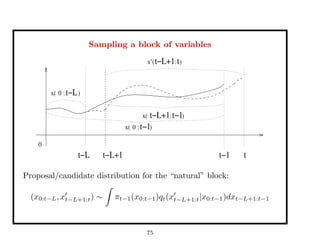
74
Sampling a block of variables
t−L t−L+1 tt−1
t−L+1x’(
t−L+1x(
0
:0 t−1x(
:0 t−Lx(
:t)
)
)
)t−1:
Proposal/candidate distribution for the “natural” block:
(x0:t−L, xt−L+1:t) ∼ πt−1(x0:t−1)qt(xt−L+1:t|x0:t−1)dxt−L+1:t−1
75
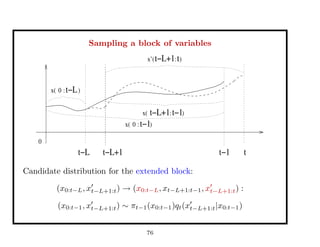
Sampling a block of variables
t−L t−L+1 tt−1
t−L+1x’(
t−L+1x(
0
:0 t−1x(
:0 t−Lx(
:t)
)
)
)t−1:
Candidate distribution for the extended block:
(x0:t−L, xt−L+1:t) → (x0:t−L, xt−L+1:t−1, xt−L+1:t) :
(x0:t−1, xt−L+1:t) ∼ πt−1(x0:t−1)qt(xt−L+1:t|x0:t−1)
76
Sampling a block of variables
Target distribution for the “natural” block (x0:t−L, xt−L+1:t):
πt(x0:t−L, xt−L+1:t)
⇒ auxiliary target distribution for the extended block
(x0:t−1, xt−L+1:t) = (x0:t−L, xt−L+1:t−1, xt−L+1:t) :
πt(x0:t−L, xt−L+1:t)rt(xt−L+1:t−1|x0:t−L, xt−L+1:t)
with rt = any conditional distribution
⇒ proposal + target distributions → importance sampling
77
Fixed-Lag Sequential Monte Carlo
A. Doucet and S. S´en´ecal, 2004
Simulation scheme t − 1 → t (index (i) dropped):
• Sampling step
xt−L+1:t ∼ qt(xt−L+1:t|x0:t−1)
• Updating weights
wt ∝ wt−1 ×
πt(x0:t−L, xt−L+1:t)rt(xt−L+1:t−1|x0:t−L, xt−L+1:t)
πt−1(x0:t−1)qt(xt−L+1:t|x0:t−1)
• Resampling step
78
Improving simulation
Optimal proposal distribution qt(xt−L+1:t|x0:t−1):
→ mimimizing variance of incremental weight:
iw =
πt(x0:t−L, xt−L+1:t)rt(xt−L+1:t−1|x0:t−L, xt−L+1:t)
πt−1(x0:t−1)qt(xt−L+1:t|x0:t−1)
⇒ qt = L-step ahead predictive
πt(xt−L+1:t|x0:t−L) = p(xt−L+1:t|xt−L, yt−L+1:t)
For one variable: optimal qt = 1-step ahead predictive
πt(xt|x0:t−1) = p(xt|xt−1, yt)
79
Improving simulation
Mimimizing variance of incremental weight
⇒ optimal target distribution
iw =
πt(x0:t−L, xt−L+1:t)rt(xt−L+1:t−1|x0:t−L, xt−L+1:t)
πt−1(x0:t−1)qt(xt−L+1:t|x0:t−1)
→ optimal conditional distribution rt(xt−L+1:t−1|x0:t−L, xt−L+1:t)
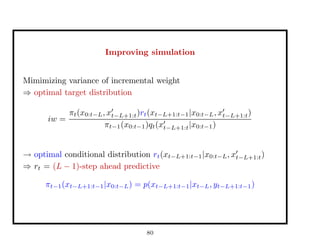
⇒ rt = (L − 1)-step ahead predictive
πt−1(xt−L+1:t−1|x0:t−L) = p(xt−L+1:t−1|xt−L, yt−L+1:t−1)
80
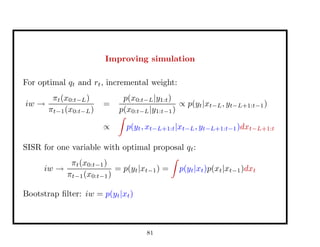
Improving simulation
For optimal qt and rt, incremental weight:
iw →
πt(x0:t−L)
πt−1(x0:t−L)
=
p(x0:t−L|y1:t)
p(x0:t−L|y1:t−1)
∝ p(yt|xt−L, yt−L+1:t−1)
∝ p(yt, xt−L+1:t|xt−L, yt−L+1:t−1)dxt−L+1:t
SISR for one variable with optimal proposal qt:
iw →
πt(x0:t−1)
πt−1(x0:t−1)
= p(yt|xt−1) = p(yt|xt)p(xt|xt−1)dxt
Bootstrap filter: iw = p(yt|xt)
81
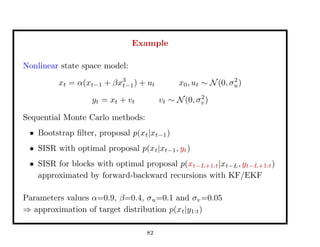
Example
Nonlinear state space model:
xt = α(xt−1 + βx3
t−1) + ut x0, ut ∼ N(0, σ2
u)
yt = xt + vt vt ∼ N(0, σ2
v)
Sequential Monte Carlo methods:
• Bootstrap filter, proposal p(xt|xt−1)
• SISR with optimal proposal p(xt|xt−1, yt)
• SISR for blocks with optimal proposal p(xt−L+1:t|xt−L, yt−L+1:t)
approximated by forward-backward recursions with KF/EKF
Parameters values α=0.9, β=0.4, σu=0.1 and σv=0.05
⇒ approximation of target distribution p(xt|y1:t)
82
Approximation of the target distribution
⇒ Effective Sample Size:
ESS =
1
N
i=1[w
(i)
t ]2
w(i)
= 1
N : ESS = N
pi(x_t)
x_t
w(i)
≈ 0 ∀i except one: ESS = 1
x_t
pi(x_t)
⇒ Resampling performed for ESS ≤ N
2 , N
10
83
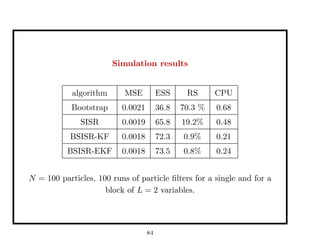
Simulation results
algorithm MSE ESS RS CPU
Bootstrap 0.0021 36.8 70.3 % 0.68
SISR 0.0019 65.8 19.2% 0.48
BSISR-KF 0.0018 72.3 0.9% 0.21
BSISR-EKF 0.0018 73.5 0.8% 0.24
N = 100 particles, 100 runs of particle filters for a single and for a
block of L = 2 variables.
84
Approximation of the target distribution
Resampling for ESS ≤ N
2 , N = 100
0 20 40 60 80 100 120 140 160 180 200
0
10
20
30
40
50
60
70
80
90
100
time index
EffectiveSampleSize
Approximated ESS vs. time index the Bootstrap filter (dotted), the
SISR with optimal proposal for a single variable (dashdotted) and
approximated for a block of L=2 variables (straight).
85
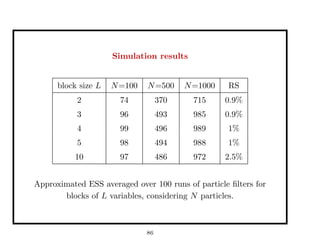
Simulation results
block size L N=100 N=500 N=1000 RS
2 74 370 715 0.9%
3 96 493 985 0.9%
4 99 496 989 1%
5 98 494 988 1%
10 97 486 972 2.5%
Approximated ESS averaged over 100 runs of particle filters for
blocks of L variables, considering N particles.
86
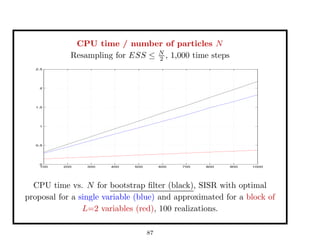
CPU time / number of particles N
Resampling for ESS ≤ N
2 , 1,000 time steps
100 200 300 400 500 600 700 800 900 1000
0
0.5
1
1.5
2
2.5
CPU time vs. N for bootstrap filter (black), SISR with optimal
proposal for a single variable (blue) and approximated for a block of
L=2 variables (red), 100 realizations.
87
Conclusions - Perspectives
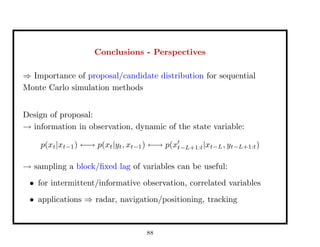
⇒ Importance of proposal/candidate distribution for sequential
Monte Carlo simulation methods
Design of proposal:
→ information in observation, dynamic of the state variable:
p(xt|xt−1) ←→ p(xt|yt, xt−1) ←→ p(xt−L+1:t|xt−L, yt−L+1:t)
→ sampling a block/fixed lag of variables can be useful:
• for intermittent/informative observation, correlated variables
• applications ⇒ radar, navigation/positioning, tracking
88
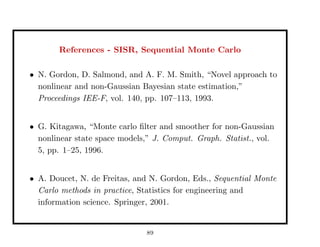
References - SISR, Sequential Monte Carlo
• N. Gordon, D. Salmond, and A. F. M. Smith, “Novel approach to
nonlinear and non-Gaussian Bayesian state estimation,”
Proceedings IEE-F, vol. 140, pp. 107–113, 1993.
• G. Kitagawa, “Monte carlo filter and smoother for non-Gaussian
nonlinear state space models,” J. Comput. Graph. Statist., vol.
5, pp. 1–25, 1996.
• A. Doucet, N. de Freitas, and N. Gordon, Eds., Sequential Monte
Carlo methods in practice, Statistics for engineering and
information science. Springer, 2001.
89
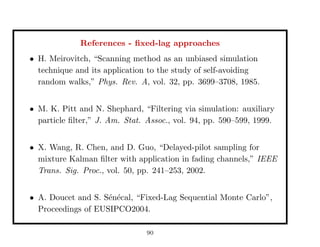
References - fixed-lag approaches
• H. Meirovitch, “Scanning method as an unbiased simulation
technique and its application to the study of self-avoiding
random walks,” Phys. Rev. A, vol. 32, pp. 3699–3708, 1985.
• M. K. Pitt and N. Shephard, “Filtering via simulation: auxiliary
particle filter,” J. Am. Stat. Assoc., vol. 94, pp. 590–599, 1999.
• X. Wang, R. Chen, and D. Guo, “Delayed-pilot sampling for
mixture Kalman filter with application in fading channels,” IEEE
Trans. Sig. Proc., vol. 50, pp. 241–253, 2002.
• A. Doucet and S. S´en´ecal, “Fixed-Lag Sequential Monte Carlo”,
Proceedings of EUSIPCO2004.
90

talk MCMC & SMC 2004

  • 1.
    Some recent advancesin Markov chain and sequential Monte Carlo methods St´ephane S´en´ecal The Institute of Statistical Mathematics, Research Organization of Information and Systems 15/12/2004 thanks to the Japan Society for the Promotion of Science 1
  • 2.
    Estimation x S=F(., ) b y θ Information on(x, θ): distribution of probability p(x, θ|y, F, prior ) ∝ p(y|x, θ, F, prior ) × p(x, θ|prior ) ⇒ Estimates (x, θ) 2
  • 3.
    Estimates • Maximum aposteriori (MAP) (x, θ) = arg max x,θ p(x, θ|y, prior ) • Expectation: posterior mean E {x, θ|y, prior} Ep(.|y,prior ) {f(x, θ)} = f(x, θ)p(x, θ|y, prior )d(x, θ) Computation : asymptotic, numerical, stochastic methods ⇒ Monte Carlo simulation methods 3
  • 4.
    Monte Carlo Estimates x1,. . . , xN ∼ π ⇒ πN = 1 N N n=1 δxn SN (f) = 1 N N n=1 f(xn) −→ f(x)π(x)dx = Eπ {f} xmax = arg max xn πN approximates xmax = arg max x π(x) ⇒ generate samples x ∼ π ? → Markov chain and sequential Monte Carlo 4
  • 5.
    Overview • Introduction toMarkov chain Monte Carlo (MCMC) Space alternating techniques Estimation of Gaussian mixture models • Introduction to Sequential Monte Carlo (SMC) Fixed-lag sampling techniques Recursive estimation of time series models 5
  • 6.
    Simulation Techniques • Classicaldistributions : cumulated density function → transformation of uniform random variable • Non-standard distributions, Rn , known up to a normalizing constant → usage of instrumental distribution: Accept-reject, importance sampling → sequential/recursive ⇒ SMC aka particle filtering, condensation algorithm ⇒ MCMC : distribution = fixed point of an operator π = Kπ → simulation schemes with Markov chain: Hastings-Metropolis, Gibbs sampling 6
  • 7.
    Markov Chain Definition: Xn|Xn−1, Xn−2,. . . , X0 d = Xn|Xn−1 homogeneity : Xn|Xn−1 independent of n Realization: X0 ∼ π0(x0) p.d.f. of Xn|Xn−1 = transition kernel K(xn|xn−1) 7
  • 8.
    Simulation of Markovchain Convergence: Xn ∼ π asymptotically ? π-invariance : π(.) = Kπ(.) A π(x)dx = y∈A K(y|x)π(x)dxdy ⇐ π-reversibility : Pr(A → B) = Pr(B → A) y∈B x∈A K(y|x)π(x)dxdy = y∈A x∈B K(y|x)π(x)dxdy Construct kernels K(.|.) such that the chain is π-invariant • Hastings-Metropolis algorithm • Gibbs sampling 8
  • 9.
    Hastings-Metropolis Draw x fromπ(.) 1. initialize x0 ∼ π0(x) 2. Iteration • propose candidate x for x +1 → x ∼ q(x|x ) • accept it with prob α = min{1, r} 3. ← + 1 and go to (2) r = π(x )q(x |x ) q(x |x )π(x ) → π(x)K(y|x) = π(y)K(x|y) π(x)q(y|x) min 1, π(y)q(x|y) q(y|x)π(x) = min {π(x)q(y|x), π(y)q(x|y)} q(x |x ) = q(x ) q(x |x ) = q(|x − x |) 9
  • 10.
    Example sample x ∼p(x) ∝ 1 1+x2 20,000 iterations x ∼ N(x , 0.12 ) 0 0.2 0.4 0.6 0.8 1 1.2 1.4 1.6 1.8 2 x 10 4 −5 0 5 10 15 −6 −4 −2 0 2 4 6 8 10 12 14 0 0.1 0.2 0.3 0.4 0.5 0.6 0.7 acc. rate = 97% x ∼ U[a,b] 0 0.2 0.4 0.6 0.8 1 1.2 1.4 1.6 1.8 2 x 10 4 −15 −10 −5 0 5 10 15 −15 −10 −5 0 5 10 15 0 0.1 0.2 0.3 0.4 0.5 0.6 0.7 acc. rate = 26% 10
  • 11.
    Gibbs sampling algorithm Samplex = (x1, ...xp) ∼ π(x1, ...xp) 1. initialize x(0) ∼ π0(x), = 0 2. iteration : Sample x ( +1) 1 ∼ π1(x1|x ( ) 2 , . . . , x( ) p ) x ( +1) 2 ∼ π2(x2|x ( +1) 1 , x ( ) 3 , . . . , x( ) p ) ... x( +1) p ∼ πp(xp|x ( +1) 1 , . . . , x ( +1) p−1 ) 3. ← + 1 and go to (2) → no rejection, reversible kernel 11
  • 12.
    x =   x1 x2   ∼N     0 0   ,   1 ρ ρ 1     x ( +1) 1 |x ( ) 2 ∼ N ρx ( ) 2 , 1 − ρ2 x ( +1) 2 |x ( +1) 1 ∼ N ρx ( +1) 1 , 1 − ρ2 −4 −3 −2 −1 0 1 2 3 4 −4 −3 −2 −1 0 1 2 3 4 x1 x2 5,000 samples, ρ=0.5 −6 −4 −2 0 2 4 6 0 1000 2000 3000 4000 5000 6000 7000 8000 9000 −6 −4 −2 0 2 4 6 0 1000 2000 3000 4000 5000 6000 7000 8000 9000 histograms (x1, x2) 12
  • 13.
    How to obtainfast converging simulation scheme ? → Missing Data, Data Augmentation, Latent Variables Idea : extend sampling space x → (x, z) and distribution π(x) → π(x, z) with constraint π(x, z)dz = π(x) such that Markov chain (x(i) , z(i) ) ∼ π faster • Optimization : Expectation-Maximization (EM) algorithm • Simulation : Data Augmentation, Gibbs sampling 13
  • 14.
    Efficient Data AugmentationSchemes Idea: construct missing data space as less informative as possible x pi(x) x ∼ π(x) x pitilde(x,z) = constant z (x, z) ∼ π(x, z) Information introduced in missing data : convergence 14
  • 15.
    Efficient Data AugmentationSchemes EM algorithm → Space Alternating Generalized EM SAGE algorithm, Hero and Fessler 1994: • update parameter components by subblocks • specific missing data space associated with each subblock • complete data spaces less informative → convergence rate 15
  • 16.
    Efficient Data AugmentationSampling Schemes SAGE Idea → MCMC algorithm: • sample parameter components by subblocks • each subblock of parameters is sampled conditionaly on a specific missing data set ⇒ Space Alternating Data Augmentation (SADA) A. Doucet, T. Matsui, S. S´en´ecal 2004 • Optimization : EM algorithm → SAGE algorithm • Simulation : DA, Gibbs sampling → SADA 16
  • 17.
    Overview - Spacealternating techniques • → Introduction to EM and SAGE algorithms • Introduction to Data Augmentation and SADA algorithms • Application to Finite Mixture of Gaussians 17
  • 18.
    EM and SAGEAlgorithms Bayesian framework: obtaining MAP estimate of random variable X given realization of Y = y xMAP = arg max p (x|y) where p (x|y) ∝ p (y|x) p (x) X is random vector whose components are partitioned into n subsets X = X1:n = (X1, . . . , Xn) Notation X−k = X1:n {Xk} = (X1, . . . , Xk−1, Xk+1, . . . , Xn) and Zk:j = (Zk, Zk+1, . . . , Zj) 18
  • 19.
    Expectation-Maximization (EM) algorithm →Maximize p (x|y) ⇒ introduce missing data Z with conditional distribution p (z|y, x) EM, iteration i: E-step : compute Q(x, x(i−1) ) = log (p (x, z|y)) p z|y, x(i−1) dz M-step : set x(i) = arg max x Q(x, x(i−1) ) 19
  • 20.
    Space Alternating EM(SAGE) algorithm → Maximize p (x|y) ⇒ introduce n missing data sets Z1:n with each random variable/vector Zk is given a conditional distribution p (zk|y, x1:n) satisfying p (y|x1:n, zk) = p (y|x−k, zk) → zk independent of xk conditionaly on x−k and y → non-informative missing data space 20
  • 21.
    Space Alternating EM(SAGE) algorithm SAGE, iteration i: • select index k ∈ {1, . . . , n} e.g. components updated cyclically k = (i mod n) + 1 • EM step for computing x (i) k : set x (i) k = arg max x log p x (i−1) −k , xk, z|y p zk|y, x(i−1) dzk and set x (i) −k = x (i−1) −k 21
  • 22.
    DA and SADAAlgorithms Bayesian framework: objective not only to maximize p (x|y) but to obtain random samples X(i) distributed according to p (x|y) Based on samples X(i) , approximation of MMSE estimate: xMMSE = 1 N N i=1 X(i) → xMMSE = xp (x|y) dx Also possible to compute posterior variances, confidence intervals or predictive distributions. Construction of efficient MCMC algorithms typically difficult → introduction of missing data 22
  • 23.
    Data Augmentation, Gibbssampling → Sample p (x|y) ⇒ introduce missing data Z with joint posterior distribution p (x, z|y) = p (x|y) p (z|y, x) Data Augmentation algorithm, iteration i given X(i−1) : • Sample Z(i) ∼ p ·|y, X(i−1) • Sample X(i) ∼ p ·|y, Z(i) 23
  • 24.
    Convergence of DA/Gibbssampling algorithm • Transition kernel associated to X(i) , Z(i) admits p (x, z|y) as invariant distribution • Under weak additional assumptions (irreducibility and aperiodicity) instantaneous distribution of X(i) , Z(i) converges towards p (x, z|y) as i → +∞ 24
  • 25.
    Space Alternating DataAugmentation → Sample p (x|y) ⇒ introduce n missing data sets Z1:n with each random variable Zk is given a conditional distribution p (zk|y, x1:n) such that p (y|x1:n, zk) = p (y|x−k, zk) → zk independent of xk conditionaly on x−k and y → non-informative missing data space Sampling of joint posterior distribution: p (x1:n, z1:n|y) = p (x1:n|y) n k=1 p (zk|y, x1:n) 25
  • 26.
    Space Alternating DataAugmentation SADA algorithm, iteration i given X (i−1) 1:n and component index k: • Sample Z (i) k ∼ p ·|y, X(i−1) • Sample X (i) k ∼ p ·|y, Z (i) k , X (i−1) −k • Set X (i) −k = X (i−1) −k Components updated cyclically k = (i mod n) + 1 26
  • 27.
    Validity of SADAsampling algorithm Generation of Markov chain X (i) 1:n, Z (i) 1:n with invariant distribution p (x1:n, z1:n|y) Idea: SADA equivalent to • Sample Z (i) k , Z−k ∼ p ·|y, X (i−1) 1:n • Sample X (i) k , Z−k ∼ p ·|y, Z (i) k , X (i−1) −k • Set X (i) −k = X (i−1) −k 27
  • 28.
    Validity of SADAsampling algorithm SADA → sample Zk and Xk but also Z−k at each iteration sampling according to full conditional distributions p (z1:n|y, x1:n) and p (x1:n|y, z1:n) ⇒ ad hoc invariant distribution p (x1:n, z1:n|y) sampling of Z−k not necessary → discarded 28
  • 29.
    Overview - Spacealternating techniques • Introduction to EM and SAGE algorithms • Introduction to Data Augmentation and SADA algorithms • ⇒ Application to Finite Mixture of Gaussians 29
  • 30.
    Finite Mixture ofGaussians EM/DA algorithms routinely used to perform ML/MAP parameter estimation/to sample the posterior distribution Straightforward extensions to hidden Markov chains with Gaussian observations T i.i.d. observations Y1:T in Rd , distributed according to a finite mixture of s Gaussians Yt ∼ s j=1 πjN (µj; Σj) 30
  • 31.
    Bayesian Estimation Parameters X ={(µj, Σj, πj) ; j = 1, . . . , s} unknown, random, distributed from conjugate prior distributions µj|Σj ∼ N (αj, Σj/λj) Σ−1 j ∼ W (rj, Cj) (π1, . . . , πs) ∼ D (ζ1, . . . , ζs) 31
  • 32.
    Bayesian Estimation Σ−1 ∼ W(r, C): Wishart distribution, p.d.f. proportional to |Σ−1 | 1 2 (r−d−1) exp − 1 2 tr Σ−1 C−1 (π1, . . . , πs) ∼ D (ζ1, . . . , ζs): Dirichlet distribution restricted to the simplex, p.d.f. proportional to s k=1 πζk−1 k Hyperparameters {(αj, λj, rj, Cj, ζj) ; j = 1, . . . , s} assumed fixed but could be estimated from data in a hierarchical Bayes model 32
  • 33.
    Missing Data forFinite Mixture of Gaussians EM/DA introduce the i.i.d. missing data Zt ∈ {1, . . . , s} such that Yt|Zt = j ∼ N (µj; Σj) Pr (Zt = j) = πj Gibbs sampling algorithm, iteration i: • sample discrete latent variables Z (i) t ∼ p ·|yt, X(i−1) • compute sufficient statistics n (i) j T t=1 δZ (i) t ,j , n (i) j y (i) j T t=1 δZ (i) t ,j yt and S (i) j T t=1 δZ (i) t ,j ytyT t • sample parameters 33
  • 34.
    Gibbs sampling forFinite Mixture of Gaussians sampling parameters, iteration i: Σ −1(i) j ∼ W rj + n (i) j , Σ −1(i) j µ (i) j |Σ (i) j ∼ N m (i) j , Σ (i) j λj + n (i) j π (i) 1 , . . . , π(i) s ∼ D n (i) 1 + ζ1, . . . , n(i) s + ζs m (i) j = λjαj + n (i) j y (i) j λj + n (i) j Σ (i) j = C−1 j + λjαjαT j + S (i) j − λj + n (i) j m (i) j m (i)T j 34
  • 35.
    Less Informative MissingData update only µj, τ2 j , µ−j, τ2 −j fixed → binary missing data Zt,j ∈ {0, j} such that Pr (Zt,j = j) = πj variable Zt,j = “observation coming from component j or not”, less informative than knowing “from which particular component observation is derived” constraint s j=1 πj = 1 ⇒ cannot update πj, use of standard EM approach for sampling the weights 35
  • 36.
    Less Informative MissingData → updating jointly the parameters of two components j and k (A. Doucet, T. Matsui and S. S´en´ecal, 2004) → missing data Zt,j,k ∈ {0, j, k} such that Pr (Zt,j,k = j) = πj, Pr (Zt,j,k = k) = πk and Yt|Zt,j,k = j ∼ N (µj; Σj) Yt|Zt,j,k = k ∼ N (µk; Σk) Yt|Zt,j,k = 0 ∼ l=j,l=k πlN (µl; Σl) l=j,l=k πl 36
  • 37.
    SAGE algorithm forFinite Mixture of Gaussians update for µj, τ2 j , iteration i: µ (i) j = λjαj + T t=1 ytp Zt,j,k = j|yt, X(i−1) λj + T t=1 p Zt,j,k = j|yt, X(i−1) Σ (i) j = C−1 j + λj µ (i) j − αj µ (i) j − αj T + . . . . . . . . . + T t=1 yt − µ (i) j yt − µ (i) j T p Zt,j,k = j|yt, X(i−1) rj − d − 1 + λj + T t=1 p Zt,j,k = j|yt, X(i−1) 37
  • 38.
    SAGE algorithm forFinite Mixture of Gaussians update for πj, iteration i: π (i) j = 1 − l=j,l=k π (i−1) l 1 + T t=1 p(Zt,j,k=k|yt,X(i−1) )+(ζk−1) T t=1 p(Zt,j,k=j|yt,X(i−1) )+(ζj −1) π (i) k = 1 − π (i) j − l=j,l=k π (i−1) l 38
  • 39.
    SADA algorithm forFinite Mixture of Gaussians SADA algorithm, iteration i, sample (µj, Σj, πj) • sample discrete latent variables Z (i) t,j,k ∼ p ·|yt, X(i−1) • compute sufficient statistics n (i) j T t=1 δZ (i) t,j,k,j and n (i) j y (i) j T t=1 δZ (i) t,j,k,j yt, S (i) j T t=1 δZ (i) t,j,k,j ytyT t • sample parameters 39
  • 40.
    SADA algorithm forFinite Mixture of Gaussians sampling parameters, iteration i: Σ −1(i) j ∼ W rj + n (i) j , Σ −1(i) j µ (i) j |Σ (i) j ∼ N m (i) j , Σ (i) j λj + n (i) j π (i) j , π (i) k ∼  1 − l=j,l=k π (i−1) l   D n (i) j + ζj, n (i) k + ζk 40
  • 41.
    Numerical experiments Mixture ofs = 8 d = 10-dimensional Gaussians T = 100 samples Parameters of components sampled from prior with parameters ζj = 1, αj = 0, λj = 0.01, rj = d + 1 and Cj = 0.01I 100 iterations of EM and SAGE algorithms 41
  • 42.
    Numerical experiments -s = 8 d = 10 0 5 10 15 20 25 30 35 40 45 50 −2000 −1800 −1600 −1400 −1200 −1000 −800 −600 −400 Log of posterior p.d.f. values (straight EM/dotted SAGE) / iterations 42
  • 43.
    Numerical experiments -s = 5 d = 25 0 5 10 15 20 25 30 35 40 45 50 −5000 −4500 −4000 −3500 −3000 −2500 −2000 −1500 −1000 −500 0 Log of posterior p.d.f. values (straight EM/dotted SAGE) / iterations 43
  • 44.
    Simulations Mixture of s= 5 d = 10-dimensional Gaussians T = 100, parameters of components sampled from prior with parameters ζj = 1, αj = 0, λj = 0.01, rj = d + 1 and Cj = 0.01I 200 iterations of EM and SAGE 50 times 5000 iterations of DA and SADA 10 times Results: • EM/SAGE: mean of log-posterior values at final iteration • SA/SADA: mean of average log-posterior values of last 1000 iterations 44
  • 45.
    Simulations Results s EMSAGE DA SADA 5 -915.8 -671.5 -873.7 -886.0 6 -929.6 –603.2 -877.3 -886.7 7 -941.4 -576.5 -893.9 -906.9 8 -965.7 -559.2 -904.9 -875.0 9 -968.9 -503.0 -898.8 -882.5 10 -983.2 -478.1 -924.0 -906.6 Log-posterior values for final iteration EM/SAGE and average log-posterior values for DA/SADA 45
  • 46.
    Conclusion - Perspectives •Sampling complex distributions: MCMC → Hastings-Metropolis, Gibbs sampler • Speed-up convergence of optimisation/simulation algorithms: missing data, data augmentation, latent/extended variable → space alternating techniques, non-informative data spaces • Applications in modeling/estimation: speech processing, tomography, digital communication, . . . 46
  • 47.
    References - EM/SAGE/MCMC •G. J. McLachlan and T. Krishnan, The EM Algorithm and Extensions, Wiley Series in Probability and Statistics, 1997 • J. A. Fessler and A. O. Hero, Space-alternating generalized expectation-maximization algorithm, IEEE Trans. Sig. Proc., 42:2664–2677, 1994 • C. P. Robert and G. Casella, Monte Carlo Statistical Methods, Springer-Verlag, 1999 • A. Doucet, T. Matsui and S. S´en´ecal, Space Alternating Data Augmentation, ICASSP’05, 2005 47
  • 48.
    Overview - MCMCand SMC methods • Introduction to Markov chain Monte Carlo (MCMC) Space alternating techniques Estimation of Gaussian mixture models • Introduction to Sequential Monte Carlo (SMC) Fixed-lag sampling techniques Recursive estimation of time series models 48
  • 49.
    Estimation of statespace models xt = ft(xt−1, ut) yt = gt(xt, vt) p(x0:t|y1:t) → p(xt|y1:t) = p(x0:t|y1:t)dx0:t−1 distribution of x0:t ⇒ computation of estimate x0:t: x0:t = x0:tp(x0:t|y1:t)dx0:t → Ep(.|y1:t){f(x0:t)} x0:t = arg max x0:t p(x0:t|y1:t) 49
  • 50.
    Computation of theestimates p(x0:t|y1:t) ⇒ multidimensionnal, non-standard distributions: → analytical, numerical approximations → integration, optimisation methods ⇒ Monte Carlo techniques 50
  • 51.
    Monte Carlo approach computeestimates for distribution π(.) → samples x1, . . . , xN ∼ π x pi(x) x_1 x_N ⇒ distribution πN = 1 N N i=1 δxi approximates π(.) 51
  • 52.
    Monte Carlo estimates SN(f) = 1 N N i=1 f(xi) −→ f(x)π(x)dx = Eπ{f(x)} arg max(xi)1≤i≤N πN (xi) approximates arg maxx π(x) ⇒ sampling xi ∼ π difficult → importance sampling techniques 52
  • 53.
    Simulation Techniques • Classicaldistributions : cumulated density function → transformation of uniform random variable • Non-standard distributions, Rn , known up to a normalizing constant → usage of instrumental distribution: Accept-reject, importance sampling → sequential/recursive ⇒ SMC aka particle filtering, condensation algorithm ⇒ MCMC : distribution = fixed point of an operator, Markov chain → simulation schemes: Hastings-Metropolis, Gibbs sampling 53
  • 54.
    Importance Sampling xi ∼π → candidate/proposal distribution xi ∼ g x g(x) pi(x) x_Nx_1 54
  • 55.
    Importance Sampling xi ∼g = π → (xi, wi) weighted sample ⇒ weight wi = π(xi) g(xi) x g(x) pi(x) x_Nx_1 55
  • 56.
    Estimation importance sampling →computation of Monte Carlo estimates e. g. expectations Eπ{f(x)}: f(x) π(x) g(x) g(x)dx = f(x)π(x)dx N i=1 wif(xi) → f(x)π(x)dx = Eπ{f(x)} dynamic model (xt, yt) ⇒ recursive estimation x0:t−1 → x0:t Monte Carlo techniques ⇒ sampling sequences x (i) 0:t−1 → x (i) 0:t 56
  • 57.
    Sequential simulation sampling sequencesx (i) 0:t ∼ πt(x0:t) recursively: time variable state x p(x,t) target distribution: t t2 t1 p(x,t2) x_t1 x_t2 p(x_t1) p(x_t2) p(x,t1) 57
  • 58.
    Sequential simulation: importancesampling samples x (i) 0:t ∼ πt(x0:t) approximated by weighted particles (x (i) 0:t, w (i) t )1≤i≤N time p(x,t) target distribution: p(x,t2) t t2 t1 x p(x,t1) 58
  • 59.
    Sequential importance sampling diffusingparticles x (i) 0:t1 → x (i) 0:t2 time p(x,t) target distribution: p(x,t2) t x p(x,t1) t2 t1 ⇒ sampling scheme x (i) 0:t−1 → x (i) 0:t 59
  • 60.
    Sequential importance sampling updatingweights w (i) t1 → w (i) t2 time p(x,t) target distribution: p(x,t2) t p(x,t1) x t2 t1 ⇒ updating rule w (i) t−1 → w (i) t 60
  • 61.
    Sequential Importance Sampling x0:t∼ πt(x0:t) ⇒ (x (i) 0:t, w (i) t )1≤i≤N Simulation scheme t − 1 → t: • Sampling step x (i) t ∼ qt(xt|x (i) 0:t−1) • Updating weights w (i) t ∝ w (i) t−1 × πt(x (i) 0:t−1, x (i) t ) πt−1(x (i) 0:t−1)qt(x (i) t |x (i) 0:t−1) incremental weight (iw) normalizing N i=1 w (i) t = 1 61
  • 62.
    Sequential Importance Sampling x0:t∼ πt(x0:t) ⇒ (x (i) 0:t, w (i) t )1≤i≤N proposal + reweighting → pi(x_t) x_t 62
  • 63.
    Sequential Importance Sampling proposal+ reweighting → var{(w (i) t )1≤i≤N } with t x_t pi(x_t) → w (i) t ≈ 0 for all i except one 63
  • 64.
    ⇒ Resampling x_t pi(x_t) 0 x_t^(1) x_t^(j)1x_t^(i)2x_t^(k)3 x_t^(N)0 → draw N particles paths from the set (x (i) 0:t)1≤i≤N with probability (w (i) t )1≤i≤N 64
  • 65.
    Sequential Importance Sampling/Resampling Simulationscheme t − 1 → t: • Sampling step x ,(i) t ∼ qt(x, t|x (i) 0:t−1) • Updating weights w (i) t ∝ w (i) t−1 × πt(x (i) 0:t−1,x ,(i) t ) πt−1(x (i) 0:t−1)qt(x ,(i) t |x (i) 0:t−1) → parallel computing • ⇒ Resampling step: sample N paths from (x (i) 0:t−1, x ,(i) t )1≤i≤N → particles interacting : computation at least O(N) 65
  • 66.
    FV: Sequential simulation:SISR Recursive estimation of state space models. Approximation with particles, importance sampling. time x p_t(x) t t+1 Bootstrap, particle filtering Gordon et al. 1993, Kitagawa 1996, Doucet et al. 2001 → time series, tracking. 66
  • 67.
    FV: Sequential ImportanceSampling/Resampling Samples x (i) 0:t ∼ πt(x0:t) approximated by weighted particles (x (i) 0:t, w (i) t )1≤i≤N Simulation scheme t − 1 → t: • Sampling step x ,(i) t ∼ qt(x, t|x (i) 0:t−1) • Updating weights w (i) t ∝ w (i) t−1 × πt(x (i) 0:t−1, x ,(i) t ) πt−1(x (i) 0:t−1)qt(x ,(i) t |x (i) 0:t−1) incremental weight (iw) • Resampling step: sample N paths from (x (i) 0:t−1, x ,(i) t )1≤i≤N 67
  • 68.
    SISR for recursiveestimation of state space models xt = ft(xt−1, ut) → p(xt|xt−1) yt = gt(xt, vt) → p(yt|xt) Usual SISR: Bootstrap filter (Gordon et al. 93, Kitagawa 96): • Sampling step x (i) t ∼ p(xt|x (i) t−1) • Updating weights : incremental weight w (i) t ∝ w (i) t−1 × iw iw ∝ p(yt|x (i) t ) • Stratified/Deterministic resampling efficient, easy, fast for a wide class of models tracking, time series → nonlinear non-Gaussian state spaces 68
  • 69.
    Improving simulation Optimal proposaldistribution qt(xt|x (i) 0:t−1) → mimimizing variance of incremental weight (w (i) t ∝ w (i) t−1 × iw) iw = πt(x (i) 0:t−1, x (i) t ) πt−1(x (i) 0:t−1)qt(x (i) t |x (i) 0:t−1) ⇒ 1-step ahead predictive: πt(xt|x0:t−1) = p(xt|xt−1, yt) ⇒ incremental weight: iw → πt(x0:t−1) πt−1(x0:t−1) = p(x0:t−1|y1:t) p(x0:t−1|y1:t−1) ∝ p(yt|xt−1) = p(yt|xt)p(xt|xt−1)dxt 69
  • 70.
    Improving simulation sampling/approximating predictiveπt(xt|x0:t−1) may not be efficient for diffusing particles: e.g. discrepancy (πt)t>0 high: ⇒ consider a block of variables xt−L:t for a fixed lag L 70
  • 71.
    Approaches using ablock of variables • discrete distributions, Meirovitch 1985 • auxiliary variables, Pitt and Shephard 1999 • reweighting before resampling, Wang et al. 2002 ⇒ discrete distribution → analytical form for xt ∼ πt+L(xt|x0:t−1) = πt+L(xt:t+L|x0:t−1)dxt+1:t+L Meirovitch 1985: random walk in discrete space (growing a polymer) → complexity X L for lag L 71
  • 72.
  • 73.
    Reweighting → need tosample xt by block ⇒ design a proposal/candidate distribution 73
  • 74.
    Sampling recursively ablock of variables t−L t−L+1 tt−1 xt−L:t−1 → xt−L+1:t: imputing xt and re-imputing xt−L+1:t−1 74
  • 75.
    Sampling a blockof variables t−L t−L+1 tt−1 t−L+1x’( t−L+1x( 0 :0 t−1x( :0 t−Lx( :t) ) ) )t−1: Proposal/candidate distribution for the “natural” block: (x0:t−L, xt−L+1:t) ∼ πt−1(x0:t−1)qt(xt−L+1:t|x0:t−1)dxt−L+1:t−1 75
  • 76.
    Sampling a blockof variables t−L t−L+1 tt−1 t−L+1x’( t−L+1x( 0 :0 t−1x( :0 t−Lx( :t) ) ) )t−1: Candidate distribution for the extended block: (x0:t−L, xt−L+1:t) → (x0:t−L, xt−L+1:t−1, xt−L+1:t) : (x0:t−1, xt−L+1:t) ∼ πt−1(x0:t−1)qt(xt−L+1:t|x0:t−1) 76
  • 77.
    Sampling a blockof variables Target distribution for the “natural” block (x0:t−L, xt−L+1:t): πt(x0:t−L, xt−L+1:t) ⇒ auxiliary target distribution for the extended block (x0:t−1, xt−L+1:t) = (x0:t−L, xt−L+1:t−1, xt−L+1:t) : πt(x0:t−L, xt−L+1:t)rt(xt−L+1:t−1|x0:t−L, xt−L+1:t) with rt = any conditional distribution ⇒ proposal + target distributions → importance sampling 77
  • 78.
    Fixed-Lag Sequential MonteCarlo A. Doucet and S. S´en´ecal, 2004 Simulation scheme t − 1 → t (index (i) dropped): • Sampling step xt−L+1:t ∼ qt(xt−L+1:t|x0:t−1) • Updating weights wt ∝ wt−1 × πt(x0:t−L, xt−L+1:t)rt(xt−L+1:t−1|x0:t−L, xt−L+1:t) πt−1(x0:t−1)qt(xt−L+1:t|x0:t−1) • Resampling step 78
  • 79.
    Improving simulation Optimal proposaldistribution qt(xt−L+1:t|x0:t−1): → mimimizing variance of incremental weight: iw = πt(x0:t−L, xt−L+1:t)rt(xt−L+1:t−1|x0:t−L, xt−L+1:t) πt−1(x0:t−1)qt(xt−L+1:t|x0:t−1) ⇒ qt = L-step ahead predictive πt(xt−L+1:t|x0:t−L) = p(xt−L+1:t|xt−L, yt−L+1:t) For one variable: optimal qt = 1-step ahead predictive πt(xt|x0:t−1) = p(xt|xt−1, yt) 79
  • 80.
    Improving simulation Mimimizing varianceof incremental weight ⇒ optimal target distribution iw = πt(x0:t−L, xt−L+1:t)rt(xt−L+1:t−1|x0:t−L, xt−L+1:t) πt−1(x0:t−1)qt(xt−L+1:t|x0:t−1) → optimal conditional distribution rt(xt−L+1:t−1|x0:t−L, xt−L+1:t) ⇒ rt = (L − 1)-step ahead predictive πt−1(xt−L+1:t−1|x0:t−L) = p(xt−L+1:t−1|xt−L, yt−L+1:t−1) 80
  • 81.
    Improving simulation For optimalqt and rt, incremental weight: iw → πt(x0:t−L) πt−1(x0:t−L) = p(x0:t−L|y1:t) p(x0:t−L|y1:t−1) ∝ p(yt|xt−L, yt−L+1:t−1) ∝ p(yt, xt−L+1:t|xt−L, yt−L+1:t−1)dxt−L+1:t SISR for one variable with optimal proposal qt: iw → πt(x0:t−1) πt−1(x0:t−1) = p(yt|xt−1) = p(yt|xt)p(xt|xt−1)dxt Bootstrap filter: iw = p(yt|xt) 81
  • 82.
    Example Nonlinear state spacemodel: xt = α(xt−1 + βx3 t−1) + ut x0, ut ∼ N(0, σ2 u) yt = xt + vt vt ∼ N(0, σ2 v) Sequential Monte Carlo methods: • Bootstrap filter, proposal p(xt|xt−1) • SISR with optimal proposal p(xt|xt−1, yt) • SISR for blocks with optimal proposal p(xt−L+1:t|xt−L, yt−L+1:t) approximated by forward-backward recursions with KF/EKF Parameters values α=0.9, β=0.4, σu=0.1 and σv=0.05 ⇒ approximation of target distribution p(xt|y1:t) 82
  • 83.
    Approximation of thetarget distribution ⇒ Effective Sample Size: ESS = 1 N i=1[w (i) t ]2 w(i) = 1 N : ESS = N pi(x_t) x_t w(i) ≈ 0 ∀i except one: ESS = 1 x_t pi(x_t) ⇒ Resampling performed for ESS ≤ N 2 , N 10 83
  • 84.
    Simulation results algorithm MSEESS RS CPU Bootstrap 0.0021 36.8 70.3 % 0.68 SISR 0.0019 65.8 19.2% 0.48 BSISR-KF 0.0018 72.3 0.9% 0.21 BSISR-EKF 0.0018 73.5 0.8% 0.24 N = 100 particles, 100 runs of particle filters for a single and for a block of L = 2 variables. 84
  • 85.
    Approximation of thetarget distribution Resampling for ESS ≤ N 2 , N = 100 0 20 40 60 80 100 120 140 160 180 200 0 10 20 30 40 50 60 70 80 90 100 time index EffectiveSampleSize Approximated ESS vs. time index the Bootstrap filter (dotted), the SISR with optimal proposal for a single variable (dashdotted) and approximated for a block of L=2 variables (straight). 85
  • 86.
    Simulation results block sizeL N=100 N=500 N=1000 RS 2 74 370 715 0.9% 3 96 493 985 0.9% 4 99 496 989 1% 5 98 494 988 1% 10 97 486 972 2.5% Approximated ESS averaged over 100 runs of particle filters for blocks of L variables, considering N particles. 86
  • 87.
    CPU time /number of particles N Resampling for ESS ≤ N 2 , 1,000 time steps 100 200 300 400 500 600 700 800 900 1000 0 0.5 1 1.5 2 2.5 CPU time vs. N for bootstrap filter (black), SISR with optimal proposal for a single variable (blue) and approximated for a block of L=2 variables (red), 100 realizations. 87
  • 88.
    Conclusions - Perspectives ⇒Importance of proposal/candidate distribution for sequential Monte Carlo simulation methods Design of proposal: → information in observation, dynamic of the state variable: p(xt|xt−1) ←→ p(xt|yt, xt−1) ←→ p(xt−L+1:t|xt−L, yt−L+1:t) → sampling a block/fixed lag of variables can be useful: • for intermittent/informative observation, correlated variables • applications ⇒ radar, navigation/positioning, tracking 88
  • 89.
    References - SISR,Sequential Monte Carlo • N. Gordon, D. Salmond, and A. F. M. Smith, “Novel approach to nonlinear and non-Gaussian Bayesian state estimation,” Proceedings IEE-F, vol. 140, pp. 107–113, 1993. • G. Kitagawa, “Monte carlo filter and smoother for non-Gaussian nonlinear state space models,” J. Comput. Graph. Statist., vol. 5, pp. 1–25, 1996. • A. Doucet, N. de Freitas, and N. Gordon, Eds., Sequential Monte Carlo methods in practice, Statistics for engineering and information science. Springer, 2001. 89
  • 90.
    References - fixed-lagapproaches • H. Meirovitch, “Scanning method as an unbiased simulation technique and its application to the study of self-avoiding random walks,” Phys. Rev. A, vol. 32, pp. 3699–3708, 1985. • M. K. Pitt and N. Shephard, “Filtering via simulation: auxiliary particle filter,” J. Am. Stat. Assoc., vol. 94, pp. 590–599, 1999. • X. Wang, R. Chen, and D. Guo, “Delayed-pilot sampling for mixture Kalman filter with application in fading channels,” IEEE Trans. Sig. Proc., vol. 50, pp. 241–253, 2002. • A. Doucet and S. S´en´ecal, “Fixed-Lag Sequential Monte Carlo”, Proceedings of EUSIPCO2004. 90