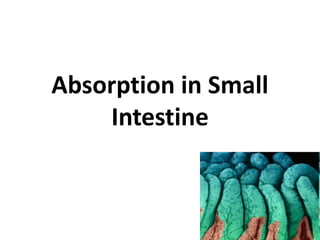
Absorption in Small
Intestine
2
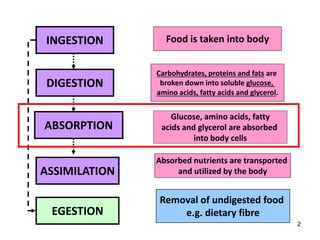
INGESTION
DIGESTION
ABSORPTION
EGESTION
ASSIMILATION
Food is taken into body
Carbohydrates, proteins and fats are
broken down into soluble glucose,
amino acids, fatty acids and glycerol.
Glucose, amino acids, fatty
acids and glycerol are absorbed
into body cells
Removal of undigested food
e.g. dietary fibre
Absorbed nutrients are transported
and utilized by the body
3
ABSORPTION
Monosaccharides (glucose, fructose and
galactose), amino acids, fatty acids, glycerol
and water are absorbed in the small intestine.
The absorbed nutrients passes
from the lumen of the small
intestine into the bloodstream.
http://www.colorado.edu/intphys/Class/IPHY3430-200/image/villi.jpg
lumen
How to ensure that nutrients
are quickly absorbed?
5
Adaptations of the Small Intestine
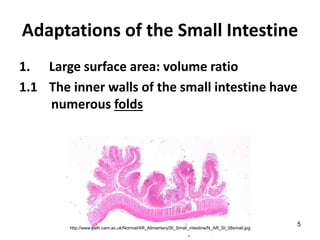
1. Large surface area: volume ratio
1.1 The inner walls of the small intestine have
numerous folds
http://www.path.cam.ac.uk/Normal/AR_Alimentary/SI_Small_intestine/N_AR_SI_08small.jpg
6
Adaptations of the Small Intestine
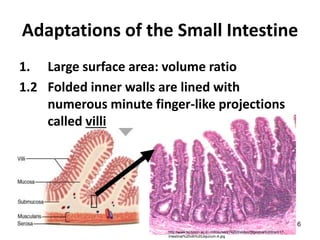
1. Large surface area: volume ratio
1.2 Folded inner walls are lined with
numerous minute finger-like projections
called villi
http://www.technion.ac.il/~mdcourse/274203/slides/Digestive%20tract/17-
Intestinal%20villi%20Jejunum-A.jpg
7
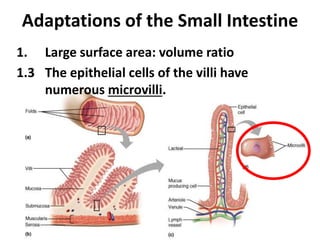
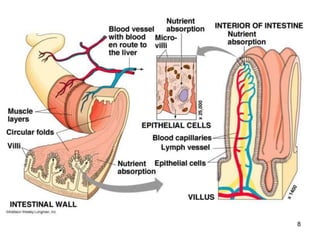
1. Large surface area: volume ratio
1.3 The epithelial cells of the villi have
numerous microvilli.
Adaptations of the Small Intestine
8
9
Adaptations of the Small Intestine
http://www.siumed.edu/~dking2/erg/images/GI020b.jpg
2. The villi wall (epithelial cell layer)
is only one cell thick.
http://www.biog1105-1106.org/demos/105/unit6/media/villus.structure.jpg
10
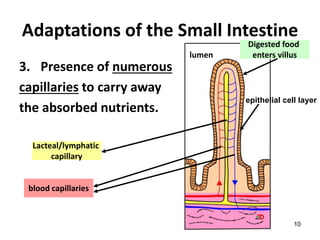
Adaptations of the Small Intestine
3. Presence of numerous
capillaries to carry away
the absorbed nutrients.
blood capillaries
Lacteal/lymphatic
capillary
Digested food
enters villuslumen
epithelial cell layer
11
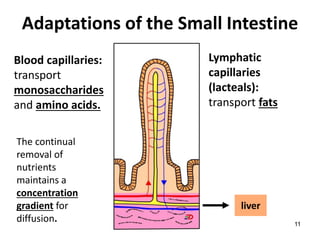
Adaptations of the Small Intestine
Blood capillaries:
transport
monosaccharides
and amino acids.
Lymphatic
capillaries
(lacteals):
transport fats
The continual
removal of
nutrients
maintains a
concentration
gradient for
diffusion.
liver
Digestive End Products
12
13
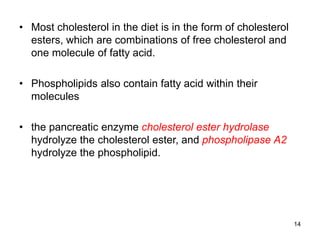
• Most cholesterol in the diet is in the form of cholesterol
esters, which are combinations of free cholesterol and
one molecule of fatty acid.
• Phospholipids also contain fatty acid within their
molecules
• the pancreatic enzyme cholesterol ester hydrolase
hydrolyze the cholesterol ester, and phospholipase A2
hydrolyze the phospholipid.
14
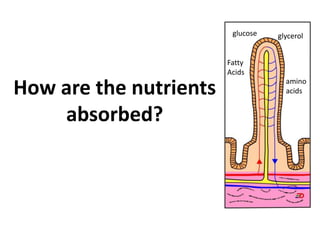
How are the nutrients
absorbed?
glucose
amino
acids
Fatty
Acids
glycerol
16
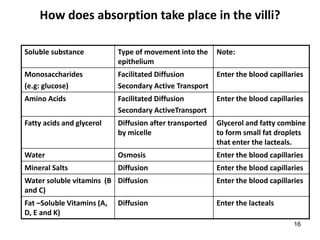
How does absorption take place in the villi?
Soluble substance Type of movement into the
epithelium
Note:
Monosaccharides
(e.g: glucose)
Facilitated Diffusion
Secondary Active Transport
Enter the blood capillaries
Amino Acids Facilitated Diffusion
Secondary ActiveTransport
Enter the blood capillaries
Fatty acids and glycerol Diffusion after transported
by micelle
Glycerol and fatty combine
to form small fat droplets
that enter the lacteals.
Water Osmosis Enter the blood capillaries
Mineral Salts Diffusion Enter the blood capillaries
Water soluble vitamins (B
and C)
Diffusion Enter the blood capillaries
Fat –Soluble Vitamins (A,
D, E and K)
Diffusion Enter the lacteals
17
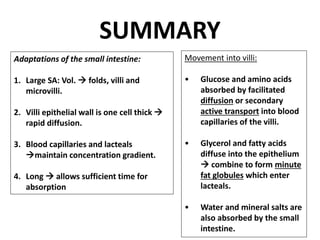
SUMMARY
Adaptations of the small intestine:
1. Large SA: Vol.  folds, villi and
microvilli.
2. Villi epithelial wall is one cell thick 
rapid diffusion.
3. Blood capillaries and lacteals
maintain concentration gradient.
4. Long  allows sufficient time for
absorption
Movement into villi:
• Glucose and amino acids
absorbed by facilitated
diffusion or secondary
active transport into blood
capillaries of the villi.
• Glycerol and fatty acids
diffuse into the epithelium
 combine to form minute
fat globules which enter
lacteals.
• Water and mineral salts are
also absorbed by the small
intestine.
18
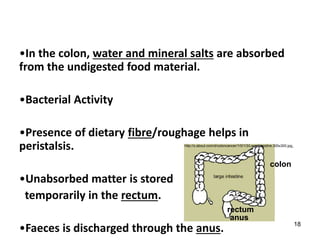
•In the colon, water and mineral salts are absorbed
from the undigested food material.
•Bacterial Activity
•Presence of dietary fibre/roughage helps in
peristalsis.
•Unabsorbed matter is stored
temporarily in the rectum.
•Faeces is discharged through the anus.
colon
rectum
anus
http://z.about.com/d/coloncancer/1/0/1/3/LargeIntestine.300x300.jpg
19
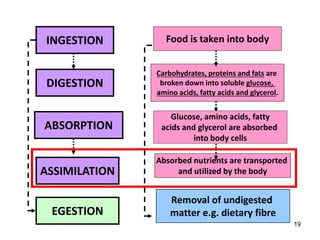
INGESTION
DIGESTION
ABSORPTION
EGESTION
ASSIMILATION
Food is taken into body
Carbohydrates, proteins and fats are
broken down into soluble glucose,
amino acids, fatty acids and glycerol.
Glucose, amino acids, fatty
acids and glycerol are absorbed
into body cells
Removal of undigested
matter e.g. dietary fibre
Absorbed nutrients are transported
and utilized by the body

Gastrointestinal absorption

  • 1.
  • 2.
    2 INGESTION DIGESTION ABSORPTION EGESTION ASSIMILATION Food is takeninto body Carbohydrates, proteins and fats are broken down into soluble glucose, amino acids, fatty acids and glycerol. Glucose, amino acids, fatty acids and glycerol are absorbed into body cells Removal of undigested food e.g. dietary fibre Absorbed nutrients are transported and utilized by the body
  • 3.
    3 ABSORPTION Monosaccharides (glucose, fructoseand galactose), amino acids, fatty acids, glycerol and water are absorbed in the small intestine. The absorbed nutrients passes from the lumen of the small intestine into the bloodstream. http://www.colorado.edu/intphys/Class/IPHY3430-200/image/villi.jpg lumen
  • 4.
    How to ensurethat nutrients are quickly absorbed?
  • 5.
    5 Adaptations of theSmall Intestine 1. Large surface area: volume ratio 1.1 The inner walls of the small intestine have numerous folds http://www.path.cam.ac.uk/Normal/AR_Alimentary/SI_Small_intestine/N_AR_SI_08small.jpg
  • 6.
    6 Adaptations of theSmall Intestine 1. Large surface area: volume ratio 1.2 Folded inner walls are lined with numerous minute finger-like projections called villi http://www.technion.ac.il/~mdcourse/274203/slides/Digestive%20tract/17- Intestinal%20villi%20Jejunum-A.jpg
  • 7.
    7 1. Large surfacearea: volume ratio 1.3 The epithelial cells of the villi have numerous microvilli. Adaptations of the Small Intestine
  • 8.
  • 9.
    9 Adaptations of theSmall Intestine http://www.siumed.edu/~dking2/erg/images/GI020b.jpg 2. The villi wall (epithelial cell layer) is only one cell thick. http://www.biog1105-1106.org/demos/105/unit6/media/villus.structure.jpg
  • 10.
    10 Adaptations of theSmall Intestine 3. Presence of numerous capillaries to carry away the absorbed nutrients. blood capillaries Lacteal/lymphatic capillary Digested food enters villuslumen epithelial cell layer
  • 11.
    11 Adaptations of theSmall Intestine Blood capillaries: transport monosaccharides and amino acids. Lymphatic capillaries (lacteals): transport fats The continual removal of nutrients maintains a concentration gradient for diffusion. liver
  • 12.
  • 13.
  • 14.
    • Most cholesterolin the diet is in the form of cholesterol esters, which are combinations of free cholesterol and one molecule of fatty acid. • Phospholipids also contain fatty acid within their molecules • the pancreatic enzyme cholesterol ester hydrolase hydrolyze the cholesterol ester, and phospholipase A2 hydrolyze the phospholipid. 14
  • 15.
    How are thenutrients absorbed? glucose amino acids Fatty Acids glycerol
  • 16.
    16 How does absorptiontake place in the villi? Soluble substance Type of movement into the epithelium Note: Monosaccharides (e.g: glucose) Facilitated Diffusion Secondary Active Transport Enter the blood capillaries Amino Acids Facilitated Diffusion Secondary ActiveTransport Enter the blood capillaries Fatty acids and glycerol Diffusion after transported by micelle Glycerol and fatty combine to form small fat droplets that enter the lacteals. Water Osmosis Enter the blood capillaries Mineral Salts Diffusion Enter the blood capillaries Water soluble vitamins (B and C) Diffusion Enter the blood capillaries Fat –Soluble Vitamins (A, D, E and K) Diffusion Enter the lacteals
  • 17.
    17 SUMMARY Adaptations of thesmall intestine: 1. Large SA: Vol.  folds, villi and microvilli. 2. Villi epithelial wall is one cell thick  rapid diffusion. 3. Blood capillaries and lacteals maintain concentration gradient. 4. Long  allows sufficient time for absorption Movement into villi: • Glucose and amino acids absorbed by facilitated diffusion or secondary active transport into blood capillaries of the villi. • Glycerol and fatty acids diffuse into the epithelium  combine to form minute fat globules which enter lacteals. • Water and mineral salts are also absorbed by the small intestine.
  • 18.
    18 •In the colon,water and mineral salts are absorbed from the undigested food material. •Bacterial Activity •Presence of dietary fibre/roughage helps in peristalsis. •Unabsorbed matter is stored temporarily in the rectum. •Faeces is discharged through the anus. colon rectum anus http://z.about.com/d/coloncancer/1/0/1/3/LargeIntestine.300x300.jpg
  • 19.
    19 INGESTION DIGESTION ABSORPTION EGESTION ASSIMILATION Food is takeninto body Carbohydrates, proteins and fats are broken down into soluble glucose, amino acids, fatty acids and glycerol. Glucose, amino acids, fatty acids and glycerol are absorbed into body cells Removal of undigested matter e.g. dietary fibre Absorbed nutrients are transported and utilized by the body