Gastro intestinal tract –part I
Dr. Radhakrishna G Pillai
Department of Life Sciences
University of Calicut
Introduction
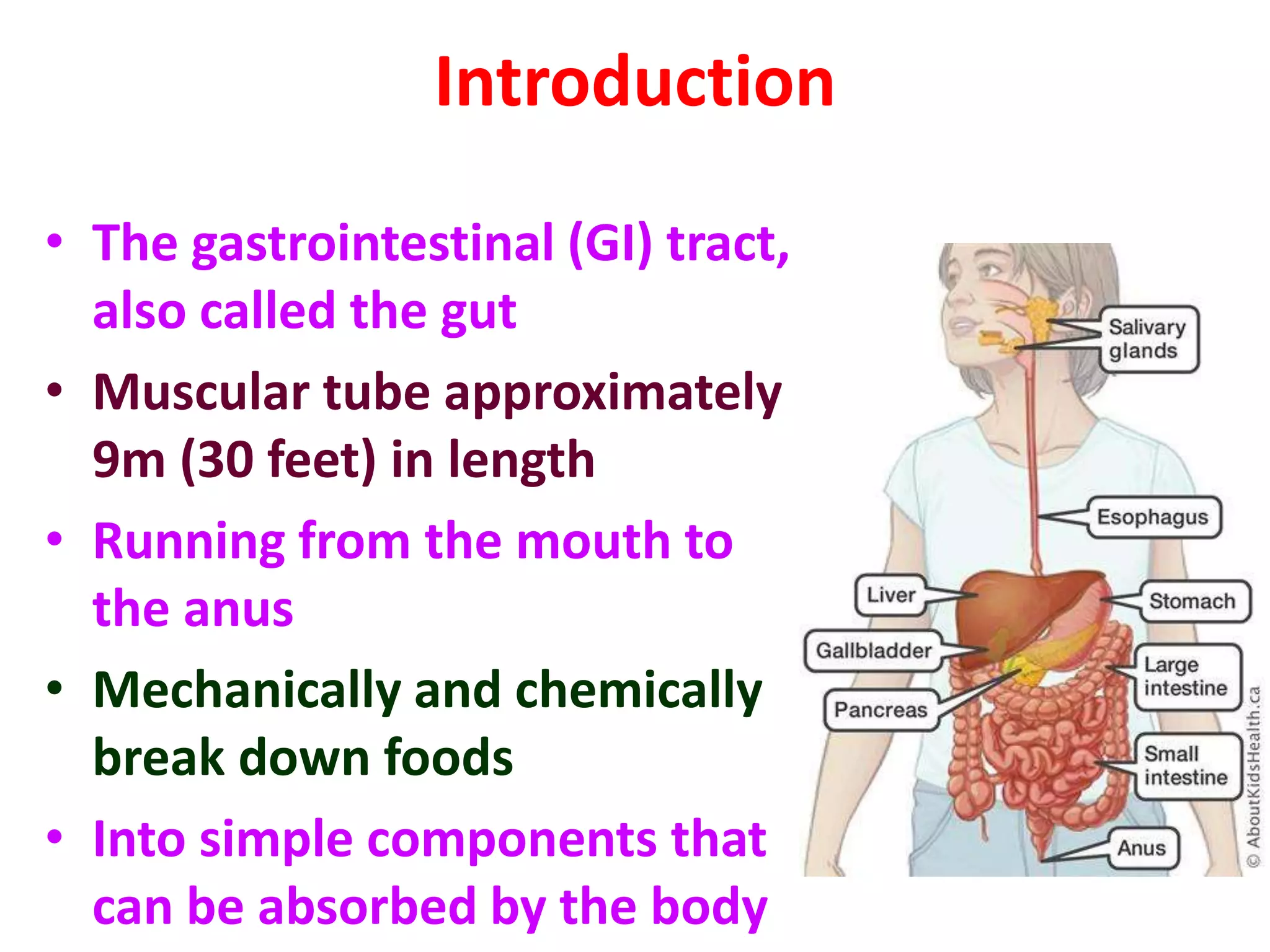
• The gastrointestinal (GI) tract,
also called the gut
• Muscular tube approximately
9m (30 feet) in length
• Running from the mouth to
the anus
• Mechanically and chemically
break down foods
• Into simple components that
can be absorbed by the body
GI Tract
• It produces various enzymes that help in the
chemical digestion of food
• It produces various hormones that play a role in
regulating digestion, appetite and satiety
• Different parts with different functions
• Home to myriad micro-organisms (mostly
bacteria): many are essential to health
• These form a large part of the human
microbiome
Mouth
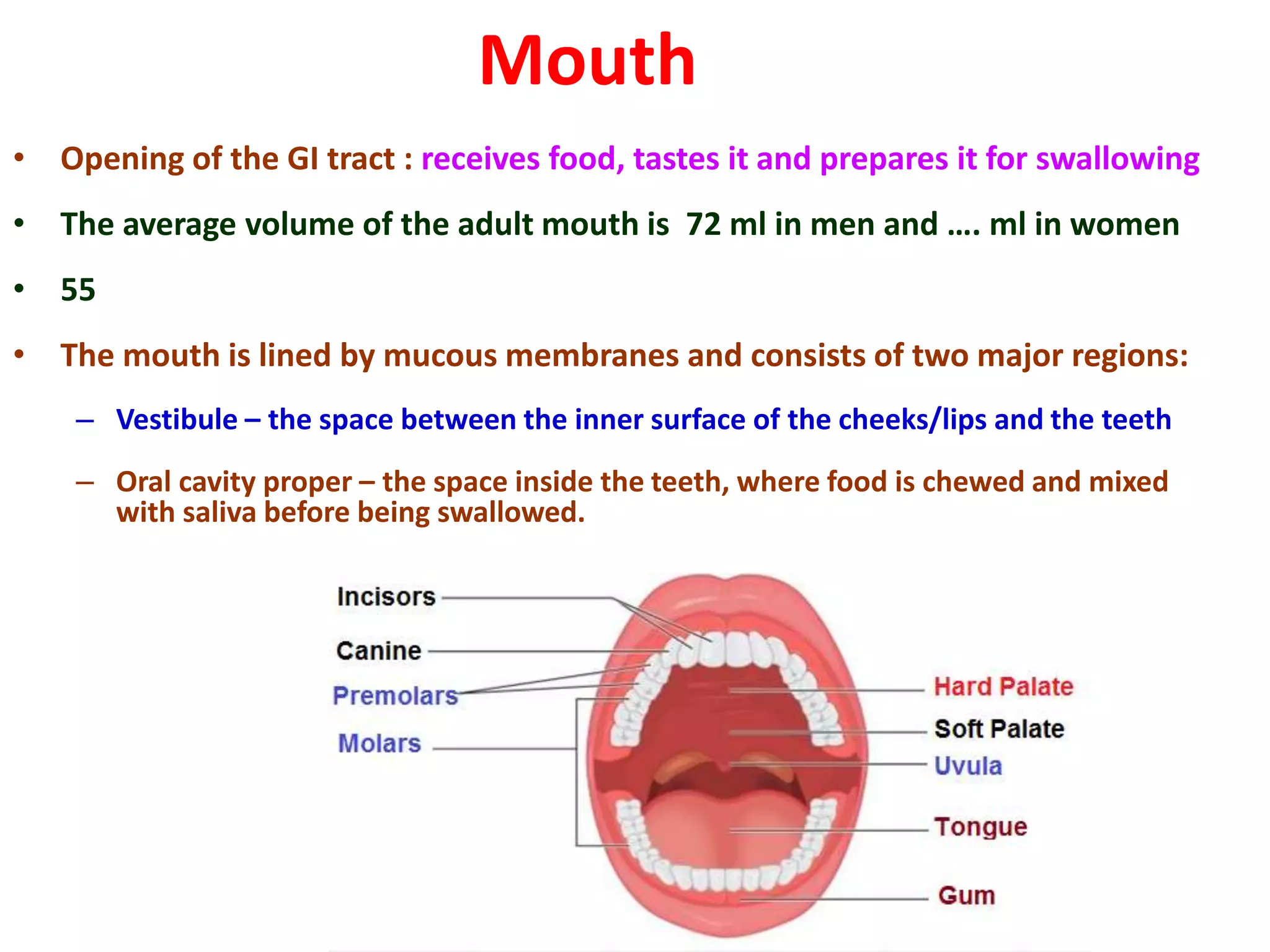
• Opening of the GI tract : receives food, tastes it and prepares it for swallowing
• The average volume of the adult mouth is 72 ml in men and …. ml in women
• 55
• The mouth is lined by mucous membranes and consists of two major regions:
– Vestibule – the space between the inner surface of the cheeks/lips and the teeth
– Oral cavity proper – the space inside the teeth, where food is chewed and mixed
with saliva before being swallowed.
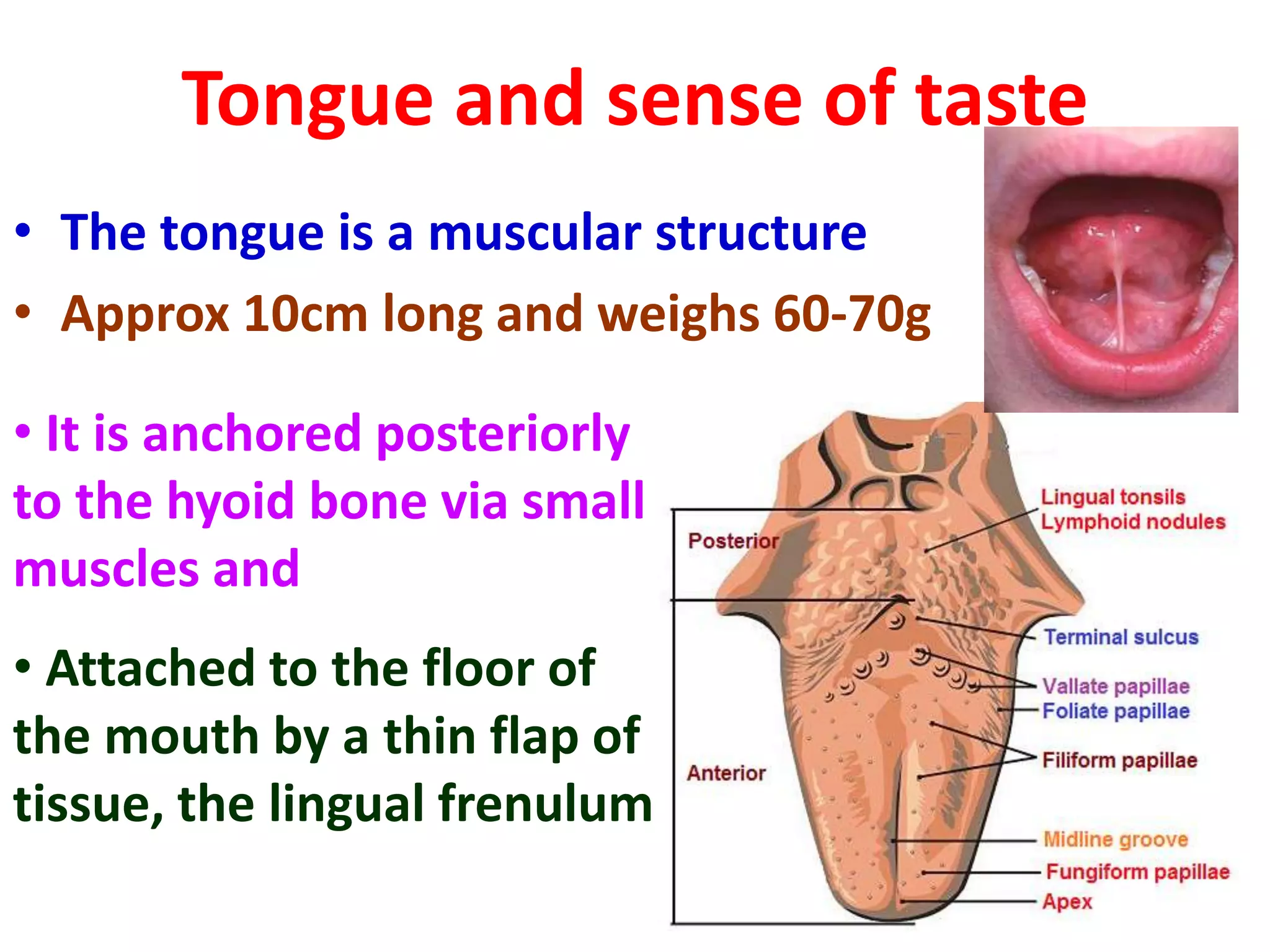
Tongue and sense of taste
• The tongue is a muscular structure
• Approx 10cm long and weighs 60-70g
• It is anchored posteriorly
to the hyoid bone via small
muscles and
• Attached to the floor of
the mouth by a thin flap of
tissue, the lingual frenulum
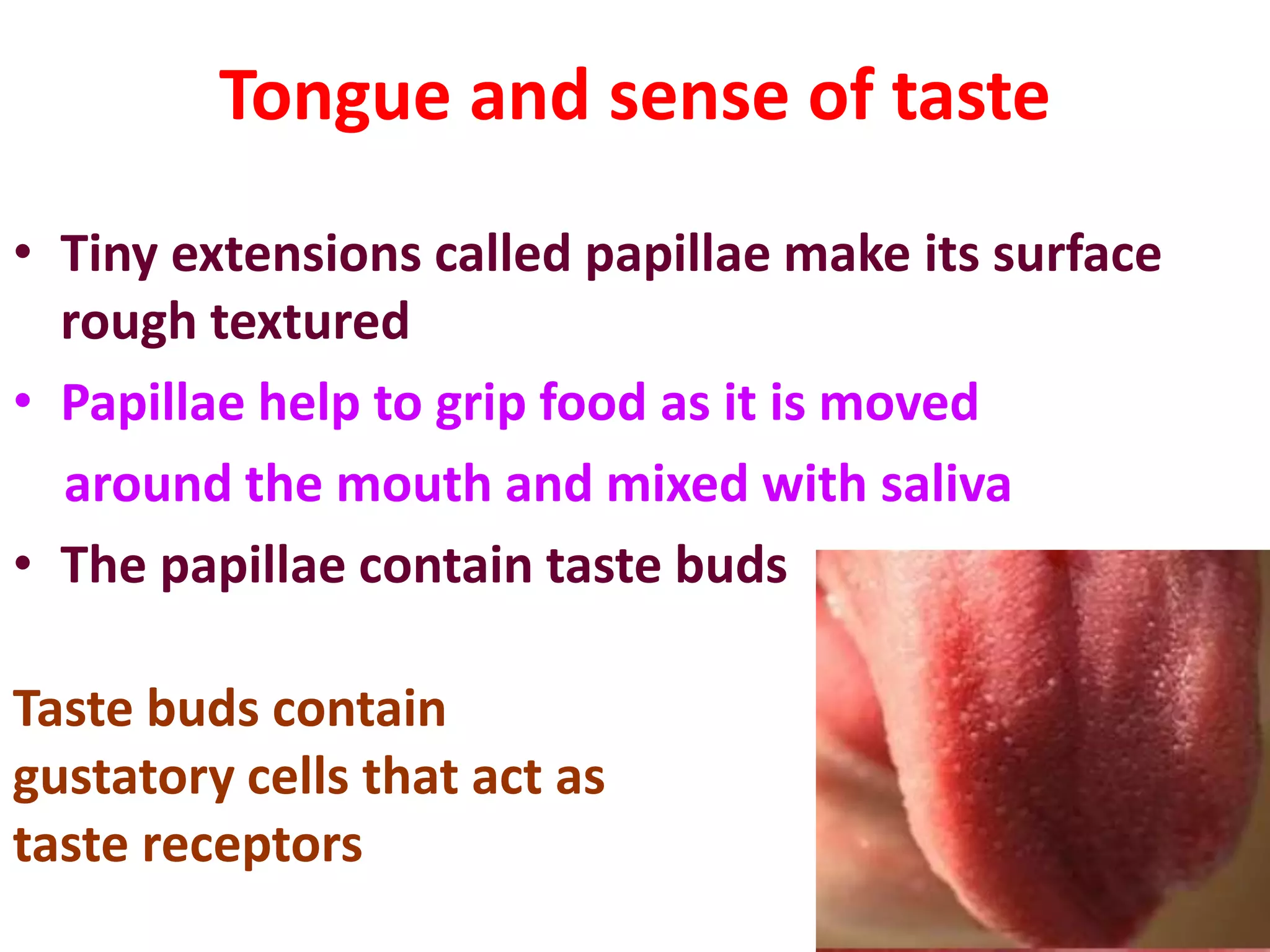
Tongue and sense of taste
• Tiny extensions called papillae make its surface
rough textured
• Papillae help to grip food as it is moved
around the mouth and mixed with saliva
• The papillae contain taste buds
Taste buds contain
gustatory cells that act as
taste receptors
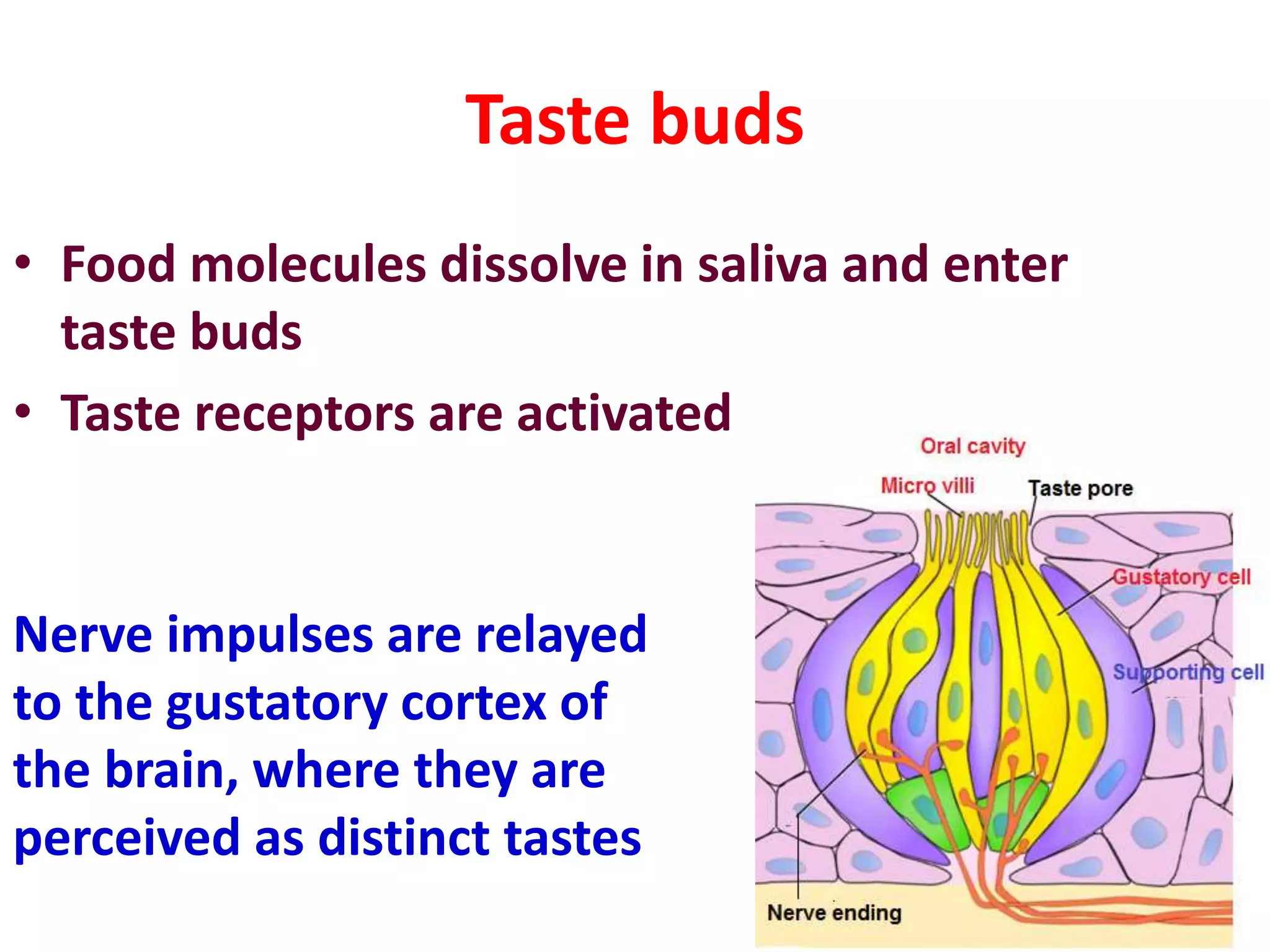
Taste buds
• Food molecules dissolve in saliva and enter
taste buds
• Taste receptors are activated
Nerve impulses are relayed
to the gustatory cortex of
the brain, where they are
perceived as distinct tastes
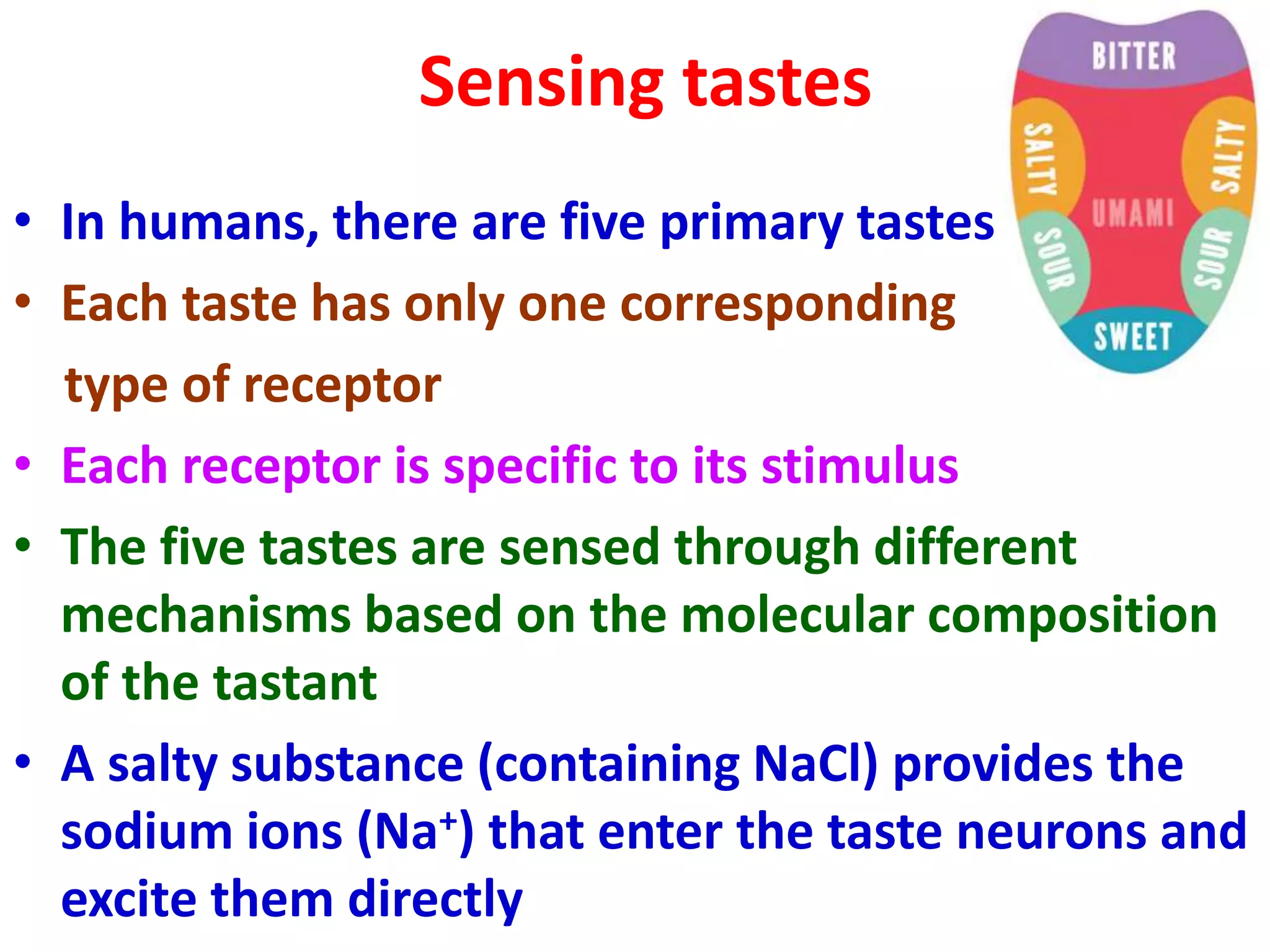
Sensing tastes
• In humans, there are five primary tastes
• Each taste has only one corresponding
type of receptor
• Each receptor is specific to its stimulus
• The five tastes are sensed through different
mechanisms based on the molecular composition
of the tastant
• A salty substance (containing NaCl) provides the
sodium ions (Na+) that enter the taste neurons and
excite them directly
Sensing tastes
• Map of the tongue showing the distribution of
different taste receptor types are misleading –
distributed across
• Sour molecules are acids
• Binding of an acid or other sour-tasting molecule
triggers a change in the ion channel and these
increase hydrogen ion (H+) concentrations in the
taste neurons, thus depolarizing them
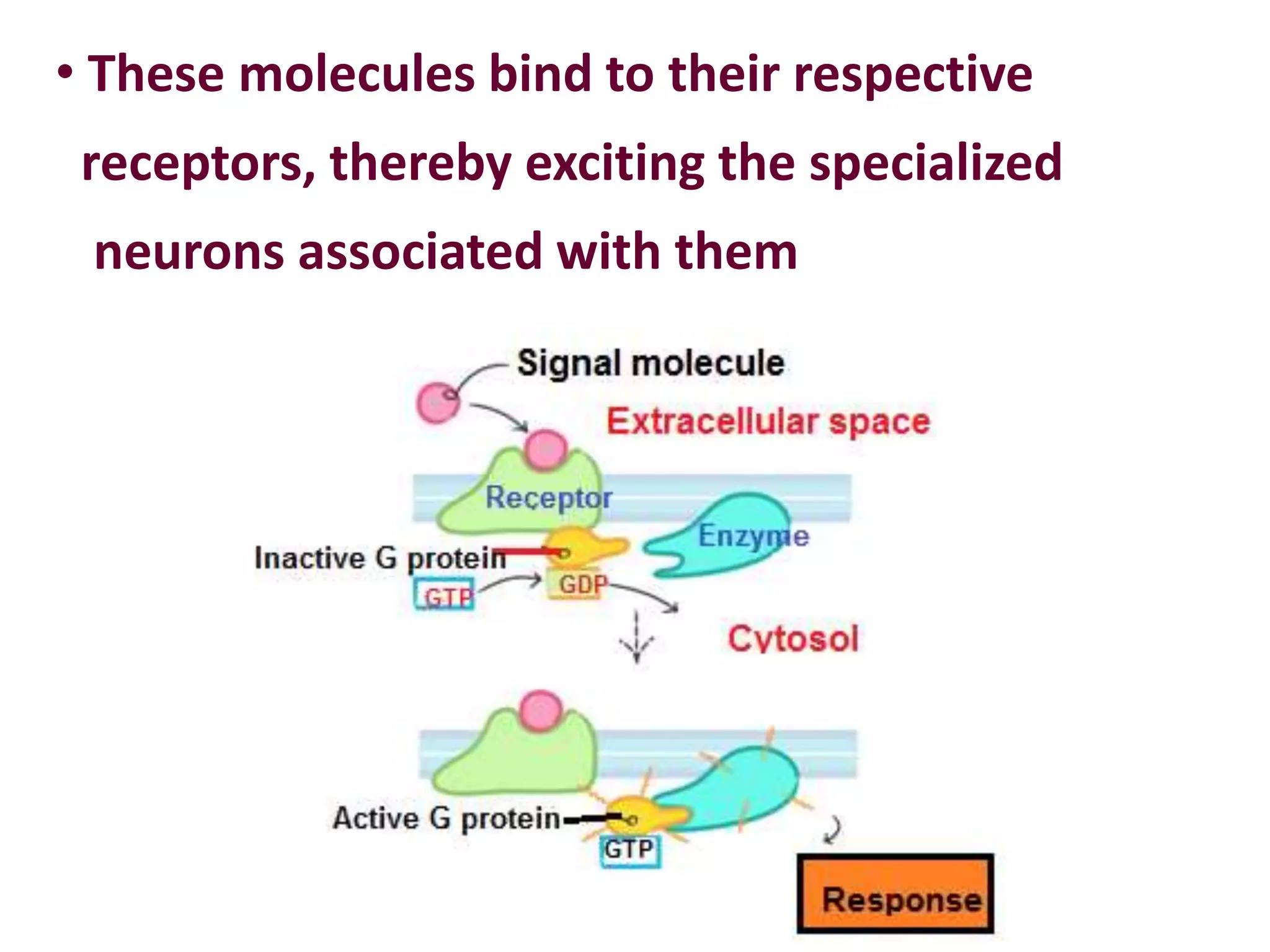
• Sweet, bitter, and umami tastants require a G-
protein coupled receptor
• These molecules bind to their respective
receptors, thereby exciting the specialized
neurons associated with them
Taste and age
• Tasting abilities change with age
• In humans, the senses decline dramatically by age 50
and continue to decline
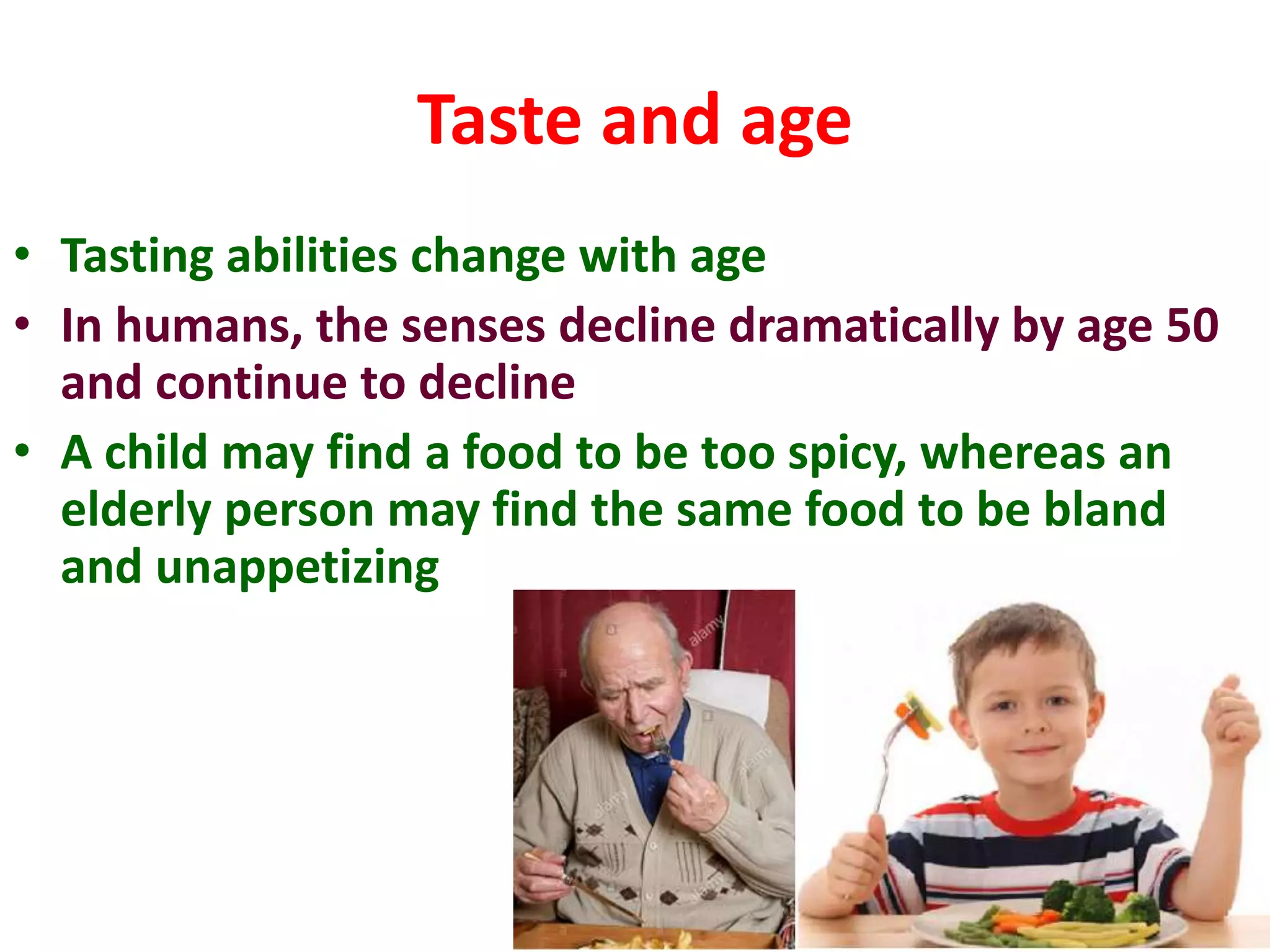
• A child may find a food to be too spicy, whereas an
elderly person may find the same food to be bland
and unappetizing
Olfaction and taste
• The sense of taste is intimately linked to
olfaction (sense of smell)
• Food cannot be tasted properly if the nose is
blocked
• As soon as the olfactory apparatus detects the
smell of food, the parasympathetic nervous
system is activated
• Salivary glands stimulated - release extra saliva,
preparing the mouth to receive the food
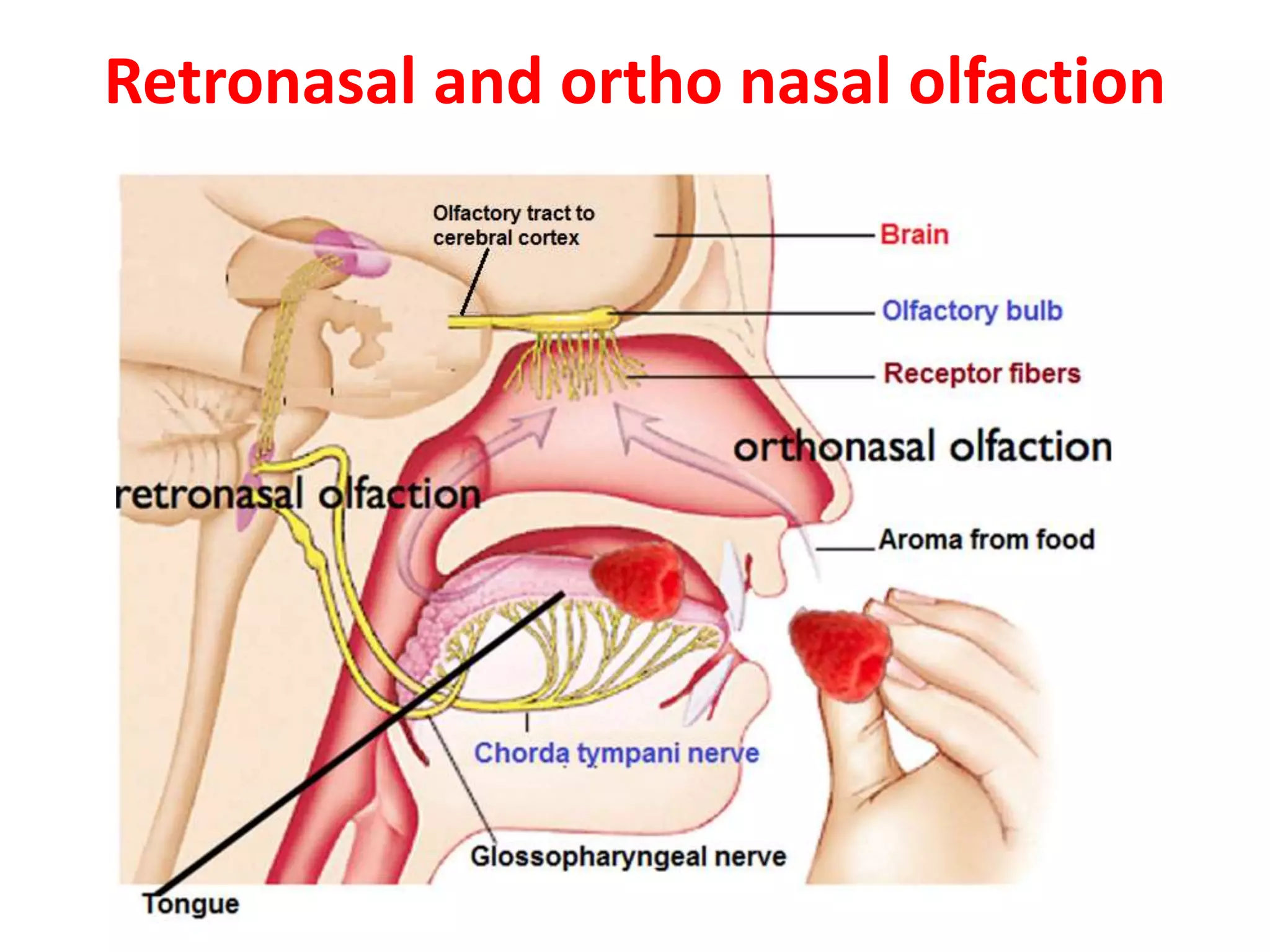
Retronasal and ortho nasal olfaction
• Retronasal olfaction -perception of odours
emanating from the oral cavity during eating and
drinking
• The retronasal olfactory pathway, which
contributes to the flavor of foods or drinks, is
commonly associated with the sense of taste
• Also named as “gustatory olfaction”
• Orthonasal olfaction- during sniffing- through
olfactory epithelium of nose
Retronasal and ortho nasal olfaction
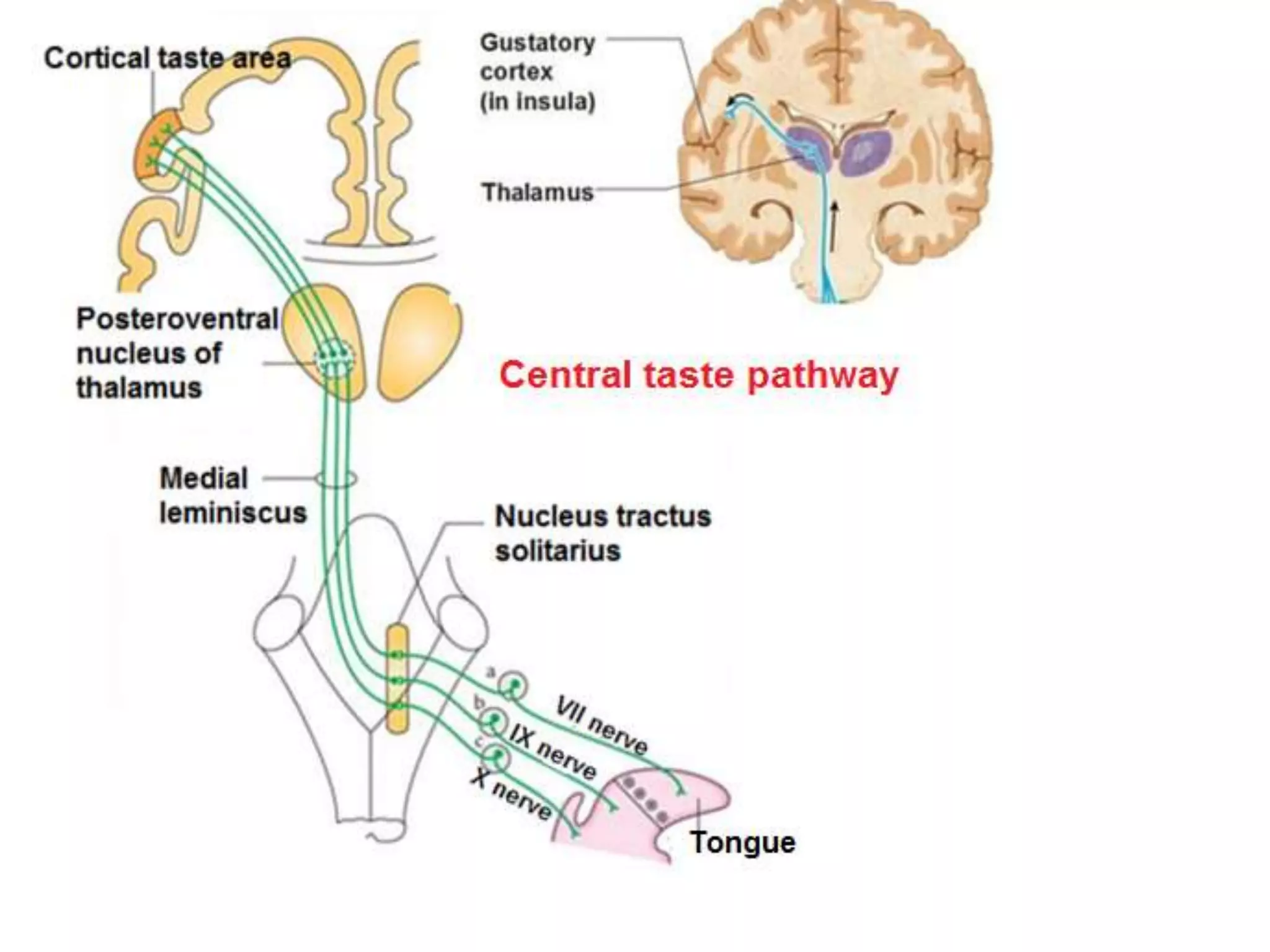
Gustatory pathway
• Taste neurons project from taste cells in the
tongue, esophagus, and palate to the medulla
in the brainstem
• From the medulla, taste signals travel to the
thalamus
• Then to the primary gustatory cortex
• Information from different regions of the
tongue is segregated in the medulla, thalamus,
and cortex
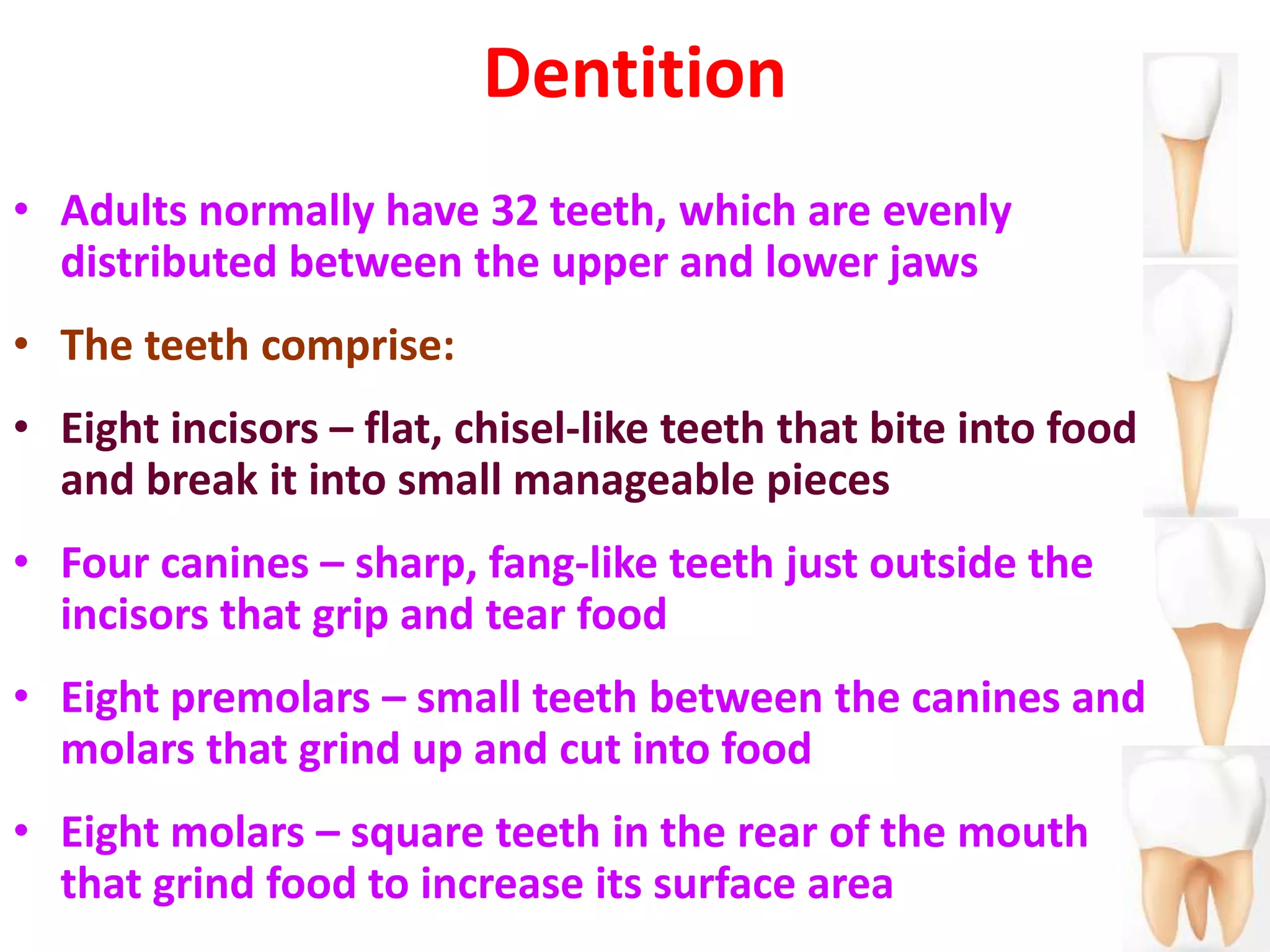
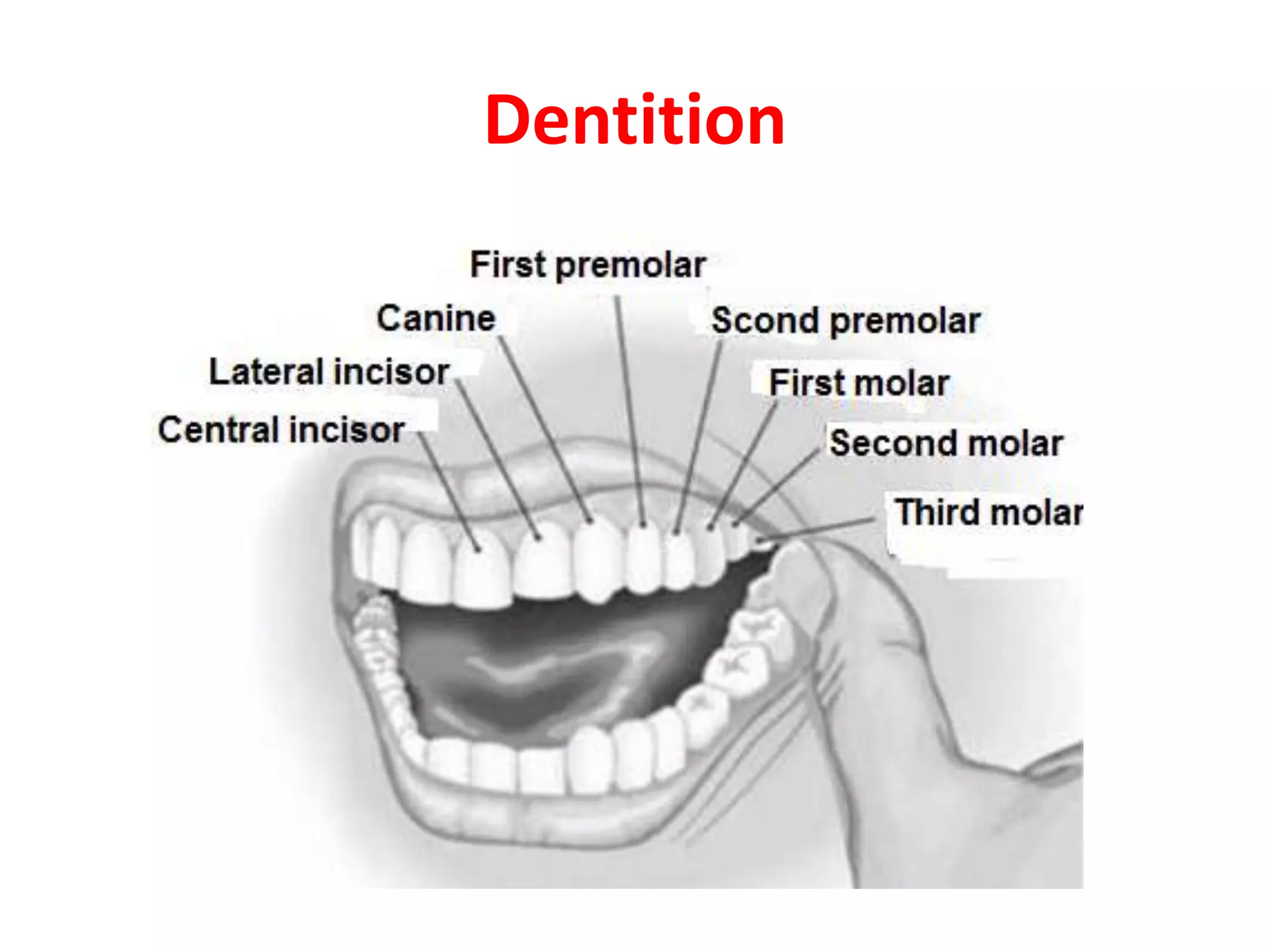
Dentition
• Adults normally have 32 teeth, which are evenly
distributed between the upper and lower jaws
• The teeth comprise:
• Eight incisors – flat, chisel-like teeth that bite into food
and break it into small manageable pieces
• Four canines – sharp, fang-like teeth just outside the
incisors that grip and tear food
• Eight premolars – small teeth between the canines and
molars that grind up and cut into food
• Eight molars – square teeth in the rear of the mouth
that grind food to increase its surface area
Dentition
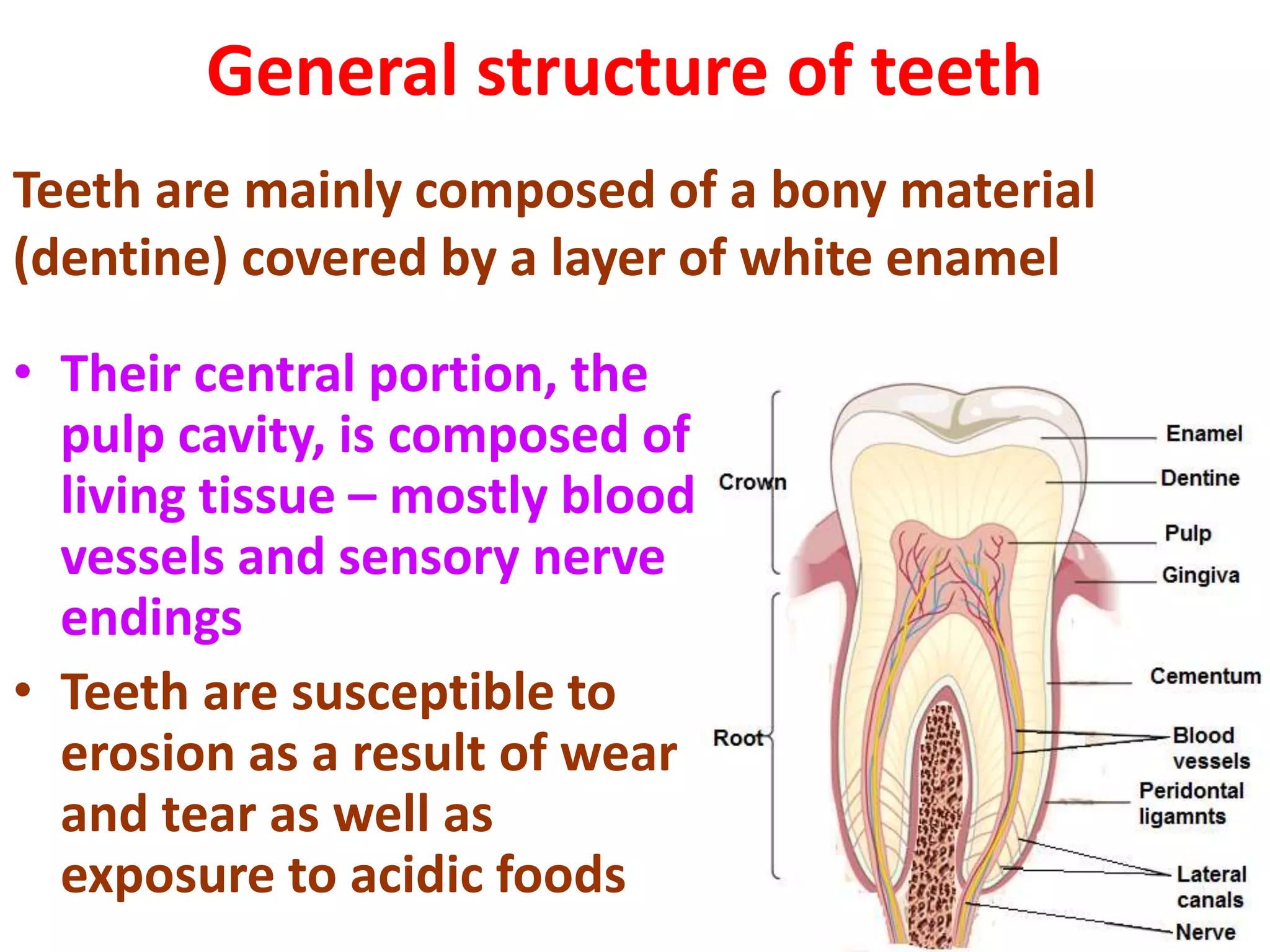
General structure of teeth
• Their central portion, the
pulp cavity, is composed of
living tissue – mostly blood
vessels and sensory nerve
endings
• Teeth are susceptible to
erosion as a result of wear
and tear as well as
exposure to acidic foods
Teeth are mainly composed of a bony material
(dentine) covered by a layer of white enamel
Mastication
• Carried out by the teeth
• The tongue moves food towards the premolars
and molars
• If teeth are missing, the gums can also chew
food- requires much more effort
• Chewing makes food easier to swallow
• Increases the surface area that is available to
the digestive enzymes-enhance chemical
digestion
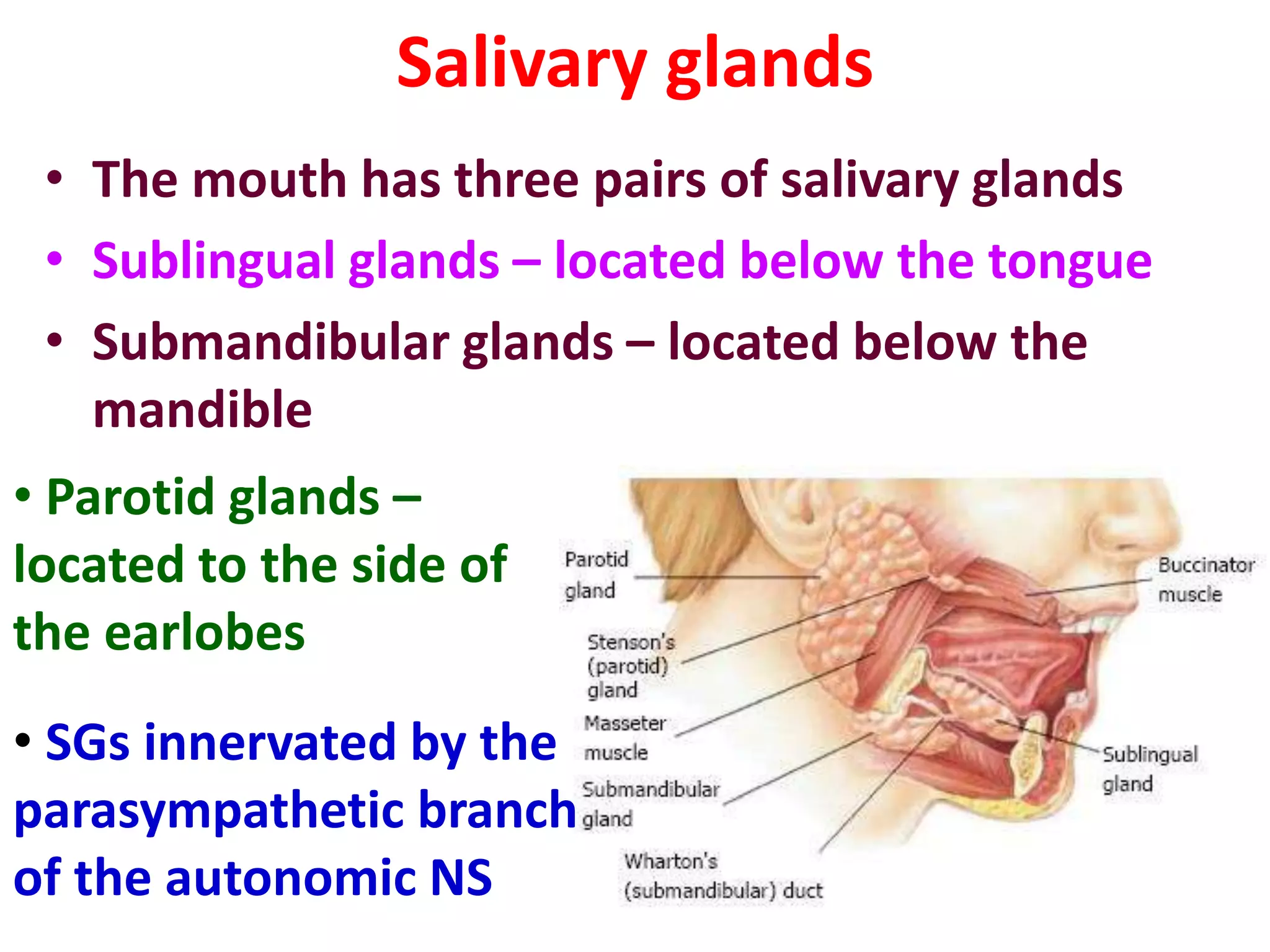
Salivary glands
• The mouth has three pairs of salivary glands
• Sublingual glands – located below the tongue
• Submandibular glands – located below the
mandible
• Parotid glands –
located to the side of
the earlobes
• SGs innervated by the
parasympathetic branch
of the autonomic NS
Saliva
• The salivary glands continuously produce small amounts of
saliva to keep the mouth moist (basal secretion)
• In a typical 24-hour period 0.5-1.5L of saliva is secreted
• Eating induces a significant increase in saliva production
(induced secretion)
• The submandibular glands do most of the basal secretion
• The parotid glands are the major contributors to secretion
induced by the presence of food
• The sublingual glands only produce around 5% of both
basal and induced saliva secretion
• The volume of saliva that is produced can be increased or
decreased according to the nature of the food
Swallowing
• Towards the end of mastication
• The tongue and roof of the mouth gather and
shape the chewed food into a pellet called bolus
• Moisture and mucus bind and coat the bolus
• Pushed towards the back of the mouth and into
the oropharynx
• Bolus in the posterior pharyngeal wall trigger the
swallowing reflex (deglutition)
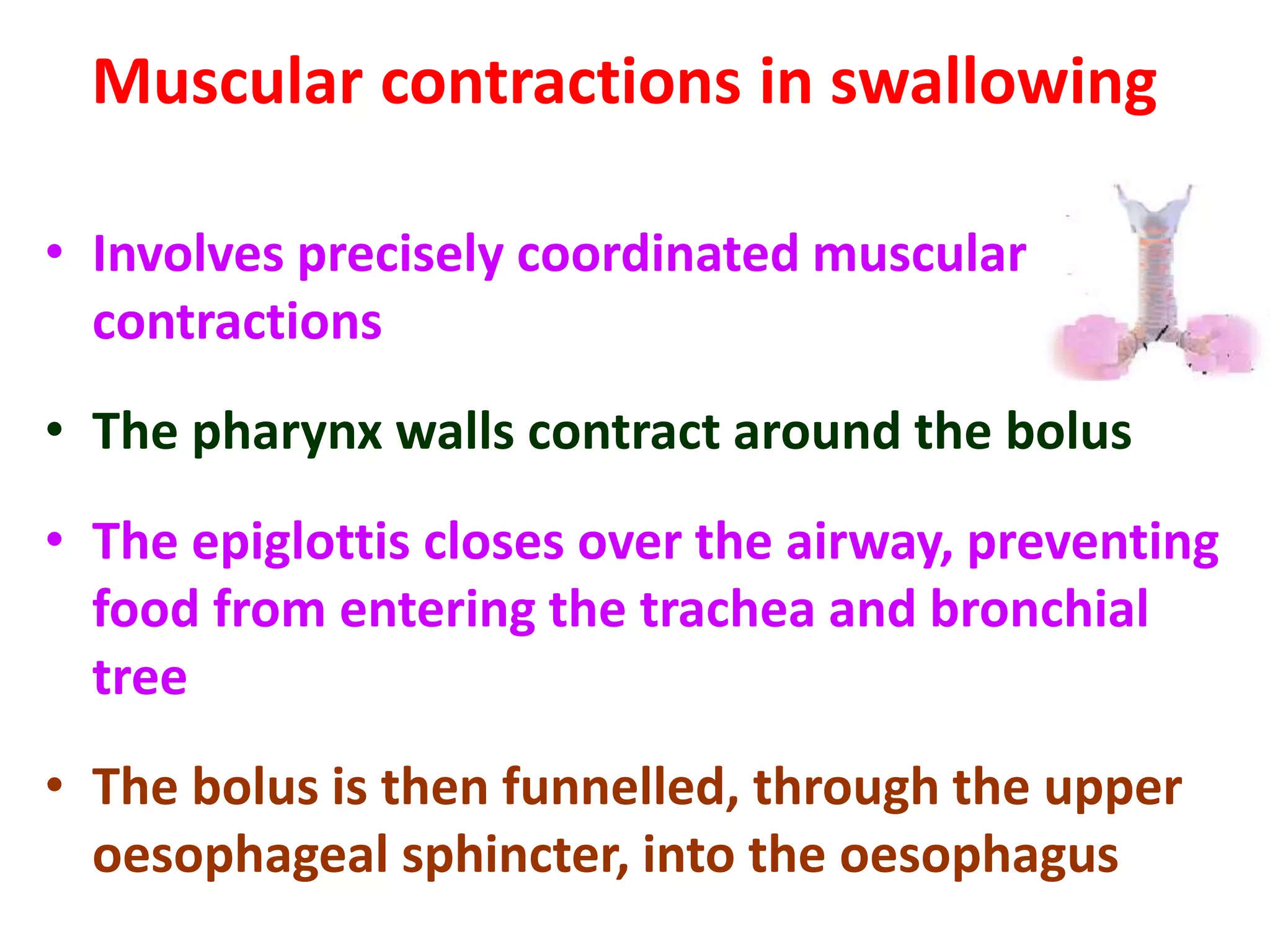
Muscular contractions in swallowing
• Involves precisely coordinated muscular
contractions
• The pharynx walls contract around the bolus
• The epiglottis closes over the airway, preventing
food from entering the trachea and bronchial
tree
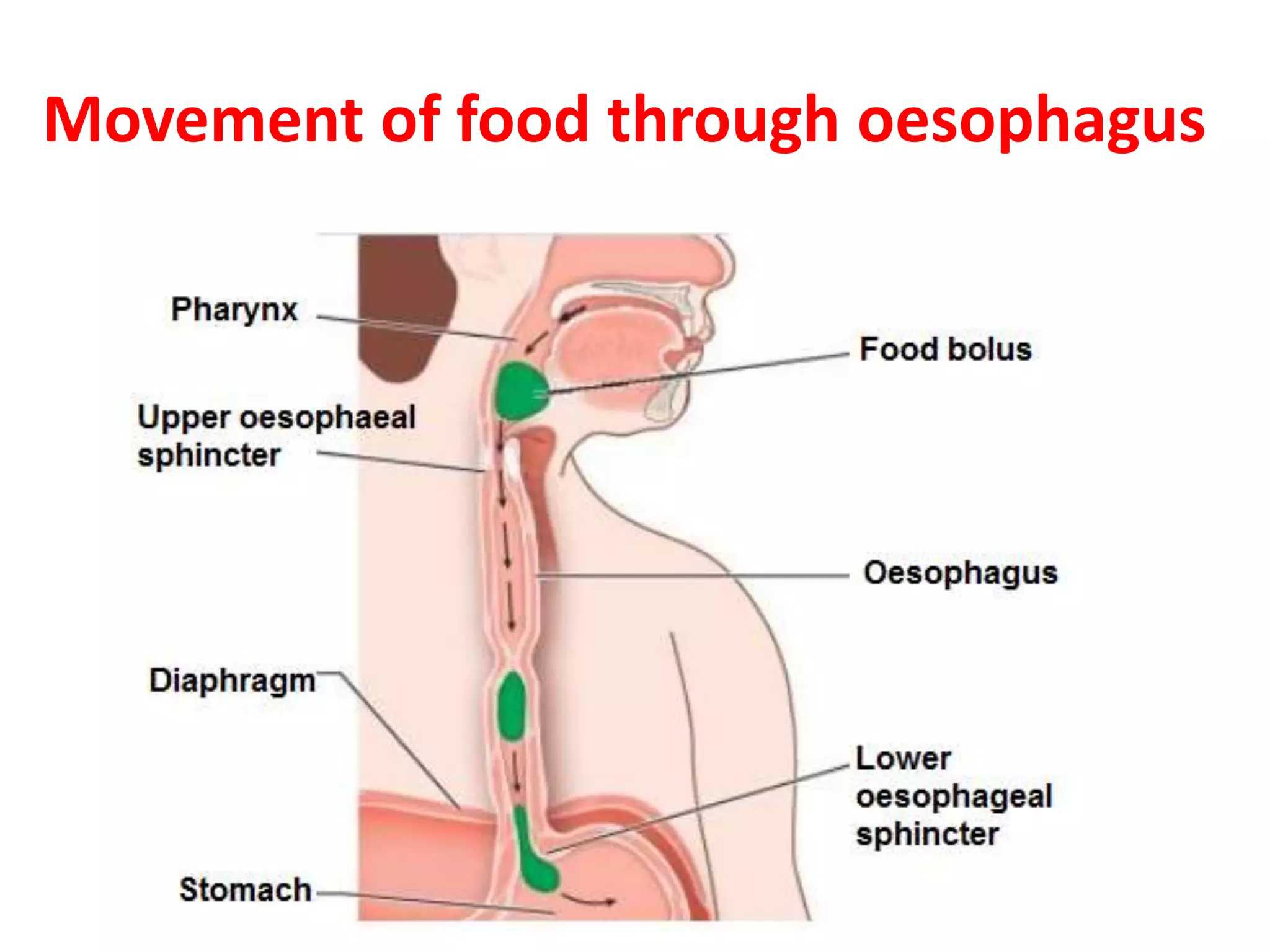
• The bolus is then funnelled, through the upper
oesophageal sphincter, into the oesophagus
Movement of food through oesophagus
• Voluntary nervous system help to swallow
• Involuntary nervous system takes over
swallowing once the liquid or food enters the top
of your esophagus
• Stretching from food stimulates the smooth
muscles on the walls of esophagus
• This stimulates network of nerves inside muscles
known as intrinsic nerves, start a coordinated
muscle action called peristalsis
Peristalsis
Peristalsis
• Peristalsis squeezes esophageal
muscles from top to bottom
• This pushes food and liquid along
• Sphincters act like one-way valves
• They relax to let food and liquid
pass into the stomach and then
tightens to prevent backflow,
called reflux
• Food enters stomach

Digestive system Mouth

  • 1.
    Gastro intestinal tract–part I Dr. Radhakrishna G Pillai Department of Life Sciences University of Calicut
  • 2.
    Introduction • The gastrointestinal(GI) tract, also called the gut • Muscular tube approximately 9m (30 feet) in length • Running from the mouth to the anus • Mechanically and chemically break down foods • Into simple components that can be absorbed by the body
  • 3.
    GI Tract • Itproduces various enzymes that help in the chemical digestion of food • It produces various hormones that play a role in regulating digestion, appetite and satiety • Different parts with different functions • Home to myriad micro-organisms (mostly bacteria): many are essential to health • These form a large part of the human microbiome
  • 4.
    Mouth • Opening ofthe GI tract : receives food, tastes it and prepares it for swallowing • The average volume of the adult mouth is 72 ml in men and …. ml in women • 55 • The mouth is lined by mucous membranes and consists of two major regions: – Vestibule – the space between the inner surface of the cheeks/lips and the teeth – Oral cavity proper – the space inside the teeth, where food is chewed and mixed with saliva before being swallowed.
  • 5.
    Tongue and senseof taste • The tongue is a muscular structure • Approx 10cm long and weighs 60-70g • It is anchored posteriorly to the hyoid bone via small muscles and • Attached to the floor of the mouth by a thin flap of tissue, the lingual frenulum
  • 6.
    Tongue and senseof taste • Tiny extensions called papillae make its surface rough textured • Papillae help to grip food as it is moved around the mouth and mixed with saliva • The papillae contain taste buds Taste buds contain gustatory cells that act as taste receptors
  • 7.
    Taste buds • Foodmolecules dissolve in saliva and enter taste buds • Taste receptors are activated Nerve impulses are relayed to the gustatory cortex of the brain, where they are perceived as distinct tastes
  • 8.
    Sensing tastes • Inhumans, there are five primary tastes • Each taste has only one corresponding type of receptor • Each receptor is specific to its stimulus • The five tastes are sensed through different mechanisms based on the molecular composition of the tastant • A salty substance (containing NaCl) provides the sodium ions (Na+) that enter the taste neurons and excite them directly
  • 9.
    Sensing tastes • Mapof the tongue showing the distribution of different taste receptor types are misleading – distributed across • Sour molecules are acids • Binding of an acid or other sour-tasting molecule triggers a change in the ion channel and these increase hydrogen ion (H+) concentrations in the taste neurons, thus depolarizing them • Sweet, bitter, and umami tastants require a G- protein coupled receptor
  • 10.
    • These moleculesbind to their respective receptors, thereby exciting the specialized neurons associated with them
  • 11.
    Taste and age •Tasting abilities change with age • In humans, the senses decline dramatically by age 50 and continue to decline • A child may find a food to be too spicy, whereas an elderly person may find the same food to be bland and unappetizing
  • 12.
    Olfaction and taste •The sense of taste is intimately linked to olfaction (sense of smell) • Food cannot be tasted properly if the nose is blocked • As soon as the olfactory apparatus detects the smell of food, the parasympathetic nervous system is activated • Salivary glands stimulated - release extra saliva, preparing the mouth to receive the food
  • 13.
    Retronasal and orthonasal olfaction • Retronasal olfaction -perception of odours emanating from the oral cavity during eating and drinking • The retronasal olfactory pathway, which contributes to the flavor of foods or drinks, is commonly associated with the sense of taste • Also named as “gustatory olfaction” • Orthonasal olfaction- during sniffing- through olfactory epithelium of nose
  • 14.
    Retronasal and orthonasal olfaction
  • 15.
    Gustatory pathway • Tasteneurons project from taste cells in the tongue, esophagus, and palate to the medulla in the brainstem • From the medulla, taste signals travel to the thalamus • Then to the primary gustatory cortex • Information from different regions of the tongue is segregated in the medulla, thalamus, and cortex
  • 17.
    Dentition • Adults normallyhave 32 teeth, which are evenly distributed between the upper and lower jaws • The teeth comprise: • Eight incisors – flat, chisel-like teeth that bite into food and break it into small manageable pieces • Four canines – sharp, fang-like teeth just outside the incisors that grip and tear food • Eight premolars – small teeth between the canines and molars that grind up and cut into food • Eight molars – square teeth in the rear of the mouth that grind food to increase its surface area
  • 18.
  • 19.
    General structure ofteeth • Their central portion, the pulp cavity, is composed of living tissue – mostly blood vessels and sensory nerve endings • Teeth are susceptible to erosion as a result of wear and tear as well as exposure to acidic foods Teeth are mainly composed of a bony material (dentine) covered by a layer of white enamel
  • 20.
    Mastication • Carried outby the teeth • The tongue moves food towards the premolars and molars • If teeth are missing, the gums can also chew food- requires much more effort • Chewing makes food easier to swallow • Increases the surface area that is available to the digestive enzymes-enhance chemical digestion
  • 21.
    Salivary glands • Themouth has three pairs of salivary glands • Sublingual glands – located below the tongue • Submandibular glands – located below the mandible • Parotid glands – located to the side of the earlobes • SGs innervated by the parasympathetic branch of the autonomic NS
  • 22.
    Saliva • The salivaryglands continuously produce small amounts of saliva to keep the mouth moist (basal secretion) • In a typical 24-hour period 0.5-1.5L of saliva is secreted • Eating induces a significant increase in saliva production (induced secretion) • The submandibular glands do most of the basal secretion • The parotid glands are the major contributors to secretion induced by the presence of food • The sublingual glands only produce around 5% of both basal and induced saliva secretion • The volume of saliva that is produced can be increased or decreased according to the nature of the food
  • 23.
    Swallowing • Towards theend of mastication • The tongue and roof of the mouth gather and shape the chewed food into a pellet called bolus • Moisture and mucus bind and coat the bolus • Pushed towards the back of the mouth and into the oropharynx • Bolus in the posterior pharyngeal wall trigger the swallowing reflex (deglutition)
  • 24.
    Muscular contractions inswallowing • Involves precisely coordinated muscular contractions • The pharynx walls contract around the bolus • The epiglottis closes over the airway, preventing food from entering the trachea and bronchial tree • The bolus is then funnelled, through the upper oesophageal sphincter, into the oesophagus
  • 25.
    Movement of foodthrough oesophagus
  • 26.
    • Voluntary nervoussystem help to swallow • Involuntary nervous system takes over swallowing once the liquid or food enters the top of your esophagus • Stretching from food stimulates the smooth muscles on the walls of esophagus • This stimulates network of nerves inside muscles known as intrinsic nerves, start a coordinated muscle action called peristalsis Peristalsis
  • 27.
    Peristalsis • Peristalsis squeezesesophageal muscles from top to bottom • This pushes food and liquid along • Sphincters act like one-way valves • They relax to let food and liquid pass into the stomach and then tightens to prevent backflow, called reflux • Food enters stomach

Editor's Notes

  • #5 Source: https://www.nursingtimes.net/clinical-archive/gastroenterology/gastrointestinal-tract-1-the-mouth-and-oesophagus-28-05-2019/
  • #15 http://www.stinciclab.com/olfaction-in-taste
  • #22 Fig source: https://www.wjgnet.com/2218-6263/full/v4/i2/56.htm
  • #26 Source: Peter Lamb