Membrane digestion &
absorption
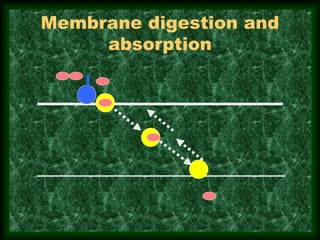
Membrane digestion
Goes in succession in three zones:
In mucus
In glycocalyx
On the apical membrane of enterocytes
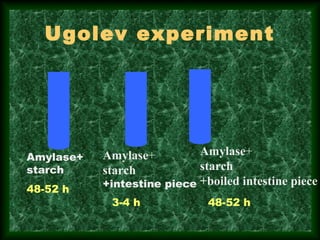
Was discovered by prof. Ugolev A.M.
Ugolev experiment
Amylase+
starch
Amylase+
starch
+intestine piece
Amylase+
starch
+boiled intestine piece
48-52 h
48-52 h3-4 h
muscels
Nervous fibres
Blood vessels
epithelium
lymphatic capillaries
villae
Sponsored
Medical Lecture Notes – All Subjects
USMLE Exam (America) – Practice
Substrates depolymerization
I the cavity & on the surface
of the intestines
Membrane with
adsorbed enzymes
МФ – memnbrane enzymes
ПФ – pancreatic enzymes
КЦФ – active centers of enzyme
РЦФ – regulatory
centers of enzymes
ТСМ – membrane transport syst
Brush boarder region
microvilli –
Up to 3000 on one
enterocyte – increase
the square up to
30 times
0,01-0,02 10-6
m
Membrane enzymes
Enzymes active centers
1-2мкм
Enteral medium
• Thin water film above the glycocalics
which isn’t mixed up
• Its content is homeostated
water film
Enteral cavity
blood
Characteristic properties of
membrane digestion
1. Large catalytic surface
2. Highly effective
3. Sterile
4. Closely connected with absorption
Enzymes
• Secreted by enterocytes
• Fixed on the apical membrane of the
enterocyte
• On enterocyte destruction get into
glycocalyx, mucus & enteric juice
• Break down olygo- & dimers to form
monomers
Membrane digestion and
absorption
Absorption in small
intestine
absorption
• Это сложный физиологический процесс
проникновения различных веществ через
биологическую мембрану в кровь и лимфу
• В результате организм получает
питательные вещества, воду, соли,
витамины и лекарственные вещества
Methods of studying
absorption in the
intestines
Acute methods
Lymphatic vessels studying
vividiffusion
v. portae
печень
solution
Chronic methods
Isolated loop of small intestine
Thiry’s mehod Thiry-Vella method
1.Polyfistule method
intestine
skin
fistuli
2.London’s angiostomy
- Fistula of vena
cava
macrovilli
Macrovilli & cript are
structural & functional
component of intestine
muscels
Nervous fibres
Blood vessels
epithelium
lymphatic capillaries
villae
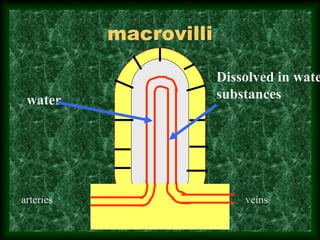
Macrovilli contents
• arteriola
• Capillary net
• venula
• Lymphatic capillary
• Muscle fibres
• Nervous ending
• Enterocytes with brush boarder
• Surface of absorption is about 200 m2
macrovilli
water
Dissolved in wate
substances
arteries veins
Types of transport
passive:
• filtration
• osmosis
• diffusion
Goes along the gradients
created by macrovilli
contraction
15-20 ml of fluid is
absorbed per 1 minute
Active
• Primary active
(sodium-potassium
pump)
• Secondary active
(glucose & amino
acids transport)
enterocyte
Renewed very quickly
Non-differentiated cylindrical cells rise up
from cripts to the top of the villi in 24-36
hours
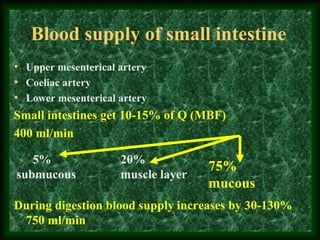
Blood supply of small intestine
• Upper mesenterical artery
• Coeliac artery
• Lower mesenterical artery
Small intestines get 10-15% of Q (MBF)
400 ml/min
During digestion blood supply increases by 30-130%
750 ml/min
5%
submucous
20%
muscle layer
75%
mucous
jejunum ileum
p
e
r
Large intestines
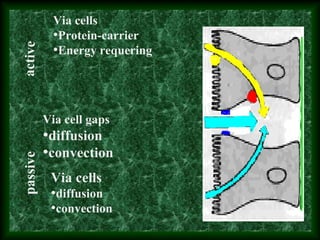
permeability
Via cells
•Protein-carrier
•Energy requering
activepassive
Via cells
•diffusion
•convection
Via cell gaps
•diffusion
•convection
Water transport
Goes via gaps between the enterocytes
along the gradients:
• Hydrostatic
• Osmotic (created additionally by sodium
absorption)
• Dissolved in water substances are
absorbed
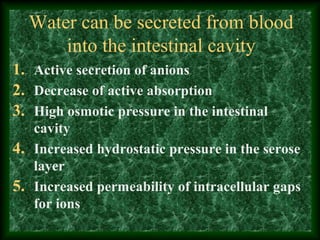
Water can be secreted from blood
into the intestinal cavity
1. Active secretion of anions
2. Decrease of active absorption
3. High osmotic pressure in the intestinal
cavity
4. Increased hydrostatic pressure in the serose
layer
5. Increased permeability of intracellular gaps
for ions
Dehydroxyle derivatives of bile acids & laxatives increase
permeability of intracellular junctions.
Magnesium sulphate increases osmotic pressure in the
intestinal cavity
Hydrostatic
pressure
“leaking” junction
Bacterial toxins
(Cholera toxin,
coletoxin)
Hormones
(prostaglandies,
secretin, VIP)
C-AMP
Calcium concentration in the enterocytes changes,
Chlorine permeability increases
Chlorine gets into the cavity,
sodium follows along the electrical gradient ,
water follows along the osmotic gradient
Proteins
• 70-90 g per day with food 60 г белка с
пищеварителными соками ( ферменты и
энтероциты).
• В полости 30% расщепляется до
нейтральных и основных АК – 70% до
олигопептидов
• Ологипептиды расщепляются до АК в
щеточной кайме (10%) и в цитоплазме
Digestion & absorption of proteins
Amino acids absorption
• Goes in duodenum (50-60%) & jejunum
(30%) by means of secondary active sodium
dependent transport
• Protein-carriers are selective for:
Neutral АA
Двухосновных АA
Dicarbonic АA
Glycin
Carbohydrates
Daily dose 250-280 g:
• 60% vegetable starch
• 30% saccharase
• 10% lactose, glucose, fructose, glycogen
Enzymes:
• In the cavity – alpha-amylaze
• On the villi – olygosacharidazes:
lactatdehydrogenaze (lactase), glycosidase
Lactase deficit
• In Europe – 15% of population
• In Africa – 80% of population
• In Muslim states of India – 15% of population
• In Hindu states of India– 80% of population
Lactose increases osmotic pressure in the cavity
& can cause dyarhea
Transport of carbohydrates
monomers
Monomers:
• Glucose
• Galactose
• Fructose
Absorbed by means of secondary active
sodium dependent transport in
duodenum (30%) & jejunum (50-60%)
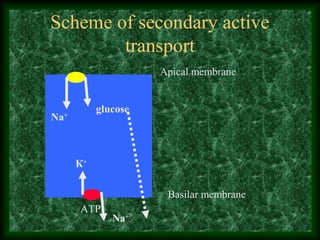
Scheme of secondary active
transport
ATP
К+
Na+
Na+
glucose
Apical membrane
Basilar membrane
Fats
• 60-100 g of fat per day
90% of them are thryglcerides
5-7 g are excreted with faeces
• Emulsified in duodenum (fat drop in stomach
is 100 nm in diameter, I the intestines – 5 nm)
• Absorbed in the form of fine emulsions or
micells with bile acids 95% in duodenum
Lipids absorption
lipid
Bile acid blood
chilomicrone
TG lipoproteins
lymph
Relative volumes of absorption
Duodenum
30 сm
jejunum
120 сm
ileum
130 сm
95%
50% 30%
30% 50-60%
fats
Amino acids
glucose
Large intestine
Absorption is completed here & faeces are
formed:
• 400 g of chyme per day enters from small
intestine
• 150-200 g of faeces is formed – 70-80% of
water; 20-30% of dry matter (cellulose, non-
organic substances; fats)
• The number of microorganisms is
exceptionally great— up to tens of milliards
per kg of contents.

Membrane digestion & absorption