Presentation on
Mechanism of HCl Production in The Stomach
Presented by:
Mahtab Uddin Mojumder
Presented to:
ESKAYEF Pharmaceuticals Ltd.
Contents
• Stomach
• Gastric Juice
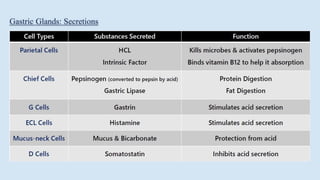
• Gastric Glands: Secretions
• Phases of Gastric Secretion
• Mechanism of HCl Production in The Stomach
• Functions of Gastric HCl
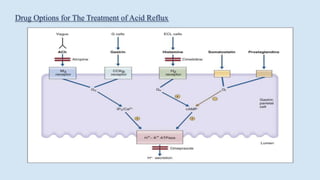
• Drug Options for The Treatment of Acid Reflux
• References
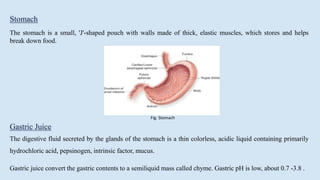
The stomach is a small, 'J'-shaped pouch with walls made of thick, elastic muscles, which stores and helps
break down food.
Stomach
Fig. Stomach
The digestive fluid secreted by the glands of the stomach is a thin colorless, acidic liquid containing primarily
hydrochloric acid, pepsinogen, intrinsic factor, mucus.
Gastric juice convert the gastric contents to a semiliquid mass called chyme. Gastric pH is low, about 0.7 -3.8 .
Gastric Juice
Gastric Glands: Secretions
Phases of Gastric Secretion
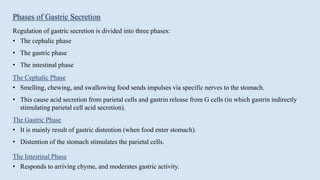
Regulation of gastric secretion is divided into three phases:
• The cephalic phase
• The gastric phase
• The intestinal phase
The Cephalic Phase
• Smelling, chewing, and swallowing food sends impulses via specific nerves to the stomach.
• This cause acid secretion from parietal cells and gastrin release from G cells (in which gastrin indirectly
stimulating parietal cell acid secretion).
The Gastric Phase
• It is mainly result of gastric distention (when food enter stomach).
• Distention of the stomach stimulates the parietal cells.
The Intestinal Phase
• Responds to arriving chyme, and moderates gastric activity.
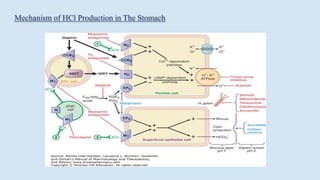
Mechanism of HCl Production in The Stomach
• Parietal cells bear receptors for three stimulators of acid secretion:
- Acetylcholine (muscarinic type receptor)
- Gastrin (CCK2 receptor)
- Histamine (H2 type receptor)
• In close proximity to the parietal cells there are gut endocrine cells called enterochromaffin-like (ECL)
cells. ECL cells have receptors for gastrin (CCK2) and acetylcholine (muscarinic M1).
• There are two pathways of gastric acid secretion:
- cyclic Adenosine Monophosphate (cAMP) dependent pathway/ Histamine dependent pathway
- Ca2+ dependent pathway/ Histamine independent pathway
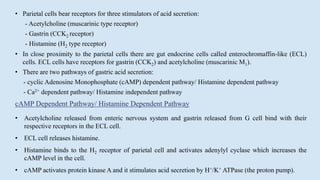
cAMP Dependent Pathway/ Histamine Dependent Pathway
• Acetylcholine released from enteric nervous system and gastrin released from G cell bind with their
respective receptors in the ECL cell.
• ECL cell releases histamine.
• Histamine binds to the H2 receptor of parietal cell and activates adenylyl cyclase which increases the
cAMP level in the cell.
• cAMP activates protein kinase A and it stimulates acid secretion by H+/K+ ATPase (the proton pump).
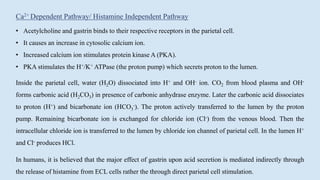
Ca2+ Dependent Pathway/ Histamine Independent Pathway
• Acetylcholine and gastrin binds to their respective receptors in the parietal cell.
• It causes an increase in cytosolic calcium ion.
• Increased calcium ion stimulates protein kinase A (PKA).
• PKA stimulates the H+/K+ ATPase (the proton pump) which secrets proton to the lumen.
Inside the parietal cell, water (H2O) dissociated into H+ and OH- ion. CO2 from blood plasma and OH-
forms carbonic acid (H2CO3) in presence of carbonic anhydrase enzyme. Later the carbonic acid dissociates
to proton (H+) and bicarbonate ion (HCO3
-). The proton actively transferred to the lumen by the proton
pump. Remaining bicarbonate ion is exchanged for chloride ion (Cl-) from the venous blood. Then the
intracellular chloride ion is transferred to the lumen by chloride ion channel of parietal cell. In the lumen H+
and Cl- produces HCl.
In humans, it is believed that the major effect of gastrin upon acid secretion is mediated indirectly through
the release of histamine from ECL cells rather the through direct parietal cell stimulation.
Functions of Gastric HCl
• It maintain the optimal pH (1.2 – 1.5) for digestion of protein by pepsin.
• It converts inactive pepsinogen into active pepsin.
• It stimulates duodenum to liberate secretin.
• It helps the absorption of iron by converting ferric hydroxide of the food into ferrous form by reduction.
• It denatures food protein making them more readily digestible.
• It has a germicidal effect on microorganism and hence prevents the growth of microorganism in the
stomach.
• It has bacteriolytic action; it kills some of the bacteria entering in to the stomach along with food
substances.
• It provide acid medium for the action of enzymes.
• It activate to release of other hormones like secretin and cholecystokinin in small intestine.
Drug Options for The Treatment of Acid Reflux
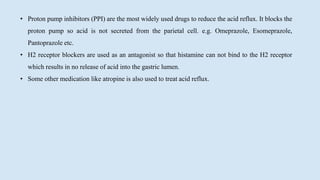
• Proton pump inhibitors (PPI) are the most widely used drugs to reduce the acid reflux. It blocks the
proton pump so acid is not secreted from the parietal cell. e.g. Omeprazole, Esomeprazole,
Pantoprazole etc.
• H2 receptor blockers are used as an antagonist so that histamine can not bind to the H2 receptor
which results in no release of acid into the gastric lumen.
• Some other medication like atropine is also used to treat acid reflux.
References
• https://anatomy-medicine.com/digestive-system/29-the-stomach.html
• https://slideplayer.com/slide/12165283/
• https://www.sciencedirect.com/topics/medicine-and-dentistry/stomach-secretion
• https://www.academia.edu/4768550/Formation_of_Hcl_in_Stomach
• https://www.medicinenet.com/protonpump_inhibitors/article.htm#what_are_proton_pump_inhibitors_ppis
and_how_do_they_work_mechanism_of_action
• Goodman and Gilman’s Manual of Pharmacology and Therapeutics
Thank You