CONTRAST AND COMPARISON
BETWEEN PSYCHOTHERAPIES
Muhammad Musawar Ali
MPHIL, ICAP
Psychmmusawarali@gmail.com
1
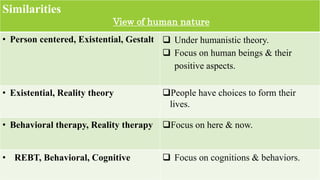
Similarities
View of human nature
• Person centered, Existential, Gestalt  Under humanistic theory.
 Focus on human beings & their
positive aspects.
• Existential, Reality theory People have choices to form their
lives.
• Behavioral therapy, Reality therapy Focus on here & now.
• REBT, Behavioral, Cognitive  Focus on cognitions & behaviors.2
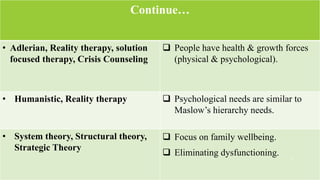
Continue…
• Adlerian, Reality therapy, solution
focused therapy, Crisis Counseling
 People have health & growth forces
(physical & psychological).
• Humanistic, Reality therapy  Psychological needs are similar to
Maslow’s hierarchy needs.
• System theory, Structural theory,
Strategic Theory
 Focus on family wellbeing.
 Eliminating dysfunctioning.
3
Continue…
• Reality therapy, Solution focused
Therapy
 No comprehensive view of human
nature.
• Psychodynamic, play therapy  People specially children engage in
play behavior in order to work
through their interior conflicts and
anxieties.
• Gestalt theory, Play therapy  Follow rules of perception.
4
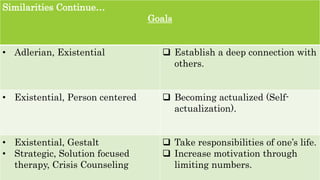
Similarities Continue…
Goals
• Adlerian, Existential  Establish a deep connection with
others.
• Existential, Person centered  Becoming actualized (Self-
actualization).
• Existential, Gestalt
• Strategic, Solution focused
therapy, Crisis Counseling
 Take responsibilities of one’s life.
 Increase motivation through
limiting numbers.
5
Continue…
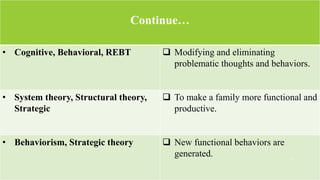
• Cognitive, Behavioral, REBT  Modifying and eliminating
problematic thoughts and behaviors.
• System theory, Structural theory,
Strategic
 To make a family more functional and
productive.
• Behaviorism, Strategic theory  New functional behaviors are
generated. 6
Similarities Continue…
Role of Counselors
• Psychoanalytic, Person-Centered
therapy, Reality therapy
 Rapport Building.
• Adlerian, Existential, Behavioral,
REBT, Reality therapy, System
theory, Narrative theory
 Counselor act as a teacher.
• Existential, Gestalt  Focus on here and now.
7
Continue…
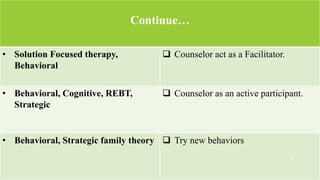
• Solution Focused therapy,
Behavioral
 Counselor act as a Facilitator.
• Behavioral, Cognitive, REBT,
Strategic
 Counselor as an active participant.
• Behavioral, Strategic family theory  Try new behaviors
8
Continue…
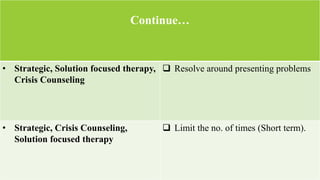
• Strategic, Solution focused therapy,
Crisis Counseling
 Resolve around presenting problems
• Strategic, Crisis Counseling,
Solution focused therapy
 Limit the no. of times (Short term).
9
Similarities Continue…
Techniques
• Adlerian, person-centered,
existential, Gestalt
 Lengthy but flexible.
• Cognitive, REBT, reality theory,
solution focused, crisis counseling
 Shorter in duration but flexible.
• Adlerian, gestalt, behavioral,
cognitive, REBT, reality, strategic,
solution focused
 Homework assignments
• Psychoanalytical, person-centered,
existential
 No homework tasks. 10
Continue…
• Psychoanalytical, existential  Use free association and
transference.
• Adlerian, existential, gestalt  Use confrontation.
• Person-centered, existential  Focus on relationship with client.
• Existential, behavioral  Use desensitization.
11
Continue…
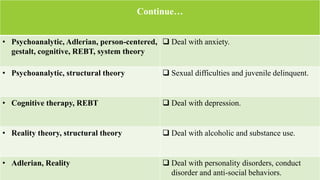
• Psychoanalytic, Adlerian, person-centered,
gestalt, cognitive, REBT, system theory
 Deal with anxiety.
• Psychoanalytic, structural theory  Sexual difficulties and juvenile delinquent.
• Cognitive therapy, REBT  Deal with depression.
• Reality theory, structural theory  Deal with alcoholic and substance use.
• Adlerian, Reality  Deal with personality disorders, conduct
disorder and anti-social behaviors.
12
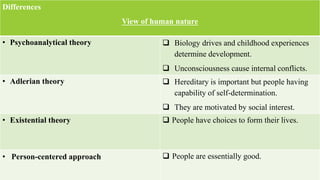
Differences
View of human nature
• Psychoanalytical theory  Biology drives and childhood experiences
determine development.
 Unconsciousness cause internal conflicts.
• Adlerian theory  Hereditary is important but people having
capability of self-determination.
 They are motivated by social interest.
• Existential theory  People have choices to form their lives.
• Person-centered approach  People are essentially good. 13
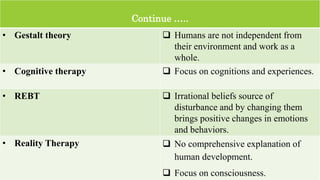
Continue …..
• Gestalt theory  Humans are not independent from
their environment and work as a
whole.
• Cognitive therapy  Focus on cognitions and experiences.
• REBT  Irrational beliefs source of
disturbance and by changing them
brings positive changes in emotions
and behaviors.
• Reality Therapy  No comprehensive explanation of
human development.
 Focus on consciousness.
14
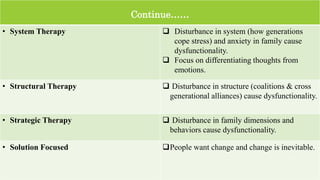
Continue……
• System Therapy  Disturbance in system (how generations
cope stress) and anxiety in family cause
dysfunctionality.
 Focus on differentiating thoughts from
emotions.
• Structural Therapy  Disturbance in structure (coalitions & cross
generational alliances) cause dysfunctionality.
• Strategic Therapy  Disturbance in family dimensions and
behaviors cause dysfunctionality.
• Solution Focused People want change and change is inevitable.
15
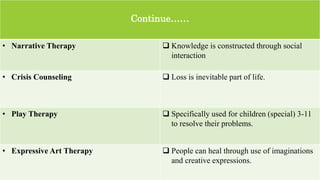
Continue……
• Narrative Therapy  Knowledge is constructed through social
interaction
• Crisis Counseling  Loss is inevitable part of life.
• Play Therapy  Specifically used for children (special) 3-11
to resolve their problems.
• Expressive Art Therapy  People can heal through use of imaginations
and creative expressions. 16
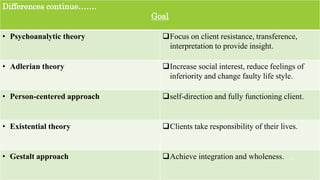
Differences continue…….
Goal
• Psychoanalytic theory Focus on client resistance, transference,
interpretation to provide insight.
• Adlerian theory Increase social interest, reduce feelings of
inferiority and change faulty life style.
• Person-centered approach self-direction and fully functioning client.
• Existential theory Clients take responsibility of their lives.
• Gestalt approach Achieve integration and wholeness. 17
Continue ……
• Behavioral theory  Modifying and eliminating maladaptive behaviors.
• Cognitive theory  Examining and modifying unexamined and
negative thoughts.
• REBT  To realize people that they can live rational and
productive lives.
• Reality Therapy  Become psychologically strong and realization
of client's choices.
 And make realistic plans.
• System Theory  Understand and modify coping strategies.
 Understand coping patterns from generation to
generation.
• Structural  Action is emphasized over insight. 18
Continue…..
• Strategic  To eliminate a problematic behavior.
 New skills for future are learned.
• Solution Focused  Understand internal feelings.
 Direct client toward solution and focus on positives
and possibilities.
• Narrative Therapy  People their lives through stories.
 Create new realities and stories for themselves.
• Crisis Counseling  Immediate help for client.
• Play Therapy  Help children systematically address and resolve
their problem.
• Expressive Art Therapy  Provide individual with deeper sense of them.
19
Differences continue…….
Role of counselor
• Psychoanalytical theory  Deal with childhood experiences and unconsciousness.
 Counselor works as an interpreter.
 Counselor is anonymous.
• Adlerian therapy Counselor is directive and provides clues.
• Person-Centered Counselor as an active listener.
• Existential therapy  No uniform rules to follow as every client is considered
unique.
 Counselor shares personal experiences.
• Gestalt therapy Counselor as an exciting, energetic and fully human.
• Behavioral therapy Counselor works to learn and unlearn behaviors of client.
20
Continue……
• Cognitive therapy  Counselor makes covert thoughts of client more overt.
• REBT  Counselor should be bright, knowledgeable,
empathetic, respectful and genuine.
• Reality theory  Client has a choice what to do.
 Counselor emphasizes on positive construction
action.
• System Theory  Relationship like a Socratic dialogue.
 Counselor constructs multigenerational genogram
• Structural Therapy  Counselors are both observer and expert.
 Advocate structural changes in family.
• Strategic Therapy  Counselor focus is on process rather than content of
dysfunctional interaction.
21
Continue….
• Solution Focused  Counselor check the activity of client to change.
 There is no interest how a problem was aroused.
 And allow the client to be expert in their life.
• Narrative Therapy  Counselor uses narrative reasoning.
• Crisis Counseling  Counselor should be calm and patient in highly
charged situations.
• Play Therapy  Therapist become the child friend and participates
in activities and plays and create safe environment.
• Expressive Art Therapy  Art therapists are trained to pick up on nonverbal
symbols and metaphors that are often expressed
through art and the creative process, concepts that
are usually difficult to express with words.
22
Differences continue…….
Techniques
• Psychoanalytical theory  Very lengthy in duration.
 Techniques are interpretation of resistance, dream analysis.
 Common treated disorders are hysteria, narcissism, OCD,
character disorders, phobias.
• Adlerian theory  Techniques are asking the question, encouragement, acting as if,
spitting in the client's soup, catching oneself, task setting, push
button.
 Common treated disorder is affective disorders
• Person-centered  Techniques are empathy, unconditional positive regard,
congruence, motivational interviewing, quality of relationship is
important.
 Deal with psychological adjustment, learning, frustration
tolerance.
• Existential theory  No specific techniques and interventions.
 Logo therapy is used for PTSD clients.
 Borrow some techniques from other models
23
Continue…….
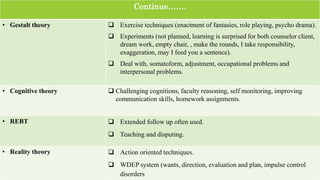
• Gestalt theory  Exercise techniques (enactment of fantasies, role playing, psycho drama).
 Experiments (not planned, learning is surprised for both counselor client,
dream work, empty chair, , make the rounds, I take responsibility,
exaggeration, may I feed you a sentence).
 Deal with, somatoform, adjustment, occupational problems and
interpersonal problems.
• Cognitive theory  Challenging cognitions, faculty reasoning, self monitoring, improving
communication skills, homework assignments.
• REBT  Extended follow up often used.
 Teaching and disputing.
• Reality theory  Action oriented techniques.
 WDEP system (wants, direction, evaluation and plan, impulse control
disorders
24
Continue…….
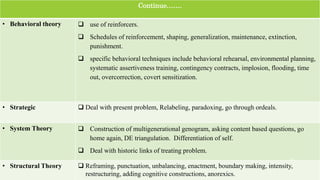
• Behavioral theory  use of reinforcers.
 Schedules of reinforcement, shaping, generalization, maintenance, extinction,
punishment.
 specific behavioral techniques include behavioral rehearsal, environmental planning,
systematic assertiveness training, contingency contracts, implosion, flooding, time
out, overcorrection, covert sensitization.
• Strategic  Deal with present problem, Relabeling, paradoxing, go through ordeals.
• System Theory  Construction of multigenerational genogram, asking content based questions, go
home again, DE triangulation. Differentiation of self.
 Deal with historic links of treating problem.
• Structural Theory  Reframing, punctuation, unbalancing, enactment, boundary making, intensity,
restructuring, adding cognitive constructions, anorexics.
25
Continue…..
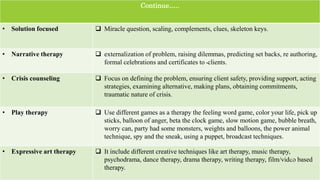
• Solution focused  Miracle question, scaling, complements, clues, skeleton keys.
• Narrative therapy  externalization of problem, raising dilemmas, predicting set backs, re authoring,
formal celebrations and certificates to ‫۔‬clients.
• Crisis counseling  Focus on defining the problem, ensuring client safety, providing support, acting
strategies, examining alternative, making plans, obtaining commitments,
traumatic nature of crisis.
• Play therapy  Use different games as a therapy the feeling word game, color your life, pick up
sticks, balloon of anger, beta the clock game, slow motion game, bubble breath,
worry can, party had some monsters, weights and balloons, the power animal
technique, spy and the sneak, using a puppet, broadcast techniques.
• Expressive art therapy  It include different creative techniques like art therapy, music therapy,
psychodrama, dance therapy, drama therapy, writing therapy, film/video based
therapy.
26
27

Comparison and similarties and differences among psychotherapy

  • 1.
    CONTRAST AND COMPARISON BETWEENPSYCHOTHERAPIES Muhammad Musawar Ali MPHIL, ICAP Psychmmusawarali@gmail.com 1
  • 2.
    Similarities View of humannature • Person centered, Existential, Gestalt  Under humanistic theory.  Focus on human beings & their positive aspects. • Existential, Reality theory People have choices to form their lives. • Behavioral therapy, Reality therapy Focus on here & now. • REBT, Behavioral, Cognitive  Focus on cognitions & behaviors.2
  • 3.
    Continue… • Adlerian, Realitytherapy, solution focused therapy, Crisis Counseling  People have health & growth forces (physical & psychological). • Humanistic, Reality therapy  Psychological needs are similar to Maslow’s hierarchy needs. • System theory, Structural theory, Strategic Theory  Focus on family wellbeing.  Eliminating dysfunctioning. 3
  • 4.
    Continue… • Reality therapy,Solution focused Therapy  No comprehensive view of human nature. • Psychodynamic, play therapy  People specially children engage in play behavior in order to work through their interior conflicts and anxieties. • Gestalt theory, Play therapy  Follow rules of perception. 4
  • 5.
    Similarities Continue… Goals • Adlerian,Existential  Establish a deep connection with others. • Existential, Person centered  Becoming actualized (Self- actualization). • Existential, Gestalt • Strategic, Solution focused therapy, Crisis Counseling  Take responsibilities of one’s life.  Increase motivation through limiting numbers. 5
  • 6.
    Continue… • Cognitive, Behavioral,REBT  Modifying and eliminating problematic thoughts and behaviors. • System theory, Structural theory, Strategic  To make a family more functional and productive. • Behaviorism, Strategic theory  New functional behaviors are generated. 6
  • 7.
    Similarities Continue… Role ofCounselors • Psychoanalytic, Person-Centered therapy, Reality therapy  Rapport Building. • Adlerian, Existential, Behavioral, REBT, Reality therapy, System theory, Narrative theory  Counselor act as a teacher. • Existential, Gestalt  Focus on here and now. 7
  • 8.
    Continue… • Solution Focusedtherapy, Behavioral  Counselor act as a Facilitator. • Behavioral, Cognitive, REBT, Strategic  Counselor as an active participant. • Behavioral, Strategic family theory  Try new behaviors 8
  • 9.
    Continue… • Strategic, Solutionfocused therapy, Crisis Counseling  Resolve around presenting problems • Strategic, Crisis Counseling, Solution focused therapy  Limit the no. of times (Short term). 9
  • 10.
    Similarities Continue… Techniques • Adlerian,person-centered, existential, Gestalt  Lengthy but flexible. • Cognitive, REBT, reality theory, solution focused, crisis counseling  Shorter in duration but flexible. • Adlerian, gestalt, behavioral, cognitive, REBT, reality, strategic, solution focused  Homework assignments • Psychoanalytical, person-centered, existential  No homework tasks. 10
  • 11.
    Continue… • Psychoanalytical, existential Use free association and transference. • Adlerian, existential, gestalt  Use confrontation. • Person-centered, existential  Focus on relationship with client. • Existential, behavioral  Use desensitization. 11
  • 12.
    Continue… • Psychoanalytic, Adlerian,person-centered, gestalt, cognitive, REBT, system theory  Deal with anxiety. • Psychoanalytic, structural theory  Sexual difficulties and juvenile delinquent. • Cognitive therapy, REBT  Deal with depression. • Reality theory, structural theory  Deal with alcoholic and substance use. • Adlerian, Reality  Deal with personality disorders, conduct disorder and anti-social behaviors. 12
  • 13.
    Differences View of humannature • Psychoanalytical theory  Biology drives and childhood experiences determine development.  Unconsciousness cause internal conflicts. • Adlerian theory  Hereditary is important but people having capability of self-determination.  They are motivated by social interest. • Existential theory  People have choices to form their lives. • Person-centered approach  People are essentially good. 13
  • 14.
    Continue ….. • Gestalttheory  Humans are not independent from their environment and work as a whole. • Cognitive therapy  Focus on cognitions and experiences. • REBT  Irrational beliefs source of disturbance and by changing them brings positive changes in emotions and behaviors. • Reality Therapy  No comprehensive explanation of human development.  Focus on consciousness. 14
  • 15.
    Continue…… • System Therapy Disturbance in system (how generations cope stress) and anxiety in family cause dysfunctionality.  Focus on differentiating thoughts from emotions. • Structural Therapy  Disturbance in structure (coalitions & cross generational alliances) cause dysfunctionality. • Strategic Therapy  Disturbance in family dimensions and behaviors cause dysfunctionality. • Solution Focused People want change and change is inevitable. 15
  • 16.
    Continue…… • Narrative Therapy Knowledge is constructed through social interaction • Crisis Counseling  Loss is inevitable part of life. • Play Therapy  Specifically used for children (special) 3-11 to resolve their problems. • Expressive Art Therapy  People can heal through use of imaginations and creative expressions. 16
  • 17.
    Differences continue……. Goal • Psychoanalytictheory Focus on client resistance, transference, interpretation to provide insight. • Adlerian theory Increase social interest, reduce feelings of inferiority and change faulty life style. • Person-centered approach self-direction and fully functioning client. • Existential theory Clients take responsibility of their lives. • Gestalt approach Achieve integration and wholeness. 17
  • 18.
    Continue …… • Behavioraltheory  Modifying and eliminating maladaptive behaviors. • Cognitive theory  Examining and modifying unexamined and negative thoughts. • REBT  To realize people that they can live rational and productive lives. • Reality Therapy  Become psychologically strong and realization of client's choices.  And make realistic plans. • System Theory  Understand and modify coping strategies.  Understand coping patterns from generation to generation. • Structural  Action is emphasized over insight. 18
  • 19.
    Continue….. • Strategic To eliminate a problematic behavior.  New skills for future are learned. • Solution Focused  Understand internal feelings.  Direct client toward solution and focus on positives and possibilities. • Narrative Therapy  People their lives through stories.  Create new realities and stories for themselves. • Crisis Counseling  Immediate help for client. • Play Therapy  Help children systematically address and resolve their problem. • Expressive Art Therapy  Provide individual with deeper sense of them. 19
  • 20.
    Differences continue……. Role ofcounselor • Psychoanalytical theory  Deal with childhood experiences and unconsciousness.  Counselor works as an interpreter.  Counselor is anonymous. • Adlerian therapy Counselor is directive and provides clues. • Person-Centered Counselor as an active listener. • Existential therapy  No uniform rules to follow as every client is considered unique.  Counselor shares personal experiences. • Gestalt therapy Counselor as an exciting, energetic and fully human. • Behavioral therapy Counselor works to learn and unlearn behaviors of client. 20
  • 21.
    Continue…… • Cognitive therapy Counselor makes covert thoughts of client more overt. • REBT  Counselor should be bright, knowledgeable, empathetic, respectful and genuine. • Reality theory  Client has a choice what to do.  Counselor emphasizes on positive construction action. • System Theory  Relationship like a Socratic dialogue.  Counselor constructs multigenerational genogram • Structural Therapy  Counselors are both observer and expert.  Advocate structural changes in family. • Strategic Therapy  Counselor focus is on process rather than content of dysfunctional interaction. 21
  • 22.
    Continue…. • Solution Focused Counselor check the activity of client to change.  There is no interest how a problem was aroused.  And allow the client to be expert in their life. • Narrative Therapy  Counselor uses narrative reasoning. • Crisis Counseling  Counselor should be calm and patient in highly charged situations. • Play Therapy  Therapist become the child friend and participates in activities and plays and create safe environment. • Expressive Art Therapy  Art therapists are trained to pick up on nonverbal symbols and metaphors that are often expressed through art and the creative process, concepts that are usually difficult to express with words. 22
  • 23.
    Differences continue……. Techniques • Psychoanalyticaltheory  Very lengthy in duration.  Techniques are interpretation of resistance, dream analysis.  Common treated disorders are hysteria, narcissism, OCD, character disorders, phobias. • Adlerian theory  Techniques are asking the question, encouragement, acting as if, spitting in the client's soup, catching oneself, task setting, push button.  Common treated disorder is affective disorders • Person-centered  Techniques are empathy, unconditional positive regard, congruence, motivational interviewing, quality of relationship is important.  Deal with psychological adjustment, learning, frustration tolerance. • Existential theory  No specific techniques and interventions.  Logo therapy is used for PTSD clients.  Borrow some techniques from other models 23
  • 24.
    Continue……. • Gestalt theory Exercise techniques (enactment of fantasies, role playing, psycho drama).  Experiments (not planned, learning is surprised for both counselor client, dream work, empty chair, , make the rounds, I take responsibility, exaggeration, may I feed you a sentence).  Deal with, somatoform, adjustment, occupational problems and interpersonal problems. • Cognitive theory  Challenging cognitions, faculty reasoning, self monitoring, improving communication skills, homework assignments. • REBT  Extended follow up often used.  Teaching and disputing. • Reality theory  Action oriented techniques.  WDEP system (wants, direction, evaluation and plan, impulse control disorders 24
  • 25.
    Continue……. • Behavioral theory use of reinforcers.  Schedules of reinforcement, shaping, generalization, maintenance, extinction, punishment.  specific behavioral techniques include behavioral rehearsal, environmental planning, systematic assertiveness training, contingency contracts, implosion, flooding, time out, overcorrection, covert sensitization. • Strategic  Deal with present problem, Relabeling, paradoxing, go through ordeals. • System Theory  Construction of multigenerational genogram, asking content based questions, go home again, DE triangulation. Differentiation of self.  Deal with historic links of treating problem. • Structural Theory  Reframing, punctuation, unbalancing, enactment, boundary making, intensity, restructuring, adding cognitive constructions, anorexics. 25
  • 26.
    Continue….. • Solution focused Miracle question, scaling, complements, clues, skeleton keys. • Narrative therapy  externalization of problem, raising dilemmas, predicting set backs, re authoring, formal celebrations and certificates to ‫۔‬clients. • Crisis counseling  Focus on defining the problem, ensuring client safety, providing support, acting strategies, examining alternative, making plans, obtaining commitments, traumatic nature of crisis. • Play therapy  Use different games as a therapy the feeling word game, color your life, pick up sticks, balloon of anger, beta the clock game, slow motion game, bubble breath, worry can, party had some monsters, weights and balloons, the power animal technique, spy and the sneak, using a puppet, broadcast techniques. • Expressive art therapy  It include different creative techniques like art therapy, music therapy, psychodrama, dance therapy, drama therapy, writing therapy, film/video based therapy. 26
  • 27.