Class Notes #1
Rev. Michael Prince MA.
WIST Introduction to Counseling © 2013
Counseling is a science and an art . It is a
science because it applies techniques and
procedures that are utilized in helping a
person to understand their situations and
employ the most adequate solutions for
problem solving and life change; it is an art
because it allows the therapist to use unique
or own personality and experiences in
assisting the client.
Counseling denotes a professional relationship
between a trained counselor and a client…to
understand and clarify their views of their life
space…and through resolution of problems of
and emotional or interpersonal nature (George,
Cristiani p. 2)
Counseling refers to the application of mental
health, psychological or human development
principles, through cognitive, affective,
behavioral or systematic intervention (Gladding
p. 6)
Counseling attempts to provide
encouragement and guidance for
those who are facing losses, decisions,
or disappointments…stimulate
personality growth and development;
help people cope more effectively with
the problems of living, with inner conflict
and with crippling emotions… (Collins
1988, p.16)
Christian Counseling may be defined as an art and a
science of applying Biblical principles to treat clients’
issues with the use of all the rudiments of professional
counseling. Class Definition (2010)

Christian counseling draws upon psychology and
Christian teaching. It is an effort to combine
professional counseling with Christian or other religious
perspectives or approaches: “integration.”
(http://en.wikipedia.org/wiki/Christian_counseling)

Christian Counseling may be defined as an art and a
science of applying Biblical principles to treat clients’
issues with the use of all the rudiments of professional
counseling.
Sin is the primary focus of mankind’s
dysfunction (Rom 5:12-14)
Salvation, and transformation through
counseling from the gospel is the primary
solution.
Scripture is authoritative and necessary for
Christian counseling because it is God’s soul
care guidebook
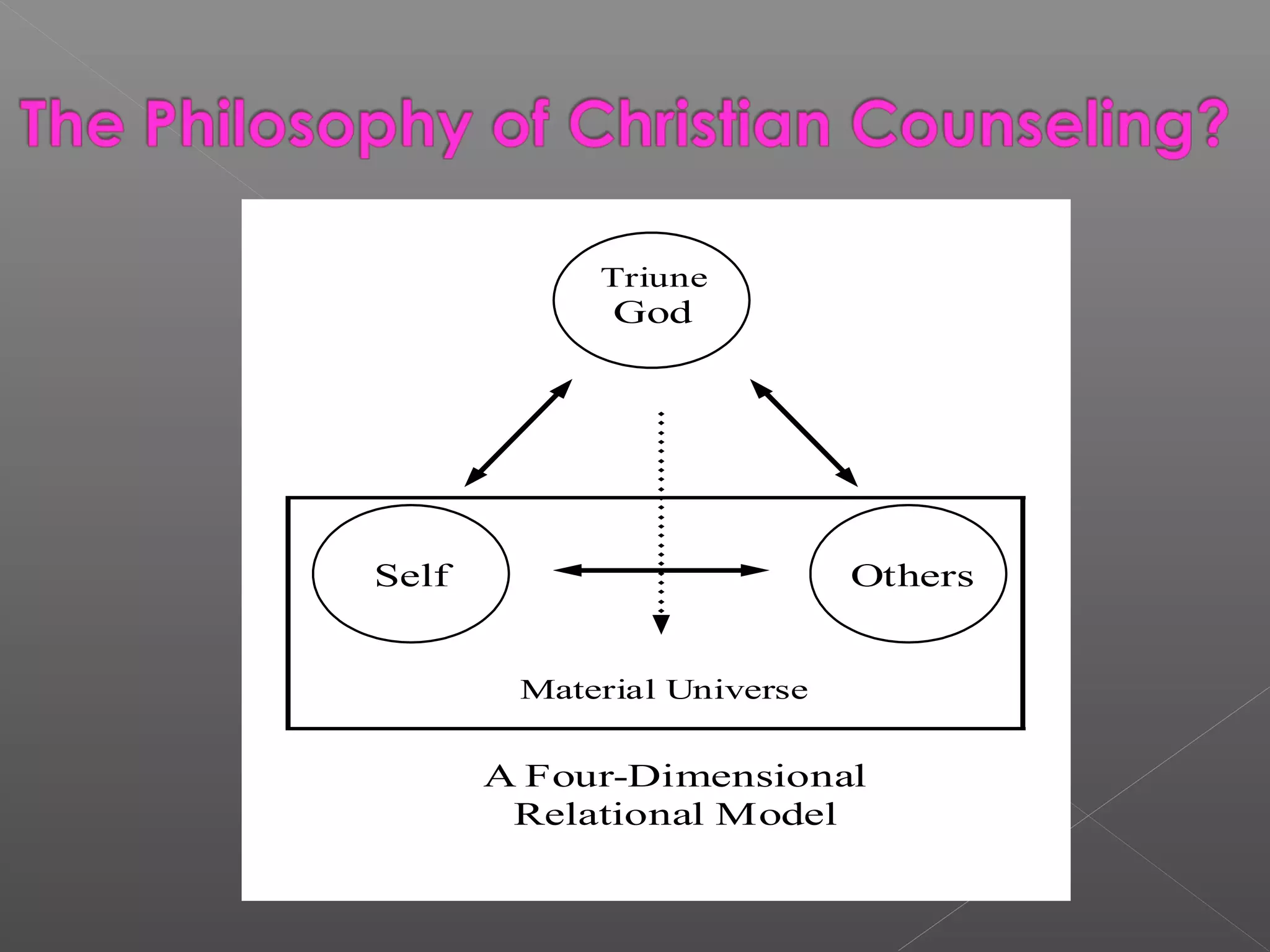
Triune
             God


Self                        Others


        Material Universe


       A Four-Dimensional
        Relational Model
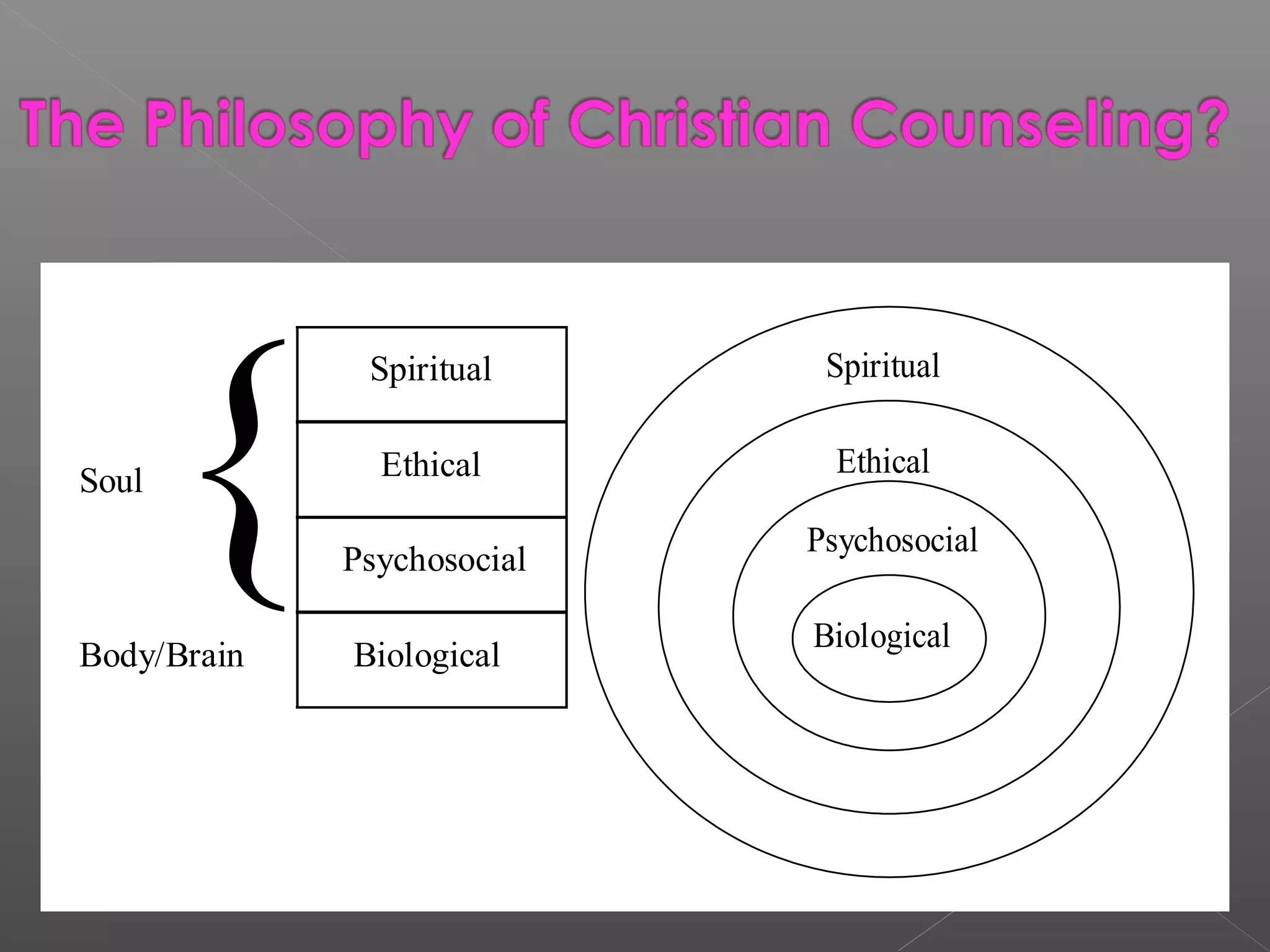
{
              Spiritual      Spiritual

               Ethical        Ethical
Soul
                            Psychosocial
             Psychosocial

                            Biological
Body/Brain   Biological
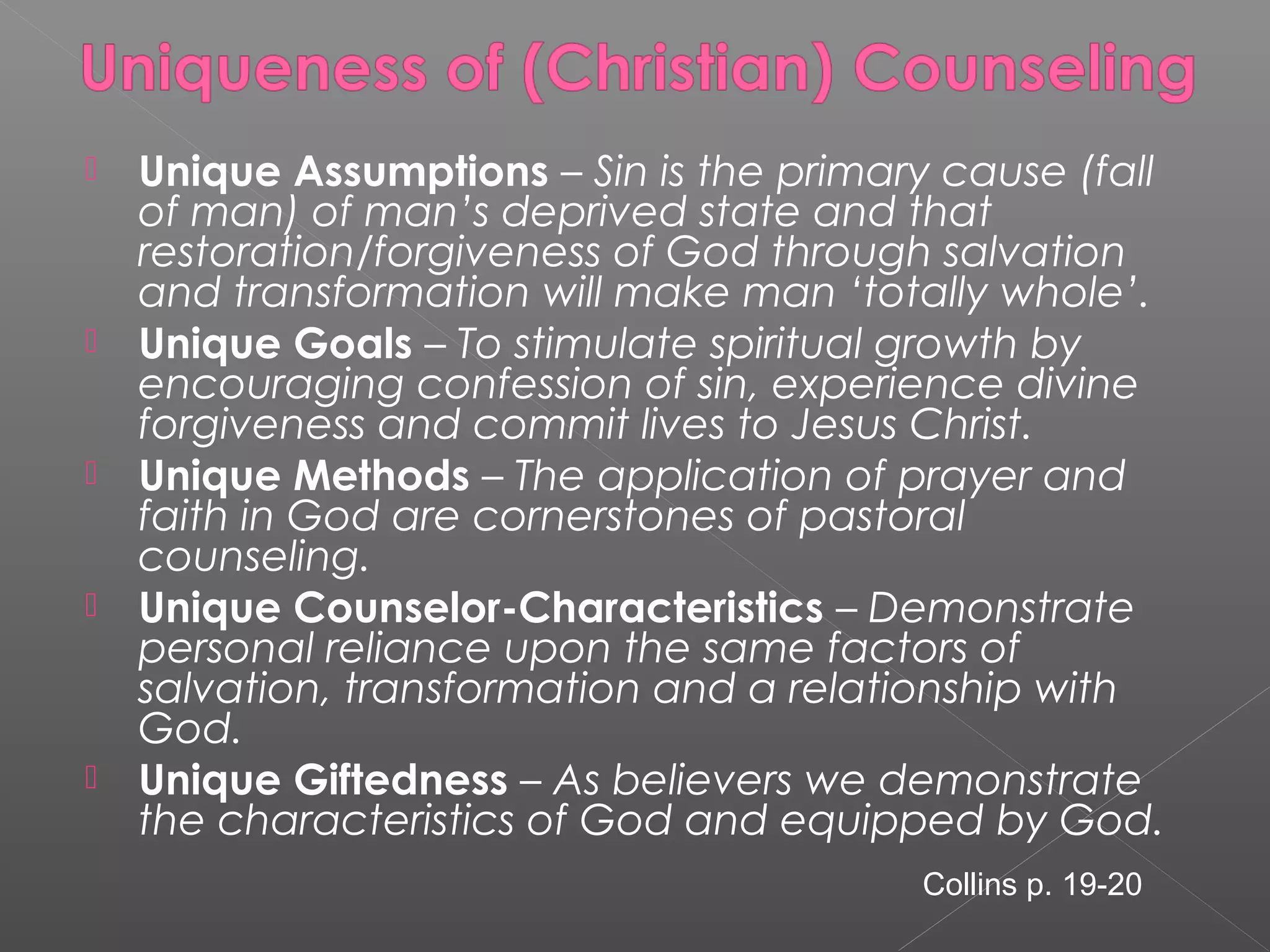
   Unique Assumptions – Sin is the primary cause (fall
    of man) of man’s deprived state and that
    restoration/forgiveness of God through salvation
    and transformation will make man ‘totally whole’.
   Unique Goals – To stimulate spiritual growth by
    encouraging confession of sin, experience divine
    forgiveness and commit lives to Jesus Christ.
   Unique Methods – The application of prayer and
    faith in God are cornerstones of pastoral
    counseling.
   Unique Counselor-Characteristics – Demonstrate
    personal reliance upon the same factors of
    salvation, transformation and a relationship with
    God.
   Unique Giftedness – As believers we demonstrate
    the characteristics of God and equipped by God.
                                          Collins p. 19-20
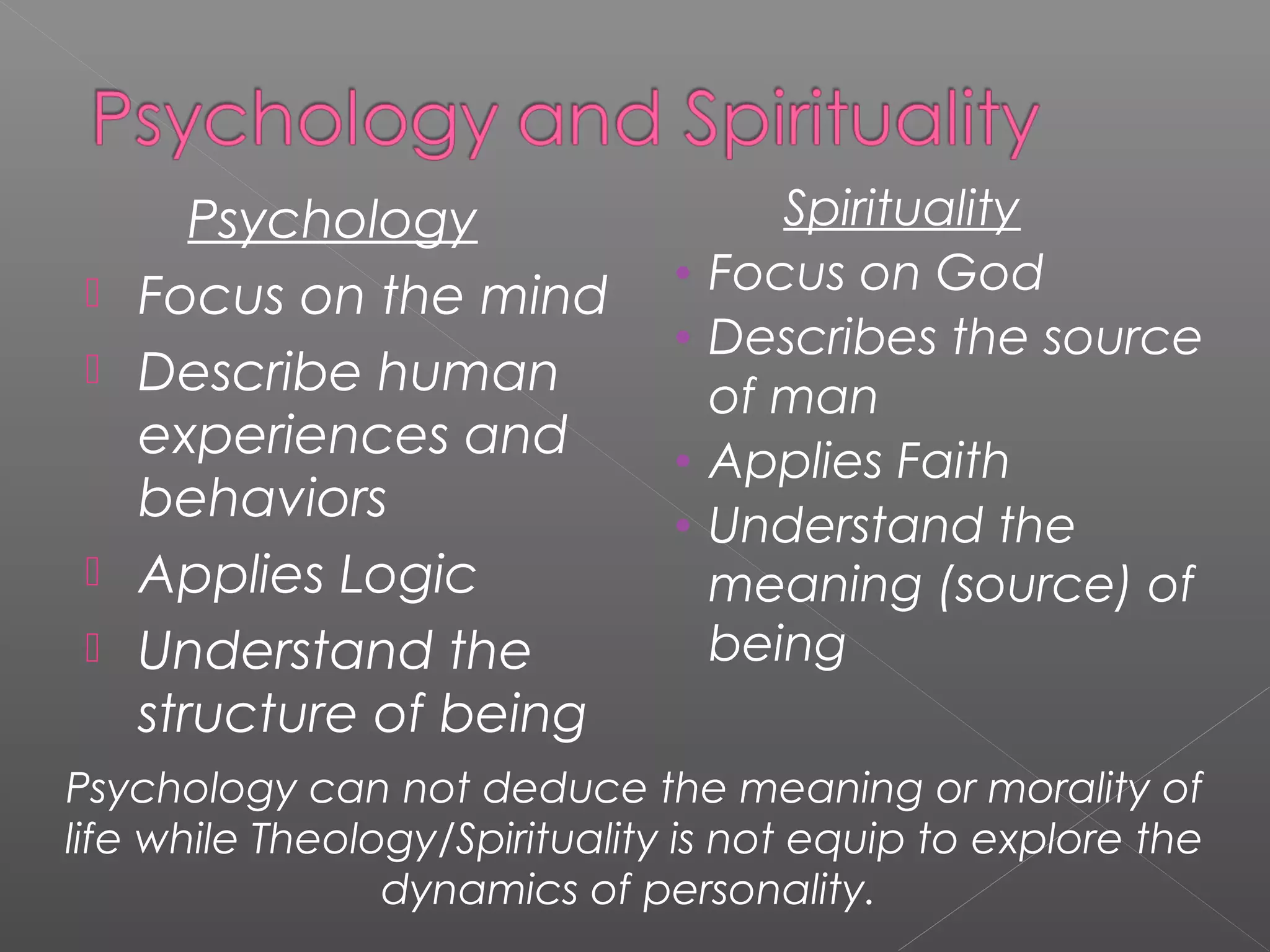
Psychology                     Spirituality
    Focus on the mind
                                •   Focus on God
                                •   Describes the source
    Describe human                 of man
     experiences and            •   Applies Faith
     behaviors                  •   Understand the
    Applies Logic                  meaning (source) of
    Understand the                 being
     structure of being
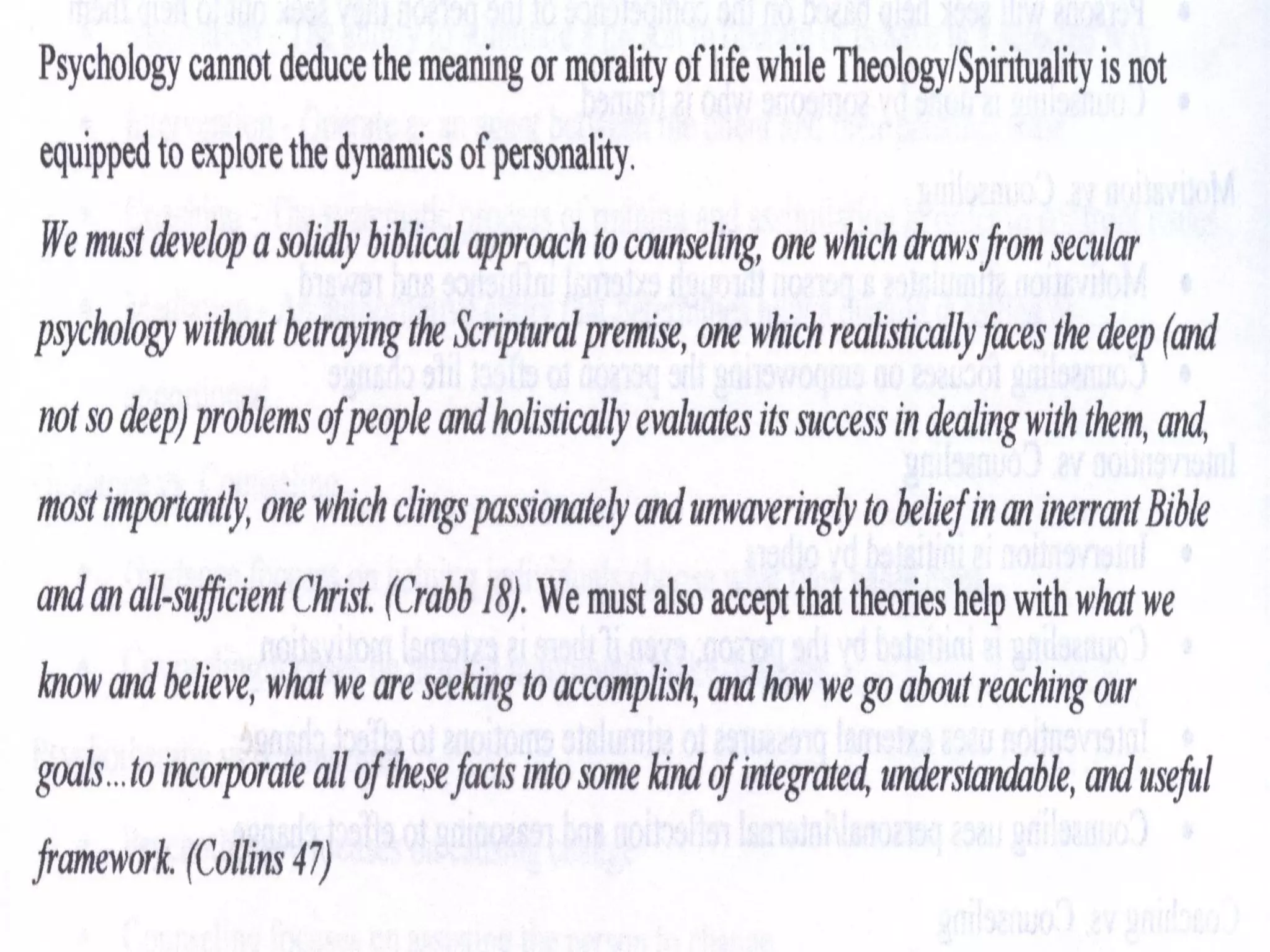
Psychology can not deduce the meaning or morality of
life while Theology/Spirituality is not equip to explore the
                 dynamics of personality.
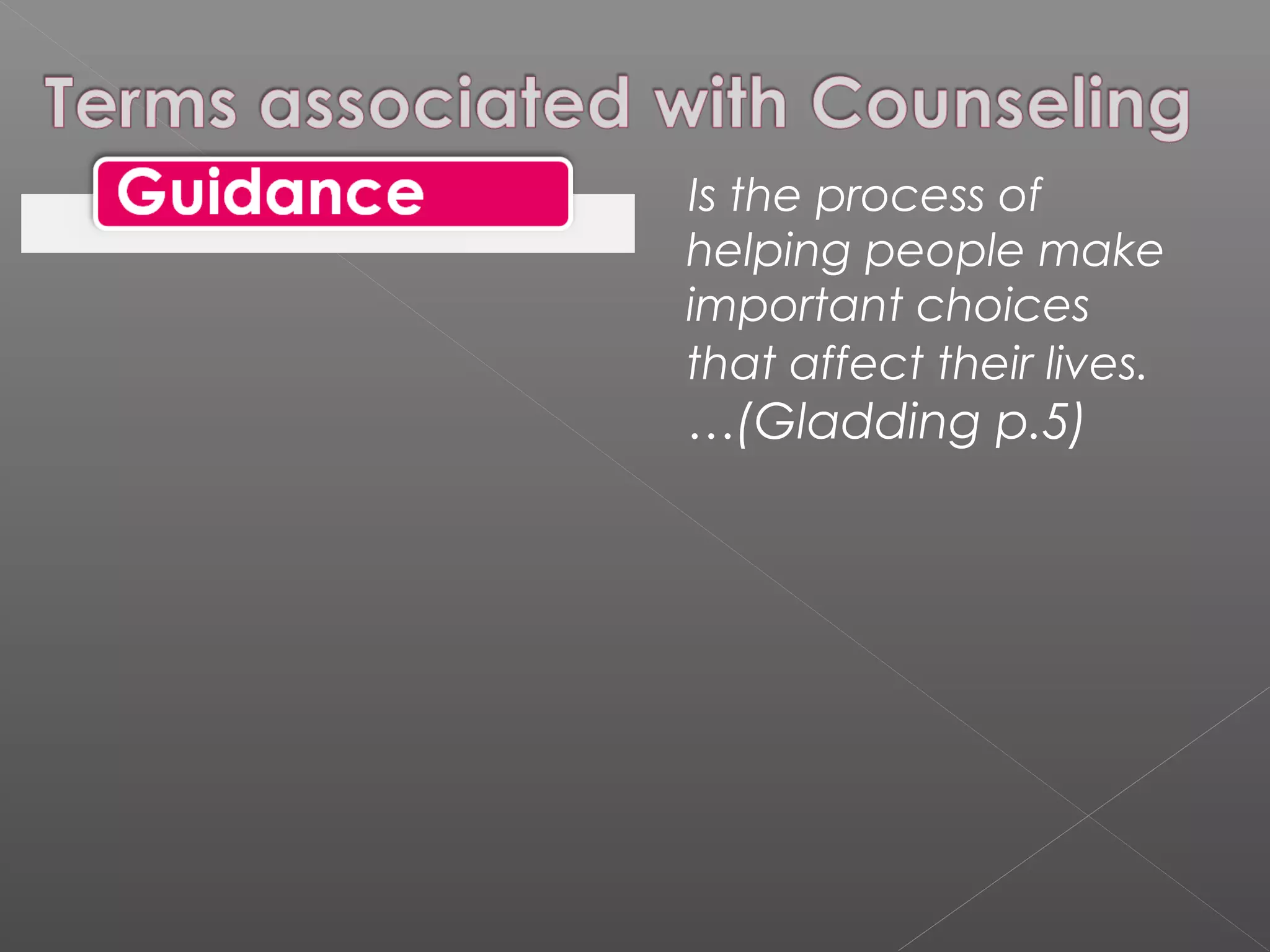
Is the process of
helping people make
important choices
that affect their lives.
…(Gladding p.5)
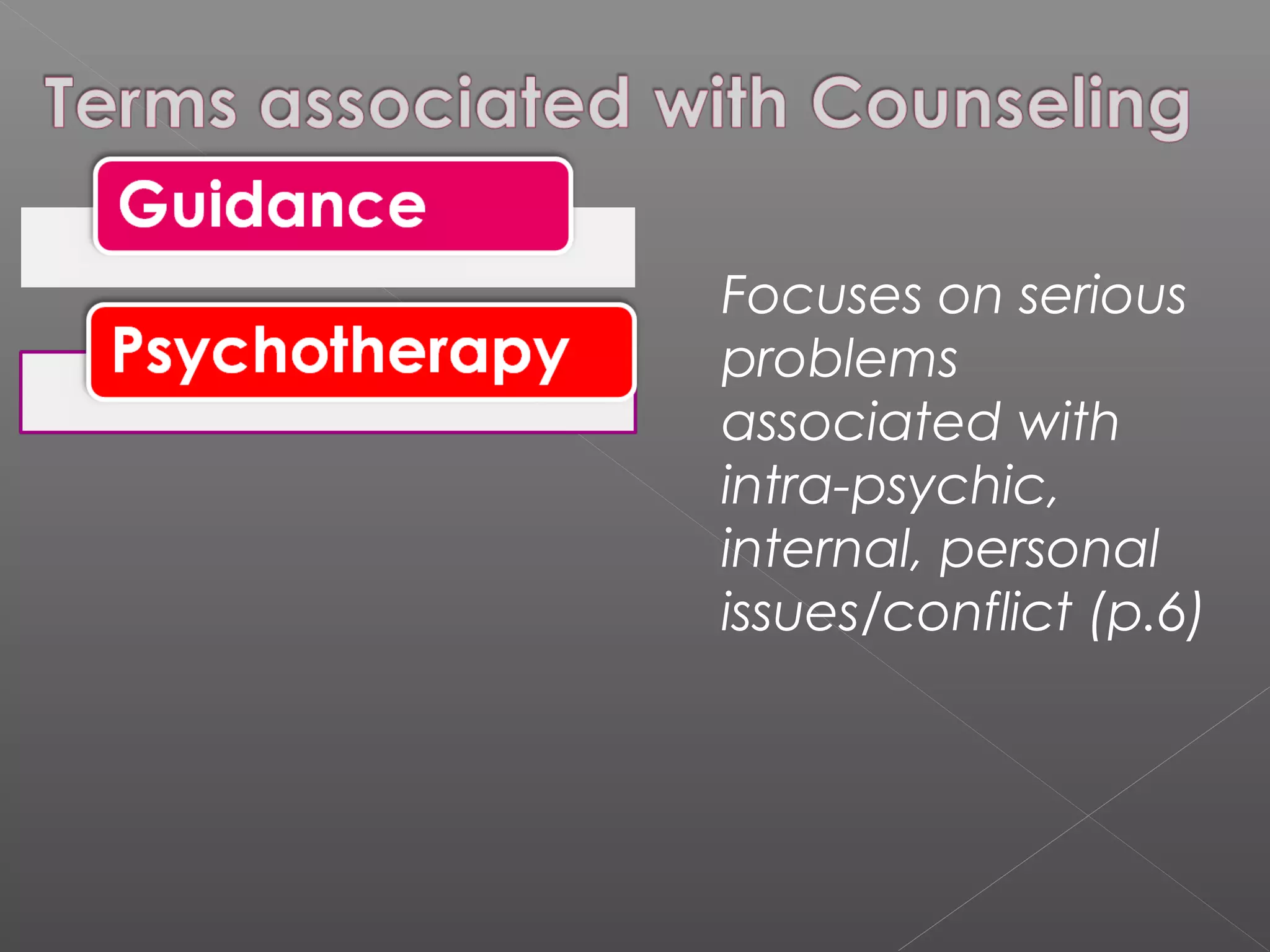
Focuses on serious
problems
associated with
intra-psychic,
internal, personal
issues/conflict (p.6)
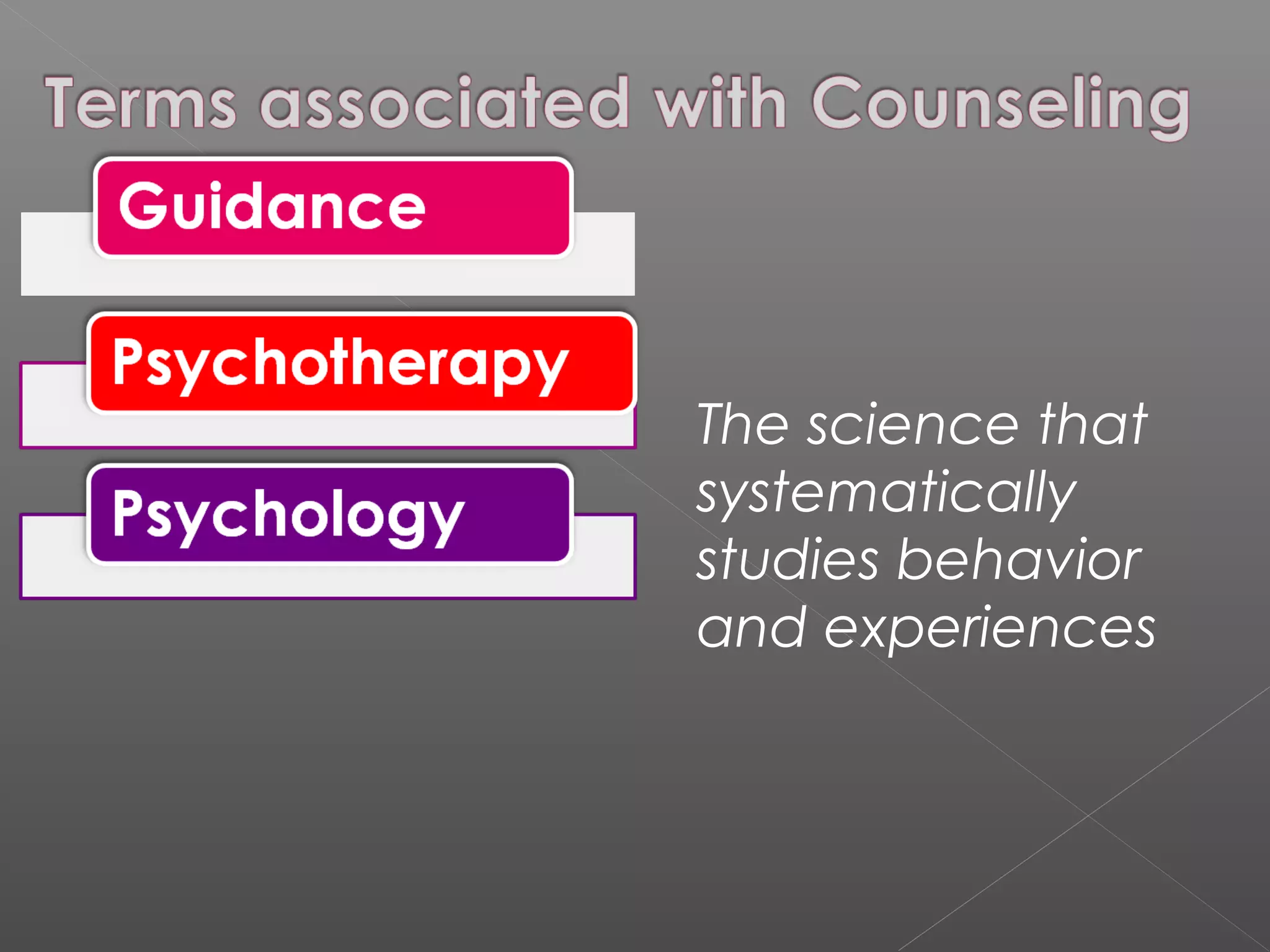
The science that
systematically
studies behavior
and experiences
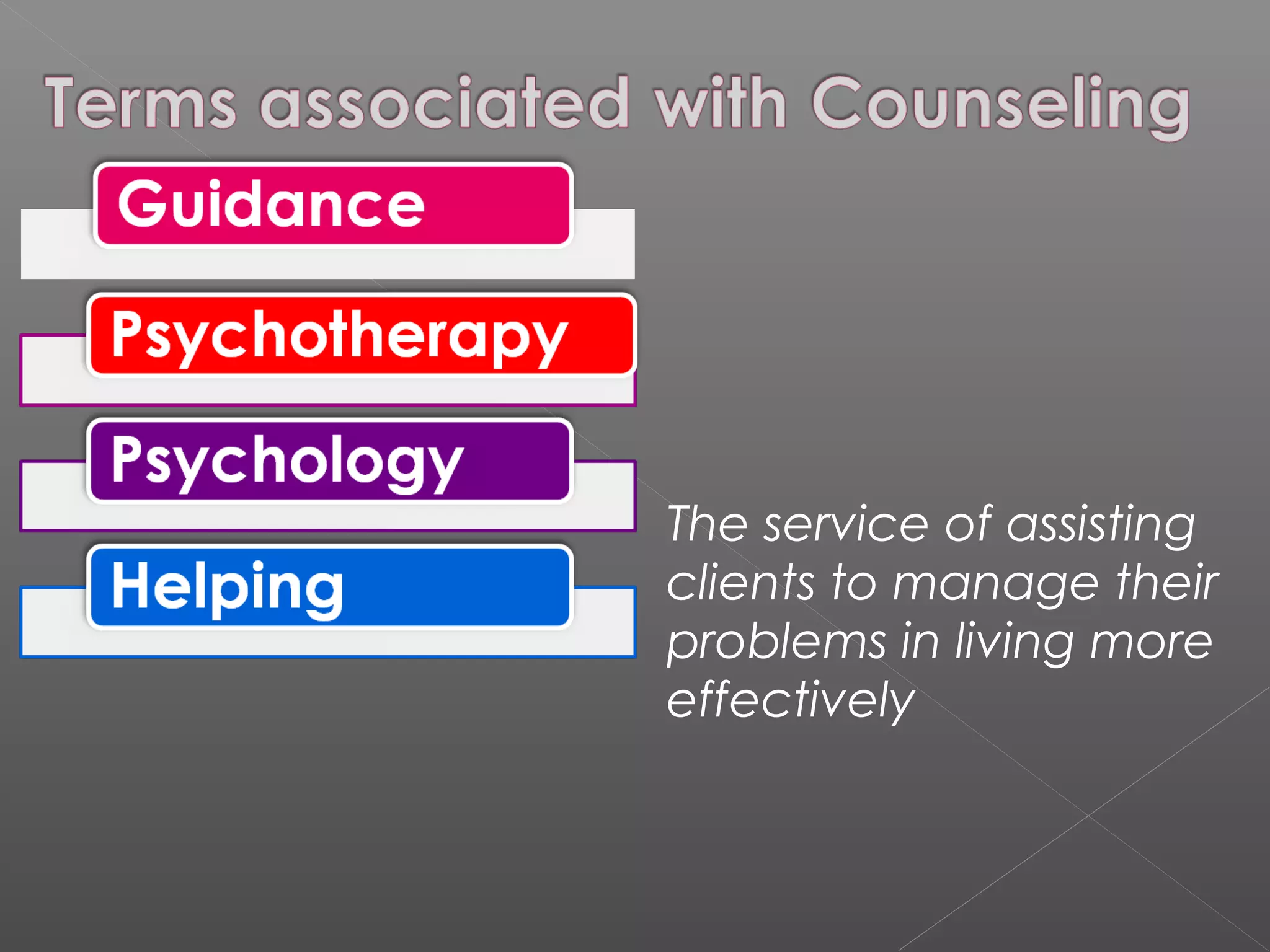
The service of assisting
clients to manage their
problems in living more
effectively
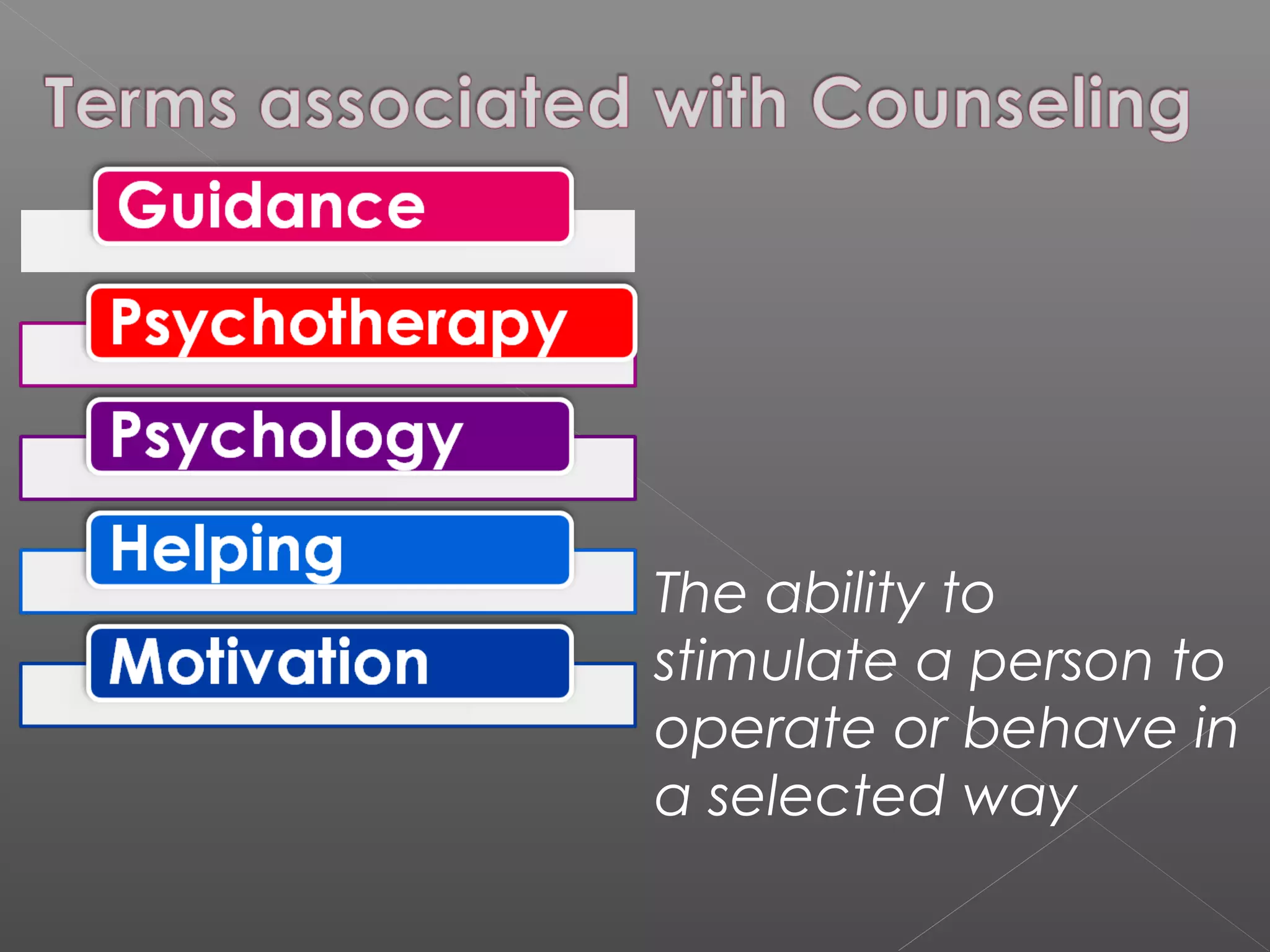
The ability to
stimulate a person to
operate or behave in
a selected way
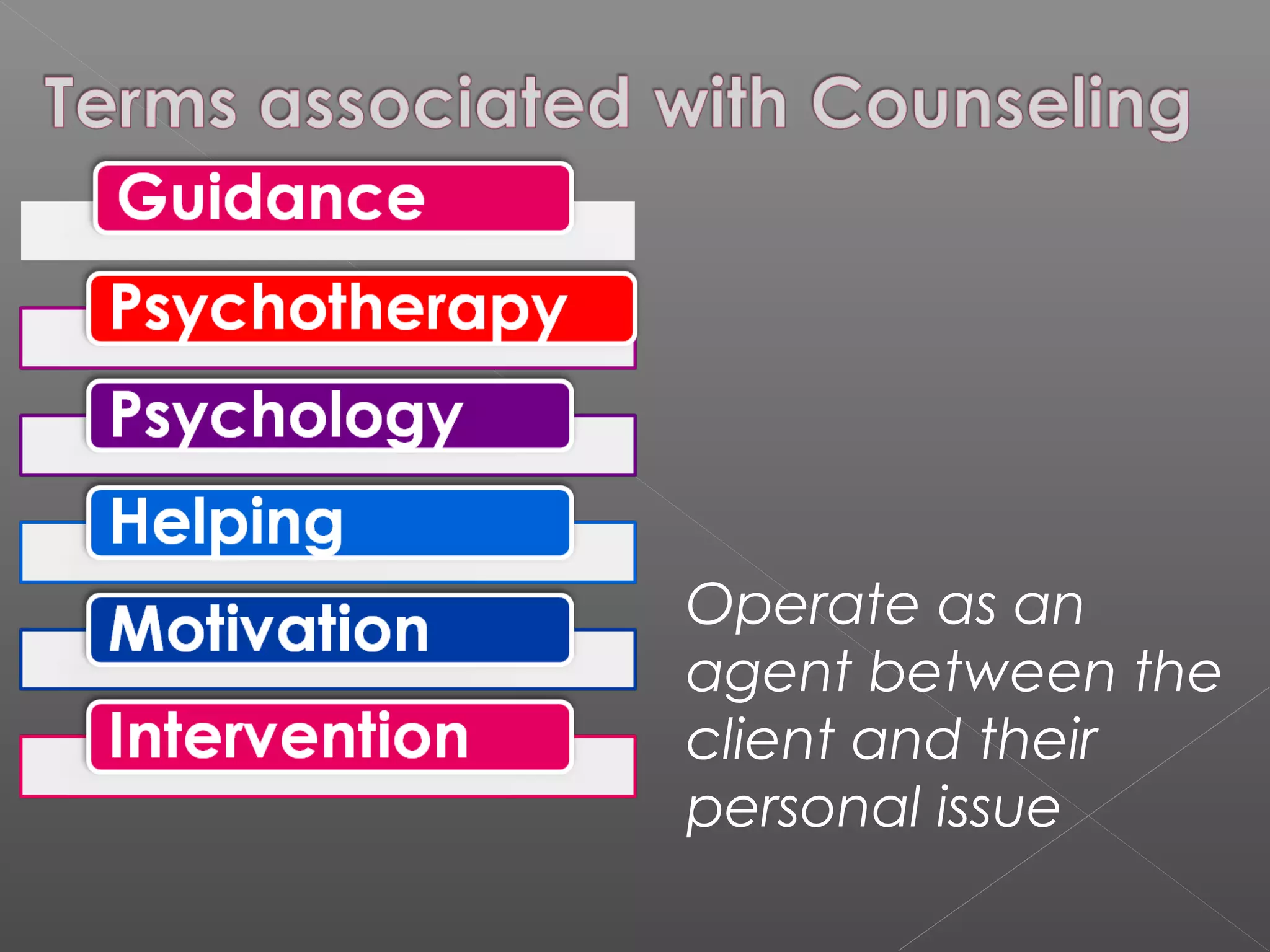
Operate as an
agent between the
client and their
personal issue
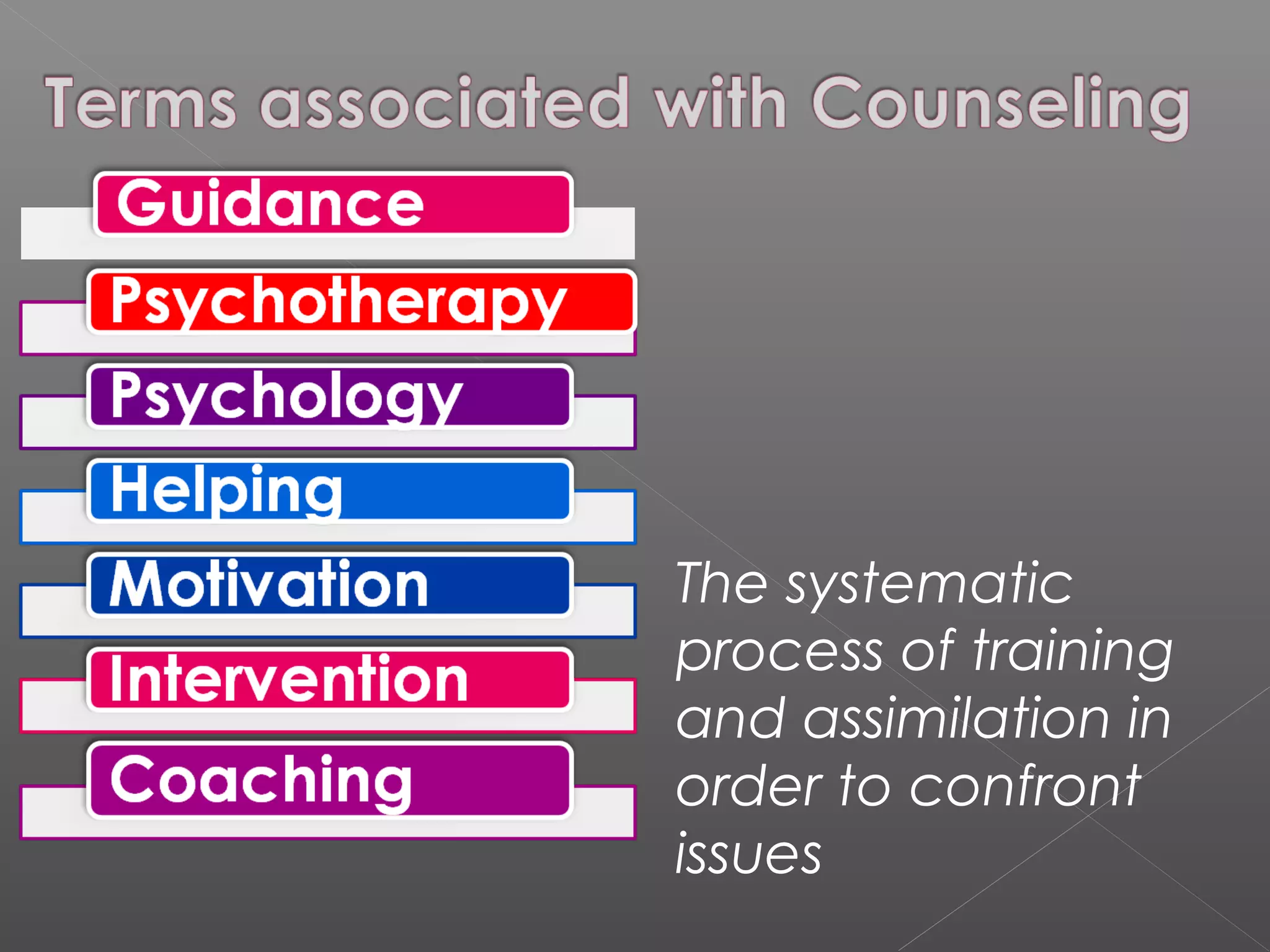
The systematic
process of training
and assimilation in
order to confront
issues
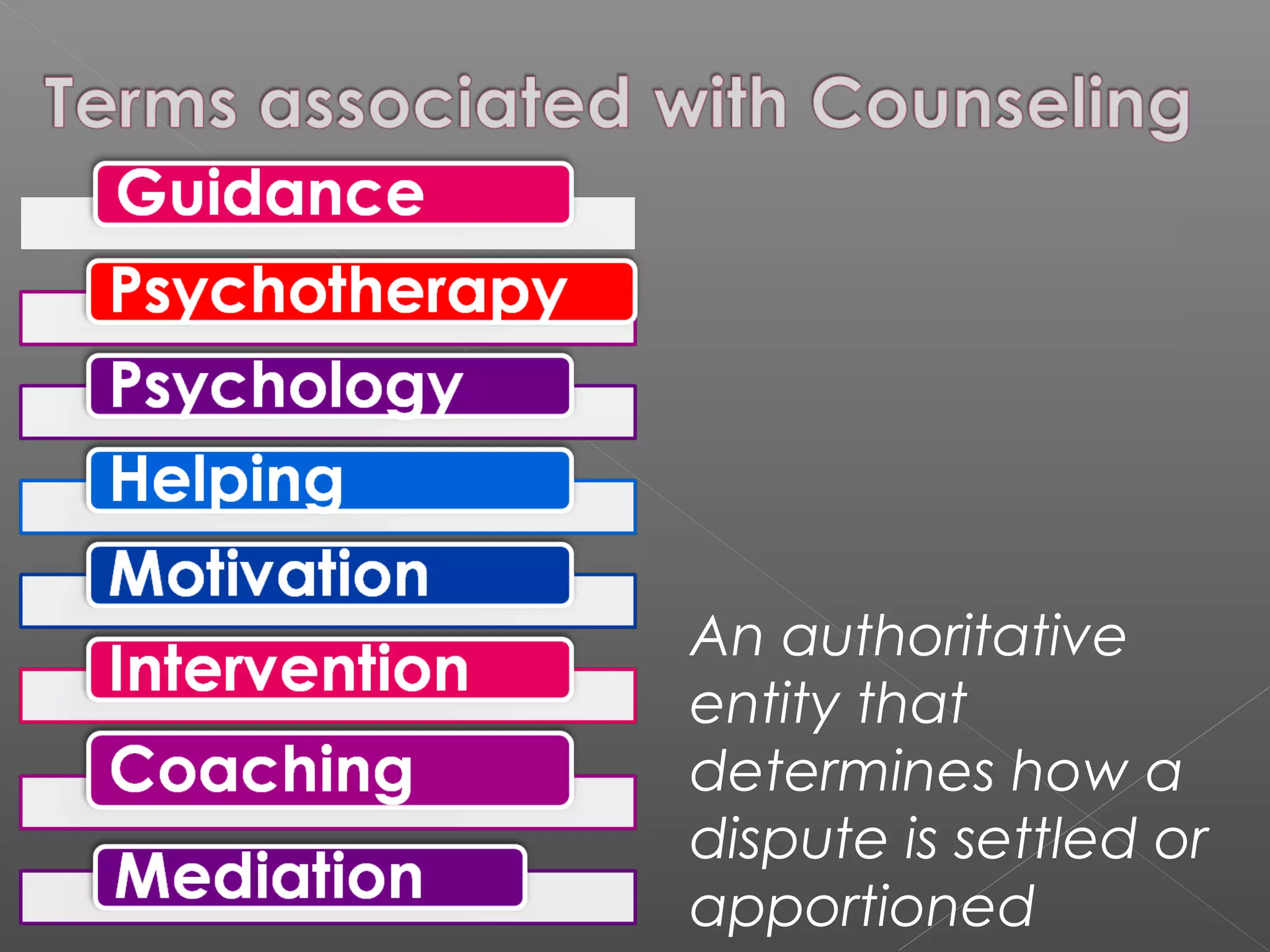
An authoritative
entity that
determines how a
dispute is settled or
apportioned
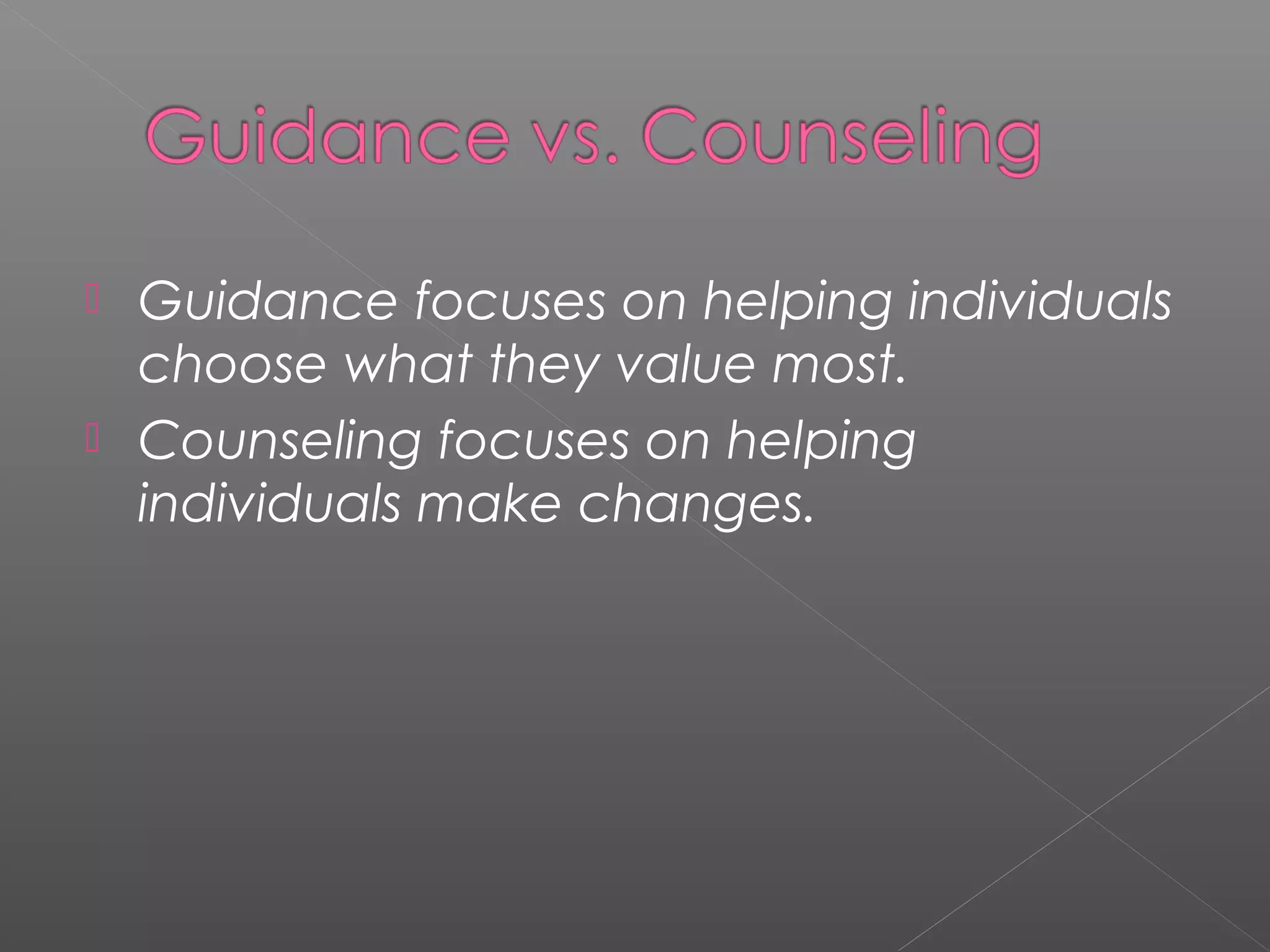
 Guidance focuses on helping individuals
  choose what they value most.
 Counseling focuses on helping
  individuals make changes.
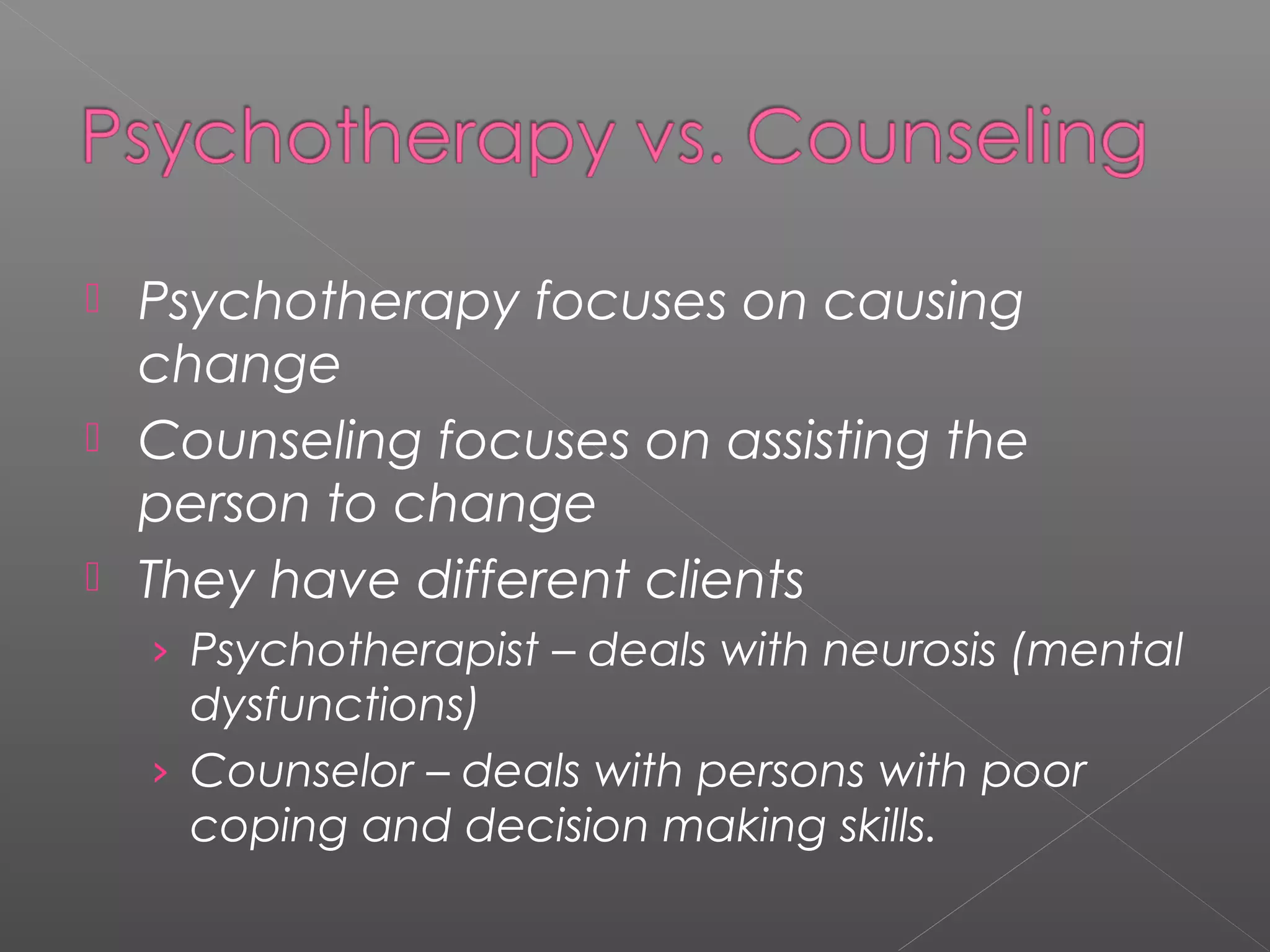
 Psychotherapy focuses on causing
  change
 Counseling focuses on assisting the
  person to change
 They have different clients
    › Psychotherapist – deals with neurosis (mental
      dysfunctions)
    › Counselor – deals with persons with poor
      coping and decision making skills.
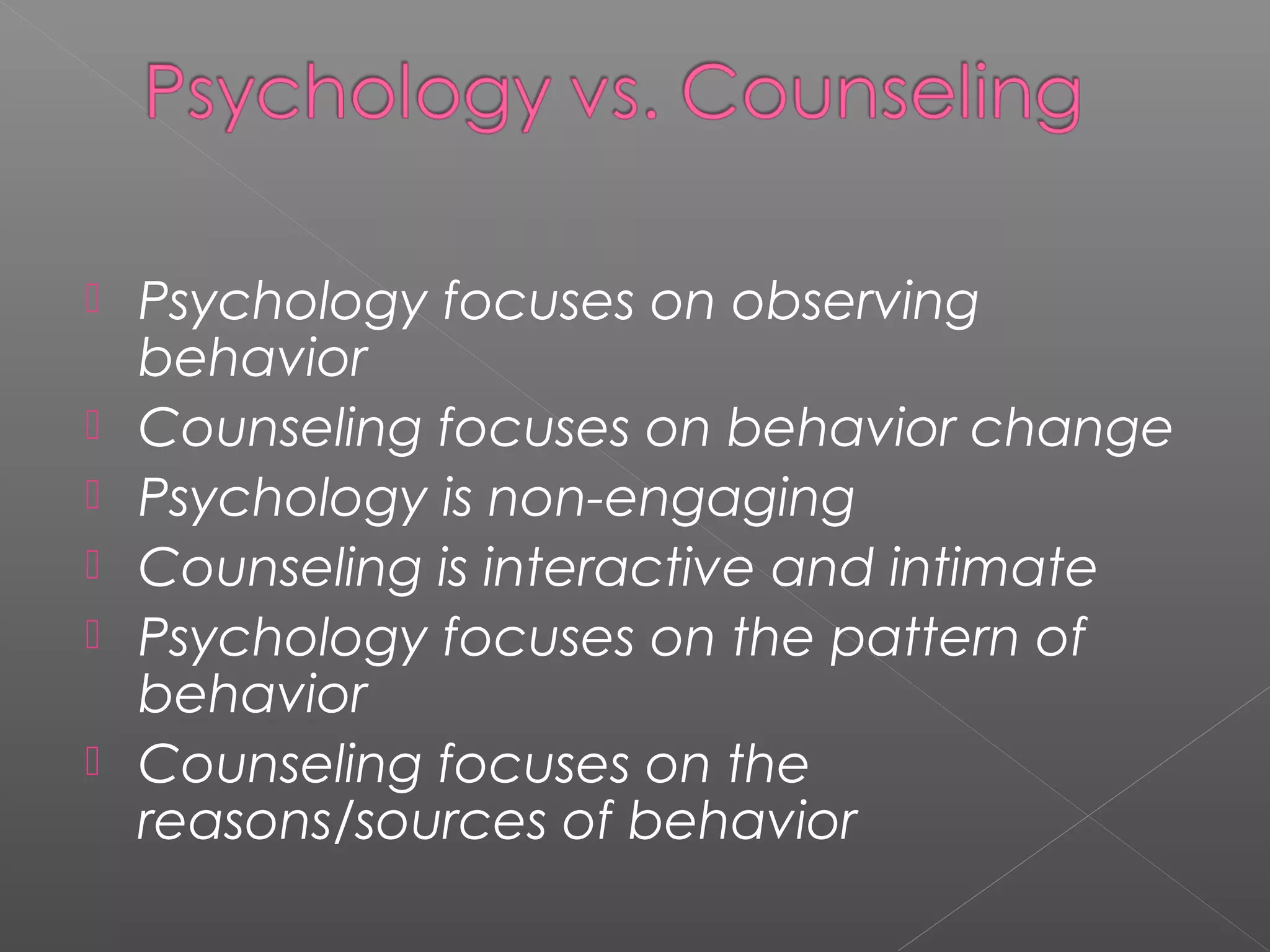
   Psychology focuses on observing
    behavior
   Counseling focuses on behavior change
   Psychology is non-engaging
   Counseling is interactive and intimate
   Psychology focuses on the pattern of
    behavior
   Counseling focuses on the
    reasons/sources of behavior
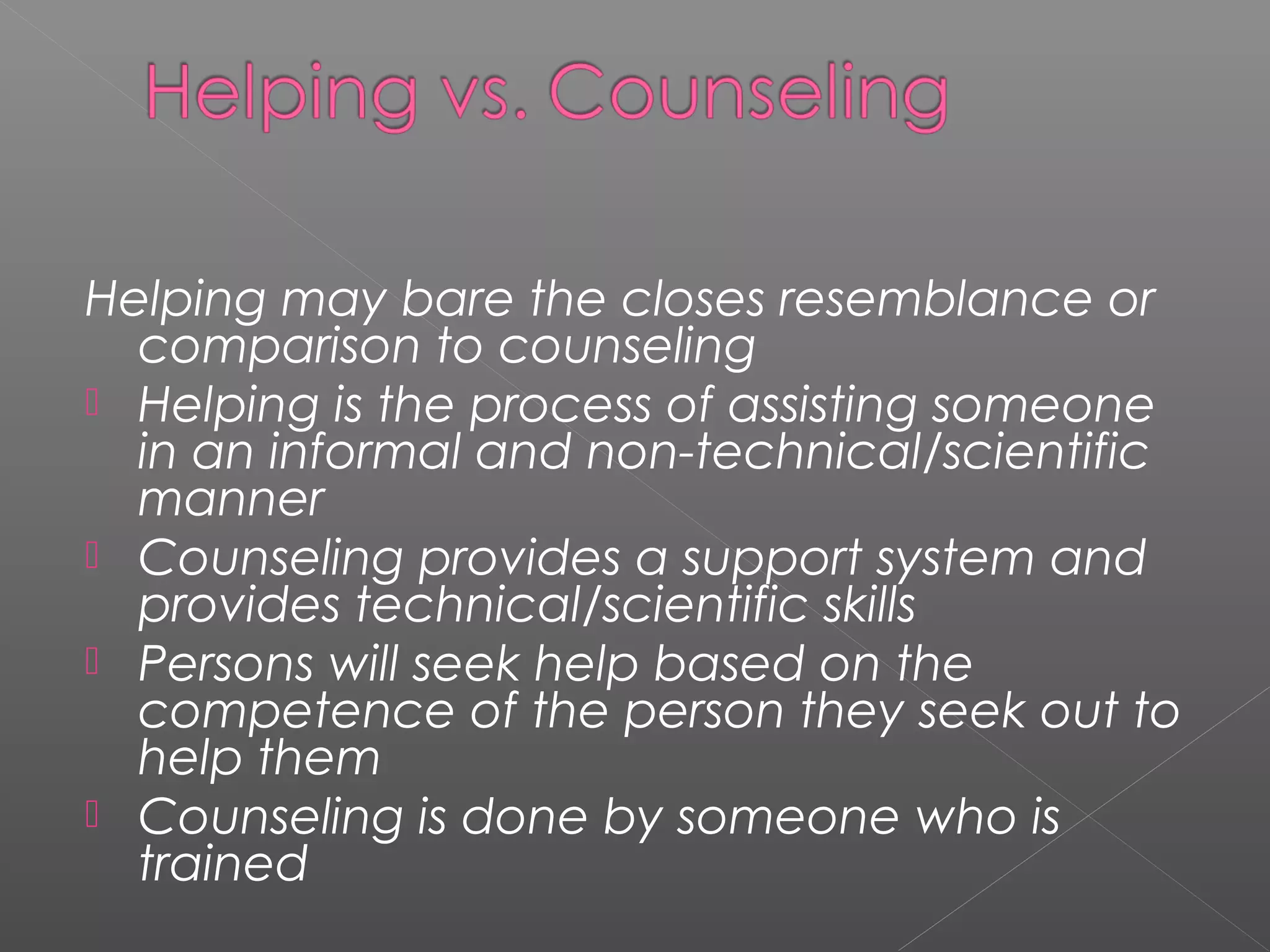
Helping may bare the closes resemblance or
  comparison to counseling
 Helping is the process of assisting someone
  in an informal and non-technical/scientific
  manner
 Counseling provides a support system and
  provides technical/scientific skills
 Persons will seek help based on the
  competence of the person they seek out to
  help them
 Counseling is done by someone who is
  trained
 Motivation stimulates a person through
  external influence and reward
 Counseling focuses on empowering the
  person to effect life change
 Intervention is initiated by others
 Counseling is initiated by the person;
  even if there is external motivation
 Intervention uses external pressures to
  stimulate emotions to effect change
 Counseling uses personal/internal
  reflection and reasoning to effect
  change
 Coaching provides premeditated or
  rehearsed action for future events
 Counseling addresses coping skills for
  present daily living
 Coaching is a form of education that
  assist in anticipating probable future
  circumstances
 Counseling educates persons in basis
  skills
 Mediation involves a third-party making
  decisions
 Counseling requires the client to reach to
  a point of making decisions
 Mediation focuses on present issue only
 Counseling focuses on present issue and
  provide coping skills for the future
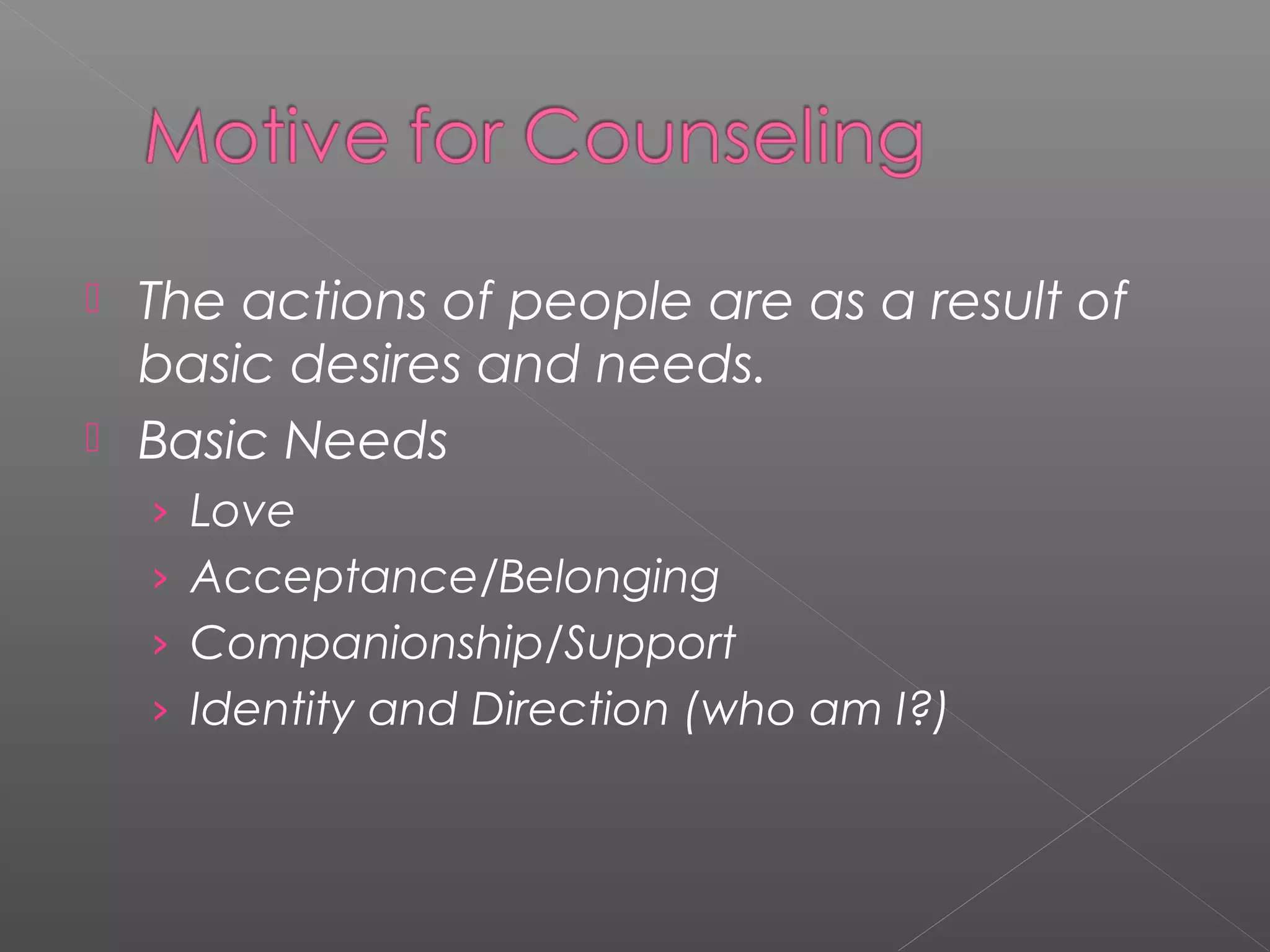
 The actions of people are as a result of
  basic desires and needs.
 Basic Needs
    › Love
    › Acceptance/Belonging
    › Companionship/Support
    › Identity and Direction (who am I?)
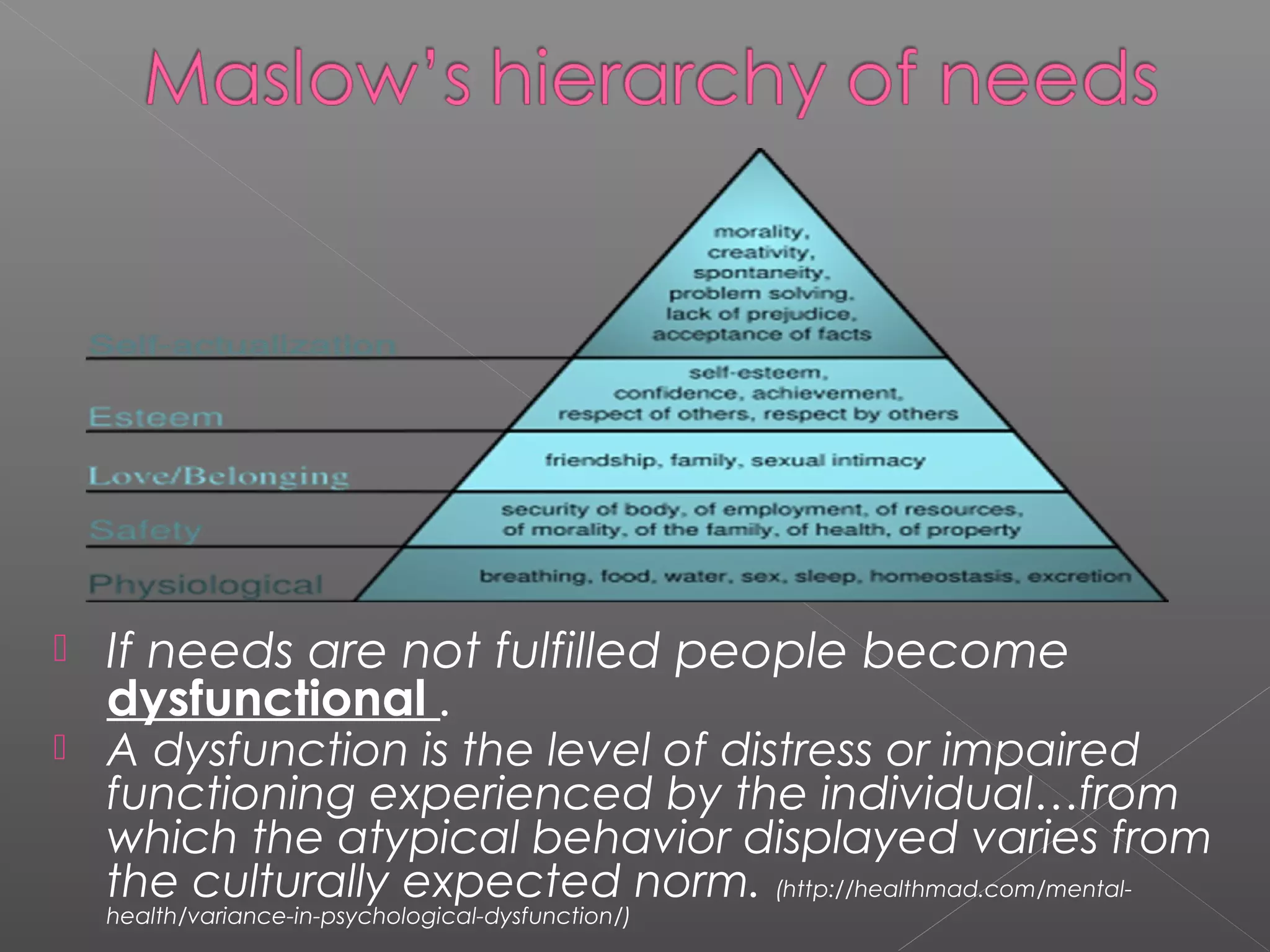
   If needs are not fulfilled people become
    dysfunctional .
   A dysfunction is the level of distress or impaired
    functioning experienced by the individual…from
    which the atypical behavior displayed varies from
    the culturally expected norm. (http://healthmad.com/mental-
    health/variance-in-psychological-dysfunction/)
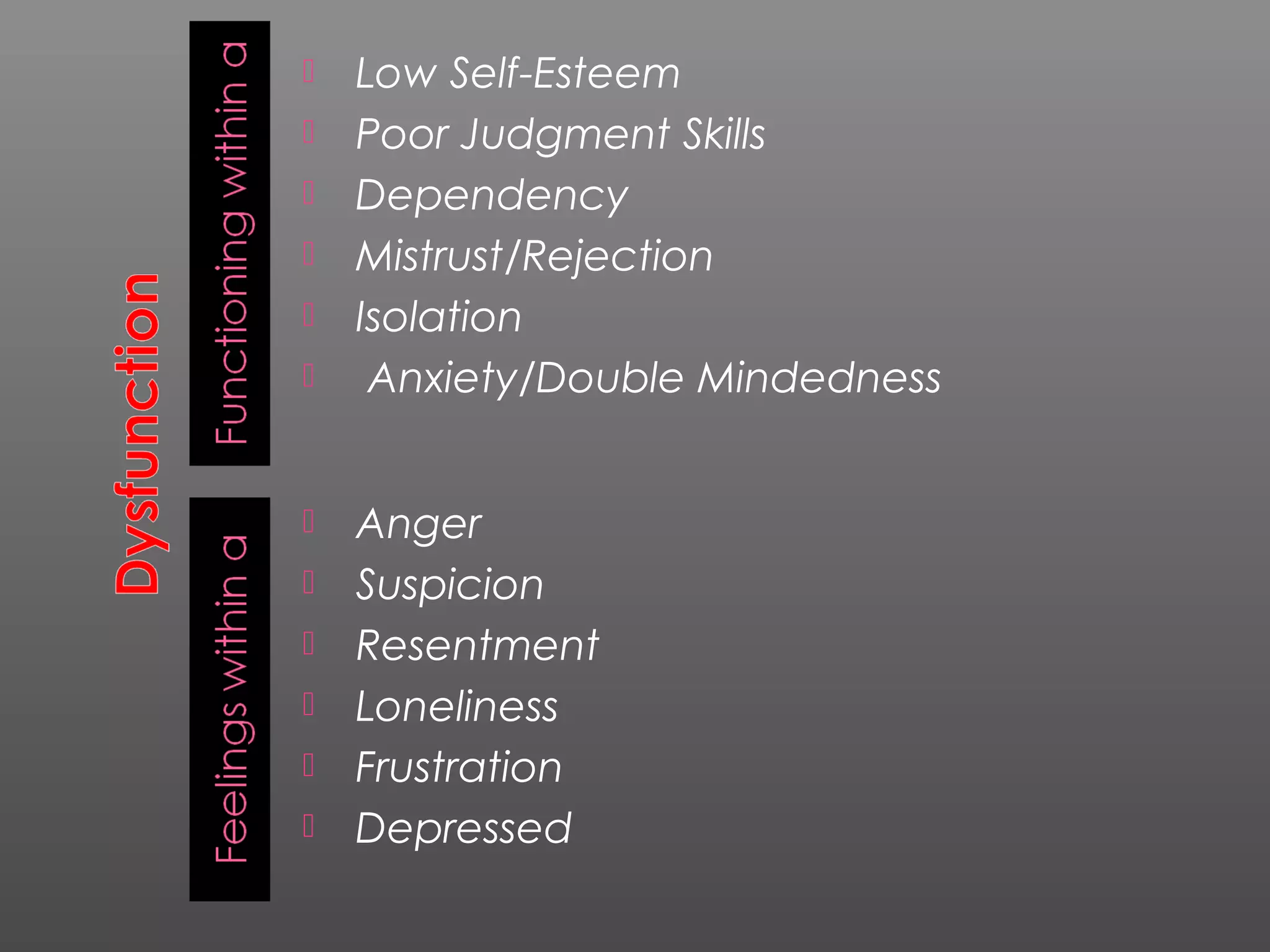
   Low Self-Esteem
   Poor Judgment Skills
   Dependency
   Mistrust/Rejection
   Isolation
    Anxiety/Double Mindedness


   Anger
   Suspicion
   Resentment
   Loneliness
   Frustration
   Depressed
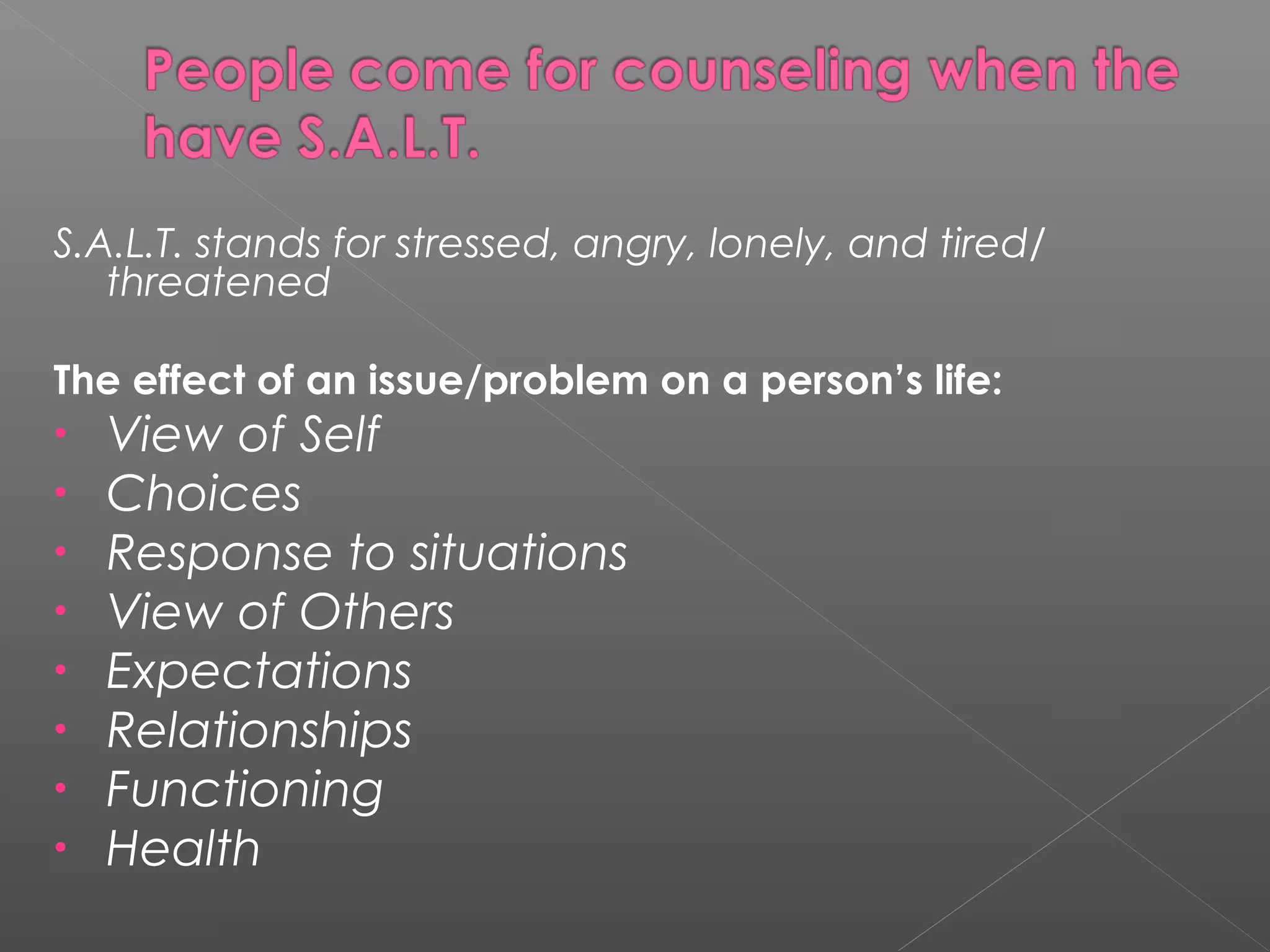
S.A.L.T. stands for stressed, angry, lonely, and tired/
   threatened

The effect of an issue/problem on a person’s life:
• View of Self
• Choices
• Response to situations
• View of Others
• Expectations
• Relationships
• Functioning
• Health
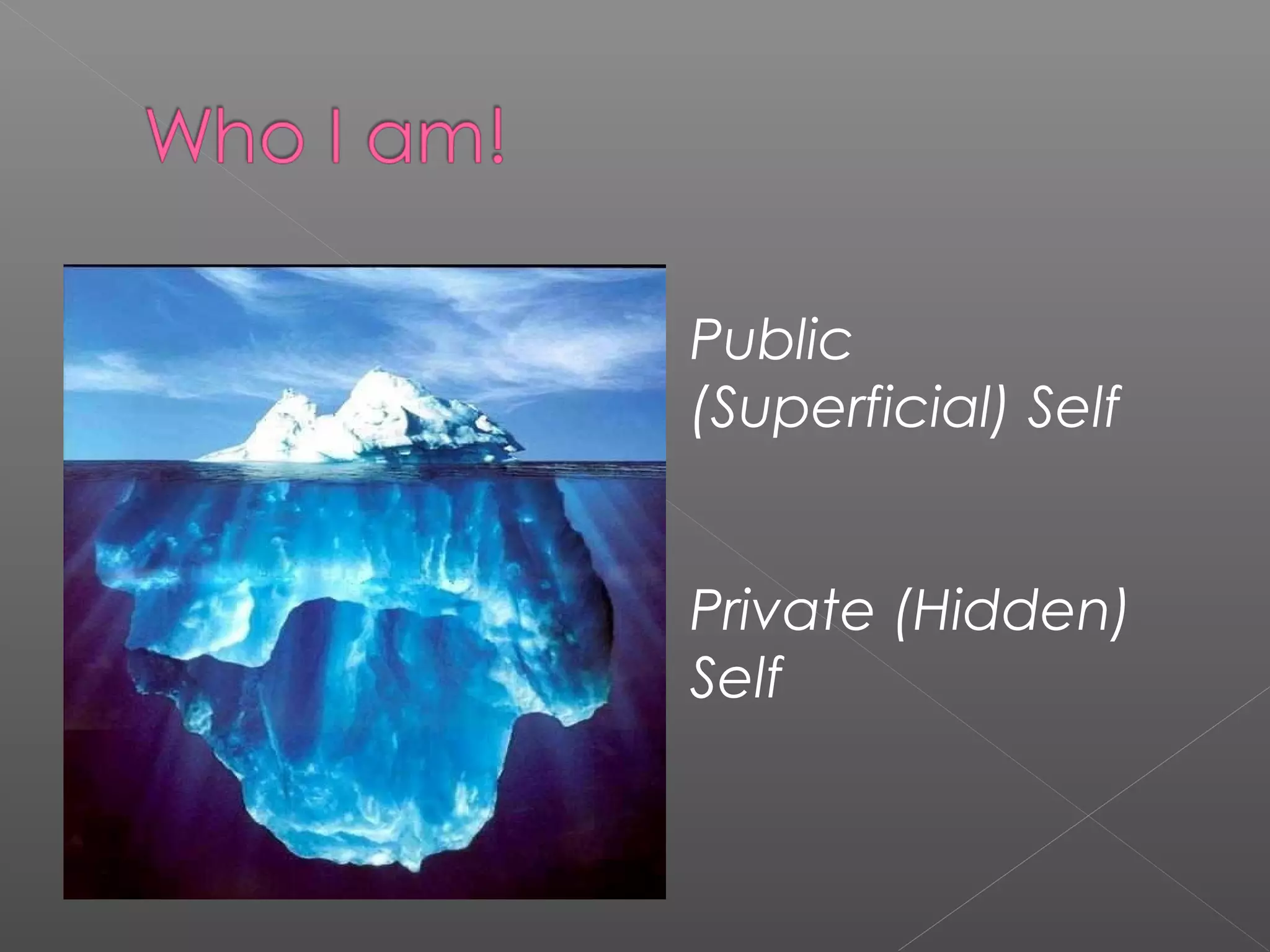
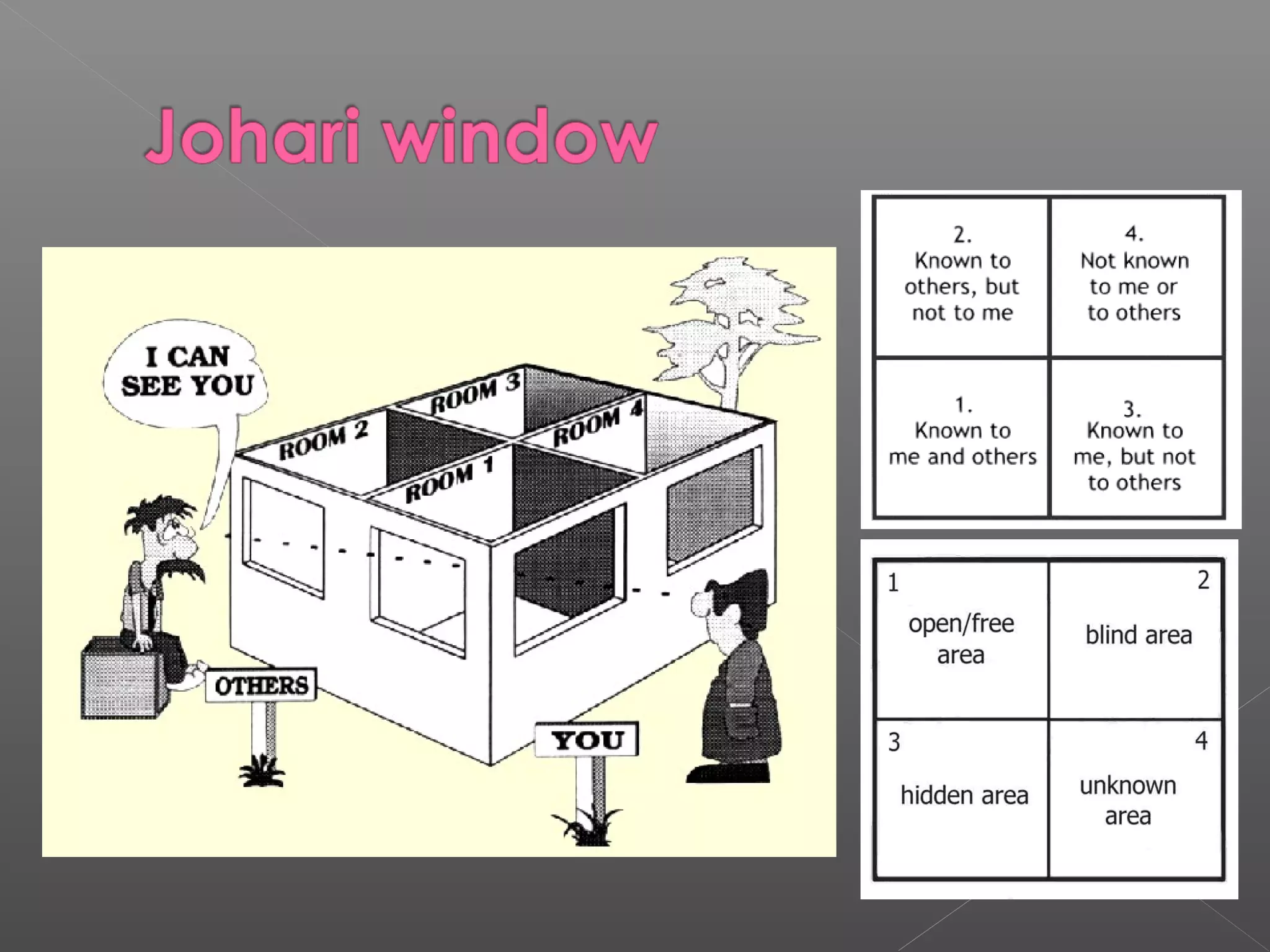
Public
(Superficial) Self


Private (Hidden)
Self
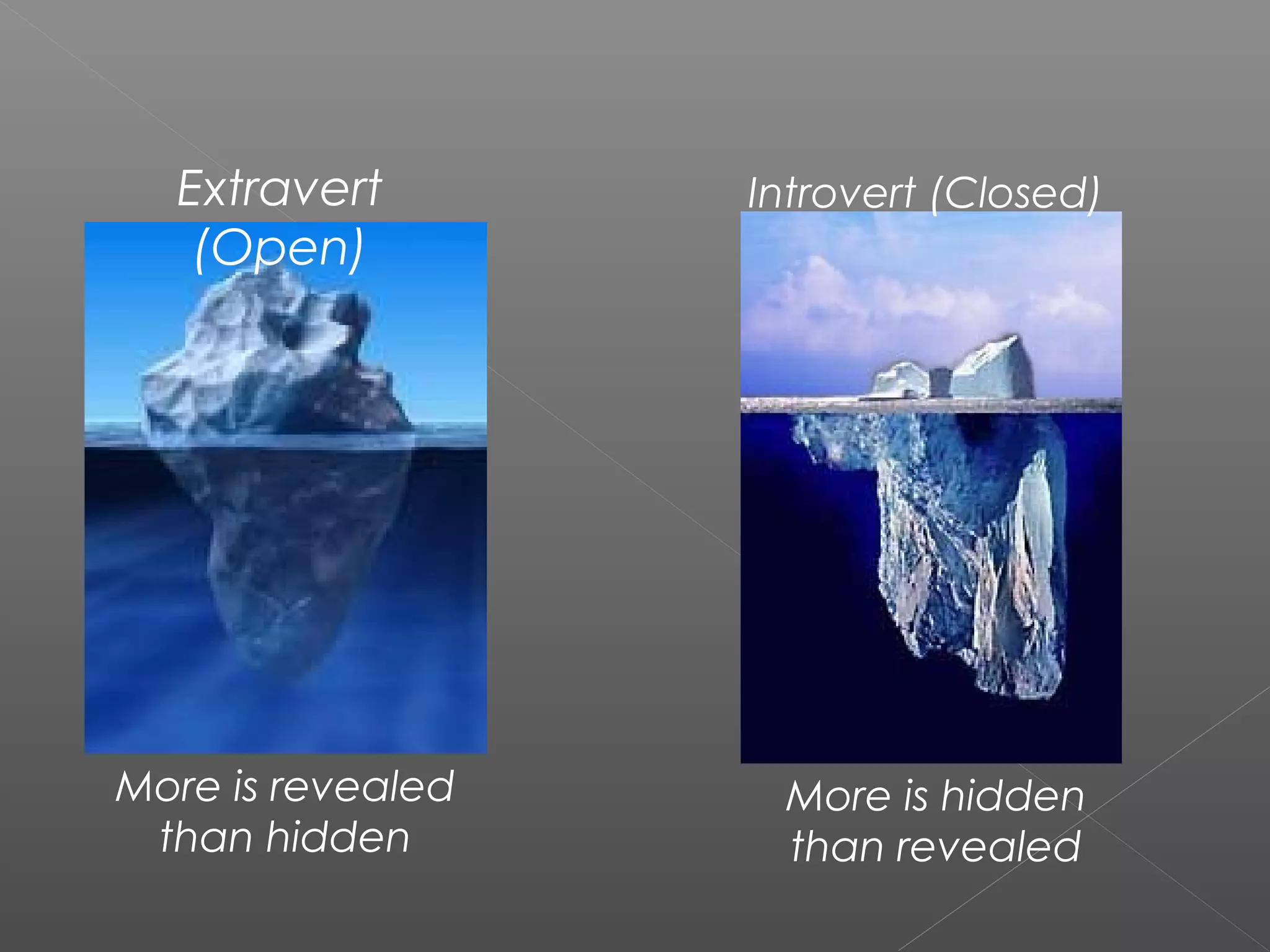
Extravert        Introvert (Closed)
   (Open)


More is revealed    More is hidden
 than hidden        than revealed
Negative Motives                      Positive Motives
•   Emotional distress/displacement       •   Is adjusted (have an identity)–
    – unresolved issues, and using            copes with personal issues
    someone else's problems to over
    shadow own.
                                          •   Respect and appreciate self
•   Vicarious Coping – Live their lives   •   Objective (Open to Change) –
    through others                            ability to be open minded
•   Filling Void of Loneliness – a        •   Makes life oriented chooses
    since of feeling important to         •   Can admit to mistakes
    others
                                          •   Appreciate the influence of
•   Desire Power – Ability to control         culture
    others
                                          •   Sincere interest in other
•   Need to Rescue – The counselor
    places self as the rescuer            •   Effective interpersonal skills
    (personal healing)
Goals of Counseling
• Facilitating Behavior Change
• Improve ability to develop healthy
  relationships
• Enhance coping skills
• Promote/ Improve decision making
  skills
• Facilitating overall development of
  the client
• Clients to develop a Christian/moral
  base (salvation and transformation)
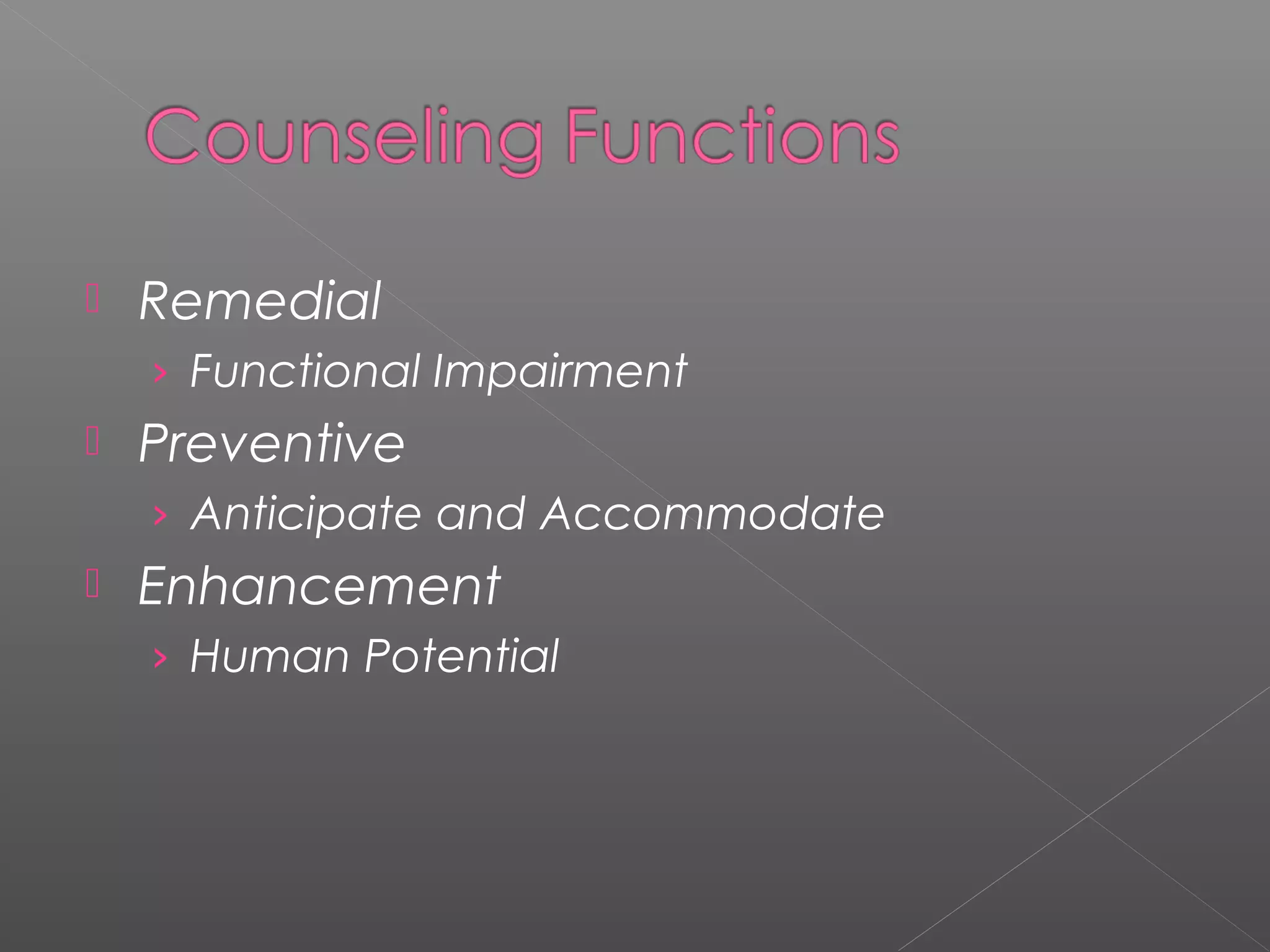
   Remedial
    › Functional Impairment
   Preventive
    › Anticipate and Accommodate
   Enhancement
    › Human Potential
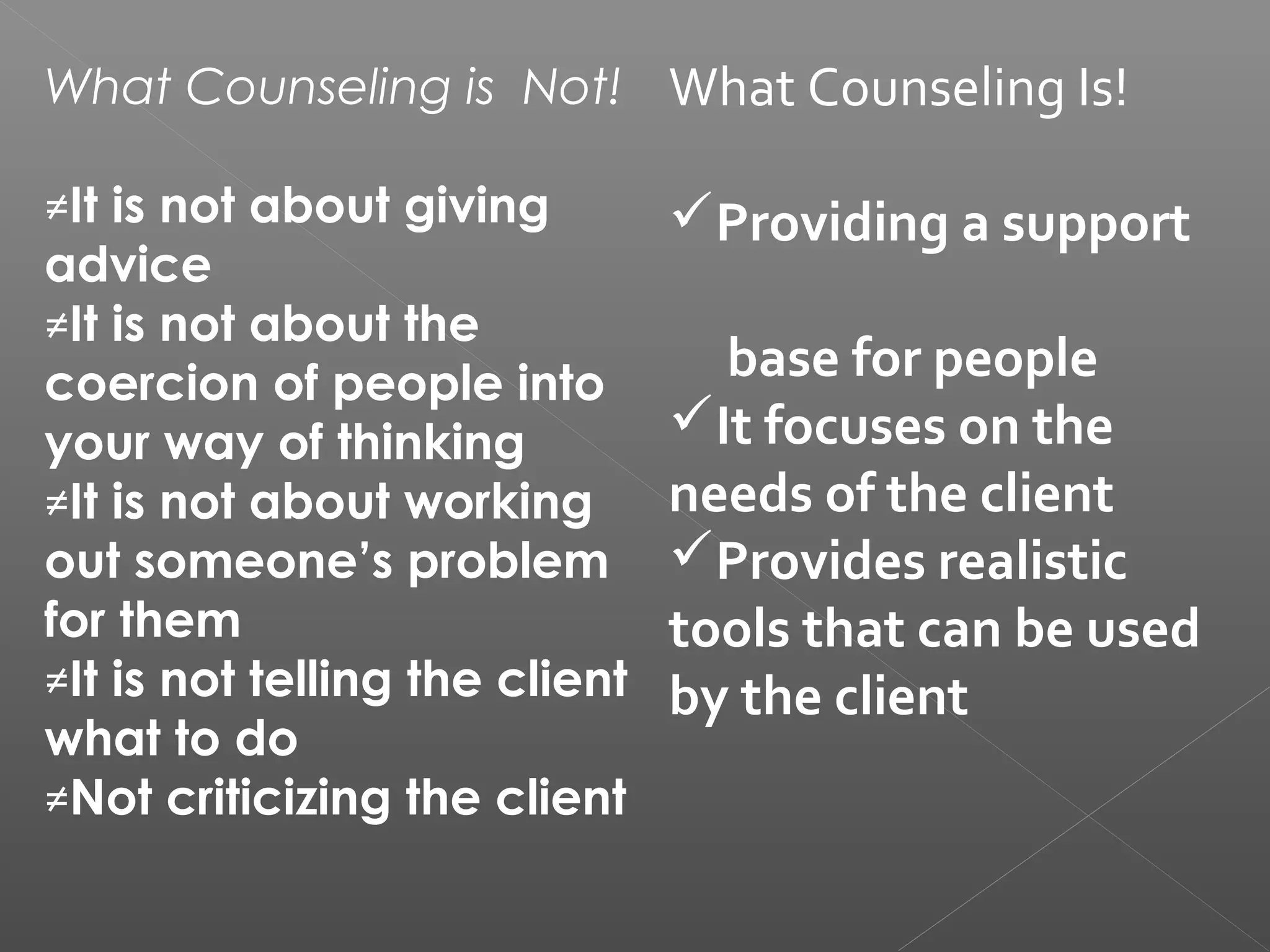
What Counseling is Not! What Counseling Is!

≠It is not about giving         Providing a support
advice
≠It is not about the
coercion of people into           base for people
your way of thinking            It focuses on the
≠It is not about working        needs of the client
out someone’s problem           Provides realistic
for them                        tools that can be used
≠It is not telling the client   by the client
what to do
≠Not criticizing the client
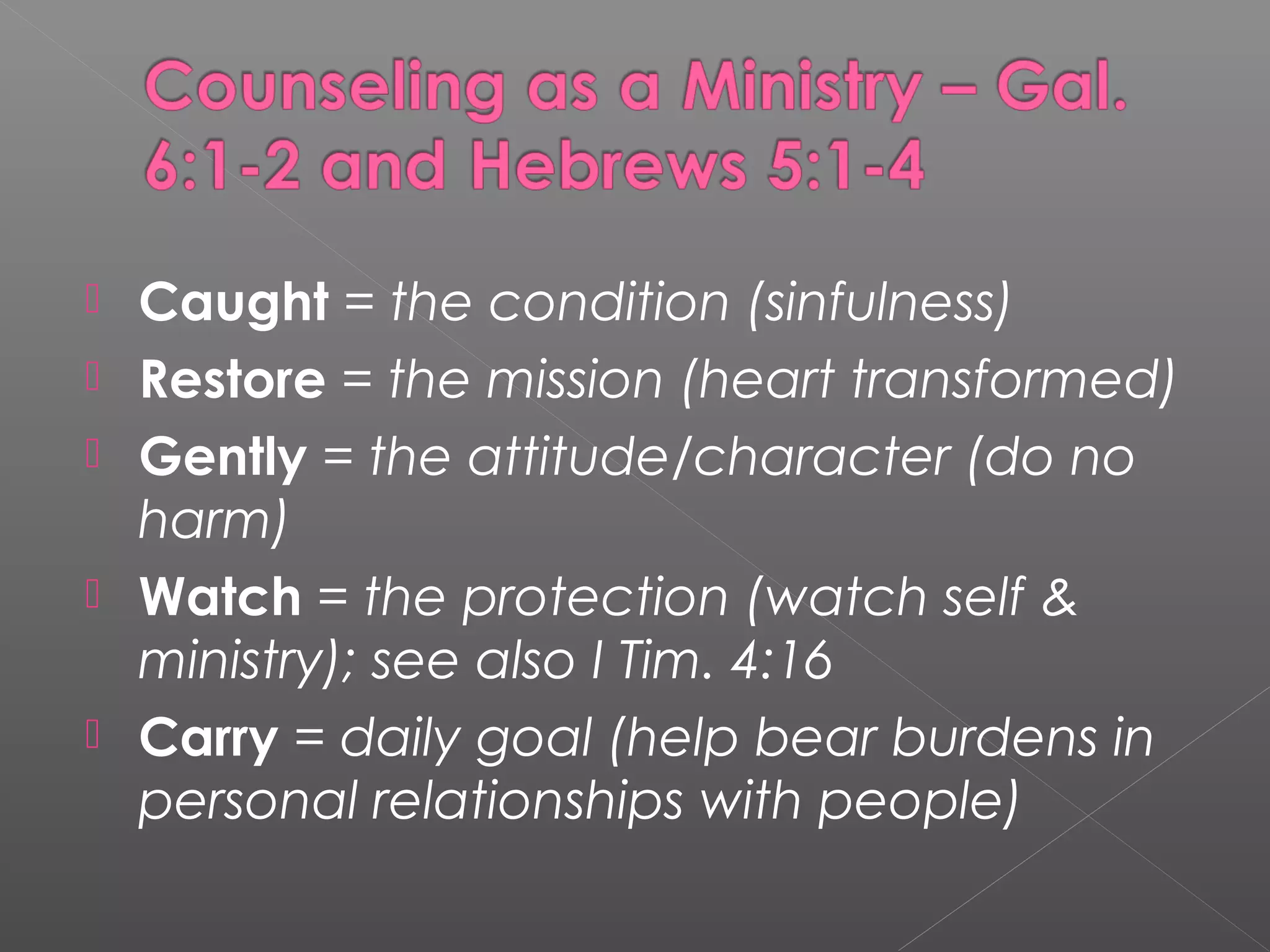
   Caught = the condition (sinfulness)
   Restore = the mission (heart transformed)
   Gently = the attitude/character (do no
    harm)
   Watch = the protection (watch self &
    ministry); see also I Tim. 4:16
   Carry = daily goal (help bear burdens in
    personal relationships with people)
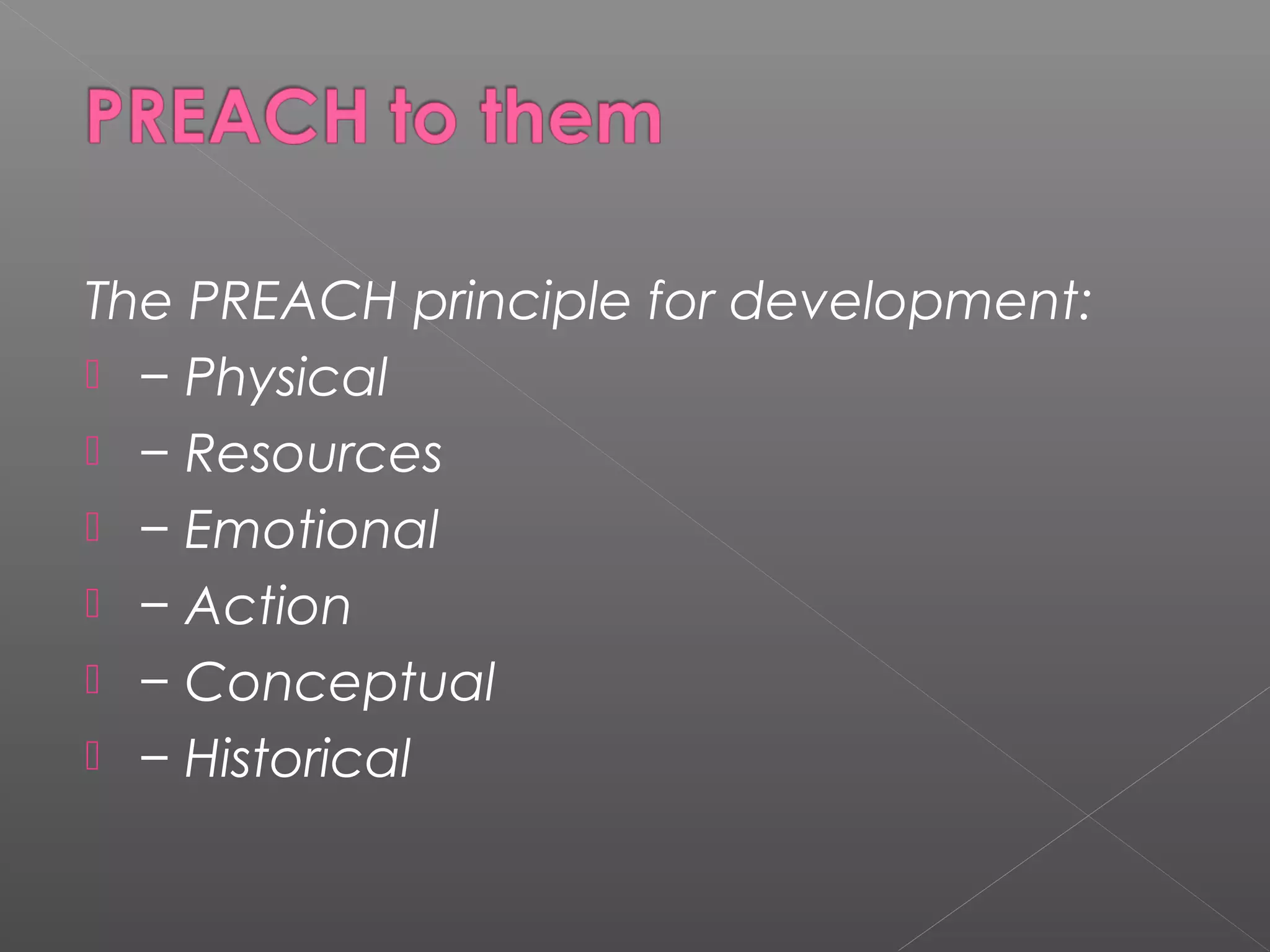
The PREACH principle for development:
 − Physical
 − Resources
 − Emotional
 − Action
 − Conceptual
 − Historical
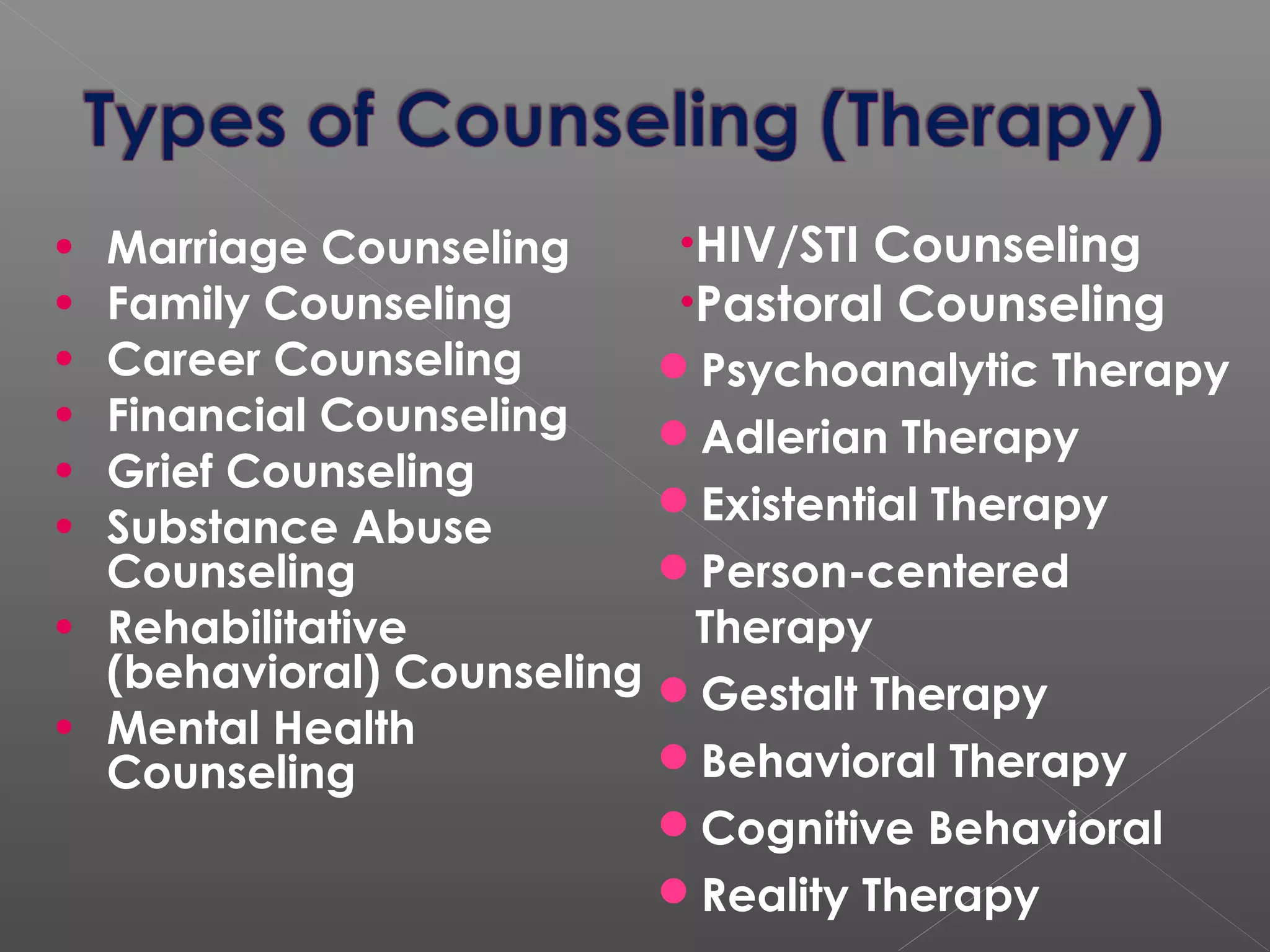
• Marriage Counseling        •HIV/STI Counseling
• Family Counseling          •Pastoral Counseling
• Career Counseling         Psychoanalytic Therapy
• Financial Counseling      Adlerian Therapy
• Grief Counseling
                            Existential Therapy
• Substance Abuse
  Counseling                Person-centered
• Rehabilitative             Therapy
  (behavioral) Counseling   Gestalt Therapy
• Mental Health
  Counseling                Behavioral Therapy
                            Cognitive Behavioral
                            Reality Therapy
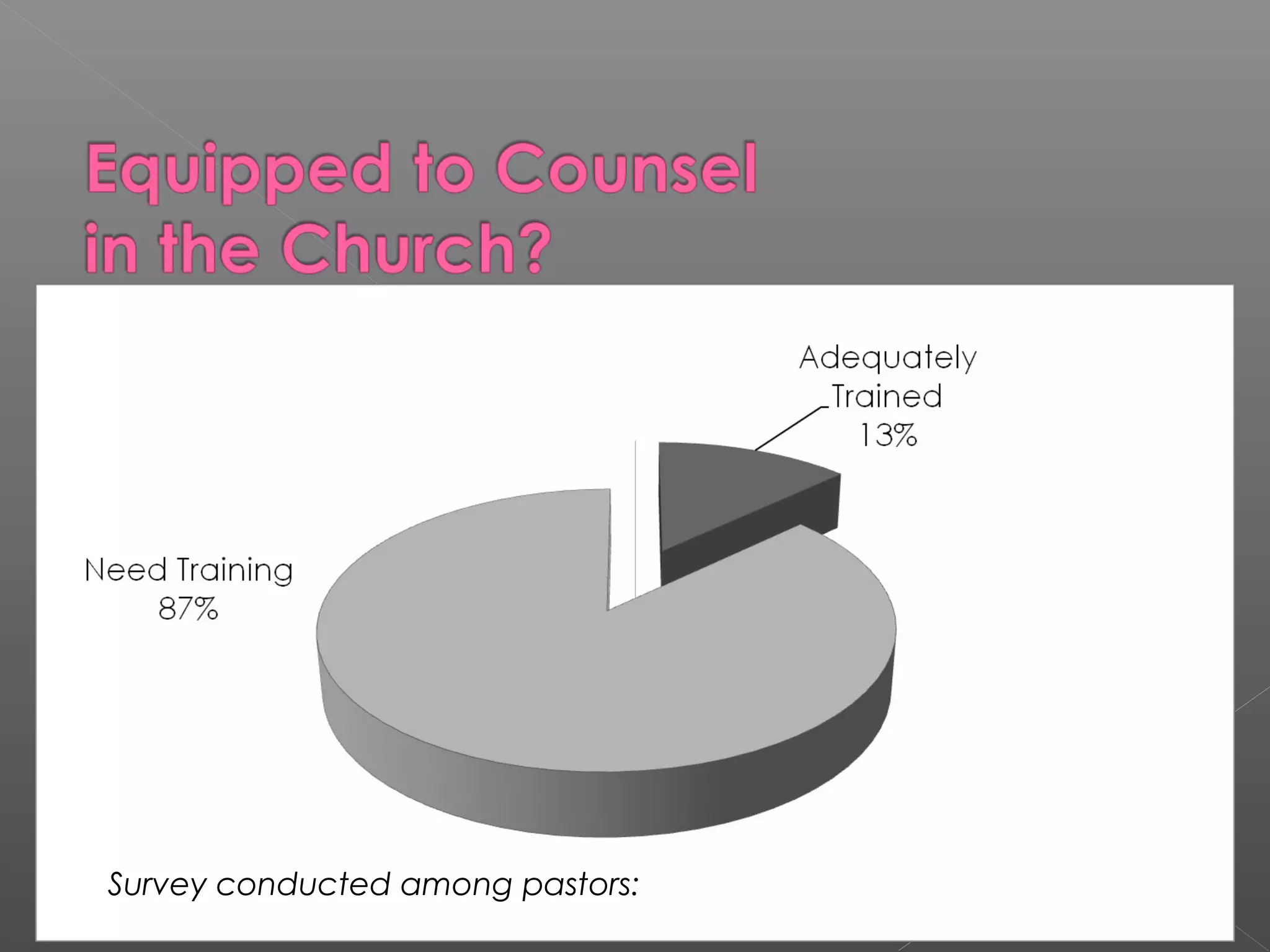
Survey conducted among pastors:
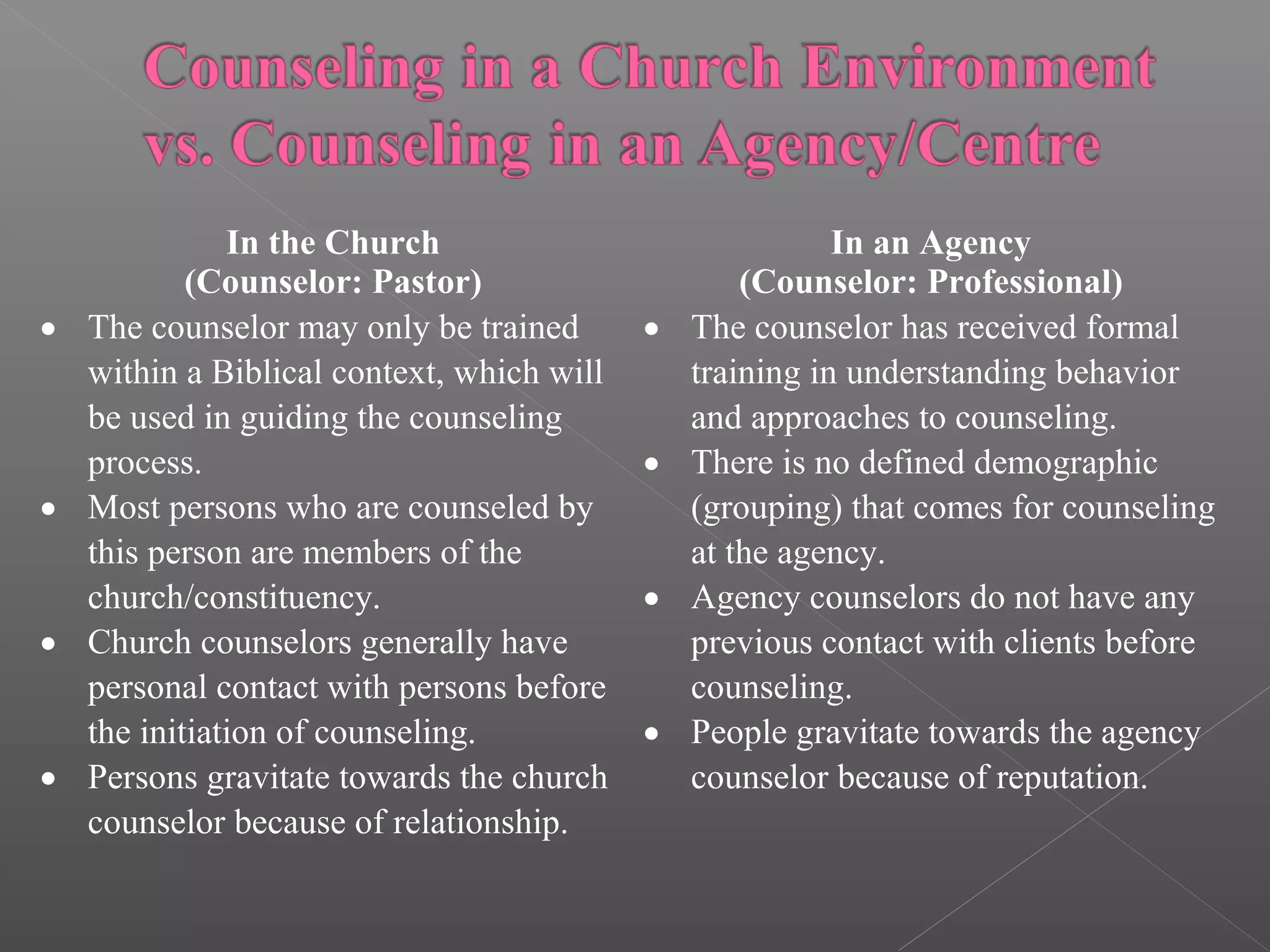
In the Church                               In an Agency
            (Counselor: Pastor)                     (Counselor: Professional)
•   The counselor may only be trained       •   The counselor has received formal
    within a Biblical context, which will       training in understanding behavior
    be used in guiding the counseling           and approaches to counseling.
    process.                                •   There is no defined demographic
•   Most persons who are counseled by           (grouping) that comes for counseling
    this person are members of the              at the agency.
    church/constituency.                    •   Agency counselors do not have any
•   Church counselors generally have            previous contact with clients before
    personal contact with persons before        counseling.
    the initiation of counseling.           •   People gravitate towards the agency
•   Persons gravitate towards the church        counselor because of reputation.
    counselor because of relationship.
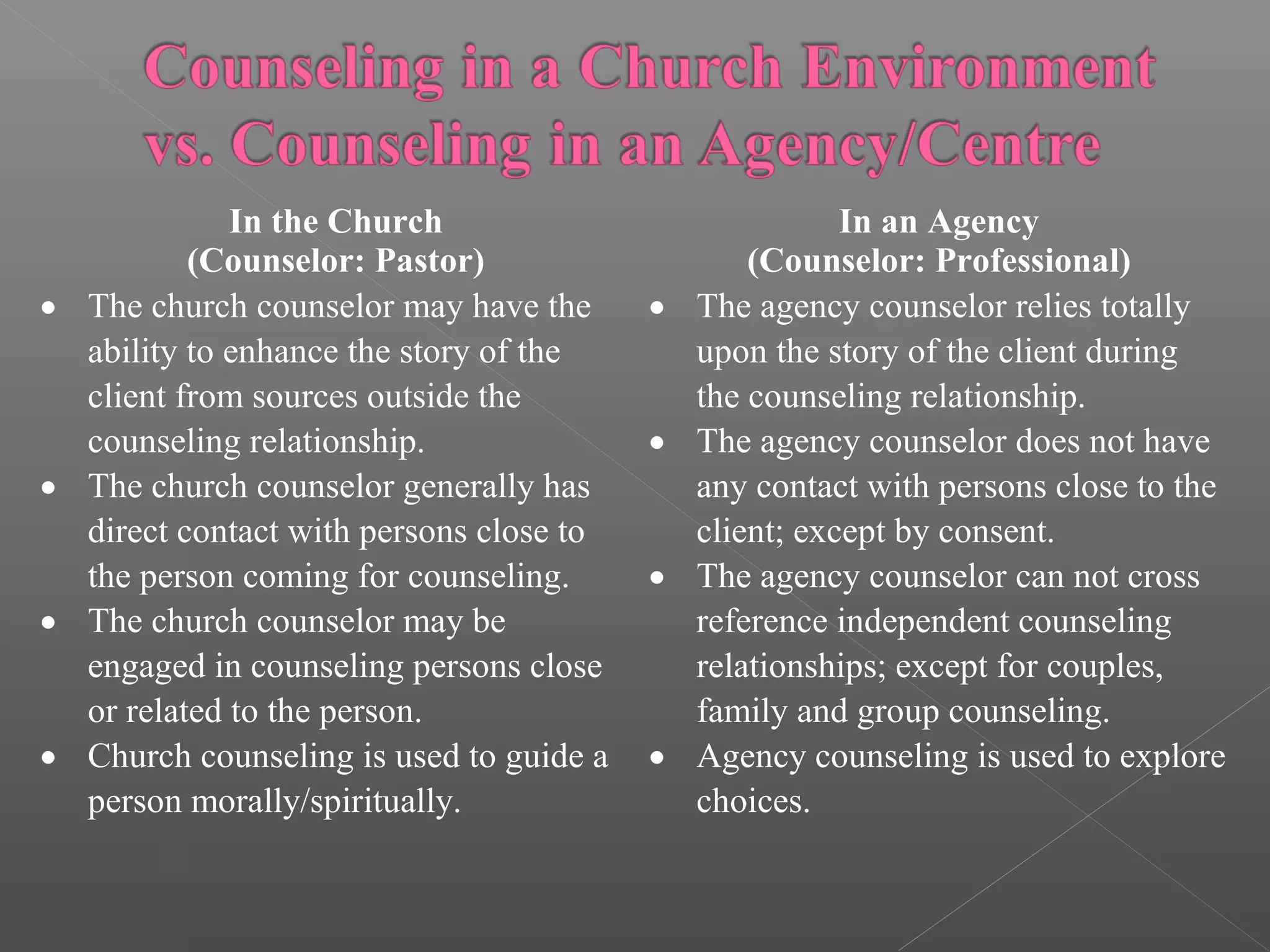
In the Church                              In an Agency
            (Counselor: Pastor)                    (Counselor: Professional)
•   The church counselor may have the      •   The agency counselor relies totally
    ability to enhance the story of the        upon the story of the client during
    client from sources outside the            the counseling relationship.
    counseling relationship.               •   The agency counselor does not have
•   The church counselor generally has         any contact with persons close to the
    direct contact with persons close to       client; except by consent.
    the person coming for counseling.      •   The agency counselor can not cross
•   The church counselor may be                reference independent counseling
    engaged in counseling persons close        relationships; except for couples,
    or related to the person.                  family and group counseling.
•   Church counseling is used to guide a   •   Agency counseling is used to explore
    person morally/spiritually.                choices.
   Gladding, S. (2004) Counseling A Comprehensive
      Profession (5th ed.) Ohio
   George, R., Christiani, T. (1995) Counseling Theory
      and Practice (4th ed.) Boston
   Collins, G. (2007) Christian Counseling (3rd ed.)
      Nashville

Intro to counseling note 1

  • 1.
    Class Notes #1 Rev.Michael Prince MA. WIST Introduction to Counseling © 2013
  • 2.
    Counseling is ascience and an art . It is a science because it applies techniques and procedures that are utilized in helping a person to understand their situations and employ the most adequate solutions for problem solving and life change; it is an art because it allows the therapist to use unique or own personality and experiences in assisting the client.
  • 3.
    Counseling denotes aprofessional relationship between a trained counselor and a client…to understand and clarify their views of their life space…and through resolution of problems of and emotional or interpersonal nature (George, Cristiani p. 2) Counseling refers to the application of mental health, psychological or human development principles, through cognitive, affective, behavioral or systematic intervention (Gladding p. 6)
  • 4.
    Counseling attempts toprovide encouragement and guidance for those who are facing losses, decisions, or disappointments…stimulate personality growth and development; help people cope more effectively with the problems of living, with inner conflict and with crippling emotions… (Collins 1988, p.16)
  • 5.
    Christian Counseling maybe defined as an art and a science of applying Biblical principles to treat clients’ issues with the use of all the rudiments of professional counseling. Class Definition (2010) Christian counseling draws upon psychology and Christian teaching. It is an effort to combine professional counseling with Christian or other religious perspectives or approaches: “integration.” (http://en.wikipedia.org/wiki/Christian_counseling) Christian Counseling may be defined as an art and a science of applying Biblical principles to treat clients’ issues with the use of all the rudiments of professional counseling.
  • 6.
    Sin is theprimary focus of mankind’s dysfunction (Rom 5:12-14) Salvation, and transformation through counseling from the gospel is the primary solution. Scripture is authoritative and necessary for Christian counseling because it is God’s soul care guidebook
  • 7.
    Triune God Self Others Material Universe A Four-Dimensional Relational Model
  • 8.
    { Spiritual Spiritual Ethical Ethical Soul Psychosocial Psychosocial Biological Body/Brain Biological
  • 10.
    Unique Assumptions – Sin is the primary cause (fall of man) of man’s deprived state and that restoration/forgiveness of God through salvation and transformation will make man ‘totally whole’.  Unique Goals – To stimulate spiritual growth by encouraging confession of sin, experience divine forgiveness and commit lives to Jesus Christ.  Unique Methods – The application of prayer and faith in God are cornerstones of pastoral counseling.  Unique Counselor-Characteristics – Demonstrate personal reliance upon the same factors of salvation, transformation and a relationship with God.  Unique Giftedness – As believers we demonstrate the characteristics of God and equipped by God. Collins p. 19-20
  • 11.
    Psychology Spirituality  Focus on the mind • Focus on God • Describes the source  Describe human of man experiences and • Applies Faith behaviors • Understand the  Applies Logic meaning (source) of  Understand the being structure of being Psychology can not deduce the meaning or morality of life while Theology/Spirituality is not equip to explore the dynamics of personality.
  • 13.
    Is the processof helping people make important choices that affect their lives. …(Gladding p.5)
  • 14.
    Focuses on serious problems associatedwith intra-psychic, internal, personal issues/conflict (p.6)
  • 15.
  • 16.
    The service ofassisting clients to manage their problems in living more effectively
  • 17.
    The ability to stimulatea person to operate or behave in a selected way
  • 18.
    Operate as an agentbetween the client and their personal issue
  • 19.
    The systematic process oftraining and assimilation in order to confront issues
  • 20.
    An authoritative entity that determineshow a dispute is settled or apportioned
  • 21.
     Guidance focuseson helping individuals choose what they value most.  Counseling focuses on helping individuals make changes.
  • 22.
     Psychotherapy focuseson causing change  Counseling focuses on assisting the person to change  They have different clients › Psychotherapist – deals with neurosis (mental dysfunctions) › Counselor – deals with persons with poor coping and decision making skills.
  • 23.
    Psychology focuses on observing behavior  Counseling focuses on behavior change  Psychology is non-engaging  Counseling is interactive and intimate  Psychology focuses on the pattern of behavior  Counseling focuses on the reasons/sources of behavior
  • 24.
    Helping may barethe closes resemblance or comparison to counseling  Helping is the process of assisting someone in an informal and non-technical/scientific manner  Counseling provides a support system and provides technical/scientific skills  Persons will seek help based on the competence of the person they seek out to help them  Counseling is done by someone who is trained
  • 25.
     Motivation stimulatesa person through external influence and reward  Counseling focuses on empowering the person to effect life change
  • 26.
     Intervention isinitiated by others  Counseling is initiated by the person; even if there is external motivation  Intervention uses external pressures to stimulate emotions to effect change  Counseling uses personal/internal reflection and reasoning to effect change
  • 27.
     Coaching providespremeditated or rehearsed action for future events  Counseling addresses coping skills for present daily living  Coaching is a form of education that assist in anticipating probable future circumstances  Counseling educates persons in basis skills
  • 28.
     Mediation involvesa third-party making decisions  Counseling requires the client to reach to a point of making decisions  Mediation focuses on present issue only  Counseling focuses on present issue and provide coping skills for the future
  • 29.
     The actionsof people are as a result of basic desires and needs.  Basic Needs › Love › Acceptance/Belonging › Companionship/Support › Identity and Direction (who am I?)
  • 30.
    If needs are not fulfilled people become dysfunctional .  A dysfunction is the level of distress or impaired functioning experienced by the individual…from which the atypical behavior displayed varies from the culturally expected norm. (http://healthmad.com/mental- health/variance-in-psychological-dysfunction/)
  • 31.
    Low Self-Esteem  Poor Judgment Skills  Dependency  Mistrust/Rejection  Isolation  Anxiety/Double Mindedness  Anger  Suspicion  Resentment  Loneliness  Frustration  Depressed
  • 32.
    S.A.L.T. stands forstressed, angry, lonely, and tired/ threatened The effect of an issue/problem on a person’s life: • View of Self • Choices • Response to situations • View of Others • Expectations • Relationships • Functioning • Health
  • 34.
  • 35.
    Extravert Introvert (Closed) (Open) More is revealed More is hidden than hidden than revealed
  • 38.
    Negative Motives Positive Motives • Emotional distress/displacement • Is adjusted (have an identity)– – unresolved issues, and using copes with personal issues someone else's problems to over shadow own. • Respect and appreciate self • Vicarious Coping – Live their lives • Objective (Open to Change) – through others ability to be open minded • Filling Void of Loneliness – a • Makes life oriented chooses since of feeling important to • Can admit to mistakes others • Appreciate the influence of • Desire Power – Ability to control culture others • Sincere interest in other • Need to Rescue – The counselor places self as the rescuer • Effective interpersonal skills (personal healing)
  • 39.
    Goals of Counseling •Facilitating Behavior Change • Improve ability to develop healthy relationships • Enhance coping skills • Promote/ Improve decision making skills • Facilitating overall development of the client • Clients to develop a Christian/moral base (salvation and transformation)
  • 40.
    Remedial › Functional Impairment  Preventive › Anticipate and Accommodate  Enhancement › Human Potential
  • 41.
    What Counseling isNot! What Counseling Is! ≠It is not about giving Providing a support advice ≠It is not about the coercion of people into base for people your way of thinking It focuses on the ≠It is not about working needs of the client out someone’s problem Provides realistic for them tools that can be used ≠It is not telling the client by the client what to do ≠Not criticizing the client
  • 42.
    Caught = the condition (sinfulness)  Restore = the mission (heart transformed)  Gently = the attitude/character (do no harm)  Watch = the protection (watch self & ministry); see also I Tim. 4:16  Carry = daily goal (help bear burdens in personal relationships with people)
  • 43.
    The PREACH principlefor development:  − Physical  − Resources  − Emotional  − Action  − Conceptual  − Historical
  • 44.
    • Marriage Counseling •HIV/STI Counseling • Family Counseling •Pastoral Counseling • Career Counseling Psychoanalytic Therapy • Financial Counseling Adlerian Therapy • Grief Counseling Existential Therapy • Substance Abuse Counseling Person-centered • Rehabilitative Therapy (behavioral) Counseling Gestalt Therapy • Mental Health Counseling Behavioral Therapy Cognitive Behavioral Reality Therapy
  • 45.
  • 46.
    In the Church In an Agency (Counselor: Pastor) (Counselor: Professional) • The counselor may only be trained • The counselor has received formal within a Biblical context, which will training in understanding behavior be used in guiding the counseling and approaches to counseling. process. • There is no defined demographic • Most persons who are counseled by (grouping) that comes for counseling this person are members of the at the agency. church/constituency. • Agency counselors do not have any • Church counselors generally have previous contact with clients before personal contact with persons before counseling. the initiation of counseling. • People gravitate towards the agency • Persons gravitate towards the church counselor because of reputation. counselor because of relationship.
  • 47.
    In the Church In an Agency (Counselor: Pastor) (Counselor: Professional) • The church counselor may have the • The agency counselor relies totally ability to enhance the story of the upon the story of the client during client from sources outside the the counseling relationship. counseling relationship. • The agency counselor does not have • The church counselor generally has any contact with persons close to the direct contact with persons close to client; except by consent. the person coming for counseling. • The agency counselor can not cross • The church counselor may be reference independent counseling engaged in counseling persons close relationships; except for couples, or related to the person. family and group counseling. • Church counseling is used to guide a • Agency counseling is used to explore person morally/spiritually. choices.
  • 48.
    Gladding, S. (2004) Counseling A Comprehensive Profession (5th ed.) Ohio  George, R., Christiani, T. (1995) Counseling Theory and Practice (4th ed.) Boston  Collins, G. (2007) Christian Counseling (3rd ed.) Nashville