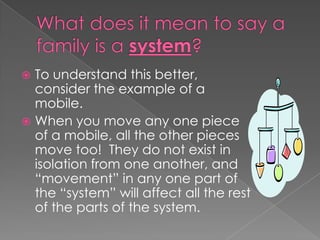
 To understand this better,
  consider the example of a
  mobile.
 When you move any one piece
  of a mobile, all the other pieces
  move too! They do not exist in
  isolation from one another, and
  “movement” in any one part of
  the “system” will affect all the rest
  of the parts of the system.
   Individuals – are best understood through
    assessing the interactions within an entire family
   Symptoms – are viewed as an expression of a
    dysfunction within a family
   Problematic behaviors –
    › Serve a purpose for the family
    › Are a function of the family’s inability to operate
      productively
    › Are symptomatic patterns handed down across
      generations
   A family – is an inter-actional unit and a
    change in one member effects all members
Inclusion of all parts of the system rather than
being limited to the “identified patient”
Rather than blaming either “identified patient”
or the family, the entire family has an
opportunity (1) to examine the multiple
perspectives and interactional patterns that
characterize the unit and (2) participate in
finding solutions.
Limitations
lose sight of the individual by focusing on the
broader system
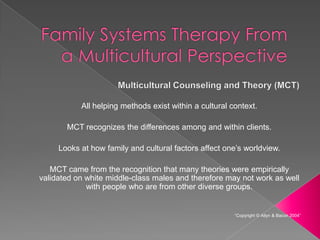
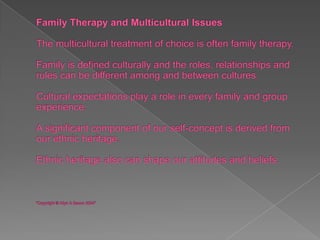
All helping methods exist within a cultural context.

       MCT recognizes the differences among and within clients.

     Looks at how family and cultural factors affect one’s worldview.

   MCT came from the recognition that many theories were empirically
validated on white middle-class males and therefore may not work as well
             with people who are from other diverse groups.


                                                        “Copyright © Allyn & Bacon 2004”
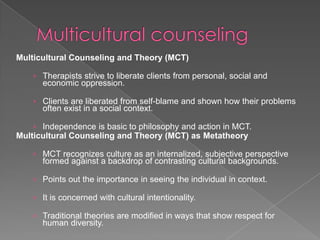
Multicultural Counseling and Theory (MCT)

   › Therapists strive to liberate clients from personal, social and
      economic oppression.

   › Clients are liberated from self-blame and shown how their problems
      often exist in a social context.

   › Independence is basic to philosophy and action in MCT.
Multicultural Counseling and Theory (MCT) as Metatheory

   › MCT recognizes culture as an internalized, subjective perspective
      formed against a backdrop of contrasting cultural backgrounds.

   › Points out the importance in seeing the individual in context.

   › It is concerned with cultural intentionality.

   › Traditional theories are modified in ways that show respect for
      human diversity.
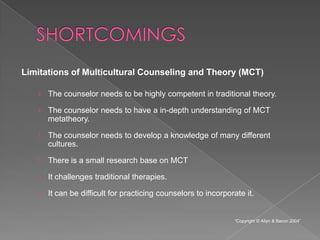
Limitations of Multicultural Counseling and Theory (MCT)

   › The counselor needs to be highly competent in traditional theory.

   › The counselor needs to have a in-depth understanding of MCT
     metatheory.

   › The counselor needs to develop a knowledge of many different
     cultures.

   › There is a small research base on MCT

   › It challenges traditional therapies.

   › It can be difficult for practicing counselors to incorporate it.


                                                               “Copyright © Allyn & Bacon 2004”
Prepared by: Krisseanne Tan

Family Systems Therapy

  • 2.
     To understandthis better, consider the example of a mobile.  When you move any one piece of a mobile, all the other pieces move too! They do not exist in isolation from one another, and “movement” in any one part of the “system” will affect all the rest of the parts of the system.
  • 3.
    Individuals – are best understood through assessing the interactions within an entire family  Symptoms – are viewed as an expression of a dysfunction within a family  Problematic behaviors – › Serve a purpose for the family › Are a function of the family’s inability to operate productively › Are symptomatic patterns handed down across generations  A family – is an inter-actional unit and a change in one member effects all members
  • 4.
    Inclusion of allparts of the system rather than being limited to the “identified patient” Rather than blaming either “identified patient” or the family, the entire family has an opportunity (1) to examine the multiple perspectives and interactional patterns that characterize the unit and (2) participate in finding solutions. Limitations lose sight of the individual by focusing on the broader system
  • 5.
    All helping methodsexist within a cultural context. MCT recognizes the differences among and within clients. Looks at how family and cultural factors affect one’s worldview. MCT came from the recognition that many theories were empirically validated on white middle-class males and therefore may not work as well with people who are from other diverse groups. “Copyright © Allyn & Bacon 2004”
  • 6.
    Multicultural Counseling andTheory (MCT) › Therapists strive to liberate clients from personal, social and economic oppression. › Clients are liberated from self-blame and shown how their problems often exist in a social context. › Independence is basic to philosophy and action in MCT. Multicultural Counseling and Theory (MCT) as Metatheory › MCT recognizes culture as an internalized, subjective perspective formed against a backdrop of contrasting cultural backgrounds. › Points out the importance in seeing the individual in context. › It is concerned with cultural intentionality. › Traditional theories are modified in ways that show respect for human diversity.
  • 11.
    Limitations of MulticulturalCounseling and Theory (MCT) › The counselor needs to be highly competent in traditional theory. › The counselor needs to have a in-depth understanding of MCT metatheory. › The counselor needs to develop a knowledge of many different cultures. › There is a small research base on MCT › It challenges traditional therapies. › It can be difficult for practicing counselors to incorporate it. “Copyright © Allyn & Bacon 2004”
  • 12.