MM: 503 Deformation Behavior
and
Failure Analysis of Materials
Engr. Muhammad Ali Siddiqui
Assistant Professor
Course Teachers
NED University of Engineering and Technology
Department of Materials Engineering
Lecture 2 Series
Failure Analysis Methodology
1
Failure Analysis Methodology
 ANALYZING FAILURES is a critical process in determining the physical root
causes of problems.
 The approach to failure analysis and the methodology adopted must
required expert analyst(s) - because a single analyst may not be
equipped with knowledge in various disciplines such as metallurgy,
materials science, structural mechanics, corrosion engineering,
propulsion engineering, aerodynamics, and so on,
 (So it is multidisciplinary activity).
 A team effort is always required to arrive at the correct solution to the
problem.
 The process is complex, draws upon many different technical disciplines,
and uses a variety of observation, inspection, and laboratory techniques.
 One of the key factors in properly performing a failure analysis is keeping
an open mind while examining and analyzing the evidence to foster a
clear, unbiased perspective of the failure.
2
1. Background Information:
 Whenever a failure analysis is carried out, at the
beginning it is essential to collect all the relevant
background information, because it helps in developing
a complete case history about the failure.
 The collection of information can fall into two groups:
i. Information about the failed component.
ii. Information about the failure itself.
Collect all available data concerned with
specification and drawing, component
design, fabrication, repairs, maintenance
and services use.
3
i) Information about the failed component includes
 Name of the component,
identification number,
manufacturer, and user
 Location
 Intended function
 Service life since new
 Service life since last
overhaul (repair)
 Design loads, actual service
loads, and load orientation
 Frequency of loading
 Service parameters such as
temperature, pressure,
rotation, etc.
 Environment
 Materials of construction
 Specifications and codes
 Concessions given in the
components
 Strength parameters
 Fabrication processes
 Thermomechanical
treatments
 Surface treatments
 Inspection techniques and
records
 Maintenance records
 Ad hoc modifications
Cont.…
4
ii) Information about the failure itself includes:
 Date and time of
failure/malfunction
 Extent of damage to the
surrounding structure,
personnel, etc.
 Operating conditions just
prior to failure
 Service abnormalities
 Sketches and
photographs of the failed
component and
surrounding areas.
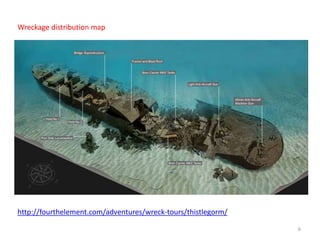
 Wreckage distribution
map (separated parts of
a badly damaged object )
 Eyewitness and
earwitness accounts
Cont.…
5
Wreckage distribution map
http://fourthelement.com/adventures/wreck-tours/thistlegorm/
6
• The investigator should visit the failure site
and make a firsthand examination and
estimation of the damages. These should be
documented immediately. (it is difficult task)
• Color Photography is the best method of
recording the damages for further detailed
investigation.
• Any delay can alter the condition of the failed
component because of handling by
unauthorized people, environmental
influences, and attempts to put the pieces
together.
Cont.…
7
2. Location of the Failed Component:
• Determining and documenting the location of the failed
component in a larger structure is an important task in the
introductory examination of a failure.
• The part may sometimes get thrown a considerable distance
as in the case of a rotating component or in the case of a
moving or flying vehicle or a big object.
• It is important to photograph the entire wreckage. Also, a
wreckage distribution map in Cartesian or polar coordinates
must be prepared.
• Secondary failures are not uncommon and may destroy the
primary failure.
• Hence, before selecting pieces for further laboratory
examination, photographic documentation of the wreckage in
the “as-is, where-is” condition should be completed.
8
• Investigation should be properly planned.
• All the tests to be carried out must be sensibly
selected and the sequence of tests should be
carefully planned.
• Decisions on any test that would involve
destruction of part of the component should
be made very carefully.
• A wrong sequence of tests could destroy some
of the important evidence or introduce
features that could be confusing.
9
Cont.…
3. Specimen Collection :
• Collection of specimens for further laboratory
examination is a vital step in any failure analysis.
• Wrong choice can, apart from wasteful work, lead to
confusion and wrong direction of the investigation.
• Primary failure must be distinguished from numerous
secondary failures.
• Samples from the suspected primary failure region
must be collected carefully, and their location in the
wreckage and in the original structure must be
recorded.
• Any other samples that can provide secondary or
additional evidence must also be collected.
10
• Fracture surfaces must be handled very
carefully  can provide a useful information
about the mode and mechanism of fracture
during detailed laboratory examination.
• In the field, it is better to keep the samples in
plastic covers with suitable desiccants and seal
them and secure the bags with suitable
identifying tags.
• The fracture surfaces may be sprayed with a
transparent lacquer before sealing.
11
Cont.…
Don'ts
• Touching the fracture surfaces must be
avoided because human sweat is a corrodant.
• The mating surfaces of a fracture should never
be made to touch each other (though this is a
normal, tempting tendency) because this
would cause abrasion and thereby lead to
loss of vital microfractographic evidences.
12
Cont.…
3.1 Preservation Techniques of Fractured Specimen:
• FRACTURE SURFACES are fragile and subject to
mechanical and environmental damage that can
destroy microstructural features. Therefore, fracture
specimens must be carefully handled during all
stages of analysis.
• Unless a fracture is evaluated, immediately after it is
produced, it should be preserved as soon as possible
to prevent attack from the environment.
• The best way to preserve a fracture is to dry it with a
gentle stream of dry compressed air, then store it in a
desiccator, a vacuum storage vessel, or a sealed
plastic bag containing a desiccant. 13
Cont.…
• However, such isolation of the fracture is often
not practical.
• Therefore, corrosion-preventive surface coatings
must be used to inhibit oxidation and corrosion
of the fracture surface.
• The main requirements for a surface coating are
as follows:
1. It should not react chemically with the base
metal
2. It should prevent chemical attack of the fracture
from the environment
3. It must be completely and easily removable
without damaging the fracture features.
14
Cont.…
15
 Fractures may be coated with fresh oil or grease.
 Clear acrylic lacquers or plastic coatings are sometimes
sprayed on the fracture surfaces. These clear sprays are
transparent to the fracture surface and can be removed with
organic solvents.
 However, on rough fracture surfaces, it can be difficult to
achieve complete coverage and to remove the coating
completely.
Cont.…
16
 Another type of plastic coating that has been successfully
used to protect most fracture surfaces is cellulose acetate
replicating tape. The tape is softened in acetone and
applied to the fracture surface with finger pressure. As the
tape dries, it adheres tightly to the fracture surface.
 The main advantage of using replicating tape is that it is
available in various thicknesses.
 Rough fracture surfaces can be coated with relatively thick
replicating tape to ensure complete coverage.
 The principal limitation of using replicating tape is that on
rough fracture surfaces it is difficult to remove the tape
completely.
Cont.…
4. Laboratory Studies
a) cleaning of fracture surface
b) Preliminary Examination (Macro-fartrography)
c) Microscopic Examination (Micro-fractrography)
d) Chemical Analysis.
e) Mechanical Properties
f) Nondestructive Evaluation
g) Any other special technique
17
Discuss in detail in next couple of lectures
5. Analysis of Data
• The most important task in any failure analysis is the
consolidation and systematic connection of all the
data obtained from the laboratory test/analysis.
• The results of tests must be compared against the
specifications and deviations, if any, and should be
carefully considered as possible contributing factors.
• At this stage, expertise from other related disciplines
would be quite useful in interpreting the data.
18
• Account of information has available through a proper
analysis. These includes;
• The failure initiation site or sites, crack length, its propagation
path and speed, and the nature and direction of load acting
on the component.
• The role of other factors such as temperature, corrosion,
wear, component manufacturing history, assembly and
alignment, repair and maintenance history, service
abnormalities, and abuses, if any, would also become clear
during the analysis.
• Ultimately, the sequence of the failure would get
established, differentiating between the primary cause of the
failure event and the significant secondary failures and
damages.
19
Cont.…
6. Preparation of the Report:
• For effective communication of the results of failure
analysis, documentation is extremely important. The
report should be clear and contain the logic behind
the conclusions.
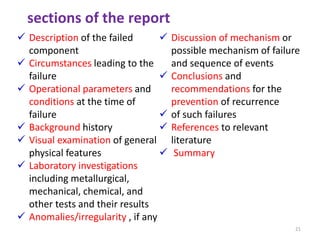
• The following components form the essential
sections of the report:
20
21
 Description of the failed
component
 Circumstances leading to the
failure
 Operational parameters and
conditions at the time of
failure
 Background history
 Visual examination of general
physical features
 Laboratory investigations
including metallurgical,
mechanical, chemical, and
other tests and their results
 Anomalies/irregularity , if any
 Discussion of mechanism or
possible mechanism of failure
and sequence of events
 Conclusions and
recommendations for the
prevention of recurrence
 of such failures
 References to relevant
literature
 Summary
sections of the report
• In addition to these elements, the report should contain an
executive summary to enable the management to take
appropriate action at various levels for avoiding future
failures.
• It is extremely important for the investigator to keep track of
the follow-up action based on his or her recommendations.
Continued interaction with the designer, manufacturer, and
operator is highly desirable.
• Failure analysis is a challenging task. It is exciting, and the
analyst learns something new in every failure. If the analysis is
carried out with utmost care and caution, the effort will be
amply rewarding.
22
Reference
1. Failure Analysis of Engineering Structures
Methodology and Case Histories
V. Ramachandran, A.C. Raghuram, R.V.
Krishnan, and S.K. Bhaumik
2. Failure Analysis and Prevention,
Volume 11
23

Failure Analysis Methodology

  • 1.
    MM: 503 DeformationBehavior and Failure Analysis of Materials Engr. Muhammad Ali Siddiqui Assistant Professor Course Teachers NED University of Engineering and Technology Department of Materials Engineering Lecture 2 Series Failure Analysis Methodology 1
  • 2.
    Failure Analysis Methodology ANALYZING FAILURES is a critical process in determining the physical root causes of problems.  The approach to failure analysis and the methodology adopted must required expert analyst(s) - because a single analyst may not be equipped with knowledge in various disciplines such as metallurgy, materials science, structural mechanics, corrosion engineering, propulsion engineering, aerodynamics, and so on,  (So it is multidisciplinary activity).  A team effort is always required to arrive at the correct solution to the problem.  The process is complex, draws upon many different technical disciplines, and uses a variety of observation, inspection, and laboratory techniques.  One of the key factors in properly performing a failure analysis is keeping an open mind while examining and analyzing the evidence to foster a clear, unbiased perspective of the failure. 2
  • 3.
    1. Background Information: Whenever a failure analysis is carried out, at the beginning it is essential to collect all the relevant background information, because it helps in developing a complete case history about the failure.  The collection of information can fall into two groups: i. Information about the failed component. ii. Information about the failure itself. Collect all available data concerned with specification and drawing, component design, fabrication, repairs, maintenance and services use. 3
  • 4.
    i) Information aboutthe failed component includes  Name of the component, identification number, manufacturer, and user  Location  Intended function  Service life since new  Service life since last overhaul (repair)  Design loads, actual service loads, and load orientation  Frequency of loading  Service parameters such as temperature, pressure, rotation, etc.  Environment  Materials of construction  Specifications and codes  Concessions given in the components  Strength parameters  Fabrication processes  Thermomechanical treatments  Surface treatments  Inspection techniques and records  Maintenance records  Ad hoc modifications Cont.… 4
  • 5.
    ii) Information aboutthe failure itself includes:  Date and time of failure/malfunction  Extent of damage to the surrounding structure, personnel, etc.  Operating conditions just prior to failure  Service abnormalities  Sketches and photographs of the failed component and surrounding areas.  Wreckage distribution map (separated parts of a badly damaged object )  Eyewitness and earwitness accounts Cont.… 5
  • 6.
  • 7.
    • The investigatorshould visit the failure site and make a firsthand examination and estimation of the damages. These should be documented immediately. (it is difficult task) • Color Photography is the best method of recording the damages for further detailed investigation. • Any delay can alter the condition of the failed component because of handling by unauthorized people, environmental influences, and attempts to put the pieces together. Cont.… 7
  • 8.
    2. Location ofthe Failed Component: • Determining and documenting the location of the failed component in a larger structure is an important task in the introductory examination of a failure. • The part may sometimes get thrown a considerable distance as in the case of a rotating component or in the case of a moving or flying vehicle or a big object. • It is important to photograph the entire wreckage. Also, a wreckage distribution map in Cartesian or polar coordinates must be prepared. • Secondary failures are not uncommon and may destroy the primary failure. • Hence, before selecting pieces for further laboratory examination, photographic documentation of the wreckage in the “as-is, where-is” condition should be completed. 8
  • 9.
    • Investigation shouldbe properly planned. • All the tests to be carried out must be sensibly selected and the sequence of tests should be carefully planned. • Decisions on any test that would involve destruction of part of the component should be made very carefully. • A wrong sequence of tests could destroy some of the important evidence or introduce features that could be confusing. 9 Cont.…
  • 10.
    3. Specimen Collection: • Collection of specimens for further laboratory examination is a vital step in any failure analysis. • Wrong choice can, apart from wasteful work, lead to confusion and wrong direction of the investigation. • Primary failure must be distinguished from numerous secondary failures. • Samples from the suspected primary failure region must be collected carefully, and their location in the wreckage and in the original structure must be recorded. • Any other samples that can provide secondary or additional evidence must also be collected. 10
  • 11.
    • Fracture surfacesmust be handled very carefully  can provide a useful information about the mode and mechanism of fracture during detailed laboratory examination. • In the field, it is better to keep the samples in plastic covers with suitable desiccants and seal them and secure the bags with suitable identifying tags. • The fracture surfaces may be sprayed with a transparent lacquer before sealing. 11 Cont.…
  • 12.
    Don'ts • Touching thefracture surfaces must be avoided because human sweat is a corrodant. • The mating surfaces of a fracture should never be made to touch each other (though this is a normal, tempting tendency) because this would cause abrasion and thereby lead to loss of vital microfractographic evidences. 12 Cont.…
  • 13.
    3.1 Preservation Techniquesof Fractured Specimen: • FRACTURE SURFACES are fragile and subject to mechanical and environmental damage that can destroy microstructural features. Therefore, fracture specimens must be carefully handled during all stages of analysis. • Unless a fracture is evaluated, immediately after it is produced, it should be preserved as soon as possible to prevent attack from the environment. • The best way to preserve a fracture is to dry it with a gentle stream of dry compressed air, then store it in a desiccator, a vacuum storage vessel, or a sealed plastic bag containing a desiccant. 13 Cont.…
  • 14.
    • However, suchisolation of the fracture is often not practical. • Therefore, corrosion-preventive surface coatings must be used to inhibit oxidation and corrosion of the fracture surface. • The main requirements for a surface coating are as follows: 1. It should not react chemically with the base metal 2. It should prevent chemical attack of the fracture from the environment 3. It must be completely and easily removable without damaging the fracture features. 14 Cont.…
  • 15.
    15  Fractures maybe coated with fresh oil or grease.  Clear acrylic lacquers or plastic coatings are sometimes sprayed on the fracture surfaces. These clear sprays are transparent to the fracture surface and can be removed with organic solvents.  However, on rough fracture surfaces, it can be difficult to achieve complete coverage and to remove the coating completely. Cont.…
  • 16.
    16  Another typeof plastic coating that has been successfully used to protect most fracture surfaces is cellulose acetate replicating tape. The tape is softened in acetone and applied to the fracture surface with finger pressure. As the tape dries, it adheres tightly to the fracture surface.  The main advantage of using replicating tape is that it is available in various thicknesses.  Rough fracture surfaces can be coated with relatively thick replicating tape to ensure complete coverage.  The principal limitation of using replicating tape is that on rough fracture surfaces it is difficult to remove the tape completely. Cont.…
  • 17.
    4. Laboratory Studies a)cleaning of fracture surface b) Preliminary Examination (Macro-fartrography) c) Microscopic Examination (Micro-fractrography) d) Chemical Analysis. e) Mechanical Properties f) Nondestructive Evaluation g) Any other special technique 17 Discuss in detail in next couple of lectures
  • 18.
    5. Analysis ofData • The most important task in any failure analysis is the consolidation and systematic connection of all the data obtained from the laboratory test/analysis. • The results of tests must be compared against the specifications and deviations, if any, and should be carefully considered as possible contributing factors. • At this stage, expertise from other related disciplines would be quite useful in interpreting the data. 18
  • 19.
    • Account ofinformation has available through a proper analysis. These includes; • The failure initiation site or sites, crack length, its propagation path and speed, and the nature and direction of load acting on the component. • The role of other factors such as temperature, corrosion, wear, component manufacturing history, assembly and alignment, repair and maintenance history, service abnormalities, and abuses, if any, would also become clear during the analysis. • Ultimately, the sequence of the failure would get established, differentiating between the primary cause of the failure event and the significant secondary failures and damages. 19 Cont.…
  • 20.
    6. Preparation ofthe Report: • For effective communication of the results of failure analysis, documentation is extremely important. The report should be clear and contain the logic behind the conclusions. • The following components form the essential sections of the report: 20
  • 21.
    21  Description ofthe failed component  Circumstances leading to the failure  Operational parameters and conditions at the time of failure  Background history  Visual examination of general physical features  Laboratory investigations including metallurgical, mechanical, chemical, and other tests and their results  Anomalies/irregularity , if any  Discussion of mechanism or possible mechanism of failure and sequence of events  Conclusions and recommendations for the prevention of recurrence  of such failures  References to relevant literature  Summary sections of the report
  • 22.
    • In additionto these elements, the report should contain an executive summary to enable the management to take appropriate action at various levels for avoiding future failures. • It is extremely important for the investigator to keep track of the follow-up action based on his or her recommendations. Continued interaction with the designer, manufacturer, and operator is highly desirable. • Failure analysis is a challenging task. It is exciting, and the analyst learns something new in every failure. If the analysis is carried out with utmost care and caution, the effort will be amply rewarding. 22
  • 23.
    Reference 1. Failure Analysisof Engineering Structures Methodology and Case Histories V. Ramachandran, A.C. Raghuram, R.V. Krishnan, and S.K. Bhaumik 2. Failure Analysis and Prevention, Volume 11 23