MM-501 Phase Transformation
in Solid (metals/alloys)
Dr. Muhammad Ali Siddiqui
Assistant Professor
Metallurgical Engineering Department
NED University of Engineering and Technology-Pakistan
m.siddiqui@cloud.neduet.edu.pk
021-99261261 Ext: 2521
1
https://www.researchgate.net/profile/Muhammad-Siddiqui-138
https://www.slideshare.net/MuhammadAliSiddiqui6?utm_campaign=profiletracking&utm_medium=ss
site&utm_source=ssslideview
2
1. Porter, D.A. and.Easterling, K.E., “Phase Transformations in Metals and
Alloys”, Van Nostrand Reinhold, 2000 or latest edition..
2. Reed-Hill, R. E. and Abbaschian, R., “Physical Metallurgy Principles”, PWS,
2000 or latest edition.
3. Smallman R.E “Modern Physical Metallurgy”, 4th ed., Butterworths, 2005.
4. Shewmon, “Diffusion in Solids”, Mineral, Metals & Mat. Soc., Latest edition.
5. Shewmon, “Phase Transformations”, Springer, Latest edition.
6. Honeycombe, R.W.K., Bhadeshia, H.K.D.H., “Steels, Microstructures and
Properties”, Edward Arnold, 2005.
7. Chadwick, G. A., “Metallography of Phase Transformations”, Butterworths,
Latest edition.
8. Wilson, E.A., “Worked Examples and Thermodynamics of Phase
Transformations”, Woodhead, 2004.
Phase Transformations
Suggested Readings
3
Lecture Series - A
• Application of Metals and Alloys
• Diffusion - Mechanism
• Phase Diagram
• Introduction to Iron-Carbon Phase Diagram
• Interphase Migration
• Classification of phase Transformation
• Decomposition of Austenite
4
Important Application of Metals and
Alloys – Brain storming
5
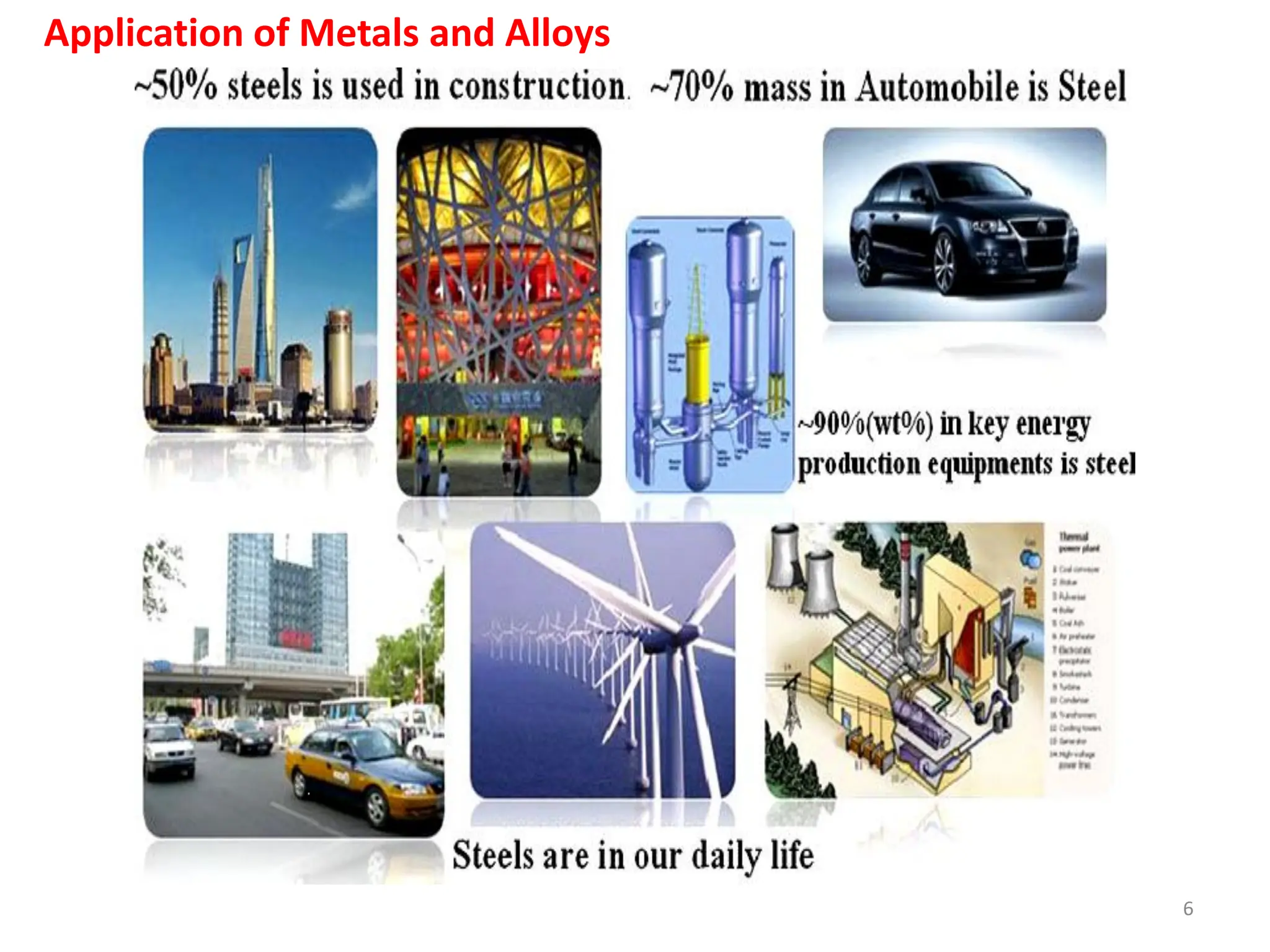
Application of Metals and Alloys
6
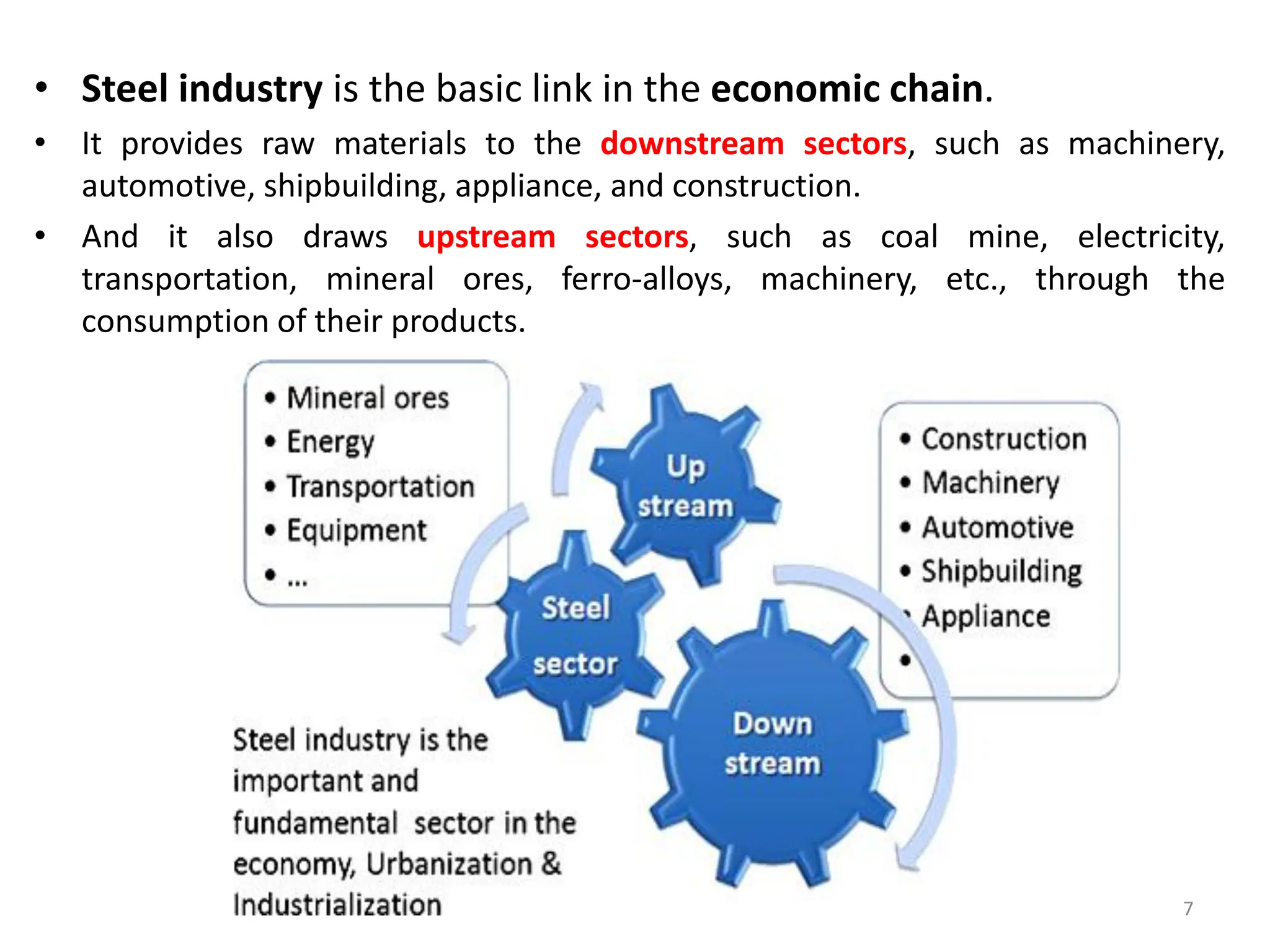
• Steel industry is the basic link in the economic chain.
• It provides raw materials to the downstream sectors, such as machinery,
automotive, shipbuilding, appliance, and construction.
• And it also draws upstream sectors, such as coal mine, electricity,
transportation, mineral ores, ferro-alloys, machinery, etc., through the
consumption of their products.
7
8
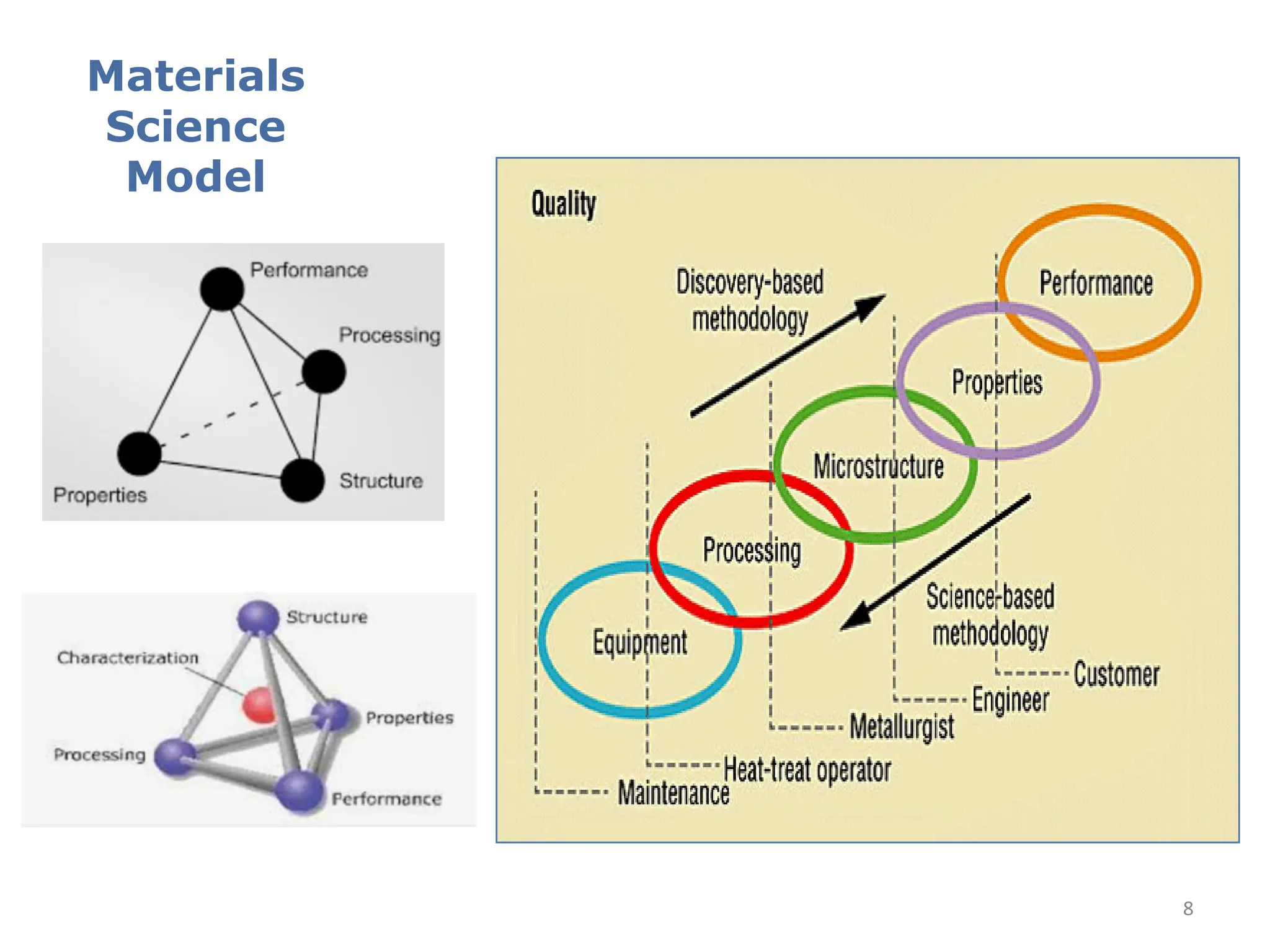
Materials
Science
Model
9
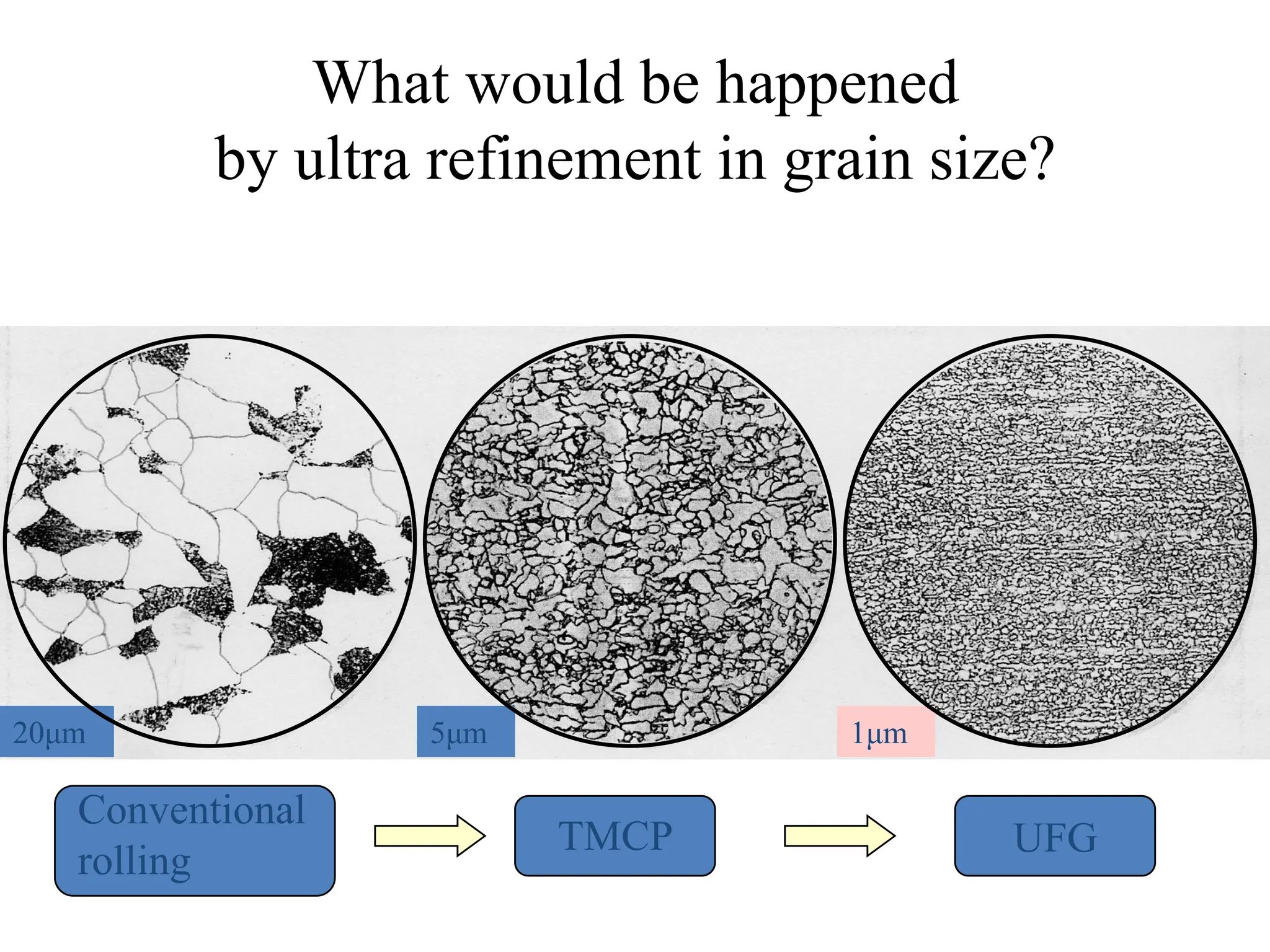
What would be happened
by ultra refinement in grain size?
20μm 5μm
Conventional
rolling
TMCP
1μm
UFG
12
Diffusion
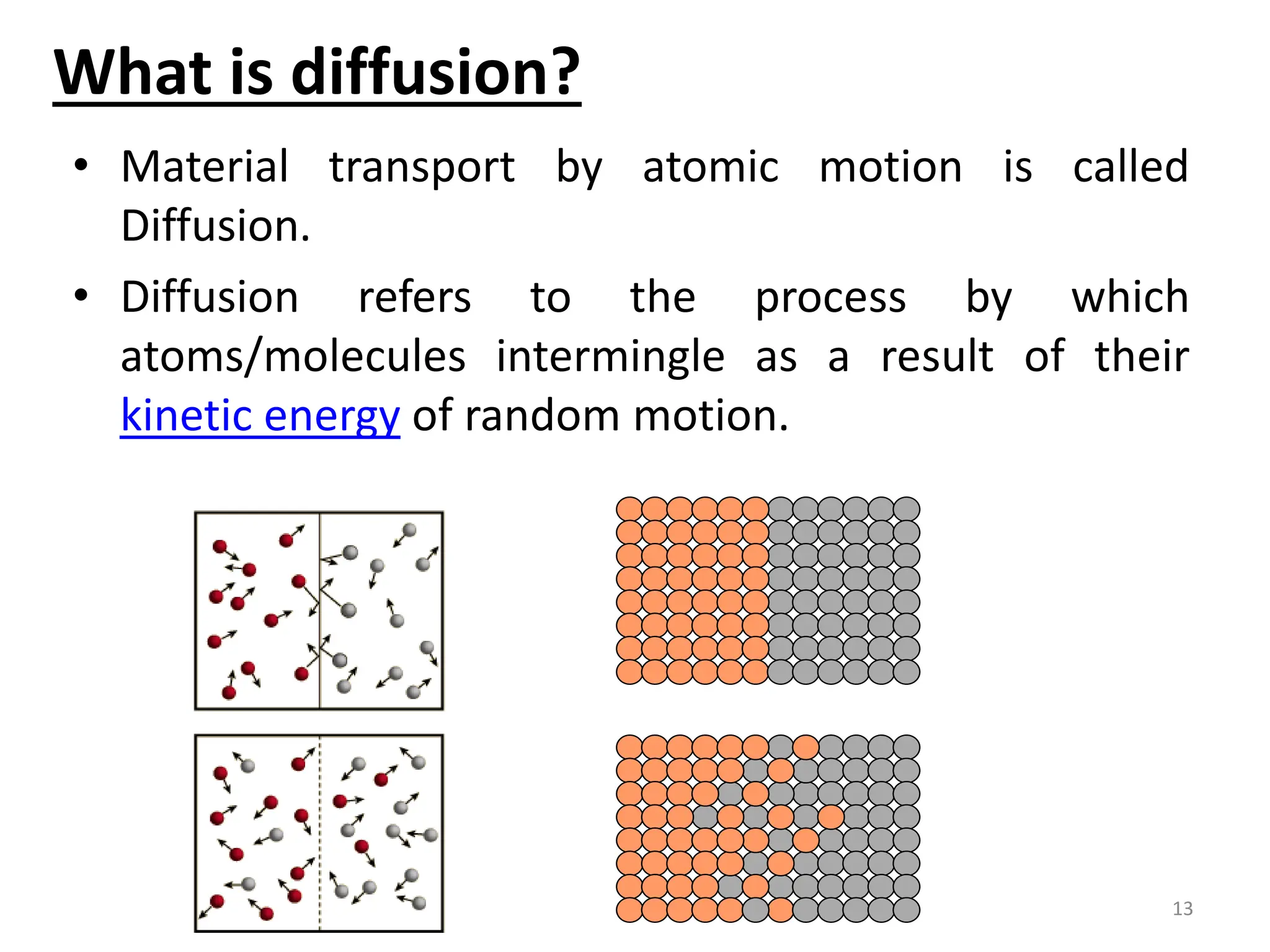
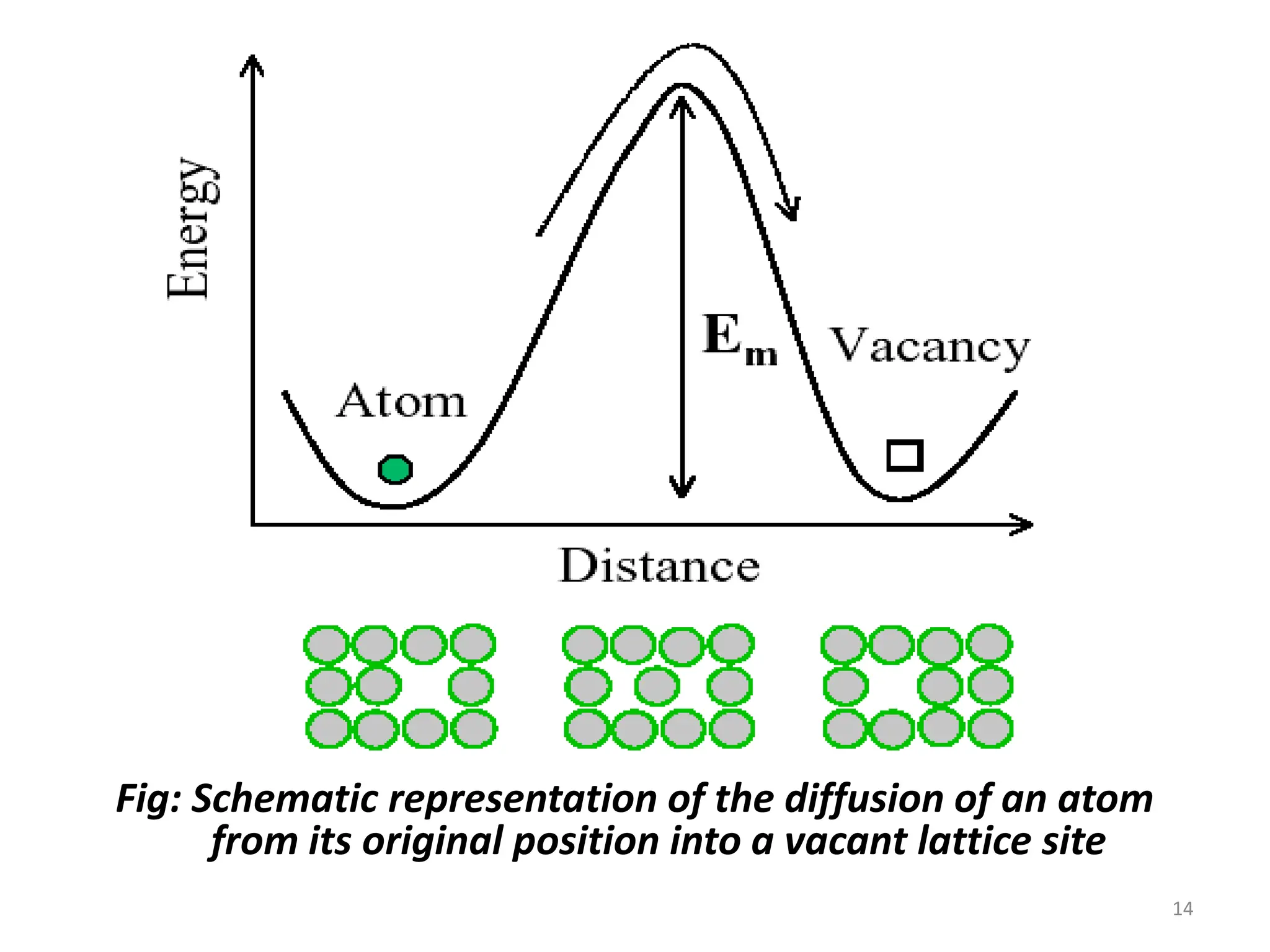
What is diffusion?
• Material transport by atomic motion is called
Diffusion.
• Diffusion refers to the process by which
atoms/molecules intermingle as a result of their
kinetic energy of random motion.
13
Fig: Schematic representation of the diffusion of an atom
from its original position into a vacant lattice site
14
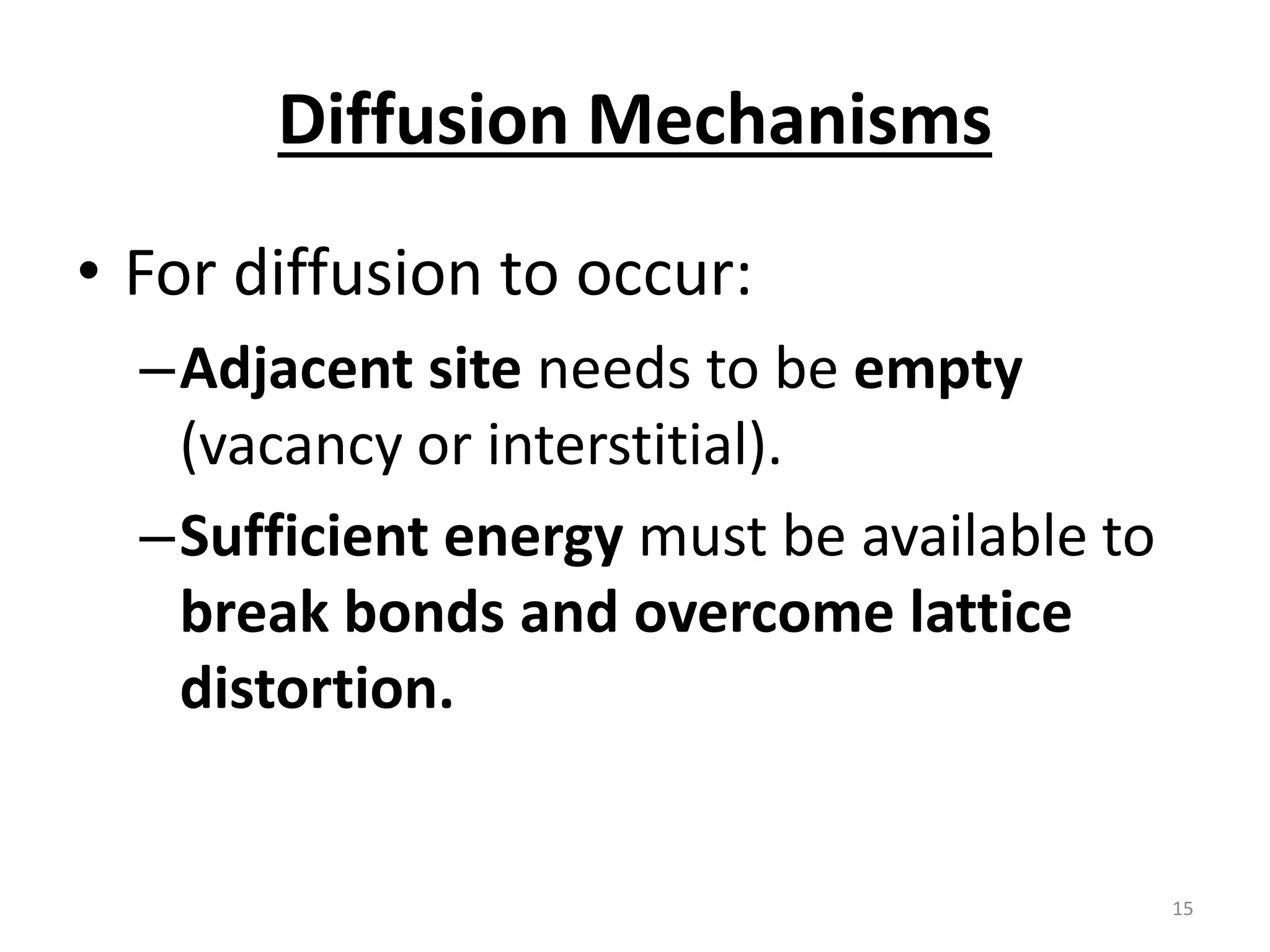
Diffusion Mechanisms
• For diffusion to occur:
–Adjacent site needs to be empty
(vacancy or interstitial).
–Sufficient energy must be available to
break bonds and overcome lattice
distortion.
15
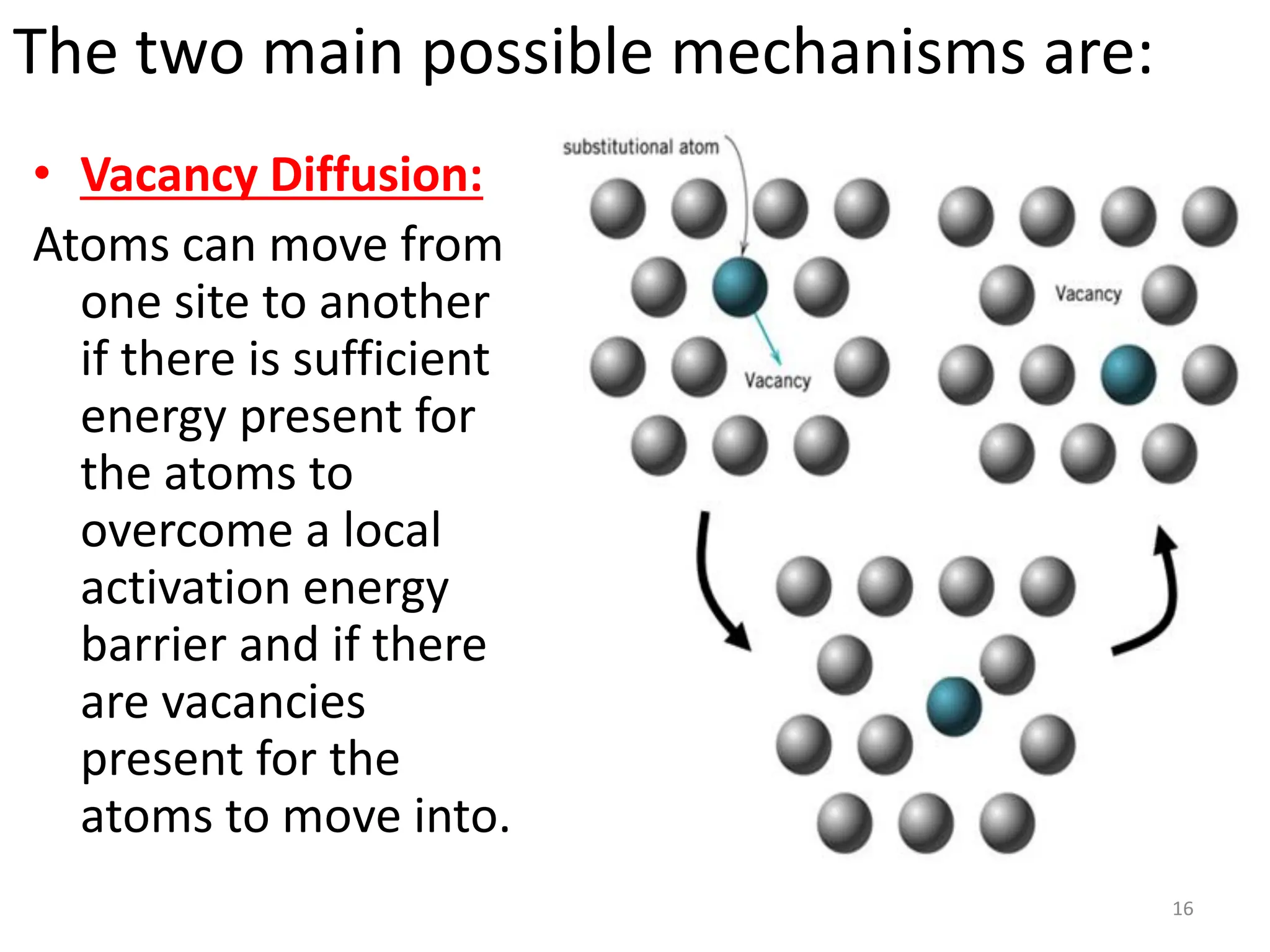
The two main possible mechanisms are:
• Vacancy Diffusion:
Atoms can move from
one site to another
if there is sufficient
energy present for
the atoms to
overcome a local
activation energy
barrier and if there
are vacancies
present for the
atoms to move into.
16
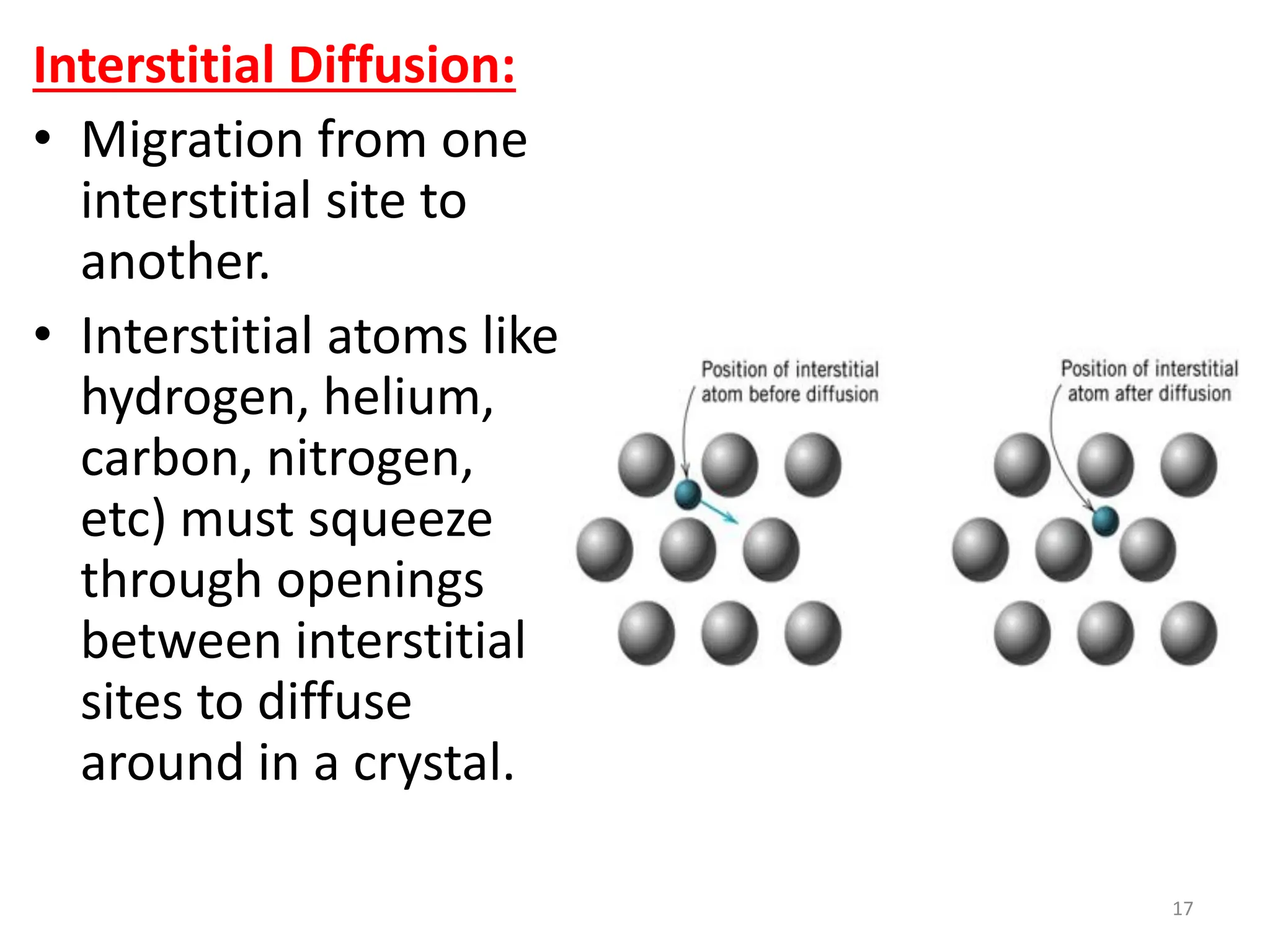
Interstitial Diffusion:
• Migration from one
interstitial site to
another.
• Interstitial atoms like
hydrogen, helium,
carbon, nitrogen,
etc) must squeeze
through openings
between interstitial
sites to diffuse
around in a crystal.
17
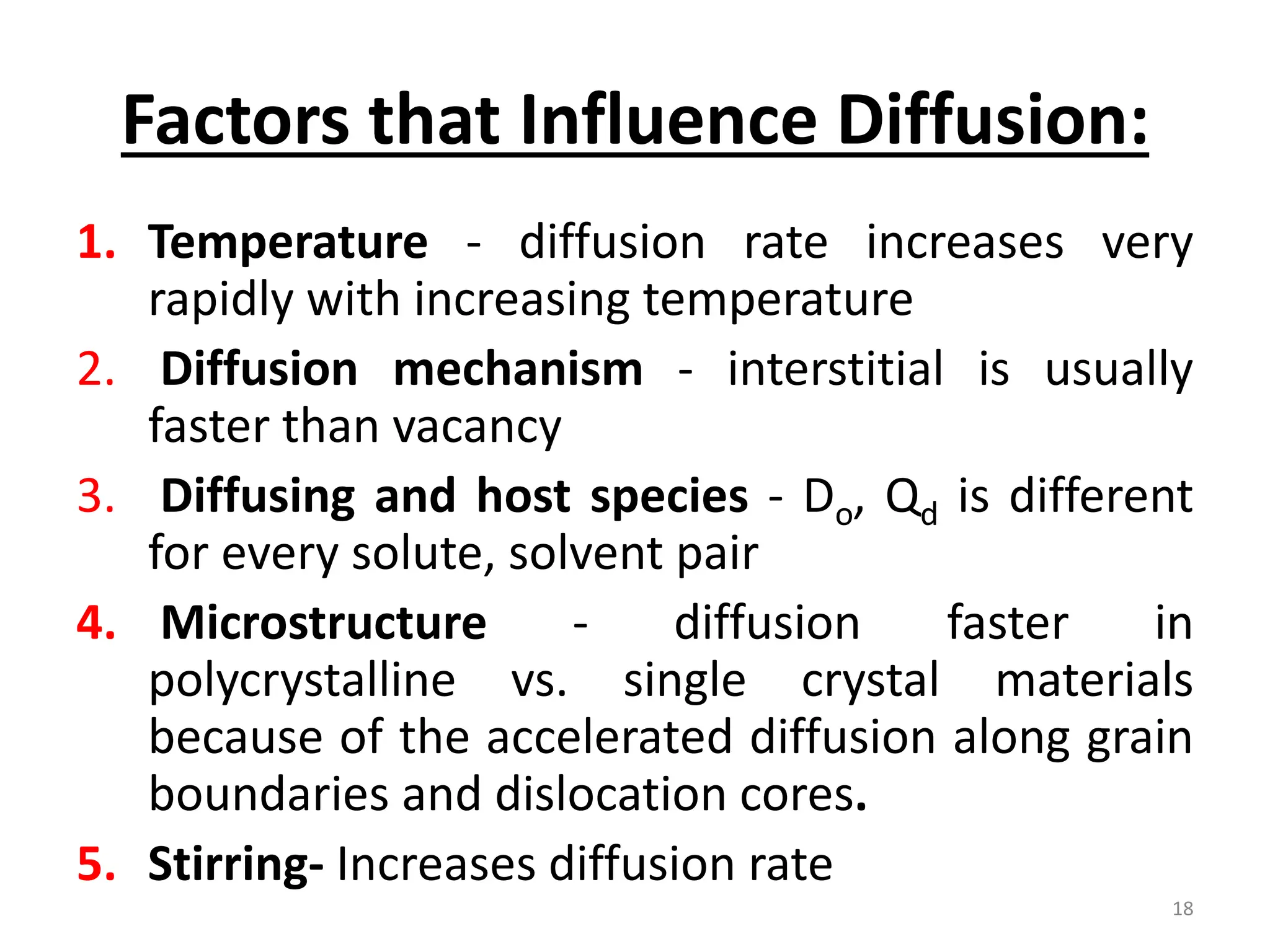
Factors that Influence Diffusion:
1. Temperature - diffusion rate increases very
rapidly with increasing temperature
2. Diffusion mechanism - interstitial is usually
faster than vacancy
3. Diffusing and host species - Do, Qd is different
for every solute, solvent pair
4. Microstructure - diffusion faster in
polycrystalline vs. single crystal materials
because of the accelerated diffusion along grain
boundaries and dislocation cores.
5. Stirring- Increases diffusion rate
18
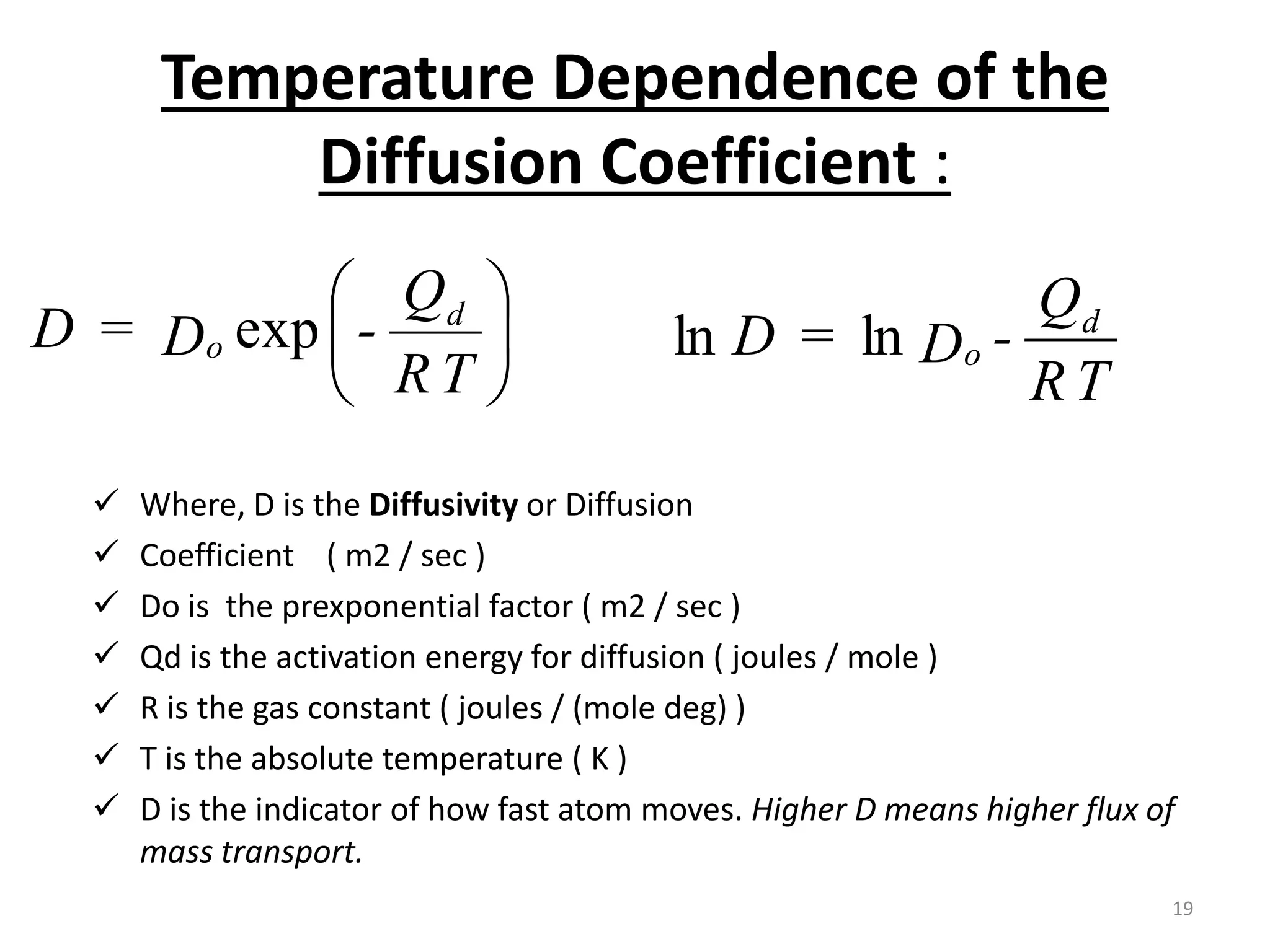
Temperature Dependence of the
Diffusion Coefficient :
 Where, D is the Diffusivity or Diffusion
 Coefficient ( m2 / sec )
 Do is the prexponential factor ( m2 / sec )
 Qd is the activation energy for diffusion ( joules / mole )
 R is the gas constant ( joules / (mole deg) )
 T is the absolute temperature ( K )
 D is the indicator of how fast atom moves. Higher D means higher flux of
mass transport.






T
R
Q
-
D
=
D d
o exp
T
R
Q
-
D
=
D d
o
ln
ln
19
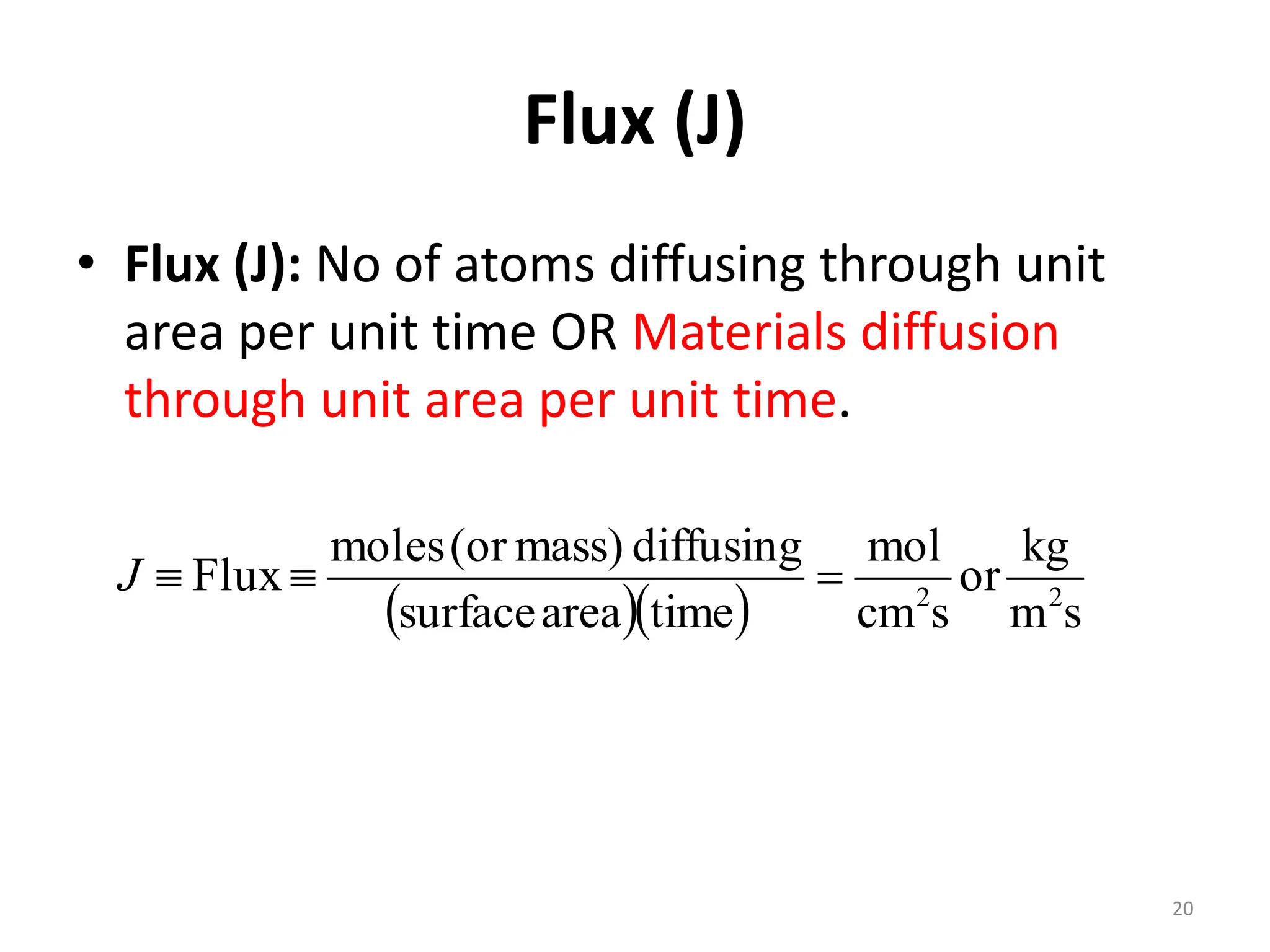
Flux (J)
• Flux (J): No of atoms diffusing through unit
area per unit time OR Materials diffusion
through unit area per unit time.
   s
m
kg
or
s
cm
mol
time
area
surface
diffusing
mass)
(or
moles
Flux 2
2



J
20
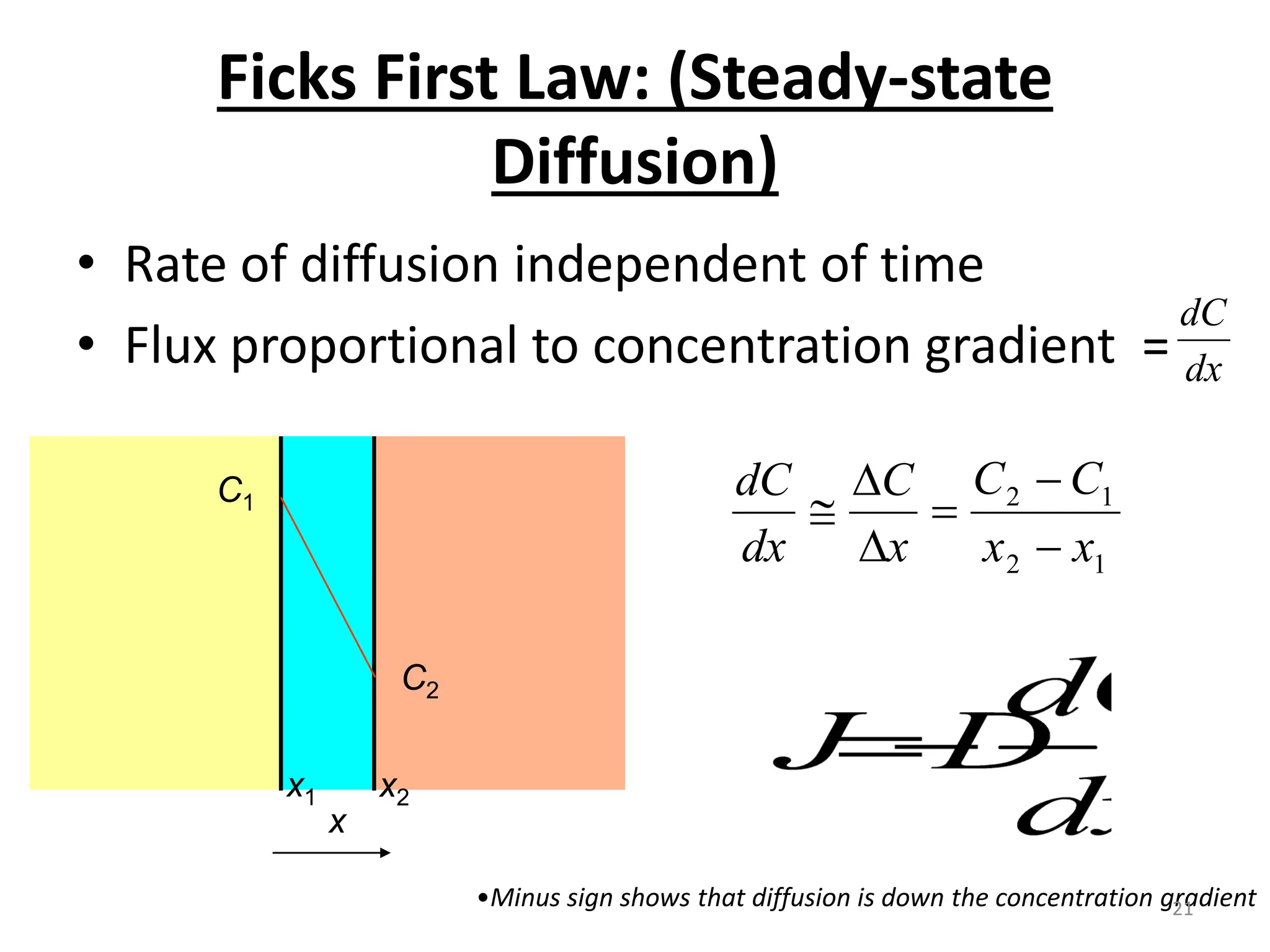
Ficks First Law: (Steady-state
Diffusion)
• Rate of diffusion independent of time
• Flux proportional to concentration gradient = dx
dC
C1
C2
x
C1
C2
x1 x2
1
2
1
2
x
x
C
C
x
C
dx
dC






•Minus sign shows that diffusion is down the concentration gradient
21
Fick’s second law :(Non-Steady-State
Diffusion)
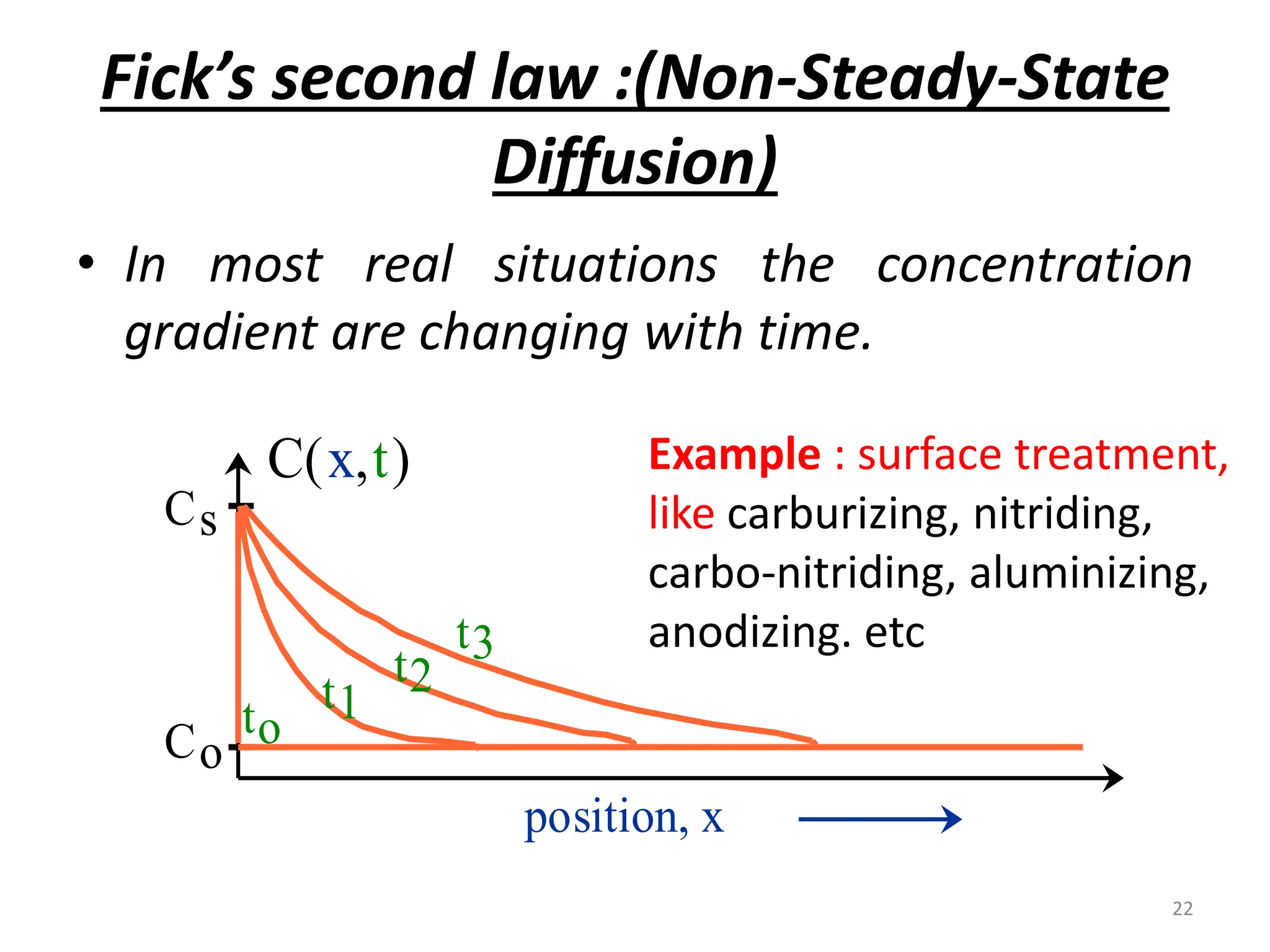
• In most real situations the concentration
gradient are changing with time.
Co
Cs
position, x
C(x,t)
to
t1
t2
t3
Example : surface treatment,
like carburizing, nitriding,
carbo-nitriding, aluminizing,
anodizing. etc
22
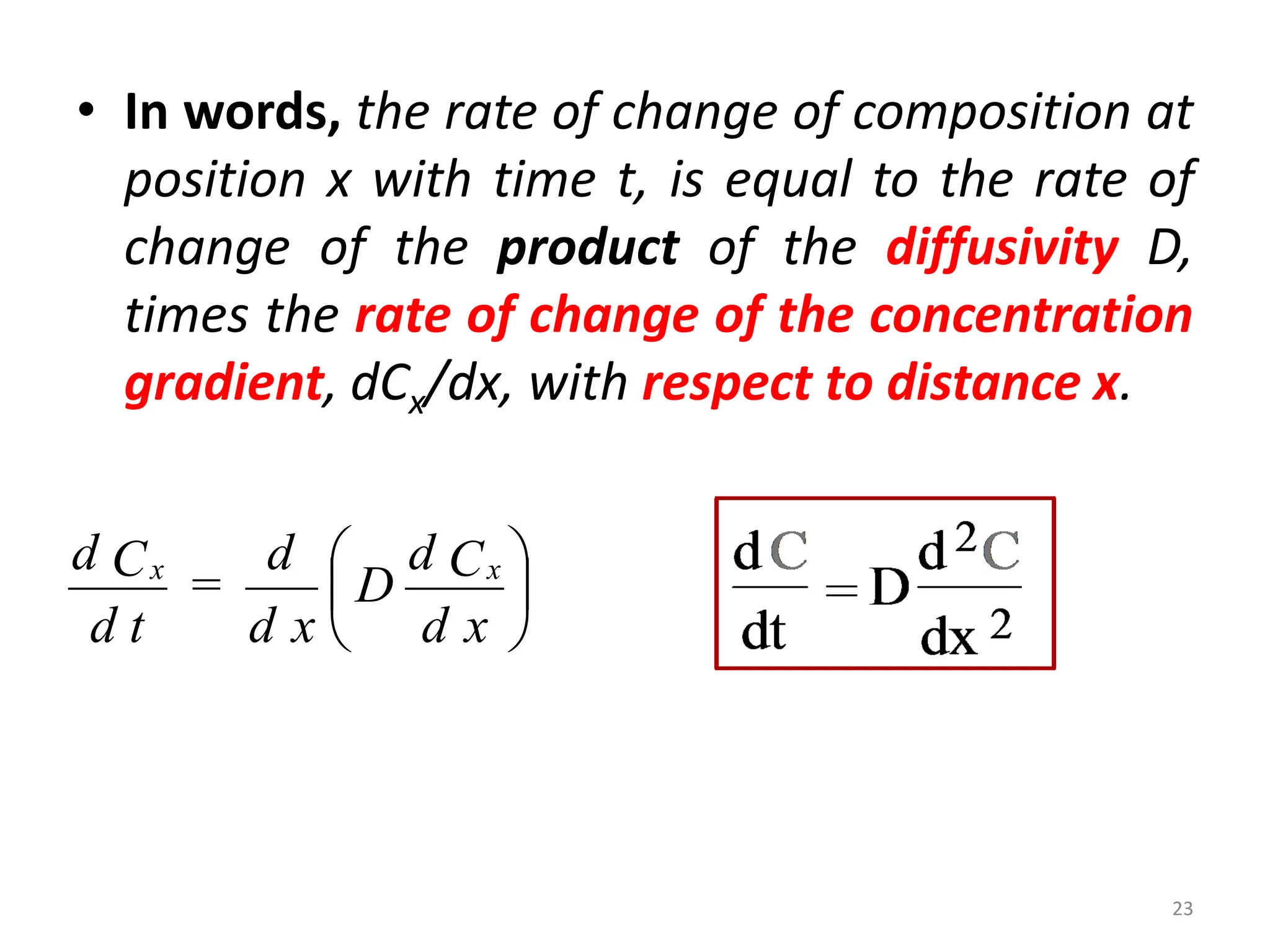
• In words, the rate of change of composition at
position x with time t, is equal to the rate of
change of the product of the diffusivity D,
times the rate of change of the concentration
gradient, dCx/dx, with respect to distance x.






x
d
C
d
D
x
d
d
=
t
d
C
d x
x
23
PHASE DIAGRAMS
24
Phase Diagrams
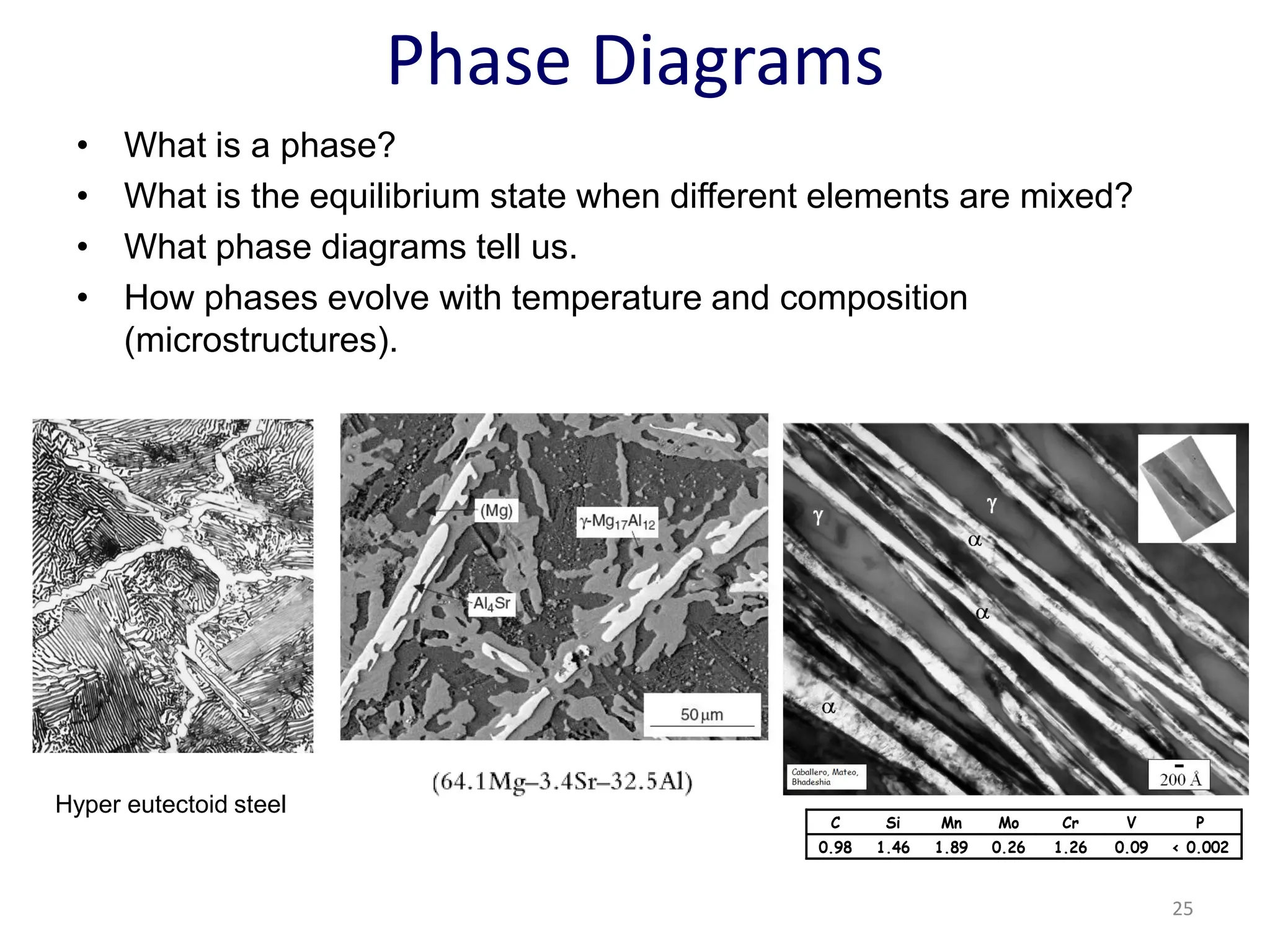
• What is a phase?
• What is the equilibrium state when different elements are mixed?
• What phase diagrams tell us.
• How phases evolve with temperature and composition
(microstructures).
C Si Mn Mo Cr V P
0.98 1.46 1.89 0.26 1.26 0.09 < 0.002
Hyper eutectoid steel
25
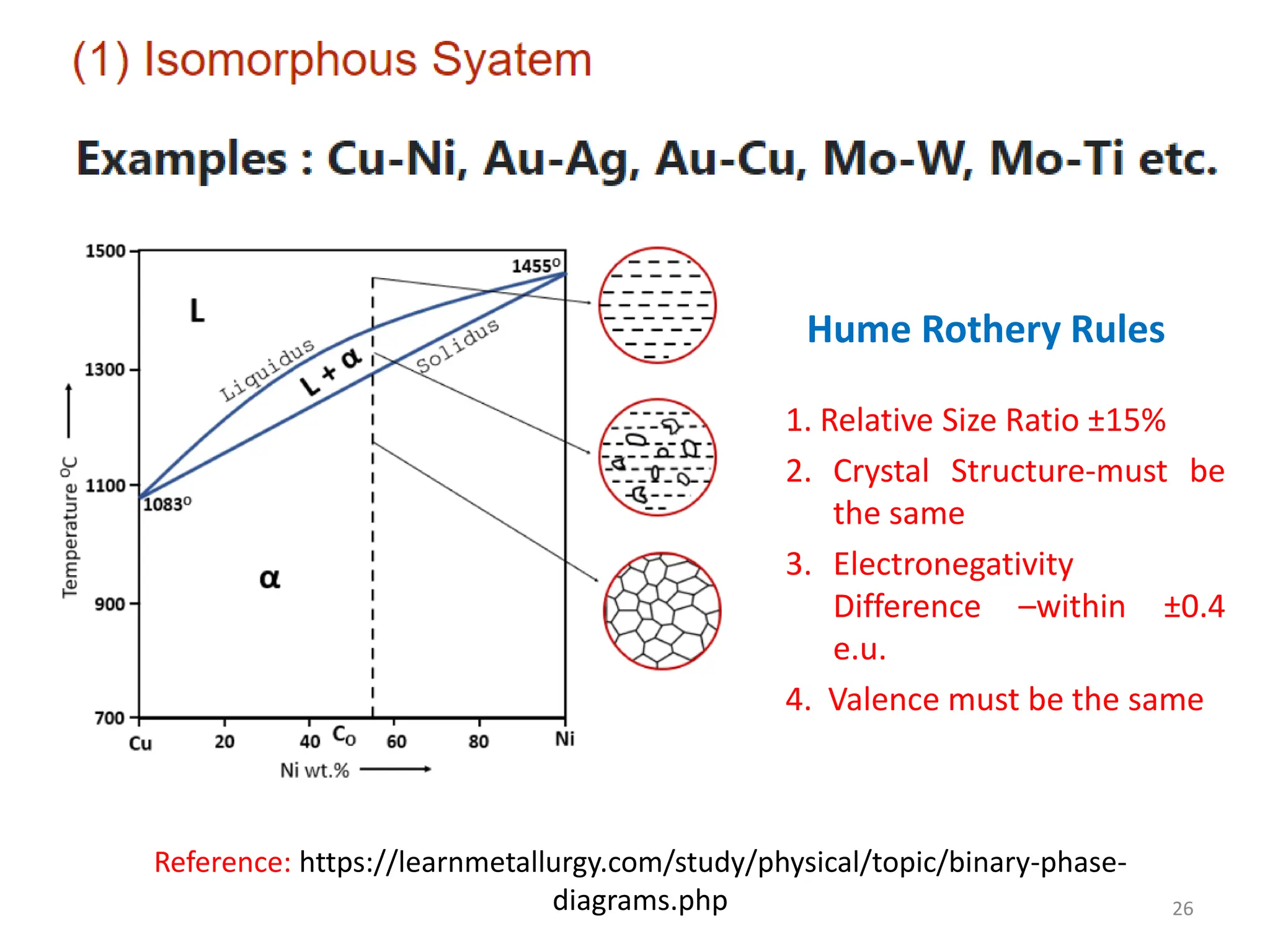
Reference: https://learnmetallurgy.com/study/physical/topic/binary-phase-
diagrams.php
1. Relative Size Ratio ±15%
2. Crystal Structure-must be
the same
3. Electronegativity
Difference –within ±0.4
e.u.
4. Valence must be the same
Hume Rothery Rules
26
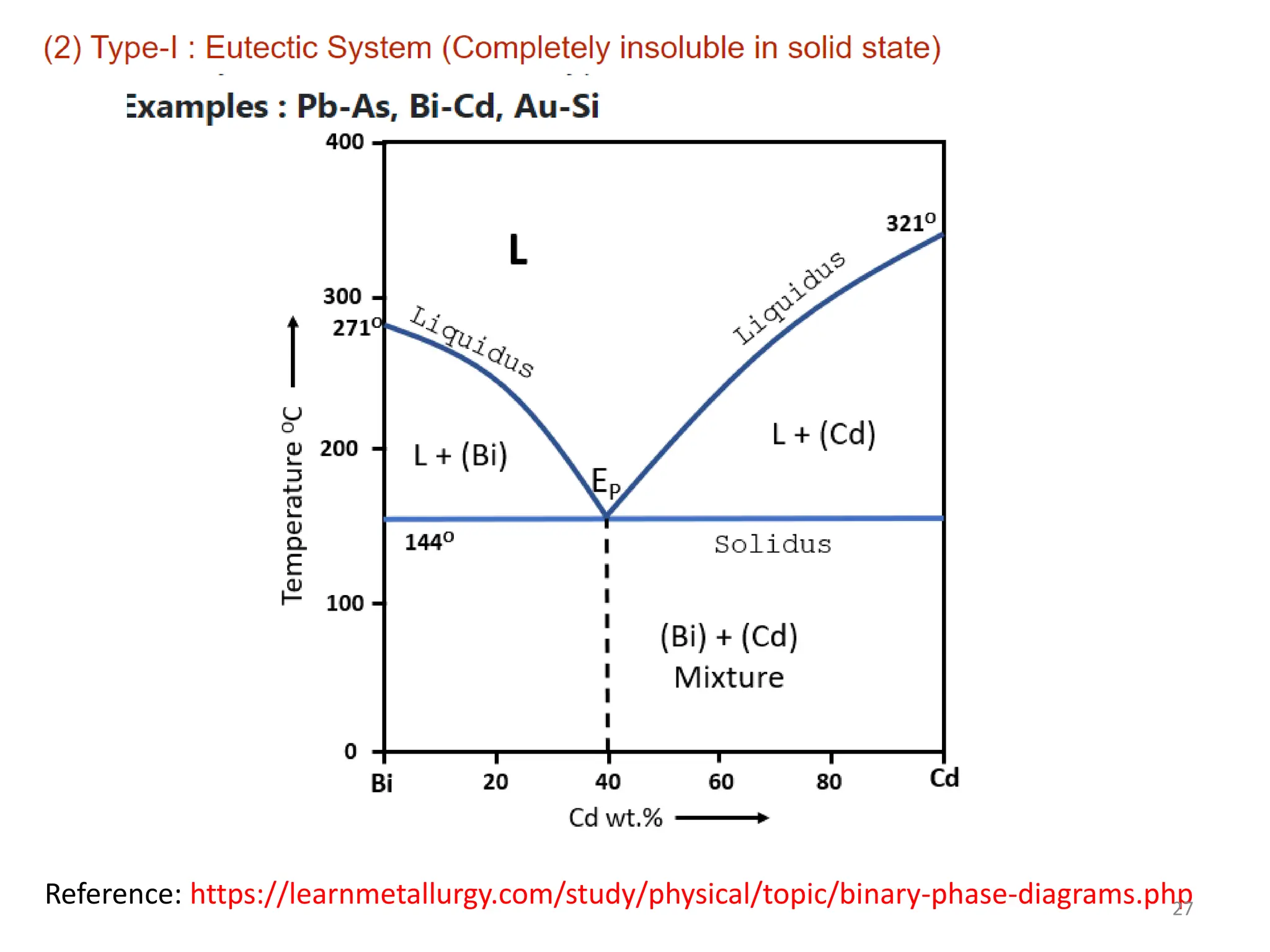
Reference: https://learnmetallurgy.com/study/physical/topic/binary-phase-diagrams.php
27
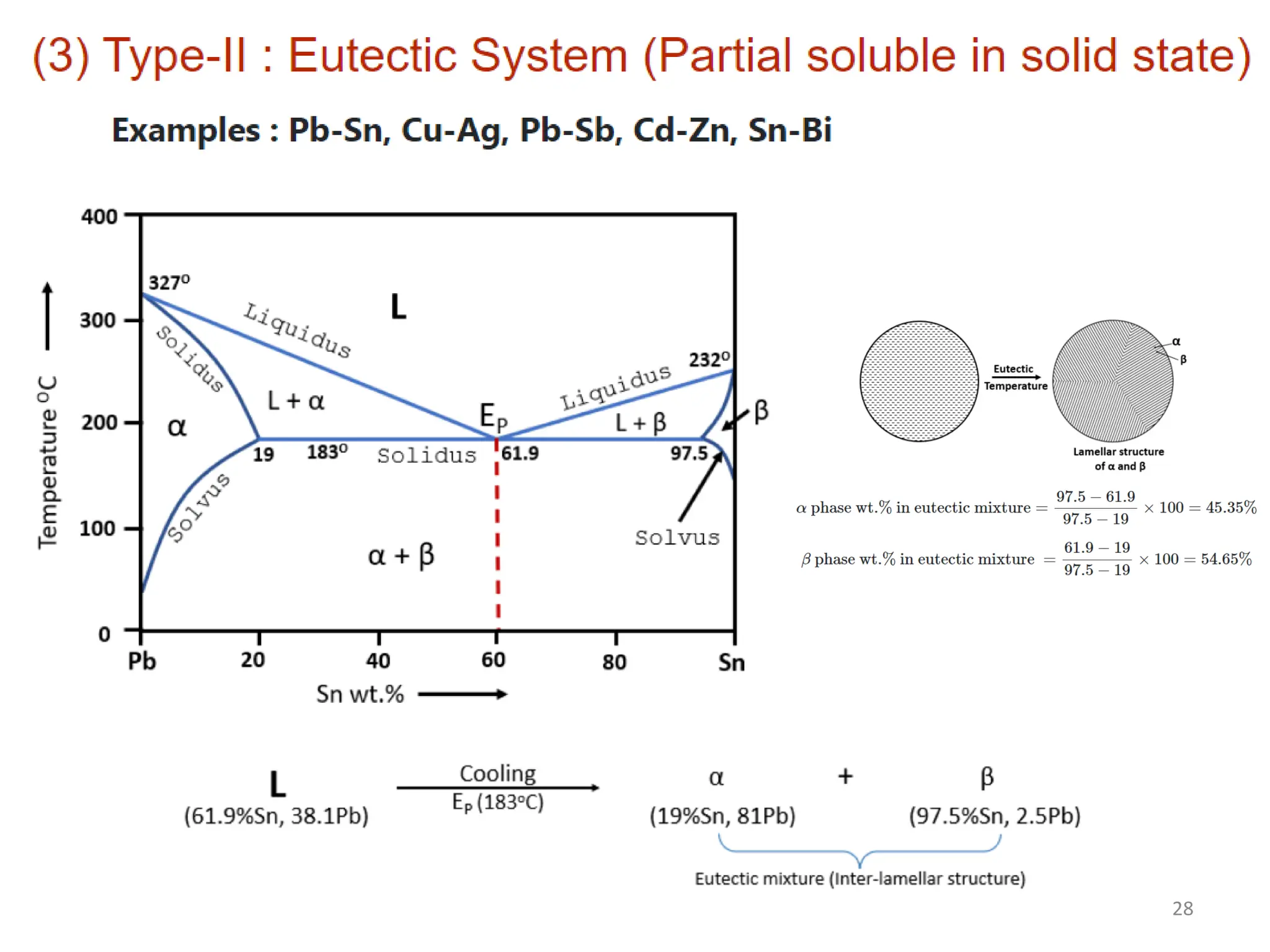
28
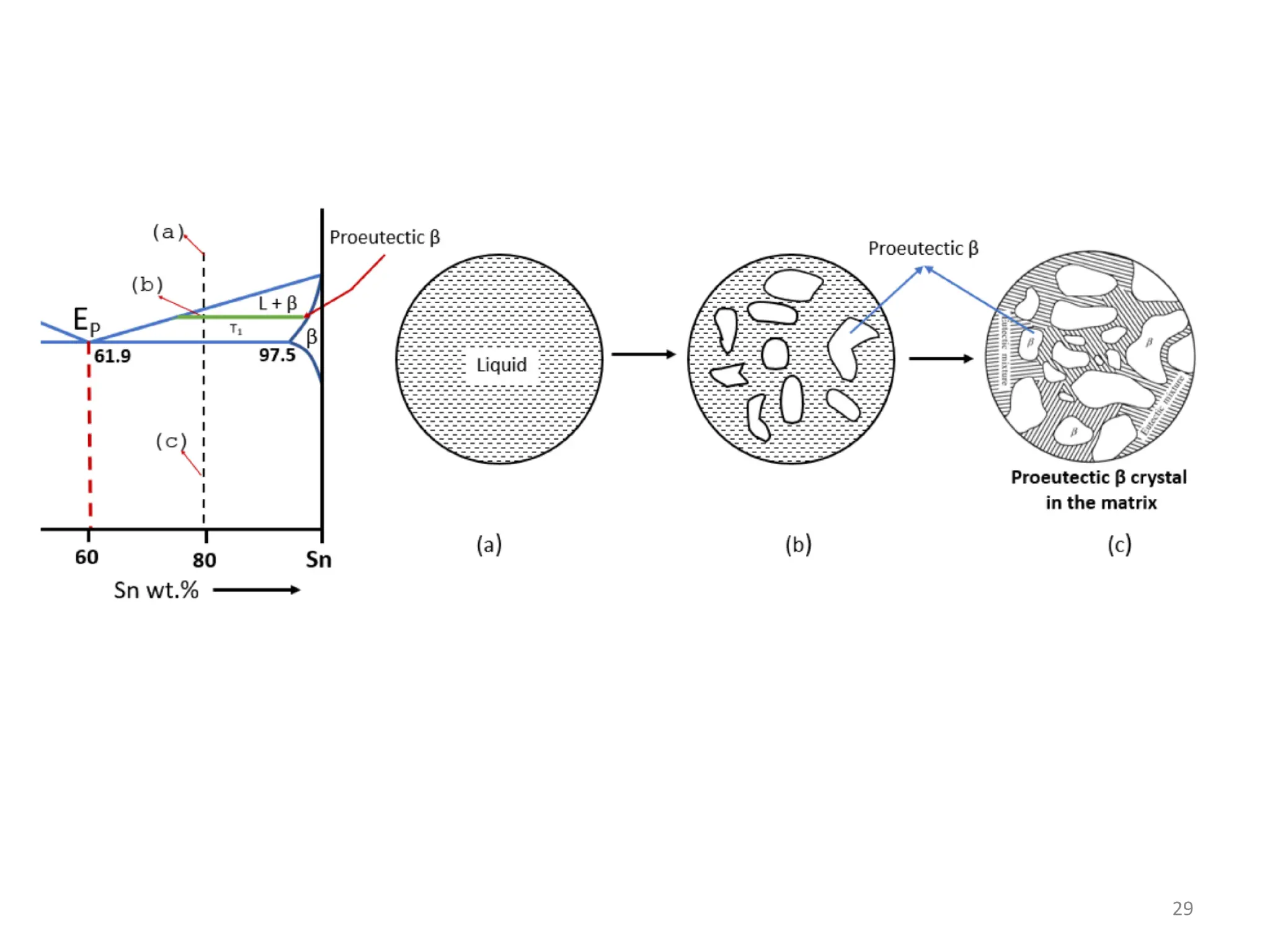
29
30
31
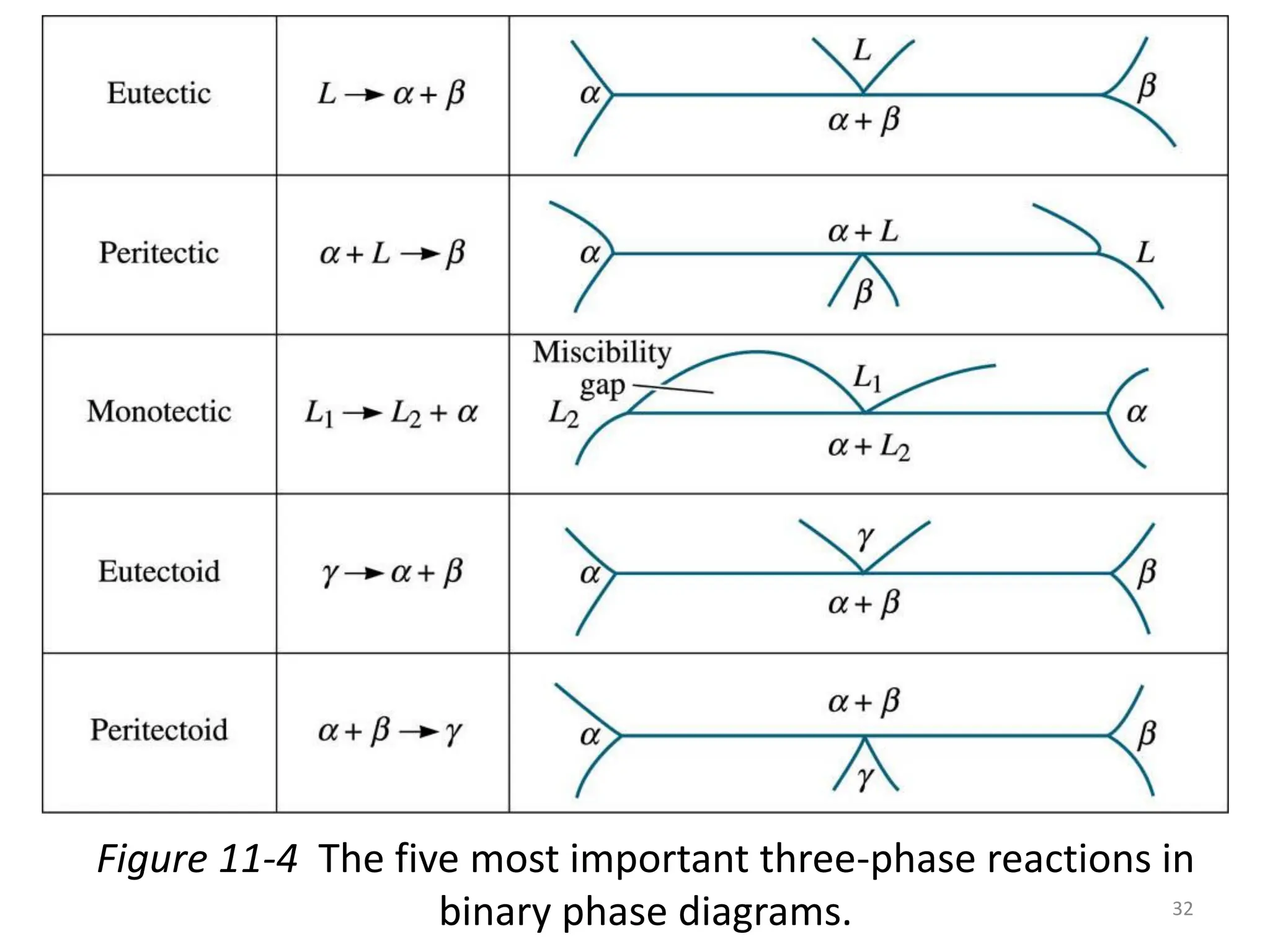
Figure 11-4 The five most important three-phase reactions in
binary phase diagrams. 32
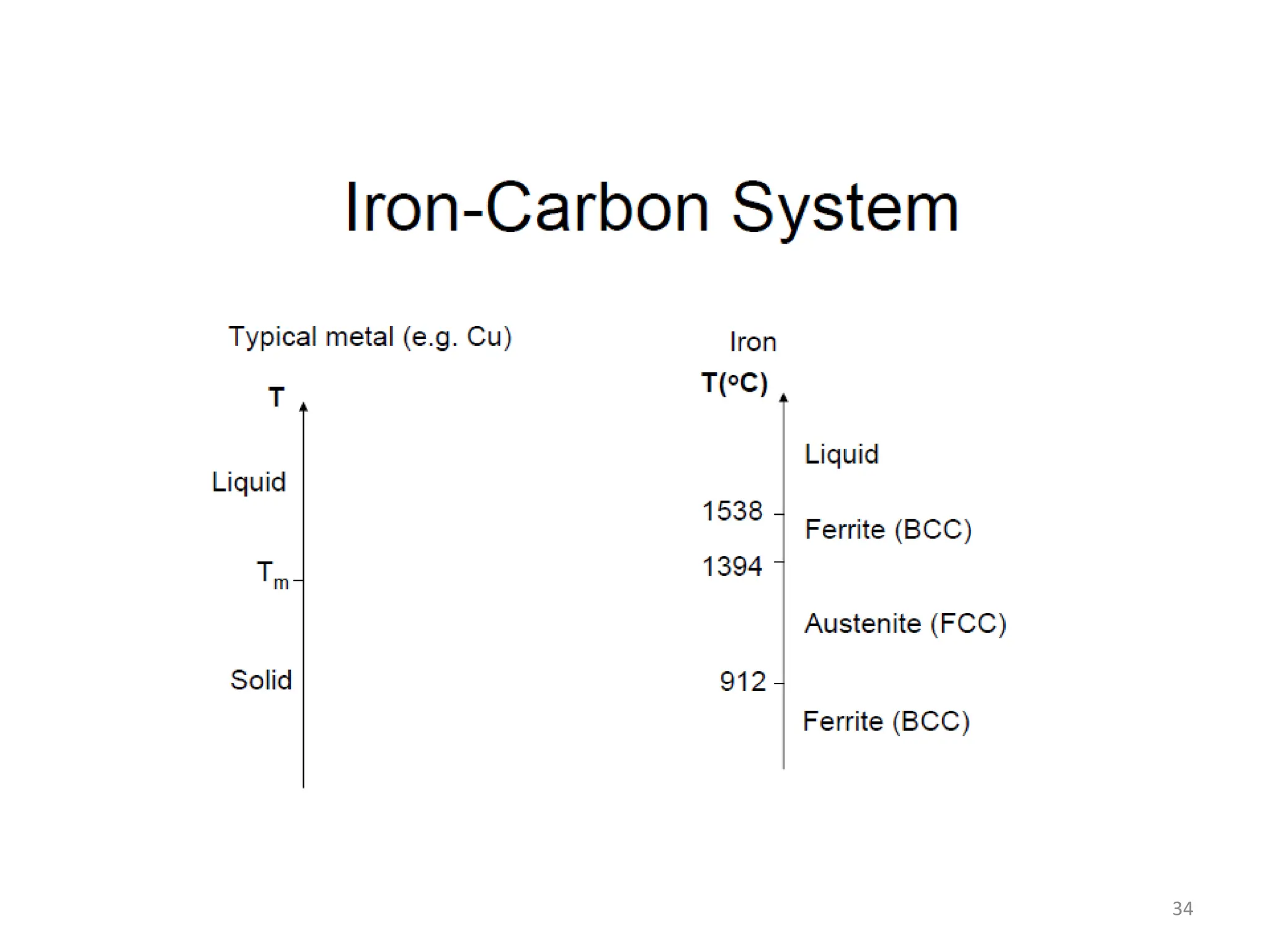
Fe-C Phase Diagram
33
34
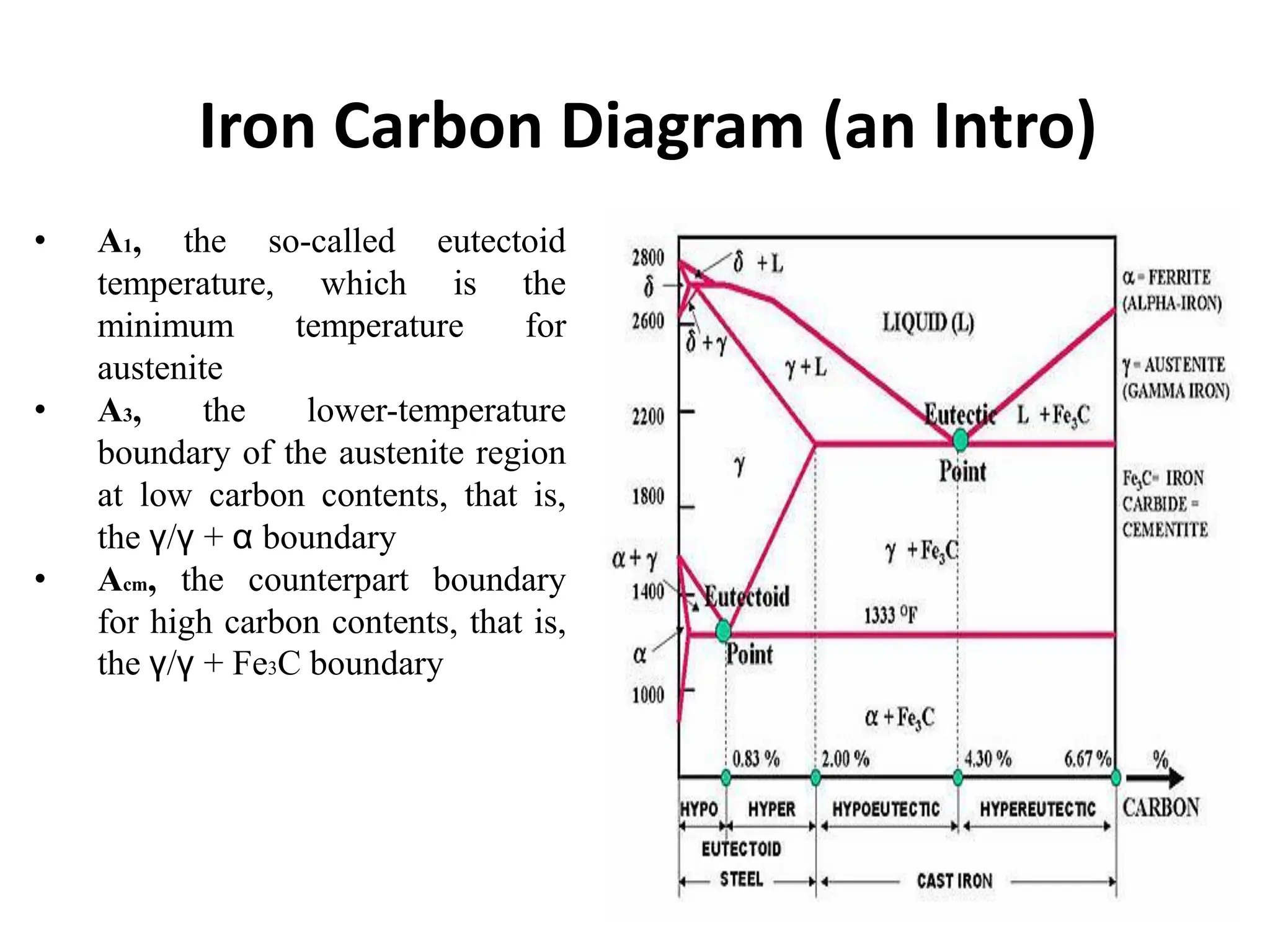
Iron Carbon Diagram (an Intro)
35
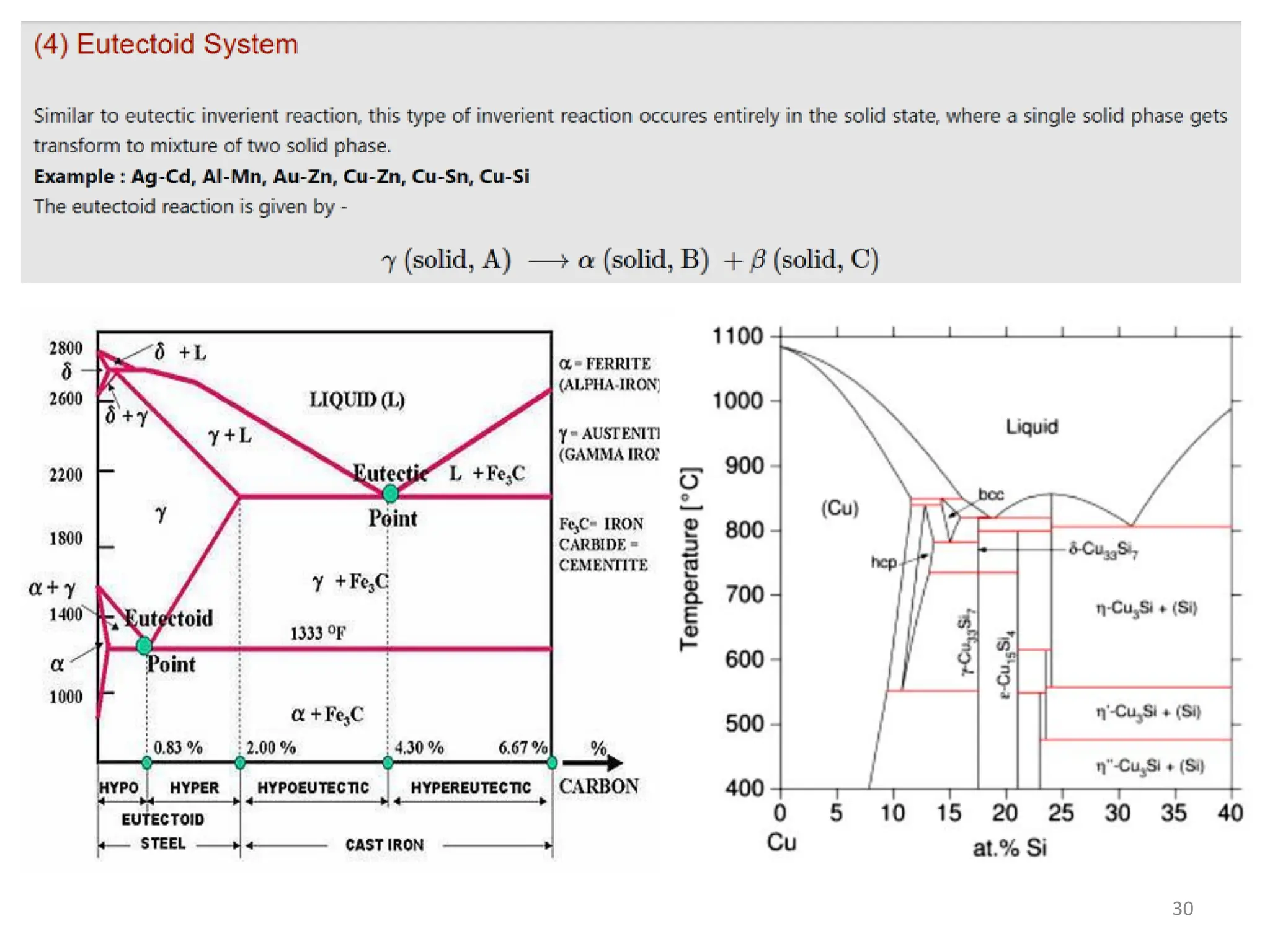
• A1, the so-called eutectoid
temperature, which is the
minimum temperature for
austenite
• A3, the lower-temperature
boundary of the austenite region
at low carbon contents, that is,
the γ/γ + α boundary
• Acm, the counterpart boundary
for high carbon contents, that is,
the γ/γ + Fe3C boundary
36
37
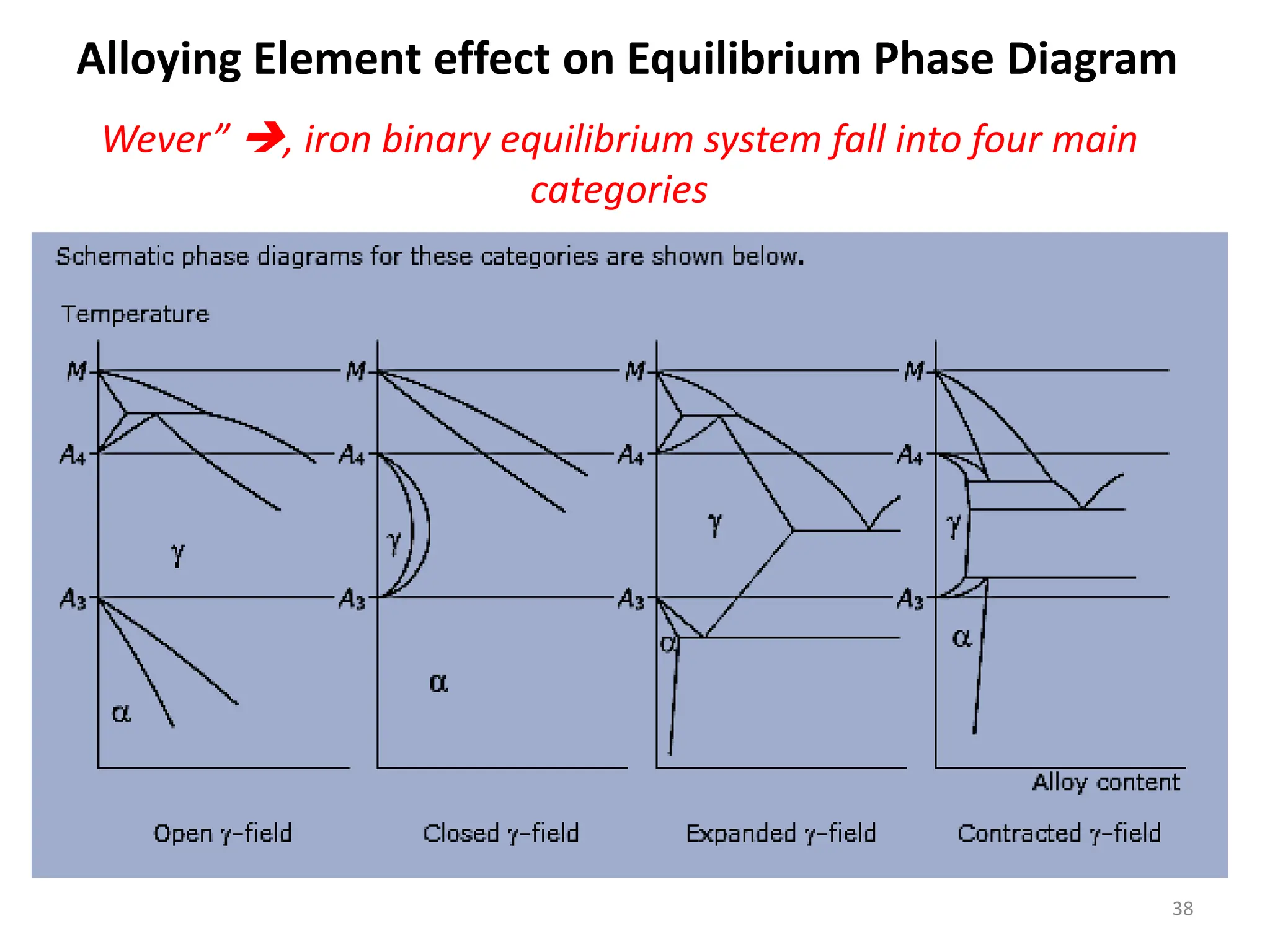
Wever” , iron binary equilibrium system fall into four main
categories
Alloying Element effect on Equilibrium Phase Diagram
38
39
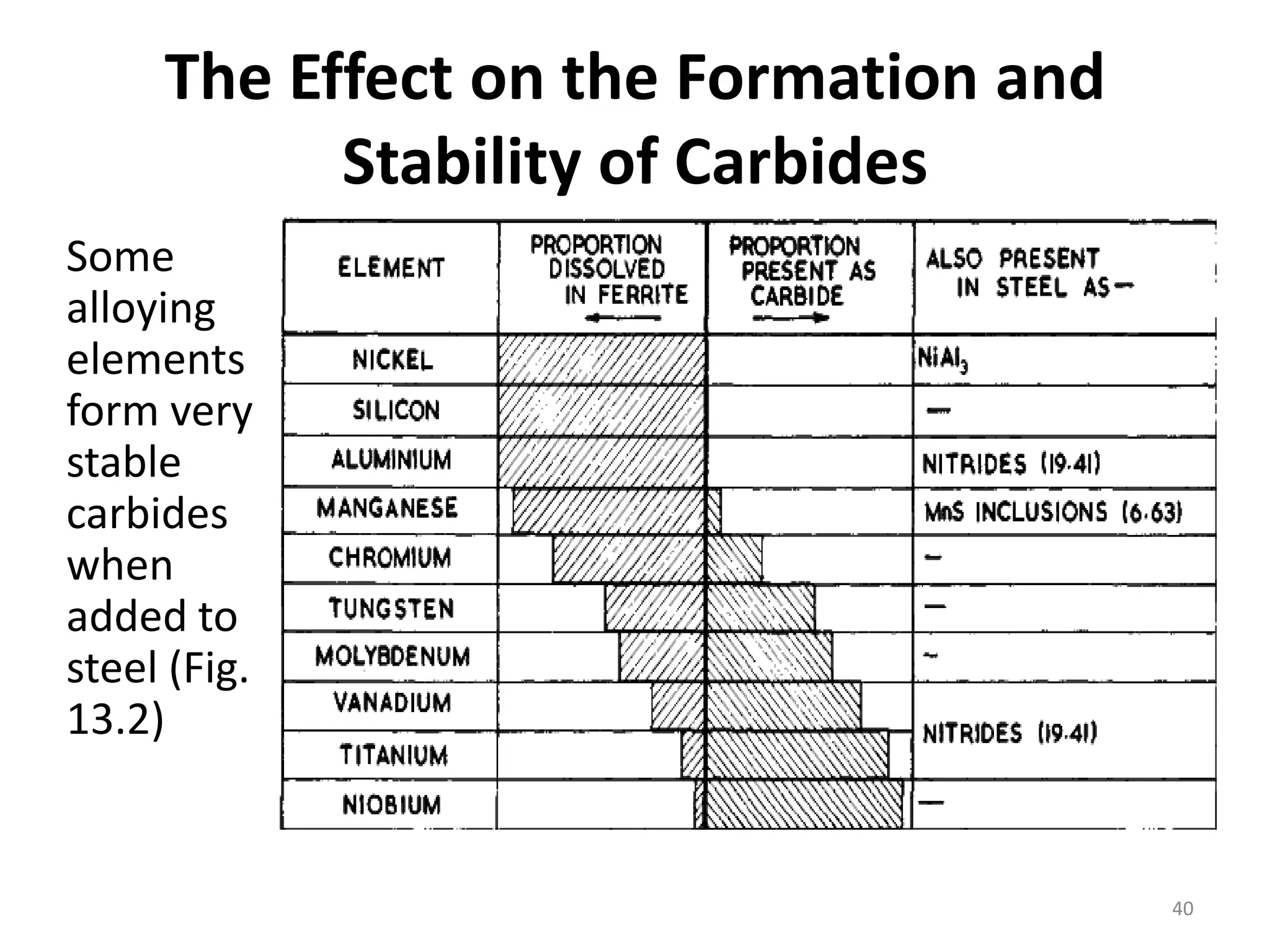
The Effect on the Formation and
Stability of Carbides
Some
alloying
elements
form very
stable
carbides
when
added to
steel (Fig.
13.2)
40
Heat Treatment of Steel
According to Fe-Fe3C
41
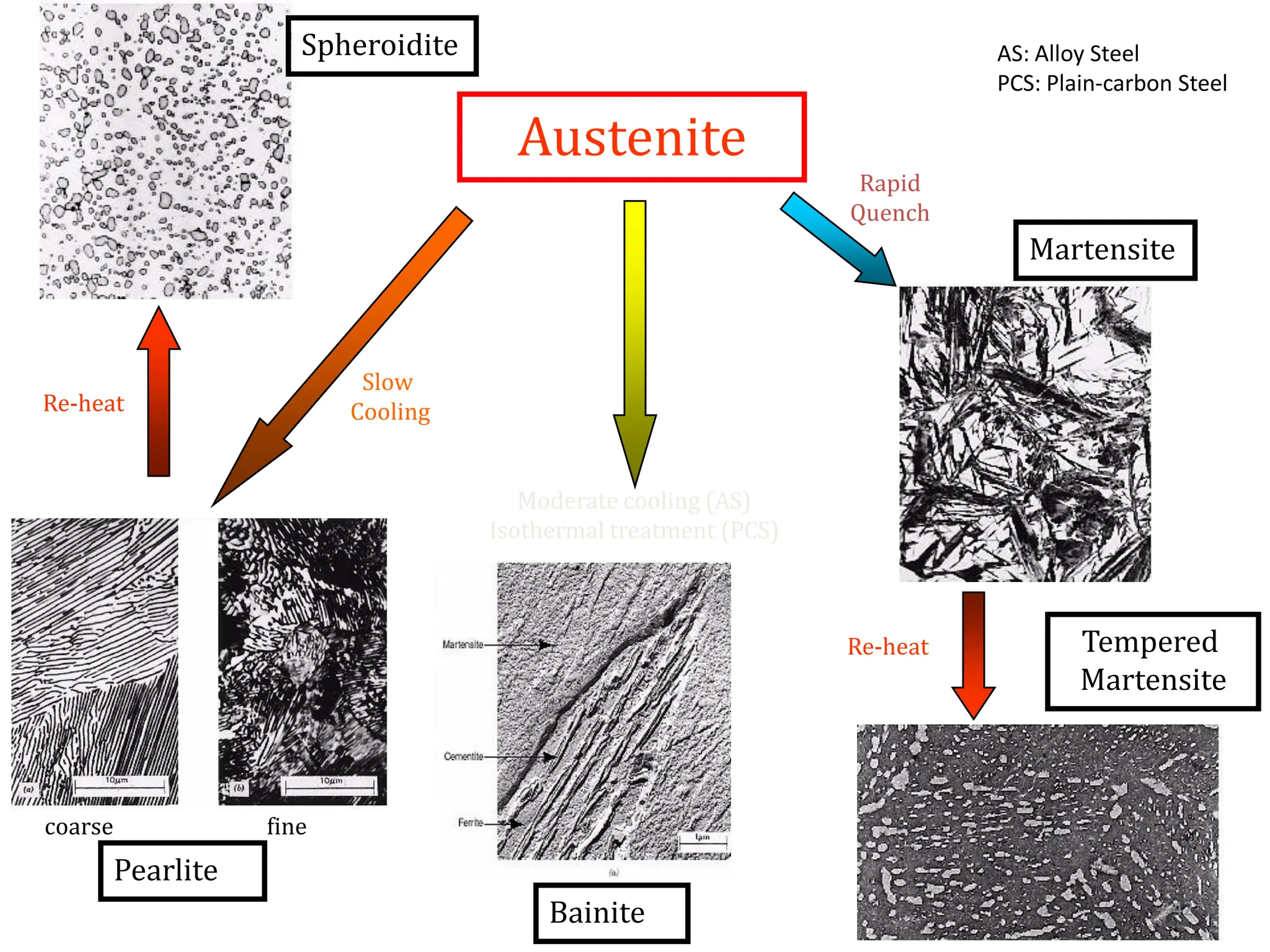
Bainite
coarse fine
Austenite
Martensite
Moderate cooling (AS)
Isothermal treatment (PCS)
Tempered
Martensite
Pearlite
AS: Alloy Steel
PCS: Plain-carbon Steel
Slow
Cooling
Rapid
Quench
Spheroidite
Re-heat
Re-heat
42
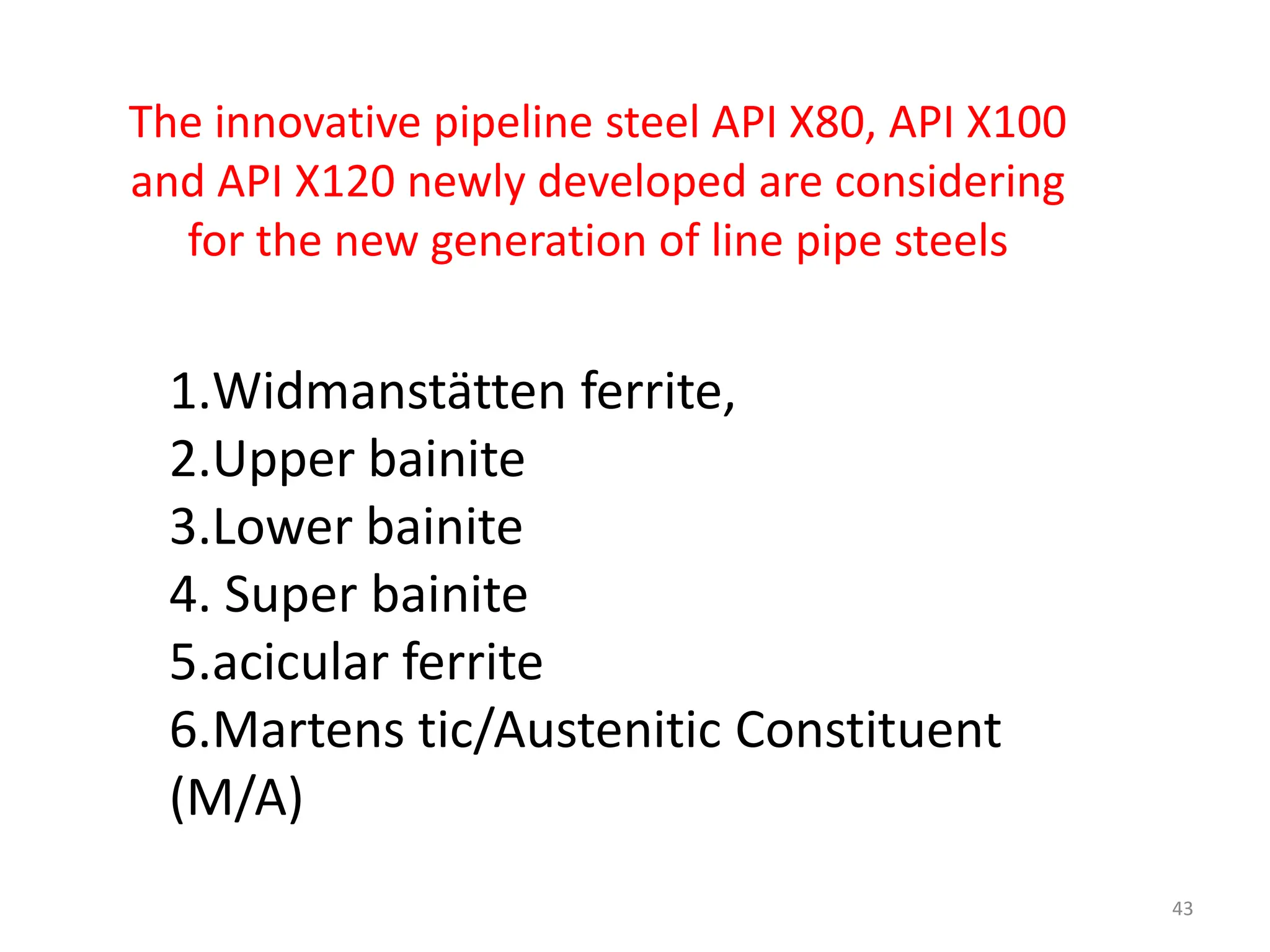
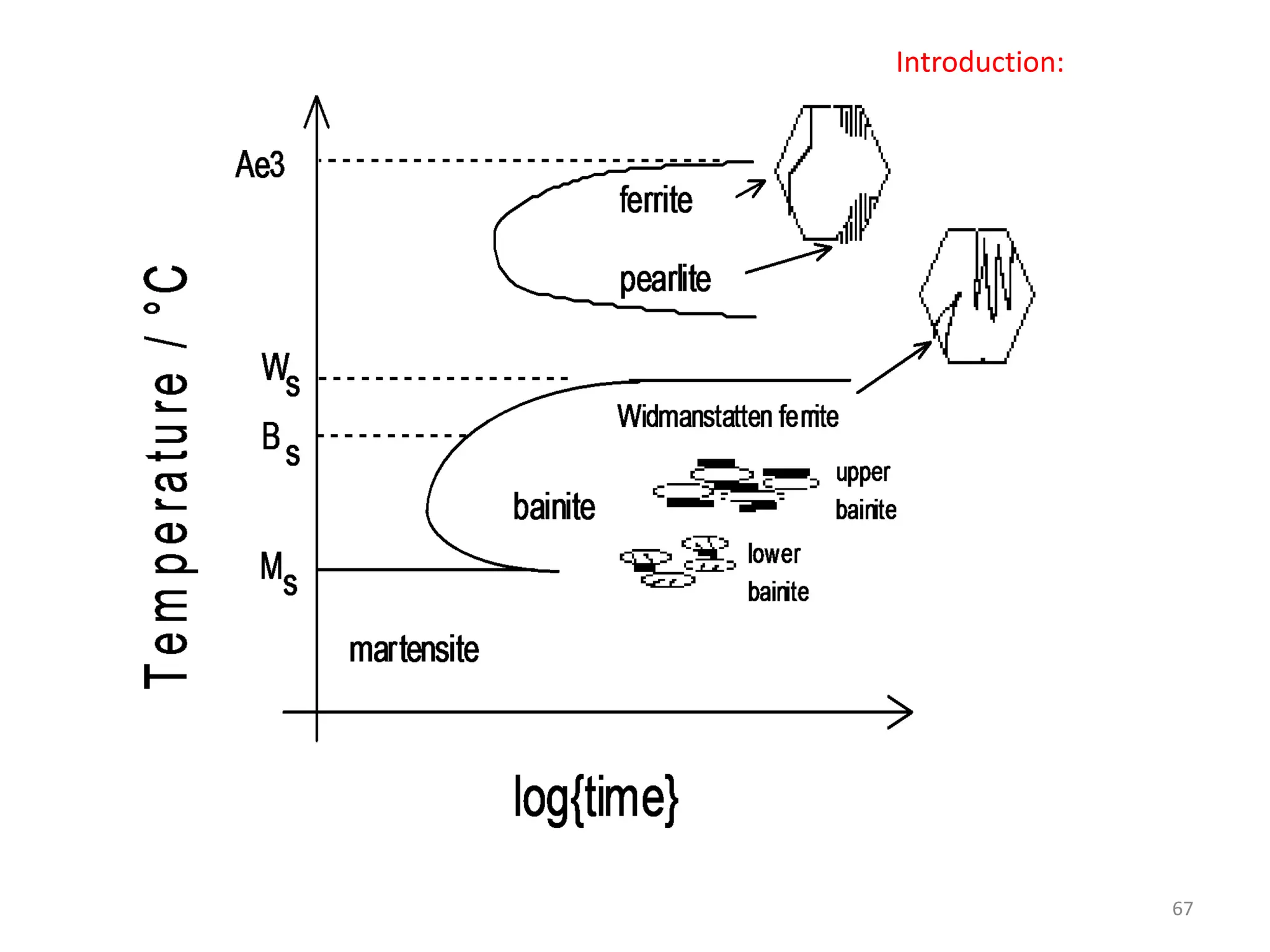
1.Widmanstätten ferrite,
2.Upper bainite
3.Lower bainite
4. Super bainite
5.acicular ferrite
6.Martens tic/Austenitic Constituent
(M/A)
43
The innovative pipeline steel API X80, API X100
and API X120 newly developed are considering
for the new generation of line pipe steels
Interphase Migration
44
Interphase Migration
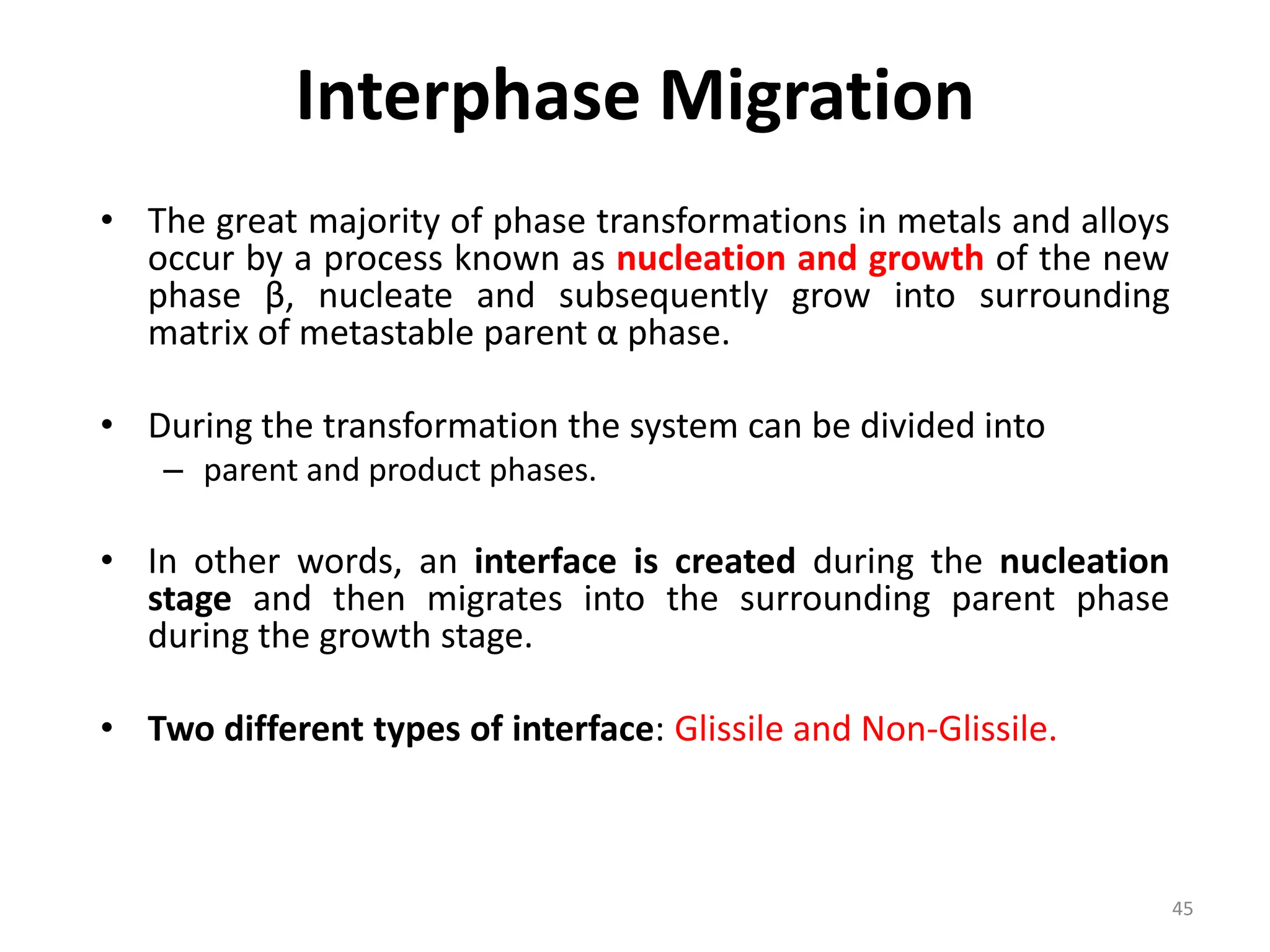
• The great majority of phase transformations in metals and alloys
occur by a process known as nucleation and growth of the new
phase β, nucleate and subsequently grow into surrounding
matrix of metastable parent α phase.
• During the transformation the system can be divided into
– parent and product phases.
• In other words, an interface is created during the nucleation
stage and then migrates into the surrounding parent phase
during the growth stage.
• Two different types of interface: Glissile and Non-Glissile.
45
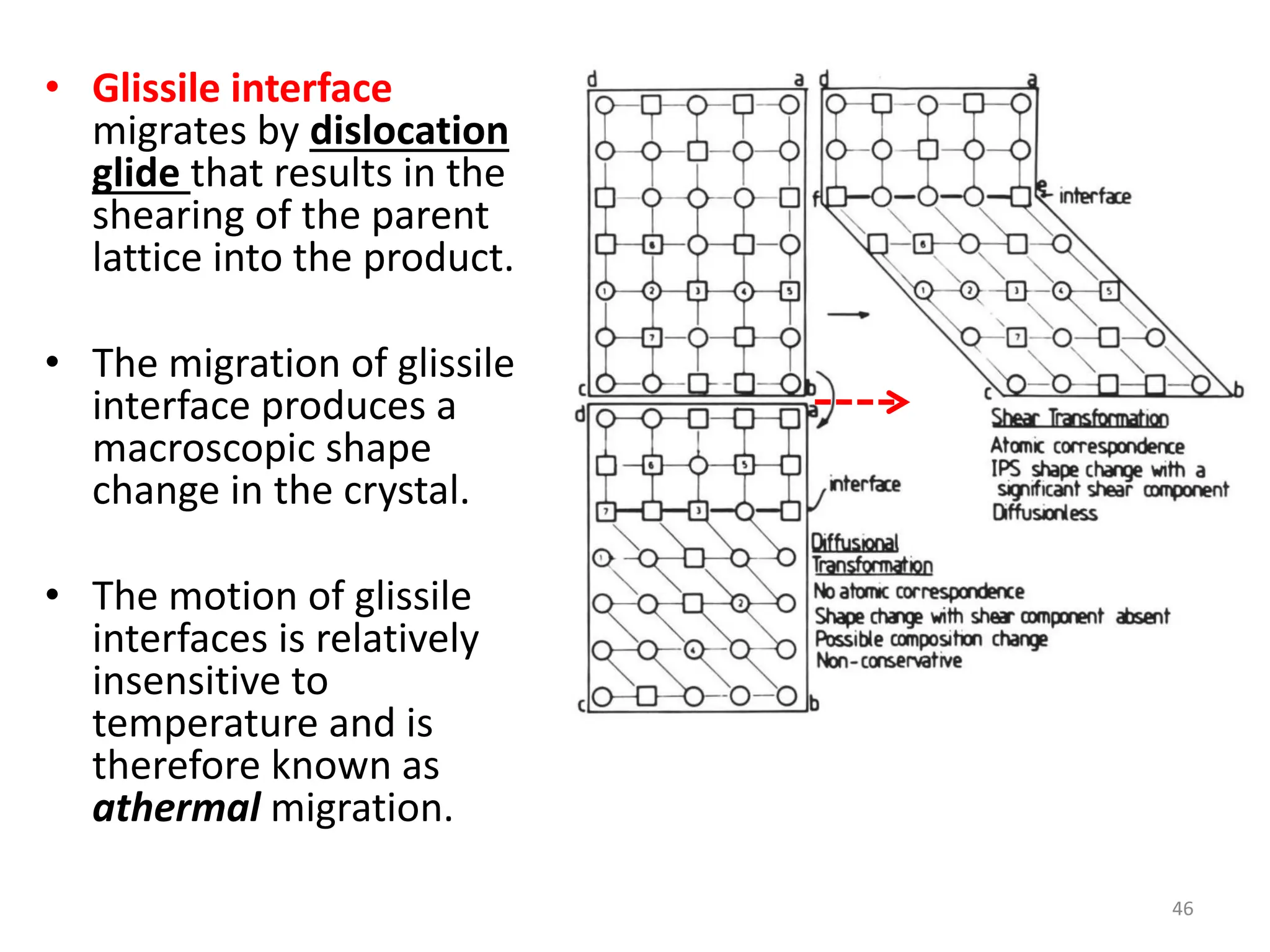
• Glissile interface
migrates by dislocation
glide that results in the
shearing of the parent
lattice into the product.
• The migration of glissile
interface produces a
macroscopic shape
change in the crystal.
• The motion of glissile
interfaces is relatively
insensitive to
temperature and is
therefore known as
athermal migration.
46
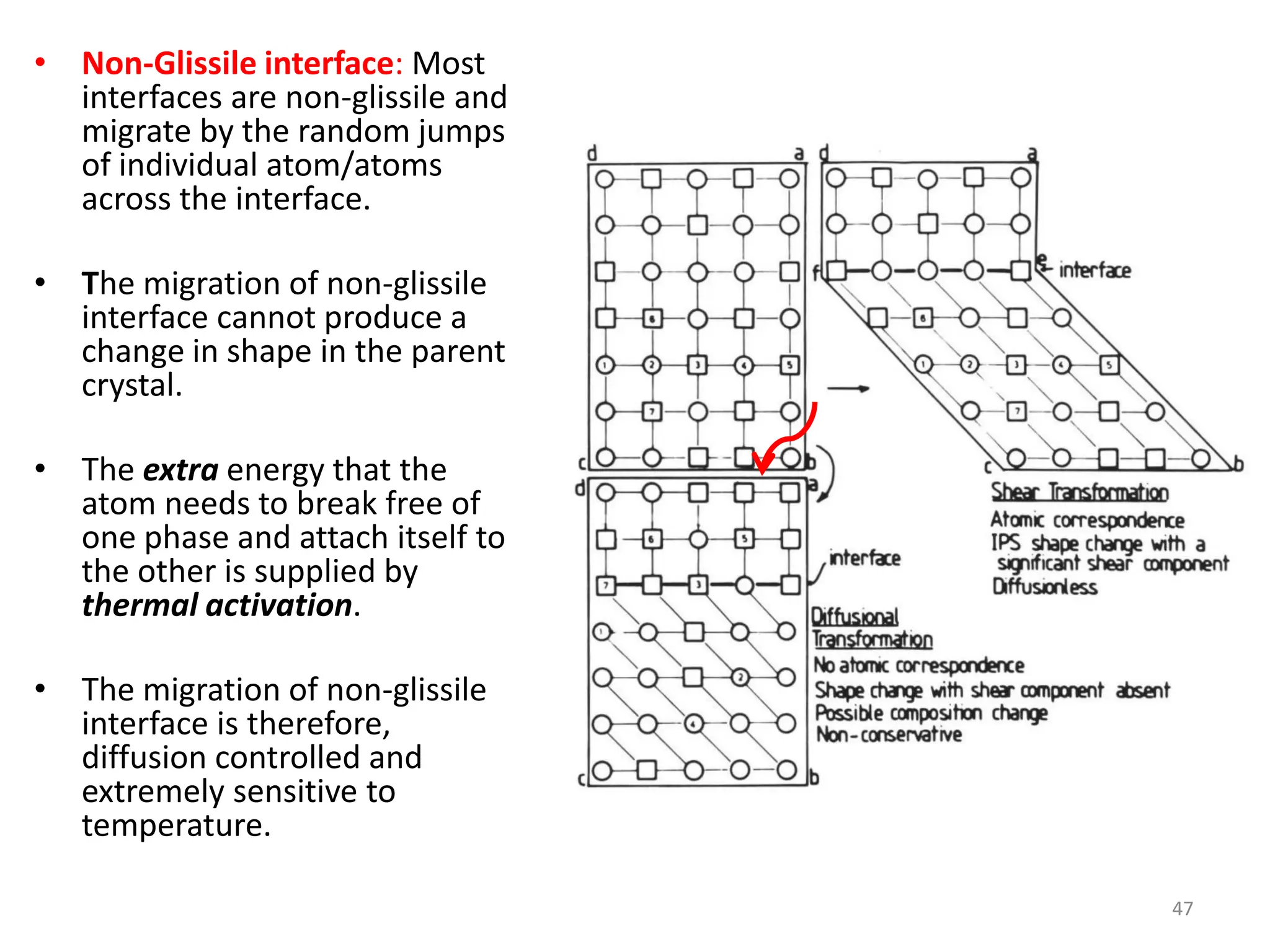
• Non-Glissile interface: Most
interfaces are non-glissile and
migrate by the random jumps
of individual atom/atoms
across the interface.
• The migration of non-glissile
interface cannot produce a
change in shape in the parent
crystal.
• The extra energy that the
atom needs to break free of
one phase and attach itself to
the other is supplied by
thermal activation.
• The migration of non-glissile
interface is therefore,
diffusion controlled and
extremely sensitive to
temperature.
47
Classification of Phase
Transformations
48
https://www.phase-
trans.msm.cam.ac.uk/index.html
Classification of Phase
Transformations
• The nucleation and growth transformations
can be classified into two groups:
1. the phases that grow by the movement of
glissile interface .
2. the phases that grow by the movement of
non-glissile interfaces.
49
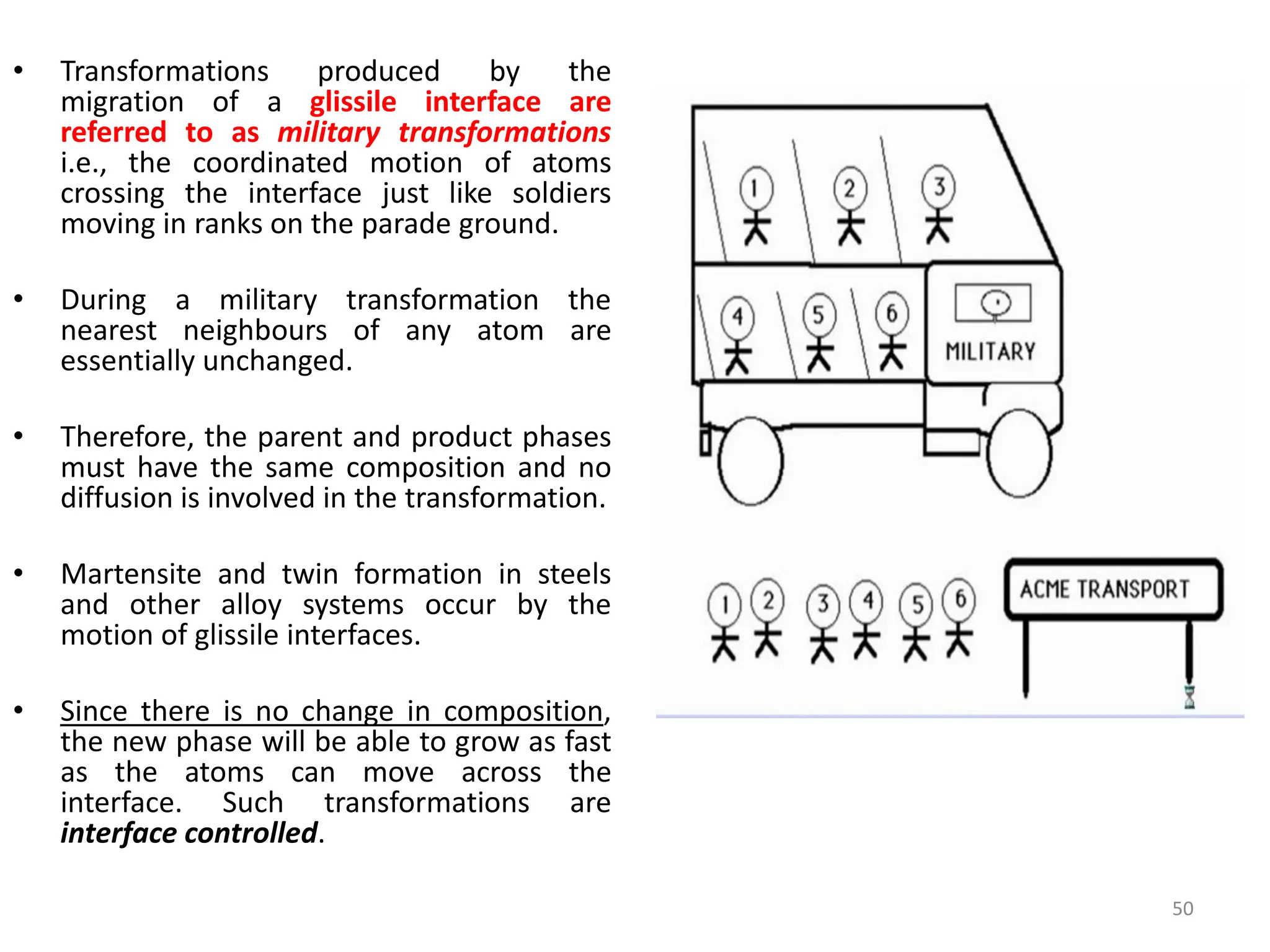
• Transformations produced by the
migration of a glissile interface are
referred to as military transformations
i.e., the coordinated motion of atoms
crossing the interface just like soldiers
moving in ranks on the parade ground.
• During a military transformation the
nearest neighbours of any atom are
essentially unchanged.
• Therefore, the parent and product phases
must have the same composition and no
diffusion is involved in the transformation.
• Martensite and twin formation in steels
and other alloy systems occur by the
motion of glissile interfaces.
• Since there is no change in composition,
the new phase will be able to grow as fast
as the atoms can move across the
interface. Such transformations are
interface controlled.
50
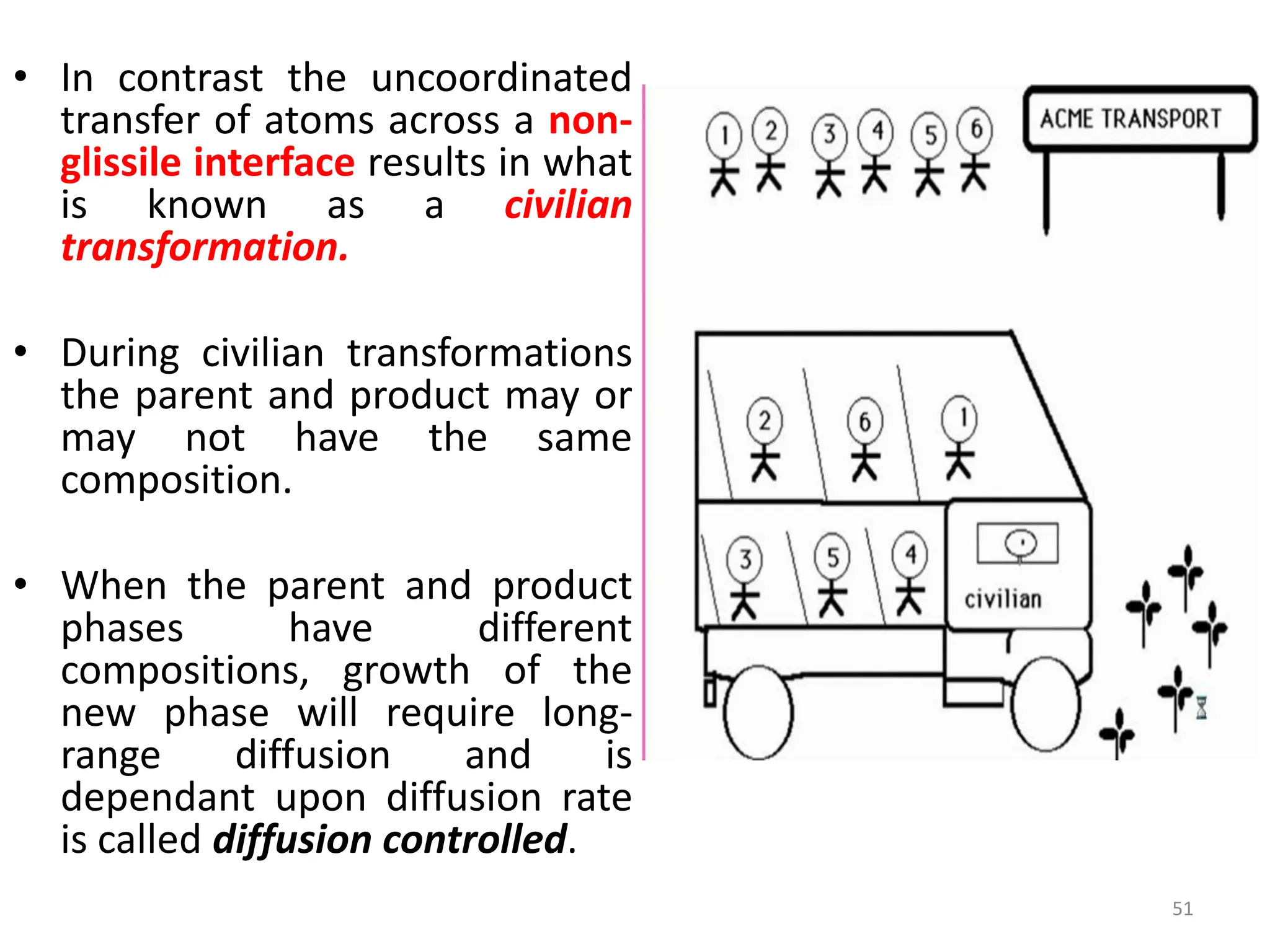
• In contrast the uncoordinated
transfer of atoms across a non-
glissile interface results in what
is known as a civilian
transformation.
• During civilian transformations
the parent and product may or
may not have the same
composition.
• When the parent and product
phases have different
compositions, growth of the
new phase will require long-
range diffusion and is
dependant upon diffusion rate
is called diffusion controlled.
51
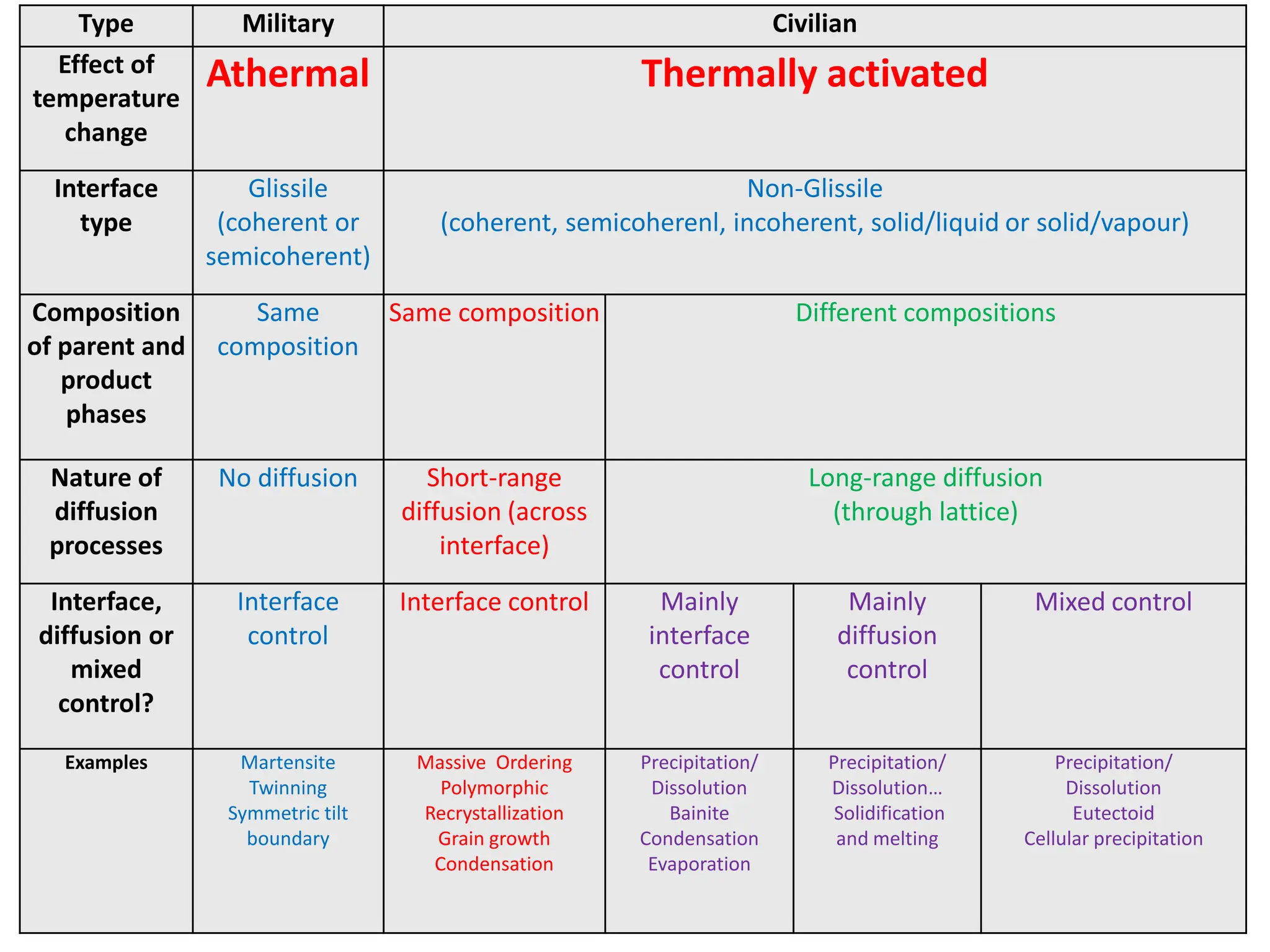
• Classification of nucleation and growth
transformations according to interface
migration process is summarized in Table 1.
• Table 1: Classification of Phase
Transformations
(Adapted from J.W. Christian, 'Phase
transformations in metals and alloys -An
introduction', in Phase Transformations, Vol.
1, p. 1, Institute of Metallurgists, 1979.)
52
53
Type Military Civilian
Effect of
temperature
change
Athermal Thermally activated
Interface
type
Glissile
(coherent or
semicoherent)
Non-Glissile
(coherent, semicoherenl, incoherent, solid/liquid or solid/vapour)
Composition
of parent and
product
phases
Same
composition
Same composition Different compositions
Nature of
diffusion
processes
No diffusion Short-range
diffusion (across
interface)
Long-range diffusion
(through lattice)
Interface,
diffusion or
mixed
control?
Interface
control
Interface control Mainly
interface
control
Mainly
diffusion
control
Mixed control
Examples Martensite
Twinning
Symmetric tilt
boundary
Massive Ordering
Polymorphic
Recrystallization
Grain growth
Condensation
Precipitation/
Dissolution
Bainite
Condensation
Evaporation
Precipitation/
Dissolution…
Solidification
and melting
Precipitation/
Dissolution
Eutectoid
Cellular precipitation
54
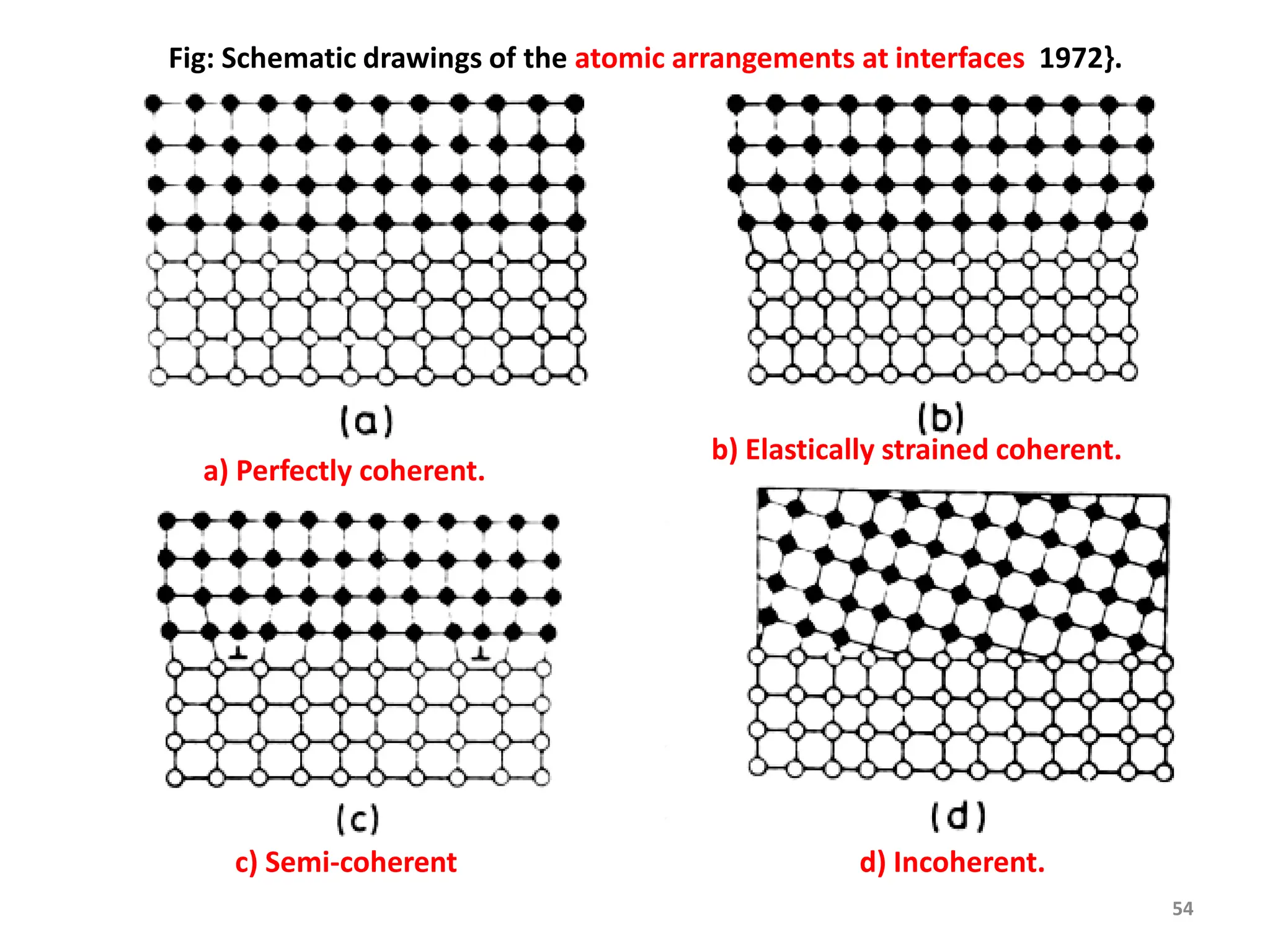
Fig: Schematic drawings of the atomic arrangements at interfaces 1972}.
a) Perfectly coherent.
b) Elastically strained coherent.
c) Semi-coherent d) Incoherent.
• While many transformations can be classified into the
above system, but there are transformations, where
difficulty arises.
• For example,
1.Widmanstätten ferrite,
2.Upper bainite
3.Lower bainite and
4.acicular ferrite
• The above listed transformations take place by thermally
activated growth(non-gillissile), but it also produces a
shape change similar to produced by the motion of a
gillissile interface.
• These transformations can conveniently be classed as
Displacive transformations as explained in Table 2.
55
56
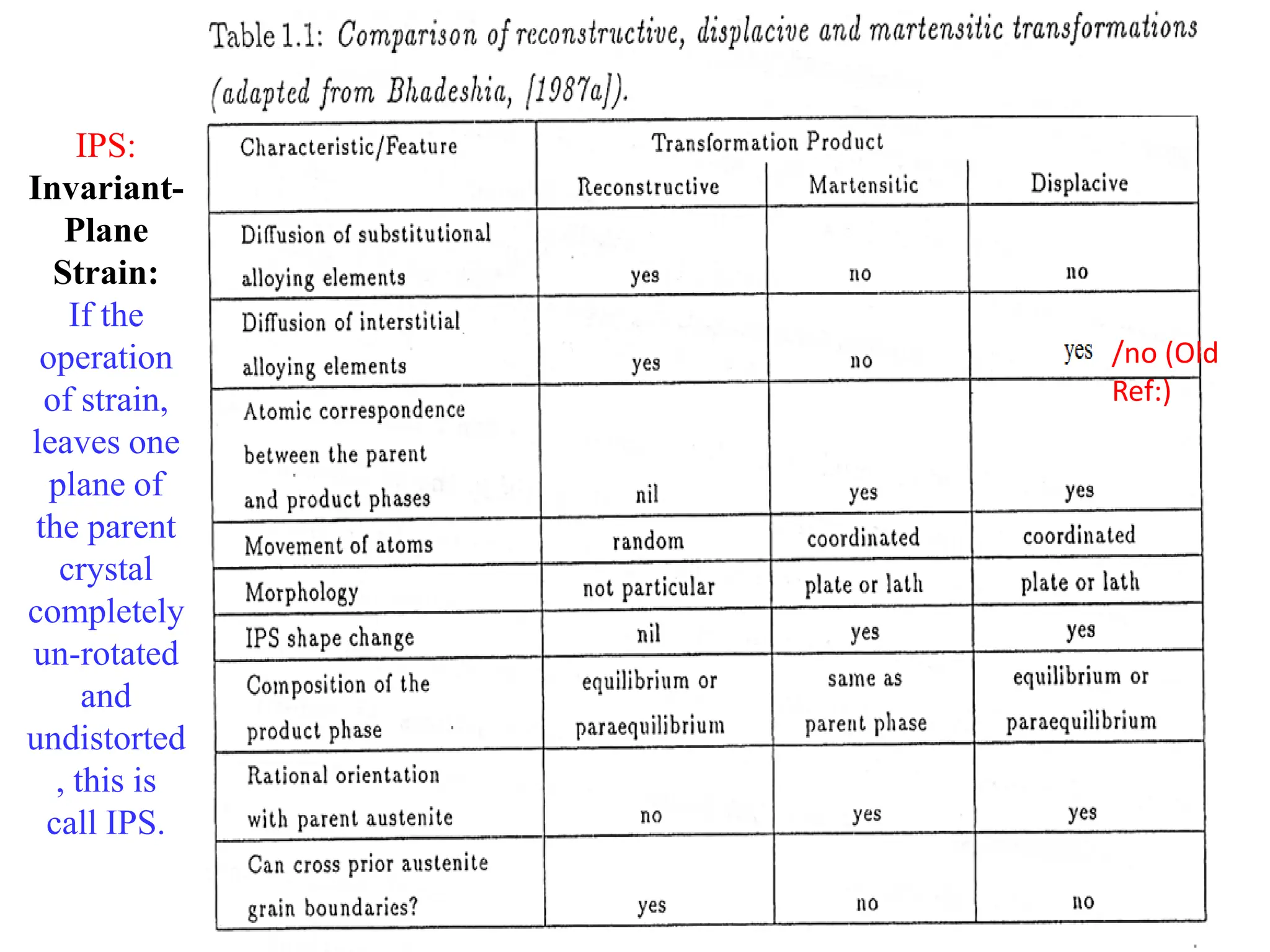
IPS:
Invariant-
Plane
Strain:
If the
operation
of strain,
leaves one
plane of
the parent
crystal
completely
un-rotated
and
undistorted
, this is
call IPS.
/no (Old
Ref:)
57
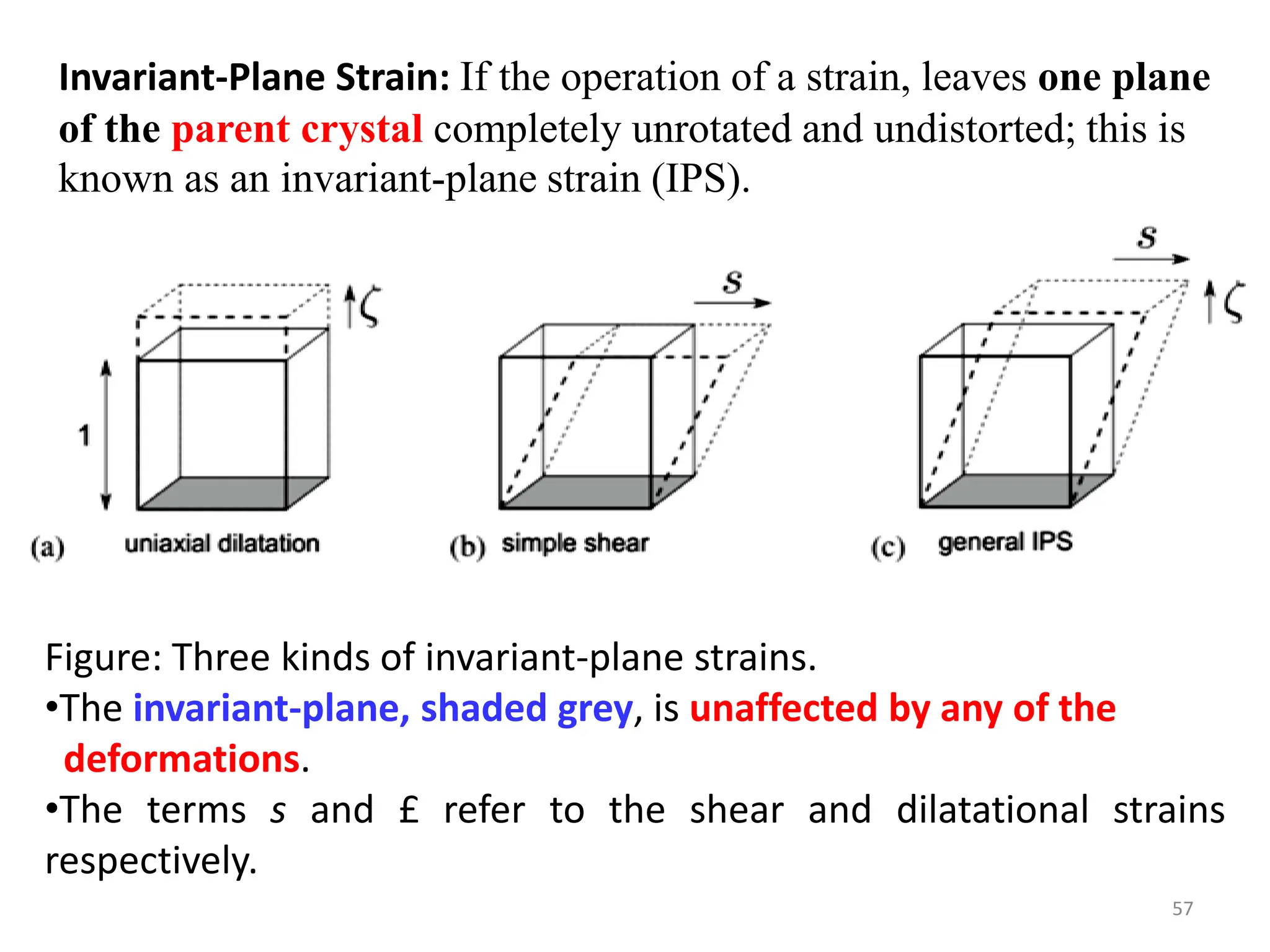
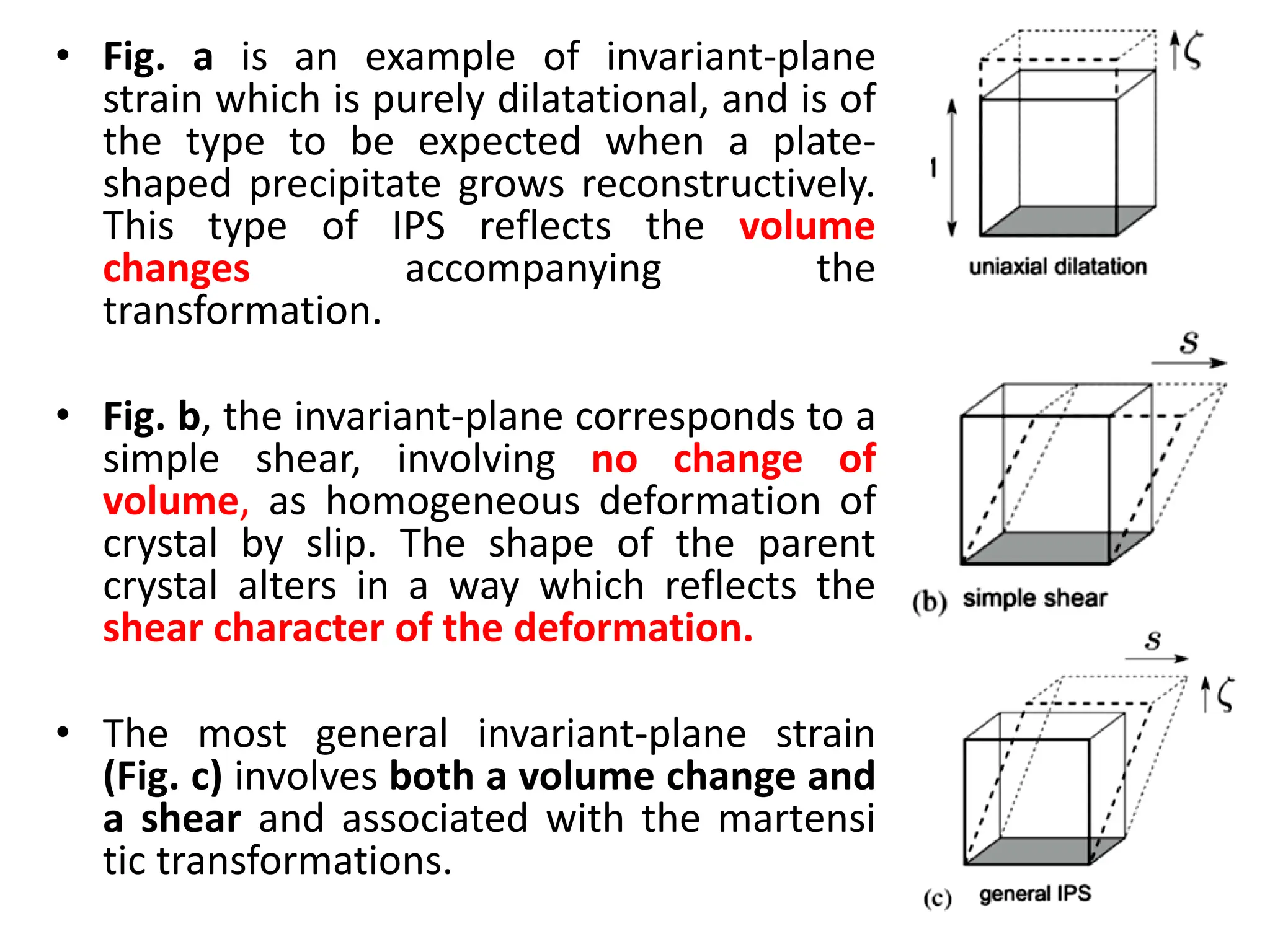
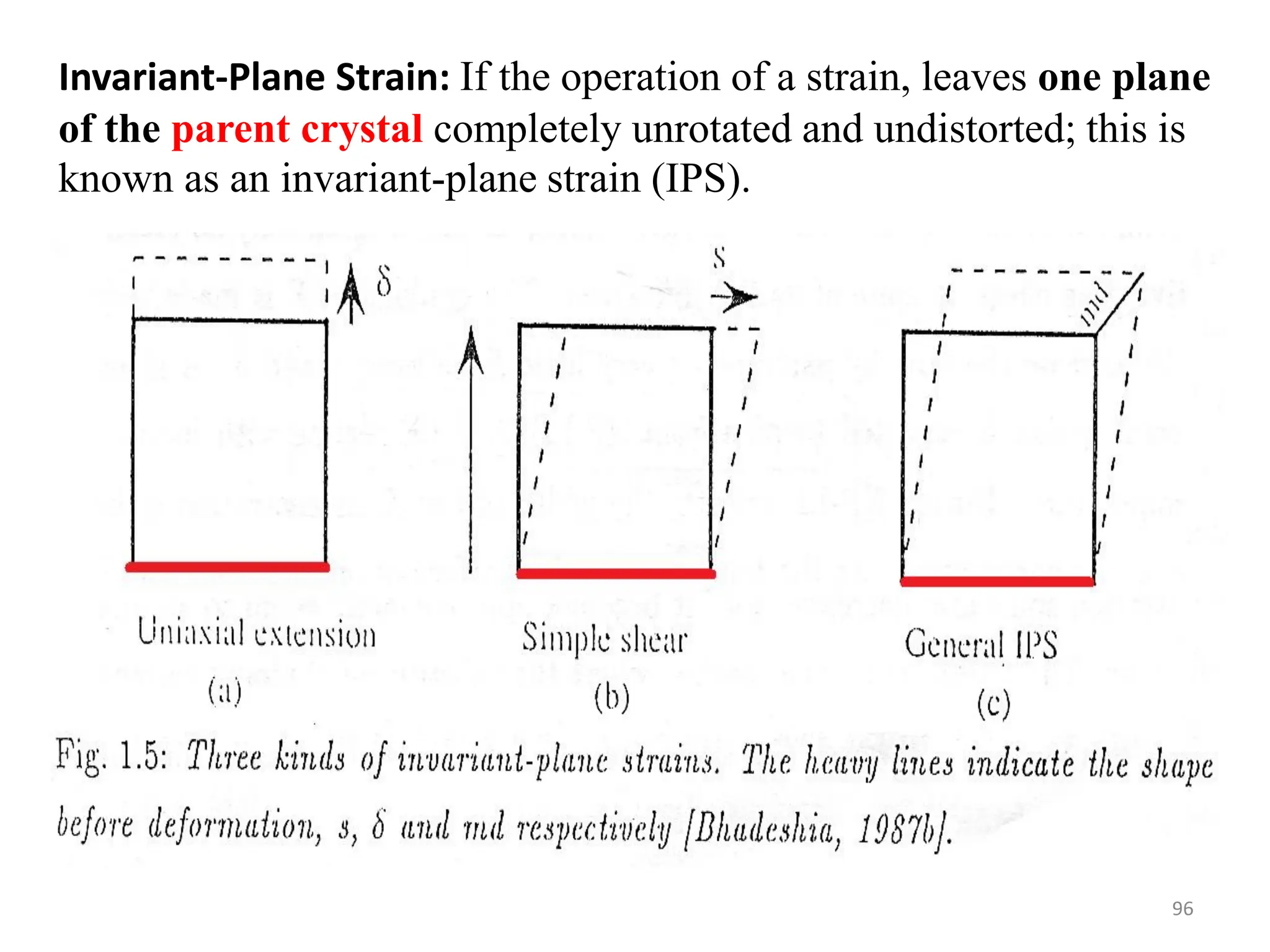
Invariant-Plane Strain: If the operation of a strain, leaves one plane
of the parent crystal completely unrotated and undistorted; this is
known as an invariant-plane strain (IPS).
Figure: Three kinds of invariant-plane strains.
•The invariant-plane, shaded grey, is unaffected by any of the
deformations.
•The terms s and £ refer to the shear and dilatational strains
respectively.
• Fig. a is an example of invariant-plane
strain which is purely dilatational, and is of
the type to be expected when a plate-
shaped precipitate grows reconstructively.
This type of IPS reflects the volume
changes accompanying the
transformation.
• Fig. b, the invariant-plane corresponds to a
simple shear, involving no change of
volume, as homogeneous deformation of
crystal by slip. The shape of the parent
crystal alters in a way which reflects the
shear character of the deformation.
• The most general invariant-plane strain
(Fig. c) involves both a volume change and
a shear and associated with the martensi
tic transformations.
58
59
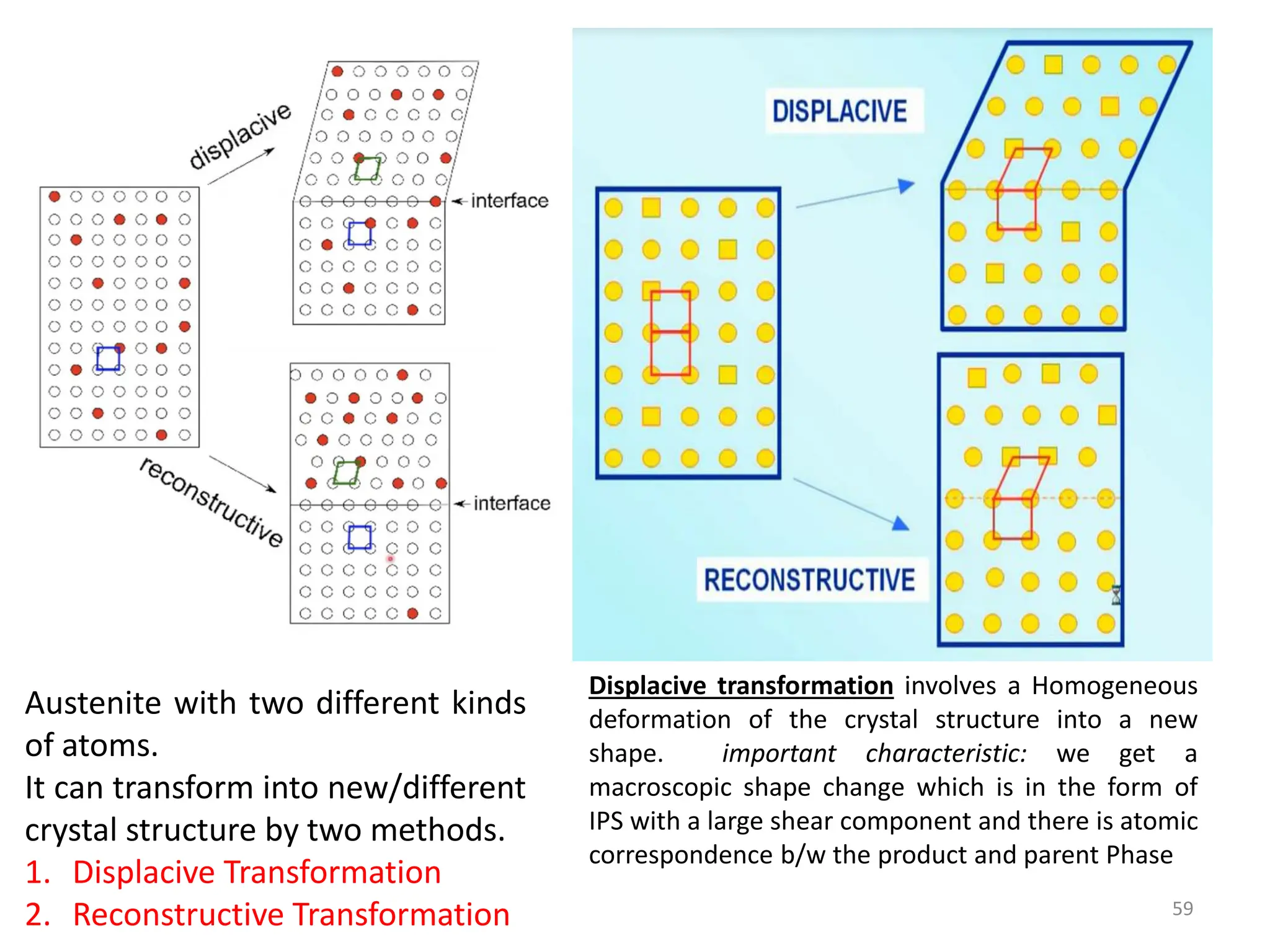
Austenite with two different kinds
of atoms.
It can transform into new/different
crystal structure by two methods.
1. Displacive Transformation
2. Reconstructive Transformation
Displacive transformation involves a Homogeneous
deformation of the crystal structure into a new
shape. important characteristic: we get a
macroscopic shape change which is in the form of
IPS with a large shear component and there is atomic
correspondence b/w the product and parent Phase
60
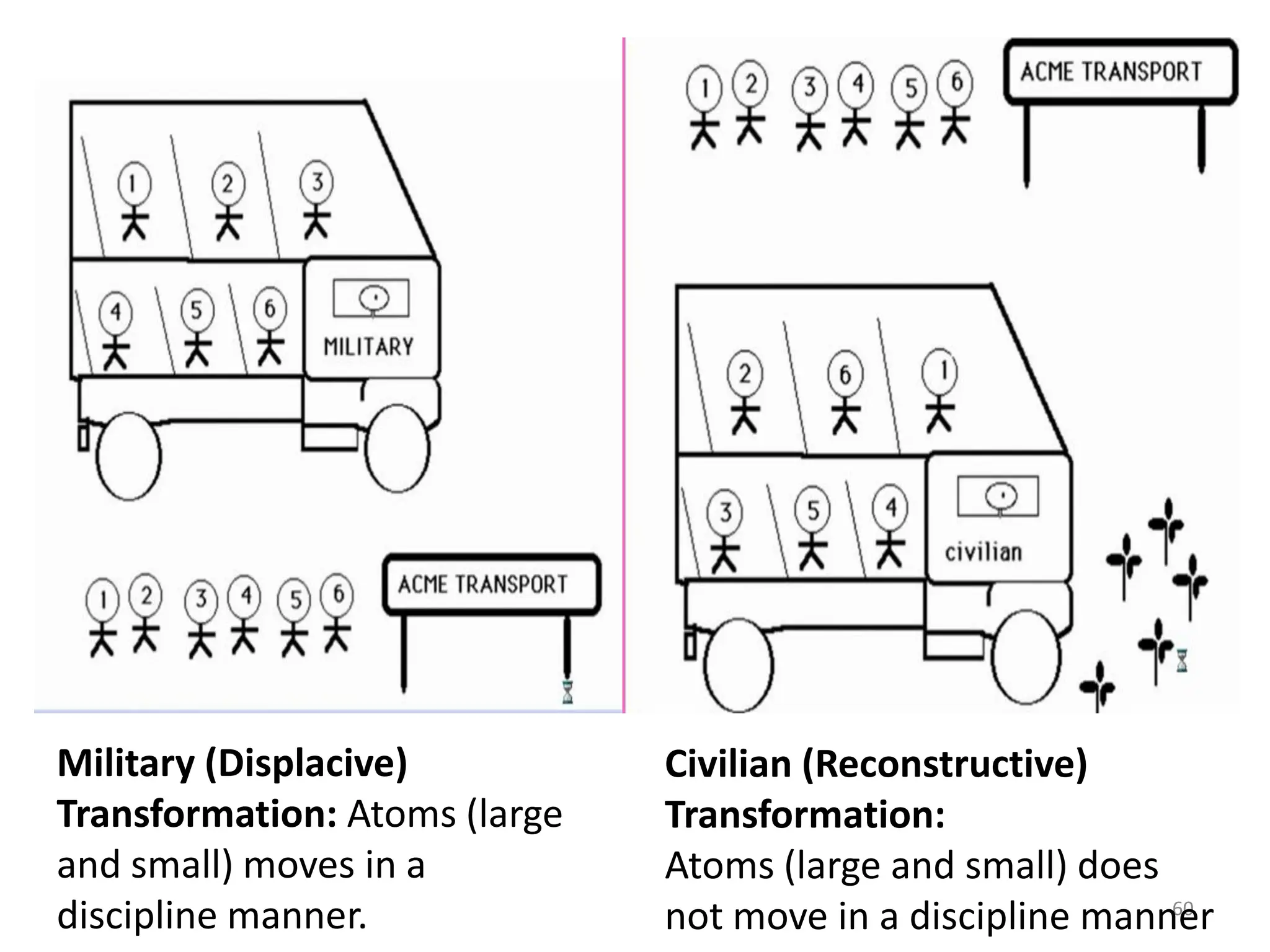
Military (Displacive)
Transformation: Atoms (large
and small) moves in a
discipline manner.
Civilian (Reconstructive)
Transformation:
Atoms (large and small) does
not move in a discipline manner
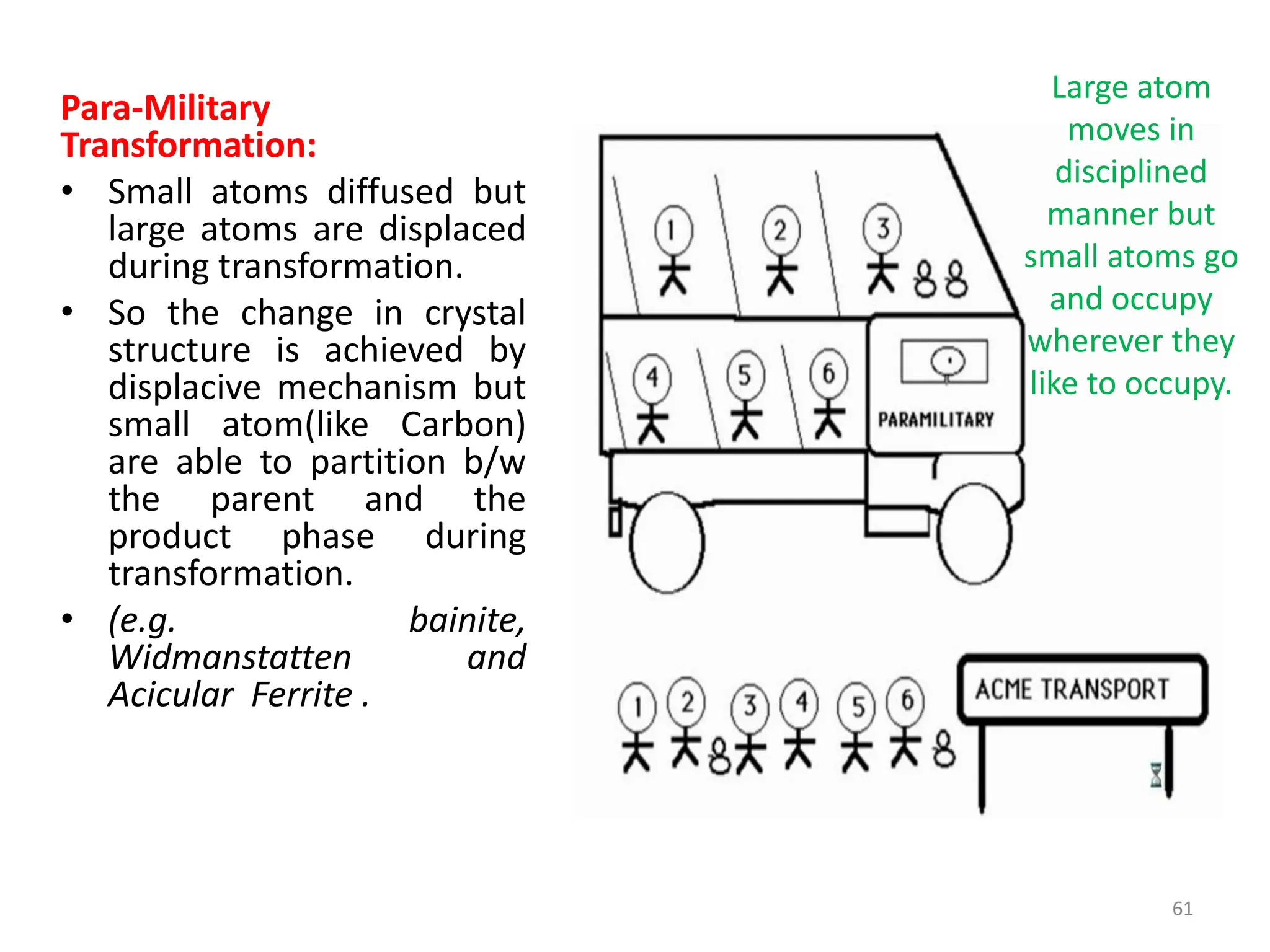
Para-Military
Transformation:
• Small atoms diffused but
large atoms are displaced
during transformation.
• So the change in crystal
structure is achieved by
displacive mechanism but
small atom(like Carbon)
are able to partition b/w
the parent and the
product phase during
transformation.
• (e.g. bainite,
Widmanstatten and
Acicular Ferrite .
61
Large atom
moves in
disciplined
manner but
small atoms go
and occupy
wherever they
like to occupy.
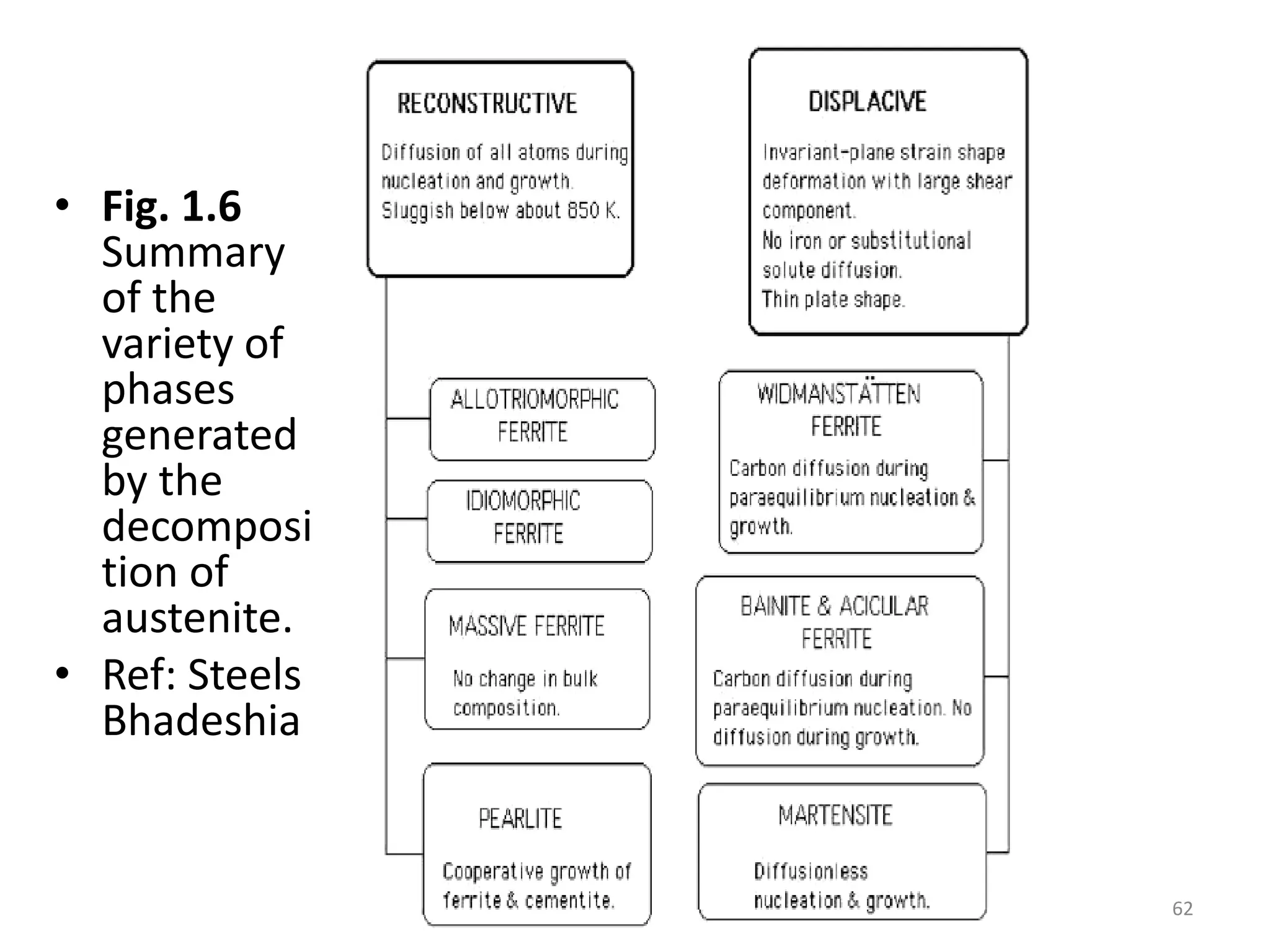
• Fig. 1.6
Summary
of the
variety of
phases
generated
by the
decomposi
tion of
austenite.
• Ref: Steels
Bhadeshia
62
• (Martensitic transformation)
• https://www.youtube.com/watch?v=OQ5lVjYssko
• https://www.youtube.com/watch?v=vdIVn3HwcbU
• https://www.youtube.com/watch?v=hXUmqM_8yJ4
(Widmanstaetten ferrite)
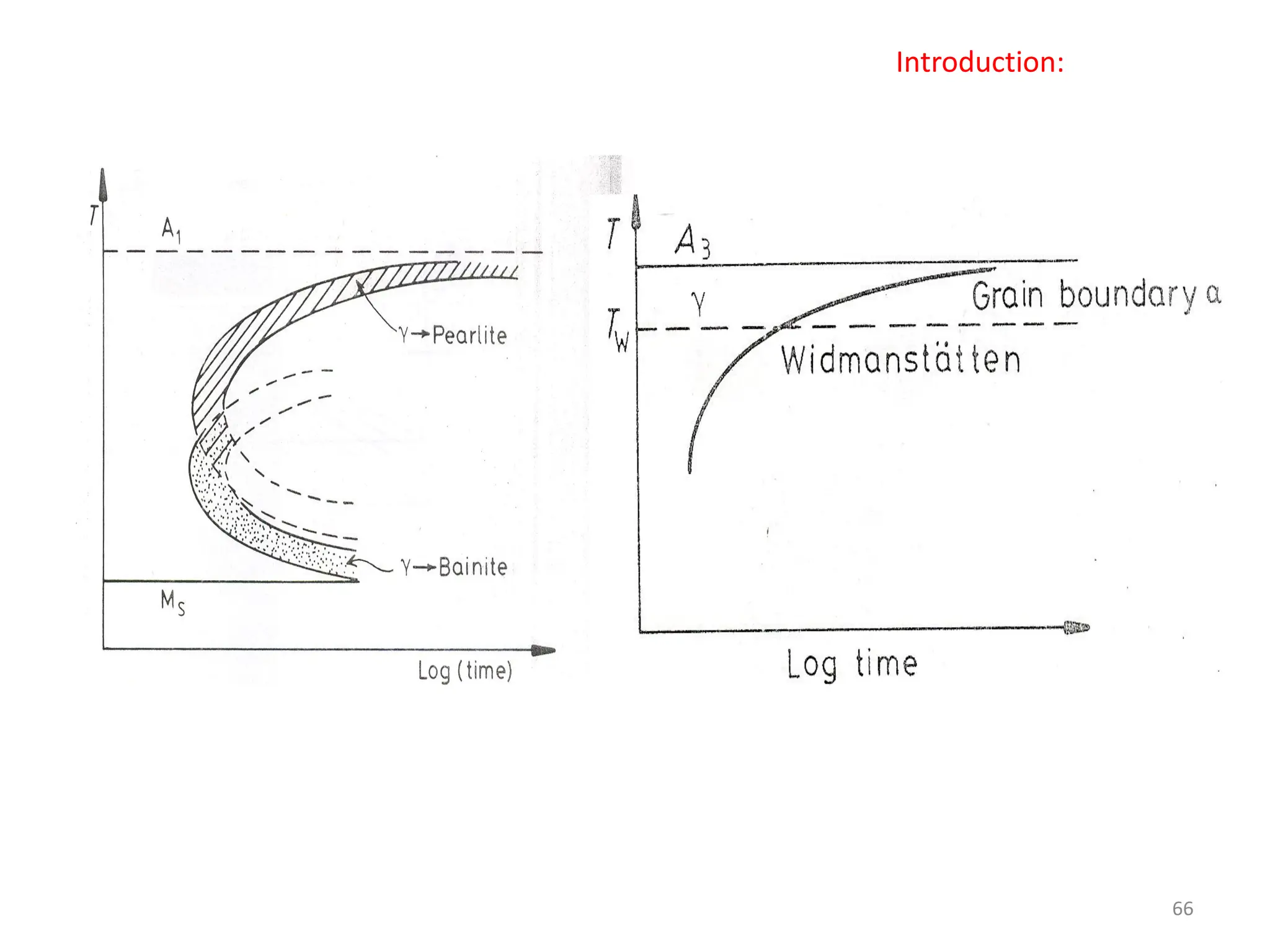
63
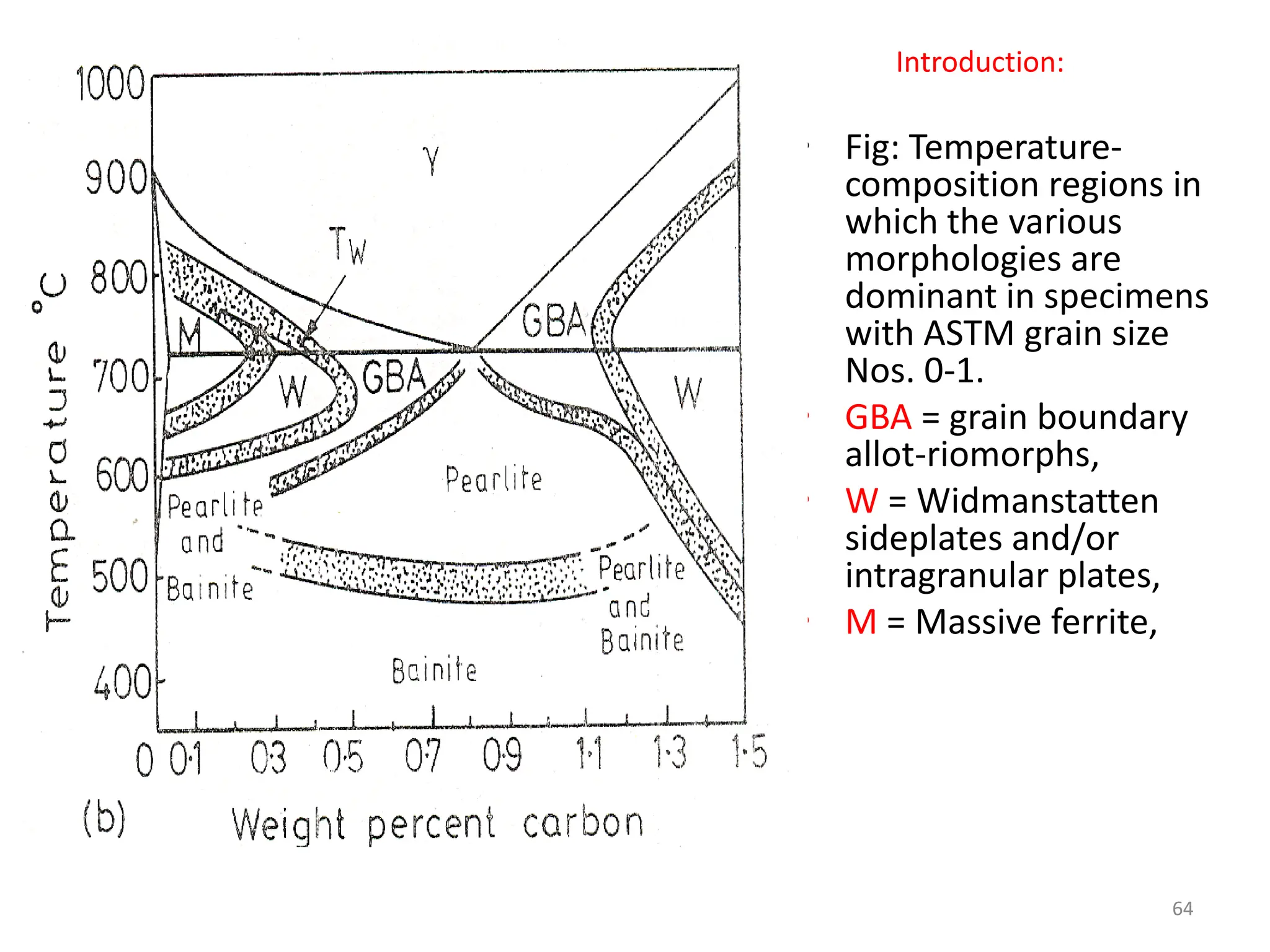
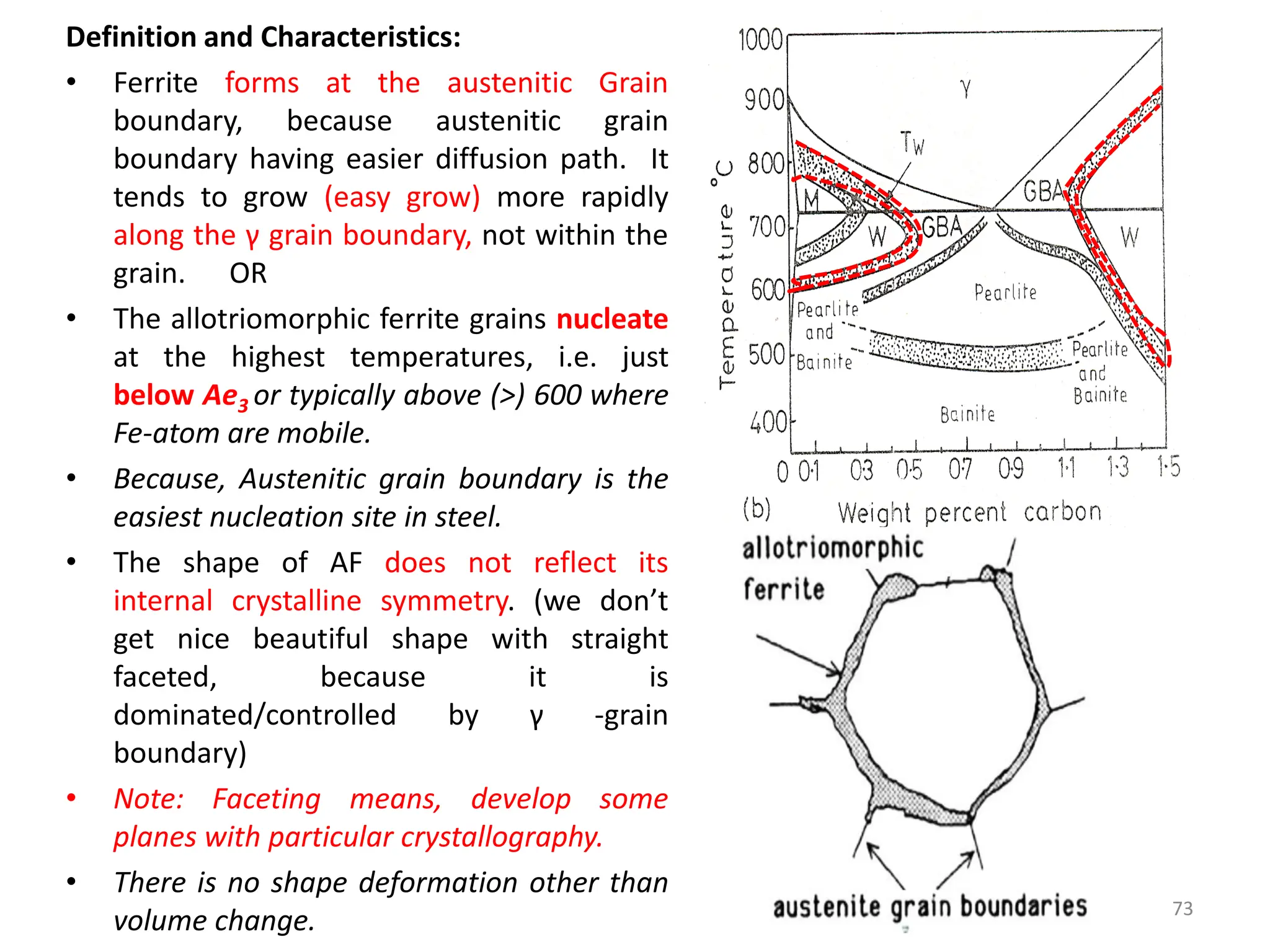
• Fig: Temperature-
composition regions in
which the various
morphologies are
dominant in specimens
with ASTM grain size
Nos. 0-1.
• GBA = grain boundary
allot-riomorphs,
• W = Widmanstatten
sideplates and/or
intragranular plates,
• M = Massive ferrite,
64
Introduction:
65
Introduction:
66
Introduction:
67
Introduction:
68
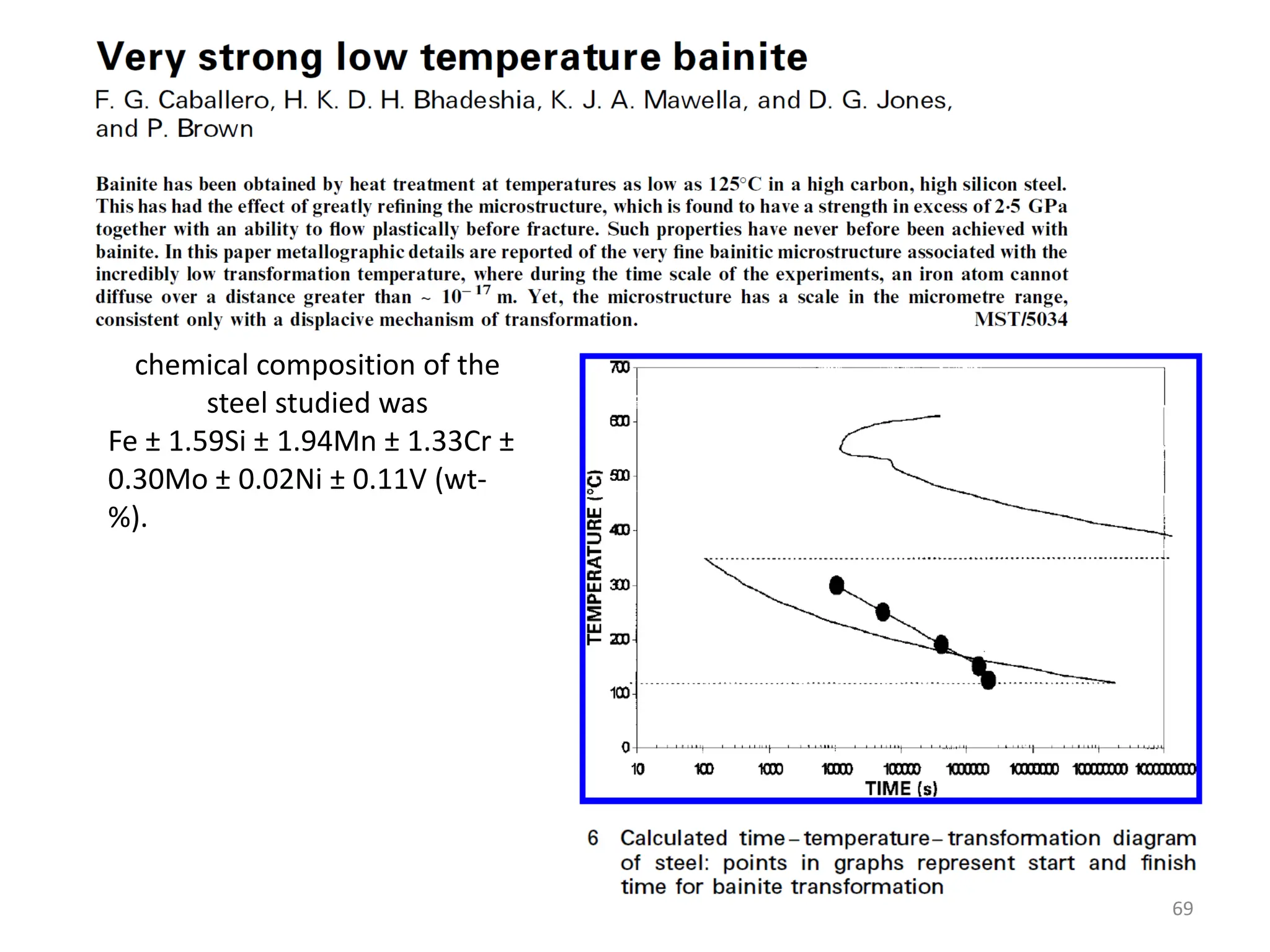
chemical composition of the
steel studied was
Fe ± 1.59Si ± 1.94Mn ± 1.33Cr ±
0.30Mo ± 0.02Ni ± 0.11V (wt-
%).
69
Decomposition of Austenite
70
• Allotriomorphic Ferrite
• Idiomorphic Ferrite
• Massive Ferrite.
• Pearlite
71
Reconstructive decomposition of
Austenite
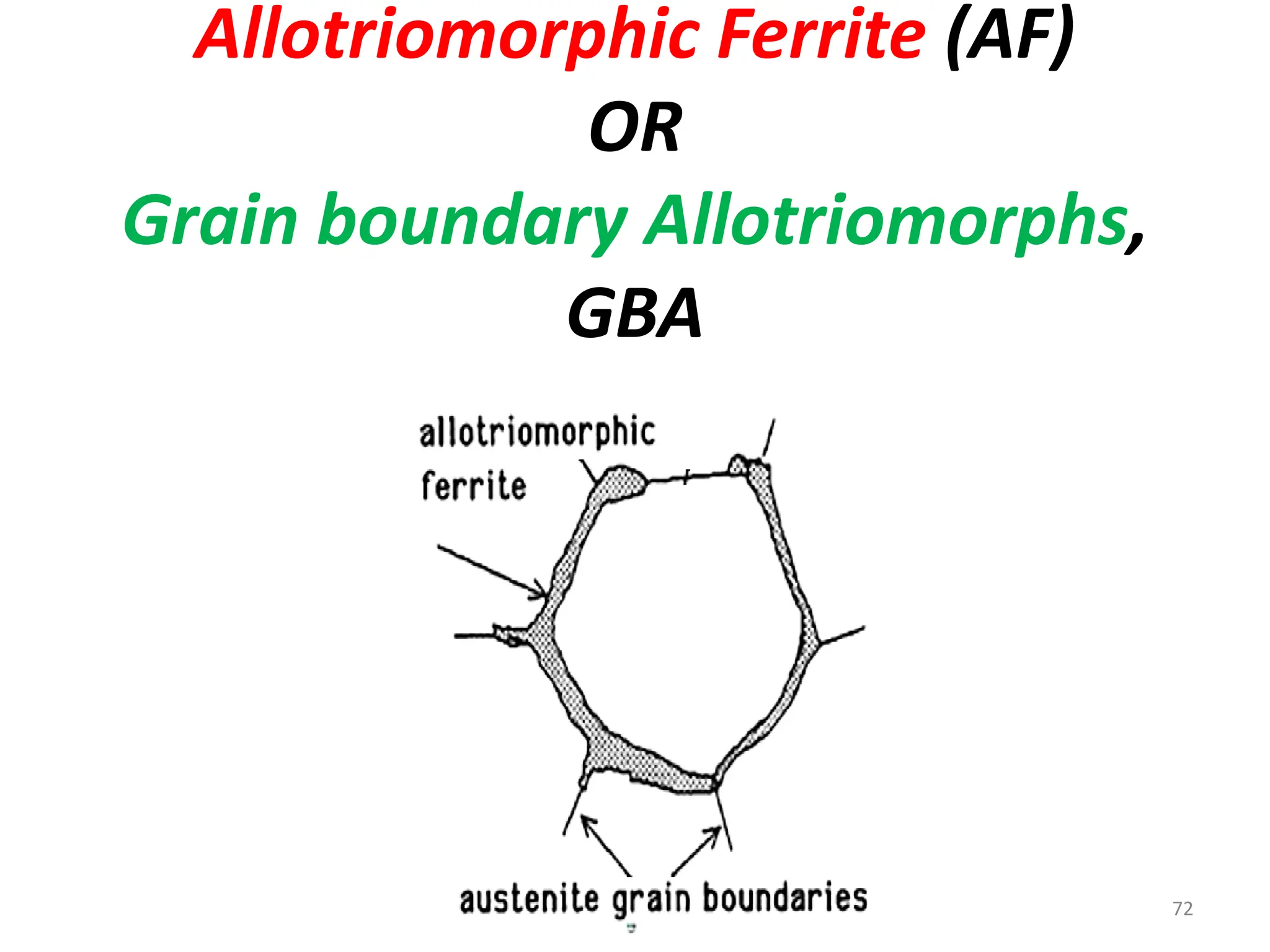
Allotriomorphic Ferrite (AF)
OR
Grain boundary Allotriomorphs,
GBA
72
Definition and Characteristics:
• Ferrite forms at the austenitic Grain
boundary, because austenitic grain
boundary having easier diffusion path. It
tends to grow (easy grow) more rapidly
along the γ grain boundary, not within the
grain. OR
• The allotriomorphic ferrite grains nucleate
at the highest temperatures, i.e. just
below Ae3 or typically above (>) 600 where
Fe-atom are mobile.
• Because, Austenitic grain boundary is the
easiest nucleation site in steel.
• The shape of AF does not reflect its
internal crystalline symmetry. (we don’t
get nice beautiful shape with straight
faceted, because it is
dominated/controlled by γ -grain
boundary)
• Note: Faceting means, develop some
planes with particular crystallography.
• There is no shape deformation other than
volume change. 73
74
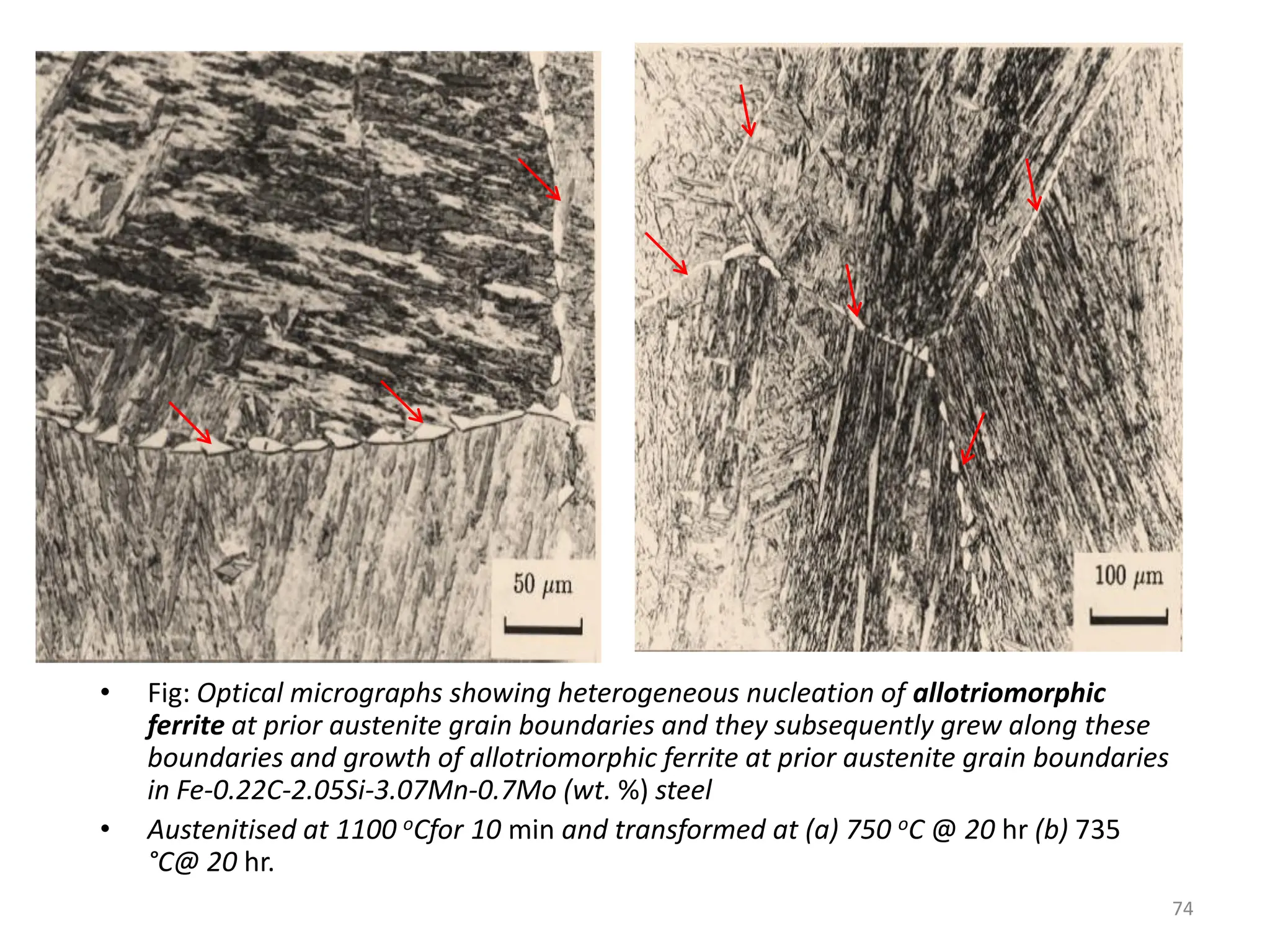
• Fig: Optical micrographs showing heterogeneous nucleation of allotriomorphic
ferrite at prior austenite grain boundaries and they subsequently grew along these
boundaries and growth of allotriomorphic ferrite at prior austenite grain boundaries
in Fe-0.22C-2.05Si-3.07Mn-0.7Mo (wt. %) steel
• Austenitised at 1100 oCfor 10 min and transformed at (a) 750 oC @ 20 hr (b) 735
°C@ 20 hr.
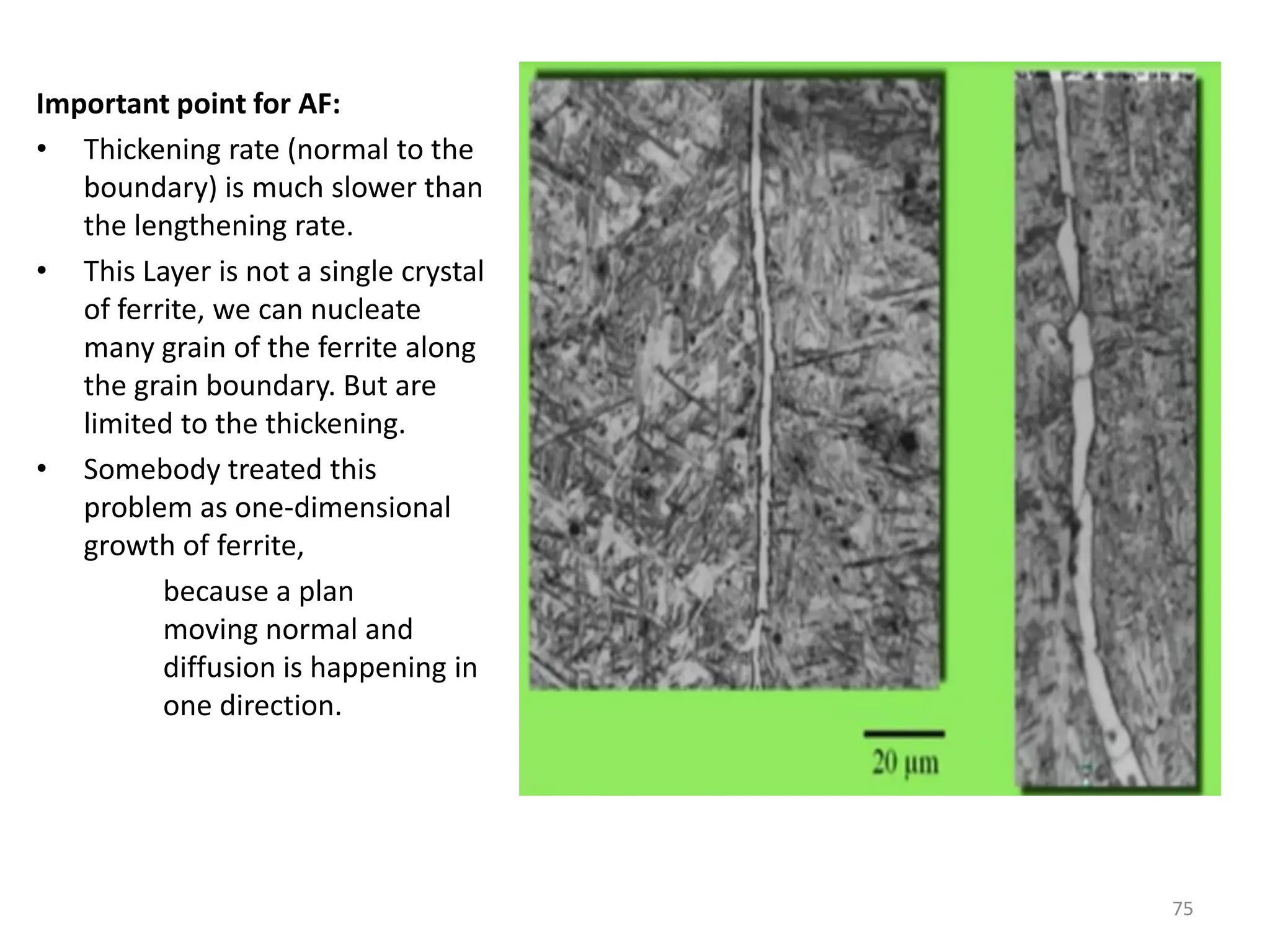
Important point for AF:
• Thickening rate (normal to the
boundary) is much slower than
the lengthening rate.
• This Layer is not a single crystal
of ferrite, we can nucleate
many grain of the ferrite along
the grain boundary. But are
limited to the thickening.
• Somebody treated this
problem as one-dimensional
growth of ferrite,
because a plan
moving normal and
diffusion is happening in
one direction.
75
76
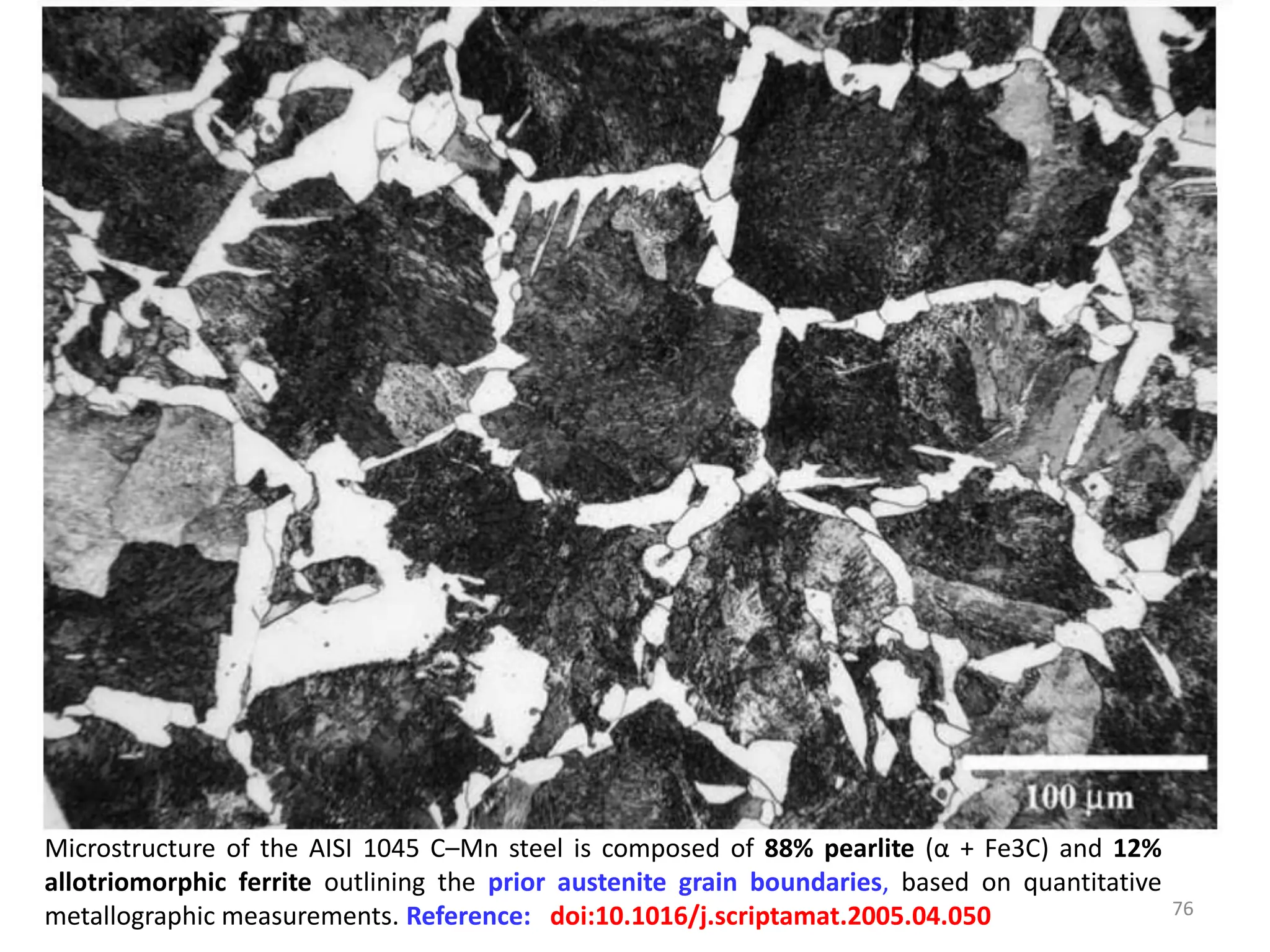
Microstructure of the AISI 1045 C–Mn steel is composed of 88% pearlite (α + Fe3C) and 12%
allotriomorphic ferrite outlining the prior austenite grain boundaries, based on quantitative
metallographic measurements. Reference: doi:10.1016/j.scriptamat.2005.04.050
77
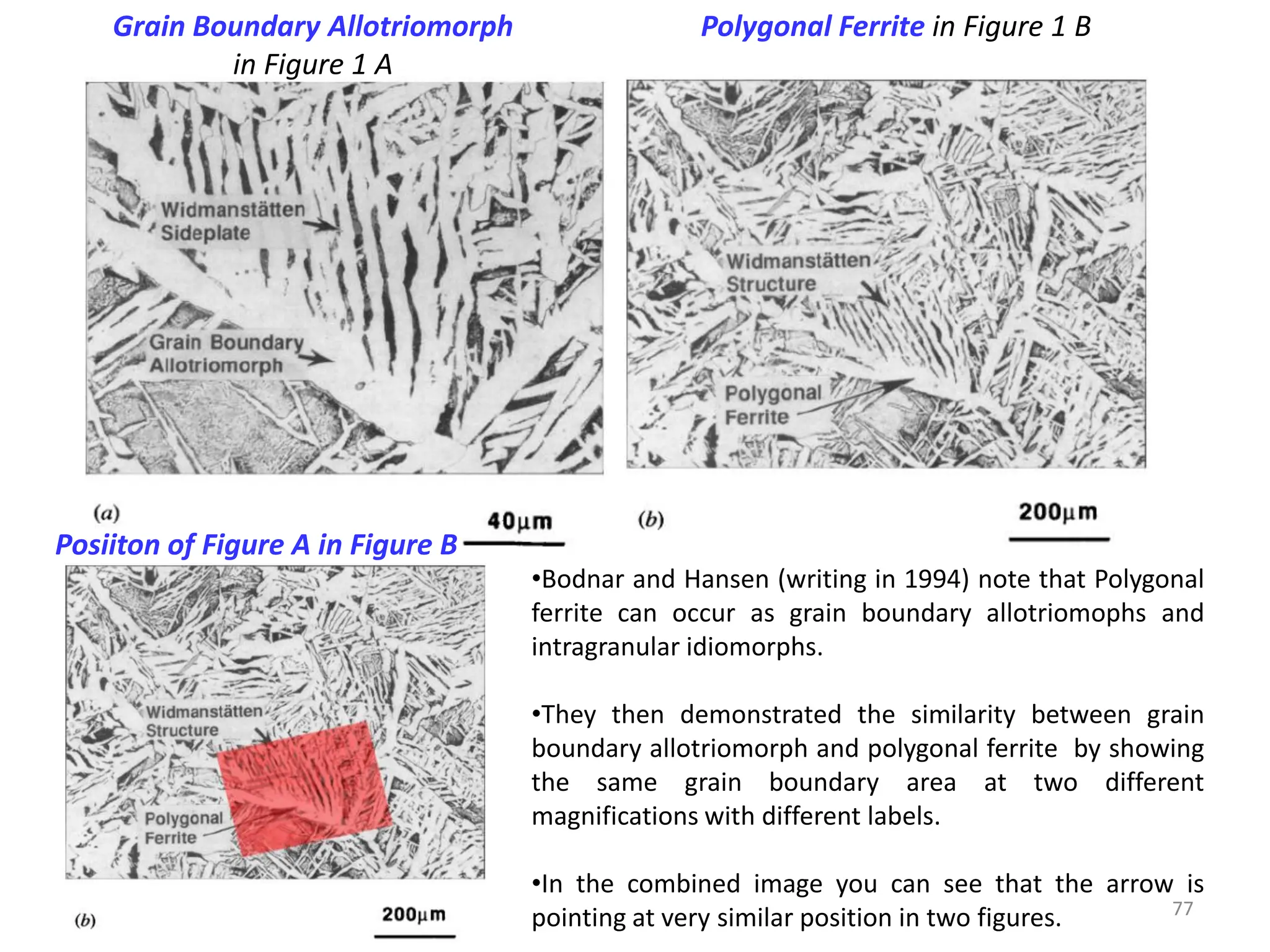
Grain Boundary Allotriomorph
in Figure 1 A
Polygonal Ferrite in Figure 1 B
Posiiton of Figure A in Figure B
•Bodnar and Hansen (writing in 1994) note that Polygonal
ferrite can occur as grain boundary allotriomophs and
intragranular idiomorphs.
•They then demonstrated the similarity between grain
boundary allotriomorph and polygonal ferrite by showing
the same grain boundary area at two different
magnifications with different labels.
•In the combined image you can see that the arrow is
pointing at very similar position in two figures.
78
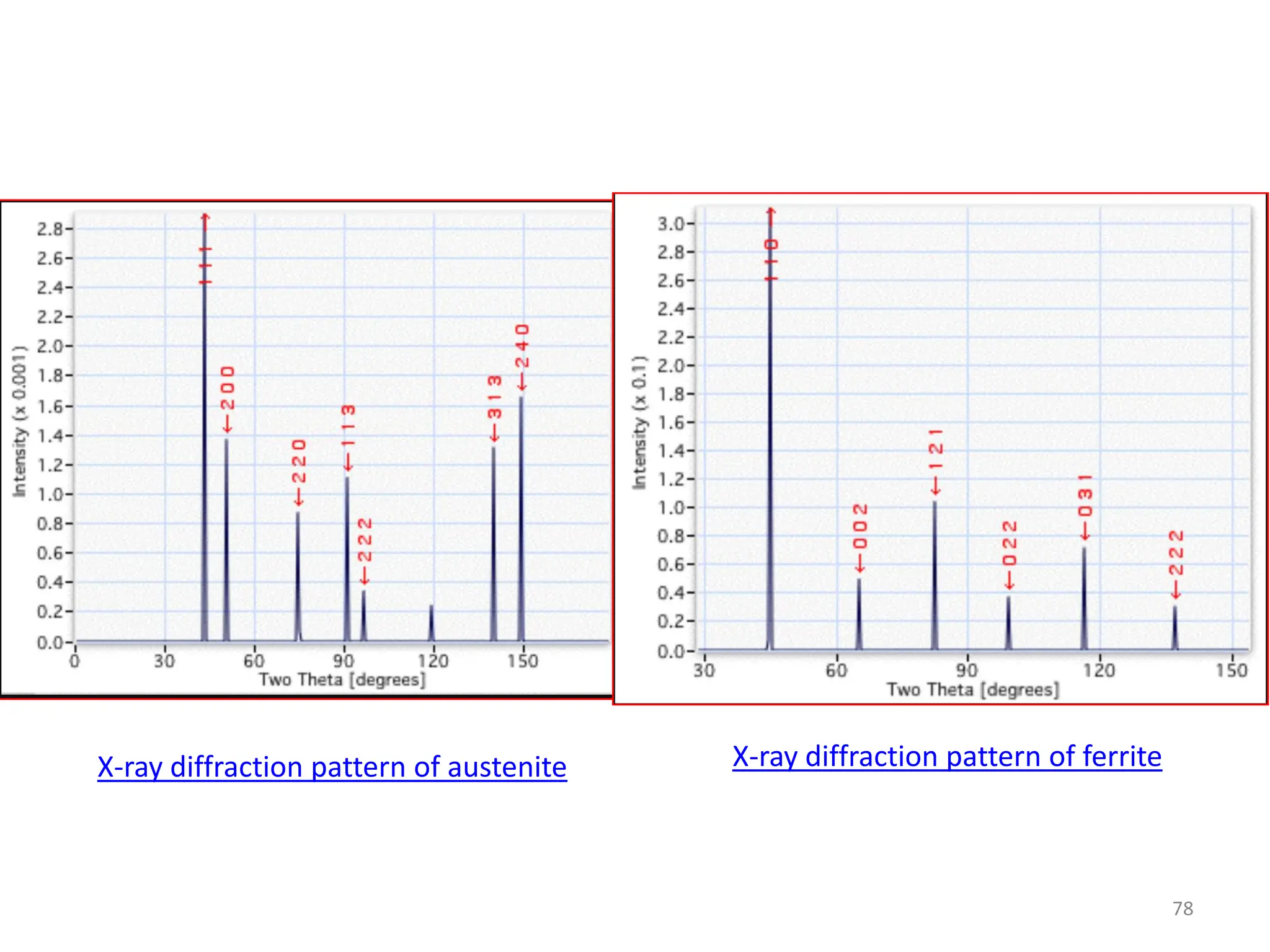
X-ray diffraction pattern of austenite X-ray diffraction pattern of ferrite
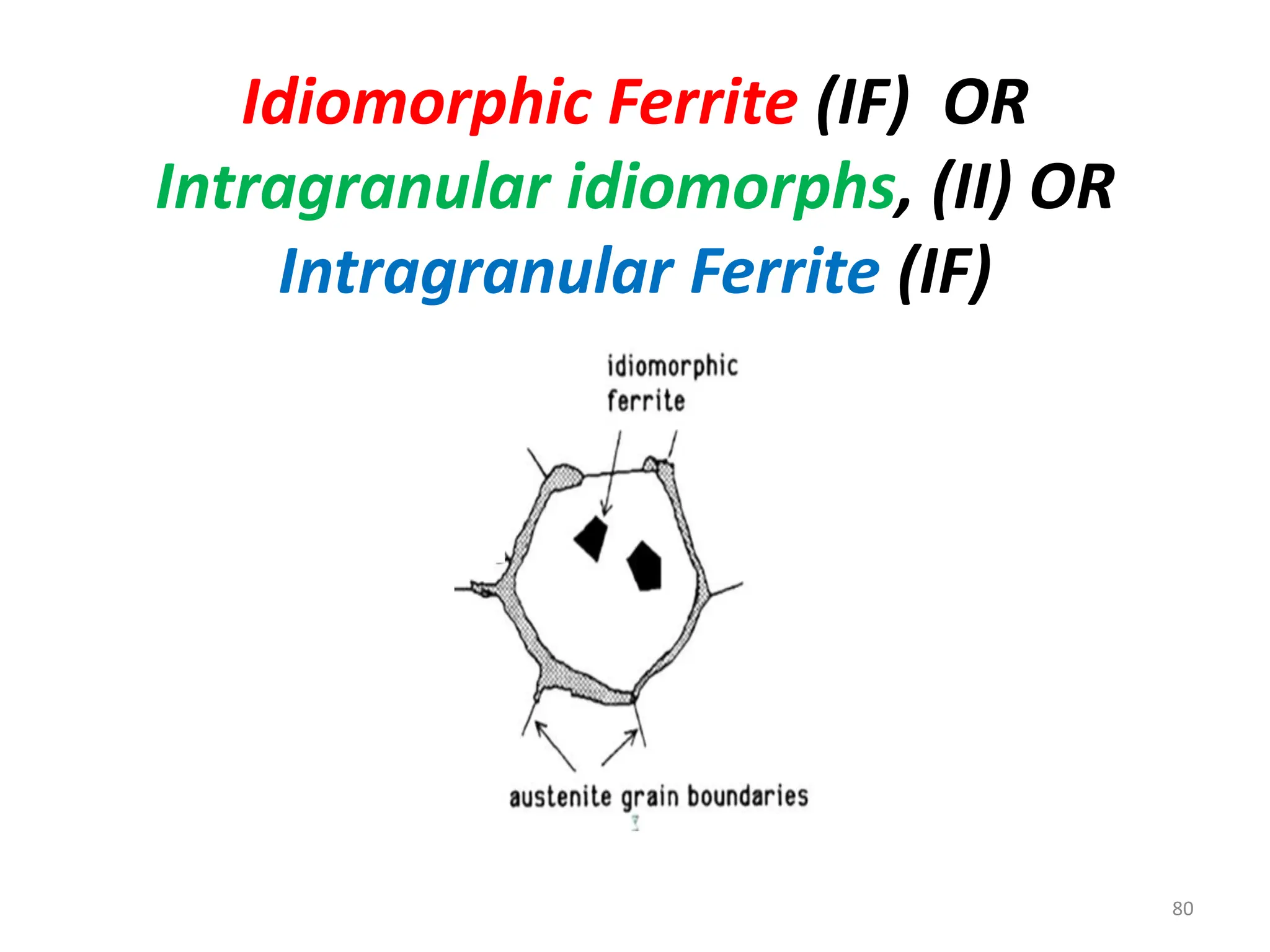
Idiomorphic Ferrite (IF) OR
Intragranular idiomorphs, (II) OR
Intragranular Ferrite (IF)
80
Definition and Characteristics:
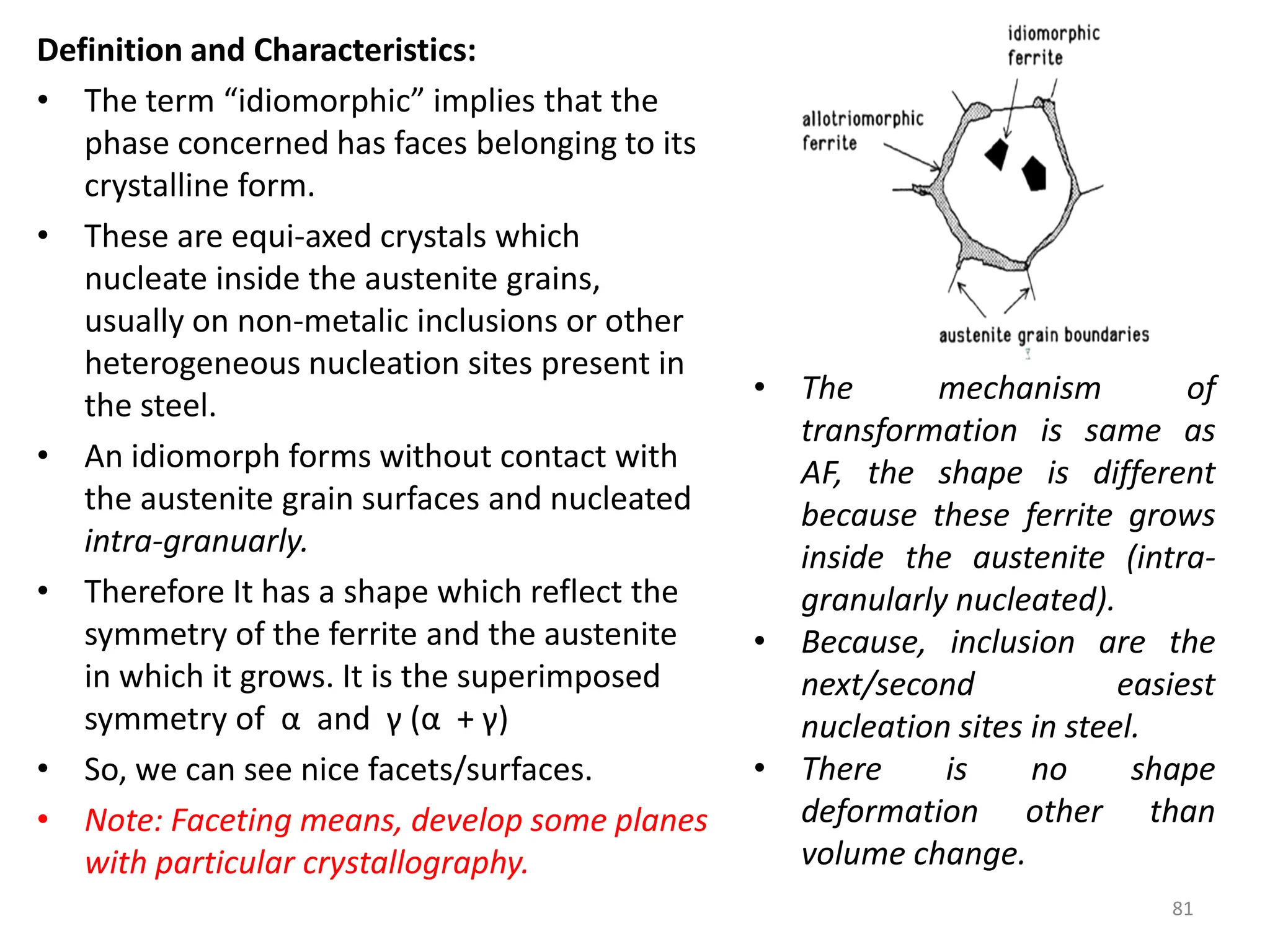
• The term “idiomorphic” implies that the
phase concerned has faces belonging to its
crystalline form.
• These are equi-axed crystals which
nucleate inside the austenite grains,
usually on non-metalic inclusions or other
heterogeneous nucleation sites present in
the steel.
• An idiomorph forms without contact with
the austenite grain surfaces and nucleated
intra-granuarly.
• Therefore It has a shape which reflect the
symmetry of the ferrite and the austenite
in which it grows. It is the superimposed
symmetry of α and γ (α + γ)
• So, we can see nice facets/surfaces.
• Note: Faceting means, develop some planes
with particular crystallography.
81
• The mechanism of
transformation is same as
AF, the shape is different
because these ferrite grows
inside the austenite (intra-
granularly nucleated).
• Because, inclusion are the
next/second easiest
nucleation sites in steel.
• There is no shape
deformation other than
volume change.
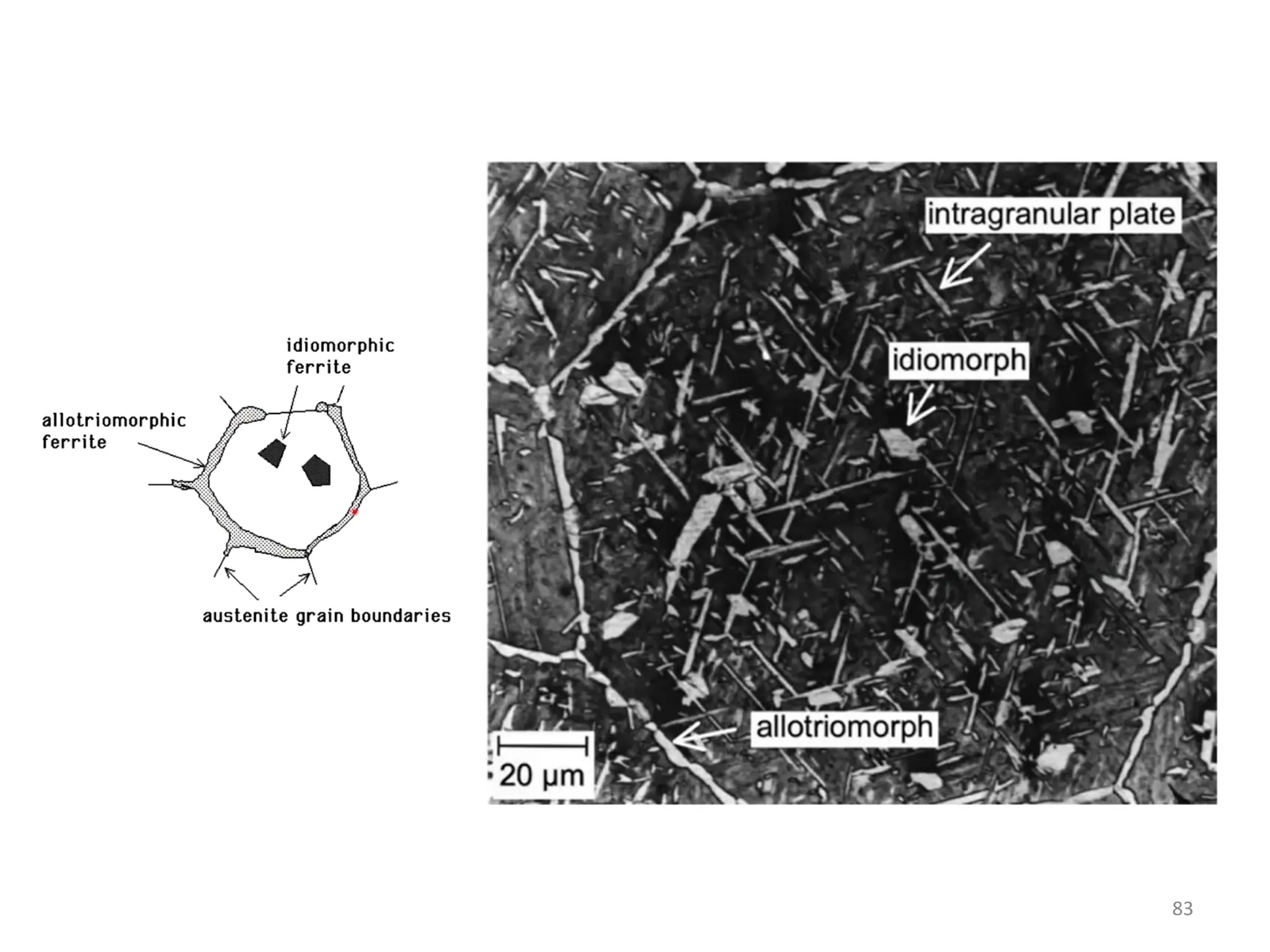
82
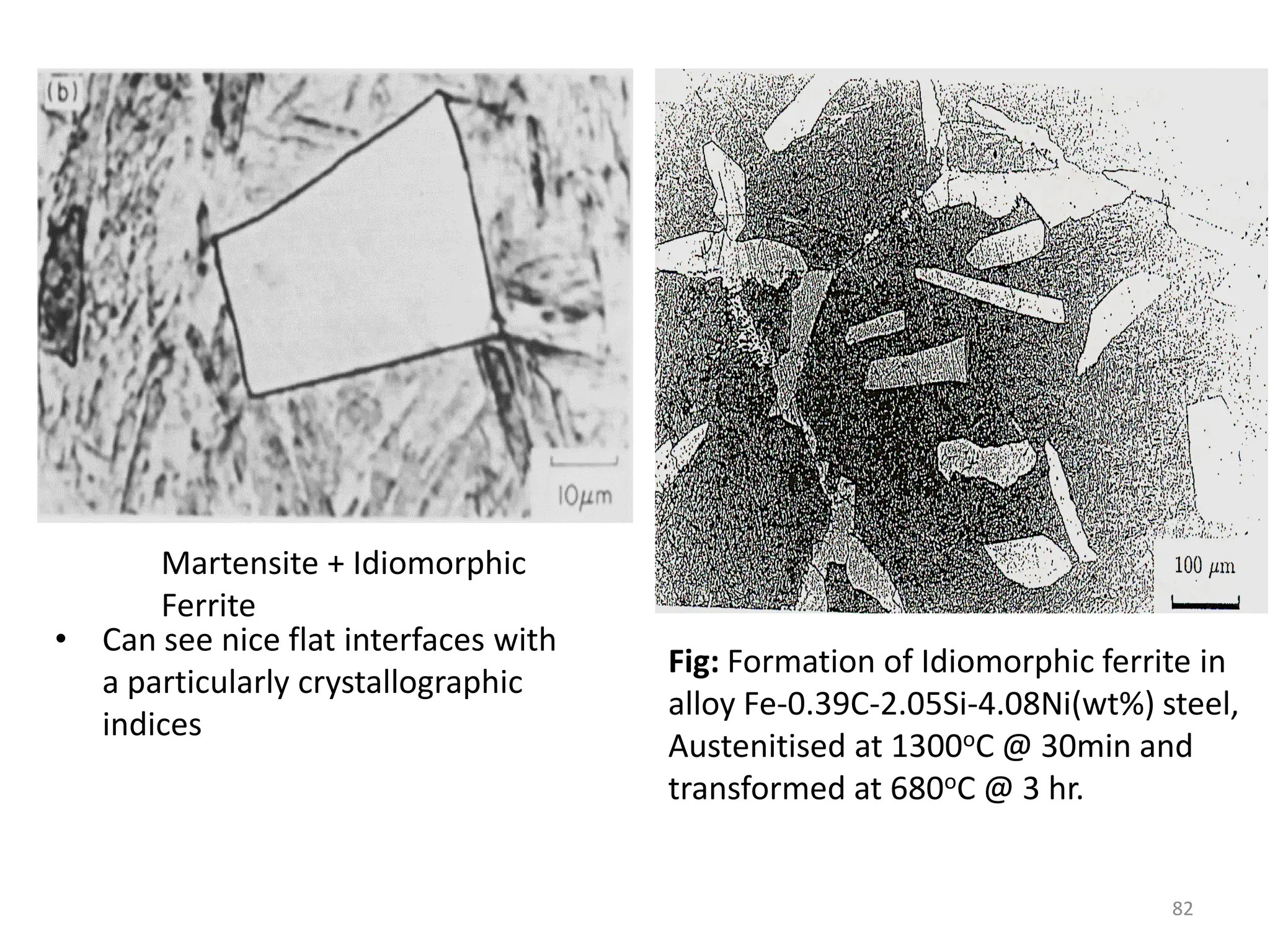
• Can see nice flat interfaces with
a particularly crystallographic
indices
Martensite + Idiomorphic
Ferrite
Fig: Formation of Idiomorphic ferrite in
alloy Fe-0.39C-2.05Si-4.08Ni(wt%) steel,
Austenitised at 1300oC @ 30min and
transformed at 680oC @ 3 hr.
83
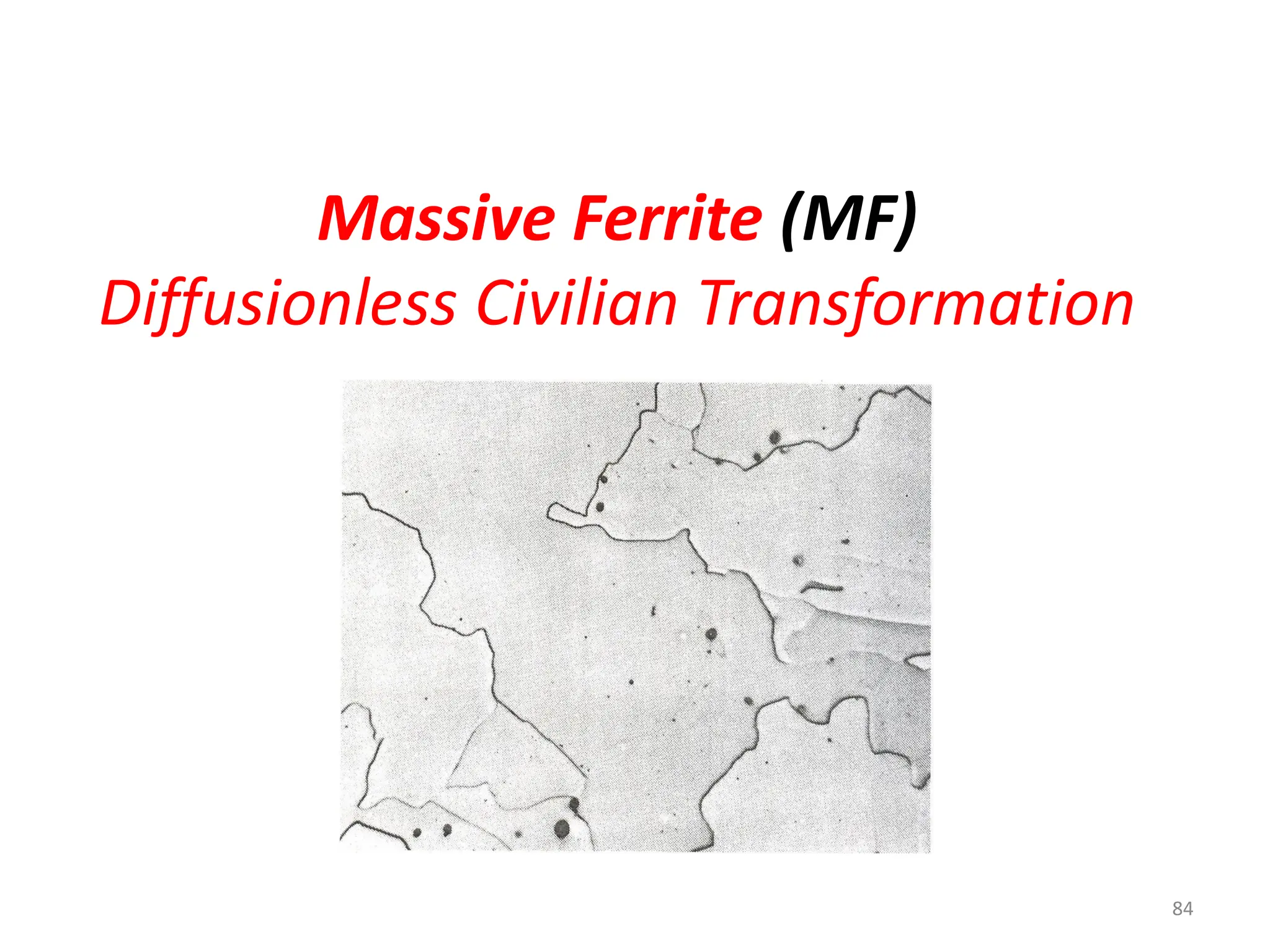
Massive Ferrite (MF)
Diffusionless Civilian Transformation
84
• Definition and Characteristics:
• Massive ferrite grows by a reconstructive transformation
mecha-nism i.e., formed by short-range movement/diffusion
of atoms and across the boundaries classed as diffusionless
civilian transformation.
• The Product phase has the same composition as the parent
austenite.
• The ability to cross parent austenite grain boundaries seems
particularly pronounced during massive transformation;
• the final ferrite grain size can be larger than the initial grain
size of the austenite.
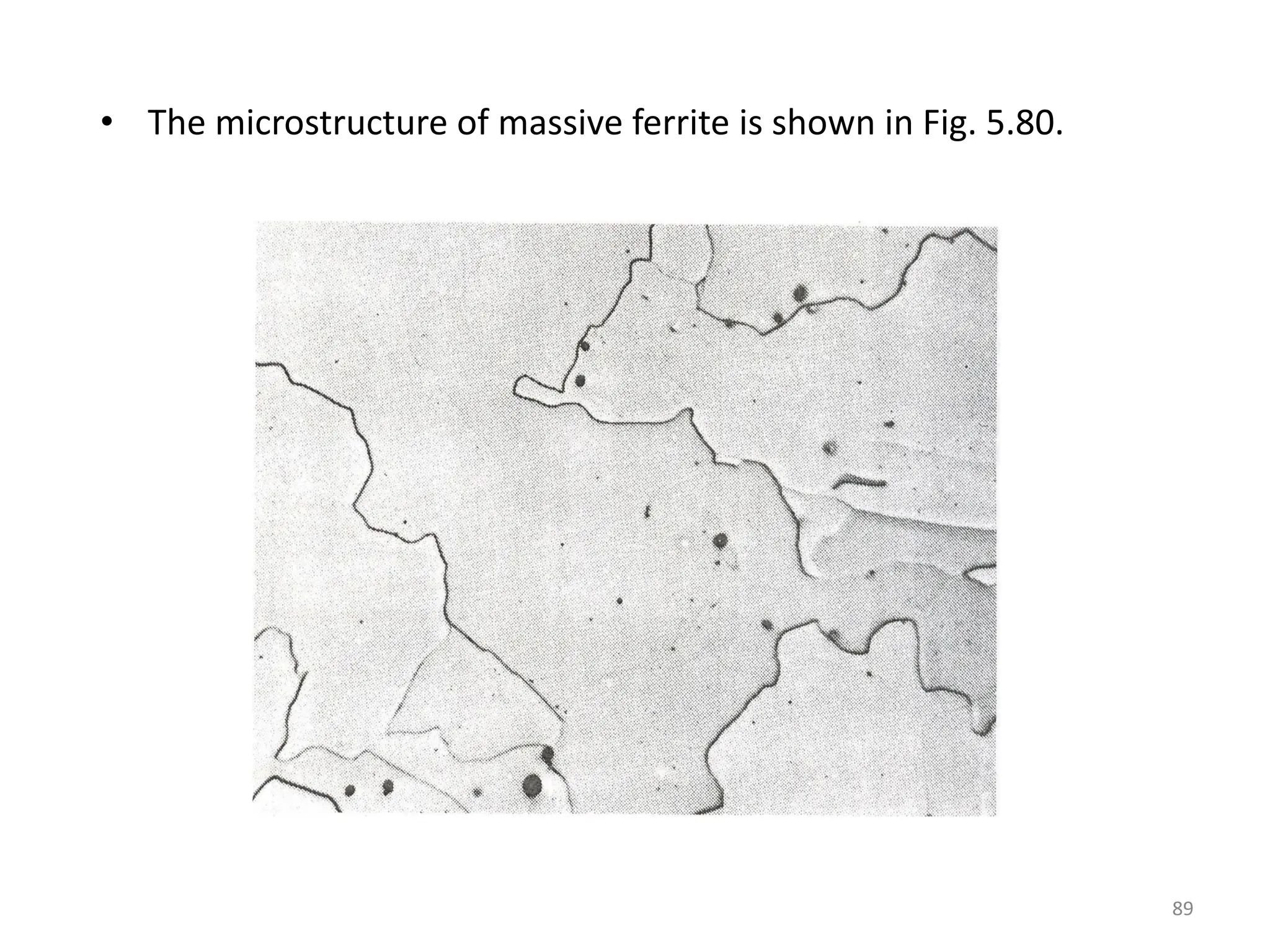
• These factors combined to give a single-phase microstructure
of larger grains of ferrite which have an approximately
equiaxed morphology due to impingement between
neighbouring grains. as shown in the micrograph of Fig.
85
• In γ→α transformation of massive ferrite can
form if the γ is quenched sufficiently rapidly to
avoid transformation near equlibrium, slow
enough to avoid the formation of martensite.
• Massive transformations should not be
confused with martensite. Although the
martensitic transformation also produces a
change of crystal structure without a change in
composition, the transformation mechanism is
quite different. E.g. (See Slide No 14)
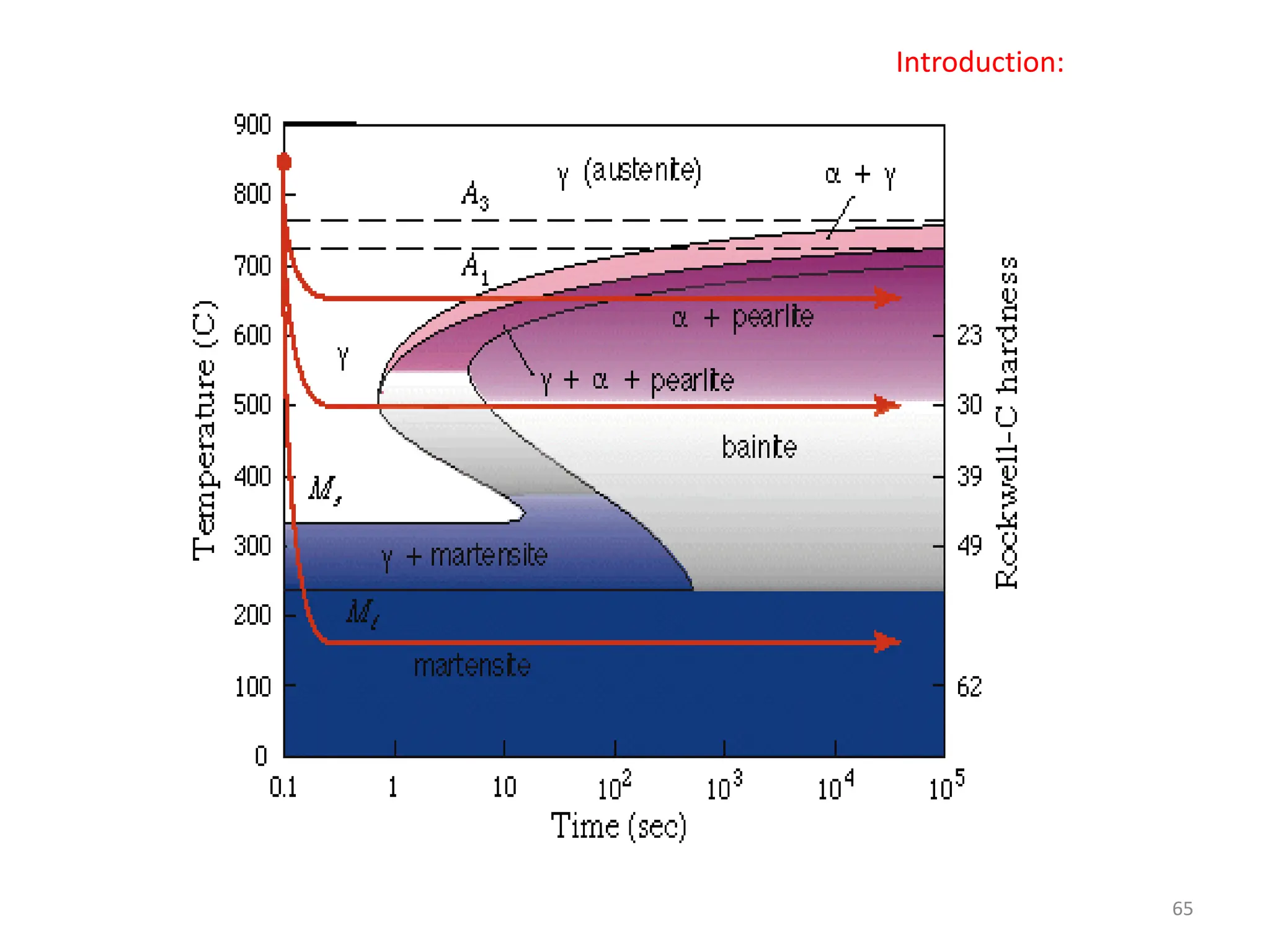
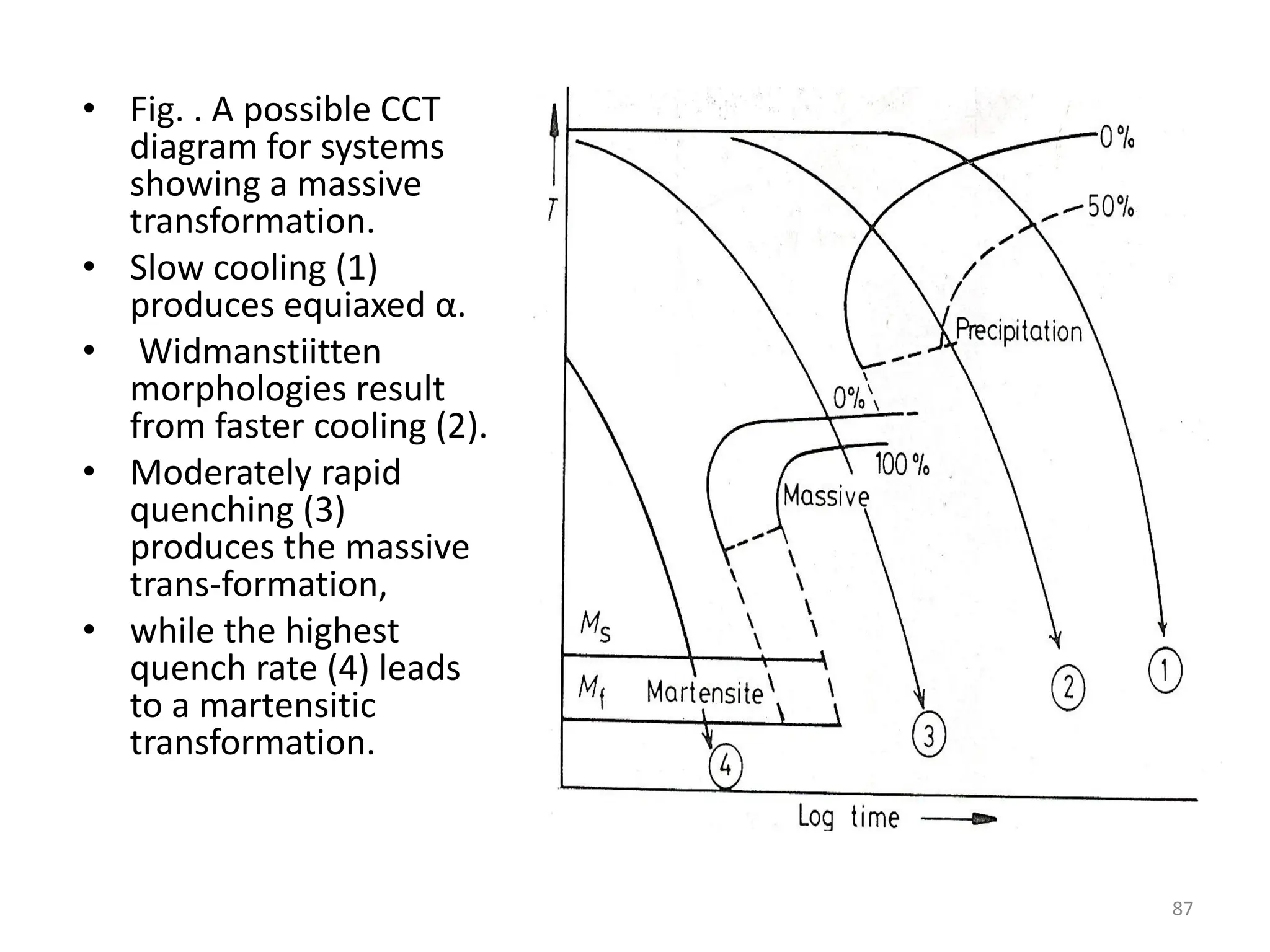
• Massive ferrite has its own C curve on TTT or
CCT diagram as shown in figure.
86
• Fig. . A possible CCT
diagram for systems
showing a massive
transformation.
• Slow cooling (1)
produces equiaxed α.
• Widmanstiitten
morphologies result
from faster cooling (2).
• Moderately rapid
quenching (3)
produces the massive
trans-formation,
• while the highest
quench rate (4) leads
to a martensitic
transformation.
87
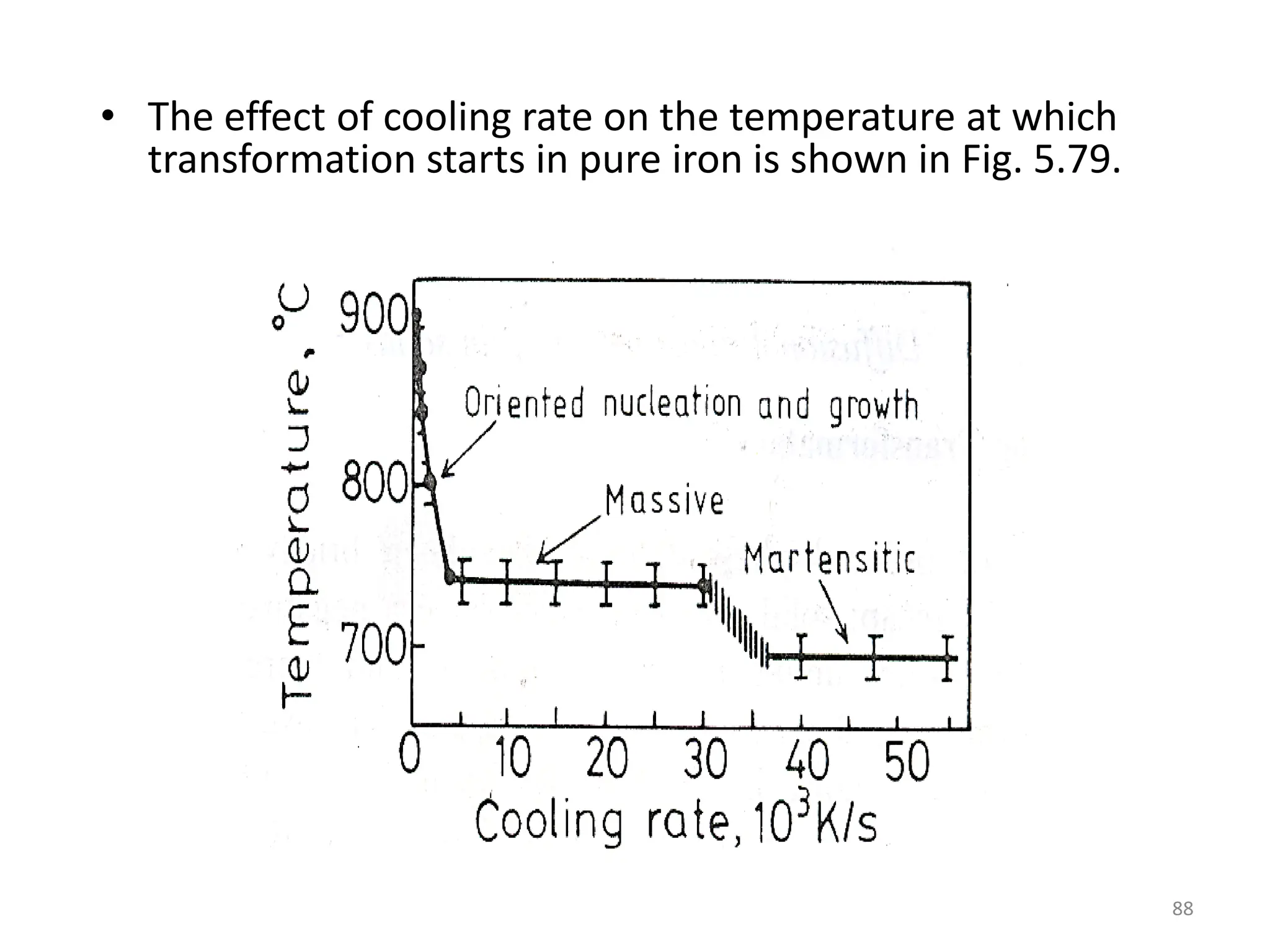
• The effect of cooling rate on the temperature at which
transformation starts in pure iron is shown in Fig. 5.79.
88
• The microstructure of massive ferrite is shown in Fig. 5.80.
89
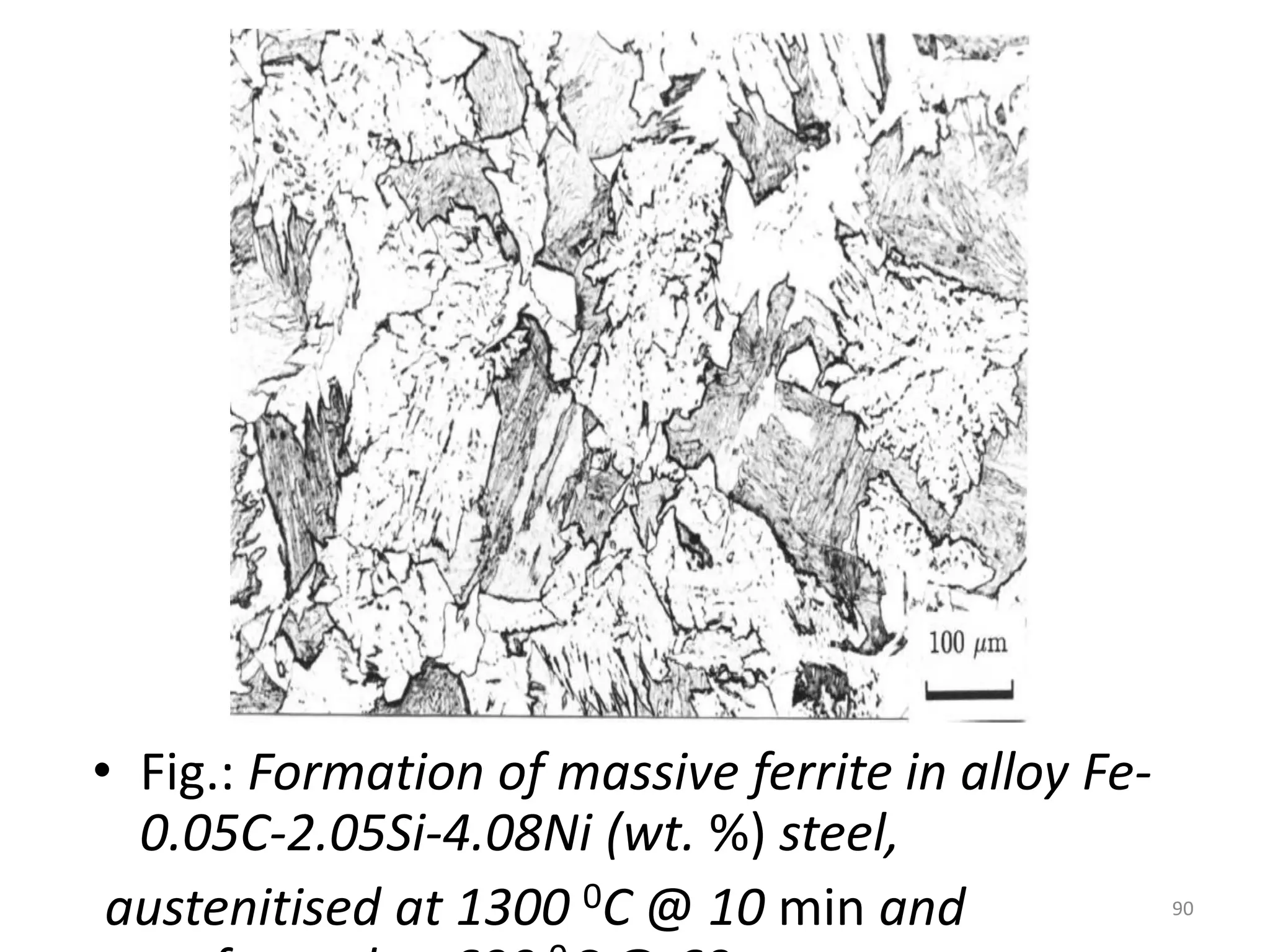
• Fig.: Formation of massive ferrite in alloy Fe-
0.05C-2.05Si-4.08Ni (wt. %) steel,
austenitised at 1300 0C @ 10 min and 90
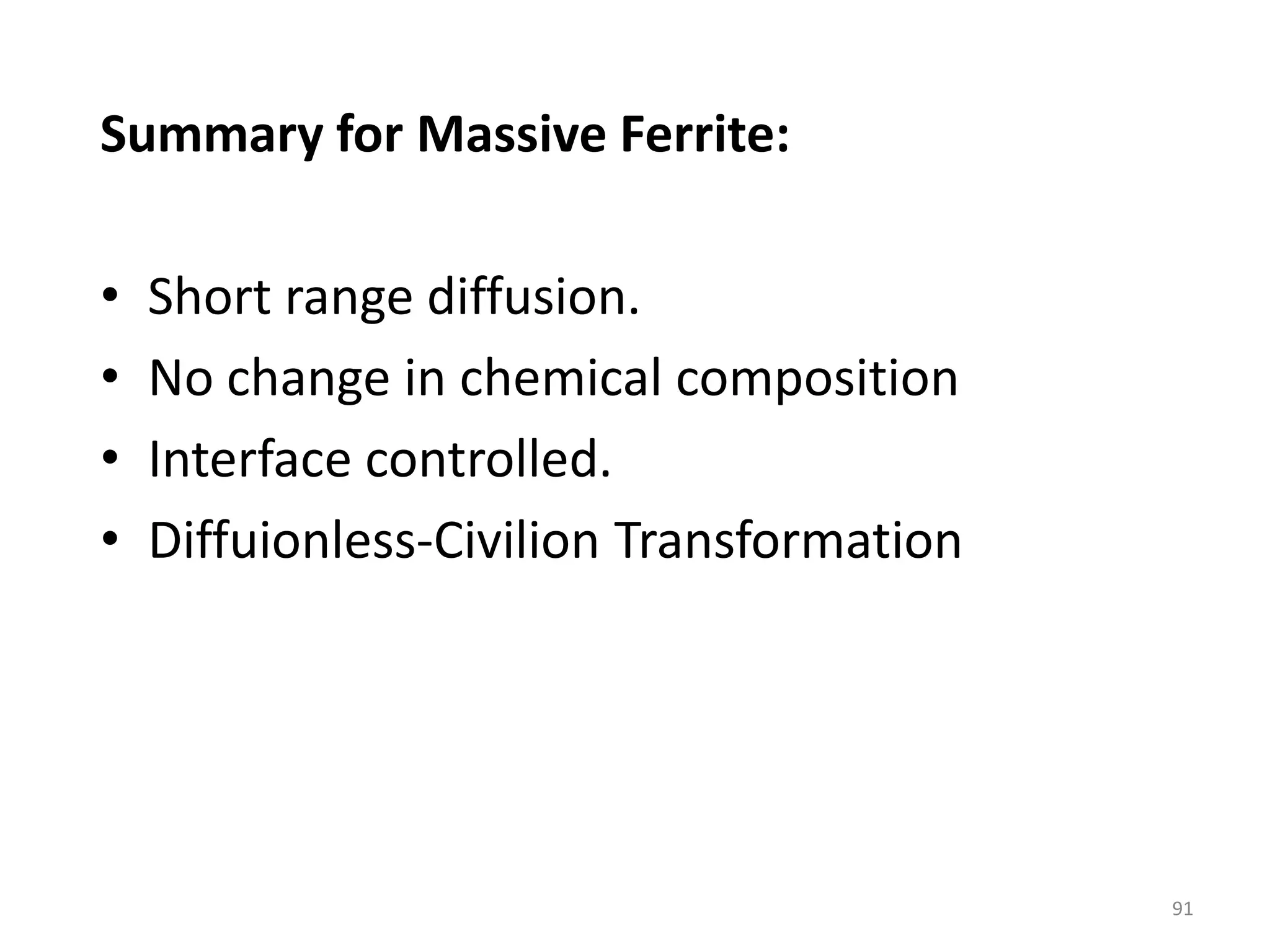
Summary for Massive Ferrite:
• Short range diffusion.
• No change in chemical composition
• Interface controlled.
• Diffuionless-Civilion Transformation
91
92
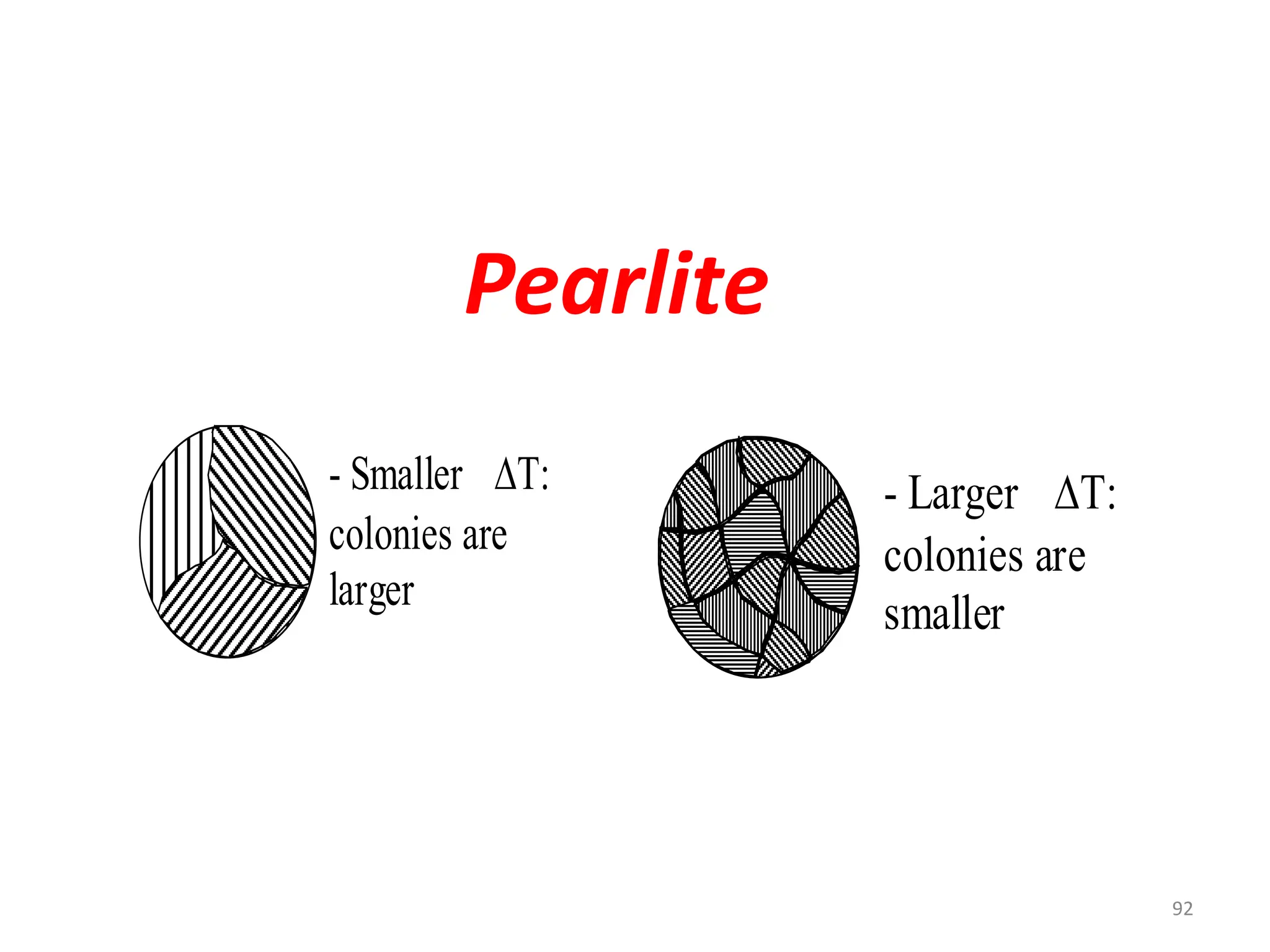
Pearlite
- Larger T:
colonies are
smaller
- Smaller T:
colonies are
larger
• Pearlite is a common microstructure in wide
variety of steels and received intensive research
attention because of it substantial strength
contribution to the steel.
• Morphologically it is a lamellar mixture of ferrite
and carbide.
• When austenite containing about 0.8wt% C is
cooled below the Ae1 temperature it becomes
supersaturated with respect to ferrite and
cementite and a eutectoid transformation results,
i.e. γ → α + Fe3C
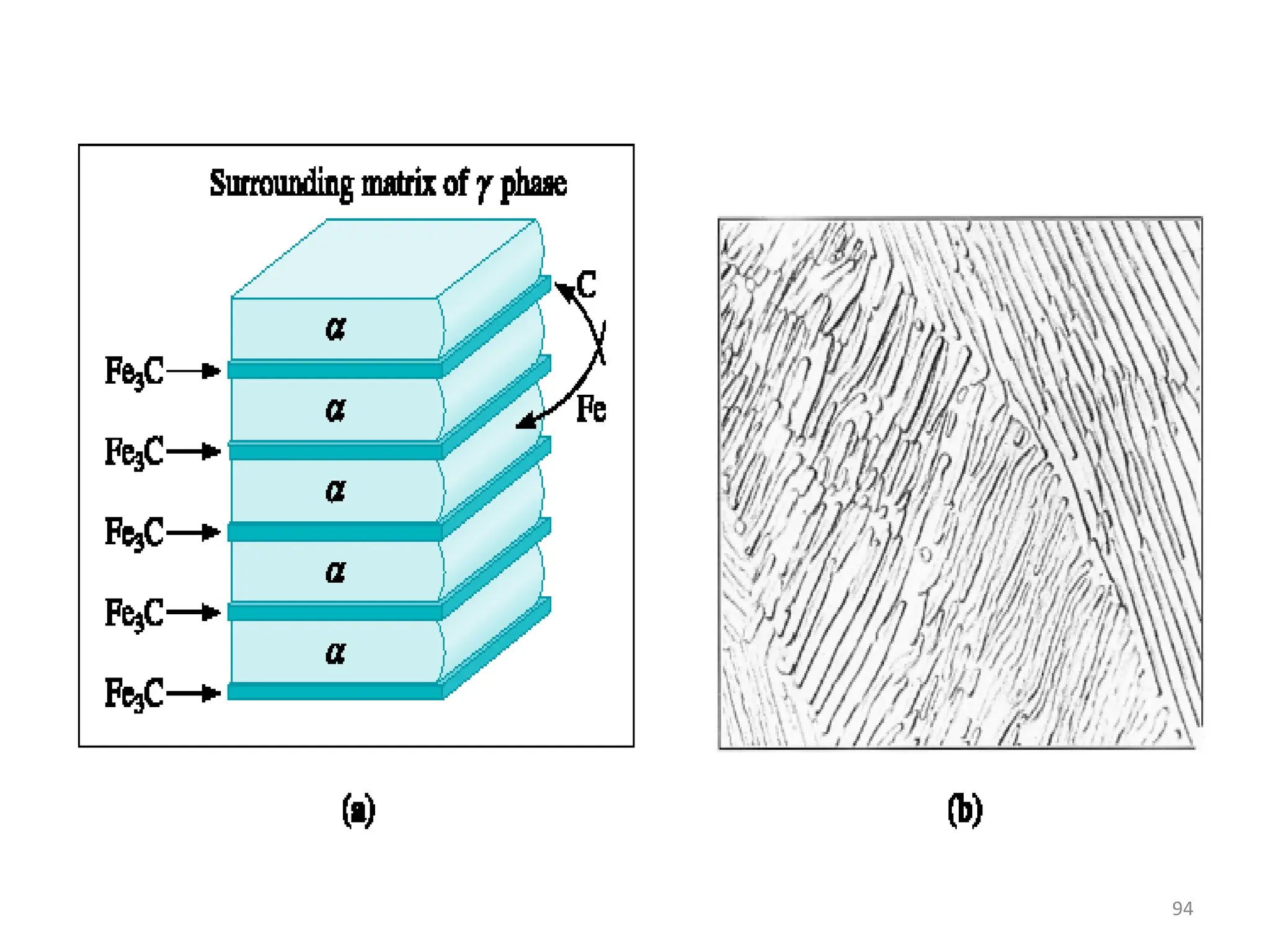
• The resultant microstructure comprises lamellae,
or sheets, of cementite embedded in ferrite as
shown in Fig. 5,55. This is known as pearlite, 93
94
End of Reconstructive
Transformation
95
96
Invariant-Plane Strain: If the operation of a strain, leaves one plane
of the parent crystal completely unrotated and undistorted; this is
known as an invariant-plane strain (IPS).
97
98

Phase Transformation in Steel- Lecture A 2023.pdf

  • 1.
    MM-501 Phase Transformation inSolid (metals/alloys) Dr. Muhammad Ali Siddiqui Assistant Professor Metallurgical Engineering Department NED University of Engineering and Technology-Pakistan m.siddiqui@cloud.neduet.edu.pk 021-99261261 Ext: 2521 1
  • 2.
  • 3.
    1. Porter, D.A.and.Easterling, K.E., “Phase Transformations in Metals and Alloys”, Van Nostrand Reinhold, 2000 or latest edition.. 2. Reed-Hill, R. E. and Abbaschian, R., “Physical Metallurgy Principles”, PWS, 2000 or latest edition. 3. Smallman R.E “Modern Physical Metallurgy”, 4th ed., Butterworths, 2005. 4. Shewmon, “Diffusion in Solids”, Mineral, Metals & Mat. Soc., Latest edition. 5. Shewmon, “Phase Transformations”, Springer, Latest edition. 6. Honeycombe, R.W.K., Bhadeshia, H.K.D.H., “Steels, Microstructures and Properties”, Edward Arnold, 2005. 7. Chadwick, G. A., “Metallography of Phase Transformations”, Butterworths, Latest edition. 8. Wilson, E.A., “Worked Examples and Thermodynamics of Phase Transformations”, Woodhead, 2004. Phase Transformations Suggested Readings 3
  • 4.
    Lecture Series -A • Application of Metals and Alloys • Diffusion - Mechanism • Phase Diagram • Introduction to Iron-Carbon Phase Diagram • Interphase Migration • Classification of phase Transformation • Decomposition of Austenite 4
  • 5.
    Important Application ofMetals and Alloys – Brain storming 5
  • 6.
  • 7.
    • Steel industryis the basic link in the economic chain. • It provides raw materials to the downstream sectors, such as machinery, automotive, shipbuilding, appliance, and construction. • And it also draws upstream sectors, such as coal mine, electricity, transportation, mineral ores, ferro-alloys, machinery, etc., through the consumption of their products. 7
  • 8.
  • 9.
  • 10.
    What would behappened by ultra refinement in grain size? 20μm 5μm Conventional rolling TMCP 1μm UFG
  • 12.
  • 13.
    What is diffusion? •Material transport by atomic motion is called Diffusion. • Diffusion refers to the process by which atoms/molecules intermingle as a result of their kinetic energy of random motion. 13
  • 14.
    Fig: Schematic representationof the diffusion of an atom from its original position into a vacant lattice site 14
  • 15.
    Diffusion Mechanisms • Fordiffusion to occur: –Adjacent site needs to be empty (vacancy or interstitial). –Sufficient energy must be available to break bonds and overcome lattice distortion. 15
  • 16.
    The two mainpossible mechanisms are: • Vacancy Diffusion: Atoms can move from one site to another if there is sufficient energy present for the atoms to overcome a local activation energy barrier and if there are vacancies present for the atoms to move into. 16
  • 17.
    Interstitial Diffusion: • Migrationfrom one interstitial site to another. • Interstitial atoms like hydrogen, helium, carbon, nitrogen, etc) must squeeze through openings between interstitial sites to diffuse around in a crystal. 17
  • 18.
    Factors that InfluenceDiffusion: 1. Temperature - diffusion rate increases very rapidly with increasing temperature 2. Diffusion mechanism - interstitial is usually faster than vacancy 3. Diffusing and host species - Do, Qd is different for every solute, solvent pair 4. Microstructure - diffusion faster in polycrystalline vs. single crystal materials because of the accelerated diffusion along grain boundaries and dislocation cores. 5. Stirring- Increases diffusion rate 18
  • 19.
    Temperature Dependence ofthe Diffusion Coefficient :  Where, D is the Diffusivity or Diffusion  Coefficient ( m2 / sec )  Do is the prexponential factor ( m2 / sec )  Qd is the activation energy for diffusion ( joules / mole )  R is the gas constant ( joules / (mole deg) )  T is the absolute temperature ( K )  D is the indicator of how fast atom moves. Higher D means higher flux of mass transport.       T R Q - D = D d o exp T R Q - D = D d o ln ln 19
  • 20.
    Flux (J) • Flux(J): No of atoms diffusing through unit area per unit time OR Materials diffusion through unit area per unit time.    s m kg or s cm mol time area surface diffusing mass) (or moles Flux 2 2    J 20
  • 21.
    Ficks First Law:(Steady-state Diffusion) • Rate of diffusion independent of time • Flux proportional to concentration gradient = dx dC C1 C2 x C1 C2 x1 x2 1 2 1 2 x x C C x C dx dC       •Minus sign shows that diffusion is down the concentration gradient 21
  • 22.
    Fick’s second law:(Non-Steady-State Diffusion) • In most real situations the concentration gradient are changing with time. Co Cs position, x C(x,t) to t1 t2 t3 Example : surface treatment, like carburizing, nitriding, carbo-nitriding, aluminizing, anodizing. etc 22
  • 23.
    • In words,the rate of change of composition at position x with time t, is equal to the rate of change of the product of the diffusivity D, times the rate of change of the concentration gradient, dCx/dx, with respect to distance x.       x d C d D x d d = t d C d x x 23
  • 24.
  • 25.
    Phase Diagrams • Whatis a phase? • What is the equilibrium state when different elements are mixed? • What phase diagrams tell us. • How phases evolve with temperature and composition (microstructures). C Si Mn Mo Cr V P 0.98 1.46 1.89 0.26 1.26 0.09 < 0.002 Hyper eutectoid steel 25
  • 26.
    Reference: https://learnmetallurgy.com/study/physical/topic/binary-phase- diagrams.php 1. RelativeSize Ratio ±15% 2. Crystal Structure-must be the same 3. Electronegativity Difference –within ±0.4 e.u. 4. Valence must be the same Hume Rothery Rules 26
  • 27.
  • 28.
  • 29.
  • 30.
  • 31.
  • 32.
    Figure 11-4 Thefive most important three-phase reactions in binary phase diagrams. 32
  • 33.
  • 34.
  • 35.
    Iron Carbon Diagram(an Intro) 35 • A1, the so-called eutectoid temperature, which is the minimum temperature for austenite • A3, the lower-temperature boundary of the austenite region at low carbon contents, that is, the γ/γ + α boundary • Acm, the counterpart boundary for high carbon contents, that is, the γ/γ + Fe3C boundary
  • 36.
  • 37.
  • 38.
    Wever” , ironbinary equilibrium system fall into four main categories Alloying Element effect on Equilibrium Phase Diagram 38
  • 39.
  • 40.
    The Effect onthe Formation and Stability of Carbides Some alloying elements form very stable carbides when added to steel (Fig. 13.2) 40
  • 41.
    Heat Treatment ofSteel According to Fe-Fe3C 41
  • 42.
    Bainite coarse fine Austenite Martensite Moderate cooling(AS) Isothermal treatment (PCS) Tempered Martensite Pearlite AS: Alloy Steel PCS: Plain-carbon Steel Slow Cooling Rapid Quench Spheroidite Re-heat Re-heat 42
  • 43.
    1.Widmanstätten ferrite, 2.Upper bainite 3.Lowerbainite 4. Super bainite 5.acicular ferrite 6.Martens tic/Austenitic Constituent (M/A) 43 The innovative pipeline steel API X80, API X100 and API X120 newly developed are considering for the new generation of line pipe steels
  • 44.
  • 45.
    Interphase Migration • Thegreat majority of phase transformations in metals and alloys occur by a process known as nucleation and growth of the new phase β, nucleate and subsequently grow into surrounding matrix of metastable parent α phase. • During the transformation the system can be divided into – parent and product phases. • In other words, an interface is created during the nucleation stage and then migrates into the surrounding parent phase during the growth stage. • Two different types of interface: Glissile and Non-Glissile. 45
  • 46.
    • Glissile interface migratesby dislocation glide that results in the shearing of the parent lattice into the product. • The migration of glissile interface produces a macroscopic shape change in the crystal. • The motion of glissile interfaces is relatively insensitive to temperature and is therefore known as athermal migration. 46
  • 47.
    • Non-Glissile interface:Most interfaces are non-glissile and migrate by the random jumps of individual atom/atoms across the interface. • The migration of non-glissile interface cannot produce a change in shape in the parent crystal. • The extra energy that the atom needs to break free of one phase and attach itself to the other is supplied by thermal activation. • The migration of non-glissile interface is therefore, diffusion controlled and extremely sensitive to temperature. 47
  • 48.
  • 49.
    Classification of Phase Transformations •The nucleation and growth transformations can be classified into two groups: 1. the phases that grow by the movement of glissile interface . 2. the phases that grow by the movement of non-glissile interfaces. 49
  • 50.
    • Transformations producedby the migration of a glissile interface are referred to as military transformations i.e., the coordinated motion of atoms crossing the interface just like soldiers moving in ranks on the parade ground. • During a military transformation the nearest neighbours of any atom are essentially unchanged. • Therefore, the parent and product phases must have the same composition and no diffusion is involved in the transformation. • Martensite and twin formation in steels and other alloy systems occur by the motion of glissile interfaces. • Since there is no change in composition, the new phase will be able to grow as fast as the atoms can move across the interface. Such transformations are interface controlled. 50
  • 51.
    • In contrastthe uncoordinated transfer of atoms across a non- glissile interface results in what is known as a civilian transformation. • During civilian transformations the parent and product may or may not have the same composition. • When the parent and product phases have different compositions, growth of the new phase will require long- range diffusion and is dependant upon diffusion rate is called diffusion controlled. 51
  • 52.
    • Classification ofnucleation and growth transformations according to interface migration process is summarized in Table 1. • Table 1: Classification of Phase Transformations (Adapted from J.W. Christian, 'Phase transformations in metals and alloys -An introduction', in Phase Transformations, Vol. 1, p. 1, Institute of Metallurgists, 1979.) 52
  • 53.
    53 Type Military Civilian Effectof temperature change Athermal Thermally activated Interface type Glissile (coherent or semicoherent) Non-Glissile (coherent, semicoherenl, incoherent, solid/liquid or solid/vapour) Composition of parent and product phases Same composition Same composition Different compositions Nature of diffusion processes No diffusion Short-range diffusion (across interface) Long-range diffusion (through lattice) Interface, diffusion or mixed control? Interface control Interface control Mainly interface control Mainly diffusion control Mixed control Examples Martensite Twinning Symmetric tilt boundary Massive Ordering Polymorphic Recrystallization Grain growth Condensation Precipitation/ Dissolution Bainite Condensation Evaporation Precipitation/ Dissolution… Solidification and melting Precipitation/ Dissolution Eutectoid Cellular precipitation
  • 54.
    54 Fig: Schematic drawingsof the atomic arrangements at interfaces 1972}. a) Perfectly coherent. b) Elastically strained coherent. c) Semi-coherent d) Incoherent.
  • 55.
    • While manytransformations can be classified into the above system, but there are transformations, where difficulty arises. • For example, 1.Widmanstätten ferrite, 2.Upper bainite 3.Lower bainite and 4.acicular ferrite • The above listed transformations take place by thermally activated growth(non-gillissile), but it also produces a shape change similar to produced by the motion of a gillissile interface. • These transformations can conveniently be classed as Displacive transformations as explained in Table 2. 55
  • 56.
    56 IPS: Invariant- Plane Strain: If the operation of strain, leavesone plane of the parent crystal completely un-rotated and undistorted , this is call IPS. /no (Old Ref:)
  • 57.
    57 Invariant-Plane Strain: Ifthe operation of a strain, leaves one plane of the parent crystal completely unrotated and undistorted; this is known as an invariant-plane strain (IPS). Figure: Three kinds of invariant-plane strains. •The invariant-plane, shaded grey, is unaffected by any of the deformations. •The terms s and £ refer to the shear and dilatational strains respectively.
  • 58.
    • Fig. ais an example of invariant-plane strain which is purely dilatational, and is of the type to be expected when a plate- shaped precipitate grows reconstructively. This type of IPS reflects the volume changes accompanying the transformation. • Fig. b, the invariant-plane corresponds to a simple shear, involving no change of volume, as homogeneous deformation of crystal by slip. The shape of the parent crystal alters in a way which reflects the shear character of the deformation. • The most general invariant-plane strain (Fig. c) involves both a volume change and a shear and associated with the martensi tic transformations. 58
  • 59.
    59 Austenite with twodifferent kinds of atoms. It can transform into new/different crystal structure by two methods. 1. Displacive Transformation 2. Reconstructive Transformation Displacive transformation involves a Homogeneous deformation of the crystal structure into a new shape. important characteristic: we get a macroscopic shape change which is in the form of IPS with a large shear component and there is atomic correspondence b/w the product and parent Phase
  • 60.
    60 Military (Displacive) Transformation: Atoms(large and small) moves in a discipline manner. Civilian (Reconstructive) Transformation: Atoms (large and small) does not move in a discipline manner
  • 61.
    Para-Military Transformation: • Small atomsdiffused but large atoms are displaced during transformation. • So the change in crystal structure is achieved by displacive mechanism but small atom(like Carbon) are able to partition b/w the parent and the product phase during transformation. • (e.g. bainite, Widmanstatten and Acicular Ferrite . 61 Large atom moves in disciplined manner but small atoms go and occupy wherever they like to occupy.
  • 62.
    • Fig. 1.6 Summary ofthe variety of phases generated by the decomposi tion of austenite. • Ref: Steels Bhadeshia 62
  • 63.
    • (Martensitic transformation) •https://www.youtube.com/watch?v=OQ5lVjYssko • https://www.youtube.com/watch?v=vdIVn3HwcbU • https://www.youtube.com/watch?v=hXUmqM_8yJ4 (Widmanstaetten ferrite) 63
  • 64.
    • Fig: Temperature- compositionregions in which the various morphologies are dominant in specimens with ASTM grain size Nos. 0-1. • GBA = grain boundary allot-riomorphs, • W = Widmanstatten sideplates and/or intragranular plates, • M = Massive ferrite, 64 Introduction:
  • 65.
  • 66.
  • 67.
  • 68.
  • 69.
    chemical composition ofthe steel studied was Fe ± 1.59Si ± 1.94Mn ± 1.33Cr ± 0.30Mo ± 0.02Ni ± 0.11V (wt- %). 69
  • 70.
  • 71.
    • Allotriomorphic Ferrite •Idiomorphic Ferrite • Massive Ferrite. • Pearlite 71 Reconstructive decomposition of Austenite
  • 72.
    Allotriomorphic Ferrite (AF) OR Grainboundary Allotriomorphs, GBA 72
  • 73.
    Definition and Characteristics: •Ferrite forms at the austenitic Grain boundary, because austenitic grain boundary having easier diffusion path. It tends to grow (easy grow) more rapidly along the γ grain boundary, not within the grain. OR • The allotriomorphic ferrite grains nucleate at the highest temperatures, i.e. just below Ae3 or typically above (>) 600 where Fe-atom are mobile. • Because, Austenitic grain boundary is the easiest nucleation site in steel. • The shape of AF does not reflect its internal crystalline symmetry. (we don’t get nice beautiful shape with straight faceted, because it is dominated/controlled by γ -grain boundary) • Note: Faceting means, develop some planes with particular crystallography. • There is no shape deformation other than volume change. 73
  • 74.
    74 • Fig: Opticalmicrographs showing heterogeneous nucleation of allotriomorphic ferrite at prior austenite grain boundaries and they subsequently grew along these boundaries and growth of allotriomorphic ferrite at prior austenite grain boundaries in Fe-0.22C-2.05Si-3.07Mn-0.7Mo (wt. %) steel • Austenitised at 1100 oCfor 10 min and transformed at (a) 750 oC @ 20 hr (b) 735 °C@ 20 hr.
  • 75.
    Important point forAF: • Thickening rate (normal to the boundary) is much slower than the lengthening rate. • This Layer is not a single crystal of ferrite, we can nucleate many grain of the ferrite along the grain boundary. But are limited to the thickening. • Somebody treated this problem as one-dimensional growth of ferrite, because a plan moving normal and diffusion is happening in one direction. 75
  • 76.
    76 Microstructure of theAISI 1045 C–Mn steel is composed of 88% pearlite (α + Fe3C) and 12% allotriomorphic ferrite outlining the prior austenite grain boundaries, based on quantitative metallographic measurements. Reference: doi:10.1016/j.scriptamat.2005.04.050
  • 77.
    77 Grain Boundary Allotriomorph inFigure 1 A Polygonal Ferrite in Figure 1 B Posiiton of Figure A in Figure B •Bodnar and Hansen (writing in 1994) note that Polygonal ferrite can occur as grain boundary allotriomophs and intragranular idiomorphs. •They then demonstrated the similarity between grain boundary allotriomorph and polygonal ferrite by showing the same grain boundary area at two different magnifications with different labels. •In the combined image you can see that the arrow is pointing at very similar position in two figures.
  • 78.
    78 X-ray diffraction patternof austenite X-ray diffraction pattern of ferrite
  • 79.
    Idiomorphic Ferrite (IF)OR Intragranular idiomorphs, (II) OR Intragranular Ferrite (IF) 80
  • 80.
    Definition and Characteristics: •The term “idiomorphic” implies that the phase concerned has faces belonging to its crystalline form. • These are equi-axed crystals which nucleate inside the austenite grains, usually on non-metalic inclusions or other heterogeneous nucleation sites present in the steel. • An idiomorph forms without contact with the austenite grain surfaces and nucleated intra-granuarly. • Therefore It has a shape which reflect the symmetry of the ferrite and the austenite in which it grows. It is the superimposed symmetry of α and γ (α + γ) • So, we can see nice facets/surfaces. • Note: Faceting means, develop some planes with particular crystallography. 81 • The mechanism of transformation is same as AF, the shape is different because these ferrite grows inside the austenite (intra- granularly nucleated). • Because, inclusion are the next/second easiest nucleation sites in steel. • There is no shape deformation other than volume change.
  • 81.
    82 • Can seenice flat interfaces with a particularly crystallographic indices Martensite + Idiomorphic Ferrite Fig: Formation of Idiomorphic ferrite in alloy Fe-0.39C-2.05Si-4.08Ni(wt%) steel, Austenitised at 1300oC @ 30min and transformed at 680oC @ 3 hr.
  • 82.
  • 83.
    Massive Ferrite (MF) DiffusionlessCivilian Transformation 84
  • 84.
    • Definition andCharacteristics: • Massive ferrite grows by a reconstructive transformation mecha-nism i.e., formed by short-range movement/diffusion of atoms and across the boundaries classed as diffusionless civilian transformation. • The Product phase has the same composition as the parent austenite. • The ability to cross parent austenite grain boundaries seems particularly pronounced during massive transformation; • the final ferrite grain size can be larger than the initial grain size of the austenite. • These factors combined to give a single-phase microstructure of larger grains of ferrite which have an approximately equiaxed morphology due to impingement between neighbouring grains. as shown in the micrograph of Fig. 85
  • 85.
    • In γ→αtransformation of massive ferrite can form if the γ is quenched sufficiently rapidly to avoid transformation near equlibrium, slow enough to avoid the formation of martensite. • Massive transformations should not be confused with martensite. Although the martensitic transformation also produces a change of crystal structure without a change in composition, the transformation mechanism is quite different. E.g. (See Slide No 14) • Massive ferrite has its own C curve on TTT or CCT diagram as shown in figure. 86
  • 86.
    • Fig. .A possible CCT diagram for systems showing a massive transformation. • Slow cooling (1) produces equiaxed α. • Widmanstiitten morphologies result from faster cooling (2). • Moderately rapid quenching (3) produces the massive trans-formation, • while the highest quench rate (4) leads to a martensitic transformation. 87
  • 87.
    • The effectof cooling rate on the temperature at which transformation starts in pure iron is shown in Fig. 5.79. 88
  • 88.
    • The microstructureof massive ferrite is shown in Fig. 5.80. 89
  • 89.
    • Fig.: Formationof massive ferrite in alloy Fe- 0.05C-2.05Si-4.08Ni (wt. %) steel, austenitised at 1300 0C @ 10 min and 90
  • 90.
    Summary for MassiveFerrite: • Short range diffusion. • No change in chemical composition • Interface controlled. • Diffuionless-Civilion Transformation 91
  • 91.
    92 Pearlite - Larger T: coloniesare smaller - Smaller T: colonies are larger
  • 92.
    • Pearlite isa common microstructure in wide variety of steels and received intensive research attention because of it substantial strength contribution to the steel. • Morphologically it is a lamellar mixture of ferrite and carbide. • When austenite containing about 0.8wt% C is cooled below the Ae1 temperature it becomes supersaturated with respect to ferrite and cementite and a eutectoid transformation results, i.e. γ → α + Fe3C • The resultant microstructure comprises lamellae, or sheets, of cementite embedded in ferrite as shown in Fig. 5,55. This is known as pearlite, 93
  • 93.
  • 94.
  • 95.
    96 Invariant-Plane Strain: Ifthe operation of a strain, leaves one plane of the parent crystal completely unrotated and undistorted; this is known as an invariant-plane strain (IPS).
  • 96.
  • 97.