Prepared by
Mr.M.Mani Vannan
Assistant Professor
Department of Mechanical Engineering
1
1.Able to identify the difference between defect and
discontinuity
2.Able to classify the different types of
discontinuity based upon the physical nature.
2
Defects and its types
A Discontinuity is defined as an imperfection or
interruption in the normal physical characteristics or
structure of an object (crack, porosity, inhomogeneity,
etc.)
A Defect is defined as a flaw or flaws that by nature
or accumulated effect render a part or product unable
to meet minimum applicable acceptance standards or
specifications (defect designates rejectability)
3
Defects and its types
Discontinuities are generally categorized according to
the stage of the manufacturing or use in which they
initiate. Therefore, discontinuities are categorized in
four groups which are:
1.Inherent discontinuities
2.Primary processing discontinuities
3.Secondary processing discontinuities
4.Service discontinuities
4
Defects and its types
It occurs during Initial casting process-when the metal
is casted into ingots for further processing.
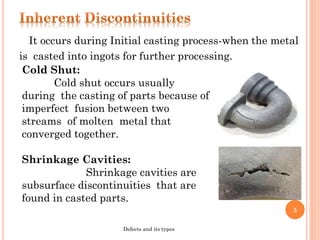
Cold Shut:
Cold shut occurs usually
during the casting of parts because of
imperfect fusion between two
streams of molten metal that
converged together.
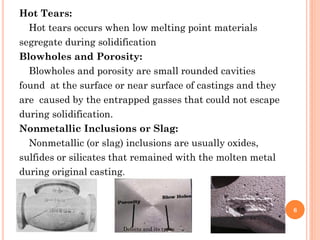
Shrinkage Cavities:
Shrinkage cavities are
subsurface discontinuities that are
found in casted parts.
5
Defects and its types
Hot Tears:
Hot tears occurs when low melting point materials
segregate during solidification
Blowholes and Porosity:
Blowholes and porosity are small rounded cavities
found at the surface or near surface of castings and they
are caused by the entrapped gasses that could not escape
during solidification.
Nonmetallic Inclusions or Slag:
Nonmetallic (or slag) inclusions are usually oxides,
sulfides or silicates that remained with the molten metal
during original casting.
6
Defects and its types
It occurs during hot or cold forming processes
(extrusion, forging, rolling, drawing, welding, etc.)
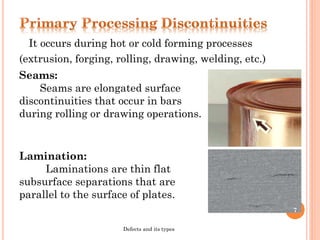
Seams:
Seams are elongated surface
discontinuities that occur in bars
during rolling or drawing operations.
`
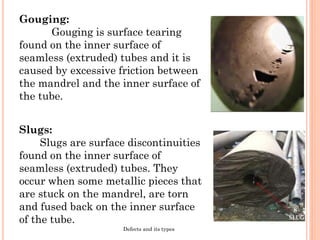
Lamination:
Laminations are thin flat
subsurface separations that are
parallel to the surface of plates.
7
Defects and its types
Gouging:
Gouging is surface tearing
found on the inner surface of
seamless (extruded) tubes and it is
caused by excessive friction between
the mandrel and the inner surface of
the tube.
Slugs:
Slugs are surface discontinuities
found on the inner surface of
seamless (extruded) tubes. They
occur when some metallic pieces that
are stuck on the mandrel, are torn
and fused back on the inner surface
of the tube.
8
Defects and its types
9
Defects and its types
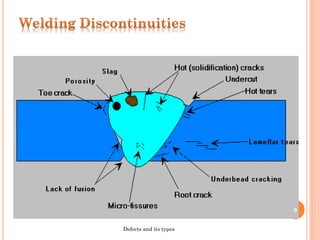
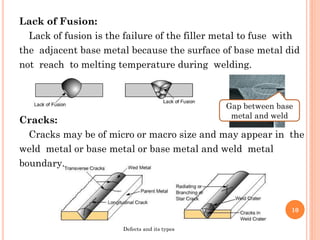
Lack of Fusion:
Lack of fusion is the failure of the filler metal to fuse with
the adjacent base metal because the surface of base metal did
not reach to melting temperature during welding.
Cracks:
Cracks may be of micro or macro size and may appear in the
weld metal or base metal or base metal and weld metal
boundary.
Gap between base
metal and weld
10
Defects and its types
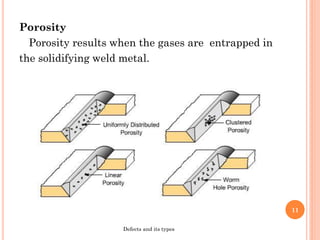
Porosity
Porosity results when the gases are entrapped in
the solidifying weld metal.
11
Defects and its types
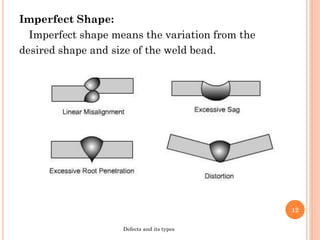
Imperfect Shape:
Imperfect shape means the variation from the
desired shape and size of the weld bead.
12
Defects and its types
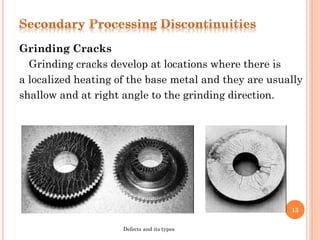
Grinding Cracks
Grinding cracks develop at locations where there is
a localized heating of the base metal and they are usually
shallow and at right angle to the grinding direction.
13
Defects and its types
Pickling Cracks:
Pickling is chemical surface cleaning operation (using
acids) used to remove unwanted scale.
Heat Treatment (Quenching) Cracks:
Heat treatment cracks mostly occur during quenching
especially when harsh media is used for quenching (such
as cold water, oil quenching is less harsh).
Machining Tears:
Machining tears result from the use of machining tools
having dull or chipped cutting edges.
14
Defects and its types
This originate or develop while the component is in
service. The service conditions (loading, mechanical and
chemical environment, maintenance) of a component
affect its expected life.
Fatigue Cracks
According to Linear-Elastic Fracture Mechanics
(LEFM), fatigue failure develops in three stages:
Stage 1: Development of one or more micro cracks
Stage 2: The cracks progress from micro cracks to larger
cracks(macro cracks)
Stage 3: Result of sudden fracture.
15
Defects and its types
Creep Cracks:
When a metal is at a temperature greater than 0.4 to
0.5 of its absolute melting temperature and is subjected
to a high enough value of stress (lower than the yield
strength at room temperature but it is actually higher
than the yield strength at the elevated temperature), it
will keep deforming continuously until it finally
fractures. Such type of deformation is called creep
16
Defects and its types
Creep Cracks
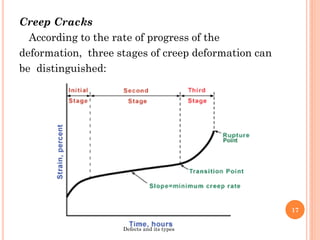
According to the rate of progress of the
deformation, three stages of creep deformation can
be distinguished:
17
Defects and its types
Initial stage (or primary creep): the strain rate is
relatively high but slows with increasing time due to
work hardening.
Second stage (or steady-state creep): the strain rate
reaches a minimum and becomes steady due to the
Balance between work hardening and annealing
(thermal softening). The characterized "creep strain rate"
typically refers to the rate in this secondary stage.
Third stage (or tertiary creep): the strain rate
exponentially increases with stress because of necking
phenomena and finally the component ruptures.
18
Defects and its types
1.Difference between discontinuity and defect
2.Types of discontinuities
3.What are Inherent discontinuities
4.What are Primary discontinuities
5.What are Secondary discontinuities
6.What are Service discontinuities
19
Defects and its types
THANK YOU
20

Defects and its types

  • 1.
    Prepared by Mr.M.Mani Vannan AssistantProfessor Department of Mechanical Engineering 1
  • 2.
    1.Able to identifythe difference between defect and discontinuity 2.Able to classify the different types of discontinuity based upon the physical nature. 2 Defects and its types
  • 3.
    A Discontinuity isdefined as an imperfection or interruption in the normal physical characteristics or structure of an object (crack, porosity, inhomogeneity, etc.) A Defect is defined as a flaw or flaws that by nature or accumulated effect render a part or product unable to meet minimum applicable acceptance standards or specifications (defect designates rejectability) 3 Defects and its types
  • 4.
    Discontinuities are generallycategorized according to the stage of the manufacturing or use in which they initiate. Therefore, discontinuities are categorized in four groups which are: 1.Inherent discontinuities 2.Primary processing discontinuities 3.Secondary processing discontinuities 4.Service discontinuities 4 Defects and its types
  • 5.
    It occurs duringInitial casting process-when the metal is casted into ingots for further processing. Cold Shut: Cold shut occurs usually during the casting of parts because of imperfect fusion between two streams of molten metal that converged together. Shrinkage Cavities: Shrinkage cavities are subsurface discontinuities that are found in casted parts. 5 Defects and its types
  • 6.
    Hot Tears: Hot tearsoccurs when low melting point materials segregate during solidification Blowholes and Porosity: Blowholes and porosity are small rounded cavities found at the surface or near surface of castings and they are caused by the entrapped gasses that could not escape during solidification. Nonmetallic Inclusions or Slag: Nonmetallic (or slag) inclusions are usually oxides, sulfides or silicates that remained with the molten metal during original casting. 6 Defects and its types
  • 7.
    It occurs duringhot or cold forming processes (extrusion, forging, rolling, drawing, welding, etc.) Seams: Seams are elongated surface discontinuities that occur in bars during rolling or drawing operations. ` Lamination: Laminations are thin flat subsurface separations that are parallel to the surface of plates. 7 Defects and its types
  • 8.
    Gouging: Gouging is surfacetearing found on the inner surface of seamless (extruded) tubes and it is caused by excessive friction between the mandrel and the inner surface of the tube. Slugs: Slugs are surface discontinuities found on the inner surface of seamless (extruded) tubes. They occur when some metallic pieces that are stuck on the mandrel, are torn and fused back on the inner surface of the tube. 8 Defects and its types
  • 9.
  • 10.
    Lack of Fusion: Lackof fusion is the failure of the filler metal to fuse with the adjacent base metal because the surface of base metal did not reach to melting temperature during welding. Cracks: Cracks may be of micro or macro size and may appear in the weld metal or base metal or base metal and weld metal boundary. Gap between base metal and weld 10 Defects and its types
  • 11.
    Porosity Porosity results whenthe gases are entrapped in the solidifying weld metal. 11 Defects and its types
  • 12.
    Imperfect Shape: Imperfect shapemeans the variation from the desired shape and size of the weld bead. 12 Defects and its types
  • 13.
    Grinding Cracks Grinding cracksdevelop at locations where there is a localized heating of the base metal and they are usually shallow and at right angle to the grinding direction. 13 Defects and its types
  • 14.
    Pickling Cracks: Pickling ischemical surface cleaning operation (using acids) used to remove unwanted scale. Heat Treatment (Quenching) Cracks: Heat treatment cracks mostly occur during quenching especially when harsh media is used for quenching (such as cold water, oil quenching is less harsh). Machining Tears: Machining tears result from the use of machining tools having dull or chipped cutting edges. 14 Defects and its types
  • 15.
    This originate ordevelop while the component is in service. The service conditions (loading, mechanical and chemical environment, maintenance) of a component affect its expected life. Fatigue Cracks According to Linear-Elastic Fracture Mechanics (LEFM), fatigue failure develops in three stages: Stage 1: Development of one or more micro cracks Stage 2: The cracks progress from micro cracks to larger cracks(macro cracks) Stage 3: Result of sudden fracture. 15 Defects and its types
  • 16.
    Creep Cracks: When ametal is at a temperature greater than 0.4 to 0.5 of its absolute melting temperature and is subjected to a high enough value of stress (lower than the yield strength at room temperature but it is actually higher than the yield strength at the elevated temperature), it will keep deforming continuously until it finally fractures. Such type of deformation is called creep 16 Defects and its types
  • 17.
    Creep Cracks According tothe rate of progress of the deformation, three stages of creep deformation can be distinguished: 17 Defects and its types
  • 18.
    Initial stage (orprimary creep): the strain rate is relatively high but slows with increasing time due to work hardening. Second stage (or steady-state creep): the strain rate reaches a minimum and becomes steady due to the Balance between work hardening and annealing (thermal softening). The characterized "creep strain rate" typically refers to the rate in this secondary stage. Third stage (or tertiary creep): the strain rate exponentially increases with stress because of necking phenomena and finally the component ruptures. 18 Defects and its types
  • 19.
    1.Difference between discontinuityand defect 2.Types of discontinuities 3.What are Inherent discontinuities 4.What are Primary discontinuities 5.What are Secondary discontinuities 6.What are Service discontinuities 19 Defects and its types
  • 20.