Dr. Jayashree Baral
Assistant Professor
Materials and Metallurgical Engineering (MME)
MME 453: Failure Analysis
MME 453 : FAILURE ANALYSIS
Introduction: Sources of failures; Description and
origin of processing defects: metal working defects,
casting defects, heat treatment defects and weld
defects; Toughness, ductile brittle transition and
fracture mechanics; Types of failure: ductile and
brittle, fatigue, creep and environment assisted;
Macroscopic and microscopic fracture surface analysis
to characterize the mechanism and origin of failure;
Overview of mechanical test parameters and non-
destructive testing; Generalized procedure for analysis
of common failures; Case histories.
1. G.E. Dieter: Mechanical Metallurgy, McGraw- Hill, 1988
2. Deformation and fracture mechanics of engineering materials,
R. W. Hertzberg
3. Elementary engineering fracture mechanics, D. Broek
4. Fundamental of fracture mechanics, J. F. Knott
5. Metallurgy of Failure Analysis. A.K. Das
6. Baldev Raj, T Jaykumar, M Thavasimuthu; Practical Non-
destructive Testing, Narosa Publishing House, New Delhi
2007.
7. Failure analysis and prevention, Volume 11, ASM Handbook,
The Materials Information Society, 2002
Text Books
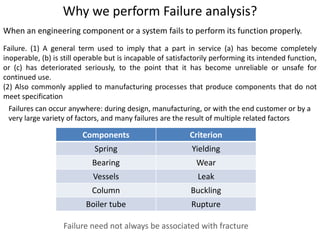
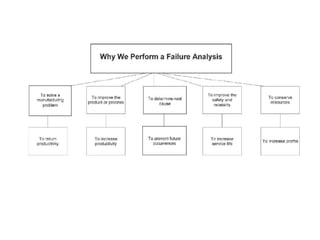
Why we perform Failure analysis?
When an engineering component or a system fails to perform its function properly.
Components Criterion
Spring Yielding
Bearing Wear
Vessels Leak
Column Buckling
Boiler tube Rupture
Failure need not always be associated with fracture
Failure. (1) A general term used to imply that a part in service (a) has become completely
inoperable, (b) is still operable but is incapable of satisfactorily performing its intended function,
or (c) has deteriorated seriously, to the point that it has become unreliable or unsafe for
continued use.
(2) Also commonly applied to manufacturing processes that produce components that do not
meet specification
Failures can occur anywhere: during design, manufacturing, or with the end customer or by a
very large variety of factors, and many failures are the result of multiple related factors
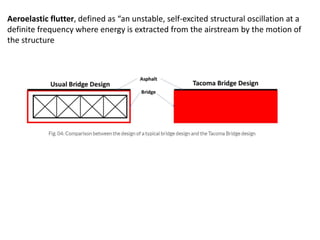
Aeroelastic flutter, defined as “an unstable, self-excited structural oscillation at a
definite frequency where energy is extracted from the airstream by the motion of
the structure
Why components fail?
• Design deficiency (Lack of knowledge)
• Material Selection Deficiency
• Processing Deficiency
• Assembly / Installation Deficiency
• Environmental Impact
• Operational & Maintenance Error
Processing deficiency
• Casting defects
• Metal working defects
• Heat treatment defects
• Welding defects
Nondestructive examination can ensure selection of
defect free material.
Material selection deficiency
• Rocket nozzle: should withstand 3000⁰C & resist
abrasion due to debris in exhaust
• Choice: W melting point 3450⁰C
• On actual test the nozzle melted
• Exhaust gas had carbon since early rockets used
hydrocarbon as fuel.
• W picked up carbon; this lowered its melting
point to 2460⁰C
Source: John Hilliard in an article in J of Educational Modules
for Materials Science & Engineering, 1:173 (1979)
Assembly / Installation Deficiency
• Residual stress due to force fitting
• Incorrect placement or incorrect assembly
order may result in high residual stress
• Improper specification for torque requirement
• Misalignment of components within an
assembly
Environmental Impact (Ageing)
• Fatigue
• Corrosion
• Wear
• Hydrogen degradation
• Creep
• Impact (Dynamic loading)
Operation / Maintenance deficiency
• Over stressing
• Over heating
• Lack of periodic inspection / monitoring
Summary
• Course content
• Text books
• Why components fail?
• Reason: deficiency in design, processing, use
• Common mechanisms of failure
• Failed parts have signature of failure
• Aim of FA is to unravel it
Failure analysis: why?
• To know why it has happened
• To fix responsibility (user or builder or lack of
knowledge): litigation
• To find ways & means of avoiding it (new
knowledge / techniques / new materials)
Failed parts have signature of what has happened
during its lifetime. Purpose of failure analysis is to
unravel it.
Design deficiency
In every design there is always some chance of failure
• Underestimate of service stress
• Undesirable geometry
a. Stress concentrators
b. Inadequate radii at corners
c. Inaccessibility for inspection
• Difficult to fabricate
• Improper choice of materials
• Improper choice of heat treatment
• Environmental effects

FA1.pptx

  • 1.
    Dr. Jayashree Baral AssistantProfessor Materials and Metallurgical Engineering (MME) MME 453: Failure Analysis
  • 2.
    MME 453 :FAILURE ANALYSIS Introduction: Sources of failures; Description and origin of processing defects: metal working defects, casting defects, heat treatment defects and weld defects; Toughness, ductile brittle transition and fracture mechanics; Types of failure: ductile and brittle, fatigue, creep and environment assisted; Macroscopic and microscopic fracture surface analysis to characterize the mechanism and origin of failure; Overview of mechanical test parameters and non- destructive testing; Generalized procedure for analysis of common failures; Case histories.
  • 3.
    1. G.E. Dieter:Mechanical Metallurgy, McGraw- Hill, 1988 2. Deformation and fracture mechanics of engineering materials, R. W. Hertzberg 3. Elementary engineering fracture mechanics, D. Broek 4. Fundamental of fracture mechanics, J. F. Knott 5. Metallurgy of Failure Analysis. A.K. Das 6. Baldev Raj, T Jaykumar, M Thavasimuthu; Practical Non- destructive Testing, Narosa Publishing House, New Delhi 2007. 7. Failure analysis and prevention, Volume 11, ASM Handbook, The Materials Information Society, 2002 Text Books
  • 4.
    Why we performFailure analysis? When an engineering component or a system fails to perform its function properly. Components Criterion Spring Yielding Bearing Wear Vessels Leak Column Buckling Boiler tube Rupture Failure need not always be associated with fracture Failure. (1) A general term used to imply that a part in service (a) has become completely inoperable, (b) is still operable but is incapable of satisfactorily performing its intended function, or (c) has deteriorated seriously, to the point that it has become unreliable or unsafe for continued use. (2) Also commonly applied to manufacturing processes that produce components that do not meet specification Failures can occur anywhere: during design, manufacturing, or with the end customer or by a very large variety of factors, and many failures are the result of multiple related factors
  • 8.
    Aeroelastic flutter, definedas “an unstable, self-excited structural oscillation at a definite frequency where energy is extracted from the airstream by the motion of the structure
  • 11.
    Why components fail? •Design deficiency (Lack of knowledge) • Material Selection Deficiency • Processing Deficiency • Assembly / Installation Deficiency • Environmental Impact • Operational & Maintenance Error
  • 12.
    Processing deficiency • Castingdefects • Metal working defects • Heat treatment defects • Welding defects Nondestructive examination can ensure selection of defect free material.
  • 13.
    Material selection deficiency •Rocket nozzle: should withstand 3000⁰C & resist abrasion due to debris in exhaust • Choice: W melting point 3450⁰C • On actual test the nozzle melted • Exhaust gas had carbon since early rockets used hydrocarbon as fuel. • W picked up carbon; this lowered its melting point to 2460⁰C Source: John Hilliard in an article in J of Educational Modules for Materials Science & Engineering, 1:173 (1979)
  • 14.
    Assembly / InstallationDeficiency • Residual stress due to force fitting • Incorrect placement or incorrect assembly order may result in high residual stress • Improper specification for torque requirement • Misalignment of components within an assembly
  • 15.
    Environmental Impact (Ageing) •Fatigue • Corrosion • Wear • Hydrogen degradation • Creep • Impact (Dynamic loading)
  • 16.
    Operation / Maintenancedeficiency • Over stressing • Over heating • Lack of periodic inspection / monitoring
  • 17.
    Summary • Course content •Text books • Why components fail? • Reason: deficiency in design, processing, use • Common mechanisms of failure • Failed parts have signature of failure • Aim of FA is to unravel it
  • 18.
    Failure analysis: why? •To know why it has happened • To fix responsibility (user or builder or lack of knowledge): litigation • To find ways & means of avoiding it (new knowledge / techniques / new materials) Failed parts have signature of what has happened during its lifetime. Purpose of failure analysis is to unravel it.
  • 19.
    Design deficiency In everydesign there is always some chance of failure • Underestimate of service stress • Undesirable geometry a. Stress concentrators b. Inadequate radii at corners c. Inaccessibility for inspection • Difficult to fabricate • Improper choice of materials • Improper choice of heat treatment • Environmental effects

Editor's Notes

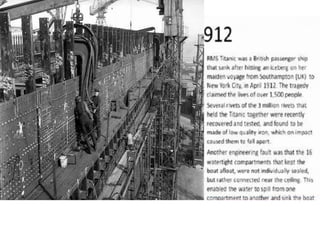
  • #7 When the Titanic collided with the iceberg, the hull steel and the wrought iron rivets failed because of brittle fracture. • The causes of brittle fracture include low temperature, high impact loading, and high sulphur content
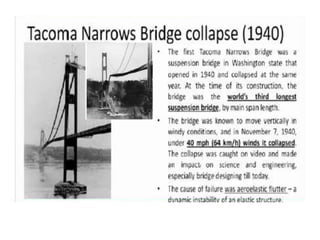
  • #8 Aeroelastic flutter, defined as “an unstable, self-excited structural oscillation at a definite frequency where energy is extracted from the airstream by the motion of the structure