SIMULATION TRAINING IN MEDICINE
AND TECHNOLOGY MANAGEMENT
I. Shchaviy, A. Bashkov, D. Konkov
Ukrainian-Swiss Mother and Child Health Programme,
Ukraine
Why simulation?
• Simulation is valuable when „on-the-job‟ training
is expensive or risky
• Simulation has been adopted for training where
consequences of error expose many people to
risk or the cost of error is high, for example:
– Aerospace
– Military
– Nuclear power plants
Medicine: A High-Risk Industry
Risk Management Considerations -
Hazards in Medicine
“Most serious medical errors are committed by
competent, caring people doing what
other competent, caring people would do.”
-Donald M. Berwick, MD, MPP
• Not just about the people, it is about the
design:
• System, medical devices, procedures
• Human Factors: safeguard in the design “making it
difficult for people to do the wrong thing”
Advantages of Simulation
• Structured learning
• Guaranteed and scheduled
opportunities for teaching learning
– Uncommon situations can be presented
– Teacher can model process, give
feedback, repeat process, modify process
• Repetition as often as needed
Successful strategies for crisis
management:
• Use of written checklists to help prevent crises
Use of established procedures in responding to
crises
Training in decision making and resource co-
ordination
• Systematic practise in handling crises including
part-task trainers and full-mission realistic
simulation
Simulation technologies used in
medical education
• Computer-based simulations (micro-worlds,
micro-simulation)
• Virtual environments +/- haptics
• Part-task trainers
• Low-fidelity simulators/manikins
• Simulated or standardised patients
• Hybrid simulations
• High-fidelity (full mission) simulation
Technical infrastructure and technology
management – key factors
• Facility
• Manikins
• Multimedia equipment
• Hardware and software
• Human resources
• Medical equipment
• Good management
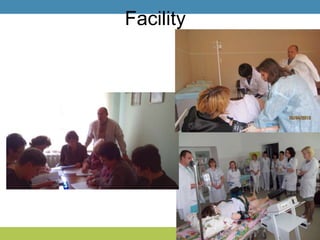
Facility
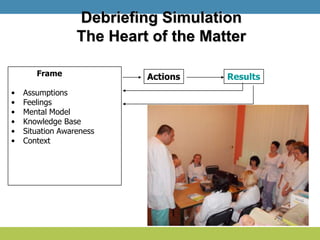
Debriefing Simulation
The Heart of the Matter
Frame
• Assumptions
• Feelings
• Mental Model
• Knowledge Base
• Situation Awareness
• Context
Actions Results
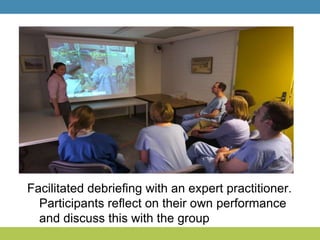
Facilitated debriefing with an expert practitioner.
Participants reflect on their own performance
and discuss this with the group
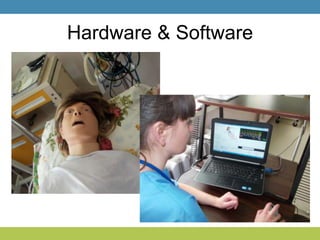
Hardware & Software
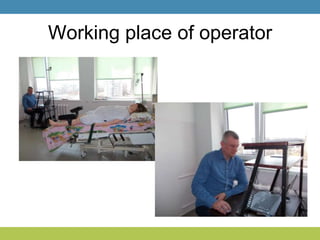
Working place of operator
Resources
• Equipment
– Simulators, monitors, defibrillator, trolleys, etc
• Disposables
– Appropriate for scenario, setting and
participants, re-use w/o compromising fidelity
• Faculty
– Trained, available, practised
• Support staff
– Bio-medical technician essential! Also clerical.
Before and after simulations...
• Set-up scenario
– eg. make blood, set up OR, X-rays, etc
• Load up simulation program
• Check everything works
– Cameras, VCR, communicators
Afterwards...
• Check simulator
• Clean everything used and put away
• Replace/reorder all used items
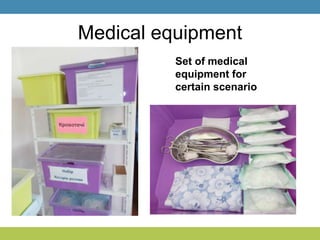
Medical equipment
Set of medical
equipment for
certain scenario
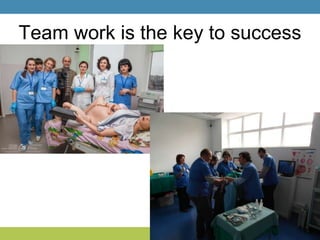
Team work is the key to success
Why Teamwork?
• Reduce clinical errors
• Improve patient outcomes
• Improve process outcomes
• Increase patient satisfaction
• Increase staff satisfaction
• Reduce malpractice claims
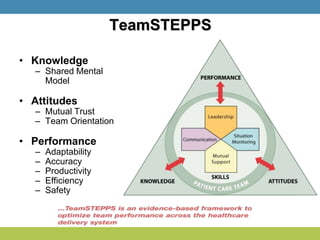
TeamSTEPPS
• Knowledge
– Shared Mental
Model
• Attitudes
– Mutual Trust
– Team Orientation
• Performance
– Adaptability
– Accuracy
– Productivity
– Efficiency
– Safety
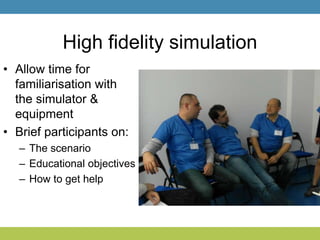
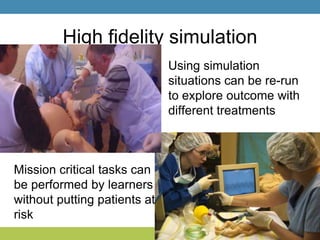
High fidelity simulation
• Allow time for
familiarisation with
the simulator &
equipment
• Brief participants on:
– The scenario
– Educational objectives
– How to get help
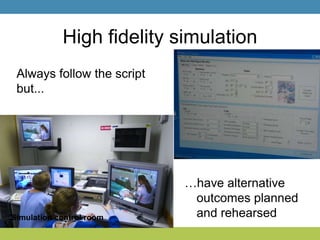
High fidelity simulation
Always follow the script
but...
…have alternative
outcomes planned
and rehearsedSimulation control room
High fidelity simulation
Using simulation
situations can be re-run
to explore outcome with
different treatments
Mission critical tasks can
be performed by learners
without putting patients at
risk
The future of simulation...
• Skills training tool for all disciplines
– Acute care
– New techniques and/or equipment
– Managing complications
– Retraining
• Multi-disciplinary training
– inter-professional communication
– team performance
• Training in decision-making/resource co-
ordination
Conclusions
• A large majority of medical errors are
related to teamwork, communication and
technology management, elements that
can be improved though use of simulation.
• The adequate simulation technology can
be used to reduce different types of
errors and their contributing factors.
Thank you!

Simulation training in medicine and technology management

  • 1.
    SIMULATION TRAINING INMEDICINE AND TECHNOLOGY MANAGEMENT I. Shchaviy, A. Bashkov, D. Konkov Ukrainian-Swiss Mother and Child Health Programme, Ukraine
  • 2.
    Why simulation? • Simulationis valuable when „on-the-job‟ training is expensive or risky • Simulation has been adopted for training where consequences of error expose many people to risk or the cost of error is high, for example: – Aerospace – Military – Nuclear power plants Medicine: A High-Risk Industry
  • 3.
    Risk Management Considerations- Hazards in Medicine “Most serious medical errors are committed by competent, caring people doing what other competent, caring people would do.” -Donald M. Berwick, MD, MPP • Not just about the people, it is about the design: • System, medical devices, procedures • Human Factors: safeguard in the design “making it difficult for people to do the wrong thing”
  • 4.
    Advantages of Simulation •Structured learning • Guaranteed and scheduled opportunities for teaching learning – Uncommon situations can be presented – Teacher can model process, give feedback, repeat process, modify process • Repetition as often as needed
  • 5.
    Successful strategies forcrisis management: • Use of written checklists to help prevent crises Use of established procedures in responding to crises Training in decision making and resource co- ordination • Systematic practise in handling crises including part-task trainers and full-mission realistic simulation
  • 6.
    Simulation technologies usedin medical education • Computer-based simulations (micro-worlds, micro-simulation) • Virtual environments +/- haptics • Part-task trainers • Low-fidelity simulators/manikins • Simulated or standardised patients • Hybrid simulations • High-fidelity (full mission) simulation
  • 7.
    Technical infrastructure andtechnology management – key factors • Facility • Manikins • Multimedia equipment • Hardware and software • Human resources • Medical equipment • Good management
  • 8.
  • 9.
    Debriefing Simulation The Heartof the Matter Frame • Assumptions • Feelings • Mental Model • Knowledge Base • Situation Awareness • Context Actions Results
  • 10.
    Facilitated debriefing withan expert practitioner. Participants reflect on their own performance and discuss this with the group
  • 11.
  • 12.
  • 13.
    Resources • Equipment – Simulators,monitors, defibrillator, trolleys, etc • Disposables – Appropriate for scenario, setting and participants, re-use w/o compromising fidelity • Faculty – Trained, available, practised • Support staff – Bio-medical technician essential! Also clerical.
  • 14.
    Before and aftersimulations... • Set-up scenario – eg. make blood, set up OR, X-rays, etc • Load up simulation program • Check everything works – Cameras, VCR, communicators Afterwards... • Check simulator • Clean everything used and put away • Replace/reorder all used items
  • 15.
    Medical equipment Set ofmedical equipment for certain scenario
  • 16.
    Team work isthe key to success
  • 17.
    Why Teamwork? • Reduceclinical errors • Improve patient outcomes • Improve process outcomes • Increase patient satisfaction • Increase staff satisfaction • Reduce malpractice claims
  • 18.
    TeamSTEPPS • Knowledge – SharedMental Model • Attitudes – Mutual Trust – Team Orientation • Performance – Adaptability – Accuracy – Productivity – Efficiency – Safety
  • 19.
    High fidelity simulation •Allow time for familiarisation with the simulator & equipment • Brief participants on: – The scenario – Educational objectives – How to get help
  • 20.
    High fidelity simulation Alwaysfollow the script but... …have alternative outcomes planned and rehearsedSimulation control room
  • 21.
    High fidelity simulation Usingsimulation situations can be re-run to explore outcome with different treatments Mission critical tasks can be performed by learners without putting patients at risk
  • 22.
    The future ofsimulation... • Skills training tool for all disciplines – Acute care – New techniques and/or equipment – Managing complications – Retraining • Multi-disciplinary training – inter-professional communication – team performance • Training in decision-making/resource co- ordination
  • 23.
    Conclusions • A largemajority of medical errors are related to teamwork, communication and technology management, elements that can be improved though use of simulation. • The adequate simulation technology can be used to reduce different types of errors and their contributing factors.
  • 24.