The Role of
Emergency Physician
in Response to
CBRNE Attack
Dr. Chew Keng Sheng
Emergency Medicine
Universiti Sains Malaysia
Objectives
 Definitions
 Key criteria for determining a terrorist attack
 Overview on selected terrorists’ attacks and WMDs
 Major Lessons Learnt from Previous Disasters
 Syndromic Surveillance
 Defining roles of EPs in response to CRBNE Terrorist
Attacks – “7Ds in Disasters”
 Q & A
Definitions of Disaster, Mass
Casualty Incidents and
Terrorism
Definitions
 Disaster – defined as a sudden ecologic
phenomenon of sufficient magnitude to
require external assistance
 In the Emergency Department, disaster exists
when the number of patients presenting in any
given space of time are such that even
minimal care cannot be offered without
external assistance.
Definitions
 Disasters occur when normal, basic services
of a society become disrupted to such extent
that widespread human and environmental
losses exceed the community’s management
capacity (SAEM Disaster Medicine White Paper
Subcommittee)
 Disasters characterized by large numbers of
deaths and injuries are also referred to “Mass
Casualty Incidents”
Definitions
 However, disasters are not defined only by a
given number of victims
 Example: The arrival of one VIP guest with
severe medical or trauma emergency conditions
can completely disrupt normal operations of
even the most efficient emergency departments.
 In short, the essence of the concept of disaster
is it has a “massive disruptive impact”
Definitions
 Mass Casualty Incidents (MCI) – events
resulting in a numbers of victims large
enough to disrupt normal course of
emergency and health care services of the
affected community
 Disasters result in MCIs, but encompass a
broad range of calamities beyond just the high
numbers of casualties
 “All MCIs are disastrous, but not all disasters are
due to MCIs”
Definitions
 Disasters can be divided into two:
 Natural Disasters OR Man-made Disasters
 External Disasters (events occurring outside the
hospital) OR Internal Disasters (events involving
the physical structures of hospital itself - e.g. fire,
lab accident involving radioactive materials)
 Terrorism – man made, external disasters
Directive 20, National Security
Council
 A Disaster is
1. an event that occurs
suddenly.
2. complex in nature.
3. loss of lives.
4. destruction of property
and/or environment.
5. disruption of the
community daily
activities
Three Levels According to Directive
20, NSC
 Level 1
 Localized, well-controlled, manageable by local
authorities
 Level 2
 Well-controlled, management at state or national
level
 Level 3
 Complete destruction, disruption of routine
activities,
Directive 20, NSC
 Disaster can be divided into 3 level
LEVEL 1
1. Localized major incident
2. Under controlled
3. Not complex
4. Small no. of casualties and property loss
5. Minor disruption of daily community activities
6. Manageable by the local authorities requiring
7. Multisectoral involvement.
 Example: bus accident, train derailment, landslide.
Directive 20, NSC
 LEVEL 2 Disaster
1. Widespread over a large area but under controlled
2. Complicated and complex
3. Large no. of casualties and property loss.
4. Affecting daily community activities
5. Not manageable by the local authorities requiring
6. Assistance from other states or National Authorities
7. Support required, Regional or National Support
 Examples: Highland Towers Collapse, Greg Storm
Sabah, Bright Sparklers.
Directive 20, NSC
 LEVEL 3 Disaster
1. Involves a very large area.
2. Loss of many lives.
3. Total Destruction of infrastructure and public facility.
4. Complicated and complex.
5. High risk to rescue workers.
6. Complete disruption of daily community activities.
7. Major destruction of resources.
8. All local resources destroyed and assistance from external
resources required.
 e.g. Earthquake, typhoons, volcanoes, war.
Disasters Vs Emergencies
Routine Emergencies Disasters
Interaction with familiar
parties
Interaction with unfamiliar
parties
Familiar tasks/procedures Unfamiliar
tasks/procedures
Intra-organization
coordination
Intra- and inter-
organization coordination
Intact communications,
roads, etc.
Disrupted
communications, blocked
roads, etc
Disasters Vs Emergencies
Routine Emergencies Disasters
Familiar terminology Unfamiliar, organization-
specific terminology
Local press attention National/international
media attention
Resources adequate for
management
Resources overwhelmed for
management capacity
PRE-HOSPITAL MANAGEMENT ORGANIZATION
Hospital Director
INCIDENT SITE
MEDICAL
MANAGER
Red Team
Leader
Medical
Triage Officer
NGO ADVANCED MEDICAL POST
Yellow Team
Leader
Evacuation
Officer
Admin.
Clerk
Transport
Officer
Ambulance
Drivers
Acute Treatment Manager
Admin.
Clerk Doctors & Paramedics
•JPA 3
•MRCS.
•SJAM
Medical/Health Officer
COMMAND POST Temporary
Morgue
Green Team
Leader
Know Your Role!
Key Criteria Defining a Terrorist
Attack
 Violence
 "the only general characteristic [of terrorism] generally agreed
upon is that terrorism involves violence and the threat of
violence"
 -Walter Laqueur of the Center for Strategic and International Studies
 Psychological Impact and Fear
 attack was carried out in such a way as to maximize the
severity and length of the psychological impact.
 Perpetrated for a Political Goal
 This is often the key difference between an act of terrorism
and a hate crime or lone-wolf "madman" attack
 The political change is desired so badly that failure is seen as
a worse outcome than the deaths of civilians.
Key Criteria Defining a Terrorist
Attack
 Targeting of non-combatants
 It is commonly held that the distinctive nature of terrorism
lies in its deliberate and specific selection of civilians as direct
targets.
 Much of the time, the victims of terrorism are targeted not
because they are threats, but because they are specific
"symbols, tools, or corrupt beings" that tie into a specific
view of the world that the terrorist possess.
 Their suffering accomplishes the terrorists' goals of instilling
fear, getting a message out to an audience, or otherwise
accomplishing their political end.
 (en.wikipedia.org)
Overview of Selected Terrorist
Incidents
 Bombing of WTC New York City 1993
 Sarin Gas Attack by Aum Shinrikyo in Matsumoto,
Japan, 1994
 Truck Bomb explosion of Alfred P. Murrah Building in
Oklahoma, 1995
 Sarin Gas Attack by Aum Shinrikyo in five subway train
stations simultaneously in Tokyo, 1995
 WTC Bombing, New York, September 11, 2001
 US Anthrax Incident, 2001
 Bombing in Bali, Indonesia 2002
Major Lessons Learnt
 Incident Confirmation
 At time of incident (whether biological, chemical or even
high explosive incidents), most people at the scene and even
the initial responders did not recognize the event as a
terrorist attack
 E.g. during the Sarin Gas Attack in Matsumoto, Japan,
emergency responders initially thought that the first victims
were ill from food poisoning, contaminated water, or natural
gas
 To improve early detection, a process called Syndromic
Surveillance is employed
Syndromic Surveillance
 A method to aid the early detection of
bioterrorism events
 This is to respond to bioterrorism attack – time
is essential
 This type of surveillance involves collecting and
analyzing statistical data on health trends – such
as symptoms reported by people seeking care in
emergency rooms or other health care setting –
or even sales of flu medicines.
Syndromic Surveillance
 Because bioterrorist agents such as anthrax,
plague, and smallpox initially present “flu-like”
symptoms, a sudden increase of individuals with
fever, headache, or muscle pain could be
evidence of a bioterrorist attack.
 By focusing on symptoms rather than confirmed
diagnoses, syndromic surveillance aims to detect
bioterror events earlier than would be possible
with traditional disease surveillance systems.
Syndromic Surveillance
 In other words, the term syndromic surveillance
refers to methods relying on detection of
clinical case features that are discernable before
confirmed diagnoses are made
Syndromic Surveillance
Recommended Website
Centers for Disease Control and Prevention –
Emergency Preparedness & Response
(http://www.bt.cdc.gov/)
Major Lessons Learnt
 Command and Control
 Unlike smaller emergencies where one single Incident
Commander in charge, in a terrorist attack, numerous
agencies and organizations involved
 The need to speedily establish a secure perimter around the
incident.
 Failure to do so during the Oklahoma bombing
 Communications
 Communications failure
 Overloaded land lines and cell phones with calls from public
trying to obtain info about their loved ones
Major Lessons Learnt
 Initial Responders
 Traditionally initial responders are defined as the local police,
firefighters, EMDs, paramedics. Well trained, part of daily
routine
 In overwhelming terrorist attacks, other professionals were
needed at the scene – NGOs, volunteers, mental health
workers
 These individuals thrust into new roles – without proper
training.
 Safety of these responders – 1993 WTC bombing, 124
emergency responders injured; in Oklahoma bombing, one
nurse killed from falling debris.
Major Lessons Learnt
 The Volunteers
 Volunteers, though well intentioned, often created problems
 Most not familiar with the emergency command and control
system
 The Victims
 At most disasters, victims left the scene and sought medical
help on their own
 Need for rapid establishment of a centralized database
containing identification victims from all responding medical
sites.
 E.g. in Bali Bombing – internet database used extensively
Major Lessons Learnt
 Psychological Effects
 PTSD – Example 11 months after 9/11 incident,
1277 stress related illnesses reported
 Need for debriefing and de-stressing; short briefings
prior to change of shift for responders
 Tokyo Sarin Attack and Anthrax threat – created
unique psychological fear – the healthy but anxious
lots taxed the health services at a time when others
needed care.
 Need for proper public education
Major Lessons Learnt
 Mortuary Affairs
 Temporary morgues, body bags
 Body decay
 Rapid identification of victims – for family
members, law, insurance companies, etc; the need for
DNA analysis
 Example – Oklahoma bombing – unavoidable delays
in official death notifications added emotional
trauma to the already bereaved families
 The need for religious sensitivity in handling bodies
Major Lessons Learnt
 Duration of event
 Prolonged duration – strained the human and material
resources; depletion of stocks
 Need for regular work shifts
 Criminal Investigations
 One of the main difference between natural disaster and
man-made disaster
 The concern to preserve the evidence
 Medical emergency responders help protect the evidence by
only touching and removing items when necessary
Major Lessons Learnt
 Media
 Mixed blessings
 Disseminate information
 Yet, in an effort to provide information ASAP, sometimes
media give false and confusing information
 VIP Visits
 Politicians, celebrities, etc
 Timing of these visits sometimes interfered with ongoing
recovery efforts
Overview
 Chemical Weapons
 Nerve Agents – G series (GA,
GB, GD), V series
 Blood Agents - cyanides
 Blistering Agents
 Biological Weapons
 Biological Agents – viruses (e.g
Ebola), bacteria (Yersenia
pestis, anthrax)
 Biological Toxins – botulism,
ricin, Staphylococcal
Enterotoxin B
 Radiation
 α radiation
 β radiation
 γ radiation
 Nuclear
 A bomb (Atomic)
 H bomb (Hydrogen)
 Explosives
 Large scale - Incendiary
bombs, Napalm-B, Mark 77
 Smaller scale - Molotov
Cocktail (Poor man’s hand
grenades)
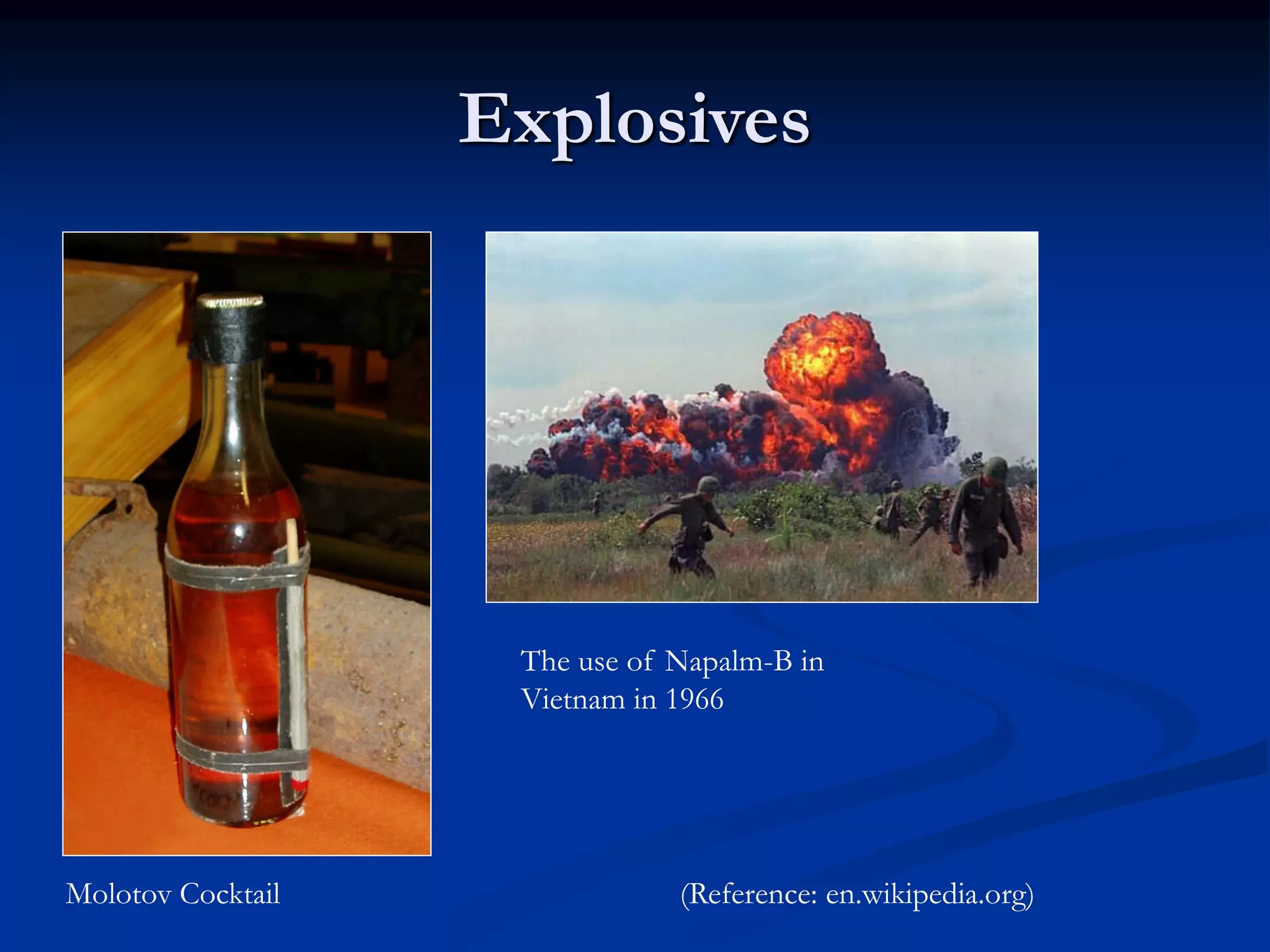
Explosives
(Reference: en.wikipedia.org)Molotov Cocktail
The use of Napalm-B in
Vietnam in 1966
How Prepared are the ED?
 In 1997, Burgess et al. reported that only 44.2% of
hospital EDs had the ability to handle any chemically
contaminated patients from HAZMAT
 41.1% - no designated decontamination facilities
 Greenberg et al. in June 2000, conducted a survey to
assess the level of preparedness of hospital EDs in a
large metropolitan area to evaluate and treat victims of
a terrorist biological or chemical agent release
 44 out of 62 ED directors responded to the questionnaire
How Prepared Are the EDs?
(Figures given in percentage) Yes No DK
Decon facilities 90.7 9.3 0
Ability to decon:
a. < 10/Hr 83.3 - -
b. 10-19/Hr 7.4 - -
c. 20-50/Hr 5.6 - -
d. >50/Hr 3.7 - -
Written plan for handling post-decon waste water 63 18.5 18.5
Written plan for handling contaminated clothings 42.6 29.6 27.8
Presence of detection equipment in ED 14.9 68.5 16.7
Personal Protective Clothing 87 13 0
(Greenberg et al., 2000)
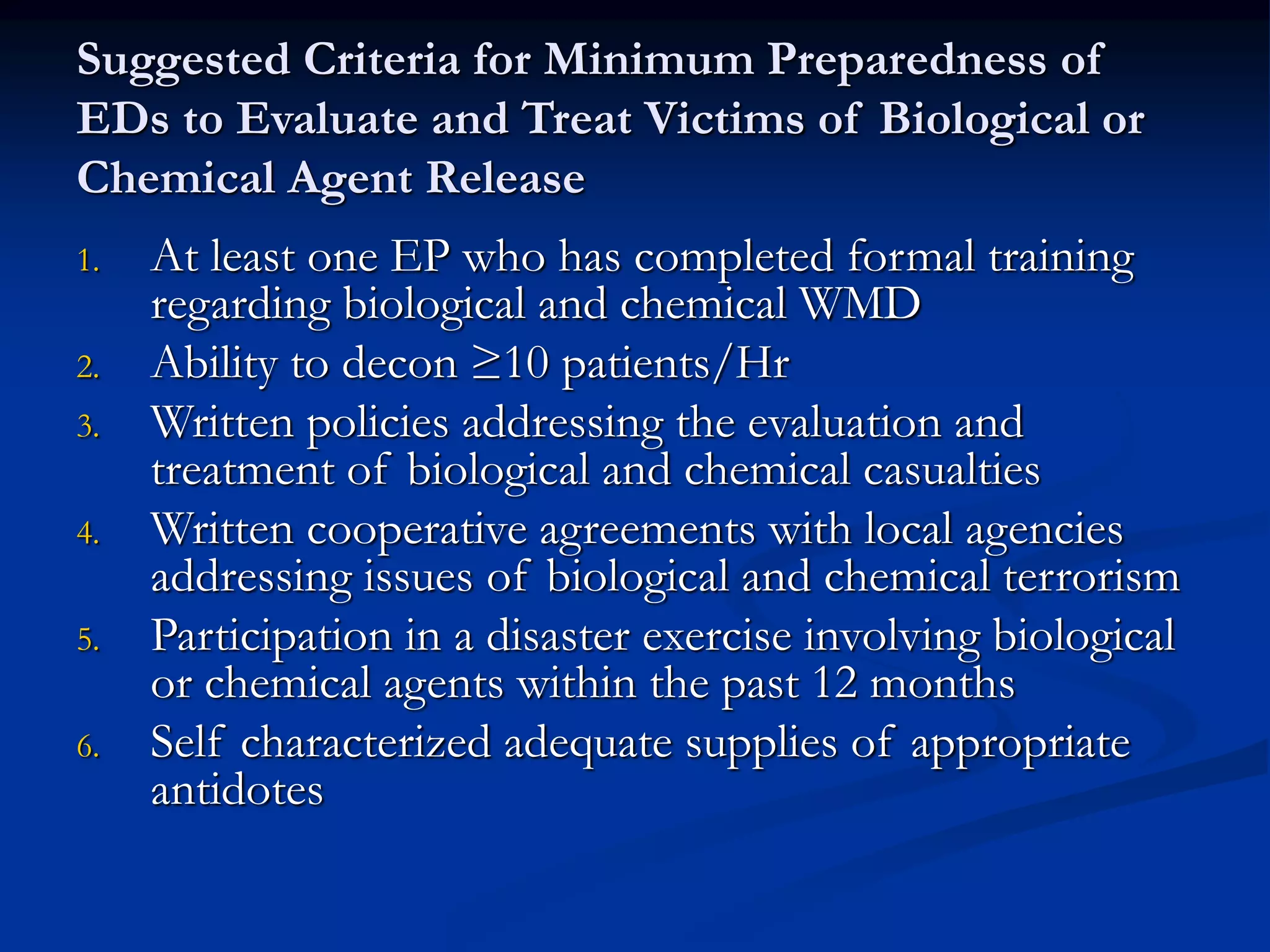
Suggested Criteria for Minimum Preparedness of
EDs to Evaluate and Treat Victims of Biological or
Chemical Agent Release
1. At least one EP who has completed formal training
regarding biological and chemical WMD
2. Ability to decon ≥10 patients/Hr
3. Written policies addressing the evaluation and
treatment of biological and chemical casualties
4. Written cooperative agreements with local agencies
addressing issues of biological and chemical terrorism
5. Participation in a disaster exercise involving biological
or chemical agents within the past 12 months
6. Self characterized adequate supplies of appropriate
antidotes
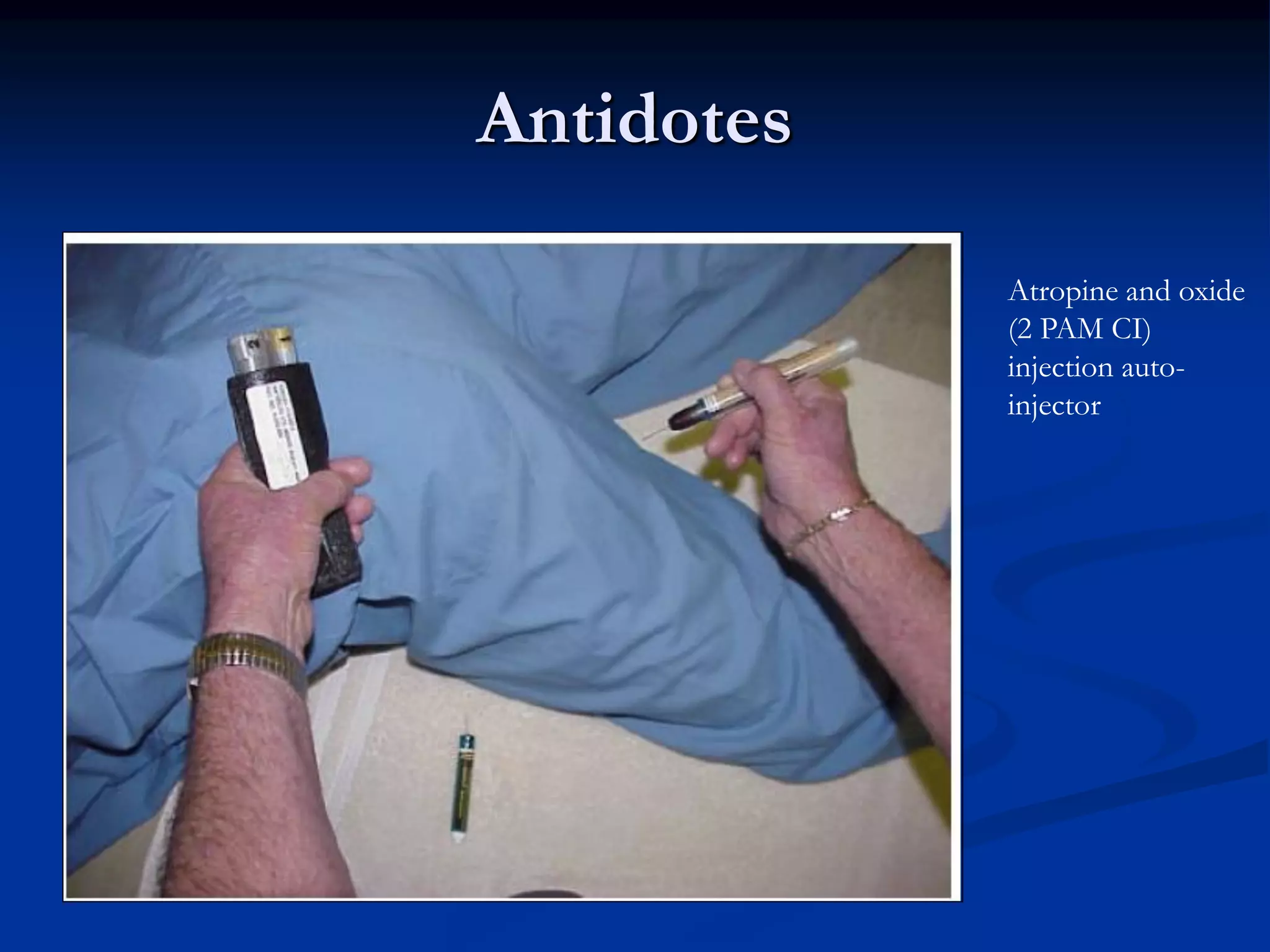
Antidotes
Atropine and oxide
(2 PAM CI)
injection auto-
injector
Roles of Emergency Physician in
DISASTERS –EIGHT ‘D’s
 Detection and Diagnosis
 Rapid Recognition
 Declaration and Activation
 Activate contingency plans
 Establish intra-hospital, inter-hospital, inter-agencies, inter-states, international
communications
 Defense
 Self-protection
 Decontamination
 Delegations
 Drugs
 Disposition
 Delivering right patients to right place and right time
 Debriefing and De-stressing
The Main Problem with Biological
Weapon
 Biological weapons can be divided into two categories
 Overt (Announced)
 First responders (fire fighters or law enforcement) are most likely to
respond to the announced release, or more likely the hoax
 Covert (Unannounced)
 First responders would probably be the GPs, family doctors, EPs, etc.
 Furthermore, patients exposed to biologic agents
usually present with vague symptoms associated with
flulike illnesses (latency period).
Overt Attack
 First responders (trained fire fighters or law enforcement) are
most likely to respond to the announced release, or more likely
the hoax
 In recent anthrax attack, an example would be the letter received
and opened in a Senator’s office in the Hart Senate Office
Building.
 The envelope contain a letter stating that it contained anthrax
spores and the opener was going to die.
 First responders called, the presence of spores of Bacillus
anthracis confirmed.
 Exposed individuals given prophylaxis. To date, none in the
Senate Building has developed anthrax
Covert Attack
 Current NO REAL TIME environmental monitoring
for a covert release of biological weapon
 A covert attack would probably go unnoticed, with
those exposed leaving the area long before the act of
terrorism became evident
 Furthermore, because of the incubation period, the
first signs of the biological agent released not be
recognized until days or weeks later.
 Thus those first responders would probably be the
family doctors, GPs, EPs, etc
Factors indicative of a Potential
Bioterrorism Event
 Multiple simultaneous patients with similar clinical syndrome
 Severe illnesses, especially among the young and otherwise
healthy
 Predominantly respiratory symptoms
 Unusual (non-endemic) organisms
 Unusual antibiotics resistance
 Atypical clinical presentation of disease
 Unusual patterns of disease such as geographic co-location of
victims
 Intelligent information – tips from law enforcement, discovery
of delivery devices, etc
 Reports of sick or dead animals or plants
 (Richards et al., 1999)
ON SITE MANAGEMENT
YELLOW ZONE
OSC
(POLICE )
COMMAND POST
F.F.C. - BOMBA
SAR TEAM
RED ZONE
WORK MATRIX
P.K.T.K.
O.M.C.
BOMBA
MEDICAL
BASE
CRTICAL
S.CRITICAL
N.CRITICAL
DEAD
RESCUERS
FORENSIC
M.E.L.O.
QUARTER
MASTER
M.E.S.A.R.O.
SAR
SAR
SPECIALISTS
SJAM
MRCS
JPA 3
BOMBA
S.B.
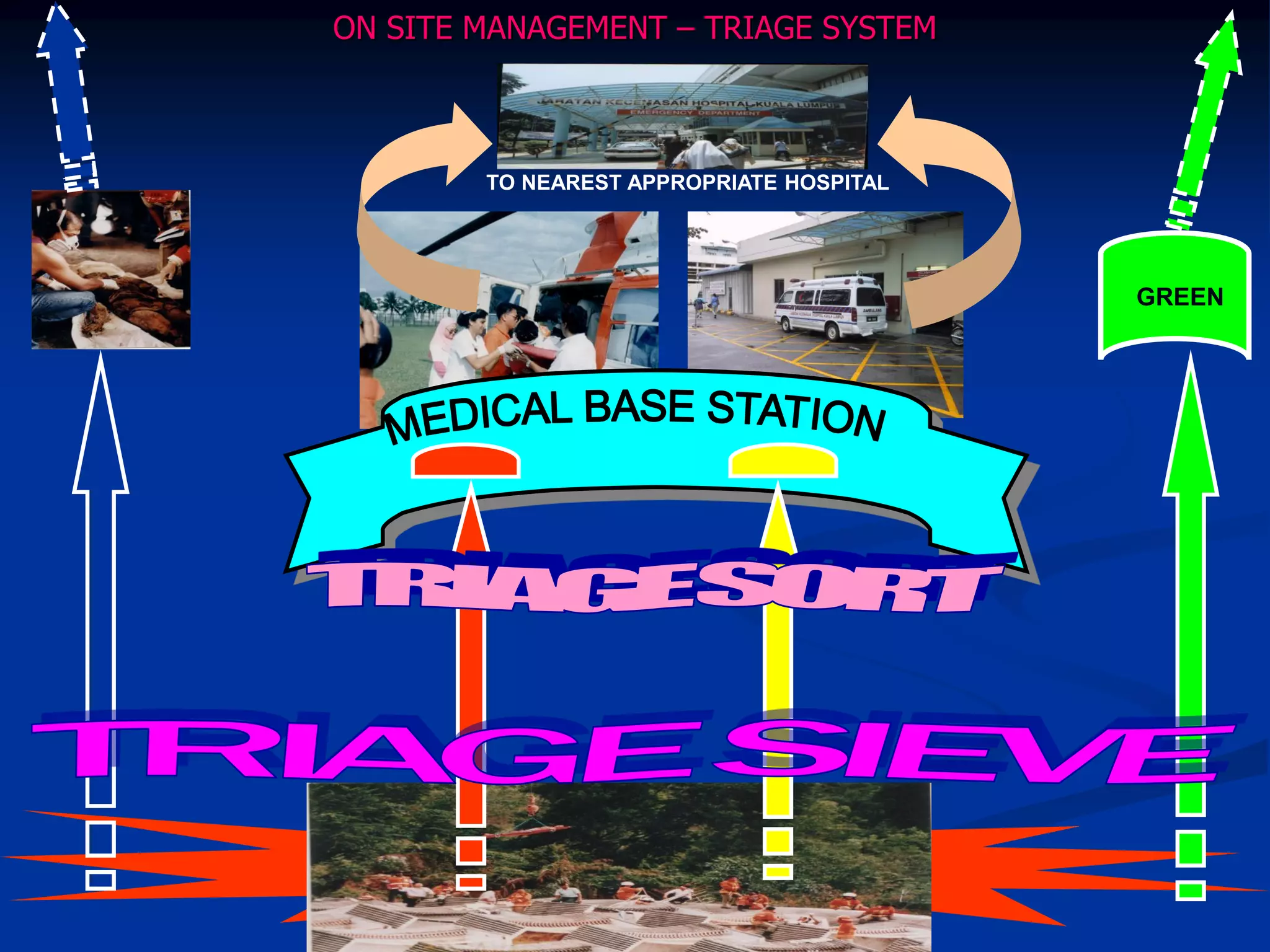
ON SITE MANAGEMENT – TRIAGE SYSTEM
TO NEAREST APPROPRIATE HOSPITAL
GREEN
Victims Collecting Point
COLLECTING POINT
Working Area
Impact Zone
Advance Medical Post
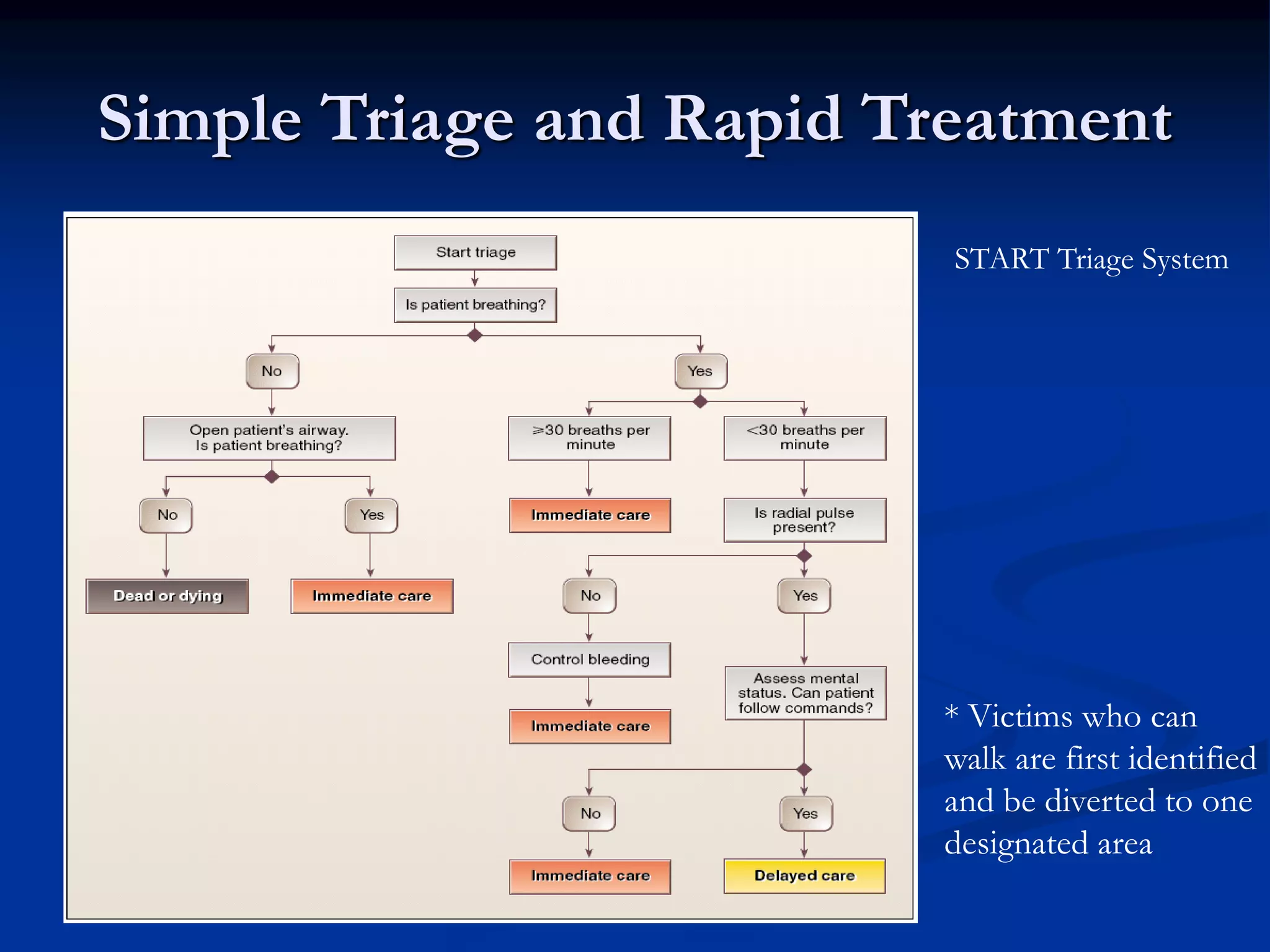
Simple Triage and Rapid Treatment
* Victims who can
walk are first identified
and be diverted to one
designated area
START Triage System
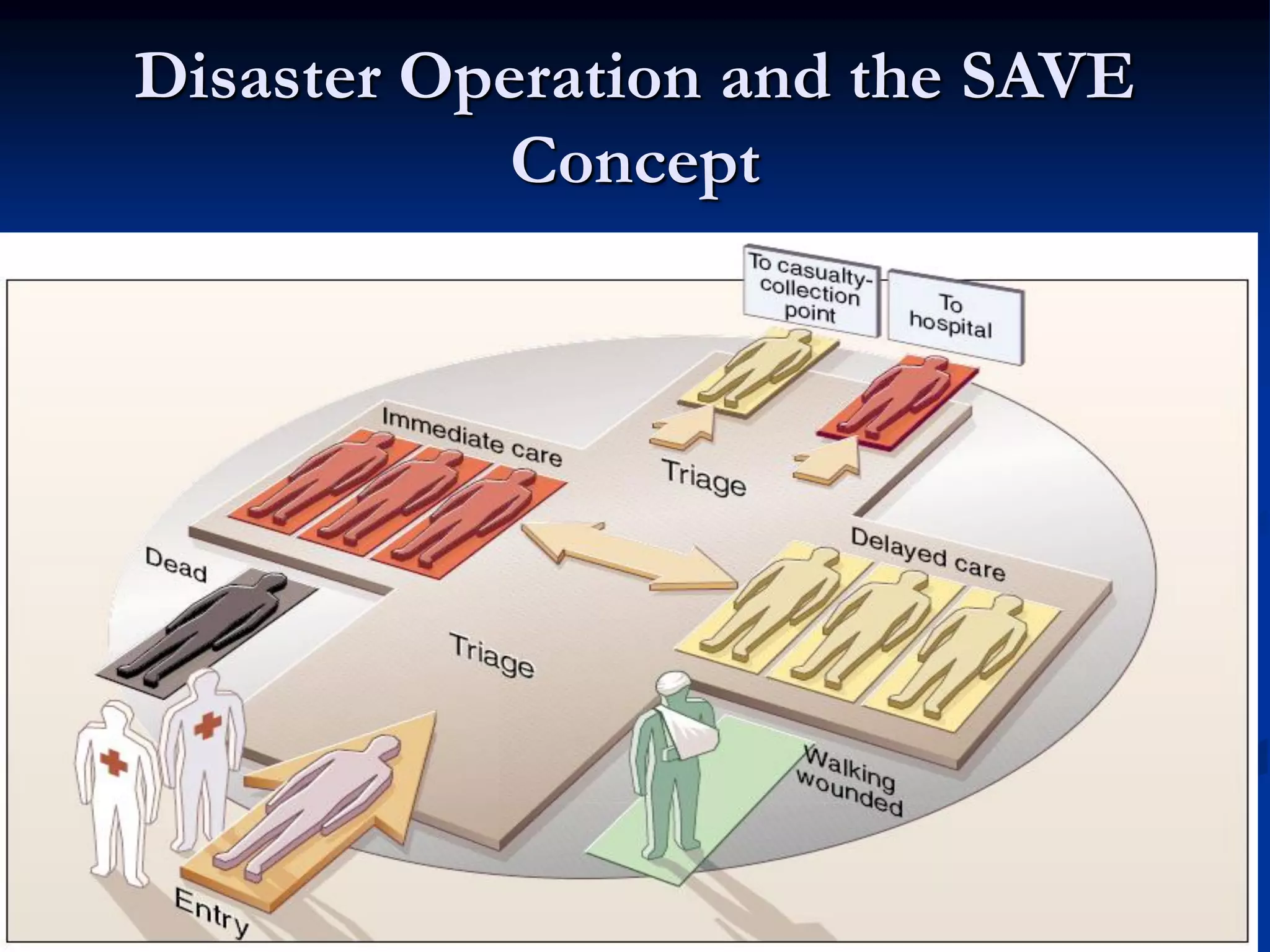
Disaster Operation and the SAVE
Concept
Basic/Simple Advanced Medical Post
RED YELLOW
GREENWHITE
TRIAGE
AREA
EVACUATION
Standard Advanced Medical Post
RED YELLOW
GREENWHITE
TRIAGE
AREA
EVACUATION
NON-
ACUTE
ACUTE
NON-ACUTE
ACUTE
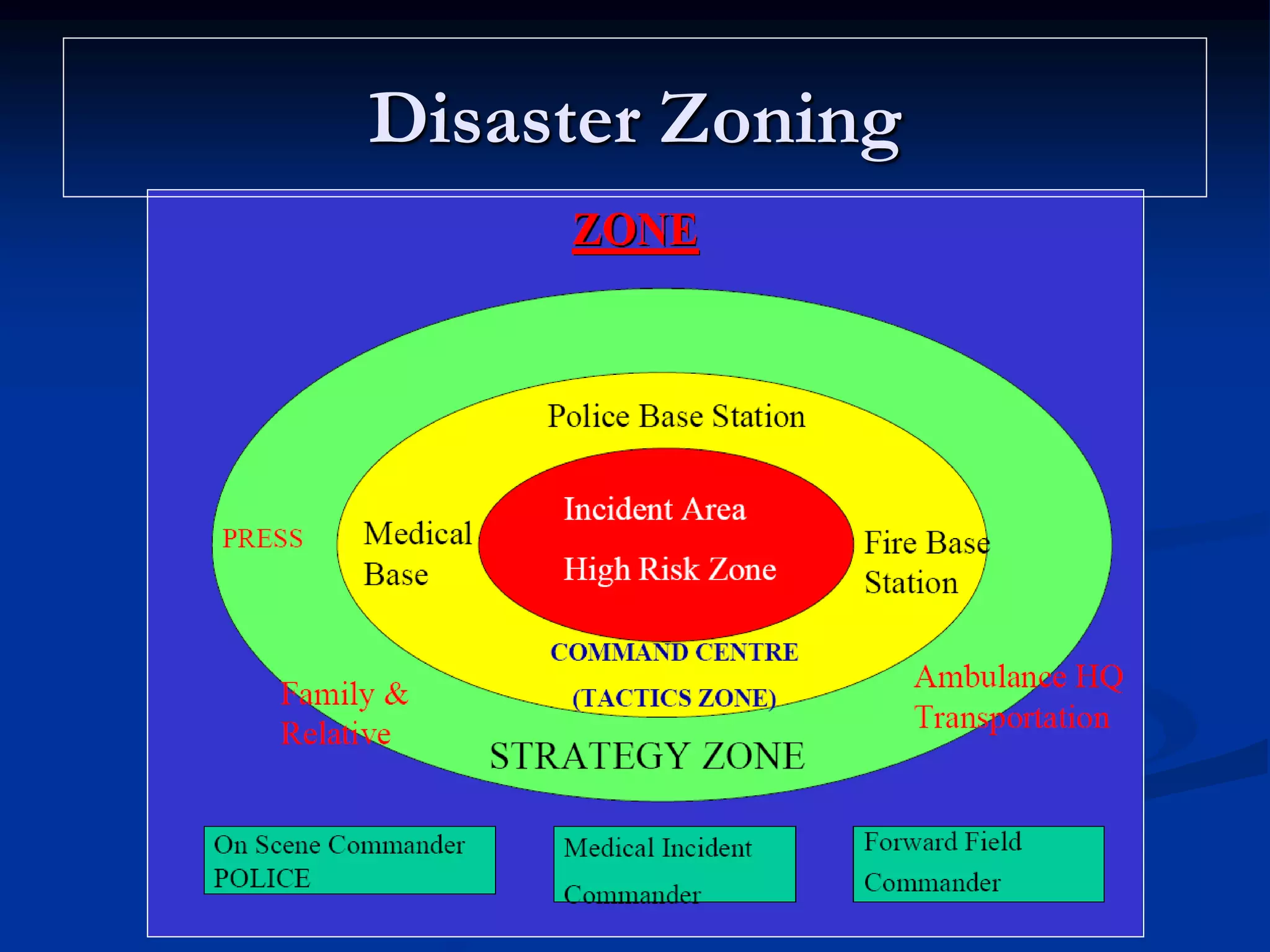
Disaster Zoning
VICTIM FLOW
“Conveyor Belt” Management
Transport Resource FlowVictim Flow
TRANSFERADVANCE
MEDICAL POST
Triage
Impact
Zone
Collecting
Point
Triage
Treatment
Treatment
HOSPITAL
Evacuation
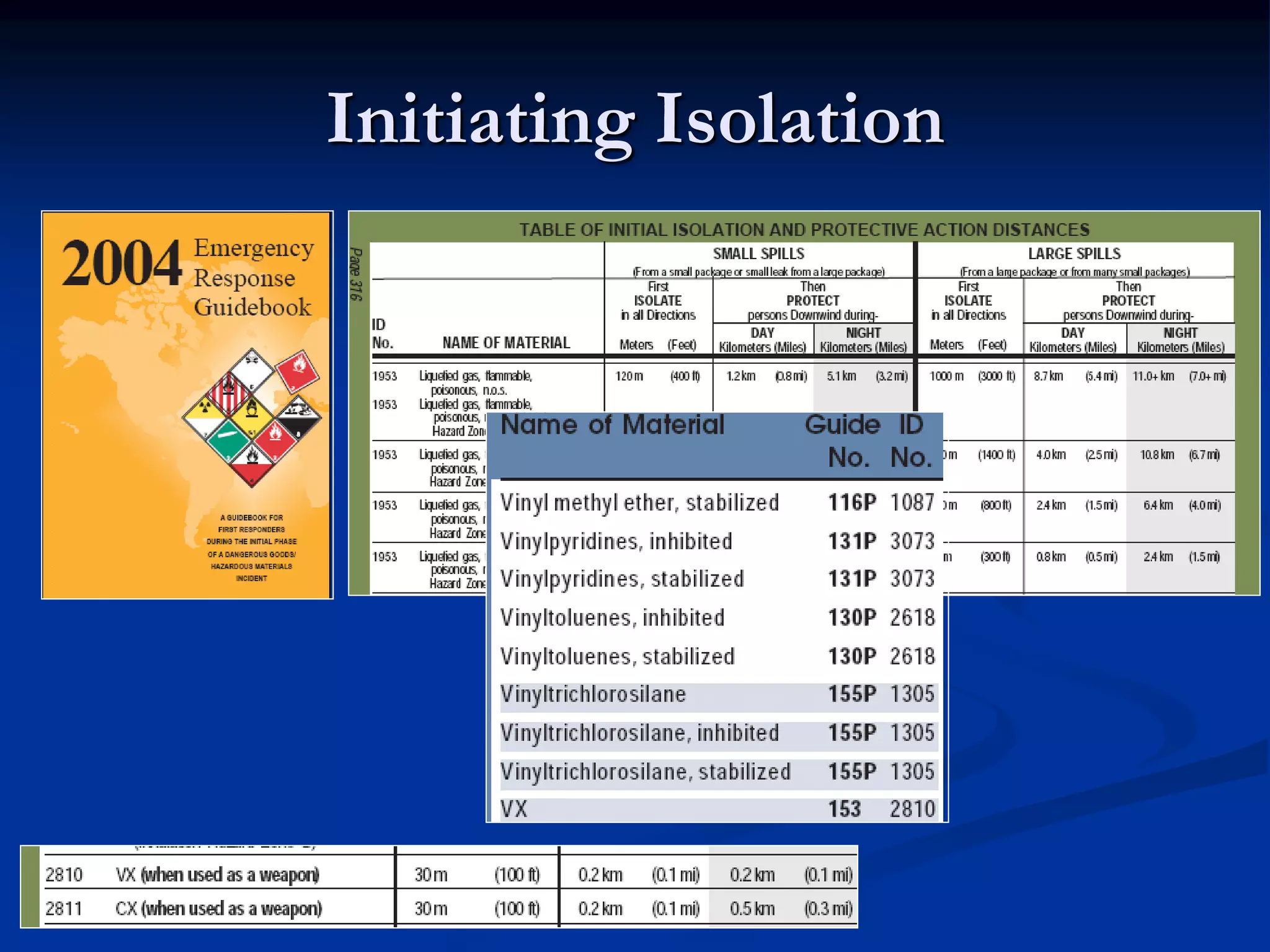
Initiating Isolation
 Ideally be decontaminated outside the hospital
 Approach from upwind direction
 Isolate at least 100 m radius (initial isolation) for hot zone
 If large spill, 500 m; and if on fire (flammable substances), 800 m
 Establish three zones
 Hot zone
 where the spill/contamination occurred
 Only trained personnel with proper attire to enter
 Only the most immediate life threats addressed here – like opening up airway,
cervical spine immobilization, bleeding control
 Warm zone
 area for thorough decontamination
 Theoretically no risk of primary contamination but secondary contamination
still possible
Initiating Isolation
Initial Isolation
Protective
Action Zone
Principles of Decontamination
 Removal of clothings
 most important step
(accomplishes 80-90% of
decon)
 From top to bottom
 The more the better
 Privacy is an issue
 Water flushing the best
 Typically shower 3 – 5min
 Decon ASAP
 Expect a 5:1 of unaffected:
affected casualties ratio
 First responders must self-
decon too
Decontamination
Emergency Decontamination
Summary
 Terrorist Attacks are disastrous – but that does
not mean that there is nothing we can do.
 Though we are probably helpless in preventing
them from coming, yet our preparedness would
hopefully be able to lessen the magnitude of
severity of the attack
References
 Kales, S. N. & Christisni, D. C. (2004) Acute Chemical
Emergencies. NEJM, 350, 800-8.
 Greenberg, M. I., Sherri, M. J. & Gracely, E. J. (2002)
Emergency Department Preparedness For The
Evaluation And Treatment of Victims of Biological or
Chemical Terrorist Attack. Journal of Emergency Medicine,
22, 273-78.
 Roy, M. J. (Ed.) (2004) Physician's Guide to Terrorist
Attack, Totowa, New Jersey, Humana Press.
References
 Schultz, C. H., Koenig, K. L. & Noji, E. K. (1996) Current
Concepts - A Medical Disaster Response To Reduce Immediate
Mortality After An Earthquake. NEJM, 334, 438-44.
 Richards, C. F., Burnstein, J. L., Waeckerie, J. F. & Hutson., H. R.
(1999) Emergency Physician and Biological Terrorism. Annals of
Emergency Medicine, 34, 183-190.
 Mandl, K. D., Overhage, J. M., Wagner, M. M., Lober, W. B.,
Sebastiani, P., Mostashari, F., Pavlin, J. A., Gesteland, P.,
Treadwell, T., Koski, E., Hutwagner, L., Buckeridge, D. L.,
Raymond, D. A. & Grannis, S. (2004) Implementing Syndromic
Surveillance: A Practical Guide Informed by the Early
Experience. Journal of the American Medical Informatics Association,
11, 141-150
Sarin Gas Attack on Tokyo Subway
 Attack on 20th March
1995 was the second
attack – 12 people died.
First attack 1994 – 7
died.
 How many perpetrators
were involved and how
many train stations were
contaminated?
 How did they do it?
Shoko Asahara –
Founder of AUM
Shinrikyo
Ikuo Hayashi
– one of the
perpetrators
The Attack
 Attack at approximately 7:55 AM on March 20, 1995.
 8:16 AM - the St Luke's ED was alerted
 520-bed tertiary care
 located near the affected subway stations (within 3 km)
 received the largest number of victims from the subway
attack.
 services comparable to those of any medical center within
the United States.
 Within hours of the terrorist incident, St Luke's
emergency department received 640 patients.
The Attack
 8:28 AM - the first subway victim arrived at the St
Luke's ED. This patient was ambulatory and arrived
without assistance from ambulance personnel. The
patient's only complaints were of eye pain and dim
vision.
 8:43 AM – arrival of first ambulance arrived
 During the next hour, approximately 500 additional
subway victims, including 3 patients who were in
cardiopulmonary arrest on arrival, presented to the ED
 Five of the female patients were pregnant.
The Attack
 9:20 AM - hospital directors activated the
hospital's disaster plan.
 This resulted in the cancellation of all routine
surgeries and outpatient activity.
 More than 100 doctors and 300 nurses and
volunteers were immediately called to care for
victims
 Victims into three clinical groups - mild,
moderate and severe
The Attack
 Mild cases (528, or 82.5%) - only eye signs or
symptoms (eg, miosis, eye pain, dim vision, decreased
visual acuity) on presentation
 released after a maximum of 12 hours of ED observation
 Moderate cases (107, or 16.7%) - systemic signs and
symptoms (eg, weakness, difficult breathing,
fasciculations, convulsions) BUT not require
mechanical ventilation
 Severe cases (5, 0.78%) - emergency respiratory support
(eg, intubation and ventilation support)
Outcomes of Patients Admitted to
St. Luke’s Hospital ED, Tokyo
Lessons Learnt
 Delay in confirming the nature of the toxin
 Delay in organizing an effective mass casualty
strategy
 Poor ventilation in patient reception area
 Secondary exposure by medical staffs treating
the patients
 Inadequate provision of privacy to remove
contaminted clothings
 Inadequate shower facilities
Treatment
 Three drugs are the mainstay treatment
 Atropine
 Counteract primarily the muscarinic effect
 Administer doses of 2 mg every 5 – 10 min to minimize dyspnea,
airway resistance or respiratory secretions
 Pralidoxime
 To reactivate acetylcholinesterase and counteract the nicotinic effect
 Over time, OP-acetylcholinesterase bond becomes irreversibly
covalent and resistant to reactivation by pralidoxime (“aging” process)
 But still, Pralidoxime should never be withheld.
 Diazepam
 The only effective anticonvulsant drugs for nerve gas poisoning
patients with seizure
Nerve Gas Agents
 Are organophosphates
 Inhibits acetylcholinesterase, block degradation of Ach at postsynaptic
membrane.
 Two main classes
 G series
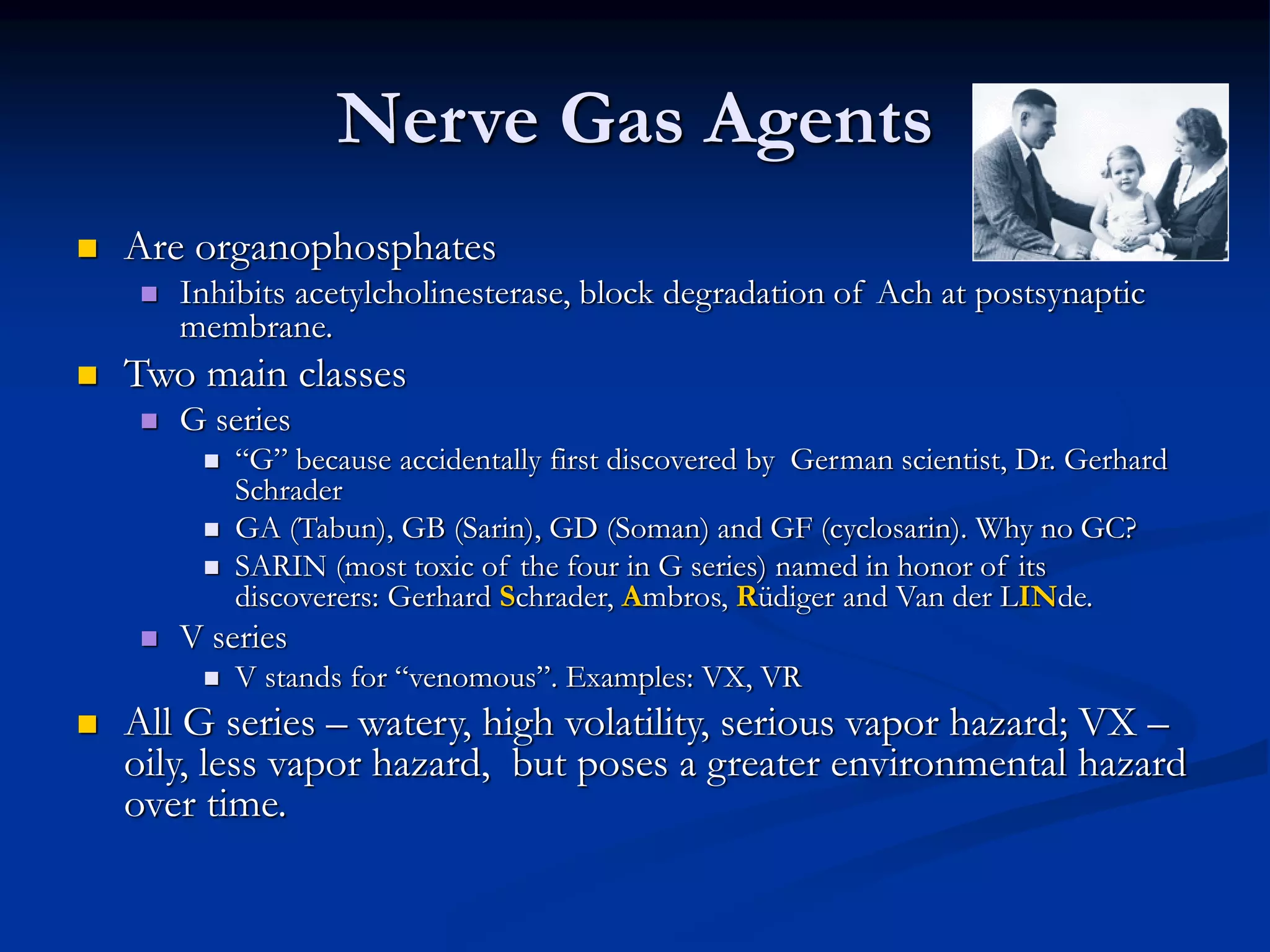
 “G” because accidentally first discovered by German scientist, Dr. Gerhard
Schrader
 GA (Tabun), GB (Sarin), GD (Soman) and GF (cyclosarin). Why no GC?
 SARIN (most toxic of the four in G series) named in honor of its
discoverers: Gerhard Schrader, Ambros, Rüdiger and Van der LINde.
 V series
 V stands for “venomous”. Examples: VX, VR
 All G series – watery, high volatility, serious vapor hazard; VX –
oily, less vapor hazard, but poses a greater environmental hazard
over time.
Nerve Gas
 Different from organophosphate insecticides
 Much more toxic
 VX – most toxic substance synthesized de novo
(botulinism toxin – biological)
 Unlike typical OP, no association with urination
 Bradycardia is rare
 Its miosis effect does not respond to systemic
therapy
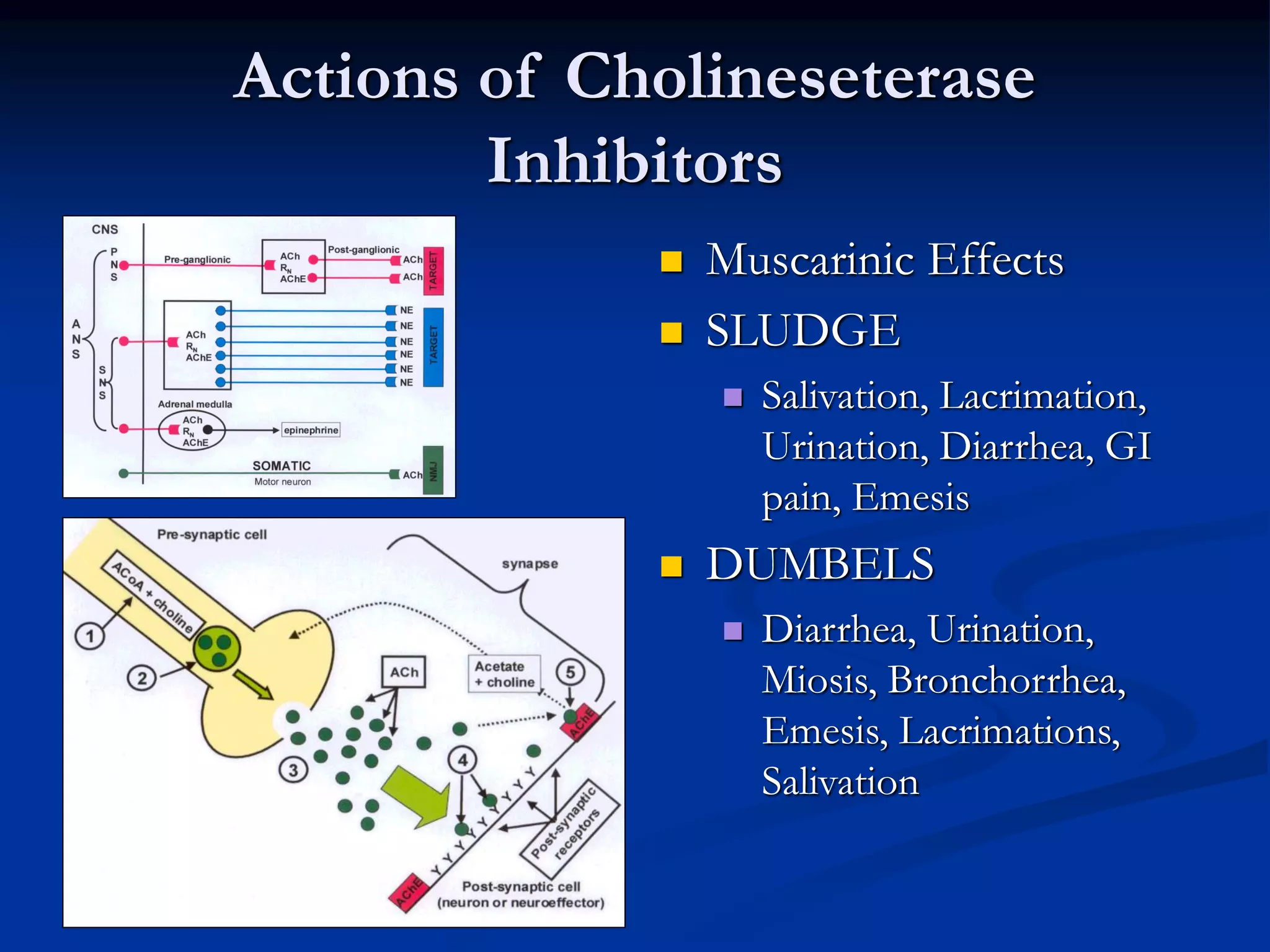
Actions of Cholineseterase
Inhibitors
 Muscarinic Effects
 SLUDGE
 Salivation, Lacrimation,
Urination, Diarrhea, GI
pain, Emesis
 DUMBELS
 Diarrhea, Urination,
Miosis, Bronchorrhea,
Emesis, Lacrimations,
Salivation
Clinical Features
 There is no delay effects
 Symptoms of sarin gas occur within seconds of
inhalation and peak at 5 minutes.
 If patients remaining asymptomatic 1 hour after
possible exposure, have not been contaminated.
 In vapor exposed – miosis first appeared but in
liquid exposed – miosis usually last sign
 Unlike botulinism toxin, flaccid paralysis never
on initial presentation.
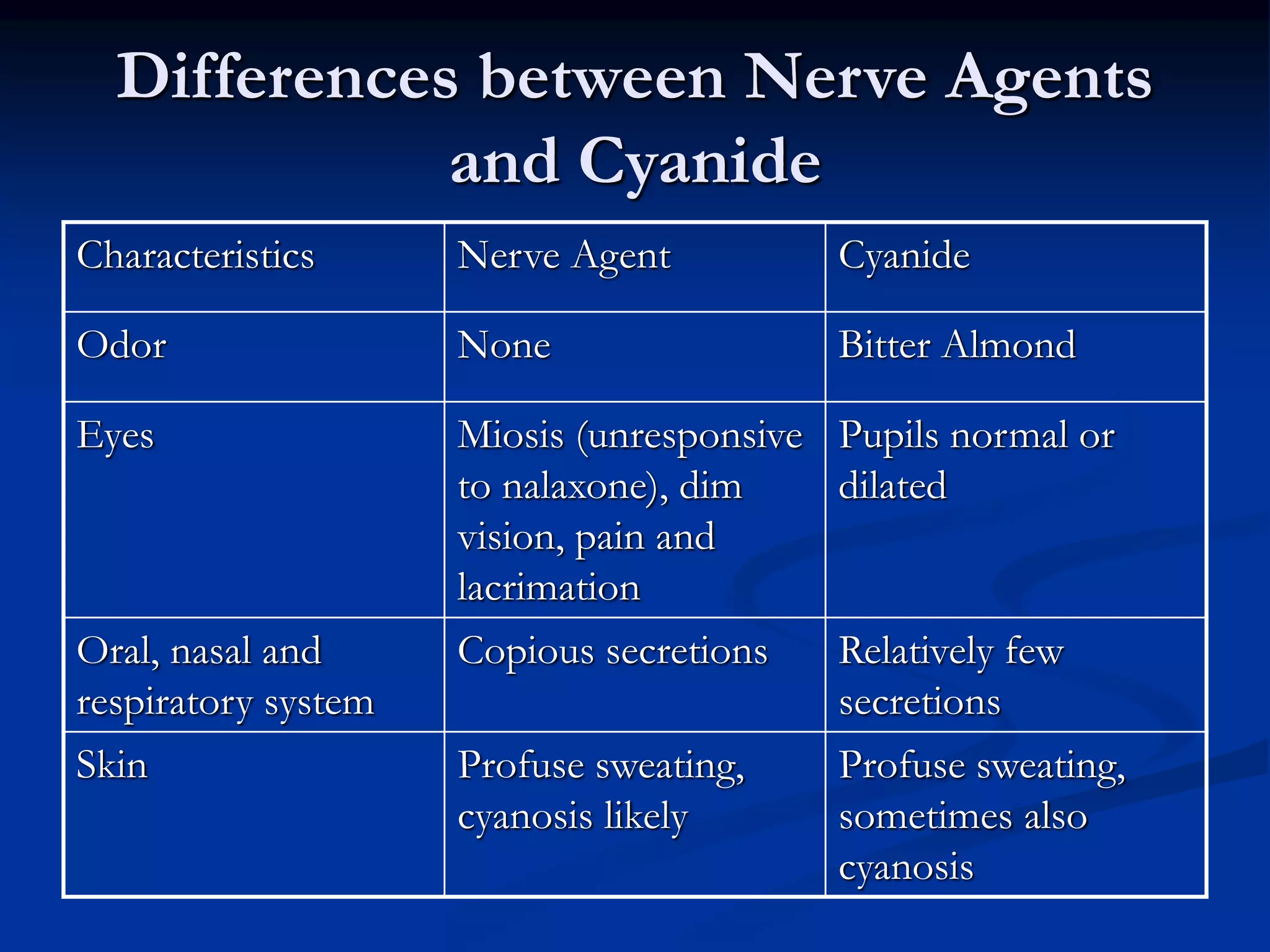
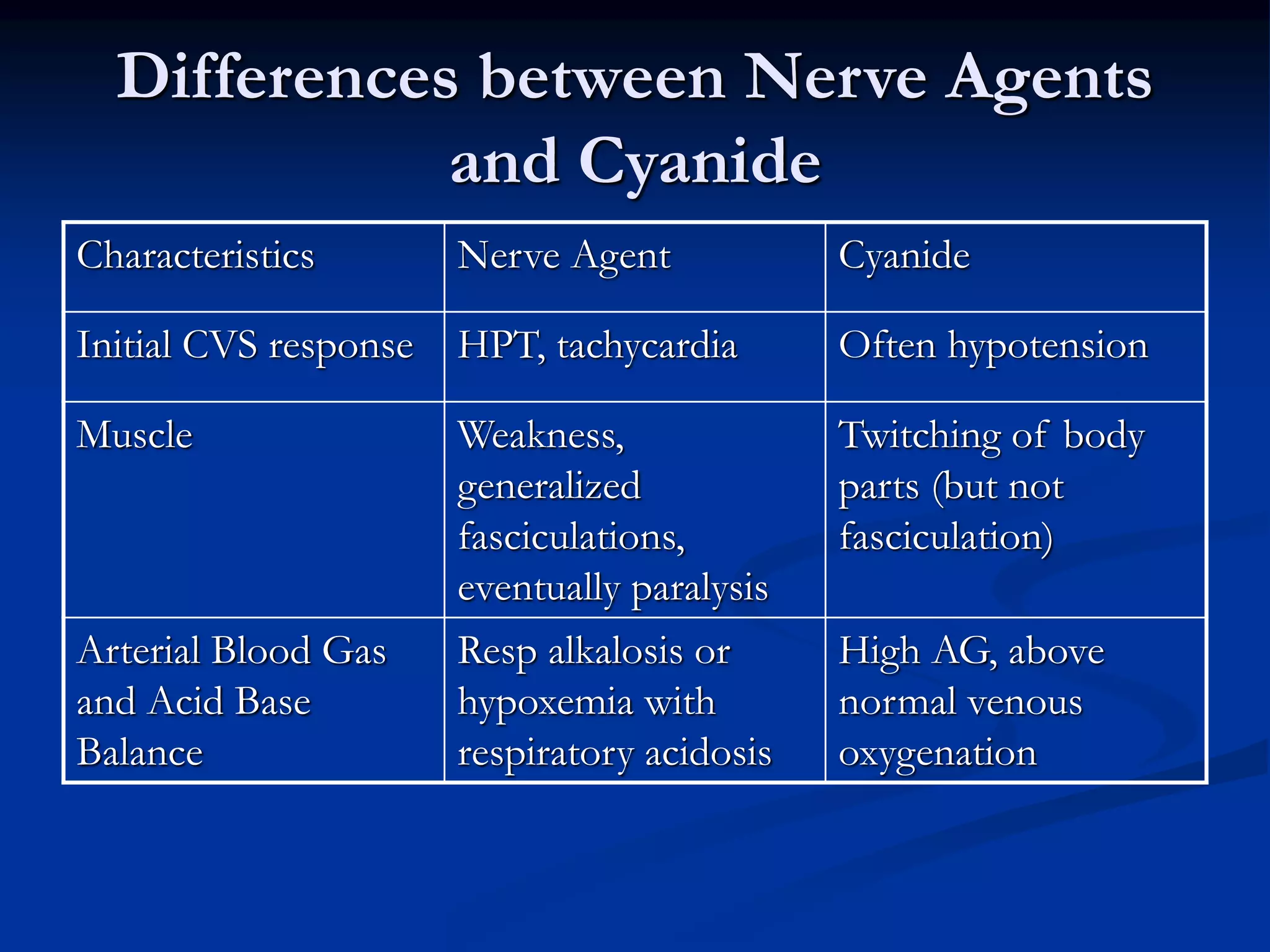
Differences between Nerve Agents
and Cyanide
Characteristics Nerve Agent Cyanide
Odor None Bitter Almond
Eyes Miosis (unresponsive
to nalaxone), dim
vision, pain and
lacrimation
Pupils normal or
dilated
Oral, nasal and
respiratory system
Copious secretions Relatively few
secretions
Skin Profuse sweating,
cyanosis likely
Profuse sweating,
sometimes also
cyanosis
Differences between Nerve Agents
and Cyanide
Characteristics Nerve Agent Cyanide
Initial CVS response HPT, tachycardia Often hypotension
Muscle Weakness,
generalized
fasciculations,
eventually paralysis
Twitching of body
parts (but not
fasciculation)
Arterial Blood Gas
and Acid Base
Balance
Resp alkalosis or
hypoxemia with
respiratory acidosis
High AG, above
normal venous
oxygenation
Vesicants
 Cause blistering and irritations to eyes, skin and airway
(example – Mustard)
 Ophthalmic effect – conjunctivitis, corneal damage,
temporal or permanent visual loss
 Skin effect – blistering like 2nd degree burn
 Systemic toxicity – BM suppression, leukopenia
 Indicators of fatal exposure
 Airway burn within 6 hours
 Burn >25%
 Absolute WBC <200/mm3
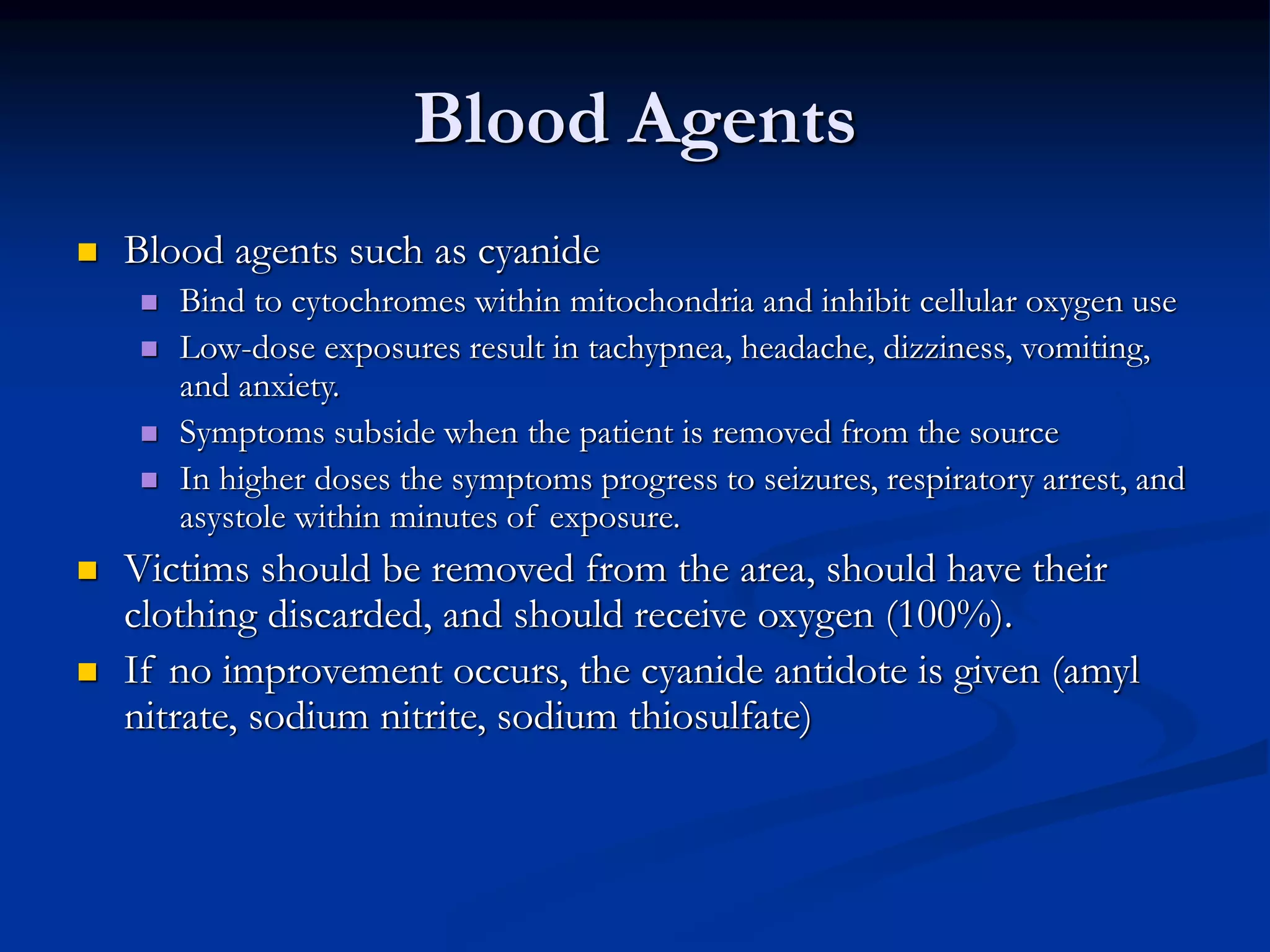
Blood Agents
 Blood agents such as cyanide
 Bind to cytochromes within mitochondria and inhibit cellular oxygen use
 Low-dose exposures result in tachypnea, headache, dizziness, vomiting,
and anxiety.
 Symptoms subside when the patient is removed from the source
 In higher doses the symptoms progress to seizures, respiratory arrest, and
asystole within minutes of exposure.
 Victims should be removed from the area, should have their
clothing discarded, and should receive oxygen (100%).
 If no improvement occurs, the cyanide antidote is given (amyl
nitrate, sodium nitrite, sodium thiosulfate)
Anthrax
 Current assessment suggests that three biologic agents—anthrax,
plague, and smallpox—represent the greatest threat
 Bacillus anthracis
 a gram-positive spore-forming bacterium, is the causative agent of
anthrax
 the spores are extremely hardy
 survive for years in the environment
 the disease is caused by exposure to the spores
 normally a disease of sheep, cattle, and horses and is rarely seen in
developed countries because of animal and human vaccination programs
 disease in humans can occur when spores are inhaled, ingested, or
inoculated into the skin
 spores germinate into bacilli inside macrophages
 bacteria then produce disease by releasing toxins that cause edema and
cell death.
Nuclear and Radiation Attack
 Terrorists selecting radiation as a means to inflict
casualties are unlikely to employ nuclear weapons
 are heavily guarded
 difficult to move due to their size and weight
 easy to detect
 Sabotage at nuclear power stations is possible, but
given tight security, multiple safety systems, and thick
concrete housings surrounding the reactors, the threat
is probably low
Nuclear and Radiation Attack
 Instead, simple radiologic devices, such as those used
by hospitals for radiation therapy, are thought to be the
source of choice.
 These sources are plentiful and usually unguarded
 The only wartime use of atomic and nuclear energy
was the detonation of atomic bombs over
Hiroshima and Nagasaki in 1945.
 However, with the dissemination of technical
information and raw materials, many nations now have
nuclear weapons in their arsenals. The real possibility
of terrorist groups obtaining and using such
weapons also exists.
Bombings of Hiroshima and
Nagasaki
 The first event occurred on
the morning of August 6,
1945, when the US dropped
a uranium gun-type device
code-named "Little Boy" on
the Japanese city of
Hiroshima.
 The second event occurred
three days later when a
plutonium implosion-type
device code-named "Fat
Man" was dropped on the
city of Nagasaki.
(en.wikipedia.org)
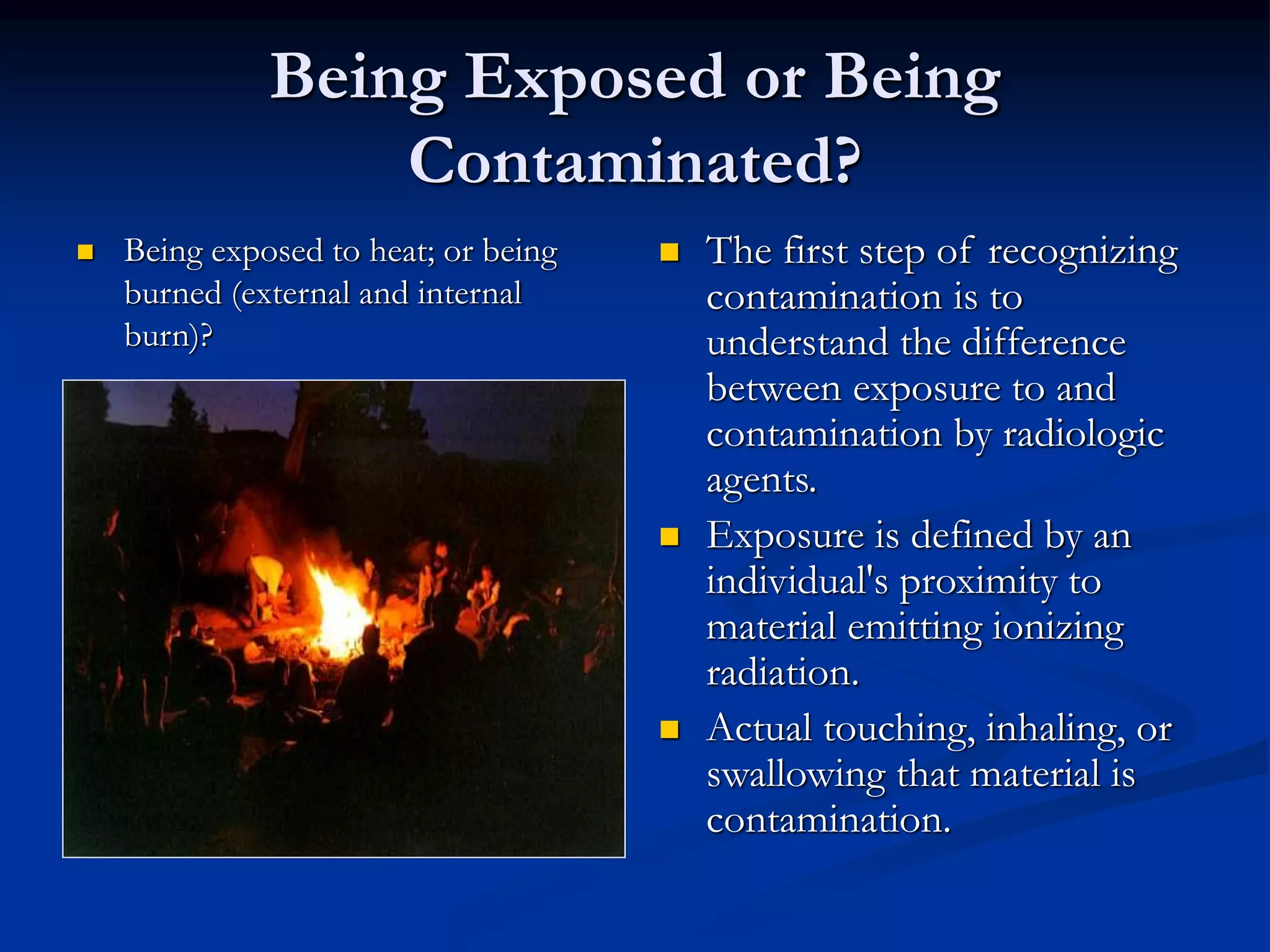
Being Exposed or Being
Contaminated?
 Being exposed to heat; or being
burned (external and internal
burn)?
 The first step of recognizing
contamination is to
understand the difference
between exposure to and
contamination by radiologic
agents.
 Exposure is defined by an
individual's proximity to
material emitting ionizing
radiation.
 Actual touching, inhaling, or
swallowing that material is
contamination.
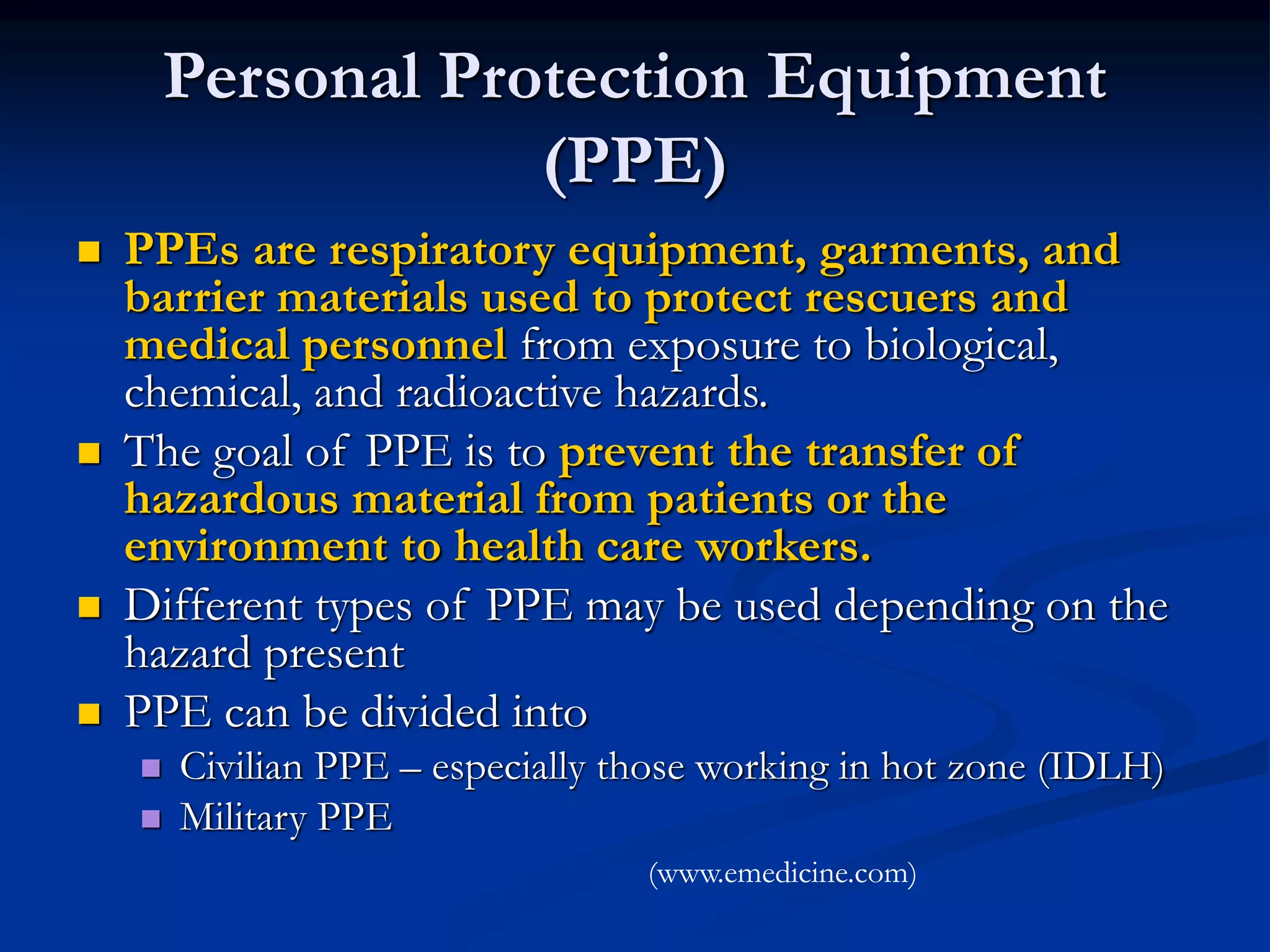
Personal Protection Equipment
(PPE)
 PPEs are respiratory equipment, garments, and
barrier materials used to protect rescuers and
medical personnel from exposure to biological,
chemical, and radioactive hazards.
 The goal of PPE is to prevent the transfer of
hazardous material from patients or the
environment to health care workers.
 Different types of PPE may be used depending on the
hazard present
 PPE can be divided into
 Civilian PPE – especially those working in hot zone (IDLH)
 Military PPE
(www.emedicine.com)
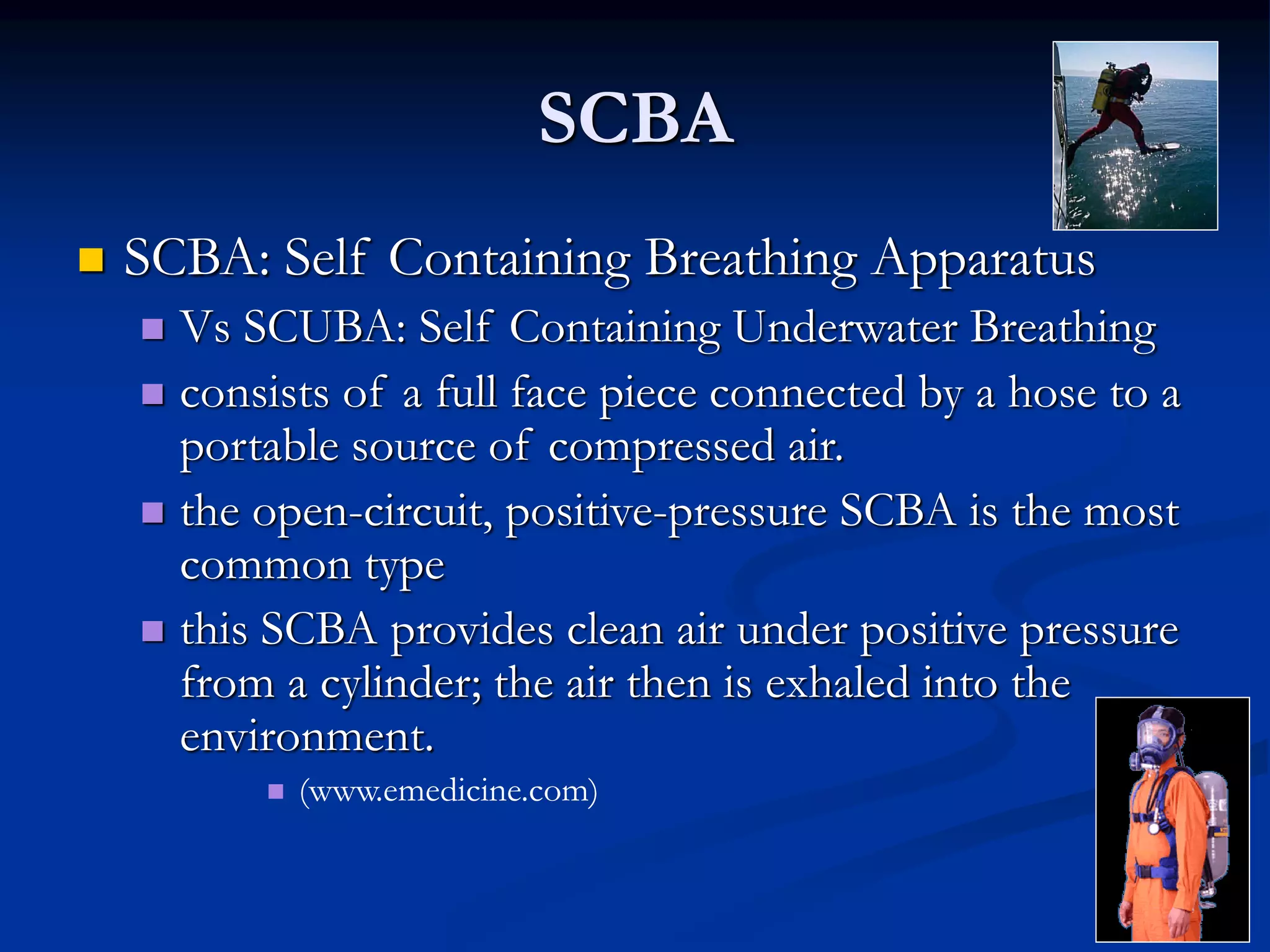
SCBA
 SCBA: Self Containing Breathing Apparatus
 Vs SCUBA: Self Containing Underwater Breathing
 consists of a full face piece connected by a hose to a
portable source of compressed air.
 the open-circuit, positive-pressure SCBA is the most
common type
 this SCBA provides clean air under positive pressure
from a cylinder; the air then is exhaled into the
environment.
 (www.emedicine.com)
Civilian PPE
 Self-contained breathing apparatus
 Supplied-air respirator
 Air-purifying respirator
 High-efficiency particulate air filter
 HEPA filters
 0.3-15 micron
 efficiency of 98-100%
 exclude aerosolized BWA particles in the highly infectious 1- to 5-mm
range
 Surgical mask
 Protective Clothing
 (www.emedicine.com)
Levels of Civilian PPE
 Level A
 SCBA and a totally encapsulating chemical-protective (TECP)
suit
 highest level of respiratory, eye, mucous membrane, skin
protection
 Level B
 positive-pressure respirator (SCBA or SAR)
 nonencapsulated chemical-resistant garments, gloves, and
boots, which guard against chemical splash exposures.
 highest level of respiratory protection with a lower level of
dermal protection.
(www.emedicine.com)
Levels of Civilian PPE
 Level C
 APR and nonencapsulated chemical-resistant clothing, gloves,
and boots.
 same level of skin protection as Level B, with a lower level of
respiratory protection.
 used when the type of airborne exposure is known to be
guarded against adequately by an APR.
 Level D
 standard work clothes without a respirator.
 In hospitals, it consists of surgical gown, mask, & latex gloves
(universal precautions).
 no respiratory protection and only minimal skin protection
(www.emedicine.com)
Decontamination
 Extenal Decontamination
 Gross Decontamination
 Removal of clothings; done before reaching hospital
 Secondary Decontamination
 Designated site at ED; with advice from Radiation Safety Officer;
head to toe survey
 Internal Decontamination
 Blockade of enteral absorption
 Gastric lavage
 Use emetic agents – Barium sulphate
 Blockade of end organ uptake
 Potassium Iodide

Role of Emergency Physicians During CBRNE Attack - The Malaysian Context

  • 1.
    The Role of EmergencyPhysician in Response to CBRNE Attack Dr. Chew Keng Sheng Emergency Medicine Universiti Sains Malaysia
  • 2.
    Objectives  Definitions  Keycriteria for determining a terrorist attack  Overview on selected terrorists’ attacks and WMDs  Major Lessons Learnt from Previous Disasters  Syndromic Surveillance  Defining roles of EPs in response to CRBNE Terrorist Attacks – “7Ds in Disasters”  Q & A
  • 3.
    Definitions of Disaster,Mass Casualty Incidents and Terrorism
  • 4.
    Definitions  Disaster –defined as a sudden ecologic phenomenon of sufficient magnitude to require external assistance  In the Emergency Department, disaster exists when the number of patients presenting in any given space of time are such that even minimal care cannot be offered without external assistance.
  • 5.
    Definitions  Disasters occurwhen normal, basic services of a society become disrupted to such extent that widespread human and environmental losses exceed the community’s management capacity (SAEM Disaster Medicine White Paper Subcommittee)  Disasters characterized by large numbers of deaths and injuries are also referred to “Mass Casualty Incidents”
  • 6.
    Definitions  However, disastersare not defined only by a given number of victims  Example: The arrival of one VIP guest with severe medical or trauma emergency conditions can completely disrupt normal operations of even the most efficient emergency departments.  In short, the essence of the concept of disaster is it has a “massive disruptive impact”
  • 7.
    Definitions  Mass CasualtyIncidents (MCI) – events resulting in a numbers of victims large enough to disrupt normal course of emergency and health care services of the affected community  Disasters result in MCIs, but encompass a broad range of calamities beyond just the high numbers of casualties  “All MCIs are disastrous, but not all disasters are due to MCIs”
  • 8.
    Definitions  Disasters canbe divided into two:  Natural Disasters OR Man-made Disasters  External Disasters (events occurring outside the hospital) OR Internal Disasters (events involving the physical structures of hospital itself - e.g. fire, lab accident involving radioactive materials)  Terrorism – man made, external disasters
  • 9.
    Directive 20, NationalSecurity Council  A Disaster is 1. an event that occurs suddenly. 2. complex in nature. 3. loss of lives. 4. destruction of property and/or environment. 5. disruption of the community daily activities
  • 10.
    Three Levels Accordingto Directive 20, NSC  Level 1  Localized, well-controlled, manageable by local authorities  Level 2  Well-controlled, management at state or national level  Level 3  Complete destruction, disruption of routine activities,
  • 11.
    Directive 20, NSC Disaster can be divided into 3 level LEVEL 1 1. Localized major incident 2. Under controlled 3. Not complex 4. Small no. of casualties and property loss 5. Minor disruption of daily community activities 6. Manageable by the local authorities requiring 7. Multisectoral involvement.  Example: bus accident, train derailment, landslide.
  • 12.
    Directive 20, NSC LEVEL 2 Disaster 1. Widespread over a large area but under controlled 2. Complicated and complex 3. Large no. of casualties and property loss. 4. Affecting daily community activities 5. Not manageable by the local authorities requiring 6. Assistance from other states or National Authorities 7. Support required, Regional or National Support  Examples: Highland Towers Collapse, Greg Storm Sabah, Bright Sparklers.
  • 13.
    Directive 20, NSC LEVEL 3 Disaster 1. Involves a very large area. 2. Loss of many lives. 3. Total Destruction of infrastructure and public facility. 4. Complicated and complex. 5. High risk to rescue workers. 6. Complete disruption of daily community activities. 7. Major destruction of resources. 8. All local resources destroyed and assistance from external resources required.  e.g. Earthquake, typhoons, volcanoes, war.
  • 14.
    Disasters Vs Emergencies RoutineEmergencies Disasters Interaction with familiar parties Interaction with unfamiliar parties Familiar tasks/procedures Unfamiliar tasks/procedures Intra-organization coordination Intra- and inter- organization coordination Intact communications, roads, etc. Disrupted communications, blocked roads, etc
  • 15.
    Disasters Vs Emergencies RoutineEmergencies Disasters Familiar terminology Unfamiliar, organization- specific terminology Local press attention National/international media attention Resources adequate for management Resources overwhelmed for management capacity
  • 16.
    PRE-HOSPITAL MANAGEMENT ORGANIZATION HospitalDirector INCIDENT SITE MEDICAL MANAGER Red Team Leader Medical Triage Officer NGO ADVANCED MEDICAL POST Yellow Team Leader Evacuation Officer Admin. Clerk Transport Officer Ambulance Drivers Acute Treatment Manager Admin. Clerk Doctors & Paramedics •JPA 3 •MRCS. •SJAM Medical/Health Officer COMMAND POST Temporary Morgue Green Team Leader Know Your Role!
  • 17.
    Key Criteria Defininga Terrorist Attack  Violence  "the only general characteristic [of terrorism] generally agreed upon is that terrorism involves violence and the threat of violence"  -Walter Laqueur of the Center for Strategic and International Studies  Psychological Impact and Fear  attack was carried out in such a way as to maximize the severity and length of the psychological impact.  Perpetrated for a Political Goal  This is often the key difference between an act of terrorism and a hate crime or lone-wolf "madman" attack  The political change is desired so badly that failure is seen as a worse outcome than the deaths of civilians.
  • 18.
    Key Criteria Defininga Terrorist Attack  Targeting of non-combatants  It is commonly held that the distinctive nature of terrorism lies in its deliberate and specific selection of civilians as direct targets.  Much of the time, the victims of terrorism are targeted not because they are threats, but because they are specific "symbols, tools, or corrupt beings" that tie into a specific view of the world that the terrorist possess.  Their suffering accomplishes the terrorists' goals of instilling fear, getting a message out to an audience, or otherwise accomplishing their political end.  (en.wikipedia.org)
  • 19.
    Overview of SelectedTerrorist Incidents  Bombing of WTC New York City 1993  Sarin Gas Attack by Aum Shinrikyo in Matsumoto, Japan, 1994  Truck Bomb explosion of Alfred P. Murrah Building in Oklahoma, 1995  Sarin Gas Attack by Aum Shinrikyo in five subway train stations simultaneously in Tokyo, 1995  WTC Bombing, New York, September 11, 2001  US Anthrax Incident, 2001  Bombing in Bali, Indonesia 2002
  • 20.
    Major Lessons Learnt Incident Confirmation  At time of incident (whether biological, chemical or even high explosive incidents), most people at the scene and even the initial responders did not recognize the event as a terrorist attack  E.g. during the Sarin Gas Attack in Matsumoto, Japan, emergency responders initially thought that the first victims were ill from food poisoning, contaminated water, or natural gas  To improve early detection, a process called Syndromic Surveillance is employed
  • 21.
    Syndromic Surveillance  Amethod to aid the early detection of bioterrorism events  This is to respond to bioterrorism attack – time is essential  This type of surveillance involves collecting and analyzing statistical data on health trends – such as symptoms reported by people seeking care in emergency rooms or other health care setting – or even sales of flu medicines.
  • 22.
    Syndromic Surveillance  Becausebioterrorist agents such as anthrax, plague, and smallpox initially present “flu-like” symptoms, a sudden increase of individuals with fever, headache, or muscle pain could be evidence of a bioterrorist attack.  By focusing on symptoms rather than confirmed diagnoses, syndromic surveillance aims to detect bioterror events earlier than would be possible with traditional disease surveillance systems.
  • 23.
    Syndromic Surveillance  Inother words, the term syndromic surveillance refers to methods relying on detection of clinical case features that are discernable before confirmed diagnoses are made
  • 24.
  • 25.
    Recommended Website Centers forDisease Control and Prevention – Emergency Preparedness & Response (http://www.bt.cdc.gov/)
  • 26.
    Major Lessons Learnt Command and Control  Unlike smaller emergencies where one single Incident Commander in charge, in a terrorist attack, numerous agencies and organizations involved  The need to speedily establish a secure perimter around the incident.  Failure to do so during the Oklahoma bombing  Communications  Communications failure  Overloaded land lines and cell phones with calls from public trying to obtain info about their loved ones
  • 27.
    Major Lessons Learnt Initial Responders  Traditionally initial responders are defined as the local police, firefighters, EMDs, paramedics. Well trained, part of daily routine  In overwhelming terrorist attacks, other professionals were needed at the scene – NGOs, volunteers, mental health workers  These individuals thrust into new roles – without proper training.  Safety of these responders – 1993 WTC bombing, 124 emergency responders injured; in Oklahoma bombing, one nurse killed from falling debris.
  • 28.
    Major Lessons Learnt The Volunteers  Volunteers, though well intentioned, often created problems  Most not familiar with the emergency command and control system  The Victims  At most disasters, victims left the scene and sought medical help on their own  Need for rapid establishment of a centralized database containing identification victims from all responding medical sites.  E.g. in Bali Bombing – internet database used extensively
  • 29.
    Major Lessons Learnt Psychological Effects  PTSD – Example 11 months after 9/11 incident, 1277 stress related illnesses reported  Need for debriefing and de-stressing; short briefings prior to change of shift for responders  Tokyo Sarin Attack and Anthrax threat – created unique psychological fear – the healthy but anxious lots taxed the health services at a time when others needed care.  Need for proper public education
  • 30.
    Major Lessons Learnt Mortuary Affairs  Temporary morgues, body bags  Body decay  Rapid identification of victims – for family members, law, insurance companies, etc; the need for DNA analysis  Example – Oklahoma bombing – unavoidable delays in official death notifications added emotional trauma to the already bereaved families  The need for religious sensitivity in handling bodies
  • 31.
    Major Lessons Learnt Duration of event  Prolonged duration – strained the human and material resources; depletion of stocks  Need for regular work shifts  Criminal Investigations  One of the main difference between natural disaster and man-made disaster  The concern to preserve the evidence  Medical emergency responders help protect the evidence by only touching and removing items when necessary
  • 32.
    Major Lessons Learnt Media  Mixed blessings  Disseminate information  Yet, in an effort to provide information ASAP, sometimes media give false and confusing information  VIP Visits  Politicians, celebrities, etc  Timing of these visits sometimes interfered with ongoing recovery efforts
  • 33.
    Overview  Chemical Weapons Nerve Agents – G series (GA, GB, GD), V series  Blood Agents - cyanides  Blistering Agents  Biological Weapons  Biological Agents – viruses (e.g Ebola), bacteria (Yersenia pestis, anthrax)  Biological Toxins – botulism, ricin, Staphylococcal Enterotoxin B  Radiation  α radiation  β radiation  γ radiation  Nuclear  A bomb (Atomic)  H bomb (Hydrogen)  Explosives  Large scale - Incendiary bombs, Napalm-B, Mark 77  Smaller scale - Molotov Cocktail (Poor man’s hand grenades)
  • 34.
  • 35.
    How Prepared arethe ED?  In 1997, Burgess et al. reported that only 44.2% of hospital EDs had the ability to handle any chemically contaminated patients from HAZMAT  41.1% - no designated decontamination facilities  Greenberg et al. in June 2000, conducted a survey to assess the level of preparedness of hospital EDs in a large metropolitan area to evaluate and treat victims of a terrorist biological or chemical agent release  44 out of 62 ED directors responded to the questionnaire
  • 36.
    How Prepared Arethe EDs? (Figures given in percentage) Yes No DK Decon facilities 90.7 9.3 0 Ability to decon: a. < 10/Hr 83.3 - - b. 10-19/Hr 7.4 - - c. 20-50/Hr 5.6 - - d. >50/Hr 3.7 - - Written plan for handling post-decon waste water 63 18.5 18.5 Written plan for handling contaminated clothings 42.6 29.6 27.8 Presence of detection equipment in ED 14.9 68.5 16.7 Personal Protective Clothing 87 13 0 (Greenberg et al., 2000)
  • 37.
    Suggested Criteria forMinimum Preparedness of EDs to Evaluate and Treat Victims of Biological or Chemical Agent Release 1. At least one EP who has completed formal training regarding biological and chemical WMD 2. Ability to decon ≥10 patients/Hr 3. Written policies addressing the evaluation and treatment of biological and chemical casualties 4. Written cooperative agreements with local agencies addressing issues of biological and chemical terrorism 5. Participation in a disaster exercise involving biological or chemical agents within the past 12 months 6. Self characterized adequate supplies of appropriate antidotes
  • 38.
    Antidotes Atropine and oxide (2PAM CI) injection auto- injector
  • 39.
    Roles of EmergencyPhysician in DISASTERS –EIGHT ‘D’s  Detection and Diagnosis  Rapid Recognition  Declaration and Activation  Activate contingency plans  Establish intra-hospital, inter-hospital, inter-agencies, inter-states, international communications  Defense  Self-protection  Decontamination  Delegations  Drugs  Disposition  Delivering right patients to right place and right time  Debriefing and De-stressing
  • 40.
    The Main Problemwith Biological Weapon  Biological weapons can be divided into two categories  Overt (Announced)  First responders (fire fighters or law enforcement) are most likely to respond to the announced release, or more likely the hoax  Covert (Unannounced)  First responders would probably be the GPs, family doctors, EPs, etc.  Furthermore, patients exposed to biologic agents usually present with vague symptoms associated with flulike illnesses (latency period).
  • 41.
    Overt Attack  Firstresponders (trained fire fighters or law enforcement) are most likely to respond to the announced release, or more likely the hoax  In recent anthrax attack, an example would be the letter received and opened in a Senator’s office in the Hart Senate Office Building.  The envelope contain a letter stating that it contained anthrax spores and the opener was going to die.  First responders called, the presence of spores of Bacillus anthracis confirmed.  Exposed individuals given prophylaxis. To date, none in the Senate Building has developed anthrax
  • 42.
    Covert Attack  CurrentNO REAL TIME environmental monitoring for a covert release of biological weapon  A covert attack would probably go unnoticed, with those exposed leaving the area long before the act of terrorism became evident  Furthermore, because of the incubation period, the first signs of the biological agent released not be recognized until days or weeks later.  Thus those first responders would probably be the family doctors, GPs, EPs, etc
  • 43.
    Factors indicative ofa Potential Bioterrorism Event  Multiple simultaneous patients with similar clinical syndrome  Severe illnesses, especially among the young and otherwise healthy  Predominantly respiratory symptoms  Unusual (non-endemic) organisms  Unusual antibiotics resistance  Atypical clinical presentation of disease  Unusual patterns of disease such as geographic co-location of victims  Intelligent information – tips from law enforcement, discovery of delivery devices, etc  Reports of sick or dead animals or plants  (Richards et al., 1999)
  • 44.
    ON SITE MANAGEMENT YELLOWZONE OSC (POLICE ) COMMAND POST F.F.C. - BOMBA SAR TEAM RED ZONE WORK MATRIX P.K.T.K. O.M.C. BOMBA MEDICAL BASE CRTICAL S.CRITICAL N.CRITICAL DEAD RESCUERS FORENSIC M.E.L.O. QUARTER MASTER M.E.S.A.R.O. SAR SAR SPECIALISTS SJAM MRCS JPA 3 BOMBA S.B.
  • 45.
    ON SITE MANAGEMENT– TRIAGE SYSTEM TO NEAREST APPROPRIATE HOSPITAL GREEN
  • 46.
    Victims Collecting Point COLLECTINGPOINT Working Area Impact Zone Advance Medical Post
  • 47.
    Simple Triage andRapid Treatment * Victims who can walk are first identified and be diverted to one designated area START Triage System
  • 48.
    Disaster Operation andthe SAVE Concept
  • 49.
    Basic/Simple Advanced MedicalPost RED YELLOW GREENWHITE TRIAGE AREA EVACUATION
  • 50.
    Standard Advanced MedicalPost RED YELLOW GREENWHITE TRIAGE AREA EVACUATION NON- ACUTE ACUTE NON-ACUTE ACUTE
  • 51.
  • 52.
    VICTIM FLOW “Conveyor Belt”Management Transport Resource FlowVictim Flow TRANSFERADVANCE MEDICAL POST Triage Impact Zone Collecting Point Triage Treatment Treatment HOSPITAL Evacuation
  • 53.
    Initiating Isolation  Ideallybe decontaminated outside the hospital  Approach from upwind direction  Isolate at least 100 m radius (initial isolation) for hot zone  If large spill, 500 m; and if on fire (flammable substances), 800 m  Establish three zones  Hot zone  where the spill/contamination occurred  Only trained personnel with proper attire to enter  Only the most immediate life threats addressed here – like opening up airway, cervical spine immobilization, bleeding control  Warm zone  area for thorough decontamination  Theoretically no risk of primary contamination but secondary contamination still possible
  • 54.
  • 55.
  • 56.
    Principles of Decontamination Removal of clothings  most important step (accomplishes 80-90% of decon)  From top to bottom  The more the better  Privacy is an issue  Water flushing the best  Typically shower 3 – 5min  Decon ASAP  Expect a 5:1 of unaffected: affected casualties ratio  First responders must self- decon too
  • 57.
  • 58.
  • 59.
    Summary  Terrorist Attacksare disastrous – but that does not mean that there is nothing we can do.  Though we are probably helpless in preventing them from coming, yet our preparedness would hopefully be able to lessen the magnitude of severity of the attack
  • 60.
    References  Kales, S.N. & Christisni, D. C. (2004) Acute Chemical Emergencies. NEJM, 350, 800-8.  Greenberg, M. I., Sherri, M. J. & Gracely, E. J. (2002) Emergency Department Preparedness For The Evaluation And Treatment of Victims of Biological or Chemical Terrorist Attack. Journal of Emergency Medicine, 22, 273-78.  Roy, M. J. (Ed.) (2004) Physician's Guide to Terrorist Attack, Totowa, New Jersey, Humana Press.
  • 61.
    References  Schultz, C.H., Koenig, K. L. & Noji, E. K. (1996) Current Concepts - A Medical Disaster Response To Reduce Immediate Mortality After An Earthquake. NEJM, 334, 438-44.  Richards, C. F., Burnstein, J. L., Waeckerie, J. F. & Hutson., H. R. (1999) Emergency Physician and Biological Terrorism. Annals of Emergency Medicine, 34, 183-190.  Mandl, K. D., Overhage, J. M., Wagner, M. M., Lober, W. B., Sebastiani, P., Mostashari, F., Pavlin, J. A., Gesteland, P., Treadwell, T., Koski, E., Hutwagner, L., Buckeridge, D. L., Raymond, D. A. & Grannis, S. (2004) Implementing Syndromic Surveillance: A Practical Guide Informed by the Early Experience. Journal of the American Medical Informatics Association, 11, 141-150
  • 62.
    Sarin Gas Attackon Tokyo Subway  Attack on 20th March 1995 was the second attack – 12 people died. First attack 1994 – 7 died.  How many perpetrators were involved and how many train stations were contaminated?  How did they do it? Shoko Asahara – Founder of AUM Shinrikyo Ikuo Hayashi – one of the perpetrators
  • 63.
    The Attack  Attackat approximately 7:55 AM on March 20, 1995.  8:16 AM - the St Luke's ED was alerted  520-bed tertiary care  located near the affected subway stations (within 3 km)  received the largest number of victims from the subway attack.  services comparable to those of any medical center within the United States.  Within hours of the terrorist incident, St Luke's emergency department received 640 patients.
  • 64.
    The Attack  8:28AM - the first subway victim arrived at the St Luke's ED. This patient was ambulatory and arrived without assistance from ambulance personnel. The patient's only complaints were of eye pain and dim vision.  8:43 AM – arrival of first ambulance arrived  During the next hour, approximately 500 additional subway victims, including 3 patients who were in cardiopulmonary arrest on arrival, presented to the ED  Five of the female patients were pregnant.
  • 65.
    The Attack  9:20AM - hospital directors activated the hospital's disaster plan.  This resulted in the cancellation of all routine surgeries and outpatient activity.  More than 100 doctors and 300 nurses and volunteers were immediately called to care for victims  Victims into three clinical groups - mild, moderate and severe
  • 66.
    The Attack  Mildcases (528, or 82.5%) - only eye signs or symptoms (eg, miosis, eye pain, dim vision, decreased visual acuity) on presentation  released after a maximum of 12 hours of ED observation  Moderate cases (107, or 16.7%) - systemic signs and symptoms (eg, weakness, difficult breathing, fasciculations, convulsions) BUT not require mechanical ventilation  Severe cases (5, 0.78%) - emergency respiratory support (eg, intubation and ventilation support)
  • 67.
    Outcomes of PatientsAdmitted to St. Luke’s Hospital ED, Tokyo
  • 68.
    Lessons Learnt  Delayin confirming the nature of the toxin  Delay in organizing an effective mass casualty strategy  Poor ventilation in patient reception area  Secondary exposure by medical staffs treating the patients  Inadequate provision of privacy to remove contaminted clothings  Inadequate shower facilities
  • 69.
    Treatment  Three drugsare the mainstay treatment  Atropine  Counteract primarily the muscarinic effect  Administer doses of 2 mg every 5 – 10 min to minimize dyspnea, airway resistance or respiratory secretions  Pralidoxime  To reactivate acetylcholinesterase and counteract the nicotinic effect  Over time, OP-acetylcholinesterase bond becomes irreversibly covalent and resistant to reactivation by pralidoxime (“aging” process)  But still, Pralidoxime should never be withheld.  Diazepam  The only effective anticonvulsant drugs for nerve gas poisoning patients with seizure
  • 70.
    Nerve Gas Agents Are organophosphates  Inhibits acetylcholinesterase, block degradation of Ach at postsynaptic membrane.  Two main classes  G series  “G” because accidentally first discovered by German scientist, Dr. Gerhard Schrader  GA (Tabun), GB (Sarin), GD (Soman) and GF (cyclosarin). Why no GC?  SARIN (most toxic of the four in G series) named in honor of its discoverers: Gerhard Schrader, Ambros, Rüdiger and Van der LINde.  V series  V stands for “venomous”. Examples: VX, VR  All G series – watery, high volatility, serious vapor hazard; VX – oily, less vapor hazard, but poses a greater environmental hazard over time.
  • 71.
    Nerve Gas  Differentfrom organophosphate insecticides  Much more toxic  VX – most toxic substance synthesized de novo (botulinism toxin – biological)  Unlike typical OP, no association with urination  Bradycardia is rare  Its miosis effect does not respond to systemic therapy
  • 72.
    Actions of Cholineseterase Inhibitors Muscarinic Effects  SLUDGE  Salivation, Lacrimation, Urination, Diarrhea, GI pain, Emesis  DUMBELS  Diarrhea, Urination, Miosis, Bronchorrhea, Emesis, Lacrimations, Salivation
  • 73.
    Clinical Features  Thereis no delay effects  Symptoms of sarin gas occur within seconds of inhalation and peak at 5 minutes.  If patients remaining asymptomatic 1 hour after possible exposure, have not been contaminated.  In vapor exposed – miosis first appeared but in liquid exposed – miosis usually last sign  Unlike botulinism toxin, flaccid paralysis never on initial presentation.
  • 74.
    Differences between NerveAgents and Cyanide Characteristics Nerve Agent Cyanide Odor None Bitter Almond Eyes Miosis (unresponsive to nalaxone), dim vision, pain and lacrimation Pupils normal or dilated Oral, nasal and respiratory system Copious secretions Relatively few secretions Skin Profuse sweating, cyanosis likely Profuse sweating, sometimes also cyanosis
  • 75.
    Differences between NerveAgents and Cyanide Characteristics Nerve Agent Cyanide Initial CVS response HPT, tachycardia Often hypotension Muscle Weakness, generalized fasciculations, eventually paralysis Twitching of body parts (but not fasciculation) Arterial Blood Gas and Acid Base Balance Resp alkalosis or hypoxemia with respiratory acidosis High AG, above normal venous oxygenation
  • 76.
    Vesicants  Cause blisteringand irritations to eyes, skin and airway (example – Mustard)  Ophthalmic effect – conjunctivitis, corneal damage, temporal or permanent visual loss  Skin effect – blistering like 2nd degree burn  Systemic toxicity – BM suppression, leukopenia  Indicators of fatal exposure  Airway burn within 6 hours  Burn >25%  Absolute WBC <200/mm3
  • 77.
    Blood Agents  Bloodagents such as cyanide  Bind to cytochromes within mitochondria and inhibit cellular oxygen use  Low-dose exposures result in tachypnea, headache, dizziness, vomiting, and anxiety.  Symptoms subside when the patient is removed from the source  In higher doses the symptoms progress to seizures, respiratory arrest, and asystole within minutes of exposure.  Victims should be removed from the area, should have their clothing discarded, and should receive oxygen (100%).  If no improvement occurs, the cyanide antidote is given (amyl nitrate, sodium nitrite, sodium thiosulfate)
  • 78.
    Anthrax  Current assessmentsuggests that three biologic agents—anthrax, plague, and smallpox—represent the greatest threat  Bacillus anthracis  a gram-positive spore-forming bacterium, is the causative agent of anthrax  the spores are extremely hardy  survive for years in the environment  the disease is caused by exposure to the spores  normally a disease of sheep, cattle, and horses and is rarely seen in developed countries because of animal and human vaccination programs  disease in humans can occur when spores are inhaled, ingested, or inoculated into the skin  spores germinate into bacilli inside macrophages  bacteria then produce disease by releasing toxins that cause edema and cell death.
  • 79.
    Nuclear and RadiationAttack  Terrorists selecting radiation as a means to inflict casualties are unlikely to employ nuclear weapons  are heavily guarded  difficult to move due to their size and weight  easy to detect  Sabotage at nuclear power stations is possible, but given tight security, multiple safety systems, and thick concrete housings surrounding the reactors, the threat is probably low
  • 80.
    Nuclear and RadiationAttack  Instead, simple radiologic devices, such as those used by hospitals for radiation therapy, are thought to be the source of choice.  These sources are plentiful and usually unguarded  The only wartime use of atomic and nuclear energy was the detonation of atomic bombs over Hiroshima and Nagasaki in 1945.  However, with the dissemination of technical information and raw materials, many nations now have nuclear weapons in their arsenals. The real possibility of terrorist groups obtaining and using such weapons also exists.
  • 81.
    Bombings of Hiroshimaand Nagasaki  The first event occurred on the morning of August 6, 1945, when the US dropped a uranium gun-type device code-named "Little Boy" on the Japanese city of Hiroshima.  The second event occurred three days later when a plutonium implosion-type device code-named "Fat Man" was dropped on the city of Nagasaki. (en.wikipedia.org)
  • 82.
    Being Exposed orBeing Contaminated?  Being exposed to heat; or being burned (external and internal burn)?  The first step of recognizing contamination is to understand the difference between exposure to and contamination by radiologic agents.  Exposure is defined by an individual's proximity to material emitting ionizing radiation.  Actual touching, inhaling, or swallowing that material is contamination.
  • 83.
    Personal Protection Equipment (PPE) PPEs are respiratory equipment, garments, and barrier materials used to protect rescuers and medical personnel from exposure to biological, chemical, and radioactive hazards.  The goal of PPE is to prevent the transfer of hazardous material from patients or the environment to health care workers.  Different types of PPE may be used depending on the hazard present  PPE can be divided into  Civilian PPE – especially those working in hot zone (IDLH)  Military PPE (www.emedicine.com)
  • 84.
    SCBA  SCBA: SelfContaining Breathing Apparatus  Vs SCUBA: Self Containing Underwater Breathing  consists of a full face piece connected by a hose to a portable source of compressed air.  the open-circuit, positive-pressure SCBA is the most common type  this SCBA provides clean air under positive pressure from a cylinder; the air then is exhaled into the environment.  (www.emedicine.com)
  • 85.
    Civilian PPE  Self-containedbreathing apparatus  Supplied-air respirator  Air-purifying respirator  High-efficiency particulate air filter  HEPA filters  0.3-15 micron  efficiency of 98-100%  exclude aerosolized BWA particles in the highly infectious 1- to 5-mm range  Surgical mask  Protective Clothing  (www.emedicine.com)
  • 86.
    Levels of CivilianPPE  Level A  SCBA and a totally encapsulating chemical-protective (TECP) suit  highest level of respiratory, eye, mucous membrane, skin protection  Level B  positive-pressure respirator (SCBA or SAR)  nonencapsulated chemical-resistant garments, gloves, and boots, which guard against chemical splash exposures.  highest level of respiratory protection with a lower level of dermal protection. (www.emedicine.com)
  • 87.
    Levels of CivilianPPE  Level C  APR and nonencapsulated chemical-resistant clothing, gloves, and boots.  same level of skin protection as Level B, with a lower level of respiratory protection.  used when the type of airborne exposure is known to be guarded against adequately by an APR.  Level D  standard work clothes without a respirator.  In hospitals, it consists of surgical gown, mask, & latex gloves (universal precautions).  no respiratory protection and only minimal skin protection (www.emedicine.com)
  • 88.
    Decontamination  Extenal Decontamination Gross Decontamination  Removal of clothings; done before reaching hospital  Secondary Decontamination  Designated site at ED; with advice from Radiation Safety Officer; head to toe survey  Internal Decontamination  Blockade of enteral absorption  Gastric lavage  Use emetic agents – Barium sulphate  Blockade of end organ uptake  Potassium Iodide