PATIENT IDENTIFICATION
INTERNATIONAL PATIENT SAFETY
GOALS
1.IDENTIFY PATIENT CORRECTLY
2.IMPROVE EFFECTIVE COMMUNICATION
3.IMPROVE THE SAFETY OF HIGH ALERT
MEDICATION
4.ENSURE CORRECT – SITE, CORRECT –
PROCEDURE, CORRECT – PATIENT SURGERY
5.REDUCE THE RISK OF HEALTH CARE ASSOSIATED
INFECTION
6.REDUCE THE RISK OF PATIENT HARM RESULTING
FROM FALLS
PRINCIPLE
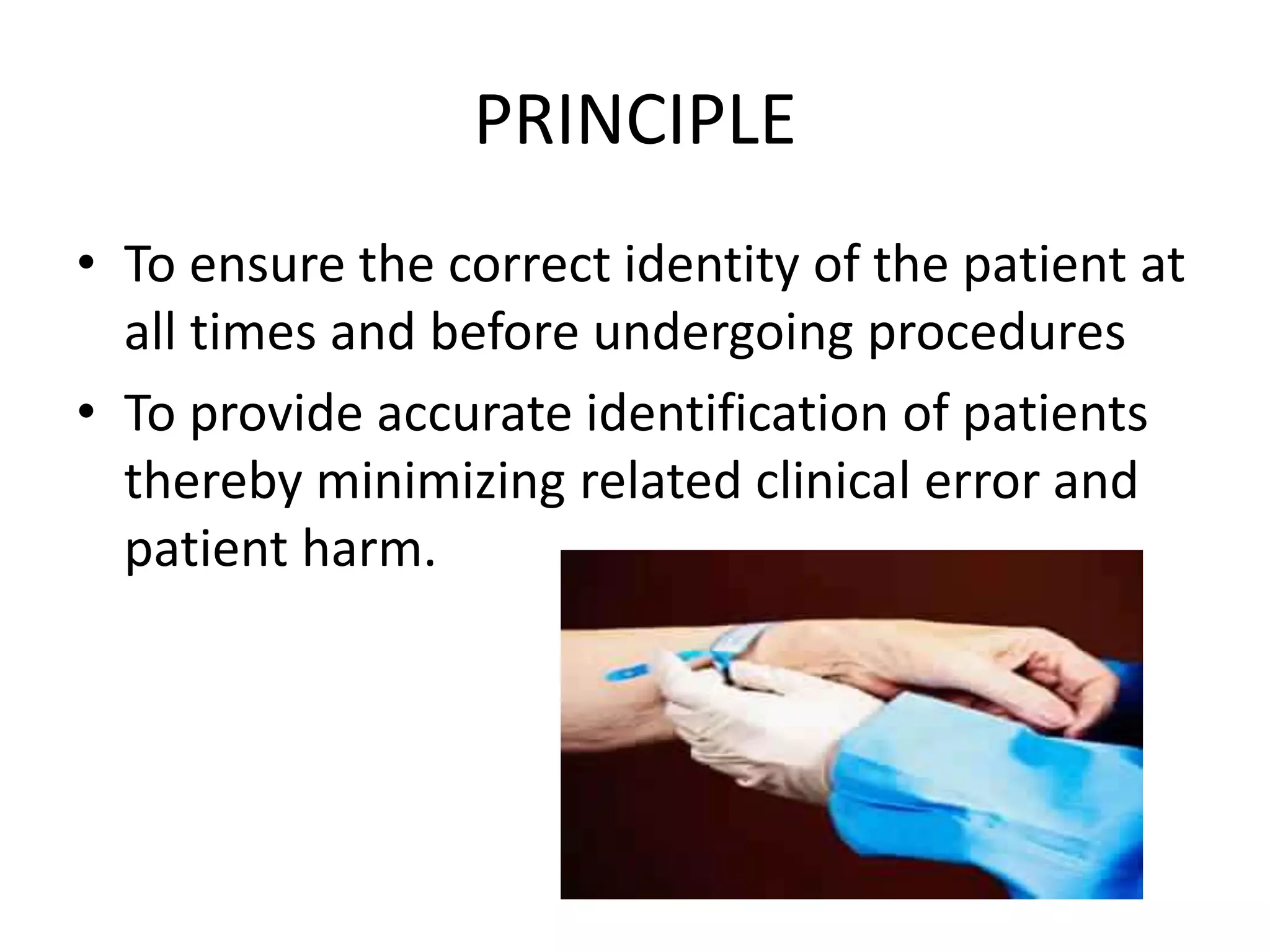
• To ensure the correct identity of the patient at
all times and before undergoing procedures
• To provide accurate identification of patients
thereby minimizing related clinical error and
patient harm.
PATIENT IDENTIFIERS AS EVIDENCE TO
CONFIRM IDENTITY
• NAME ( GIVEN NAME, FATHER’S NAME,
HUSBAND’S NAME, FAMILY NAME )
• ASSIGNED IDENTIFICATION NUMBER
• TELEPHONE NUMBER
• DATE OF BIRTH
• ADDRESS
• MEDICAL RECORD NUMBER
Note : Patient’s room number cannot be used as
identifier
Patient identification must be confirmed prior to
conducting the following procedures:
• Administration of medicines
• Transfusion of blood and blood products
• Obtaining blood and other specimens
• Performing a diagnostic test
• Prior to transferring/discharging a patient
• Prior to carrying out any invasive procedures such as
urethral catheterization, inserting a nasogastric tube,
etc.
• Giving results of diagnostic tests.
DO’S ON PATIENT IDENTIFICATION
NUMBER
• Do identify the patient correctly on admission.
• Do ensure that you have the full forename of the patient.
• Do check again with the patient that all the details are correct,
when you place an identity bracelet on.
• Do regularly check the legibility of ID wristbands. Replace any ID
wristbands which become illegible.
• Do always check the details of patients even if you think you know
them well.
• Someone may just have placed the wrong medication chart at the
foot of the bed.
• Do double check verbally and physically that the details of a patient
matches the details on a fully completed request form, especially if
another member of the healthcare team has completed the form.
• Do label samples taken from the patient straight away. The safest
way is to label the bottles after the sample has been taken and
before leaving the patient’s bedside.
DON’T’S ON PATIENT IDENTIFICATION
• Do not read the patients details to them and allow them to
passively agree with you. Ask the patient to give you their full
detail
• Do not accept a patient’s pointing to the name board above their
bed as a signal that it is correct for that patient. Speak to the
patient and check.
• Do not take bloods from a patient without checking the patients
details against a fully completed request form.
• Do not label a sample bottle before you take blood. You may get
distracted before you have completed the task.
• Do not perform two tasks at the same time e.g. taking bloods
from several patients and labeling them afterwards or filling out
requests forms for several patients at the same time
• Do not perform tasks remotely from the patient if at all possible.
Try to fill out request forms and complete tasks at the patients’
bedside
NURSES’ RESPONSIBILITIES
• Patient is wearing correct patient
identification bands
• A bracelet stating patient’s name, date of
birth, hospital number/chart No. and ward is
attached to an appropriate limb
• The information on the patient’s wristband
must correspond with the information in the
patient’s chart.
FAILURE TO CORRECTLY IDENTIFY THE PATIENT
LEADS TO :
• MEDICATION ERROR
• TRANSFUSION ERROR
• TESTING ERROR
• WRONG PERSON PROCEDURE
REFERENCES
QUESTIONS??
THANK YOU!!

patient identification.pptx

  • 1.
  • 2.
    INTERNATIONAL PATIENT SAFETY GOALS 1.IDENTIFYPATIENT CORRECTLY 2.IMPROVE EFFECTIVE COMMUNICATION 3.IMPROVE THE SAFETY OF HIGH ALERT MEDICATION 4.ENSURE CORRECT – SITE, CORRECT – PROCEDURE, CORRECT – PATIENT SURGERY 5.REDUCE THE RISK OF HEALTH CARE ASSOSIATED INFECTION 6.REDUCE THE RISK OF PATIENT HARM RESULTING FROM FALLS
  • 3.
    PRINCIPLE • To ensurethe correct identity of the patient at all times and before undergoing procedures • To provide accurate identification of patients thereby minimizing related clinical error and patient harm.
  • 4.
    PATIENT IDENTIFIERS ASEVIDENCE TO CONFIRM IDENTITY • NAME ( GIVEN NAME, FATHER’S NAME, HUSBAND’S NAME, FAMILY NAME ) • ASSIGNED IDENTIFICATION NUMBER • TELEPHONE NUMBER • DATE OF BIRTH • ADDRESS • MEDICAL RECORD NUMBER Note : Patient’s room number cannot be used as identifier
  • 6.
    Patient identification mustbe confirmed prior to conducting the following procedures: • Administration of medicines • Transfusion of blood and blood products • Obtaining blood and other specimens • Performing a diagnostic test • Prior to transferring/discharging a patient • Prior to carrying out any invasive procedures such as urethral catheterization, inserting a nasogastric tube, etc. • Giving results of diagnostic tests.
  • 7.
    DO’S ON PATIENTIDENTIFICATION NUMBER • Do identify the patient correctly on admission. • Do ensure that you have the full forename of the patient. • Do check again with the patient that all the details are correct, when you place an identity bracelet on. • Do regularly check the legibility of ID wristbands. Replace any ID wristbands which become illegible. • Do always check the details of patients even if you think you know them well. • Someone may just have placed the wrong medication chart at the foot of the bed. • Do double check verbally and physically that the details of a patient matches the details on a fully completed request form, especially if another member of the healthcare team has completed the form. • Do label samples taken from the patient straight away. The safest way is to label the bottles after the sample has been taken and before leaving the patient’s bedside.
  • 8.
    DON’T’S ON PATIENTIDENTIFICATION • Do not read the patients details to them and allow them to passively agree with you. Ask the patient to give you their full detail • Do not accept a patient’s pointing to the name board above their bed as a signal that it is correct for that patient. Speak to the patient and check. • Do not take bloods from a patient without checking the patients details against a fully completed request form. • Do not label a sample bottle before you take blood. You may get distracted before you have completed the task. • Do not perform two tasks at the same time e.g. taking bloods from several patients and labeling them afterwards or filling out requests forms for several patients at the same time • Do not perform tasks remotely from the patient if at all possible. Try to fill out request forms and complete tasks at the patients’ bedside
  • 9.
    NURSES’ RESPONSIBILITIES • Patientis wearing correct patient identification bands • A bracelet stating patient’s name, date of birth, hospital number/chart No. and ward is attached to an appropriate limb • The information on the patient’s wristband must correspond with the information in the patient’s chart.
  • 10.
    FAILURE TO CORRECTLYIDENTIFY THE PATIENT LEADS TO : • MEDICATION ERROR • TRANSFUSION ERROR • TESTING ERROR • WRONG PERSON PROCEDURE
  • 11.
  • 12.
  • 13.