Clinical Skills Training &
Simulation Pedagogy
Prof K.R. Sethuraman
Dean – Faculty of Medicine &
Deputy VC – Academic/International Affairs
AIMST University
“That which we must learn to do, we learn by doing.”
– Aristotle
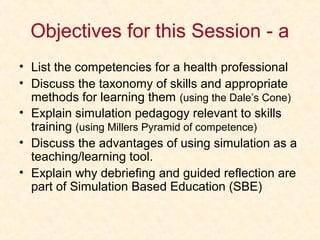
Objectives for this Session - a
• List the competencies for a health professional
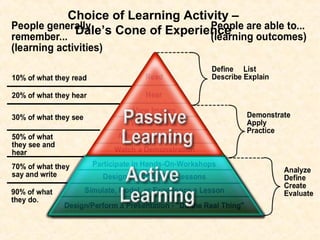
• Discuss the taxonomy of skills and appropriate
methods for learning them (using the Dale’s Cone)
• Explain simulation pedagogy relevant to skills
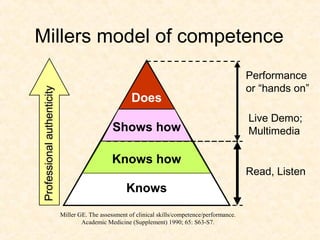
training (using Millers Pyramid of competence)
• Discuss the advantages of using simulation as a
teaching/learning tool.
• Explain why debriefing and guided reflection are
part of Simulation Based Education (SBE)
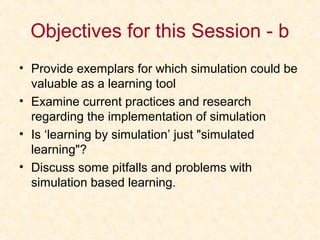
Objectives for this Session - b
• Provide exemplars for which simulation could be
valuable as a learning tool
• Examine current practices and research
regarding the implementation of simulation
• Is ‘learning by simulation’ just "simulated
learning"?
• Discuss some pitfalls and problems with
simulation based learning.
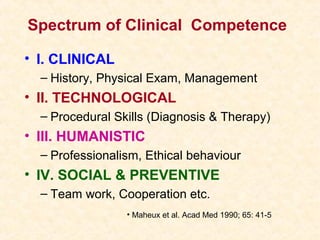
Spectrum of Clinical Competence
• I. CLINICAL
– History, Physical Exam, Management
• II. TECHNOLOGICAL
– Procedural Skills (Diagnosis & Therapy)
• III. HUMANISTIC
– Professionalism, Ethical behaviour
• IV. SOCIAL & PREVENTIVE
– Team work, Cooperation etc.
• Maheux et al. Acad Med 1990; 65: 41-5
Choice of Learning Activity –
Dale’s Cone of Experience
Millers model of competence
Miller GE. The assessment of clinical skills/competence/performance.
Academic Medicine (Supplement) 1990; 65: S63-S7.
ProfessionalauthenticityProfessionalauthenticity
Read, Listen
Knows
Shows how
Knows how
Does
Performance
or “hands on”
Live Demo;
Multimedia
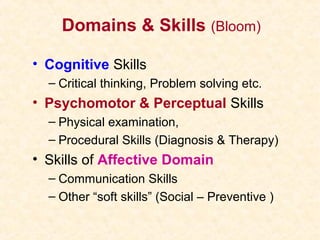
Domains & Skills (Bloom)
• Cognitive Skills
– Critical thinking, Problem solving etc.
• Psychomotor & Perceptual Skills
– Physical examination,
– Procedural Skills (Diagnosis & Therapy)
• Skills of Affective Domain
– Communication Skills
– Other “soft skills” (Social – Preventive )
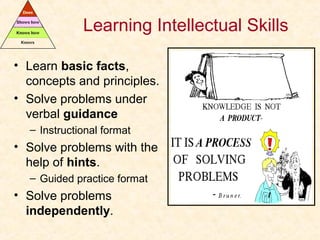
Learning Intellectual Skills
• Learn basic facts,
concepts and principles.
• Solve problems under
verbal guidance
– Instructional format
• Solve problems with the
help of hints.
– Guided practice format
• Solve problems
independently.
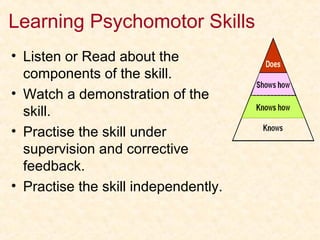
Learning Psychomotor Skills
• Listen or Read about the
components of the skill.
• Watch a demonstration of the
skill.
• Practise the skill under
supervision and corrective
feedback.
• Practise the skill independently.
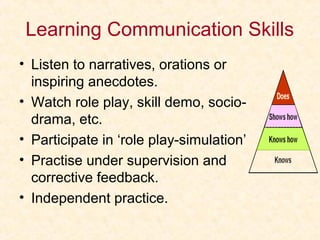
Learning Communication Skills
• Listen to narratives, orations or
inspiring anecdotes.
• Watch role play, skill demo, socio-
drama, etc.
• Participate in ‘role play-simulation’
• Practise under supervision and
corrective feedback.
• Independent practice.
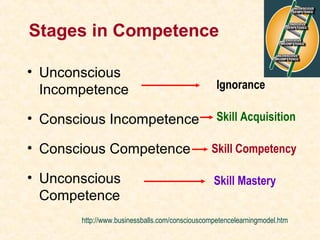
Stages in Competence
• Unconscious
Incompetence
• Conscious Incompetence
• Conscious Competence
• Unconscious
Competence
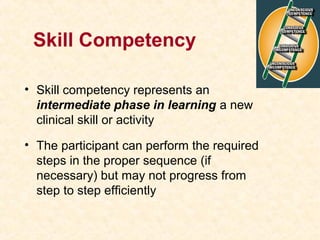
Skill Acquisition
Skill Competency
Skill Mastery
Ignorance
http://www.businessballs.com/consciouscompetencelearningmodel.htm
Skill Acquisition
• Skill acquisition represents the initial phase in
learning a new clinical skill or activity
• One or more practice sessions are needed for
learning how to perform the required steps and the
sequence
• Teacher’s guidance is necessary to achieve
correct performance
Skill Competency
• Skill competency represents an
intermediate phase in learning a new
clinical skill or activity
• The participant can perform the required
steps in the proper sequence (if
necessary) but may not progress from
step to step efficiently
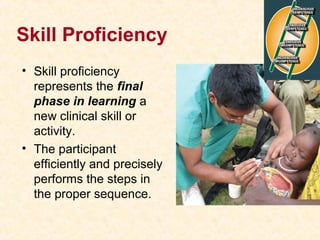
Skill Proficiency
• Skill proficiency
represents the final
phase in learning a
new clinical skill or
activity.
• The participant
efficiently and precisely
performs the steps in
the proper sequence.
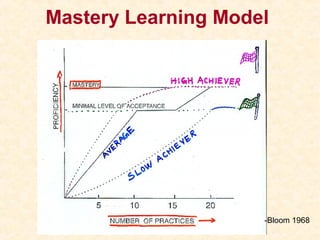
Mastery Learning Model
-Bloom 1968
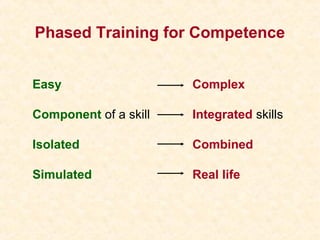
Phased Training for Competence
Easy Complex
Component of a skill Integrated skills
Isolated Combined
Simulated Real life
II. Simulation for
Skill Learning
What is simulation?
Simulate: Aping =
Imitate uncritically and in every aspect
(simia = Ape)
Fidelity of Simulation
• How closely the appearance & behaviour of
the simulation match those of the simulated
system (reality)
– Physical (Engineering) fidelity refers to the
fidelity to the physical characteristics of the real
task (visual, auditory, haptic etc)
– Functional (Psychological) fidelity refers to
the fidelity to the skills involved in the real task
• (cognitive, perceptual, manipulative or behavioural)
N J Maran & R J Glavin. Low- to high-fidelity simulation – a continuum of
medical education? Medical Education 2003;37(Suppl. 1):22–28
The ‘ADDIE’ framework for Design of
Hi Fi Simulations
• Analyze: Analyze relevant learner
characteristics and tasks to be learned
• Design: Define objectives and outcomes; select
an instructional approach (of Gagne)
• Develop: Create the instructional materials
• Implement: Deliver the instructional materials
• Evaluate: Ensure that the instruction achieved
the desired goals
Simulation Based Education (SBE)
• An educational
simulation is:
– A sequential decision-
making exercise in
which
– students fulfill assigned
roles to manage
– discipline-specific tasks
– according to guidelines
provided by the
instructor
– in an environment that
models reality
Simulation vs.
Game
• In educational
simulations there
are no elements of
fantasy.
• Simulations are
more fluid and
spontaneous.
Simulations for SBE
• Written simulations
• Three-dimensional or
static models
• Audio based
• Video-based
• Computer-based
clinical simulation
• Animal models
• Human cadavers
• Peer to Peer
• Standardized patients
• Task-specific
simulators –
Designed to teach a
specific skill or task
• Immersive simulation
– Virtual reality (VR)
– High Fidelity (Robotic)
Advantages of SBE
• Risks to patients and
learners are avoided
• Undesirable interference
is reduced
• Scenarios can be
created as per need
• Skills can be practised
repeatedly
• Retention and accuracy
are increased
• Training can be tailored to
individuals/teams
• Chronic diseases can be
simulated in its entirety
• Bridges the “classroom –
bedside” gap
• “Intimate examination”
can be practised and
learnt by every student
(e.g. – Rectal exam)
Key elements in SBE
• Simulation based Education (SBE) has
four key elements –
1. Create motivation a priori (briefing)
2. Active learner, not passive recipient of info
3. Individualized and paced for each learner
4. Prompt feedback on success and error
(debriefing)
Rationale for Teacher in SBE –
Objectivism vs. Constructivism
Objectivist view
– the real world can be
described and
structured in terms of
objects
– a well-structured
experience will result
all the learners
acquiring an identical
perspective on
knowledge
• Constructivist view
– each learner projects
his or her own reality
onto the world.
– the world does not
exist independently
as a consistently
objective component
– identical perspective
on knowledge is a
naïve notion
Role of the Teacher in SBE
• Not all experiences
are equally educative
(Dewey)
• A teacher has to
assist the learner in
understanding the
simulated process &
• guide the student
through critical
thinking processes to-
• help the students
– differentiate between
reliable and
unreliable facts
– to look for patterns
within these bits of
information
– to construct new
knowledge from the
experience.
Debrief Consolidates Learning
• Often the real learning takes place in the
debrief session
• Debrief goals are:
– What did the students experience?
– What did they learn?
– How can they apply that learning to future
experiences and learning?
Debrief – Things to avoid
– Don’t Lecture
– Don’t provide your analysis before
listening to the team
– Don’t create the sense of an
interrogation
– Avoid a rigid agenda; let them
construct the learning outcomes
– Don’t interrupt team discussion
unless needed
Three C’s of education
Constructive
Contextual
Collaborative
These apply well to the debrief sessions
III. Skill Learning through
Simulation
 Problem Solving Skill
 Communication skill
 Physical Examination Skills
 Integrated Complex Skills
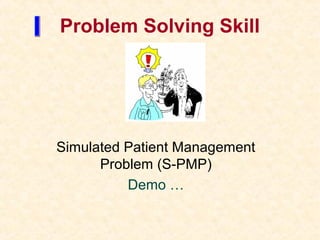
Problem Solving Skill
Simulated Patient Management
Problem (S-PMP)
Demo …
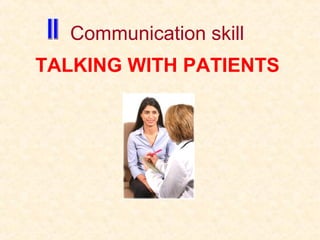
Communication skill
TALKING WITH PATIENTS
Talking with Patients – Value of
In primary care,
about 86% of the
Diagnostic value is
from historical data
[ Ref - Hampton JR et al.
BMJ 1975;2: 486-9]
History
Exam Lab
Learning to Elicit
History
• Role play simulation!
• Let them play Doctor-
Patient roles and learn
“There is no cement like interest;
no stimulus like the hint of
practical consideration." [A Flexner-1910]
Role Play Simulation –
The Method
• Triad of “Doctor” “Patient” & “Observer”
• Assigned a problem, e.g. headache to elicit history
• Each "patient" is individually coached on an entity -
e.g., migraine, tension headache, etc - totally 4 or 5
• Next day, every “Patient” is assigned to a "Doc" and
an observer – 4 or 5 groups
• They interact for about 30 minutes in any mutually
acceptable language
Role Play Simulation –
The Method – contd..
• Observer (3rd
in the triad) monitors for
– Realism in interview, and
– Any use of medical jargon in lieu of lay-words
• In the plenary session, systematic
debriefing is done on
– History & Analysis of the history
– Lay medical words if unknown or unclear
Role Play Simulation –
FEEDBACK
• Students were mostly appreciative:
– "Felt like Sherlock Holmes"
– "Fun way to learn ‘boring’ history"
– "Never knew so many conditions exist in which
patients are physically normal"
– "Since student-patient gap is bypassed, I could
realise the value of eliciting history"
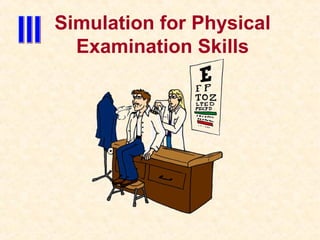
Simulation for Physical
Examination Skills
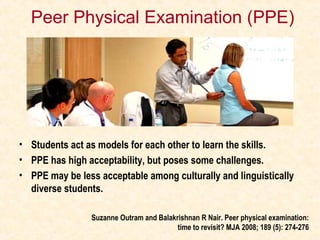
Peer Physical Examination (PPE)
• Students act as models for each other to learn the skills.
• PPE has high acceptability, but poses some challenges.
• PPE may be less acceptable among culturally and linguistically
diverse students.
Suzanne Outram and Balakrishnan R Nair. Peer physical examination:
time to revisit? MJA 2008; 189 (5): 274-276
Detecting Errors in Physical
Exam for Effective Debriefing
Physical Exam Skills
MISSION
• Every student must perform the core
'must do' skills
• Observe each one perform & give
corrective feedback
• Try and eliminate all learning errors
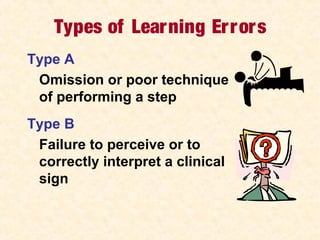
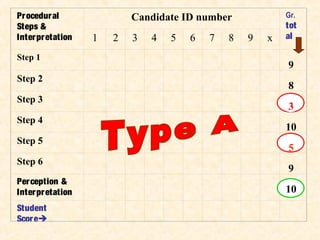
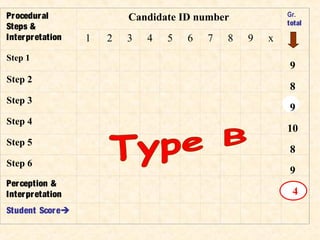
Types of Learning Errors
Type A
Omission or poor technique
of performing a step
Type B
Failure to perceive or to
correctly interpret a clinical
sign
Procedural
Steps &
Interpretation
Candidate ID number Gr.
tot
al1 2 3 4 5 6 7 8 9 x
Step 1                      
 9
Step 2                      
 8
Step 3                      
 3
Step 4                      
10
Step 5                      
 5
Step 6                      
 9
Perception &
Interpretation
                     
10
Student
Score
                     
Procedural
Steps &
Interpretation
Candidate ID number Gr.
total
1 2 3 4 5 6 7 8 9 x
Step 1                      
 9
Step 2                      
 8
Step 3                      
 9
Step 4                      
10
Step 5                      
 8
Step 6                      
 9
Perception &
Interpretation
                     
4
Student Score                      
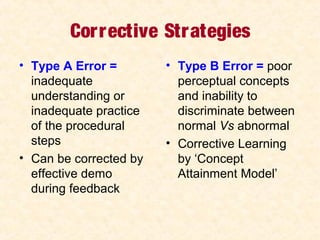
Corrective Strategies
• Type A Error =
inadequate
understanding or
inadequate practice
of the procedural
steps
• Can be corrected by
effective demo
during feedback
• Type B Error = poor
perceptual concepts
and inability to
discriminate between
normal Vs abnormal
• Corrective Learning
by ‘Concept
Attainment Model’
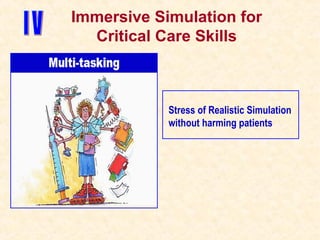
Immersive Simulation for
Critical Care Skills
Stress of Realistic Simulation
without harming patients
Barriers to the Widespread Use of
SBE for Skill Learning
• The cost of equipment, personnel, maintenance
and training.
– the initial cost of a simulation center approximates RM
0.5 to 1 million.
• The lack of valid and reliable assessment tools
for simulation learning (esp. predictive validity).
• The lack of academic recognition for the time
spent in developing simulation scenarios
(compared with publishing scholarly work)
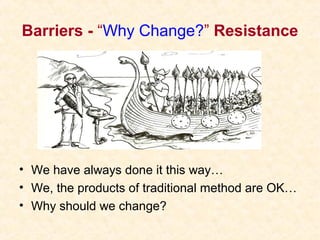
Barriers - “Why Change?” Resistance
• We have always done it this way…
• We, the products of traditional method are OK…
• Why should we change?
To Sum Up:
Education –Teaching – Learning
Education is about learning
Teaching is NOT = Learning
&
Education is to achieve learning outcomes
So, Education should be adapted to skill learning
An Enlightened Teacher is -
!
Terima Kasih !

Clinical Skills Training and Simulation Pedagogy

  • 1.
    Clinical Skills Training& Simulation Pedagogy Prof K.R. Sethuraman Dean – Faculty of Medicine & Deputy VC – Academic/International Affairs AIMST University “That which we must learn to do, we learn by doing.” – Aristotle
  • 2.
    Objectives for thisSession - a • List the competencies for a health professional • Discuss the taxonomy of skills and appropriate methods for learning them (using the Dale’s Cone) • Explain simulation pedagogy relevant to skills training (using Millers Pyramid of competence) • Discuss the advantages of using simulation as a teaching/learning tool. • Explain why debriefing and guided reflection are part of Simulation Based Education (SBE)
  • 3.
    Objectives for thisSession - b • Provide exemplars for which simulation could be valuable as a learning tool • Examine current practices and research regarding the implementation of simulation • Is ‘learning by simulation’ just "simulated learning"? • Discuss some pitfalls and problems with simulation based learning.
  • 4.
    Spectrum of ClinicalCompetence • I. CLINICAL – History, Physical Exam, Management • II. TECHNOLOGICAL – Procedural Skills (Diagnosis & Therapy) • III. HUMANISTIC – Professionalism, Ethical behaviour • IV. SOCIAL & PREVENTIVE – Team work, Cooperation etc. • Maheux et al. Acad Med 1990; 65: 41-5
  • 5.
    Choice of LearningActivity – Dale’s Cone of Experience
  • 6.
    Millers model ofcompetence Miller GE. The assessment of clinical skills/competence/performance. Academic Medicine (Supplement) 1990; 65: S63-S7. ProfessionalauthenticityProfessionalauthenticity Read, Listen Knows Shows how Knows how Does Performance or “hands on” Live Demo; Multimedia
  • 7.
    Domains & Skills(Bloom) • Cognitive Skills – Critical thinking, Problem solving etc. • Psychomotor & Perceptual Skills – Physical examination, – Procedural Skills (Diagnosis & Therapy) • Skills of Affective Domain – Communication Skills – Other “soft skills” (Social – Preventive )
  • 8.
    Learning Intellectual Skills •Learn basic facts, concepts and principles. • Solve problems under verbal guidance – Instructional format • Solve problems with the help of hints. – Guided practice format • Solve problems independently.
  • 9.
    Learning Psychomotor Skills •Listen or Read about the components of the skill. • Watch a demonstration of the skill. • Practise the skill under supervision and corrective feedback. • Practise the skill independently.
  • 10.
    Learning Communication Skills •Listen to narratives, orations or inspiring anecdotes. • Watch role play, skill demo, socio- drama, etc. • Participate in ‘role play-simulation’ • Practise under supervision and corrective feedback. • Independent practice.
  • 11.
    Stages in Competence •Unconscious Incompetence • Conscious Incompetence • Conscious Competence • Unconscious Competence Skill Acquisition Skill Competency Skill Mastery Ignorance http://www.businessballs.com/consciouscompetencelearningmodel.htm
  • 12.
    Skill Acquisition • Skillacquisition represents the initial phase in learning a new clinical skill or activity • One or more practice sessions are needed for learning how to perform the required steps and the sequence • Teacher’s guidance is necessary to achieve correct performance
  • 13.
    Skill Competency • Skillcompetency represents an intermediate phase in learning a new clinical skill or activity • The participant can perform the required steps in the proper sequence (if necessary) but may not progress from step to step efficiently
  • 14.
    Skill Proficiency • Skillproficiency represents the final phase in learning a new clinical skill or activity. • The participant efficiently and precisely performs the steps in the proper sequence.
  • 15.
  • 16.
    Phased Training forCompetence Easy Complex Component of a skill Integrated skills Isolated Combined Simulated Real life
  • 17.
  • 18.
    What is simulation? Simulate:Aping = Imitate uncritically and in every aspect (simia = Ape)
  • 19.
    Fidelity of Simulation •How closely the appearance & behaviour of the simulation match those of the simulated system (reality) – Physical (Engineering) fidelity refers to the fidelity to the physical characteristics of the real task (visual, auditory, haptic etc) – Functional (Psychological) fidelity refers to the fidelity to the skills involved in the real task • (cognitive, perceptual, manipulative or behavioural) N J Maran & R J Glavin. Low- to high-fidelity simulation – a continuum of medical education? Medical Education 2003;37(Suppl. 1):22–28
  • 20.
    The ‘ADDIE’ frameworkfor Design of Hi Fi Simulations • Analyze: Analyze relevant learner characteristics and tasks to be learned • Design: Define objectives and outcomes; select an instructional approach (of Gagne) • Develop: Create the instructional materials • Implement: Deliver the instructional materials • Evaluate: Ensure that the instruction achieved the desired goals
  • 21.
    Simulation Based Education(SBE) • An educational simulation is: – A sequential decision- making exercise in which – students fulfill assigned roles to manage – discipline-specific tasks – according to guidelines provided by the instructor – in an environment that models reality Simulation vs. Game • In educational simulations there are no elements of fantasy. • Simulations are more fluid and spontaneous.
  • 22.
    Simulations for SBE •Written simulations • Three-dimensional or static models • Audio based • Video-based • Computer-based clinical simulation • Animal models • Human cadavers • Peer to Peer • Standardized patients • Task-specific simulators – Designed to teach a specific skill or task • Immersive simulation – Virtual reality (VR) – High Fidelity (Robotic)
  • 23.
    Advantages of SBE •Risks to patients and learners are avoided • Undesirable interference is reduced • Scenarios can be created as per need • Skills can be practised repeatedly • Retention and accuracy are increased • Training can be tailored to individuals/teams • Chronic diseases can be simulated in its entirety • Bridges the “classroom – bedside” gap • “Intimate examination” can be practised and learnt by every student (e.g. – Rectal exam)
  • 24.
    Key elements inSBE • Simulation based Education (SBE) has four key elements – 1. Create motivation a priori (briefing) 2. Active learner, not passive recipient of info 3. Individualized and paced for each learner 4. Prompt feedback on success and error (debriefing)
  • 25.
    Rationale for Teacherin SBE – Objectivism vs. Constructivism Objectivist view – the real world can be described and structured in terms of objects – a well-structured experience will result all the learners acquiring an identical perspective on knowledge • Constructivist view – each learner projects his or her own reality onto the world. – the world does not exist independently as a consistently objective component – identical perspective on knowledge is a naïve notion
  • 26.
    Role of theTeacher in SBE • Not all experiences are equally educative (Dewey) • A teacher has to assist the learner in understanding the simulated process & • guide the student through critical thinking processes to- • help the students – differentiate between reliable and unreliable facts – to look for patterns within these bits of information – to construct new knowledge from the experience.
  • 27.
    Debrief Consolidates Learning •Often the real learning takes place in the debrief session • Debrief goals are: – What did the students experience? – What did they learn? – How can they apply that learning to future experiences and learning?
  • 28.
    Debrief – Thingsto avoid – Don’t Lecture – Don’t provide your analysis before listening to the team – Don’t create the sense of an interrogation – Avoid a rigid agenda; let them construct the learning outcomes – Don’t interrupt team discussion unless needed
  • 29.
    Three C’s ofeducation Constructive Contextual Collaborative These apply well to the debrief sessions
  • 30.
    III. Skill Learningthrough Simulation  Problem Solving Skill  Communication skill  Physical Examination Skills  Integrated Complex Skills
  • 31.
    Problem Solving Skill SimulatedPatient Management Problem (S-PMP) Demo …
  • 32.
  • 33.
    Talking with Patients– Value of In primary care, about 86% of the Diagnostic value is from historical data [ Ref - Hampton JR et al. BMJ 1975;2: 486-9] History Exam Lab
  • 34.
    Learning to Elicit History •Role play simulation! • Let them play Doctor- Patient roles and learn “There is no cement like interest; no stimulus like the hint of practical consideration." [A Flexner-1910]
  • 35.
    Role Play Simulation– The Method • Triad of “Doctor” “Patient” & “Observer” • Assigned a problem, e.g. headache to elicit history • Each "patient" is individually coached on an entity - e.g., migraine, tension headache, etc - totally 4 or 5 • Next day, every “Patient” is assigned to a "Doc" and an observer – 4 or 5 groups • They interact for about 30 minutes in any mutually acceptable language
  • 36.
    Role Play Simulation– The Method – contd.. • Observer (3rd in the triad) monitors for – Realism in interview, and – Any use of medical jargon in lieu of lay-words • In the plenary session, systematic debriefing is done on – History & Analysis of the history – Lay medical words if unknown or unclear
  • 37.
    Role Play Simulation– FEEDBACK • Students were mostly appreciative: – "Felt like Sherlock Holmes" – "Fun way to learn ‘boring’ history" – "Never knew so many conditions exist in which patients are physically normal" – "Since student-patient gap is bypassed, I could realise the value of eliciting history"
  • 38.
  • 39.
    Peer Physical Examination(PPE) • Students act as models for each other to learn the skills. • PPE has high acceptability, but poses some challenges. • PPE may be less acceptable among culturally and linguistically diverse students. Suzanne Outram and Balakrishnan R Nair. Peer physical examination: time to revisit? MJA 2008; 189 (5): 274-276
  • 40.
    Detecting Errors inPhysical Exam for Effective Debriefing
  • 41.
    Physical Exam Skills MISSION •Every student must perform the core 'must do' skills • Observe each one perform & give corrective feedback • Try and eliminate all learning errors
  • 42.
    Types of LearningErrors Type A Omission or poor technique of performing a step Type B Failure to perceive or to correctly interpret a clinical sign
  • 43.
    Procedural Steps & Interpretation Candidate IDnumber Gr. tot al1 2 3 4 5 6 7 8 9 x Step 1                        9 Step 2                        8 Step 3                        3 Step 4                       10 Step 5                        5 Step 6                        9 Perception & Interpretation                       10 Student Score                      
  • 44.
    Procedural Steps & Interpretation Candidate IDnumber Gr. total 1 2 3 4 5 6 7 8 9 x Step 1                        9 Step 2                        8 Step 3                        9 Step 4                       10 Step 5                        8 Step 6                        9 Perception & Interpretation                       4 Student Score                      
  • 45.
    Corrective Strategies • TypeA Error = inadequate understanding or inadequate practice of the procedural steps • Can be corrected by effective demo during feedback • Type B Error = poor perceptual concepts and inability to discriminate between normal Vs abnormal • Corrective Learning by ‘Concept Attainment Model’
  • 46.
    Immersive Simulation for CriticalCare Skills Stress of Realistic Simulation without harming patients
  • 47.
    Barriers to theWidespread Use of SBE for Skill Learning • The cost of equipment, personnel, maintenance and training. – the initial cost of a simulation center approximates RM 0.5 to 1 million. • The lack of valid and reliable assessment tools for simulation learning (esp. predictive validity). • The lack of academic recognition for the time spent in developing simulation scenarios (compared with publishing scholarly work)
  • 48.
    Barriers - “WhyChange?” Resistance • We have always done it this way… • We, the products of traditional method are OK… • Why should we change?
  • 49.
    To Sum Up: Education–Teaching – Learning Education is about learning Teaching is NOT = Learning & Education is to achieve learning outcomes So, Education should be adapted to skill learning
  • 50.
  • 51.