PATIENT SAFETY
Dr. Rashmi kulkarni
QUALITY MANAGER
INTERNAL AUDITOR FOR NABH & NABL
SRI AUROBINDO MEDICAL COLLEGE& PG
INSTITUTE INDORE
ORIGIN OF PATIENT SAFETY
CONCEPT
 PART OF HIPPOCRATIC OATH
 I will prescribe regimens for the good of my patients
according to my ability and my judgment and ”never do
harm” to anyone.
WHAT IS PATIENT SAFETY?
 Patient safety is the absence of preventable harm to a
patient during the process of healthcare.
 The meaning of patient safety is…“Please do no harm”
• Eliminating preventable medical mistakes by care givers
Guarding against the impact of human error
• Establishing systems to safeguard patients' health and
well-being
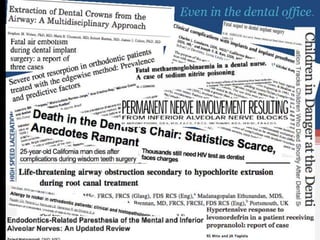
 ACCIDENTS ,ERROR & COMPLICATIONS
ORGANIZATIONS FOR
PATIENT SAFETY IN DENTAL
• World Dental Federation
• Dental Patient Safety Foundation
• INDIAN DENTAL COUNCIL
• The Council Of European Dentist
• Organization For Safety, Asepsis And
Prevention
• In Spain, Spanish Observatory For Dental
Patient Safety (OESPO)
• Etc
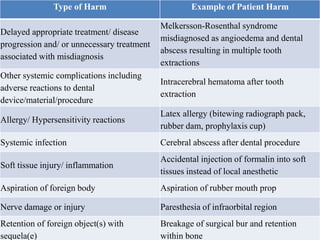
Type of Harm Example of Patient Harm
Delayed appropriate treatment/ disease
progression and/ or unnecessary treatment
associated with misdiagnosis
Melkersson-Rosenthal syndrome
misdiagnosed as angioedema and dental
abscess resulting in multiple tooth
extractions
Other systemic complications including
adverse reactions to dental
device/material/procedure
Intracerebral hematoma after tooth
extraction
Allergy/ Hypersensitivity reactions
Latex allergy (bitewing radiograph pack,
rubber dam, prophylaxis cup)
Systemic infection Cerebral abscess after dental procedure
Soft tissue injury/ inflammation
Accidental injection of formalin into soft
tissues instead of local anesthetic
Aspiration of foreign body Aspiration of rubber mouth prop
Nerve damage or injury Paresthesia of infraorbital region
Retention of foreign object(s) with
sequela(e)
Breakage of surgical bur and retention
within bone
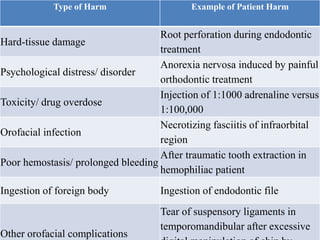
Type of Harm Example of Patient Harm
Hard-tissue damage
Root perforation during endodontic
treatment
Psychological distress/ disorder
Anorexia nervosa induced by painful
orthodontic treatment
Toxicity/ drug overdose
Injection of 1:1000 adrenaline versus
1:100,000
Orofacial infection
Necrotizing fasciitis of infraorbital
region
Poor hemostasis/ prolonged bleeding
After traumatic tooth extraction in
hemophiliac patient
Ingestion of foreign body Ingestion of endodontic file
Other orofacial complications
Tear of suspensory ligaments in
temporomandibular after excessive
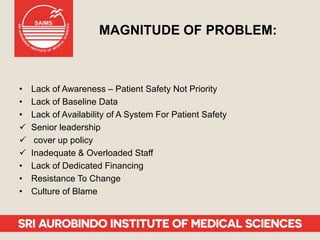
MAGNITUDE OF PROBLEM:
• Lack of Awareness – Patient Safety Not Priority
• Lack of Baseline Data
• Lack of Availability of A System For Patient Safety
 Senior leadership
 cover up policy
 Inadequate & Overloaded Staff
• Lack of Dedicated Financing
• Resistance To Change
• Culture of Blame
AIMS OF THIS INITIATIVE
• A successful, healthy outcome of patient care
• Safe, error-free care
• The most expert and advanced Dental care available for patients
• Comfort and peace of mind for patients and providers
PERFORMA'S
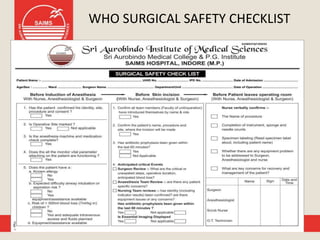
• Check list for safety of surgical patients
• Patient safety evaluation
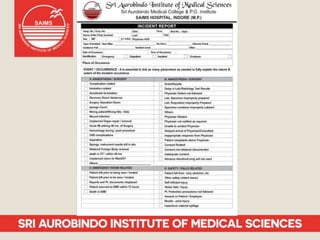
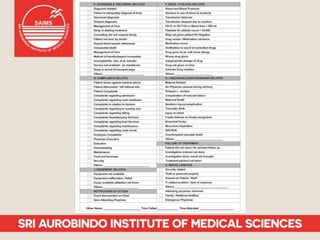
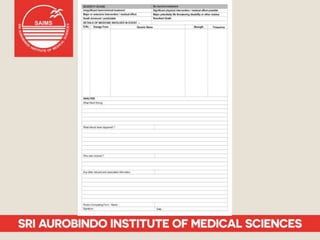
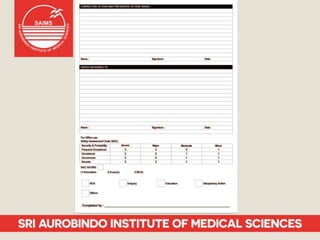
• Adverse Event Reporting Performa
• Incidence form
KEY POINTS
• Develop a culture of safety and a health care system
focused on prioritizing patient safety.
• Look after the quality of clinical records.
• Check the procedures for cleaning, disinfection, sterilization,
and preservation of clinical instruments.
• Exercise extreme caution when prescribing medications.
• Limit the exposure of patients to ionizing radiation only to
what is strictly necessary.
KEY POINTS
• Never reuse packaging materials or substances intended for one clinical
use only.
• Protect the patient's eyes during dental procedures.
• Establish barriers to prevent ingestion or inhalation of materials or small
instruments.
• Use a checklist in all oral surgical procedures.
• Monitor the onset and progression of infection in the oral cavity.
• Have an action protocol for life-threatening emergencies in the dental clinic.
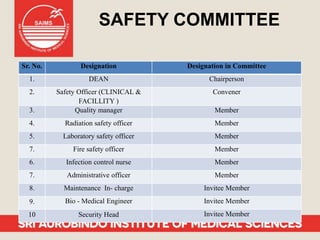
SAFETY COMMITTEE
Sr. No. Designation Designation in Committee
1. DEAN Chairperson
2. Safety Officer (CLINICAL &
FACILLITY )
Convener
3. Quality manager Member
4. Radiation safety officer Member
5. Laboratory safety officer Member
7. Fire safety officer Member
6. Infection control nurse Member
7. Administrative officer Member
8. Maintenance In- charge Invitee Member
9. Bio - Medical Engineer Invitee Member
10 Security Head Invitee Member
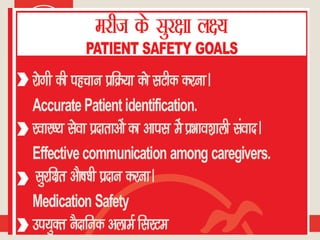
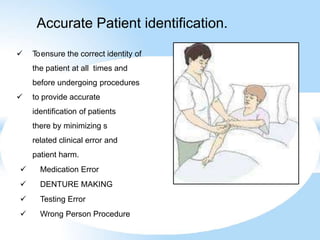
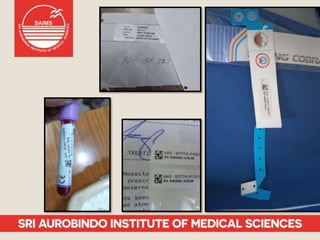
Accurate Patient identification.
 Toensure the correct identity of
the patient at all times and
before undergoing procedures
 to provide accurate
identification of patients
there by minimizing s
related clinical error and
patient harm.
 Medication Error
 DENTURE MAKING
 Testing Error
 Wrong Person Procedure
EFFECATIVE
COMMUNICATION
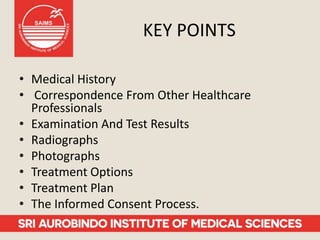
KEY POINTS
• Medical History
• Correspondence From Other Healthcare
Professionals
• Examination And Test Results
• Radiographs
• Photographs
• Treatment Options
• Treatment Plan
• The Informed Consent Process.
Medication safety
PHARMACOVIGILANCE
SAFE DRUG PRESCRIPTION
AN ADVERSE EVENT REPORTING CELL
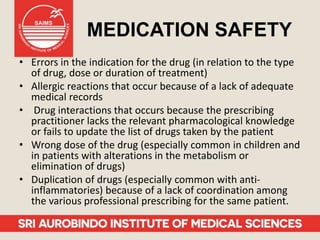
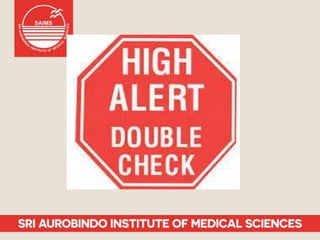
MEDICATION SAFETY
 Illegible Writing prescription by doctors.
 Wrong medicines or wrong does or wrong patient.
 Wrong injection and wrong route of administration.
 Clear & legible written medication guidelines.
 Identification of each patient with Similar patient names
 High risk drugs
 Look alike and Sound Alike “LASA”
 Food drug interaction
 Drug –drug interaction
MEDICATION SAFETY
• Errors in the indication for the drug (in relation to the type
of drug, dose or duration of treatment)
• Allergic reactions that occur because of a lack of adequate
medical records
• Drug interactions that occurs because the prescribing
practitioner lacks the relevant pharmacological knowledge
or fails to update the list of drugs taken by the patient
• Wrong dose of the drug (especially common in children and
in patients with alterations in the metabolism or
elimination of drugs)
• Duplication of drugs (especially common with anti-
inflammatories) because of a lack of coordination among
the various professional prescribing for the same patient.
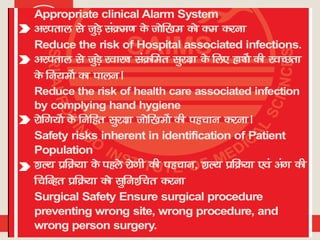
Reduce the risk of Hospital
associated infections.
HIC
• HOSPITAL ASSOCIATED INFECTION
Surgical site infection rate
• POST EXPOSURE PROPHYLAXIS
• Needle stick injury
• Blood & body fluid exposure
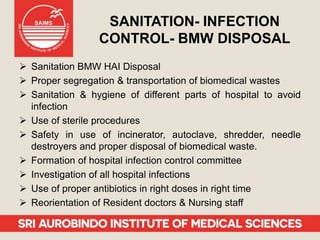
SANITATION- INFECTION
CONTROL- BMW DISPOSAL
 Sanitation BMW HAI Disposal
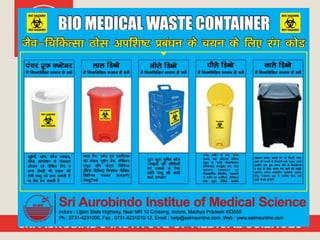
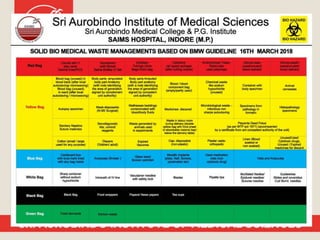
 Proper segregation & transportation of biomedical wastes
 Sanitation & hygiene of different parts of hospital to avoid
infection
 Use of sterile procedures
 Safety in use of incinerator, autoclave, shredder, needle
destroyers and proper disposal of biomedical waste.
 Formation of hospital infection control committee
 Investigation of all hospital infections
 Use of proper antibiotics in right doses in right time
 Reorientation of Resident doctors & Nursing staff
RISK ASSESSMENT
Risk assessment
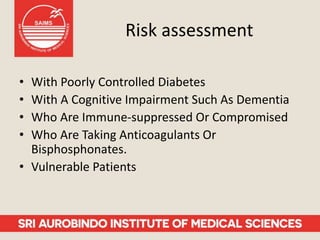
• With Poorly Controlled Diabetes
• With A Cognitive Impairment Such As Dementia
• Who Are Immune-suppressed Or Compromised
• Who Are Taking Anticoagulants Or
Bisphosphonates.
• Vulnerable Patients
Risk assessment
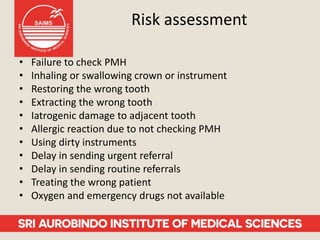
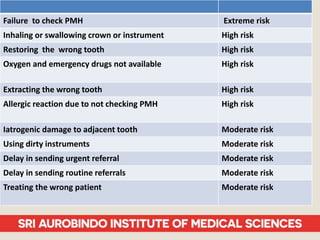
• Failure to check PMH
• Inhaling or swallowing crown or instrument
• Restoring the wrong tooth
• Extracting the wrong tooth
• Iatrogenic damage to adjacent tooth
• Allergic reaction due to not checking PMH
• Using dirty instruments
• Delay in sending urgent referral
• Delay in sending routine referrals
• Treating the wrong patient
• Oxygen and emergency drugs not available
Failure to check PMH Extreme risk
Inhaling or swallowing crown or instrument High risk
Restoring the wrong tooth High risk
Oxygen and emergency drugs not available High risk
Extracting the wrong tooth High risk
Allergic reaction due to not checking PMH High risk
Iatrogenic damage to adjacent tooth Moderate risk
Using dirty instruments Moderate risk
Delay in sending urgent referral Moderate risk
Delay in sending routine referrals Moderate risk
Treating the wrong patient Moderate risk
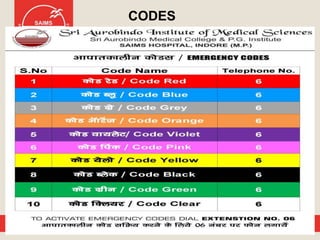
CODES
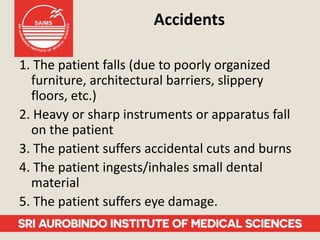
Accidents
1. The patient falls (due to poorly organized
furniture, architectural barriers, slippery
floors, etc.)
2. Heavy or sharp instruments or apparatus fall
on the patient
3. The patient suffers accidental cuts and burns
4. The patient ingests/inhales small dental
material
5. The patient suffers eye damage.
RADIATION SAFETY
• All exposures should be kept As Low As is Reasonably Achievable,
(ALARA) economic and social factors being taken into account.
(Optimization)
• The dose equivalent to individuals shall not exceed the limits
recommended for the appropriate circumstances. (Limitation)
• Time of exposure, Distance of exposure and Shielding to be
appropriately defined
Basic Principles of Radiation Protection
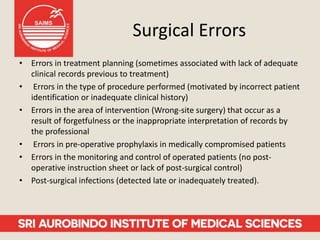
Surgical Errors
• Errors in treatment planning (sometimes associated with lack of adequate
clinical records previous to treatment)
• Errors in the type of procedure performed (motivated by incorrect patient
identification or inadequate clinical history)
• Errors in the area of intervention (Wrong-site surgery) that occur as a
result of forgetfulness or the inappropriate interpretation of records by
the professional
• Errors in pre-operative prophylaxis in medically compromised patients
• Errors in the monitoring and control of operated patients (no post-
operative instruction sheet or lack of post-surgical control)
• Post-surgical infections (detected late or inadequately treated).
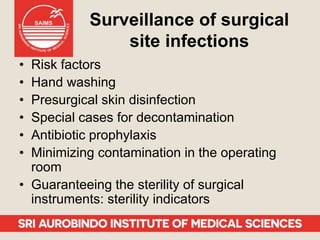
Surveillance of surgical
site infections
• Risk factors
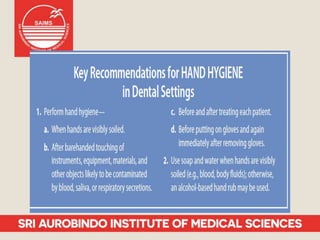
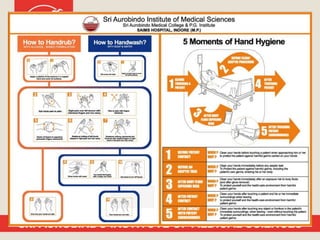
• Hand washing
• Presurgical skin disinfection
• Special cases for decontamination
• Antibiotic prophylaxis
• Minimizing contamination in the operating
room
• Guaranteeing the sterility of surgical
instruments: sterility indicators
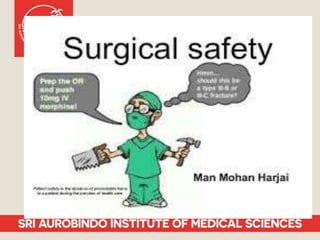
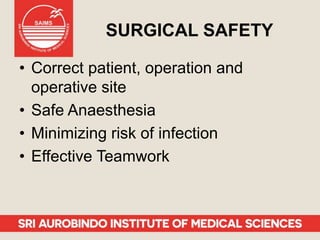
SURGICAL SAFETY
• Correct patient, operation and
operative site
• Safe Anaesthesia
• Minimizing risk of infection
• Effective Teamwork
WHO SURGICAL SAFETY CHECKLIST
ENVIRONMENTAL SAFETY
 Adequate light
 Adequate ventilation, exhaust fan
 Stairs with hand rails
 Window-door-closer
 Slip preventing floors
 Fire extinguishers and fire alarms
 Prevent noise pollution
 Safe wheel chairs and trolleys
 No water logging in bathrooms
FIRE SAFETY
 Use Fire proof material for construction.
 Have Fire Exit in all Buildings.
 Smoke detectors and water sprinklers on the roof of all
Floors.
 Fire Extinguishers in all areas.
 Fire Hydrants in all buildings.
 Training in Fire management
TIPS FOR IMPROVING
PATIENT SAFETY
 Constitution of Patient Safety Committee.
 Develop clear policies and protocols for patient safety.
 Discuss regularly patient safety initiative within hospital
staff.
 Orientation, Re-orientation hospital staff on patient safety
 Each department to devise their own patient safety
protocols.
 Investigate each accident/ incident reported and take
remedial measures.
 Review, monitor & evaluate. safety procedures regularly.
PATIENT SAFETY CULTURE
• Understanding our current situation
• Recall and analyze adverse events encountered
• Check correctness of 20 medical records chosen at random
• Review our protocols for cleaning and sterilizing non-disposable
instruments
• Review our protocols for action in a life-threatening emergency.
• Establishing “Safety Instructions” (red lines)
• Never re-use containers designed for single-use only
• Do not perform Root Canal Treatment (RCT) without rubber dam
• Never prescribe any drug without consulting patient clinical record
and without directly asking the patient about allergies or other
health problems
Patient safety
Patient safety
Patient safety
Patient safety
Patient safety

Patient safety

  • 1.
    PATIENT SAFETY Dr. Rashmikulkarni QUALITY MANAGER INTERNAL AUDITOR FOR NABH & NABL SRI AUROBINDO MEDICAL COLLEGE& PG INSTITUTE INDORE
  • 2.
    ORIGIN OF PATIENTSAFETY CONCEPT  PART OF HIPPOCRATIC OATH  I will prescribe regimens for the good of my patients according to my ability and my judgment and ”never do harm” to anyone.
  • 3.
    WHAT IS PATIENTSAFETY?  Patient safety is the absence of preventable harm to a patient during the process of healthcare.  The meaning of patient safety is…“Please do no harm” • Eliminating preventable medical mistakes by care givers Guarding against the impact of human error • Establishing systems to safeguard patients' health and well-being  ACCIDENTS ,ERROR & COMPLICATIONS
  • 4.
    ORGANIZATIONS FOR PATIENT SAFETYIN DENTAL • World Dental Federation • Dental Patient Safety Foundation • INDIAN DENTAL COUNCIL • The Council Of European Dentist • Organization For Safety, Asepsis And Prevention • In Spain, Spanish Observatory For Dental Patient Safety (OESPO) • Etc
  • 6.
    Type of HarmExample of Patient Harm Delayed appropriate treatment/ disease progression and/ or unnecessary treatment associated with misdiagnosis Melkersson-Rosenthal syndrome misdiagnosed as angioedema and dental abscess resulting in multiple tooth extractions Other systemic complications including adverse reactions to dental device/material/procedure Intracerebral hematoma after tooth extraction Allergy/ Hypersensitivity reactions Latex allergy (bitewing radiograph pack, rubber dam, prophylaxis cup) Systemic infection Cerebral abscess after dental procedure Soft tissue injury/ inflammation Accidental injection of formalin into soft tissues instead of local anesthetic Aspiration of foreign body Aspiration of rubber mouth prop Nerve damage or injury Paresthesia of infraorbital region Retention of foreign object(s) with sequela(e) Breakage of surgical bur and retention within bone
  • 7.
    Type of HarmExample of Patient Harm Hard-tissue damage Root perforation during endodontic treatment Psychological distress/ disorder Anorexia nervosa induced by painful orthodontic treatment Toxicity/ drug overdose Injection of 1:1000 adrenaline versus 1:100,000 Orofacial infection Necrotizing fasciitis of infraorbital region Poor hemostasis/ prolonged bleeding After traumatic tooth extraction in hemophiliac patient Ingestion of foreign body Ingestion of endodontic file Other orofacial complications Tear of suspensory ligaments in temporomandibular after excessive
  • 8.
    MAGNITUDE OF PROBLEM: •Lack of Awareness – Patient Safety Not Priority • Lack of Baseline Data • Lack of Availability of A System For Patient Safety  Senior leadership  cover up policy  Inadequate & Overloaded Staff • Lack of Dedicated Financing • Resistance To Change • Culture of Blame
  • 9.
    AIMS OF THISINITIATIVE • A successful, healthy outcome of patient care • Safe, error-free care • The most expert and advanced Dental care available for patients • Comfort and peace of mind for patients and providers
  • 10.
    PERFORMA'S • Check listfor safety of surgical patients • Patient safety evaluation • Adverse Event Reporting Performa • Incidence form
  • 11.
    KEY POINTS • Developa culture of safety and a health care system focused on prioritizing patient safety. • Look after the quality of clinical records. • Check the procedures for cleaning, disinfection, sterilization, and preservation of clinical instruments. • Exercise extreme caution when prescribing medications. • Limit the exposure of patients to ionizing radiation only to what is strictly necessary.
  • 12.
    KEY POINTS • Neverreuse packaging materials or substances intended for one clinical use only. • Protect the patient's eyes during dental procedures. • Establish barriers to prevent ingestion or inhalation of materials or small instruments. • Use a checklist in all oral surgical procedures. • Monitor the onset and progression of infection in the oral cavity. • Have an action protocol for life-threatening emergencies in the dental clinic.
  • 13.
    SAFETY COMMITTEE Sr. No.Designation Designation in Committee 1. DEAN Chairperson 2. Safety Officer (CLINICAL & FACILLITY ) Convener 3. Quality manager Member 4. Radiation safety officer Member 5. Laboratory safety officer Member 7. Fire safety officer Member 6. Infection control nurse Member 7. Administrative officer Member 8. Maintenance In- charge Invitee Member 9. Bio - Medical Engineer Invitee Member 10 Security Head Invitee Member
  • 16.
    Accurate Patient identification. Toensure the correct identity of the patient at all times and before undergoing procedures  to provide accurate identification of patients there by minimizing s related clinical error and patient harm.  Medication Error  DENTURE MAKING  Testing Error  Wrong Person Procedure
  • 18.
  • 20.
    KEY POINTS • MedicalHistory • Correspondence From Other Healthcare Professionals • Examination And Test Results • Radiographs • Photographs • Treatment Options • Treatment Plan • The Informed Consent Process.
  • 22.
  • 23.
    PHARMACOVIGILANCE SAFE DRUG PRESCRIPTION ANADVERSE EVENT REPORTING CELL
  • 24.
    MEDICATION SAFETY  IllegibleWriting prescription by doctors.  Wrong medicines or wrong does or wrong patient.  Wrong injection and wrong route of administration.  Clear & legible written medication guidelines.  Identification of each patient with Similar patient names  High risk drugs  Look alike and Sound Alike “LASA”  Food drug interaction  Drug –drug interaction
  • 25.
    MEDICATION SAFETY • Errorsin the indication for the drug (in relation to the type of drug, dose or duration of treatment) • Allergic reactions that occur because of a lack of adequate medical records • Drug interactions that occurs because the prescribing practitioner lacks the relevant pharmacological knowledge or fails to update the list of drugs taken by the patient • Wrong dose of the drug (especially common in children and in patients with alterations in the metabolism or elimination of drugs) • Duplication of drugs (especially common with anti- inflammatories) because of a lack of coordination among the various professional prescribing for the same patient.
  • 27.
    Reduce the riskof Hospital associated infections.
  • 28.
    HIC • HOSPITAL ASSOCIATEDINFECTION Surgical site infection rate • POST EXPOSURE PROPHYLAXIS • Needle stick injury • Blood & body fluid exposure
  • 29.
    SANITATION- INFECTION CONTROL- BMWDISPOSAL  Sanitation BMW HAI Disposal  Proper segregation & transportation of biomedical wastes  Sanitation & hygiene of different parts of hospital to avoid infection  Use of sterile procedures  Safety in use of incinerator, autoclave, shredder, needle destroyers and proper disposal of biomedical waste.  Formation of hospital infection control committee  Investigation of all hospital infections  Use of proper antibiotics in right doses in right time  Reorientation of Resident doctors & Nursing staff
  • 34.
  • 35.
    Risk assessment • WithPoorly Controlled Diabetes • With A Cognitive Impairment Such As Dementia • Who Are Immune-suppressed Or Compromised • Who Are Taking Anticoagulants Or Bisphosphonates. • Vulnerable Patients
  • 36.
    Risk assessment • Failureto check PMH • Inhaling or swallowing crown or instrument • Restoring the wrong tooth • Extracting the wrong tooth • Iatrogenic damage to adjacent tooth • Allergic reaction due to not checking PMH • Using dirty instruments • Delay in sending urgent referral • Delay in sending routine referrals • Treating the wrong patient • Oxygen and emergency drugs not available
  • 37.
    Failure to checkPMH Extreme risk Inhaling or swallowing crown or instrument High risk Restoring the wrong tooth High risk Oxygen and emergency drugs not available High risk Extracting the wrong tooth High risk Allergic reaction due to not checking PMH High risk Iatrogenic damage to adjacent tooth Moderate risk Using dirty instruments Moderate risk Delay in sending urgent referral Moderate risk Delay in sending routine referrals Moderate risk Treating the wrong patient Moderate risk
  • 38.
  • 39.
    Accidents 1. The patientfalls (due to poorly organized furniture, architectural barriers, slippery floors, etc.) 2. Heavy or sharp instruments or apparatus fall on the patient 3. The patient suffers accidental cuts and burns 4. The patient ingests/inhales small dental material 5. The patient suffers eye damage.
  • 40.
  • 41.
    • All exposuresshould be kept As Low As is Reasonably Achievable, (ALARA) economic and social factors being taken into account. (Optimization) • The dose equivalent to individuals shall not exceed the limits recommended for the appropriate circumstances. (Limitation) • Time of exposure, Distance of exposure and Shielding to be appropriately defined Basic Principles of Radiation Protection
  • 43.
    Surgical Errors • Errorsin treatment planning (sometimes associated with lack of adequate clinical records previous to treatment) • Errors in the type of procedure performed (motivated by incorrect patient identification or inadequate clinical history) • Errors in the area of intervention (Wrong-site surgery) that occur as a result of forgetfulness or the inappropriate interpretation of records by the professional • Errors in pre-operative prophylaxis in medically compromised patients • Errors in the monitoring and control of operated patients (no post- operative instruction sheet or lack of post-surgical control) • Post-surgical infections (detected late or inadequately treated).
  • 44.
    Surveillance of surgical siteinfections • Risk factors • Hand washing • Presurgical skin disinfection • Special cases for decontamination • Antibiotic prophylaxis • Minimizing contamination in the operating room • Guaranteeing the sterility of surgical instruments: sterility indicators
  • 45.
    SURGICAL SAFETY • Correctpatient, operation and operative site • Safe Anaesthesia • Minimizing risk of infection • Effective Teamwork
  • 46.
  • 47.
    ENVIRONMENTAL SAFETY  Adequatelight  Adequate ventilation, exhaust fan  Stairs with hand rails  Window-door-closer  Slip preventing floors  Fire extinguishers and fire alarms  Prevent noise pollution  Safe wheel chairs and trolleys  No water logging in bathrooms
  • 48.
    FIRE SAFETY  UseFire proof material for construction.  Have Fire Exit in all Buildings.  Smoke detectors and water sprinklers on the roof of all Floors.  Fire Extinguishers in all areas.  Fire Hydrants in all buildings.  Training in Fire management
  • 49.
    TIPS FOR IMPROVING PATIENTSAFETY  Constitution of Patient Safety Committee.  Develop clear policies and protocols for patient safety.  Discuss regularly patient safety initiative within hospital staff.  Orientation, Re-orientation hospital staff on patient safety  Each department to devise their own patient safety protocols.  Investigate each accident/ incident reported and take remedial measures.  Review, monitor & evaluate. safety procedures regularly.
  • 50.
    PATIENT SAFETY CULTURE •Understanding our current situation • Recall and analyze adverse events encountered • Check correctness of 20 medical records chosen at random • Review our protocols for cleaning and sterilizing non-disposable instruments • Review our protocols for action in a life-threatening emergency. • Establishing “Safety Instructions” (red lines) • Never re-use containers designed for single-use only • Do not perform Root Canal Treatment (RCT) without rubber dam • Never prescribe any drug without consulting patient clinical record and without directly asking the patient about allergies or other health problems

Editor's Notes

  • #7  Lessons learnt from Dental Patient Safety Case Reports,2015,PUBMED, J Am Dent Assoc