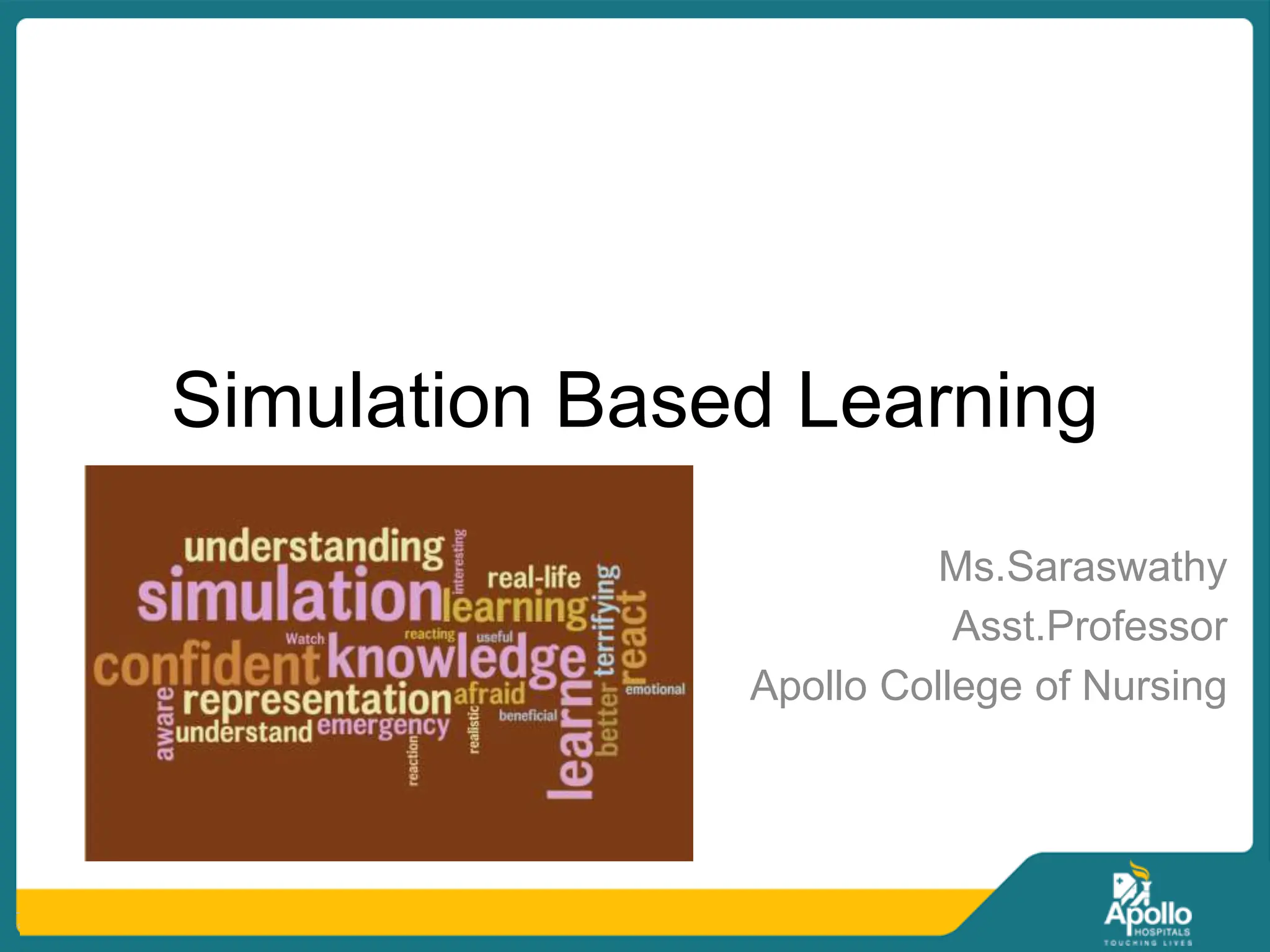
Simulation Based Learning
Ms.Saraswathy
Asst.Professor
Apollo College of Nursing
See One, Do One,
Teach One
See One, Practice
Many, Do One
Teaching methodologies
What is simulation?
 Simulation is defined as a:
“real world event that that represents a referent which
then draws its essential meaning from that referent”
 Unlike a simulator:
“a simulator is comparable to a genetic code,
and a simulation to the realization of that code
into the living organism”
Crookhall, Oxford and Saunders (1987)
Values
Psychological safety
Controlled environment
Repetitive practice, proficiency
Enhanced teamwork and collaboration
Cognitive, practical understanding
Values
- * Communication *
Improve
Critical
Thinking
Judgment
Organizational
culture
Prioritization
.
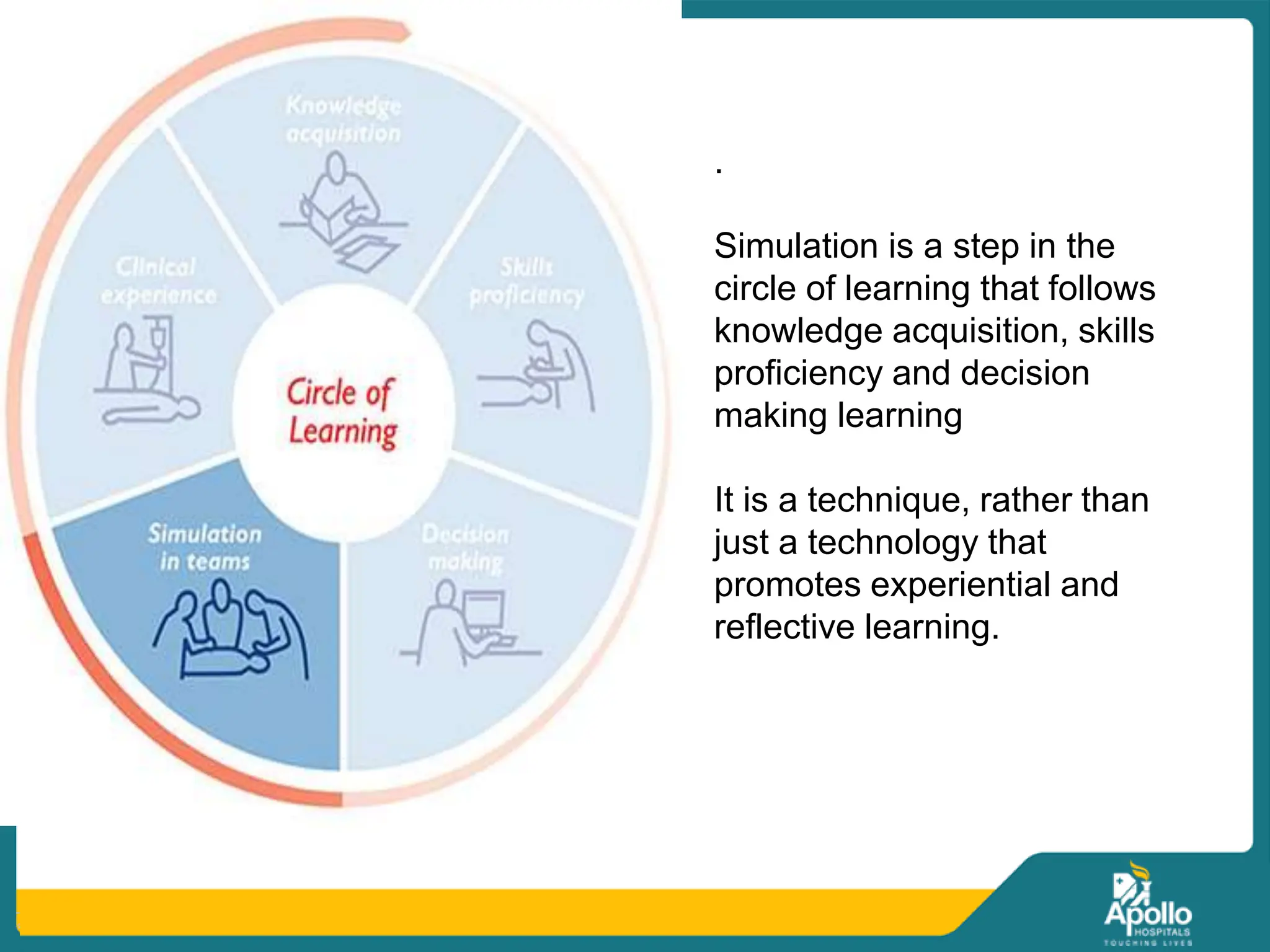
Simulation is a step in the
circle of learning that follows
knowledge acquisition, skills
proficiency and decision
making learning
It is a technique, rather than
just a technology that
promotes experiential and
reflective learning.
History of simulation
 Jousting, chess, war-gaming, military
exercise, Aviation
 1832 – Anatomy Act
 1960’s – SimONE
 1980’s –GAS
 1990’s – Surgical haptic simulators
 2000’s – HPS/ECS
 2010 – 3G/iStan
Defining simulation types
 Wargaming
 Aviation
 Nuclear industry
 Space programme
 Tribal dancing
 Military training
 Jousting
 Chess
 Emergency services
 Forensics
Theory – practice dichotomy
 If used correctly simulation will facilitate
classical conditioning (2nd nature)
 Objective outcome measurement (Anne vs
iStan)
 Development of communication and
psychomotor domains
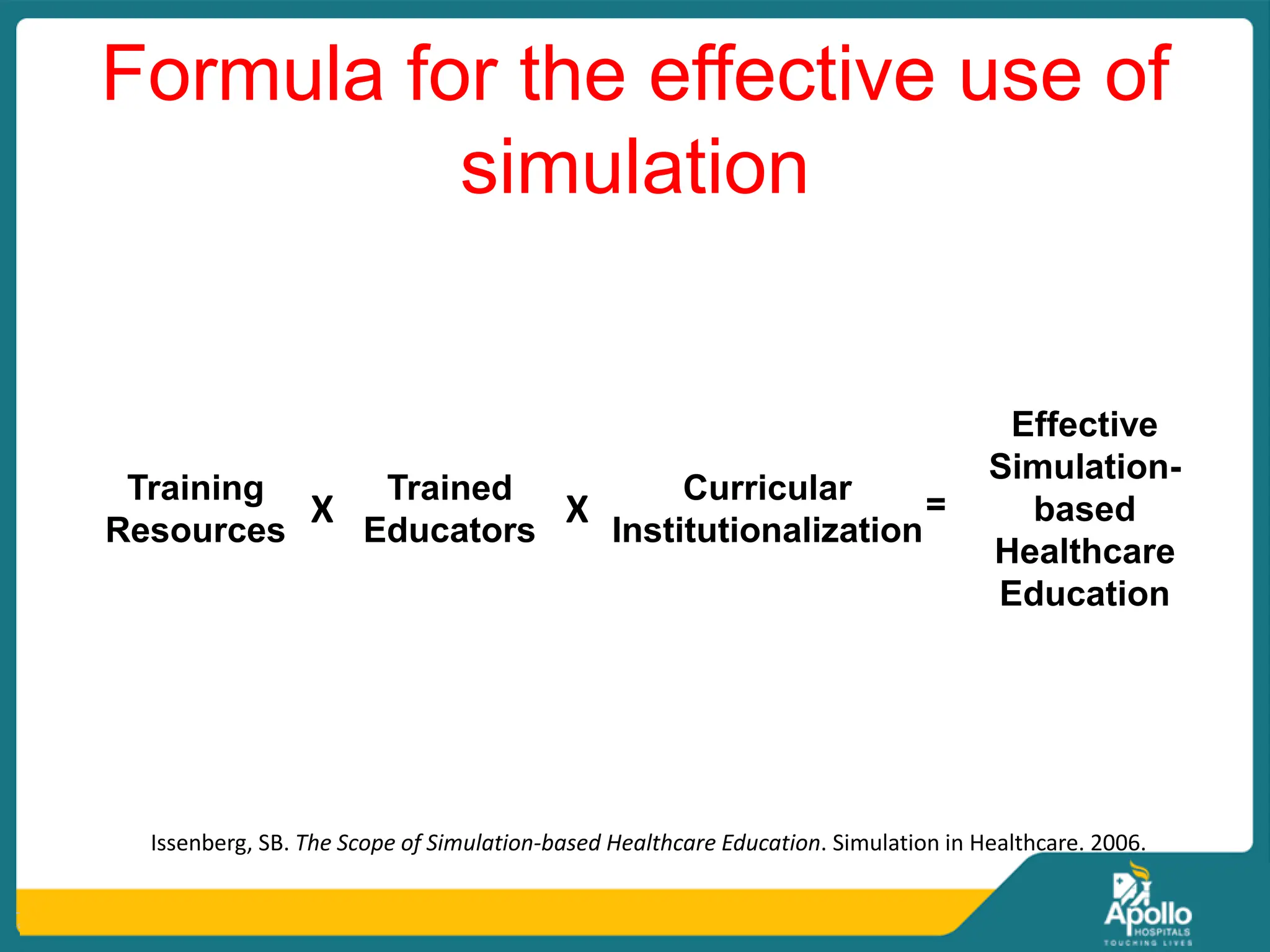
Formula for the effective use of
simulation
Training
Resources
Trained
Educators
Curricular
Institutionalization
X X =
Effective
Simulation-
based
Healthcare
Education
Issenberg, SB. The Scope of Simulation-based Healthcare Education. Simulation in Healthcare. 2006.
Options for running simulations
 Free-form
 Easy but poor learning
 ‘On the fly’
 Scripted but intensive for the ‘controller’ and
some variables may appear discontinuous
 Programmed trends
 More sophisticated simulations possible
 Trends and event handlers
 Facilitates high-fidelity simulation with most
realistic response to interventions
Resources needed
 Equipment:
 Simulators, monitors, defibrillator, trolleys, etc
 Disposables:
 Appropriate for scenario, setting and
participants, re-use w/o compromising fidelity
 Faculty:
 Trained, available, practised
 Support staff:
 Technician/bio-medical engineer essential!
Before and after simulations...
 Set-up scenario
 eg. make blood, set up area, X-rays, notes, etc
 Load simulation program
 Check everything works
 Cameras, VCR, communicators
Afterwards...
 Check simulator (replace or repair parts)
 Clean everything used and put away
 Replace/reorder all used items
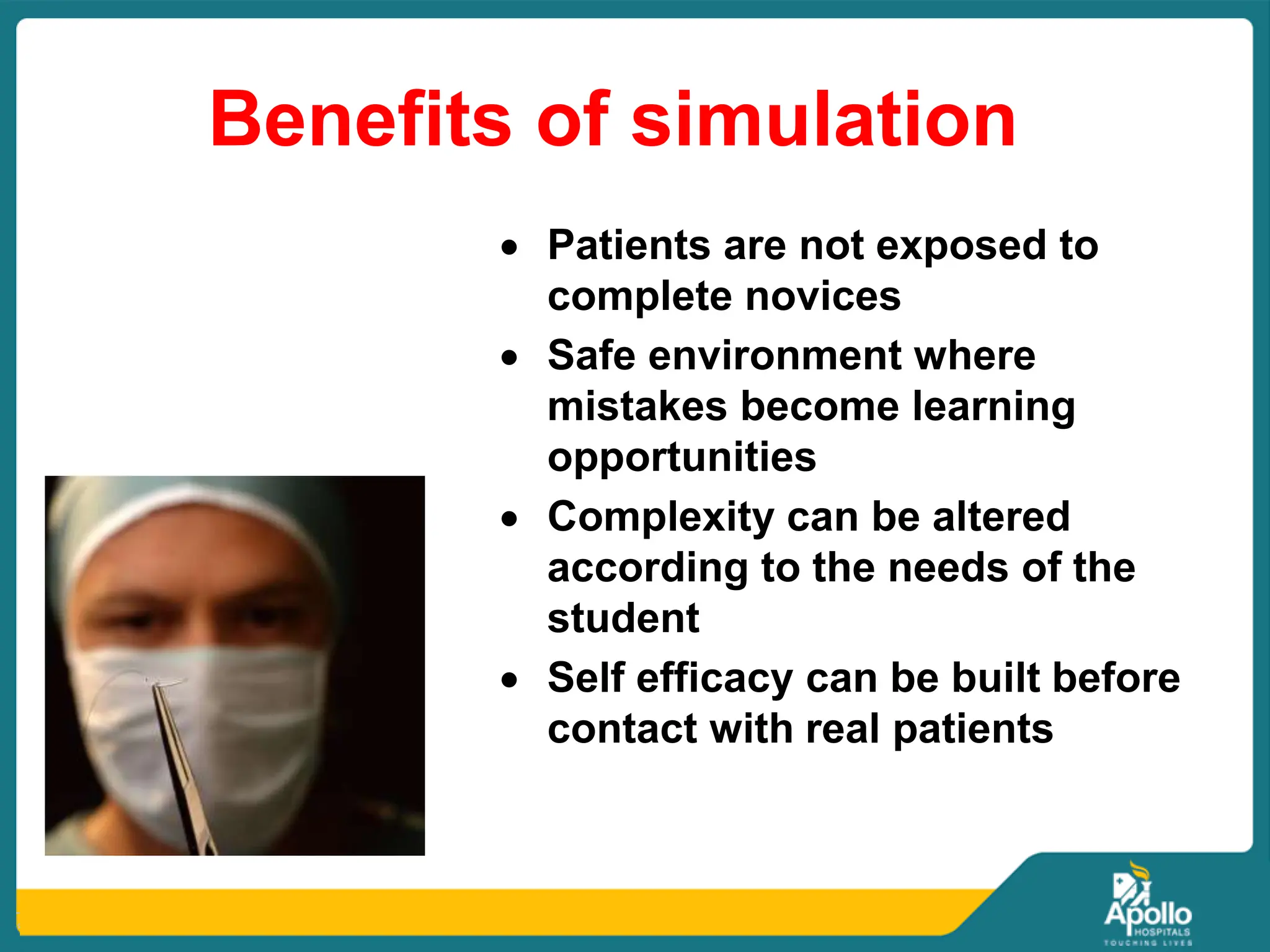
Benefits of simulation
 Patients are not exposed to
complete novices
 Safe environment where
mistakes become learning
opportunities
 Complexity can be altered
according to the needs of the
student
 Self efficacy can be built before
contact with real patients
Benefits of simulation
Students can:
 repeat the skill as often as
necessary to develop confidence
 learn at their own pace
 experience being ‘on the receiving
end’
 express their fears and ask ‘difficult’
questions
 make mistakes and appreciate the
consequences without harm to the
patient
Hi fidelity simulation
disadvantages
 Adrenaline gap
 Uncanny valley
 Fear / upset
 Manpower hours
Simulation as a concept
 Low fidelity manikin
 Hi Fidelity manikin
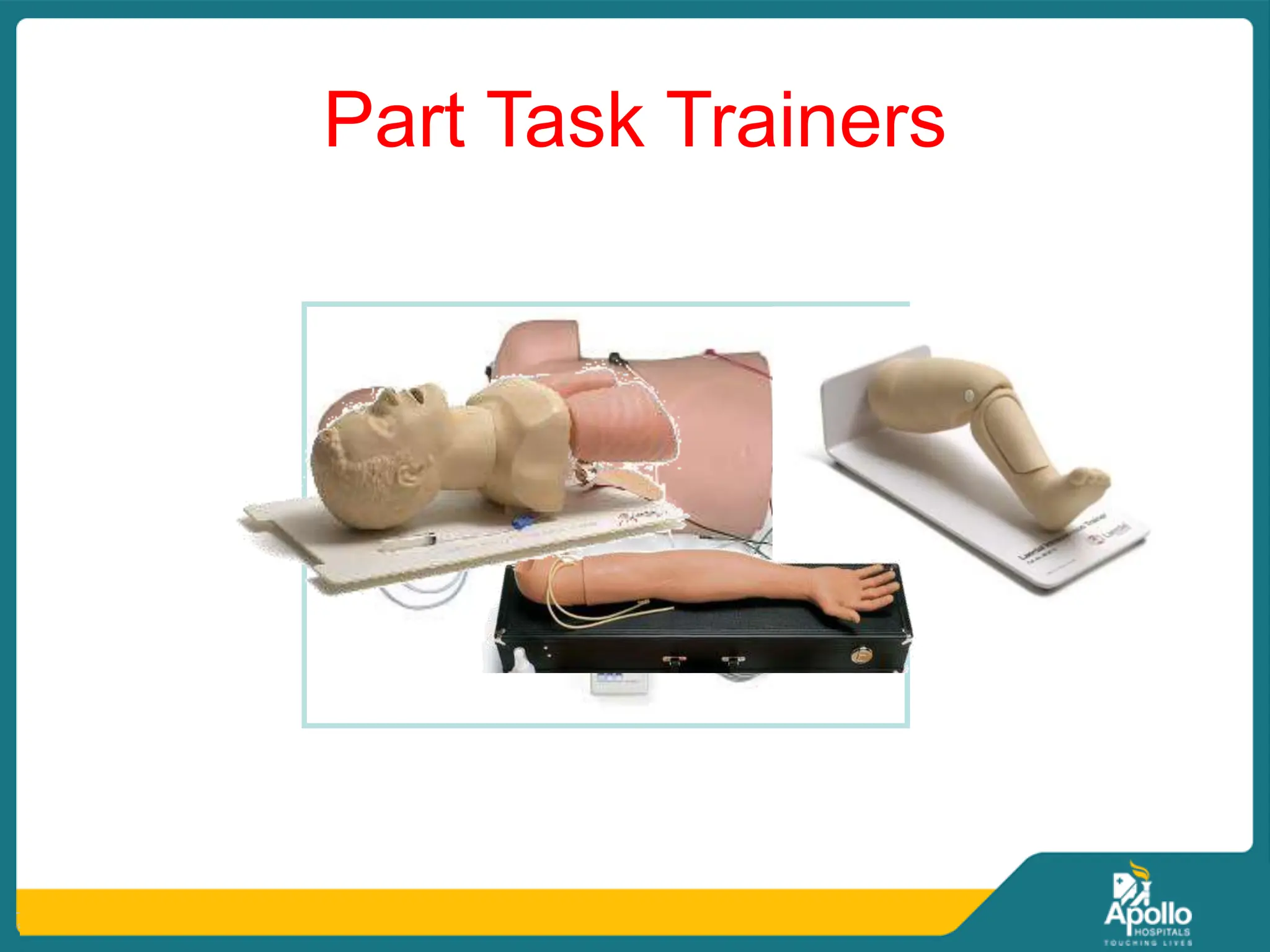
 Part task trainers
 Games (driving
rehearsal)
 Haptic systems
 VR
 Simulated patients
 Multimedia
There are many terms that are afforded the term simulation,
including:
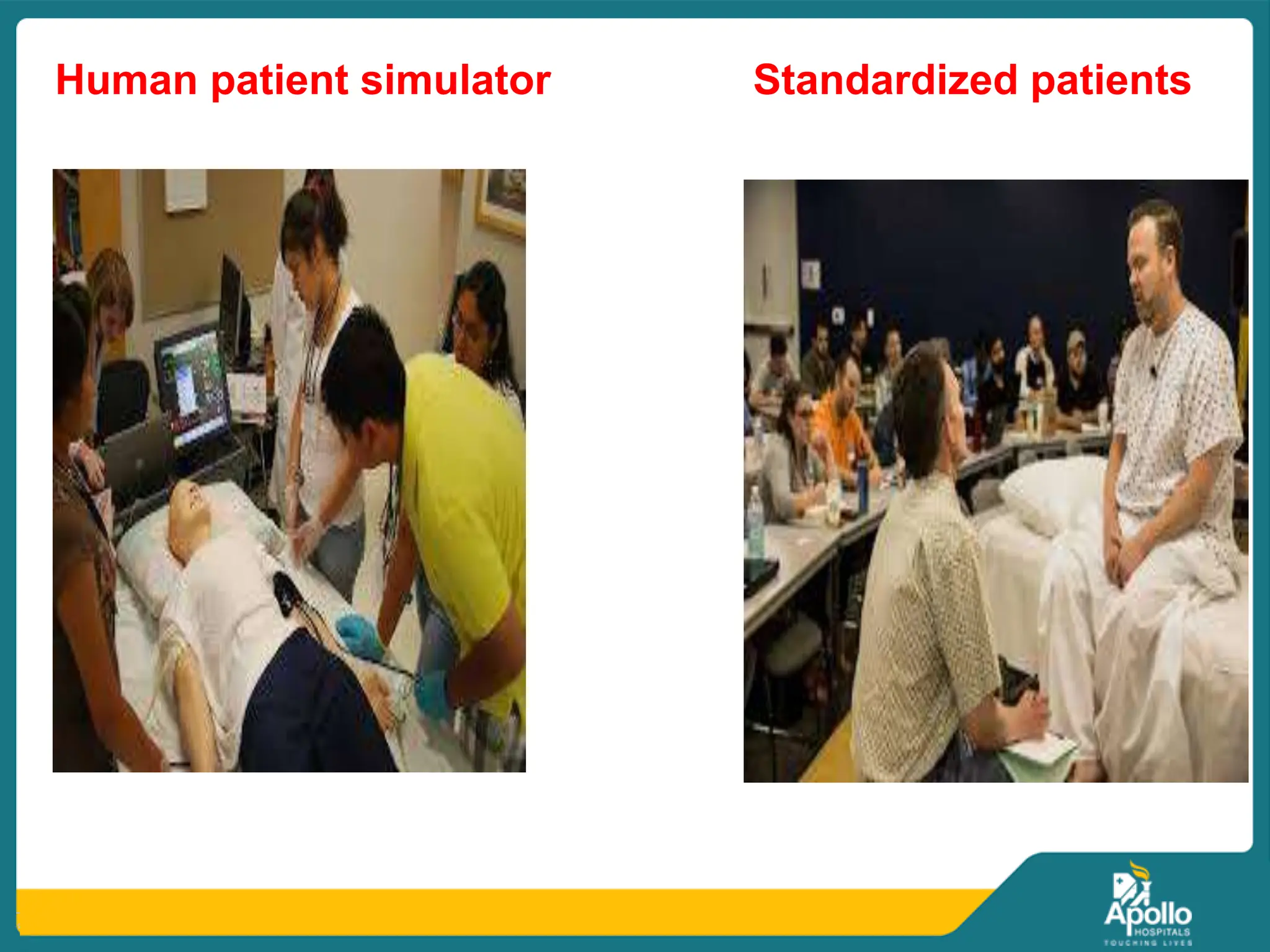
Human patient simulator Standardized patients
Part Task Trainers
Virtual Reality
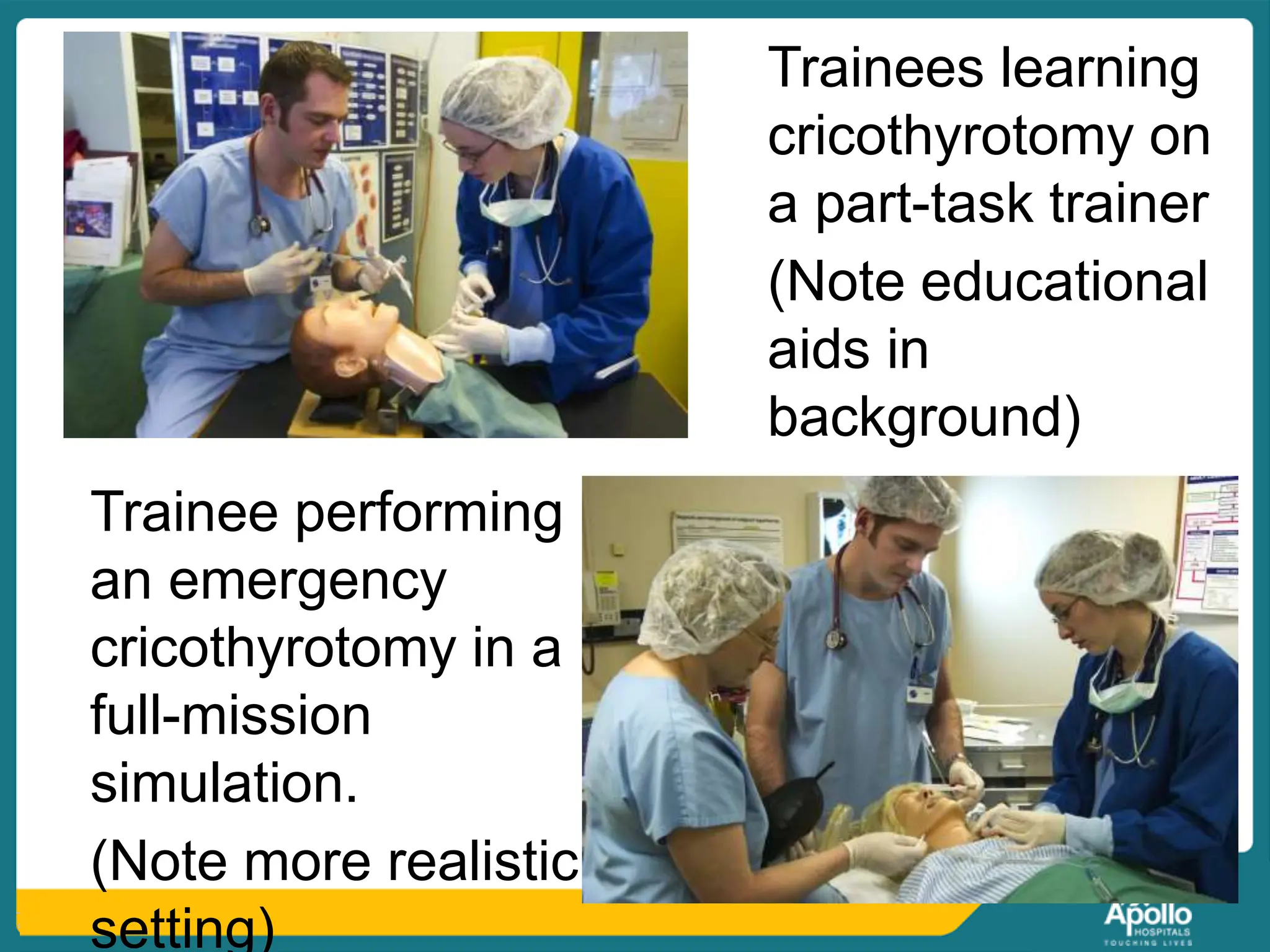
Trainees learning
cricothyrotomy on
a part-task trainer
(Note educational
aids in
background)
Trainee performing
an emergency
cricothyrotomy in a
full-mission
simulation.
(Note more realistic
setting)
Anaphylaxis simulation
Hi fidelity simulation advantages
 Draws referent from clinical practice
(context)
 Aims to facilitate suspension of disbelief
 Allows for 4D teaching (time)
 Allows for repetition and rehearsal
 Stress innoculation (covert sensitisation)
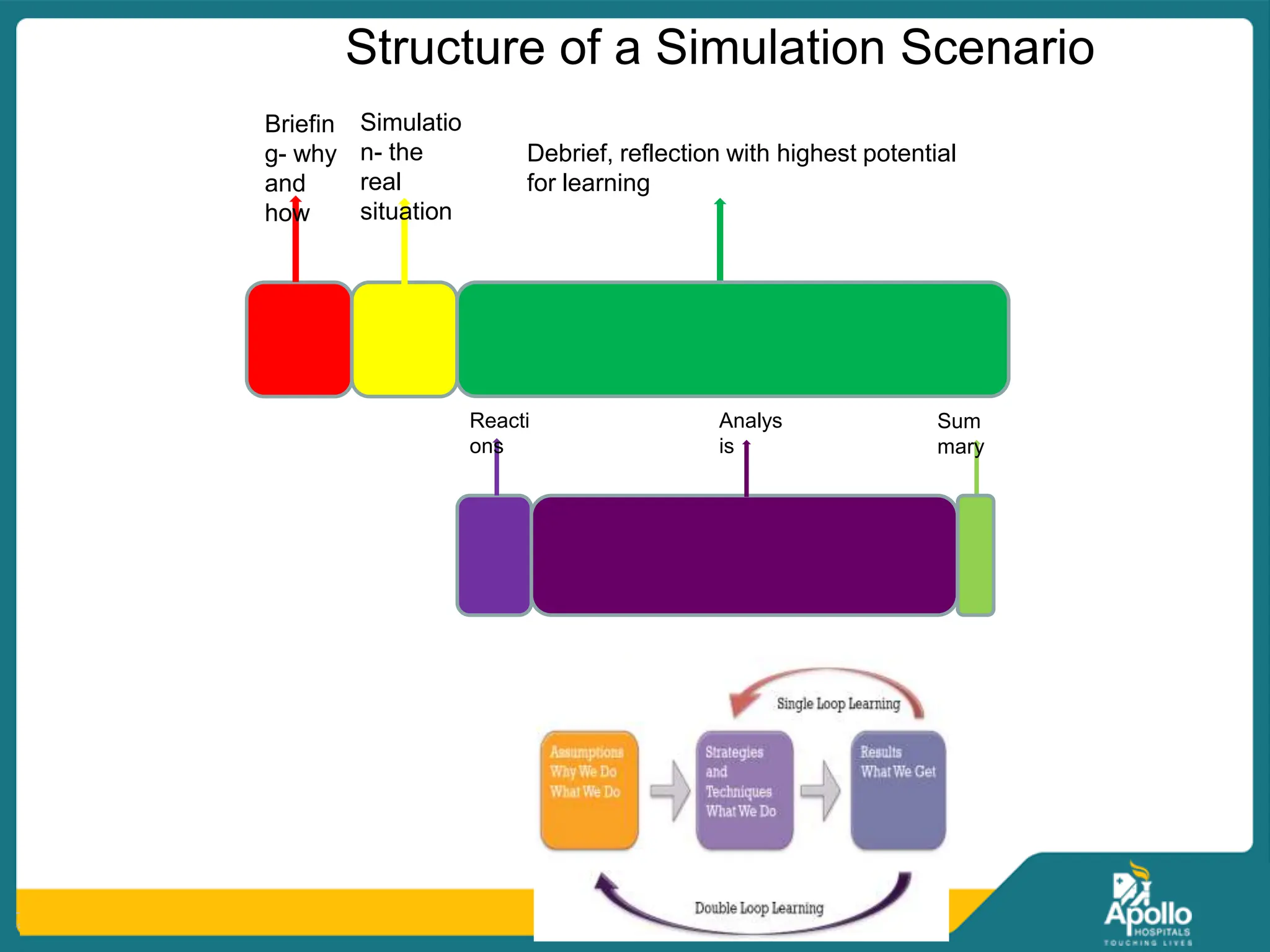
Briefin
g- why
and
how
Simulatio
n- the
real
situation
Debrief, reflection with highest potential
for learning
Structure of a Simulation Scenario
Reacti
ons
Analys
is
Sum
mary
Successful strategies for crisis
management:
 Use of written checklists to help prevent crises
 Use of established procedures in responding to
crises
 Training in decision making and resource co-
ordination
 Systematic practise in handling crises including
part-task trainers and full-mission realistic
simulation
Steps
Analyse
Design
Development
Implementation
Evaluation
1 - Analysis
 What and why should this be undertaken?
 Determine through:
 Needs assessments
 Quality assurance/quality management data
 Curricular requirements
 Focus groups, evaluations
Defining outcomes
 Learners are more likely to achieve competency and
mastery of skills if the outcomes are well defined
and appropriate for the level of skill training
 Define clear benchmarks for learners to achieve
 Plain goals with tangible, measurable objectives
 Start with the end-goal in mind and the assessment
metrics, then the content will begin to develop itself
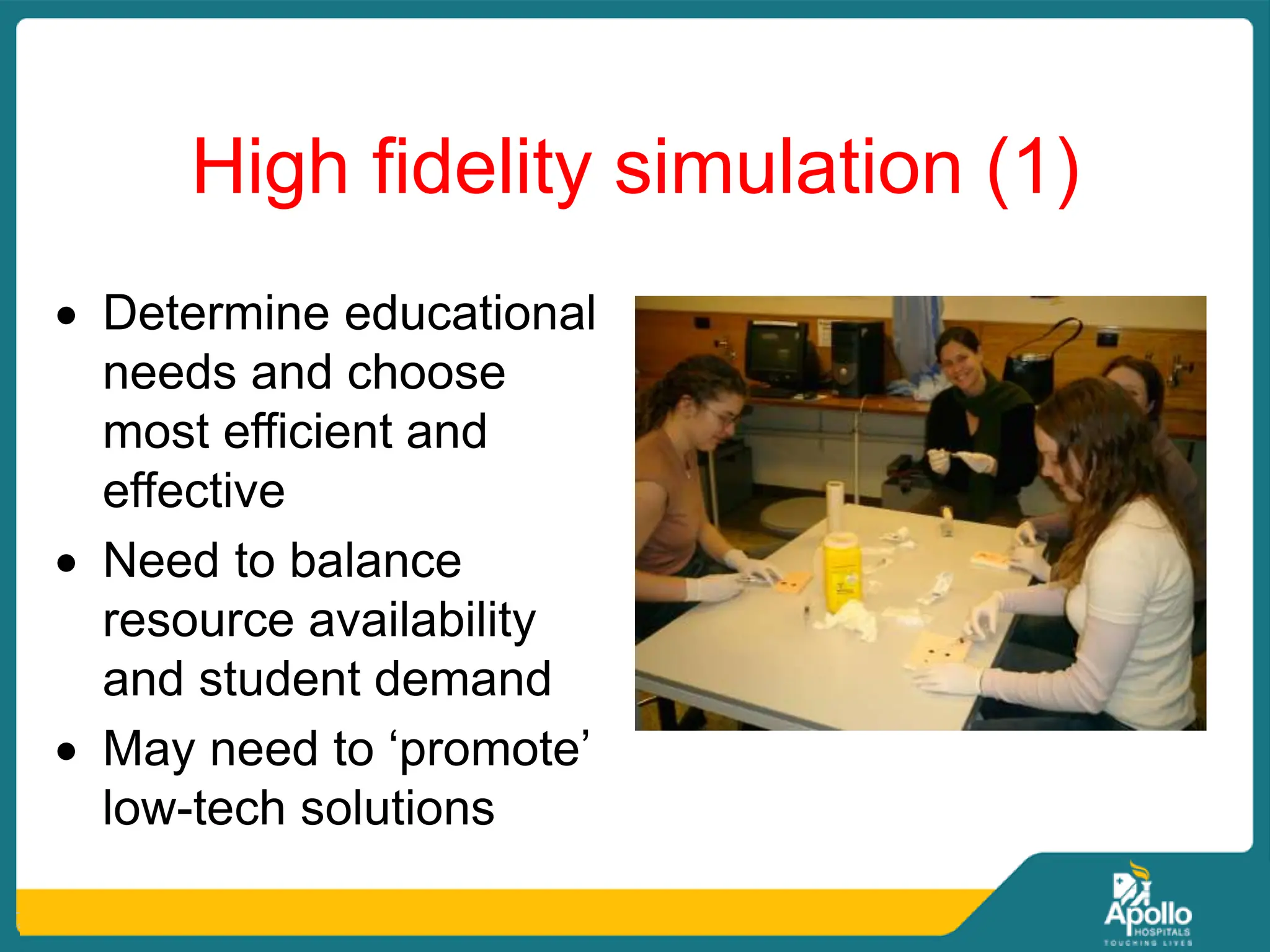
High fidelity simulation (1)
 Determine educational
needs and choose
most efficient and
effective
 Need to balance
resource availability
and student demand
 May need to ‘promote’
low-tech solutions
Possible outcome competencies
 Patient care
 Medical knowledge
 Practice-based
learning and
improvement
 Interpersonal and
communication
skills
 Professionalism
 Systems-Based
Practice
Knowledge
Skills
Attitudes
Miller’s Pyramid of Competence
 Learner:
 “Knows” – learns
information
 “Knows How” - to use
learned information
 “Shows” - how to use the
information
 “Does” – performs in
practice
 Instructor:
 “Knows” – content to be
taught
 “Knows how” – to teach
 “Shows” – teaching is
delivered
 “Does” – teaches effectively
Does
Shows
Knows How
Knows
George E. Miller MD. The Assessment of Clinical Skills/Competence/Performance.
Academic Medicine. 1990. Vol. 65 No. 9: S63-67.
2 – Design: “agree on content”
 Choose curriculum content to ensure it
address the learning outcomes.
 This will enable one to describe which core
learning outcomes are addressed by specific
content.
 Redundancies and omissions of content that
address core competencies should be noted
and modified.
2 – Design: “organize the
content”
 Develop the curriculum design to ensure a
vertically integrated curriculum. There should be:
 a repetition of core topics,
 topics should be revisited at numerous levels of
difficulty,
 new learning should be related to previous learning,
and
 the competence of learners should increase with each
exposure to a topic.
 When developing assessment it is important to
ensure that learners are assessed based on the
same schema or organization that is presented
during their learning opportunities.
2 – Design: “decide on the educational
strategy”
 These include:
 student-centered vs. teacher-centered
learning;
 problem-based / task-based learning vs.
information oriented learning;
 integrated/interprofessional vs. subject /
discipline-based;
 community-based vs. hospital-based learning;
 systematic vs. opportunistic
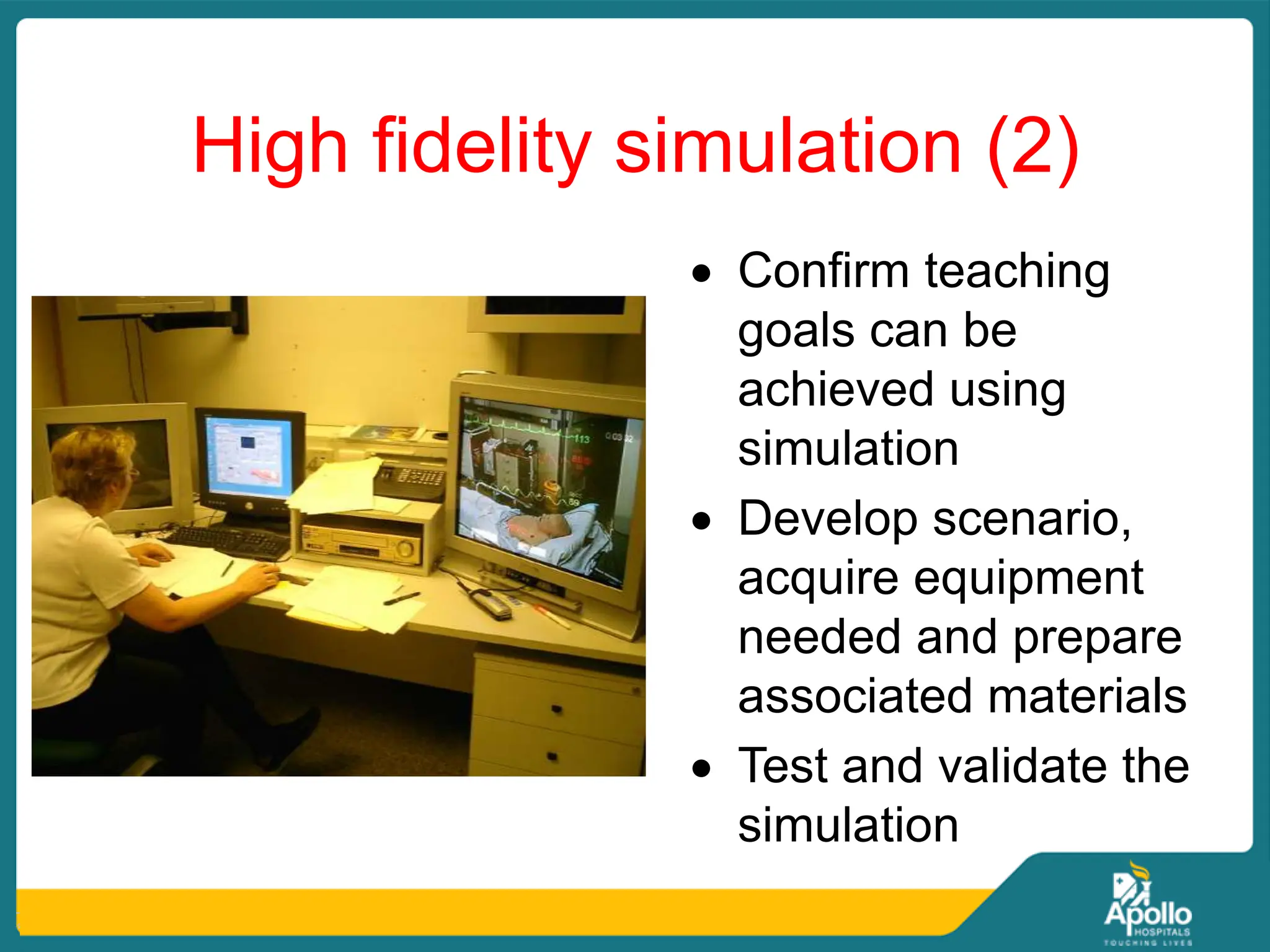
High fidelity simulation (2)
 Confirm teaching
goals can be
achieved using
simulation
 Develop scenario,
acquire equipment
needed and prepare
associated materials
 Test and validate the
simulation
Quiz
Answers
2 – Design: “decide the appropriate teaching
methods”
 An effective curriculum makes effective use
of a range of teaching methods applying each
method for the use to which it is most
appropriate.
 These include:
 lectures;
 small-group sessions;
 independent study;
 clinical skills exercises.
 NOTE: simulations can be integrated into each of
these areas.
Ranges of difficulty
 Learning is enhanced when a wide range of difficulty
levels is employed
 Learners will have different “learning curves”
 Begin at the basic level, allow learner to
demonstrate mastery, then proceed to progressively
higher levels of difficulty
Alessi S. Design of Instructional Simulations. J Computer-based Instruction. 1988. 40-7.
Effect of realism and initial
learning
Tips for improving simulation
validity
 Determine the
appropriate level of
“simulator” technology to
accomplish the desired
outcome
 Develop the appropriate
levels of “simulation”
fidelity around the
simulator
Low fidelity
High
technology
Low fidelity
Low
technology
High fidelity
High
technology
High fidelity
Low
technology
Fidelity
Technology
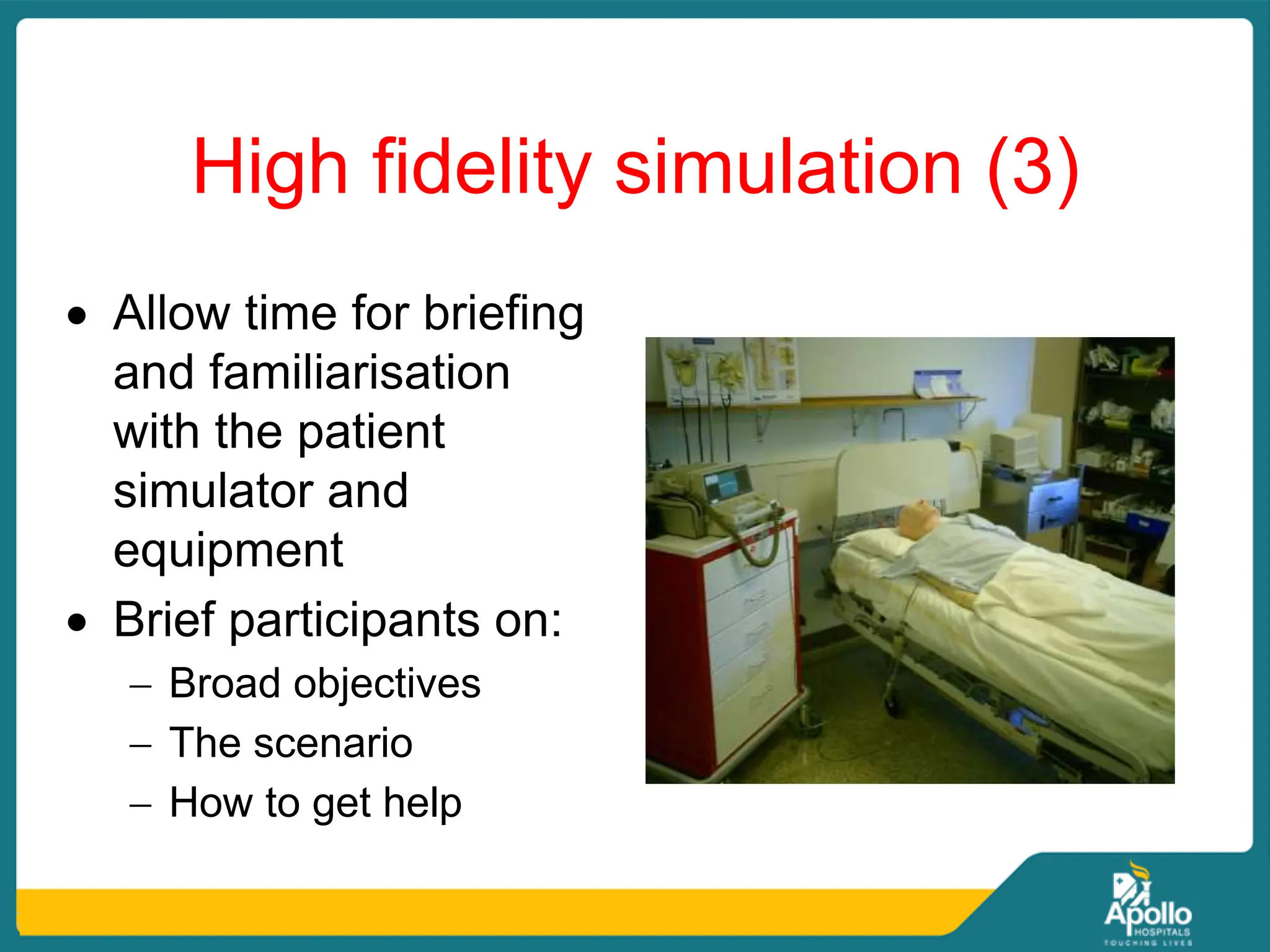
High fidelity simulation (3)
 Allow time for briefing
and familiarisation
with the patient
simulator and
equipment
 Brief participants on:
 Broad objectives
 The scenario
 How to get help
3 – Development: “prepare the assessment”
 What should be assessed?
 Every aspect of the curriculum that is
considered essential and/or has had
significant teaching time designated to it
 Should be consistent with the learning
outcomes that have been established as they
are the competencies students should master
at the end of the course / phase of study
High fidelity simulation (4)
Always follow the
script but...
…have alternative
outcomes planned
and rehearsed
Simulation control room
Assessments
 Should include assessment of:
 Knowledge – not only factual recall, but
comprehension, application, analysis,
synthesis and evaluation of cognitive
knowledge
 Skills – communication, physical exam,
informatics, self-learning, time management,
problem-solving
 Attitudes – behavior, teamwork – key
personal qualities thought necessary of a
professional
Assessing team performance
Team
Structure
Leadership
• Assemble team
• Establish leader
• Identifies team
goals and vision
• Assigns roles
and
responsibilities
• Hold team
accountable
• Actively shares
information
• Utilizes
resources to
maximize
performance
• Balances
workload within
the team
• Delegates tasks
or assignments,
as appropriate
• Conducts briefs,
huddles and
debriefs
• Empowers team
to speak freely
and ask
questions
Situation
Monitoring
Mutual
Support
• Includes
patient/family in
communication
• Cross monitors
team members
• Applies the
STEP process
• Fosters
communication
to ensure a
shared mental
model
• Provides task-
related support
• Provides timely
and constructive
feedback
• Effectively
advocates for
the patient
• Uses the “two-
challenge” rule,
CUS, DESCscript
to resolve
conflict
• Collaborates
with team
Communication
• Coaching
feedback
routinely
provided to
team members
when
appropriate
• Provides brief,
clear, specific,
and timely
information
• Seeks
information
from all
available sources
• Verifies
information that
is communicated
• Uses SBAR, call-
outs, check-
backs, and
handoff
Assessments
 Choose the appropriate assessment
method:
 Formative
 Summative
 Self
 Peer
4 – Implementation: “provide communication
about the curriculum”
 Teachers have the responsibility to ensure that
students have a clear understanding of:
 What they should be learning – the learning
outcomes;
 The range of learning experiences and opportunities
available;
 How and when they can access these most efficiently
and effectively;
 How they can match the available learning
experiences to their own needs;
 Whether they have mastered the topic or not, and if
not, what further studies and experience are required.
4 – Implementation: “define the teaching
team”
Learning
activity
Technicians
Confederates
Instructors
Assessors
Actors/SPs
Facilitators
Course
Directors,
SMEs,
Authors
NOTE: Multidisciplinary learner groups = multidisciplinary instructor groups
4 – Implementation: “promote appropriate
educational environment”
 The educational environment or ‘climate’ is
a key aspect of the curriculum
 Although it is less tangible than the content
studied, or the teaching methods used or the
examinations, it is just as important
 For example:
 there is little point in developing a curriculum
whose aim is to orient a student to prehospital
disaster preparedness, if the students perceive
that what is valued by the faculty is routine
prehospital healthcare rather than disaster
preparedness.
4 – Implementation: “provide effective
curriculum management”
 This will ensure proper communication at
multiple levels regarding different aspects of the
curriculum
 Communication should occur between:
 faculty and the learners, so they are apprised of their
performance in the course or assessment,
 between faculty members to evaluate the
effectiveness of the learning opportunities or
assessments
High fidelity simulation (5)
Using simulation
situations can be re-run
to explore outcome with
different treatments
Mission critical tasks can
be performed by
learners without putting
patients at risk
5. Evaluation: “measure
effectiveness”
 Evaluate
 Course
 Learners
 Instructors
 Effect on practice
High fidelity simulation (6)
Facilitated debriefing with an expert
practitioner. Participants reflect on their own
performance and discuss this with the group
Three Phases of Debriefing
 Reactions - Clear the air and set the stage for discussion
- Feelings
- Facts
 Understanding
- Exploring - explore participant perspectives on scenario
events
- Discussion and teaching
 Summary - distill lessons learned for future use
- What worked well
- What should be changed next time
- Major take always
Quiz
Answers
Benefits of Debriefing
Few Procedures in OBG
Amniocentesis
Vaginal breech delivery
Cesarean
section
Cordocentesis
Eclampsia
Maternal
cardiac
arrest
Episiotomy repair
The future of simulation...
 Skills training tool for all disciplines
 Acute care
 Try new techniques and/or equipment
 Patient safety initiatives
 Retraining
 Multi-disciplinary training
 inter-professional communication
 team performance
 Training in decision-making/resource co-
ordination
Simulation technologies used in
medical education
 Computer-based simulations (micro-
worlds, micro-simulation)
 Virtual environments +/- haptics
 Part-task trainers
 Low-fidelity simulators/manikins
 Simulated or standardised patients
 Hybrid simulations
 High-fidelity (full mission) simulation
Simulation research must address
healthcare training needs
 Improved outcomes
 Fewer adverse events, fewer preventable
incidents, fewer ‘near miss’ events
 Increased efficiency of training
 Improved outcomes in same or (preferably)
less training time
 Improved use of resources
 Fewer failures, more efficient training,
quicker performance
High Quality Simulation- can substitute upto
50% clinical hours
High quality simulation
experiences could be
substituted for up to 50% of
traditional clinical hours
across the pre-licensure
nursing curriculum
Best practice is
characterized by
Evidence supports best practices for simulation
based education
1. Feedback
2. Repetitive Practice (LDHF)
3. Distributed Practice
4. Curriculum Integration
5. Clinical variation
6. Range of difficulty
7. Individualized learning
8. Multiple learning strategies
9. Defined Outcomes
10. Valid simulator
1. Facilitated Reflective
Debriefing
Debriefing = reflective
discussion
Feedback = provision
of information
Cognitive improvement
0 10 20 30 40 50 60 70 80 90
Posttest
Pretest
54.5%
84.2%
n= 264, p= < 0.0005
Self-assessment
18%
15%
93%
86%
n= 264, p= < 0.0005
Individual and team skills
Results
Future concerns
Practise makes perfect
Practise makes permanent!
Only well supervised practise with
constructive feedback
makes perfect
 https://www.youtube.com/watch?v=SCKh
M7nDrKY

nursing education- Simulation Learning 2.pptx

  • 1.
  • 2.
    See One, DoOne, Teach One See One, Practice Many, Do One Teaching methodologies
  • 3.
    What is simulation? Simulation is defined as a: “real world event that that represents a referent which then draws its essential meaning from that referent”  Unlike a simulator: “a simulator is comparable to a genetic code, and a simulation to the realization of that code into the living organism” Crookhall, Oxford and Saunders (1987)
  • 5.
    Values Psychological safety Controlled environment Repetitivepractice, proficiency Enhanced teamwork and collaboration Cognitive, practical understanding
  • 6.
    Values - * Communication* Improve Critical Thinking Judgment Organizational culture Prioritization
  • 7.
    . Simulation is astep in the circle of learning that follows knowledge acquisition, skills proficiency and decision making learning It is a technique, rather than just a technology that promotes experiential and reflective learning.
  • 8.
    History of simulation Jousting, chess, war-gaming, military exercise, Aviation  1832 – Anatomy Act  1960’s – SimONE  1980’s –GAS  1990’s – Surgical haptic simulators  2000’s – HPS/ECS  2010 – 3G/iStan
  • 9.
    Defining simulation types Wargaming  Aviation  Nuclear industry  Space programme  Tribal dancing  Military training  Jousting  Chess  Emergency services  Forensics
  • 10.
    Theory – practicedichotomy  If used correctly simulation will facilitate classical conditioning (2nd nature)  Objective outcome measurement (Anne vs iStan)  Development of communication and psychomotor domains
  • 11.
    Formula for theeffective use of simulation Training Resources Trained Educators Curricular Institutionalization X X = Effective Simulation- based Healthcare Education Issenberg, SB. The Scope of Simulation-based Healthcare Education. Simulation in Healthcare. 2006.
  • 12.
    Options for runningsimulations  Free-form  Easy but poor learning  ‘On the fly’  Scripted but intensive for the ‘controller’ and some variables may appear discontinuous  Programmed trends  More sophisticated simulations possible  Trends and event handlers  Facilitates high-fidelity simulation with most realistic response to interventions
  • 13.
    Resources needed  Equipment: Simulators, monitors, defibrillator, trolleys, etc  Disposables:  Appropriate for scenario, setting and participants, re-use w/o compromising fidelity  Faculty:  Trained, available, practised  Support staff:  Technician/bio-medical engineer essential!
  • 14.
    Before and aftersimulations...  Set-up scenario  eg. make blood, set up area, X-rays, notes, etc  Load simulation program  Check everything works  Cameras, VCR, communicators Afterwards...  Check simulator (replace or repair parts)  Clean everything used and put away  Replace/reorder all used items
  • 15.
    Benefits of simulation Patients are not exposed to complete novices  Safe environment where mistakes become learning opportunities  Complexity can be altered according to the needs of the student  Self efficacy can be built before contact with real patients
  • 16.
    Benefits of simulation Studentscan:  repeat the skill as often as necessary to develop confidence  learn at their own pace  experience being ‘on the receiving end’  express their fears and ask ‘difficult’ questions  make mistakes and appreciate the consequences without harm to the patient
  • 18.
    Hi fidelity simulation disadvantages Adrenaline gap  Uncanny valley  Fear / upset  Manpower hours
  • 20.
    Simulation as aconcept  Low fidelity manikin  Hi Fidelity manikin  Part task trainers  Games (driving rehearsal)  Haptic systems  VR  Simulated patients  Multimedia There are many terms that are afforded the term simulation, including:
  • 21.
    Human patient simulatorStandardized patients
  • 22.
  • 24.
  • 26.
    Trainees learning cricothyrotomy on apart-task trainer (Note educational aids in background) Trainee performing an emergency cricothyrotomy in a full-mission simulation. (Note more realistic setting)
  • 27.
  • 28.
    Hi fidelity simulationadvantages  Draws referent from clinical practice (context)  Aims to facilitate suspension of disbelief  Allows for 4D teaching (time)  Allows for repetition and rehearsal  Stress innoculation (covert sensitisation)
  • 29.
    Briefin g- why and how Simulatio n- the real situation Debrief,reflection with highest potential for learning Structure of a Simulation Scenario Reacti ons Analys is Sum mary
  • 31.
    Successful strategies forcrisis management:  Use of written checklists to help prevent crises  Use of established procedures in responding to crises  Training in decision making and resource co- ordination  Systematic practise in handling crises including part-task trainers and full-mission realistic simulation
  • 32.
  • 33.
    1 - Analysis What and why should this be undertaken?  Determine through:  Needs assessments  Quality assurance/quality management data  Curricular requirements  Focus groups, evaluations
  • 34.
    Defining outcomes  Learnersare more likely to achieve competency and mastery of skills if the outcomes are well defined and appropriate for the level of skill training  Define clear benchmarks for learners to achieve  Plain goals with tangible, measurable objectives  Start with the end-goal in mind and the assessment metrics, then the content will begin to develop itself
  • 35.
    High fidelity simulation(1)  Determine educational needs and choose most efficient and effective  Need to balance resource availability and student demand  May need to ‘promote’ low-tech solutions
  • 36.
    Possible outcome competencies Patient care  Medical knowledge  Practice-based learning and improvement  Interpersonal and communication skills  Professionalism  Systems-Based Practice Knowledge Skills Attitudes
  • 37.
    Miller’s Pyramid ofCompetence  Learner:  “Knows” – learns information  “Knows How” - to use learned information  “Shows” - how to use the information  “Does” – performs in practice  Instructor:  “Knows” – content to be taught  “Knows how” – to teach  “Shows” – teaching is delivered  “Does” – teaches effectively Does Shows Knows How Knows George E. Miller MD. The Assessment of Clinical Skills/Competence/Performance. Academic Medicine. 1990. Vol. 65 No. 9: S63-67.
  • 38.
    2 – Design:“agree on content”  Choose curriculum content to ensure it address the learning outcomes.  This will enable one to describe which core learning outcomes are addressed by specific content.  Redundancies and omissions of content that address core competencies should be noted and modified.
  • 39.
    2 – Design:“organize the content”  Develop the curriculum design to ensure a vertically integrated curriculum. There should be:  a repetition of core topics,  topics should be revisited at numerous levels of difficulty,  new learning should be related to previous learning, and  the competence of learners should increase with each exposure to a topic.  When developing assessment it is important to ensure that learners are assessed based on the same schema or organization that is presented during their learning opportunities.
  • 40.
    2 – Design:“decide on the educational strategy”  These include:  student-centered vs. teacher-centered learning;  problem-based / task-based learning vs. information oriented learning;  integrated/interprofessional vs. subject / discipline-based;  community-based vs. hospital-based learning;  systematic vs. opportunistic
  • 41.
    High fidelity simulation(2)  Confirm teaching goals can be achieved using simulation  Develop scenario, acquire equipment needed and prepare associated materials  Test and validate the simulation
  • 42.
  • 43.
  • 44.
    2 – Design:“decide the appropriate teaching methods”  An effective curriculum makes effective use of a range of teaching methods applying each method for the use to which it is most appropriate.  These include:  lectures;  small-group sessions;  independent study;  clinical skills exercises.  NOTE: simulations can be integrated into each of these areas.
  • 45.
    Ranges of difficulty Learning is enhanced when a wide range of difficulty levels is employed  Learners will have different “learning curves”  Begin at the basic level, allow learner to demonstrate mastery, then proceed to progressively higher levels of difficulty
  • 46.
    Alessi S. Designof Instructional Simulations. J Computer-based Instruction. 1988. 40-7. Effect of realism and initial learning
  • 47.
    Tips for improvingsimulation validity  Determine the appropriate level of “simulator” technology to accomplish the desired outcome  Develop the appropriate levels of “simulation” fidelity around the simulator Low fidelity High technology Low fidelity Low technology High fidelity High technology High fidelity Low technology Fidelity Technology
  • 48.
    High fidelity simulation(3)  Allow time for briefing and familiarisation with the patient simulator and equipment  Brief participants on:  Broad objectives  The scenario  How to get help
  • 49.
    3 – Development:“prepare the assessment”  What should be assessed?  Every aspect of the curriculum that is considered essential and/or has had significant teaching time designated to it  Should be consistent with the learning outcomes that have been established as they are the competencies students should master at the end of the course / phase of study
  • 50.
    High fidelity simulation(4) Always follow the script but... …have alternative outcomes planned and rehearsed Simulation control room
  • 51.
    Assessments  Should includeassessment of:  Knowledge – not only factual recall, but comprehension, application, analysis, synthesis and evaluation of cognitive knowledge  Skills – communication, physical exam, informatics, self-learning, time management, problem-solving  Attitudes – behavior, teamwork – key personal qualities thought necessary of a professional
  • 52.
    Assessing team performance Team Structure Leadership •Assemble team • Establish leader • Identifies team goals and vision • Assigns roles and responsibilities • Hold team accountable • Actively shares information • Utilizes resources to maximize performance • Balances workload within the team • Delegates tasks or assignments, as appropriate • Conducts briefs, huddles and debriefs • Empowers team to speak freely and ask questions Situation Monitoring Mutual Support • Includes patient/family in communication • Cross monitors team members • Applies the STEP process • Fosters communication to ensure a shared mental model • Provides task- related support • Provides timely and constructive feedback • Effectively advocates for the patient • Uses the “two- challenge” rule, CUS, DESCscript to resolve conflict • Collaborates with team Communication • Coaching feedback routinely provided to team members when appropriate • Provides brief, clear, specific, and timely information • Seeks information from all available sources • Verifies information that is communicated • Uses SBAR, call- outs, check- backs, and handoff
  • 53.
    Assessments  Choose theappropriate assessment method:  Formative  Summative  Self  Peer
  • 54.
    4 – Implementation:“provide communication about the curriculum”  Teachers have the responsibility to ensure that students have a clear understanding of:  What they should be learning – the learning outcomes;  The range of learning experiences and opportunities available;  How and when they can access these most efficiently and effectively;  How they can match the available learning experiences to their own needs;  Whether they have mastered the topic or not, and if not, what further studies and experience are required.
  • 55.
    4 – Implementation:“define the teaching team” Learning activity Technicians Confederates Instructors Assessors Actors/SPs Facilitators Course Directors, SMEs, Authors NOTE: Multidisciplinary learner groups = multidisciplinary instructor groups
  • 56.
    4 – Implementation:“promote appropriate educational environment”  The educational environment or ‘climate’ is a key aspect of the curriculum  Although it is less tangible than the content studied, or the teaching methods used or the examinations, it is just as important  For example:  there is little point in developing a curriculum whose aim is to orient a student to prehospital disaster preparedness, if the students perceive that what is valued by the faculty is routine prehospital healthcare rather than disaster preparedness.
  • 57.
    4 – Implementation:“provide effective curriculum management”  This will ensure proper communication at multiple levels regarding different aspects of the curriculum  Communication should occur between:  faculty and the learners, so they are apprised of their performance in the course or assessment,  between faculty members to evaluate the effectiveness of the learning opportunities or assessments
  • 58.
    High fidelity simulation(5) Using simulation situations can be re-run to explore outcome with different treatments Mission critical tasks can be performed by learners without putting patients at risk
  • 59.
    5. Evaluation: “measure effectiveness” Evaluate  Course  Learners  Instructors  Effect on practice
  • 60.
    High fidelity simulation(6) Facilitated debriefing with an expert practitioner. Participants reflect on their own performance and discuss this with the group
  • 61.
    Three Phases ofDebriefing  Reactions - Clear the air and set the stage for discussion - Feelings - Facts  Understanding - Exploring - explore participant perspectives on scenario events - Discussion and teaching  Summary - distill lessons learned for future use - What worked well - What should be changed next time - Major take always
  • 62.
  • 63.
  • 69.
  • 71.
    Few Procedures inOBG Amniocentesis Vaginal breech delivery Cesarean section Cordocentesis Eclampsia Maternal cardiac arrest Episiotomy repair
  • 72.
    The future ofsimulation...  Skills training tool for all disciplines  Acute care  Try new techniques and/or equipment  Patient safety initiatives  Retraining  Multi-disciplinary training  inter-professional communication  team performance  Training in decision-making/resource co- ordination
  • 73.
    Simulation technologies usedin medical education  Computer-based simulations (micro- worlds, micro-simulation)  Virtual environments +/- haptics  Part-task trainers  Low-fidelity simulators/manikins  Simulated or standardised patients  Hybrid simulations  High-fidelity (full mission) simulation
  • 74.
    Simulation research mustaddress healthcare training needs  Improved outcomes  Fewer adverse events, fewer preventable incidents, fewer ‘near miss’ events  Increased efficiency of training  Improved outcomes in same or (preferably) less training time  Improved use of resources  Fewer failures, more efficient training, quicker performance
  • 75.
    High Quality Simulation-can substitute upto 50% clinical hours High quality simulation experiences could be substituted for up to 50% of traditional clinical hours across the pre-licensure nursing curriculum
  • 76.
    Best practice is characterizedby Evidence supports best practices for simulation based education 1. Feedback 2. Repetitive Practice (LDHF) 3. Distributed Practice 4. Curriculum Integration 5. Clinical variation 6. Range of difficulty 7. Individualized learning 8. Multiple learning strategies 9. Defined Outcomes 10. Valid simulator 1. Facilitated Reflective Debriefing Debriefing = reflective discussion Feedback = provision of information
  • 77.
    Cognitive improvement 0 1020 30 40 50 60 70 80 90 Posttest Pretest 54.5% 84.2% n= 264, p= < 0.0005
  • 78.
  • 79.
  • 80.
  • 81.
  • 82.
    Practise makes perfect Practisemakes permanent! Only well supervised practise with constructive feedback makes perfect
  • 83.