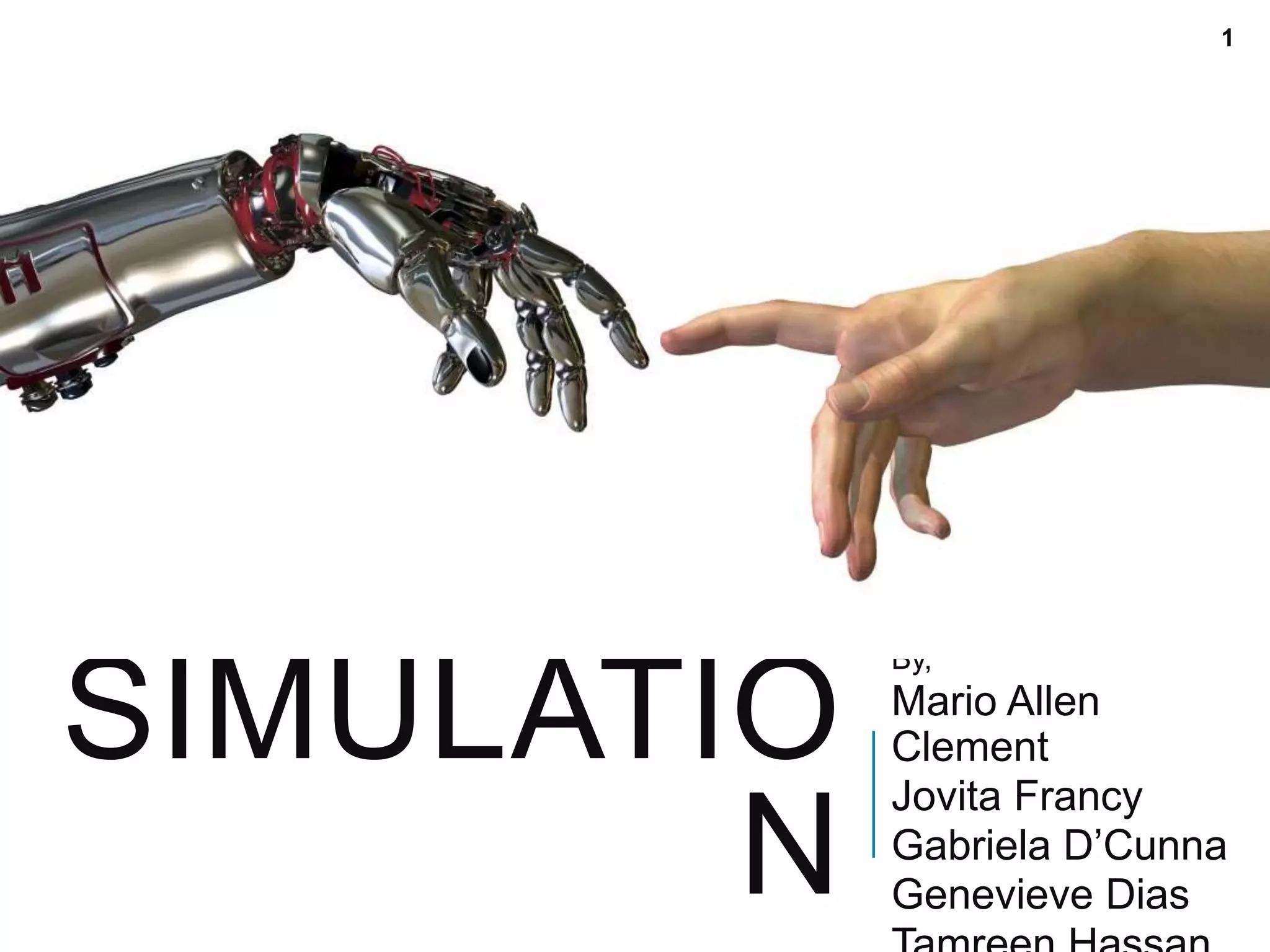
SIMULATIO
N
By,
Mario Allen
Clement
Jovita Francy
Gabriela D’Cunna
Genevieve Dias
1
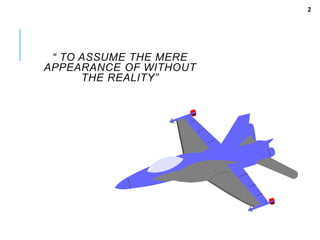
“ TO ASSUME THE MERE
APPEARANCE OF WITHOUT
THE REALITY”
2
AGENDA
Introduction
Types of simulations
Steps in simulation process
Simulation theory
Widely used simulation
Used By
Simulation in computers
Examples of Applications at Disney World
Advantages
Limitations
Future of Simulation
3
INTRODUCTION
 Simulation is imitation of some real thing, or a process.
 It generally involves representation of certain.
 Key characteristics.
 Behaviors.
 Involves the use of models to represent real life
situation.
 Used to analyze practical situation.
 The technique has long been used by designers and
analysts.
 Two models:
 Scale model.
 Quantitative model.
4
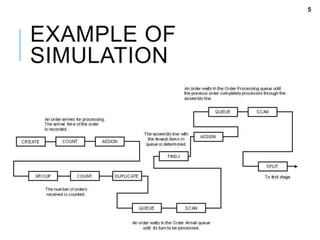
EXAMPLE OF
SIMULATION
5
TYPES OF
SIMULATIONS Static vs. Dynamic
 Does time have a role in the model?
 Continuous-change vs. Discrete-change
 Can the “state” change continuously or only at
discrete points in time?
 Deterministic vs. Stochastic
 Is everything for sure or is there uncertainty?
 Most operational models:
 Dynamic, Discrete-change, Stochastic
6
STEPS IN THE
SIMULATION PROCESS
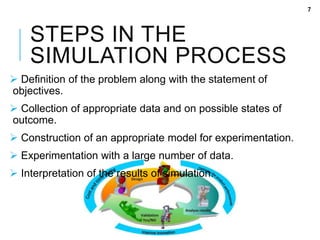
 Definition of the problem along with the statement of
objectives.
 Collection of appropriate data and on possible states of
outcome.
 Construction of an appropriate model for experimentation.
 Experimentation with a large number of data.
 Interpretation of the results of simulation.
7
SIMULATION THEORY
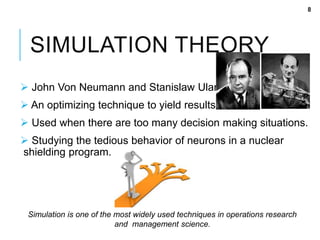
 John Von Neumann and Stanislaw Ulam.
 An optimizing technique to yield results.
 Used when there are too many decision making situations.
 Studying the tedious behavior of neurons in a nuclear
shielding program.
Simulation is one of the most widely used techniques in operations research
and management science.
8
WIDELY USED
SIMULATION
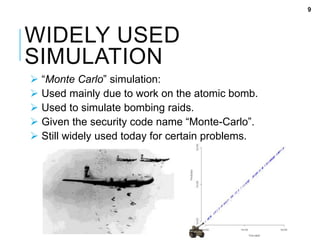
 “Monte Carlo” simulation:
 Used mainly due to work on the atomic bomb.
 Used to simulate bombing raids.
 Given the security code name “Monte-Carlo”.
 Still widely used today for certain problems.
9
WHAT CAN BE
SIMULATED?
Almost anything can
and
almost everything has...
10
USED BY
 Computer systems: hardware components, software
systems, networks, data base management, information
processing, etc..
 Manufacturing: material handling systems, assembly
lines, automated production facilities, inventory control
systems, plant layout, etc..
 Business: stock and commodity analysis, pricing
policies, marketing strategies, cash flow analysis,
forecasting, etc..
 Government: military weapons and their use, military
tactics, population forecasting, land use, health care,
delivery, fire protection, criminal justice, traffic control, etc..
11
SIMULATION IN
COMPUTERS
 Simulation languages
 GPSS, SIMSCRIPT, SLAM, SIMAN
 Popular, still in use
 Learning curve for features, effective use, syntax
 High-level simulators
 Very easy, graphical interface
 Domain-restricted (manufacturing,
communications)
 Limited flexibility - model validity.
12
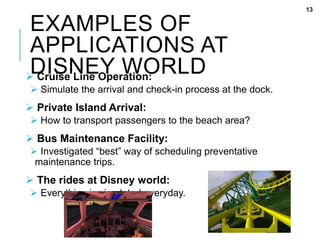
EXAMPLES OF
APPLICATIONS AT
DISNEY WORLD Cruise Line Operation:
 Simulate the arrival and check-in process at the dock.
 Private Island Arrival:
 How to transport passengers to the beach area?
 Bus Maintenance Facility:
 Investigated “best” way of scheduling preventative
maintenance trips.
 The rides at Disney world:
 Everything is simulated everyday.
13
ADVANTAGES
 Interaction of random events
 Non-standard distributions
 Communication tool (visualisation, animation).
 It is able to show the behaviour of a system
 Allows us to control time.
 Allows us to identify bottlenecks.
 Basic concept of simulation is easy to comprehend
 Requires fewer simplifying assumptions
14
LIMITATIONS
 Not an optimum solution.
 Observations fail to detect the worse situation.
 Many experiments have to be conducted
 Any experimentation results in the destruction of product
experimented.
 Simulation results are sometimes hard to interpret.
 Get random output.
15
FUTURE OF
SIMULATION
 Used widely and extensively.
 Will form a basis for a ground breaking technology.
 Better technology will simulate more accurate.
 Simulation might just be replaced by predictions (minority
report)
 Will help human kind.
 Even kids might start using it very soon.
16

Simulation

  • 1.
  • 2.
    “ TO ASSUMETHE MERE APPEARANCE OF WITHOUT THE REALITY” 2
  • 3.
    AGENDA Introduction Types of simulations Stepsin simulation process Simulation theory Widely used simulation Used By Simulation in computers Examples of Applications at Disney World Advantages Limitations Future of Simulation 3
  • 4.
    INTRODUCTION  Simulation isimitation of some real thing, or a process.  It generally involves representation of certain.  Key characteristics.  Behaviors.  Involves the use of models to represent real life situation.  Used to analyze practical situation.  The technique has long been used by designers and analysts.  Two models:  Scale model.  Quantitative model. 4
  • 5.
  • 6.
    TYPES OF SIMULATIONS Staticvs. Dynamic  Does time have a role in the model?  Continuous-change vs. Discrete-change  Can the “state” change continuously or only at discrete points in time?  Deterministic vs. Stochastic  Is everything for sure or is there uncertainty?  Most operational models:  Dynamic, Discrete-change, Stochastic 6
  • 7.
    STEPS IN THE SIMULATIONPROCESS  Definition of the problem along with the statement of objectives.  Collection of appropriate data and on possible states of outcome.  Construction of an appropriate model for experimentation.  Experimentation with a large number of data.  Interpretation of the results of simulation. 7
  • 8.
    SIMULATION THEORY  JohnVon Neumann and Stanislaw Ulam.  An optimizing technique to yield results.  Used when there are too many decision making situations.  Studying the tedious behavior of neurons in a nuclear shielding program. Simulation is one of the most widely used techniques in operations research and management science. 8
  • 9.
    WIDELY USED SIMULATION  “MonteCarlo” simulation:  Used mainly due to work on the atomic bomb.  Used to simulate bombing raids.  Given the security code name “Monte-Carlo”.  Still widely used today for certain problems. 9
  • 10.
    WHAT CAN BE SIMULATED? Almostanything can and almost everything has... 10
  • 11.
    USED BY  Computersystems: hardware components, software systems, networks, data base management, information processing, etc..  Manufacturing: material handling systems, assembly lines, automated production facilities, inventory control systems, plant layout, etc..  Business: stock and commodity analysis, pricing policies, marketing strategies, cash flow analysis, forecasting, etc..  Government: military weapons and their use, military tactics, population forecasting, land use, health care, delivery, fire protection, criminal justice, traffic control, etc.. 11
  • 12.
    SIMULATION IN COMPUTERS  Simulationlanguages  GPSS, SIMSCRIPT, SLAM, SIMAN  Popular, still in use  Learning curve for features, effective use, syntax  High-level simulators  Very easy, graphical interface  Domain-restricted (manufacturing, communications)  Limited flexibility - model validity. 12
  • 13.
    EXAMPLES OF APPLICATIONS AT DISNEYWORLD Cruise Line Operation:  Simulate the arrival and check-in process at the dock.  Private Island Arrival:  How to transport passengers to the beach area?  Bus Maintenance Facility:  Investigated “best” way of scheduling preventative maintenance trips.  The rides at Disney world:  Everything is simulated everyday. 13
  • 14.
    ADVANTAGES  Interaction ofrandom events  Non-standard distributions  Communication tool (visualisation, animation).  It is able to show the behaviour of a system  Allows us to control time.  Allows us to identify bottlenecks.  Basic concept of simulation is easy to comprehend  Requires fewer simplifying assumptions 14
  • 15.
    LIMITATIONS  Not anoptimum solution.  Observations fail to detect the worse situation.  Many experiments have to be conducted  Any experimentation results in the destruction of product experimented.  Simulation results are sometimes hard to interpret.  Get random output. 15
  • 16.
    FUTURE OF SIMULATION  Usedwidely and extensively.  Will form a basis for a ground breaking technology.  Better technology will simulate more accurate.  Simulation might just be replaced by predictions (minority report)  Will help human kind.  Even kids might start using it very soon. 16