L/O/G/O
Jhessie L. Abella, RN, RM, MAN, CPSO, SMRIN
PATIENT SAFETY &
International Patient
Safety Goals (IPSG)
What is Patient Safety
• Patient safety is the prevention of errors and adverse effects to patients associated with
health care (WHO,2010)
• “The Prevention of Harm to Patients” (IOM, 2001)
• The avoidance, prevention and amelioration of adverse outcomes or injuries stemming from
the process of healthcare.
• Patient safety is fundamental to delivering quality essential health services.
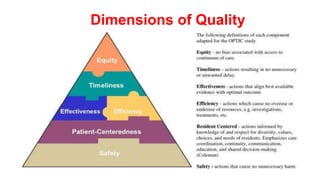
Dimensions of Quality
https://www.classmarker.com/online-
test/start/?quiz=tjp5da574a7429bf
4
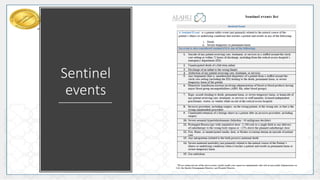
• Sentinel event
is a patient safety event (not
primarily related to the
natural course of the
patient’s illness or
underlying condition) that
reaches a patient and
results in any of the
following:
• Death
• Severe temporary
• Near miss
is an Incident or situation
directly associated with care or
services provided within the
hospital that could have
resulted in an accident, injury,
illness or property damage, but
did not, either by chance or
through timely intervention.
Sentinel
events
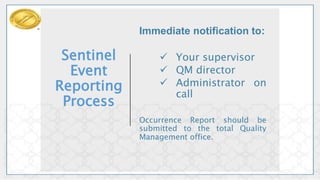
Sentinel
Event
Reporting
Process
Immediate notification to:
 Your supervisor
 QM director
 Administrator on
call
Occurrence Report should be
submitted to the total Quality
Management office.
Key Points in Patient Safety
• Harm is what patients care most about. We will all put up with errors in our
care, to some extent at least, as long as we do not come to harm.
• Some errors cause harm but many do not
• Blame and discipline are an ineffective response to most safety problems
9
10
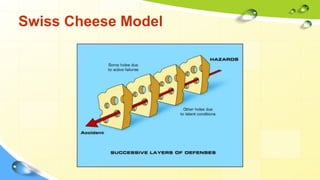
Swiss Cheese Model
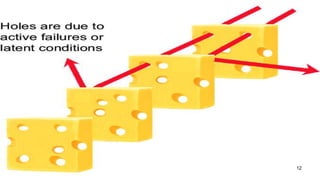
12
“We can not change the
human condition
But we can change the
condition under which
14
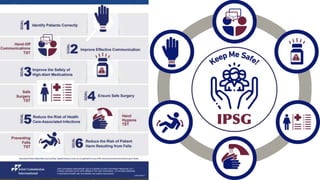
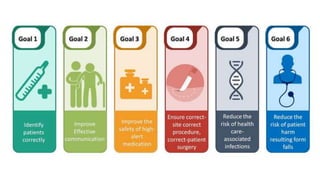
International patient safety
goals
IPSGs
• Joint Commission International “JCI” and the
WHO conjointly promoting the six
international patient safety goals to ensure
safe delivery of care.
• To promote specific improvements in patient
safety
• Highlight problematic areas in health care
• Describe evidence-and expert-based
consensus solutions to these problems
16
17
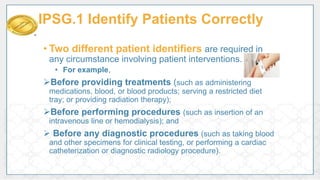
• Two different patient identifiers are required in
any circumstance involving patient interventions.
• For example,
Before providing treatments (such as administering
medications, blood, or blood products; serving a restricted diet
tray; or providing radiation therapy);
Before performing procedures (such as insertion of an
intravenous line or hemodialysis); and
 Before any diagnostic procedures (such as taking blood
and other specimens for clinical testing, or performing a cardiac
catheterization or diagnostic radiology procedure).
IPSG.1 Identify Patients Correctly
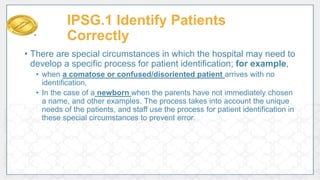
• There are special circumstances in which the hospital may need to
develop a specific process for patient identification; for example,
• when a comatose or confused/disoriented patient arrives with no
identification,
• In the case of a newborn when the parents have not immediately chosen
a name, and other examples. The process takes into account the unique
needs of the patients, and staff use the process for patient identification in
these special circumstances to prevent error.
IPSG.1 Identify Patients
Correctly
• Verbal and/or telephone communication among caregivers. “Read
back process”
• Reporting critical results of diagnostic tests. “Read back process”
• Handover communication. “SBAR”
IPSG.2 Improve Effective
Communication
IPSG.2 Improve Effective
Communication
The complete verbal and telephone order or test
result is written down by the receiver of the order
or test result.
The complete verbal and telephone order or test
result is read back by the receiver of the order or
test result.
The order or test result is confirmed by the
individual who gave the order or test result.
IPSG.3 Improve the Safety of High-Alert
Medications
High-Alert Medications are
• Medications involved in a high percentage of errors and/or
sentinel events
• Medications that carry a higher risk for adverse outcomes
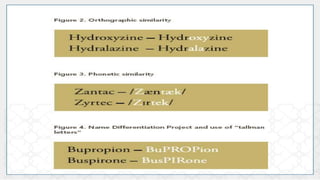
• Look-alike/sound-alike medications
• anticoagulants,
• controlled medications,
• investigational medications,
• medications with a narrow therapeutic range,
• chemotherapy,
• Psychotherapeutic medications,
• and look-alike/sound-alike medications (LASA).
IPSG.3 Improve the Safety of High-
Alert Medications
IPSG.3 Improve the Safety of High-
Alert Medications
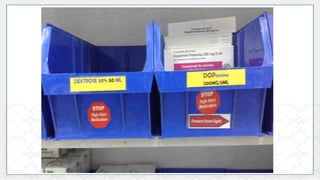
• Concentrated electrolytes are not present in patient
care units unless clinically necessary, and actions are
taken inadvertent administration in those areas where
permitted by policy.
• Concentrated electrolytes that are stored in patient care
units are clearly labeled and stored in manner that
restricted areas.
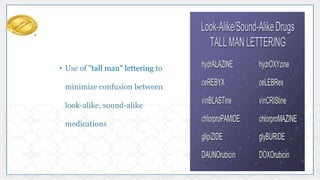
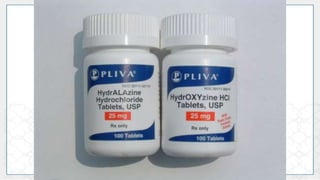
• Use of "tall man" lettering to
minimize confusion between
look-alike, sound-alike
medications
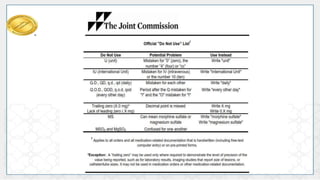
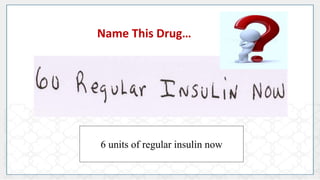
6 units of regular insulin now
Name This Drug…
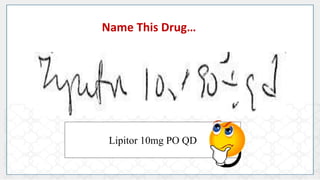
Lipitor 10mg PO QD
Name This Drug…
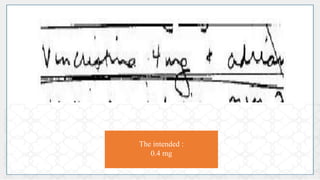
The intended :
0.4 mg
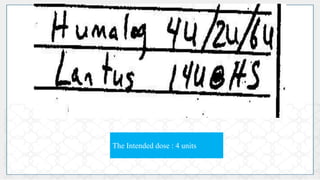
The Intended dose : 4 units
IPSG.4 Ensure Correct-Site,
Correct- Procedure, Correct-
Patient Surgery
• Uses an instantly recognized mark for surgical-
site identification and involves the patient in the
marking process.
• Uses a checklist or other process to verify
preoperatively the correct site, correct procedure,
and correct patient and that all documents and
equipment needed are on hand, correct, and
functional.
IPSG.4 Ensure Correct-Site,
Correct- Procedure, Correct-
Patient Surgery
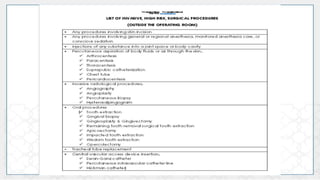
• The full surgical team conducts and documents
a time-out procedure just before starting a
surgical procedure.
• Policies and procedures are developed that
support uniform process to ensure the correct
site, correct procedure, and correct patient,
including medical and dental procedures done
in settings other than the operating theatre.
IPSG.5Reduce the Risk of Health
Care-Associated Infections
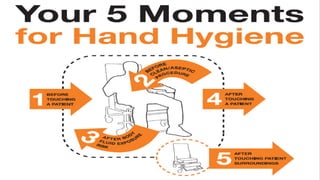
• The organization has adopted or adapted currently
published and generally accepted hand-hygiene
guidelines.
• The organization implements an effective hand-
hygiene program.
• Policies and/or procedures are developed that
support continued reduction of health care-
associated infections.
IPSG.6Reduce the Risk of Patient
Harm Resulting from Falls
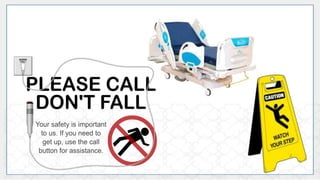
• Implements a process for the initial assessment of
patients for fall risk and reassessment of patients
when indicated by a change in condition or
medications, among others.
• Measures are implemented to reduce fall risk for
those assessed to be at risk.
• Measured are monitored for results, both successful
fall injury reduction and any unintended related
consequences.
IPSG.6Reduce the Risk of Patient
Harm Resulting from Falls
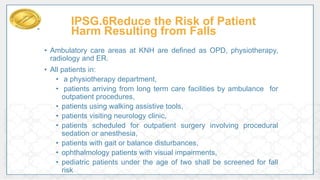
• Ambulatory care areas at KNH are defined as OPD, physiotherapy,
radiology and ER.
• All patients in:
• a physiotherapy department,
• patients arriving from long term care facilities by ambulance for
outpatient procedures,
• patients using walking assistive tools,
• patients visiting neurology clinic,
• patients scheduled for outpatient surgery involving procedural
sedation or anesthesia,
• patients with gait or balance disturbances,
• ophthalmology patients with visual impairments,
• pediatric patients under the age of two shall be screened for fall
risk

Patient Safety and IPSG

  • 1.
    L/O/G/O Jhessie L. Abella,RN, RM, MAN, CPSO, SMRIN PATIENT SAFETY & International Patient Safety Goals (IPSG)
  • 2.
    What is PatientSafety • Patient safety is the prevention of errors and adverse effects to patients associated with health care (WHO,2010) • “The Prevention of Harm to Patients” (IOM, 2001) • The avoidance, prevention and amelioration of adverse outcomes or injuries stemming from the process of healthcare. • Patient safety is fundamental to delivering quality essential health services.
  • 3.
  • 4.
  • 5.
    • Sentinel event isa patient safety event (not primarily related to the natural course of the patient’s illness or underlying condition) that reaches a patient and results in any of the following: • Death • Severe temporary • Near miss is an Incident or situation directly associated with care or services provided within the hospital that could have resulted in an accident, injury, illness or property damage, but did not, either by chance or through timely intervention.
  • 6.
  • 7.
    Sentinel Event Reporting Process Immediate notification to: Your supervisor  QM director  Administrator on call Occurrence Report should be submitted to the total Quality Management office.
  • 8.
    Key Points inPatient Safety • Harm is what patients care most about. We will all put up with errors in our care, to some extent at least, as long as we do not come to harm. • Some errors cause harm but many do not • Blame and discipline are an ineffective response to most safety problems
  • 9.
  • 10.
  • 11.
  • 12.
  • 13.
    “We can notchange the human condition But we can change the condition under which
  • 14.
  • 15.
    International patient safety goals IPSGs •Joint Commission International “JCI” and the WHO conjointly promoting the six international patient safety goals to ensure safe delivery of care. • To promote specific improvements in patient safety • Highlight problematic areas in health care • Describe evidence-and expert-based consensus solutions to these problems
  • 16.
  • 17.
  • 18.
    • Two differentpatient identifiers are required in any circumstance involving patient interventions. • For example, Before providing treatments (such as administering medications, blood, or blood products; serving a restricted diet tray; or providing radiation therapy); Before performing procedures (such as insertion of an intravenous line or hemodialysis); and  Before any diagnostic procedures (such as taking blood and other specimens for clinical testing, or performing a cardiac catheterization or diagnostic radiology procedure). IPSG.1 Identify Patients Correctly
  • 19.
    • There arespecial circumstances in which the hospital may need to develop a specific process for patient identification; for example, • when a comatose or confused/disoriented patient arrives with no identification, • In the case of a newborn when the parents have not immediately chosen a name, and other examples. The process takes into account the unique needs of the patients, and staff use the process for patient identification in these special circumstances to prevent error. IPSG.1 Identify Patients Correctly
  • 20.
    • Verbal and/ortelephone communication among caregivers. “Read back process” • Reporting critical results of diagnostic tests. “Read back process” • Handover communication. “SBAR” IPSG.2 Improve Effective Communication
  • 21.
    IPSG.2 Improve Effective Communication Thecomplete verbal and telephone order or test result is written down by the receiver of the order or test result. The complete verbal and telephone order or test result is read back by the receiver of the order or test result. The order or test result is confirmed by the individual who gave the order or test result.
  • 22.
    IPSG.3 Improve theSafety of High-Alert Medications High-Alert Medications are • Medications involved in a high percentage of errors and/or sentinel events • Medications that carry a higher risk for adverse outcomes • Look-alike/sound-alike medications
  • 23.
    • anticoagulants, • controlledmedications, • investigational medications, • medications with a narrow therapeutic range, • chemotherapy, • Psychotherapeutic medications, • and look-alike/sound-alike medications (LASA). IPSG.3 Improve the Safety of High- Alert Medications
  • 24.
    IPSG.3 Improve theSafety of High- Alert Medications • Concentrated electrolytes are not present in patient care units unless clinically necessary, and actions are taken inadvertent administration in those areas where permitted by policy. • Concentrated electrolytes that are stored in patient care units are clearly labeled and stored in manner that restricted areas.
  • 28.
    • Use of"tall man" lettering to minimize confusion between look-alike, sound-alike medications
  • 31.
    6 units ofregular insulin now Name This Drug…
  • 32.
    Lipitor 10mg POQD Name This Drug…
  • 33.
  • 34.
  • 35.
    IPSG.4 Ensure Correct-Site, Correct-Procedure, Correct- Patient Surgery • Uses an instantly recognized mark for surgical- site identification and involves the patient in the marking process. • Uses a checklist or other process to verify preoperatively the correct site, correct procedure, and correct patient and that all documents and equipment needed are on hand, correct, and functional.
  • 36.
    IPSG.4 Ensure Correct-Site, Correct-Procedure, Correct- Patient Surgery • The full surgical team conducts and documents a time-out procedure just before starting a surgical procedure. • Policies and procedures are developed that support uniform process to ensure the correct site, correct procedure, and correct patient, including medical and dental procedures done in settings other than the operating theatre.
  • 38.
    IPSG.5Reduce the Riskof Health Care-Associated Infections • The organization has adopted or adapted currently published and generally accepted hand-hygiene guidelines. • The organization implements an effective hand- hygiene program. • Policies and/or procedures are developed that support continued reduction of health care- associated infections.
  • 40.
    IPSG.6Reduce the Riskof Patient Harm Resulting from Falls • Implements a process for the initial assessment of patients for fall risk and reassessment of patients when indicated by a change in condition or medications, among others. • Measures are implemented to reduce fall risk for those assessed to be at risk. • Measured are monitored for results, both successful fall injury reduction and any unintended related consequences.
  • 42.
    IPSG.6Reduce the Riskof Patient Harm Resulting from Falls • Ambulatory care areas at KNH are defined as OPD, physiotherapy, radiology and ER. • All patients in: • a physiotherapy department, • patients arriving from long term care facilities by ambulance for outpatient procedures, • patients using walking assistive tools, • patients visiting neurology clinic, • patients scheduled for outpatient surgery involving procedural sedation or anesthesia, • patients with gait or balance disturbances, • ophthalmology patients with visual impairments, • pediatric patients under the age of two shall be screened for fall risk

Editor's Notes

  • #3 ”Today’s healthcare landscape is arguably the most difficult ever,” *****despite the number of worldwide flight hours doubling over the past 20 years (from approximately 25 million in 1993 to 54 million in 2013), the number of fatalities has fallen from approximately 450 to 250 per year. ****this stands in comparison to healthcare, where in the USA alone there are an estimated 200,000 preventable medical deaths every year, which amounts to the equivalent of almost three fatal airline crashes per day.
  • #4 Achieving safe care is part of the broader quest to achieve high quality care on a number of dimensions.
  • #9 Errors are not isolated problems, but have underlying systemic causes. viii Research has long shown that working in complex, stressful environments like hospitals makes everyone prone to mistakes. Despite the demand for "multi-tasking," the human brain is not capable of keeping more than a few pieces of information straight at any one time. ii- iv Thus there is a risk of information overload when healthcare professionals must monitor many pieces of equipment in surgery or fill several medication orders in a short time. ii- vi This is made worse when they are tired and overworked, or when there isn't enough staff. ii- vi Physical aspects of healthcare today also contribute to mistakes; for example, handwritten prescriptions are often difficult to read, especially when medications have similar names. We can eliminate errors in healthcare by getting rid of the "bad apples"
  • #10 Why is the issue of human factors in health care important Human factors issues are major contributors to adverse events in health care. In health care, human factors can have serious and sometimes fatal consequences. However, the health-care system can be made safer by recognizing the potential for error, and by developing systems and strategies to learn from mistakes, so as to minimize their occurrence and effects. Is it possible to manage human factors? Yes, management of human factors involves the application of proactive techniques aimed at minimizing and learning from errors or near misses. A work culture that encourages the reporting of adverse events in health care allows the health-care system and patient safety to improve.
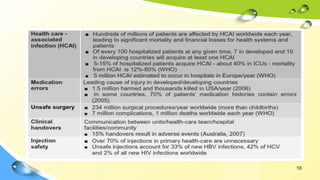
  • #11 Health care is one of the most unsafe industries. Studies show that about 10% of hospital patients suffer an adverse event (AE) and the incidence of AE in developing countries is higher than 10%.
  • #12 Reason compares Human Systems to Layers of Swiss Cheese (see image above), Each layer is a defence against something going wrong (mistakes & failure). There are ‘holes’ in the defence – no human system is perfect (we aren’t machines). Something breaking through a hole isn’t a huge problem – things go wrong occasionally. As humans we have developed to cope with minor failures/mistakes as a routine part of life (something small goes wrong, we fix it and move on). Within our ‘systems’ there are often several ‘layers of defence’ (more slices of Swiss Cheese). You can see where this is going….. Things become a major problem when failures follow a path through all of the holes in the Swiss Cheese – all of the defence layers have been broken because the holes have ‘lined up’.