Operations Management Session 3 –  Process and Layout Strategies
Outline Global Company Profile:  Dell Computer Corp. Four Process Strategies Process Focus Repetitive Focus Product Focus Mass Customization Focus Comparison of Process Choices
Outline – Continued Process Analysis and Design Flow Diagrams Time-Function Mapping Value-Stream Mapping Process Charts Service Blueprinting
Outline – Continued Service Process Design Customer Interaction and Process Design More Opportunities to Improve Service Processes Selection of Equipment and Technology
Outline – Continued Production Technology Machine Technology Automatic Identification Systems (AISs) and RFID Process Control Vision Systems Robots
Outline – Continued Production Technology (cont.) Automated Storage and Retrieval Systems (ASRSs) Automated Guided Vehicles (AGVs) Flexible Manufacturing Systems (FMSs) Computer-Integrated Manufacturing (CIM)
Outline – Continued Technology in Services Process Redesign  Ethics and Environmentally Friendly Processes
Learning Objectives When you complete this chapter you should be able to: Describe four production processes Compute crossover points for different processes Use the tools of process analysis Describe customer interaction in process design Identify recent advances in production technology
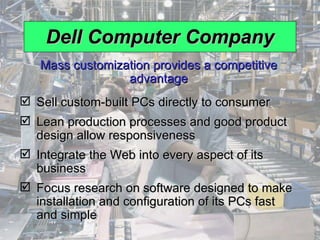
Dell Computer Company Mass customization provides a competitive advantage Sell custom-built PCs directly to consumer Lean production processes and good product design allow responsiveness Integrate the Web into every aspect of its business Focus research on software designed to make installation and configuration of its PCs fast and simple
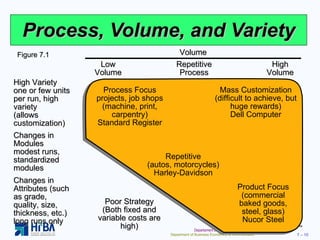
Process, Volume, and Variety Process Focus projects, job shops (machine, print, carpentry) Standard Register Repetitive (autos, motorcycles) Harley-Davidson Product Focus (commercial baked goods, steel, glass) Nucor Steel High Variety one or few units per run, high variety (allows customization) Changes in Modules modest runs, standardized modules Changes in Attributes (such as grade, quality, size, thickness, etc.)  long runs only Mass Customization (difficult to achieve, but huge rewards) Dell Computer Poor Strategy (Both fixed and variable costs are high) Figure 7.1 Low Volume Repetitive Process High Volume Volume
Process Strategies How to produce a product or provide a service that Meets or exceeds customer requirements Meets cost and managerial goals Has long term effects on Efficiency and production flexibility Costs and quality
Process Strategies Four basic strategies Process focus Repetitive focus Product focus Mass customization Within these basic strategies there are many ways they may be implemented
Process Focus Facilities are organized around specific activities or processes General purpose equipment and skilled personnel High degree of product flexibility Typically high costs and low equipment utilization Product flows may vary considerably making planning and scheduling a challenge
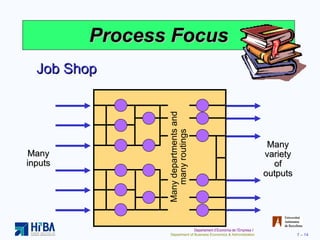
Process Focus Job Shop Many inputs Many variety of outputs Many departments and many routings
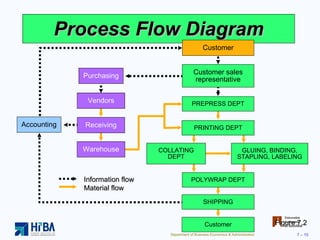
Process Flow Diagram Figure 7.2 Accounting Information flow Material flow COLLATING DEPT GLUING, BINDING, STAPLING, LABELING POLYWRAP DEPT SHIPPING Customer PRINTING DEPT PREPRESS DEPT Vendors Receiving Warehouse Purchasing Customer Customer sales representative
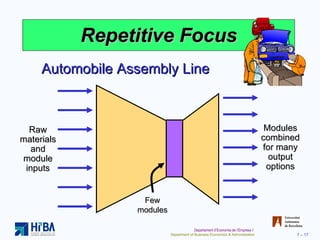
Repetitive Focus Facilities often organized as assembly lines Characterized by modules with parts and assemblies made previously Modules may be combined for many output options Less flexibility than process-focused facilities but more efficient
Repetitive Focus Automobile Assembly Line Raw materials and module inputs Modules combined for many output options Few modules
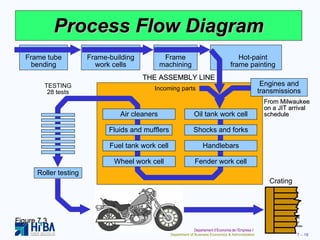
Process Flow Diagram Figure 7.3 THE ASSEMBLY LINE TESTING 28 tests Oil tank work cell Shocks and forks Handlebars Fender work cell Air cleaners Fluids and mufflers Fuel tank work cell Wheel work cell Roller testing Incoming parts From Milwaukee on a JIT arrival schedule Engines and transmissions Frame tube bending Frame-building work cells Frame machining Hot-paint frame painting Crating
Product Focus Facilities are organized by product High volume but low variety of products Long, continuous production runs enable efficient processes Typically high fixed cost but low variable cost Generally less skilled labor
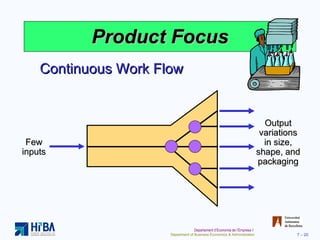
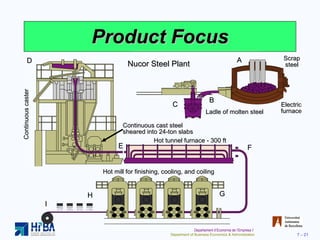
Product Focus Continuous Work Flow Few inputs Output variations in size, shape, and packaging
Product Focus Nucor Steel Plant Continuous caster Continuous cast steel sheared into 24-ton slabs Hot tunnel furnace - 300 ft Hot mill for finishing, cooling, and coiling D E F G H I Scrap steel Ladle of molten steel Electric furnace A B C
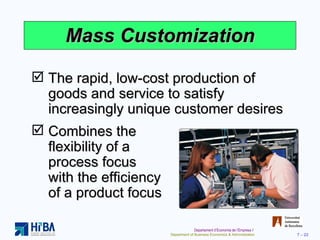
Mass Customization The rapid, low-cost production of goods and service to satisfy increasingly unique customer desires Combines the  flexibility of a  process focus  with the efficiency  of a product focus
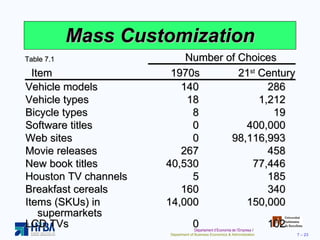
Mass Customization Table 7.1 Vehicle models 140 286 Vehicle types 18 1,212 Bicycle types 8 19 Software titles 0 400,000 Web sites 0 98,116,993 Movie releases 267 458 New book titles 40,530 77,446 Houston TV channels 5 185 Breakfast cereals 160 340 Items (SKUs) in  14,000 150,000 supermarkets LCD TVs 0 102 Number of Choices Item 1970s 21 st  Century
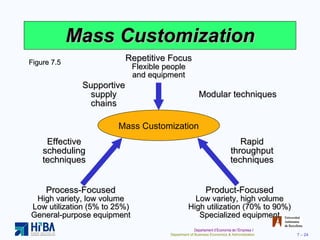
Mass Customization Effective scheduling techniques Rapid throughput techniques Figure 7.5 Mass Customization Repetitive Focus Flexible people and equipment Process-Focused High variety, low volume Low utilization (5% to 25%) General-purpose equipment Product-Focused Low variety, high volume High utilization (70% to 90%) Specialized equipment Modular techniques Supportive supply chains
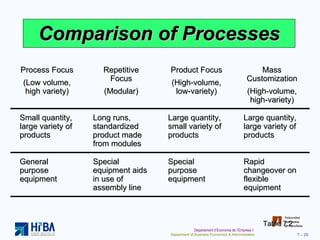
Comparison of Processes Table 7.2 Process Focus (Low volume, high variety) Repetitive Focus (Modular) Product Focus (High-volume, low-variety) Mass Customization (High-volume, high-variety) Small quantity, large variety of products Long runs, standardized product made from modules Large quantity, small variety of products Large quantity, large variety of products General purpose equipment Special equipment aids in use of assembly line Special purpose equipment Rapid changeover on flexible equipment
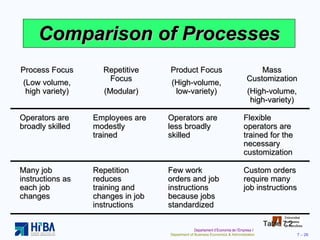
Comparison of Processes Table 7.2 Process Focus (Low volume, high variety) Repetitive Focus (Modular) Product Focus (High-volume, low-variety) Mass Customization (High-volume, high-variety) Operators are broadly skilled Employees are modestly trained Operators are less broadly skilled Flexible operators are trained for the necessary customization Many job instructions as each job changes Repetition reduces training and changes in job instructions Few work orders and job instructions because jobs standardized Custom orders require many job instructions
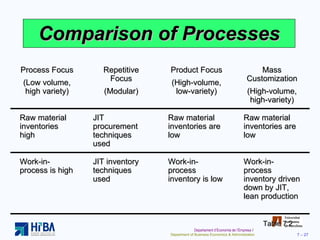
Comparison of Processes Table 7.2 Process Focus (Low volume, high variety) Repetitive Focus (Modular) Product Focus (High-volume, low-variety) Mass Customization (High-volume, high-variety) Raw material inventories high JIT procurement techniques used Raw material inventories are low Raw material inventories are low Work-in-process is high JIT inventory techniques used Work-in-process inventory is low Work-in-process inventory driven down by JIT, lean production
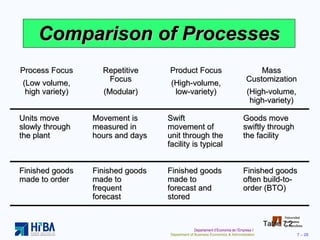
Comparison of Processes Table 7.2 Process Focus (Low volume, high variety) Repetitive Focus (Modular) Product Focus (High-volume, low-variety) Mass Customization (High-volume, high-variety) Units move slowly through the plant Movement is measured in hours and days Swift movement of unit through the facility is typical Goods move swiftly through the facility Finished goods made to order Finished goods made to frequent forecast Finished goods made to forecast and stored Finished goods often build-to-order (BTO)
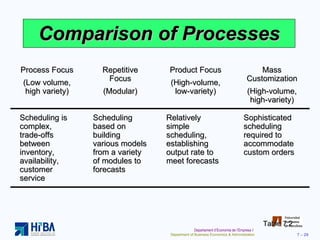
Comparison of Processes Table 7.2 Process Focus (Low volume, high variety) Repetitive Focus (Modular) Product Focus (High-volume, low-variety) Mass Customization (High-volume, high-variety) Scheduling is complex, trade-offs between inventory, availability, customer service Scheduling based on building various models from a variety of modules to forecasts Relatively simple scheduling, establishing output rate to meet forecasts Sophisticated scheduling required to accommodate custom orders
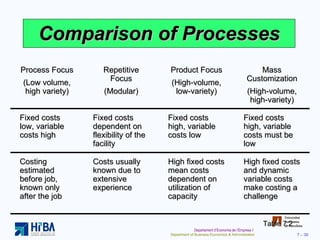
Comparison of Processes Table 7.2 Process Focus (Low volume, high variety) Repetitive Focus (Modular) Product Focus (High-volume, low-variety) Mass Customization (High-volume, high-variety) Fixed costs low, variable costs high Fixed costs dependent on flexibility of the facility Fixed costs high, variable costs low Fixed costs high, variable costs must be low Costing estimated before job, known only after the job Costs usually known due to extensive experience High fixed costs mean costs dependent on utilization of capacity High fixed costs and dynamic variable costs make costing a challenge
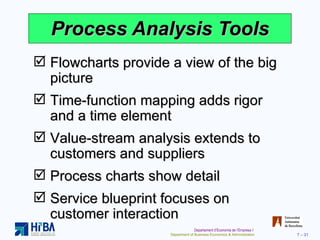
Process Analysis Tools Flowcharts provide a view of the big picture Time-function mapping adds rigor and a time element Value-stream analysis extends to customers and suppliers Process charts show detail Service blueprint focuses on customer interaction
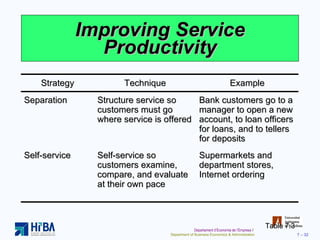
Improving Service Productivity Table 7.3 Strategy Technique Example Separation Structure service so customers must go where service is offered Bank customers go to a manager to open a new account, to loan officers for loans, and to tellers for deposits Self-service Self-service so customers examine, compare, and evaluate at their own pace Supermarkets and department stores, Internet ordering
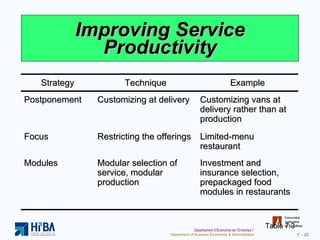
Improving Service Productivity Table 7.3 Strategy Technique Example Postponement Customizing at delivery Customizing vans at delivery rather than at production Focus Restricting the offerings Limited-menu restaurant Modules Modular selection of service, modular production Investment and insurance selection, prepackaged food modules in restaurants
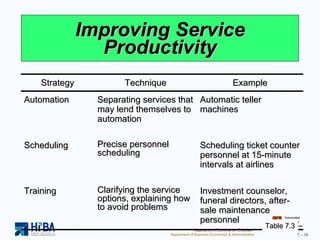
Improving Service Productivity Table 7.3 Strategy Technique Example Automation Separating services that may lend themselves to automation Automatic teller machines Scheduling Precise personnel scheduling Scheduling ticket counter personnel at 15-minute intervals at airlines Training Clarifying the service options, explaining how to avoid problems Investment counselor, funeral directors, after-sale maintenance personnel
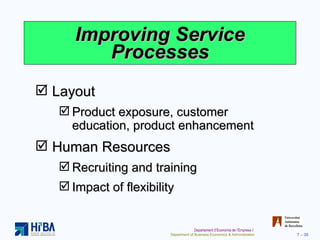
Improving Service Processes Layout Product exposure, customer education, product enhancement Human Resources Recruiting and training Impact of flexibility
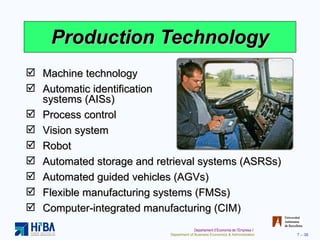
Production Technology Machine technology Automatic identification  systems (AISs) Process control Vision system Robot Automated storage and retrieval systems (ASRSs) Automated guided vehicles (AGVs) Flexible manufacturing systems (FMSs) Computer-integrated manufacturing (CIM)
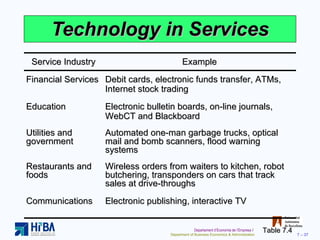
Technology in Services Table 7.4 Service Industry Example Financial Services Debit cards, electronic funds transfer, ATMs, Internet stock trading Education Electronic bulletin boards, on-line journals, WebCT and Blackboard Utilities and government Automated one-man garbage trucks, optical mail and bomb scanners, flood warning systems Restaurants and foods Wireless orders from waiters to kitchen, robot butchering, transponders on cars that track sales at drive-throughs Communications Electronic publishing, interactive TV
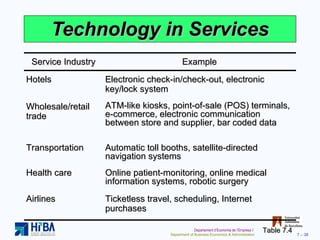
Technology in Services Table 7.4 Service Industry Example Hotels Electronic check-in/check-out, electronic key/lock system Wholesale/retail trade ATM-like kiosks, point-of-sale (POS) terminals, e-commerce, electronic communication between store and supplier, bar coded data Transportation Automatic toll booths, satellite-directed navigation systems Health care Online patient-monitoring, online medical information systems, robotic surgery Airlines Ticketless travel, scheduling, Internet purchases
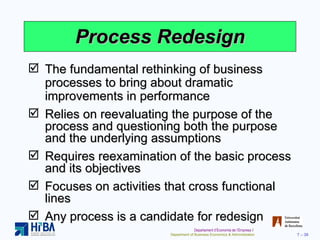
Process Redesign The fundamental rethinking of business processes to bring about dramatic improvements in performance Relies on reevaluating the purpose of the process and questioning both the purpose and the underlying assumptions Requires reexamination of the basic process and its objectives Focuses on activities that cross functional lines Any process is a candidate for redesign
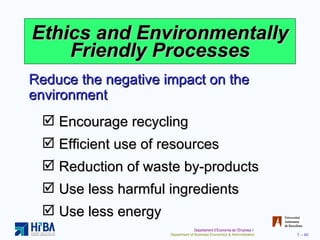
Ethics and Environmentally Friendly Processes Encourage recycling Efficient use of resources Reduction of waste by-products Use less harmful ingredients Use less energy Reduce the negative impact on the environment
Operations Management Layout Strategies
Outline Global Company Profile:  McDonald’s The Strategic Importance of Layout Decisions Types of Layout Office Layout
Outline – Continued Retail Layout Servicescapes Warehousing and Storage Layouts Cross-Docking Random Docking Customizing Fixed-Position Layout
Outline – Continued Process-Oriented Layout Computer Software for Process-Oriented Layouts Work Cells Requirements of Work Cells Staffing and Balancing Work Cells The Focused Work Center and the Focused Factory
Outline – Continued Repetitive and Product-Oriented Layout Assembly-Line Balancing
Learning Objectives When you complete this chapter you should be able to: Identify the different types of layout and its uses Understand layout relevance for strategy
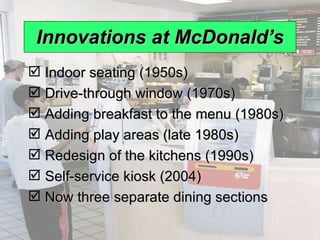
Innovations at McDonald’s Indoor seating (1950s) Drive-through window (1970s) Adding breakfast to the menu (1980s) Adding play areas (late 1980s) Redesign of the kitchens (1990s) Self-service kiosk (2004) Now three separate dining sections
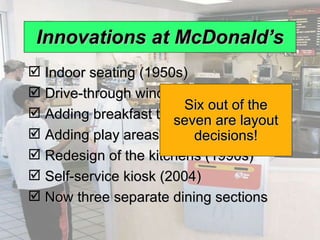
Innovations at McDonald’s Indoor seating (1950s) Drive-through window (1970s) Adding breakfast to the menu (1980s) Adding play areas (late 1980s) Redesign of the kitchens (1990s) Self-service kiosk (2004) Now three separate dining sections Six out of the seven are layout decisions!
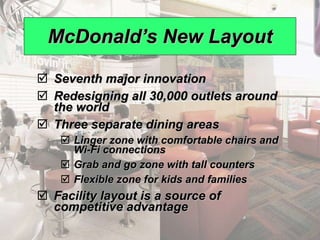
McDonald’s New Layout Seventh major innovation  Redesigning all 30,000 outlets around the world Three separate dining areas Linger zone with comfortable chairs and Wi-Fi connections Grab and go zone with tall counters Flexible zone for kids and families Facility layout is a source of competitive advantage
Strategic Importance of Layout Decisions The objective of layout strategy is to develop a cost-effective layout that will meet a firm’s competitive needs
Layout Design Considerations Higher utilization of space, equipment, and people Improved flow of information, materials, or people Improved employee morale and safer working conditions Improved customer/client interaction Flexibility
Types of Layout Office layout  Retail layout  Warehouse layout Fixed-position layout Process-oriented layout Work-cell layout  Product-oriented layout
Types of Layout Office layout: Positions workers, their equipment, and spaces/offices to provide for movement of information Retail layout: Allocates shelf space and responds to customer behavior  Warehouse layout: Addresses trade-offs between space and material handling
Types of Layout Fixed-position layout: Addresses the layout requirements of large, bulky projects such as ships and buildings Process-oriented layout: Deals with low-volume, high-variety production (also called job shop or intermittent production)
Types of Layout Work cell layout: Arranges machinery and equipment to focus on production of a single product or group of related products Product-oriented layout: Seeks the best personnel and machine utilizations in repetitive or continuous production
Good Layouts Consider Material handling equipment Capacity and space requirements Environment and aesthetics Flows of information Cost of moving between various work areas
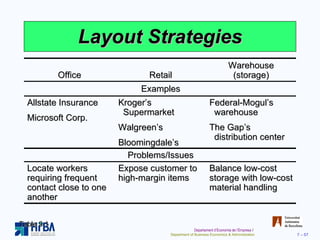
Layout Strategies Table 9.1 Office Retail Warehouse (storage) Examples Allstate Insurance Microsoft Corp. Kroger’s   Supermarket Walgreen’s Bloomingdale’s Federal-Mogul’s   warehouse The Gap’s   distribution center Problems/Issues Locate workers requiring frequent contact close to one another Expose customer to high-margin items Balance low-cost storage with low-cost material handling
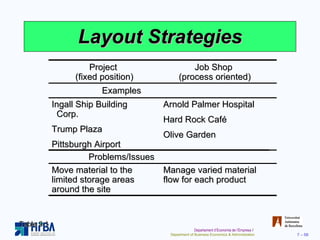
Layout Strategies Table 9.1 Project  (fixed position) Job Shop  (process oriented) Examples Ingall Ship Building   Corp. Trump Plaza Pittsburgh Airport Arnold Palmer Hospital Hard Rock Café Olive Garden Problems/Issues Move material to the limited storage areas around the site Manage varied material flow for each product
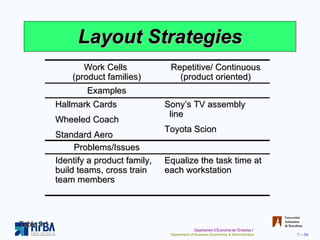
Layout Strategies Table 9.1 Work Cells  (product families) Repetitive/ Continuous (product oriented) Examples Hallmark Cards Wheeled Coach Standard Aero Sony’s TV assembly   line Toyota Scion Problems/Issues Identify a product family, build teams, cross train team members Equalize the task time at each workstation

Process And Layout Strategies

  • 1.
    Operations Management Session3 – Process and Layout Strategies
  • 2.
    Outline Global CompanyProfile: Dell Computer Corp. Four Process Strategies Process Focus Repetitive Focus Product Focus Mass Customization Focus Comparison of Process Choices
  • 3.
    Outline – ContinuedProcess Analysis and Design Flow Diagrams Time-Function Mapping Value-Stream Mapping Process Charts Service Blueprinting
  • 4.
    Outline – ContinuedService Process Design Customer Interaction and Process Design More Opportunities to Improve Service Processes Selection of Equipment and Technology
  • 5.
    Outline – ContinuedProduction Technology Machine Technology Automatic Identification Systems (AISs) and RFID Process Control Vision Systems Robots
  • 6.
    Outline – ContinuedProduction Technology (cont.) Automated Storage and Retrieval Systems (ASRSs) Automated Guided Vehicles (AGVs) Flexible Manufacturing Systems (FMSs) Computer-Integrated Manufacturing (CIM)
  • 7.
    Outline – ContinuedTechnology in Services Process Redesign Ethics and Environmentally Friendly Processes
  • 8.
    Learning Objectives Whenyou complete this chapter you should be able to: Describe four production processes Compute crossover points for different processes Use the tools of process analysis Describe customer interaction in process design Identify recent advances in production technology
  • 9.
    Dell Computer CompanyMass customization provides a competitive advantage Sell custom-built PCs directly to consumer Lean production processes and good product design allow responsiveness Integrate the Web into every aspect of its business Focus research on software designed to make installation and configuration of its PCs fast and simple
  • 10.
    Process, Volume, andVariety Process Focus projects, job shops (machine, print, carpentry) Standard Register Repetitive (autos, motorcycles) Harley-Davidson Product Focus (commercial baked goods, steel, glass) Nucor Steel High Variety one or few units per run, high variety (allows customization) Changes in Modules modest runs, standardized modules Changes in Attributes (such as grade, quality, size, thickness, etc.) long runs only Mass Customization (difficult to achieve, but huge rewards) Dell Computer Poor Strategy (Both fixed and variable costs are high) Figure 7.1 Low Volume Repetitive Process High Volume Volume
  • 11.
    Process Strategies Howto produce a product or provide a service that Meets or exceeds customer requirements Meets cost and managerial goals Has long term effects on Efficiency and production flexibility Costs and quality
  • 12.
    Process Strategies Fourbasic strategies Process focus Repetitive focus Product focus Mass customization Within these basic strategies there are many ways they may be implemented
  • 13.
    Process Focus Facilitiesare organized around specific activities or processes General purpose equipment and skilled personnel High degree of product flexibility Typically high costs and low equipment utilization Product flows may vary considerably making planning and scheduling a challenge
  • 14.
    Process Focus JobShop Many inputs Many variety of outputs Many departments and many routings
  • 15.
    Process Flow DiagramFigure 7.2 Accounting Information flow Material flow COLLATING DEPT GLUING, BINDING, STAPLING, LABELING POLYWRAP DEPT SHIPPING Customer PRINTING DEPT PREPRESS DEPT Vendors Receiving Warehouse Purchasing Customer Customer sales representative
  • 16.
    Repetitive Focus Facilitiesoften organized as assembly lines Characterized by modules with parts and assemblies made previously Modules may be combined for many output options Less flexibility than process-focused facilities but more efficient
  • 17.
    Repetitive Focus AutomobileAssembly Line Raw materials and module inputs Modules combined for many output options Few modules
  • 18.
    Process Flow DiagramFigure 7.3 THE ASSEMBLY LINE TESTING 28 tests Oil tank work cell Shocks and forks Handlebars Fender work cell Air cleaners Fluids and mufflers Fuel tank work cell Wheel work cell Roller testing Incoming parts From Milwaukee on a JIT arrival schedule Engines and transmissions Frame tube bending Frame-building work cells Frame machining Hot-paint frame painting Crating
  • 19.
    Product Focus Facilitiesare organized by product High volume but low variety of products Long, continuous production runs enable efficient processes Typically high fixed cost but low variable cost Generally less skilled labor
  • 20.
    Product Focus ContinuousWork Flow Few inputs Output variations in size, shape, and packaging
  • 21.
    Product Focus NucorSteel Plant Continuous caster Continuous cast steel sheared into 24-ton slabs Hot tunnel furnace - 300 ft Hot mill for finishing, cooling, and coiling D E F G H I Scrap steel Ladle of molten steel Electric furnace A B C
  • 22.
    Mass Customization Therapid, low-cost production of goods and service to satisfy increasingly unique customer desires Combines the flexibility of a process focus with the efficiency of a product focus
  • 23.
    Mass Customization Table7.1 Vehicle models 140 286 Vehicle types 18 1,212 Bicycle types 8 19 Software titles 0 400,000 Web sites 0 98,116,993 Movie releases 267 458 New book titles 40,530 77,446 Houston TV channels 5 185 Breakfast cereals 160 340 Items (SKUs) in 14,000 150,000 supermarkets LCD TVs 0 102 Number of Choices Item 1970s 21 st Century
  • 24.
    Mass Customization Effectivescheduling techniques Rapid throughput techniques Figure 7.5 Mass Customization Repetitive Focus Flexible people and equipment Process-Focused High variety, low volume Low utilization (5% to 25%) General-purpose equipment Product-Focused Low variety, high volume High utilization (70% to 90%) Specialized equipment Modular techniques Supportive supply chains
  • 25.
    Comparison of ProcessesTable 7.2 Process Focus (Low volume, high variety) Repetitive Focus (Modular) Product Focus (High-volume, low-variety) Mass Customization (High-volume, high-variety) Small quantity, large variety of products Long runs, standardized product made from modules Large quantity, small variety of products Large quantity, large variety of products General purpose equipment Special equipment aids in use of assembly line Special purpose equipment Rapid changeover on flexible equipment
  • 26.
    Comparison of ProcessesTable 7.2 Process Focus (Low volume, high variety) Repetitive Focus (Modular) Product Focus (High-volume, low-variety) Mass Customization (High-volume, high-variety) Operators are broadly skilled Employees are modestly trained Operators are less broadly skilled Flexible operators are trained for the necessary customization Many job instructions as each job changes Repetition reduces training and changes in job instructions Few work orders and job instructions because jobs standardized Custom orders require many job instructions
  • 27.
    Comparison of ProcessesTable 7.2 Process Focus (Low volume, high variety) Repetitive Focus (Modular) Product Focus (High-volume, low-variety) Mass Customization (High-volume, high-variety) Raw material inventories high JIT procurement techniques used Raw material inventories are low Raw material inventories are low Work-in-process is high JIT inventory techniques used Work-in-process inventory is low Work-in-process inventory driven down by JIT, lean production
  • 28.
    Comparison of ProcessesTable 7.2 Process Focus (Low volume, high variety) Repetitive Focus (Modular) Product Focus (High-volume, low-variety) Mass Customization (High-volume, high-variety) Units move slowly through the plant Movement is measured in hours and days Swift movement of unit through the facility is typical Goods move swiftly through the facility Finished goods made to order Finished goods made to frequent forecast Finished goods made to forecast and stored Finished goods often build-to-order (BTO)
  • 29.
    Comparison of ProcessesTable 7.2 Process Focus (Low volume, high variety) Repetitive Focus (Modular) Product Focus (High-volume, low-variety) Mass Customization (High-volume, high-variety) Scheduling is complex, trade-offs between inventory, availability, customer service Scheduling based on building various models from a variety of modules to forecasts Relatively simple scheduling, establishing output rate to meet forecasts Sophisticated scheduling required to accommodate custom orders
  • 30.
    Comparison of ProcessesTable 7.2 Process Focus (Low volume, high variety) Repetitive Focus (Modular) Product Focus (High-volume, low-variety) Mass Customization (High-volume, high-variety) Fixed costs low, variable costs high Fixed costs dependent on flexibility of the facility Fixed costs high, variable costs low Fixed costs high, variable costs must be low Costing estimated before job, known only after the job Costs usually known due to extensive experience High fixed costs mean costs dependent on utilization of capacity High fixed costs and dynamic variable costs make costing a challenge
  • 31.
    Process Analysis ToolsFlowcharts provide a view of the big picture Time-function mapping adds rigor and a time element Value-stream analysis extends to customers and suppliers Process charts show detail Service blueprint focuses on customer interaction
  • 32.
    Improving Service ProductivityTable 7.3 Strategy Technique Example Separation Structure service so customers must go where service is offered Bank customers go to a manager to open a new account, to loan officers for loans, and to tellers for deposits Self-service Self-service so customers examine, compare, and evaluate at their own pace Supermarkets and department stores, Internet ordering
  • 33.
    Improving Service ProductivityTable 7.3 Strategy Technique Example Postponement Customizing at delivery Customizing vans at delivery rather than at production Focus Restricting the offerings Limited-menu restaurant Modules Modular selection of service, modular production Investment and insurance selection, prepackaged food modules in restaurants
  • 34.
    Improving Service ProductivityTable 7.3 Strategy Technique Example Automation Separating services that may lend themselves to automation Automatic teller machines Scheduling Precise personnel scheduling Scheduling ticket counter personnel at 15-minute intervals at airlines Training Clarifying the service options, explaining how to avoid problems Investment counselor, funeral directors, after-sale maintenance personnel
  • 35.
    Improving Service ProcessesLayout Product exposure, customer education, product enhancement Human Resources Recruiting and training Impact of flexibility
  • 36.
    Production Technology Machinetechnology Automatic identification systems (AISs) Process control Vision system Robot Automated storage and retrieval systems (ASRSs) Automated guided vehicles (AGVs) Flexible manufacturing systems (FMSs) Computer-integrated manufacturing (CIM)
  • 37.
    Technology in ServicesTable 7.4 Service Industry Example Financial Services Debit cards, electronic funds transfer, ATMs, Internet stock trading Education Electronic bulletin boards, on-line journals, WebCT and Blackboard Utilities and government Automated one-man garbage trucks, optical mail and bomb scanners, flood warning systems Restaurants and foods Wireless orders from waiters to kitchen, robot butchering, transponders on cars that track sales at drive-throughs Communications Electronic publishing, interactive TV
  • 38.
    Technology in ServicesTable 7.4 Service Industry Example Hotels Electronic check-in/check-out, electronic key/lock system Wholesale/retail trade ATM-like kiosks, point-of-sale (POS) terminals, e-commerce, electronic communication between store and supplier, bar coded data Transportation Automatic toll booths, satellite-directed navigation systems Health care Online patient-monitoring, online medical information systems, robotic surgery Airlines Ticketless travel, scheduling, Internet purchases
  • 39.
    Process Redesign Thefundamental rethinking of business processes to bring about dramatic improvements in performance Relies on reevaluating the purpose of the process and questioning both the purpose and the underlying assumptions Requires reexamination of the basic process and its objectives Focuses on activities that cross functional lines Any process is a candidate for redesign
  • 40.
    Ethics and EnvironmentallyFriendly Processes Encourage recycling Efficient use of resources Reduction of waste by-products Use less harmful ingredients Use less energy Reduce the negative impact on the environment
  • 41.
  • 42.
    Outline Global CompanyProfile: McDonald’s The Strategic Importance of Layout Decisions Types of Layout Office Layout
  • 43.
    Outline – ContinuedRetail Layout Servicescapes Warehousing and Storage Layouts Cross-Docking Random Docking Customizing Fixed-Position Layout
  • 44.
    Outline – ContinuedProcess-Oriented Layout Computer Software for Process-Oriented Layouts Work Cells Requirements of Work Cells Staffing and Balancing Work Cells The Focused Work Center and the Focused Factory
  • 45.
    Outline – ContinuedRepetitive and Product-Oriented Layout Assembly-Line Balancing
  • 46.
    Learning Objectives Whenyou complete this chapter you should be able to: Identify the different types of layout and its uses Understand layout relevance for strategy
  • 47.
    Innovations at McDonald’sIndoor seating (1950s) Drive-through window (1970s) Adding breakfast to the menu (1980s) Adding play areas (late 1980s) Redesign of the kitchens (1990s) Self-service kiosk (2004) Now three separate dining sections
  • 48.
    Innovations at McDonald’sIndoor seating (1950s) Drive-through window (1970s) Adding breakfast to the menu (1980s) Adding play areas (late 1980s) Redesign of the kitchens (1990s) Self-service kiosk (2004) Now three separate dining sections Six out of the seven are layout decisions!
  • 49.
    McDonald’s New LayoutSeventh major innovation Redesigning all 30,000 outlets around the world Three separate dining areas Linger zone with comfortable chairs and Wi-Fi connections Grab and go zone with tall counters Flexible zone for kids and families Facility layout is a source of competitive advantage
  • 50.
    Strategic Importance ofLayout Decisions The objective of layout strategy is to develop a cost-effective layout that will meet a firm’s competitive needs
  • 51.
    Layout Design ConsiderationsHigher utilization of space, equipment, and people Improved flow of information, materials, or people Improved employee morale and safer working conditions Improved customer/client interaction Flexibility
  • 52.
    Types of LayoutOffice layout Retail layout Warehouse layout Fixed-position layout Process-oriented layout Work-cell layout Product-oriented layout
  • 53.
    Types of LayoutOffice layout: Positions workers, their equipment, and spaces/offices to provide for movement of information Retail layout: Allocates shelf space and responds to customer behavior Warehouse layout: Addresses trade-offs between space and material handling
  • 54.
    Types of LayoutFixed-position layout: Addresses the layout requirements of large, bulky projects such as ships and buildings Process-oriented layout: Deals with low-volume, high-variety production (also called job shop or intermittent production)
  • 55.
    Types of LayoutWork cell layout: Arranges machinery and equipment to focus on production of a single product or group of related products Product-oriented layout: Seeks the best personnel and machine utilizations in repetitive or continuous production
  • 56.
    Good Layouts ConsiderMaterial handling equipment Capacity and space requirements Environment and aesthetics Flows of information Cost of moving between various work areas
  • 57.
    Layout Strategies Table9.1 Office Retail Warehouse (storage) Examples Allstate Insurance Microsoft Corp. Kroger’s Supermarket Walgreen’s Bloomingdale’s Federal-Mogul’s warehouse The Gap’s distribution center Problems/Issues Locate workers requiring frequent contact close to one another Expose customer to high-margin items Balance low-cost storage with low-cost material handling
  • 58.
    Layout Strategies Table9.1 Project (fixed position) Job Shop (process oriented) Examples Ingall Ship Building Corp. Trump Plaza Pittsburgh Airport Arnold Palmer Hospital Hard Rock Café Olive Garden Problems/Issues Move material to the limited storage areas around the site Manage varied material flow for each product
  • 59.
    Layout Strategies Table9.1 Work Cells (product families) Repetitive/ Continuous (product oriented) Examples Hallmark Cards Wheeled Coach Standard Aero Sony’s TV assembly line Toyota Scion Problems/Issues Identify a product family, build teams, cross train team members Equalize the task time at each workstation