OPERATION AND SUPPLY
STRATEGY
-Pritesh Kholkar
WHAT IS OPERATION STRATEGY?
Setting broad policies and plans for using the resources of the firm to
the best support its long term competitive strategy.
Strategic decisions involves logic associated with planning and
control systems, quality assurance and control approaches, work
payment structures and organization of operations function.
OPERATION COMPETITIVE
DIMENSIONS
 COMPETITIVE DIMENSIONS
Cost or Price
Quantity
Delivery Speed
Delivery Reliability
Coping with changes in Demand
Flexibility and New-Product Introduction Speed
Other Product-Specific Criteria
COST OR PRICE
Make product or deliver the service cheap.
QUALITY
•Make a great product or deliver great service
• Quality has two characteristics defined as design quality and process
quality.
• Design quality relates to set of features the product or service
contains.
• Process Quality relates directly reliability of product or services.
DELIVERY SPEED
• Make product or deliver the service quickly.
• Firms ability to deliver more quickly then competitors
DELIVERY RELAIBILITY
• Deliver it when promised.
• Firms ability to supply product or service on or before promised delivery
date and time
COPING WITH CHANGES IN DEMAND
• Firms ability to respond to increase and decrease in demand is
important to its ability to compete.
FLEXIBILITY & NEW PRODUCT
INTRODUCTION SPEED
• Ability of a company to offer a wide variety of products to its
customers.OTHER PRODUCT SPECIFIC CRITERIA
• Technical liaison and support.
• Meeting a launch date
• Supplier after sales support
• Other dimensions
THE NOTION OF TRADE-OFFS
• Central to concept of operation strategy in the notion of operation
focus and trade-offs
• Firms cannot excel simultaneously on all competitive dimensions.
• Management has to decide which parameters of performance are
critical for firms success and then concentrate resources on these
particular characteristics.
• Plant within a plant (PWP) concept in which different locations within
facility are allocated to different production line each with their own
operation strategy.
• Strategic position is not sustainable unless there are compromises
with other position
• Straddling occurs when company seeks to match the benefits of a
ORDER WINNERS AND QUALIFIERS
• Interface between marketing and operations is necessary to provide
a business with an understanding of its market from both
prospective.
• Order winner is a criterion that differentiates products or services of
one firm from another
• Order Qualifier is a screening criterion that permits a firms products
to even be considered as possible candidates for purchase.
CORPORATE STRATEGY DESIGN
PROCESS
CORPORATE STRATEGY DESIGN
PROCESS
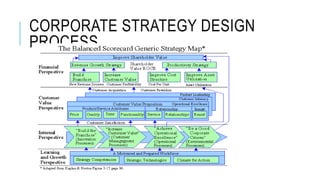
Financial Prospective
Whether companies use return on investment, return on capital
employed (ROCE), Economic Value Added (EVA) or some other value
based metric as a high level financial objective
They have basic two strategies
• Revenue growth strategy
• Productivity strategy
CORPORATE STRATEGY DESIGN
PROCESS
Financial Perspective
Revenue growth strategy
Revenue growth strategy focusses on developing new sources and
profitability it has generally two components:-
•Built a franchise – Develop new sources of revenue from new market
new products or new customers. This strategy implies greatest
amount of change but longer time to execute.
• Increase customer value – work with existing customers to expand
their relationship with company.
CORPORATE STRATEGY DESIGN
PROCESS
Financial Prospective
Productivity strategy
Efficient execution of operational activities in support of existing
customers. Productivity strategy focusses on cost reduction and
efficiency. Two components are:-
• Improve cost structure – Lowering the direct cost of products and
services reducing indirect cost and share common resources with
other business unit.
• Improve asset utilization – Reduce the working and fixed capital
needed to support a given level of business by more efficient
utilization, more careful acquisition or disposal of parts of current
and fixed asset.
CORPORATE STRATEGY DESIGN
PROCESS
The Customer perspective
The customer perspective is the heart of strategy and defines how
growth will be achieved.This value proposition defines the specific
strategy to compete for new customers or an increased share of
existing customers. Three strategies are defined:-
• Product leadership – A product leadership companies pushes its
product into realm of the unknown, the untried or highly desirable.
• Customer intimacy – This type companies builds bonds with its
customers: it knows the people to whom it sells and the product and
services it needs.
•Operational Excellence – Operationally Excellent Companies delivers a
combination of quality , price and ease of purchase that no one else
CORPORATE STRATEGY DESIGN
PROCESS
The Internal Perspective
It defines the business process and the specific activities the
organization must master to support customer value proposition.
• Innovation process
• Customer management process
• operational process
• Regulatory and environment process
It is important that companies whose operation entail significant
Environment, Health, Safety (EHS) risk need to comply with
regulations in community where they operate.
CORPORATE STRATEGY DESIGN
PROCESS
The learning and growth prospective
It defines the intangible asset needed to enable activities and
customer relationship to be conducted at higher levels of
performance.
There are three principal categories:-
• Strategic competencies – Strategic skills and knowledge required by
workforce support strategy
• Strategic technologies – are the materials and process technologies,
information system, database, tools and network required to support
the strategy.
• Climate for actions – cultural shifts needed to motivate, empower
and align the workforce behind strategy.
STRATEGIC FIT : FITTING OPERATIONAL
ACTIVITY TO STRATEGY
• Activities of firms operation related to one another.
•Making this activities efficient means minimizing total cost
• Also making them effective means making the combined set of
activities support the firm strategy.
Activity System Map
• shows how company strategy is delivered through a set of tailored
activities.
• useful in understanding how good the fit is between the system of
activities and comparing Strategy.
• Competitive advantage comes from the way a firms activities fit and
reinforce one another
STRATEGIC FIT : FITTING OPERATIONAL
ACTIVITY TO STRATEGY
A Framework for operating strategy in manufacturing
Linked vertically to customer and horizontally to other parts of
enterprise.
Core Capabilities – skills that differentiates the service or
manufacturing from others.
Getting advanced with technologies.
STRATEGIC FIT : FITTING OPERATIONAL
ACTIVITY TO STRATEGY
Developing Manufacturing Strategies
OBJECTIVES
• Translate required competitive dimensions into specific performance
requirement for operations.
• To make plans necessary to ensure that operations capabilities are
significant to accomplish them.
STEPS
1. Segment the market according to product group.
2. Identify the product requirments, demand patterns and profit margin of
each group
3. Determine the order winners & order qualifiers of each group.
4. Convert order winners into specific performance requirement.
STRATEGIC FIT : FITTING OPERATIONAL
ACTIVITY TO STRATEGY
Operation Strategy in services
• PWP
• focus on uniqueness
• Good location
• Easy access
•Identify order winner and order qualifier.
STRATEGIC FIT : FITTING OPERATIONAL
ACTIVITY TO STRATEGY
Internet complements Strategy
• Replaced conventional ways of doing business
• Strategies that employ online activities do not eliminate the need for
physical activity.
• Integration of Internet and traditional way of competing should be a
win for any company.
PRODUCTIVITY MEASUREMENT
Key Performance Indicators
A quantifiable measure used to evaluate the success of an
organization, Employees etc. in meeting objectives for performance.
Productivity
It is a common measure of how well industry, business unit is using
its resources
OPERATION MANAGEMENT focusses on making the best use of
available resources. PRODUCTIVITY measurement is fundamental to
understand operation related performance.
THANK YOU

Operation strategy and competitiveness

  • 1.
  • 2.
    WHAT IS OPERATIONSTRATEGY? Setting broad policies and plans for using the resources of the firm to the best support its long term competitive strategy. Strategic decisions involves logic associated with planning and control systems, quality assurance and control approaches, work payment structures and organization of operations function.
  • 3.
    OPERATION COMPETITIVE DIMENSIONS  COMPETITIVEDIMENSIONS Cost or Price Quantity Delivery Speed Delivery Reliability Coping with changes in Demand Flexibility and New-Product Introduction Speed Other Product-Specific Criteria
  • 4.
    COST OR PRICE Makeproduct or deliver the service cheap.
  • 5.
    QUALITY •Make a greatproduct or deliver great service • Quality has two characteristics defined as design quality and process quality. • Design quality relates to set of features the product or service contains. • Process Quality relates directly reliability of product or services.
  • 6.
    DELIVERY SPEED • Makeproduct or deliver the service quickly. • Firms ability to deliver more quickly then competitors DELIVERY RELAIBILITY • Deliver it when promised. • Firms ability to supply product or service on or before promised delivery date and time COPING WITH CHANGES IN DEMAND • Firms ability to respond to increase and decrease in demand is important to its ability to compete.
  • 7.
    FLEXIBILITY & NEWPRODUCT INTRODUCTION SPEED • Ability of a company to offer a wide variety of products to its customers.OTHER PRODUCT SPECIFIC CRITERIA • Technical liaison and support. • Meeting a launch date • Supplier after sales support • Other dimensions
  • 8.
    THE NOTION OFTRADE-OFFS • Central to concept of operation strategy in the notion of operation focus and trade-offs • Firms cannot excel simultaneously on all competitive dimensions. • Management has to decide which parameters of performance are critical for firms success and then concentrate resources on these particular characteristics. • Plant within a plant (PWP) concept in which different locations within facility are allocated to different production line each with their own operation strategy. • Strategic position is not sustainable unless there are compromises with other position • Straddling occurs when company seeks to match the benefits of a
  • 9.
    ORDER WINNERS ANDQUALIFIERS • Interface between marketing and operations is necessary to provide a business with an understanding of its market from both prospective. • Order winner is a criterion that differentiates products or services of one firm from another • Order Qualifier is a screening criterion that permits a firms products to even be considered as possible candidates for purchase.
  • 10.
  • 11.
    CORPORATE STRATEGY DESIGN PROCESS FinancialProspective Whether companies use return on investment, return on capital employed (ROCE), Economic Value Added (EVA) or some other value based metric as a high level financial objective They have basic two strategies • Revenue growth strategy • Productivity strategy
  • 12.
    CORPORATE STRATEGY DESIGN PROCESS FinancialPerspective Revenue growth strategy Revenue growth strategy focusses on developing new sources and profitability it has generally two components:- •Built a franchise – Develop new sources of revenue from new market new products or new customers. This strategy implies greatest amount of change but longer time to execute. • Increase customer value – work with existing customers to expand their relationship with company.
  • 13.
    CORPORATE STRATEGY DESIGN PROCESS FinancialProspective Productivity strategy Efficient execution of operational activities in support of existing customers. Productivity strategy focusses on cost reduction and efficiency. Two components are:- • Improve cost structure – Lowering the direct cost of products and services reducing indirect cost and share common resources with other business unit. • Improve asset utilization – Reduce the working and fixed capital needed to support a given level of business by more efficient utilization, more careful acquisition or disposal of parts of current and fixed asset.
  • 14.
    CORPORATE STRATEGY DESIGN PROCESS TheCustomer perspective The customer perspective is the heart of strategy and defines how growth will be achieved.This value proposition defines the specific strategy to compete for new customers or an increased share of existing customers. Three strategies are defined:- • Product leadership – A product leadership companies pushes its product into realm of the unknown, the untried or highly desirable. • Customer intimacy – This type companies builds bonds with its customers: it knows the people to whom it sells and the product and services it needs. •Operational Excellence – Operationally Excellent Companies delivers a combination of quality , price and ease of purchase that no one else
  • 15.
    CORPORATE STRATEGY DESIGN PROCESS TheInternal Perspective It defines the business process and the specific activities the organization must master to support customer value proposition. • Innovation process • Customer management process • operational process • Regulatory and environment process It is important that companies whose operation entail significant Environment, Health, Safety (EHS) risk need to comply with regulations in community where they operate.
  • 16.
    CORPORATE STRATEGY DESIGN PROCESS Thelearning and growth prospective It defines the intangible asset needed to enable activities and customer relationship to be conducted at higher levels of performance. There are three principal categories:- • Strategic competencies – Strategic skills and knowledge required by workforce support strategy • Strategic technologies – are the materials and process technologies, information system, database, tools and network required to support the strategy. • Climate for actions – cultural shifts needed to motivate, empower and align the workforce behind strategy.
  • 17.
    STRATEGIC FIT :FITTING OPERATIONAL ACTIVITY TO STRATEGY • Activities of firms operation related to one another. •Making this activities efficient means minimizing total cost • Also making them effective means making the combined set of activities support the firm strategy. Activity System Map • shows how company strategy is delivered through a set of tailored activities. • useful in understanding how good the fit is between the system of activities and comparing Strategy. • Competitive advantage comes from the way a firms activities fit and reinforce one another
  • 19.
    STRATEGIC FIT :FITTING OPERATIONAL ACTIVITY TO STRATEGY A Framework for operating strategy in manufacturing Linked vertically to customer and horizontally to other parts of enterprise. Core Capabilities – skills that differentiates the service or manufacturing from others. Getting advanced with technologies.
  • 21.
    STRATEGIC FIT :FITTING OPERATIONAL ACTIVITY TO STRATEGY Developing Manufacturing Strategies OBJECTIVES • Translate required competitive dimensions into specific performance requirement for operations. • To make plans necessary to ensure that operations capabilities are significant to accomplish them. STEPS 1. Segment the market according to product group. 2. Identify the product requirments, demand patterns and profit margin of each group 3. Determine the order winners & order qualifiers of each group. 4. Convert order winners into specific performance requirement.
  • 22.
    STRATEGIC FIT :FITTING OPERATIONAL ACTIVITY TO STRATEGY Operation Strategy in services • PWP • focus on uniqueness • Good location • Easy access •Identify order winner and order qualifier.
  • 23.
    STRATEGIC FIT :FITTING OPERATIONAL ACTIVITY TO STRATEGY Internet complements Strategy • Replaced conventional ways of doing business • Strategies that employ online activities do not eliminate the need for physical activity. • Integration of Internet and traditional way of competing should be a win for any company.
  • 24.
    PRODUCTIVITY MEASUREMENT Key PerformanceIndicators A quantifiable measure used to evaluate the success of an organization, Employees etc. in meeting objectives for performance. Productivity It is a common measure of how well industry, business unit is using its resources OPERATION MANAGEMENT focusses on making the best use of available resources. PRODUCTIVITY measurement is fundamental to understand operation related performance.
  • 25.