Process Strategies
Chapter 7
Process Strategy
“An organization’s approach to transforming
resources into goods and services”.
The objective of a process strategy is to build a
production process that meets customer
requirements and product specifications within
cost and other managerial constraints.
Process Strategy
Almost every good or service is made by using some
variation of one of four process strategies:
1. Process focus
2. Repetitive focus
3. Product focus
4. Mass customization
Process Strategy
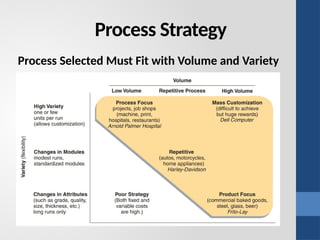
Process Selected Must Fit with Volume and Variety
FOUR PROCESS STRATEGIES
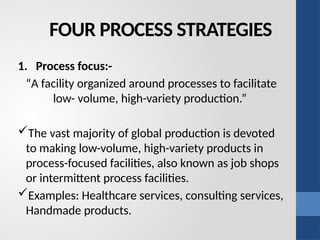
1. Process focus:-
“A facility organized around processes to facilitate
low- volume, high-variety production.”
The vast majority of global production is devoted
to making low-volume, high-variety products in
process-focused facilities, also known as job shops
or intermittent process facilities.
Examples: Healthcare services, consulting services,
Handmade products.
FOUR PROCESS STRATEGIES
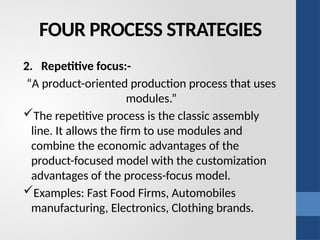
2. Repetitive focus:-
“A product-oriented production process that uses
modules.”
The repetitive process is the classic assembly
line. It allows the firm to use modules and
combine the economic advantages of the
product-focused model with the customization
advantages of the process-focus model.
Examples: Fast Food Firms, Automobiles
manufacturing, Electronics, Clothing brands.
FOUR PROCESS STRATEGIES
3. Product Focus:-
“A facility organized around products; a product-
oriented, high volume, low-variety process”.
Product-focused facilities are also called continuous
processes because they have very long, continuous
production runs.
The specialized nature of a product-focused facility
requires high fixed cost; however, low variable costs
reward high facility utilization.
Examples: Soft Drinks, Packaged Snacks, Personal
Care products.
FOUR PROCESS STRATEGIES
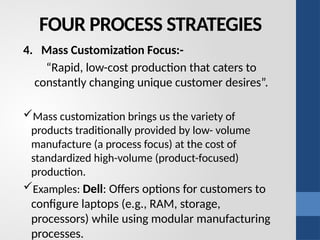
4. Mass Customization Focus:-
“Rapid, low-cost production that caters to
constantly changing unique customer desires”.
Mass customization brings us the variety of
products traditionally provided by low- volume
manufacture (a process focus) at the cost of
standardized high-volume (product-focused)
production.
Examples: Dell: Offers options for customers to
configure laptops (e.g., RAM, storage,
processors) while using modular manufacturing
processes.
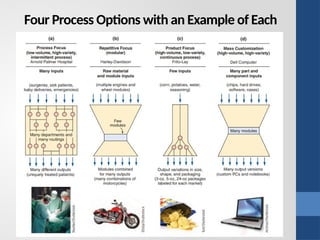
Four Process Options with an Example of Each
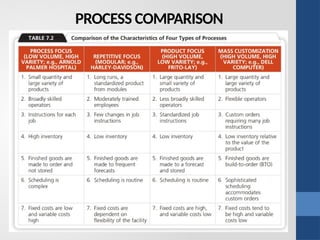
PROCESS COMPARISON
PROCESS COMPARISON
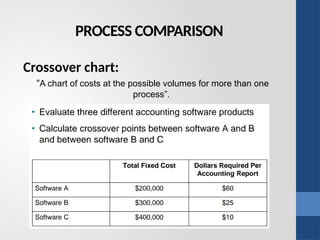
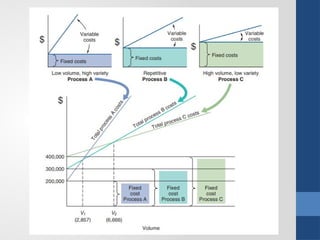
Crossover chart:
“A chart of costs at the possible volumes for more than one
process”.
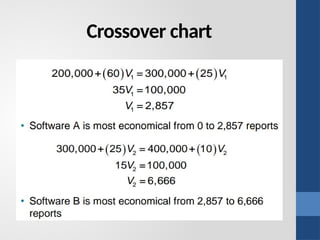
Crossover chart
SELECTION OF EQUIPMENT
“Picking the best equipment involves understanding
the specific industry and available processes and
technology”.
Important factors include:
• Cost
• Quality
• Capacity
• Flexibility: Ability to respond
In this age of rapid technological change and short
product life cycles, adding flexibility to the
production process can be a major competitive
advantage.
PROCESS ANALYSIS AND DESIGN
Process analysis and design not only addresses various
issues regarding value addition, but also related Operations
Management issues such as throughput, cost, and quality.
Process is key so its important to examine the process and
then continuously improve the process.
Five tools of process analysis are:
1. Flowcharts
2. time-function mapping
3. process charts
4. value-stream mapping
5. service blueprinting.
PROCESS ANALYSIS AND DESIGN
1. Flowchart: A drawing used to analyze movement
of people or materials.
2. Time-function mapping (or process mapping): A
flowchart with time added on the horizontal axis.
3. Process charts: Charts that use symbols to
analyze the movement of people or material.
PROCESS ANALYSIS AND DESIGN
4. Value-stream mapping (VSM): A tool that helps
managers understand how to add value in the
flow of material and information through the
entire production process.
5. Service blueprinting: A process analysis
technique that lends itself to a focus on the
customer and the provider’s interaction with the
customer.
SPECIAL CONSIDERATIONS FOR SERVICE
PROCESS STRATEGIES
Some interaction with customer is necessary, but
this often affects performance adversely.
The better these interactions are accommodated
in the process design, the more efficient and
effective the process.
So its important to select the right combination of
cost and customization.
PRODUCTION TECHNOLOGY
Advances in technology that enhance production and
productivity are changing how things are designed,
made, and serviced around the world.
1. Machine technology
2. Automatic identification systems (AISs)
3. Process control
4. Vision systems
5. Robots
6. Automated storage and retrieval systems (ASRSs)
7. Automated guided vehicles (AGVs)
8. Flexible manufacturing systems (FMSs)
9. Computer-integrated manufacturing (CIM
PROCESS REDEIGN
The world is a dynamic place, and customer
desires, product technology, and product mix
change. Consequently, processes are redesigned.
Process Redesign is “the fundamental rethinking
of business processes to bring about dramatic
improvements in performance”.

OPMgmt Chapter 7 (Process Strategies).pptx

  • 1.
  • 2.
    Process Strategy “An organization’sapproach to transforming resources into goods and services”. The objective of a process strategy is to build a production process that meets customer requirements and product specifications within cost and other managerial constraints.
  • 3.
    Process Strategy Almost everygood or service is made by using some variation of one of four process strategies: 1. Process focus 2. Repetitive focus 3. Product focus 4. Mass customization
  • 4.
    Process Strategy Process SelectedMust Fit with Volume and Variety
  • 5.
    FOUR PROCESS STRATEGIES 1.Process focus:- “A facility organized around processes to facilitate low- volume, high-variety production.” The vast majority of global production is devoted to making low-volume, high-variety products in process-focused facilities, also known as job shops or intermittent process facilities. Examples: Healthcare services, consulting services, Handmade products.
  • 6.
    FOUR PROCESS STRATEGIES 2.Repetitive focus:- “A product-oriented production process that uses modules.” The repetitive process is the classic assembly line. It allows the firm to use modules and combine the economic advantages of the product-focused model with the customization advantages of the process-focus model. Examples: Fast Food Firms, Automobiles manufacturing, Electronics, Clothing brands.
  • 7.
    FOUR PROCESS STRATEGIES 3.Product Focus:- “A facility organized around products; a product- oriented, high volume, low-variety process”. Product-focused facilities are also called continuous processes because they have very long, continuous production runs. The specialized nature of a product-focused facility requires high fixed cost; however, low variable costs reward high facility utilization. Examples: Soft Drinks, Packaged Snacks, Personal Care products.
  • 8.
    FOUR PROCESS STRATEGIES 4.Mass Customization Focus:- “Rapid, low-cost production that caters to constantly changing unique customer desires”. Mass customization brings us the variety of products traditionally provided by low- volume manufacture (a process focus) at the cost of standardized high-volume (product-focused) production. Examples: Dell: Offers options for customers to configure laptops (e.g., RAM, storage, processors) while using modular manufacturing processes.
  • 9.
    Four Process Optionswith an Example of Each
  • 10.
  • 11.
    PROCESS COMPARISON Crossover chart: “Achart of costs at the possible volumes for more than one process”.
  • 12.
  • 14.
    SELECTION OF EQUIPMENT “Pickingthe best equipment involves understanding the specific industry and available processes and technology”. Important factors include: • Cost • Quality • Capacity • Flexibility: Ability to respond In this age of rapid technological change and short product life cycles, adding flexibility to the production process can be a major competitive advantage.
  • 15.
    PROCESS ANALYSIS ANDDESIGN Process analysis and design not only addresses various issues regarding value addition, but also related Operations Management issues such as throughput, cost, and quality. Process is key so its important to examine the process and then continuously improve the process. Five tools of process analysis are: 1. Flowcharts 2. time-function mapping 3. process charts 4. value-stream mapping 5. service blueprinting.
  • 16.
    PROCESS ANALYSIS ANDDESIGN 1. Flowchart: A drawing used to analyze movement of people or materials. 2. Time-function mapping (or process mapping): A flowchart with time added on the horizontal axis. 3. Process charts: Charts that use symbols to analyze the movement of people or material.
  • 17.
    PROCESS ANALYSIS ANDDESIGN 4. Value-stream mapping (VSM): A tool that helps managers understand how to add value in the flow of material and information through the entire production process. 5. Service blueprinting: A process analysis technique that lends itself to a focus on the customer and the provider’s interaction with the customer.
  • 18.
    SPECIAL CONSIDERATIONS FORSERVICE PROCESS STRATEGIES Some interaction with customer is necessary, but this often affects performance adversely. The better these interactions are accommodated in the process design, the more efficient and effective the process. So its important to select the right combination of cost and customization.
  • 19.
    PRODUCTION TECHNOLOGY Advances intechnology that enhance production and productivity are changing how things are designed, made, and serviced around the world. 1. Machine technology 2. Automatic identification systems (AISs) 3. Process control 4. Vision systems 5. Robots 6. Automated storage and retrieval systems (ASRSs) 7. Automated guided vehicles (AGVs) 8. Flexible manufacturing systems (FMSs) 9. Computer-integrated manufacturing (CIM
  • 20.
    PROCESS REDEIGN The worldis a dynamic place, and customer desires, product technology, and product mix change. Consequently, processes are redesigned. Process Redesign is “the fundamental rethinking of business processes to bring about dramatic improvements in performance”.