HISTORICAL EVOLUTION OF OM
INTRODUCTION
 operations management is the management of
systems or processes that create goods or provide
services.
EVOLUTION
Industrial Revolution
 Began in the 1770s in England and spread
to the rest of Europe and to the United
States during the 19th century.
 Substituted machine power for human
power.
 Most significant machine was steam engine.
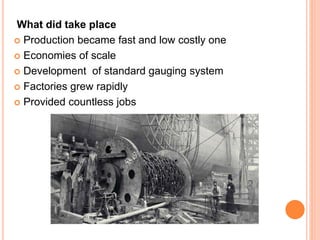
What did take place
 Production became fast and low costly one
 Economies of scale
 Development of standard gauging system
 Factories grew rapidly
 Provided countless jobs
SCIENTIFIC MANAGEMENT
 Widely changed the management of factories.
 Developed by Frederick Winslow Taylor, the
father of scientific management.
 Based on observation, measurement,
analysis and improvement of work methods
and economic incentives.
 Studied to identify the best method for doing
each job.
Cont….
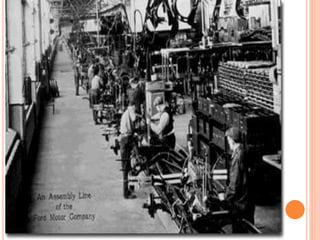
 Henry Ford practically adopted the scientific management
principles for Taylor.
 Introduced the moving assembly line, which affected to
many industries.
 Introduced mass production to the automotive industry.
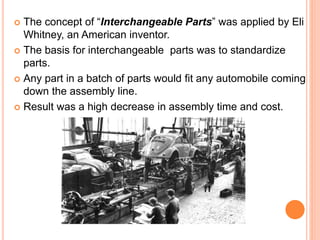
 The concept of “Interchangeable Parts” was applied by Eli
Whitney, an American inventor.
 The basis for interchangeable parts was to standardize
parts.
 Any part in a batch of parts would fit any automobile coming
down the assembly line.
 Result was a high decrease in assembly time and cost.
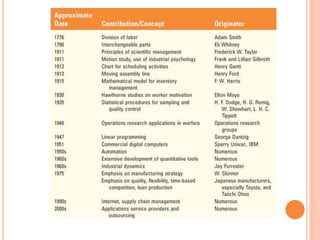
 Concept of division of labor, which Adam Smith wrote
about in the wealth of Nations (1776) was used by Ford.
 An operation is divided up in to a series of many small
tasks, individual workers are assigned to one of those
tasks.
PIONEERS WHO CONTRIBUTED
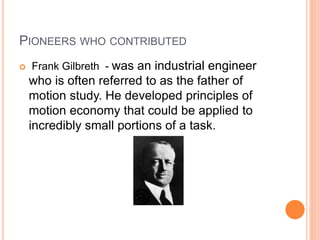
 Frank Gilbreth - was an industrial engineer
who is often referred to as the father of
motion study. He developed principles of
motion economy that could be applied to
incredibly small portions of a task.
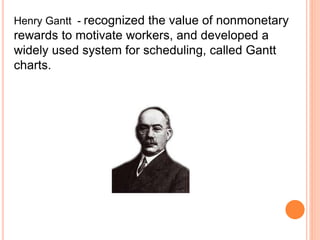
Henry Gantt - recognized the value of nonmonetary
rewards to motivate workers, and developed a
widely used system for scheduling, called Gantt
charts.
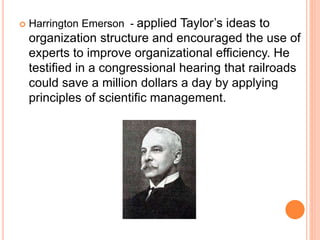
 Harrington Emerson - applied Taylor’s ideas to
organization structure and encouraged the use of
experts to improve organizational efficiency. He
testified in a congressional hearing that railroads
could save a million dollars a day by applying
principles of scientific management.
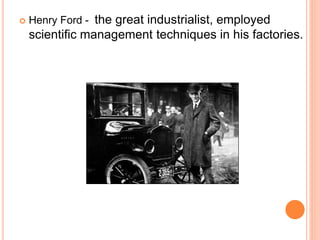
 Henry Ford - the great industrialist, employed
scientific management techniques in his factories.
DECISION MODELS AND MANAGEMENT
SCIENCE
Accompanied by the development of several
quantitative techniques.
 F.W. Harris developed a mathematical model for
inventory order size in 1915.
 H.F. Dodge, H.G. Romig and W. Shewhart
developed statistical procedures for sampling and
quality control in 1930.
 L.H.C. Tippott conducted studies that provided the
groundwork for statistical sampling theory In 1935.
 Those qualitative models were widely used in world war
2.
 These decision models were also used for forecasting,
inventory management, project management and other
areas of operations management
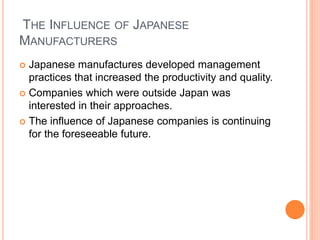
THE INFLUENCE OF JAPANESE
MANUFACTURERS
 Japanese manufactures developed management
practices that increased the productivity and quality.
 Companies which were outside Japan was
interested in their approaches.
 The influence of Japanese companies is continuing
for the foreseeable future.
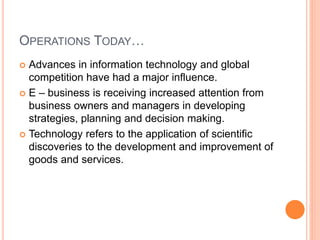
OPERATIONS TODAY…
 Advances in information technology and global
competition have had a major influence.
 E – business is receiving increased attention from
business owners and managers in developing
strategies, planning and decision making.
 Technology refers to the application of scientific
discoveries to the development and improvement of
goods and services.
 Operations management is concerned with product and
service technology, process technology and information
technology.
 Created by;
 Shakthi Fernando
 Sandun Ulpathakumbura
 BSc. Financial management(Special)-Undergraduates
Sabaragamuwa University of Sri Lanka
Historical evolution of operations management

Historical evolution of operations management

  • 1.
  • 2.
    INTRODUCTION  operations managementis the management of systems or processes that create goods or provide services.
  • 3.
    EVOLUTION Industrial Revolution  Beganin the 1770s in England and spread to the rest of Europe and to the United States during the 19th century.  Substituted machine power for human power.  Most significant machine was steam engine.
  • 4.
    What did takeplace  Production became fast and low costly one  Economies of scale  Development of standard gauging system  Factories grew rapidly  Provided countless jobs
  • 5.
    SCIENTIFIC MANAGEMENT  Widelychanged the management of factories.  Developed by Frederick Winslow Taylor, the father of scientific management.  Based on observation, measurement, analysis and improvement of work methods and economic incentives.  Studied to identify the best method for doing each job.
  • 6.
    Cont….  Henry Fordpractically adopted the scientific management principles for Taylor.  Introduced the moving assembly line, which affected to many industries.  Introduced mass production to the automotive industry.
  • 8.
     The conceptof “Interchangeable Parts” was applied by Eli Whitney, an American inventor.  The basis for interchangeable parts was to standardize parts.  Any part in a batch of parts would fit any automobile coming down the assembly line.  Result was a high decrease in assembly time and cost.
  • 9.
     Concept ofdivision of labor, which Adam Smith wrote about in the wealth of Nations (1776) was used by Ford.  An operation is divided up in to a series of many small tasks, individual workers are assigned to one of those tasks.
  • 10.
    PIONEERS WHO CONTRIBUTED Frank Gilbreth - was an industrial engineer who is often referred to as the father of motion study. He developed principles of motion economy that could be applied to incredibly small portions of a task.
  • 11.
    Henry Gantt -recognized the value of nonmonetary rewards to motivate workers, and developed a widely used system for scheduling, called Gantt charts.
  • 12.
     Harrington Emerson- applied Taylor’s ideas to organization structure and encouraged the use of experts to improve organizational efficiency. He testified in a congressional hearing that railroads could save a million dollars a day by applying principles of scientific management.
  • 13.
     Henry Ford- the great industrialist, employed scientific management techniques in his factories.
  • 14.
    DECISION MODELS ANDMANAGEMENT SCIENCE Accompanied by the development of several quantitative techniques.  F.W. Harris developed a mathematical model for inventory order size in 1915.  H.F. Dodge, H.G. Romig and W. Shewhart developed statistical procedures for sampling and quality control in 1930.  L.H.C. Tippott conducted studies that provided the groundwork for statistical sampling theory In 1935.
  • 15.
     Those qualitativemodels were widely used in world war 2.  These decision models were also used for forecasting, inventory management, project management and other areas of operations management
  • 16.
    THE INFLUENCE OFJAPANESE MANUFACTURERS  Japanese manufactures developed management practices that increased the productivity and quality.  Companies which were outside Japan was interested in their approaches.  The influence of Japanese companies is continuing for the foreseeable future.
  • 17.
    OPERATIONS TODAY…  Advancesin information technology and global competition have had a major influence.  E – business is receiving increased attention from business owners and managers in developing strategies, planning and decision making.  Technology refers to the application of scientific discoveries to the development and improvement of goods and services.
  • 18.
     Operations managementis concerned with product and service technology, process technology and information technology.
  • 20.
     Created by; Shakthi Fernando  Sandun Ulpathakumbura  BSc. Financial management(Special)-Undergraduates Sabaragamuwa University of Sri Lanka