 Introduction .
 Definition Of Atrio-ventricular Heart Block .
 Etiology .
 Types of Heart Block :
 First degree heart block .
 Second degree heart block.
 Third Degree ( Complete ) heart block .
 Clinical Manifestation .
 Management .
 Nursing Diagnosis.
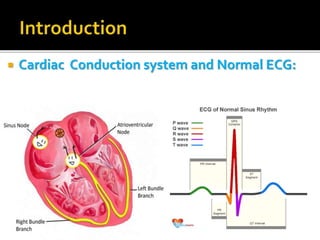
 Cardiac Conduction system and Normal ECG:
 It is a partial or complete interruption of
impulses transmission from Atrium to
Ventricle .
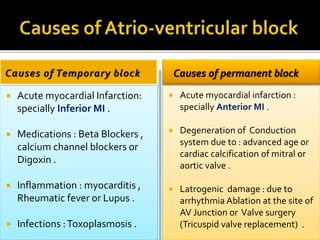
 Acute myocardial Infarction:
specially Inferior MI .
 Medications : Beta Blockers ,
calcium channel blockers or
Digoxin .
 Inflammation : myocarditis ,
Rheumatic fever or Lupus .
 Infections :Toxoplasmosis .
Causes of permanent block
 Acute myocardial infarction :
specially Anterior MI .
 Degeneration of Conduction
system due to : advanced age or
cardiac calcification of mitral or
aortic valve .
 Latrogenic damage : due to
arrhythmia Ablation at the site of
AV Junction or Valve surgery
(Tricuspid valve replacement) .
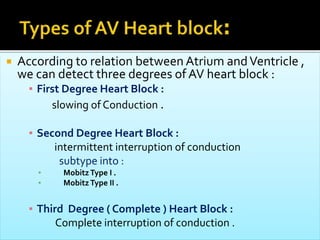
 According to relation between Atrium andVentricle ,
we can detect three degrees of AV heart block :
▪ First Degree Heart Block :
slowing of Conduction .
▪ Second Degree Heart Block :
intermittent interruption of conduction
subtype into :
▪ Mobitz Type I .
▪ Mobitz Type II .
▪ Third Degree ( Complete ) Heart Block :
Complete interruption of conduction .
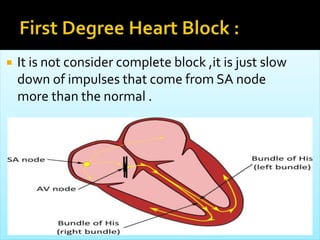
 It is not consider complete block ,it is just slow
down of impulses that come from SA node
more than the normal .
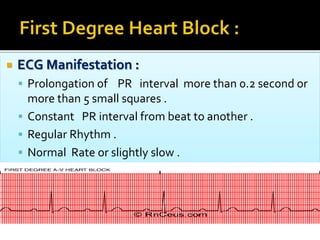
 ECG Manifestation :
 Prolongation of PR interval more than 0.2 second or
more than 5 small squares .
 Constant PR interval from beat to another .
 Regular Rhythm .
 Normal Rate or slightly slow .
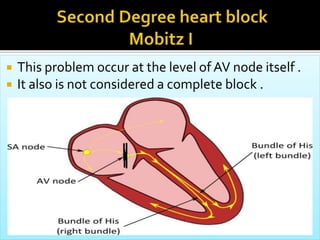
 This problem occur at the level of AV node itself .
 It also is not considered a complete block .
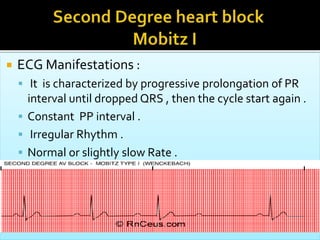
 ECG Manifestations :
 It is characterized by progressive prolongation of PR
interval until dropped QRS , then the cycle start again .
 Constant PP interval .
 Irregular Rhythm .
 Normal or slightly slow Rate .
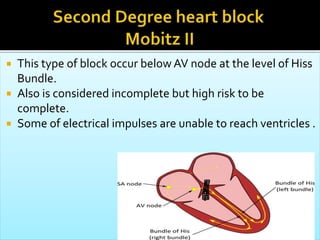
 This type of block occur below AV node at the level of Hiss
Bundle.
 Also is considered incomplete but high risk to be
complete.
 Some of electrical impulses are unable to reach ventricles .
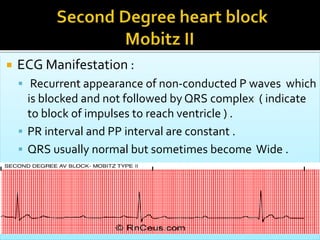
 ECG Manifestation :
 Recurrent appearance of non-conducted P waves which
is blocked and not followed by QRS complex ( indicate
to block of impulses to reach ventricle ) .
 PR interval and PP interval are constant .
 QRS usually normal but sometimes become Wide .
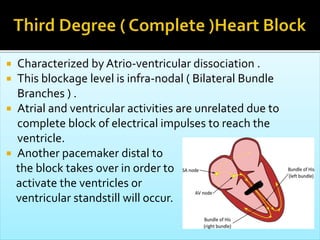
 Characterized by Atrio-ventricular dissociation .
 This blockage level is infra-nodal ( Bilateral Bundle
Branches ) .
 Atrial and ventricular activities are unrelated due to
complete block of electrical impulses to reach the
ventricle.
 Another pacemaker distal to
the block takes over in order to
activate the ventricles or
ventricular standstill will occur.
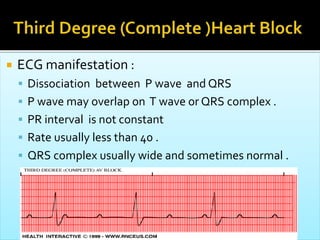
 ECG manifestation :
 Dissociation between P wave and QRS
 P wave may overlap on T wave or QRS complex .
 PR interval is not constant
 Rate usually less than 40 .
 QRS complex usually wide and sometimes normal .
 Usually first degree and sometimes second degree
are asymptomatic .
 The most common signs and symptoms :
 Sever Bradycardia .
 Hypotension .
 Syncope ( fainting ) .
 Chest pain .
 Dyspnea .
 Dizziness .
 General Management :
 Cardiac monitoring : for close observation .
 Oxygen supply : to Manage de-saturated patients .
 IV Line :To support blood pressure with fluids .
 Atropine standby : to treat bradycardia specially
incomplete degrees .
Management of heart block depend on symptoms
 First degree heart block :
this type usually is asymptomatic and not indicated for treatment :
 Close observation of Hemodynamic status .
 Discontinue of some medication that cause bradycardia such as :
▪ Beta-blockers : Concor
▪ Digoxins : Lanoxine
▪ calcium channel blockers : Diltiazem .
Just for
 Second Degree and Complete heart block :
 Usually these degrees are associated with sever bradycardia which can be
treated by atropine .
 Associated conditions should be treated correctly such as :
▪ Myocardial infarction.
▪ Electrolyte disturbance (hyperkalemia).
▪ Digitals intoxication.
 Transvenous temporary pacemaker is indicated for pt with sever
bradycardia who has no effect of Atropine administration (For 24 hours : 48
hours .)
 Transcutanous permanent pace-maker is indicated for
chronic AV block .
 Nursing priorities :
 Decrease cardiac output related to failure of the heart to pump
enough blood to meet metabolic needs of the body as manifested by
hypotension .
 Acute chest Pain related to decrease blood flow to myocardium
through coronary arteries .
 Ineffective Tissue perfusion related to decrease cardiac output as
manifested by pt syncope .
 Fatigue related to increase hypoxic tissue and slowed removal of
metabolic wastes.
Heart block

Heart block

  • 2.
     Introduction . Definition Of Atrio-ventricular Heart Block .  Etiology .  Types of Heart Block :  First degree heart block .  Second degree heart block.  Third Degree ( Complete ) heart block .  Clinical Manifestation .  Management .  Nursing Diagnosis.
  • 3.
     Cardiac Conductionsystem and Normal ECG:
  • 4.
     It isa partial or complete interruption of impulses transmission from Atrium to Ventricle .
  • 5.
     Acute myocardialInfarction: specially Inferior MI .  Medications : Beta Blockers , calcium channel blockers or Digoxin .  Inflammation : myocarditis , Rheumatic fever or Lupus .  Infections :Toxoplasmosis . Causes of permanent block  Acute myocardial infarction : specially Anterior MI .  Degeneration of Conduction system due to : advanced age or cardiac calcification of mitral or aortic valve .  Latrogenic damage : due to arrhythmia Ablation at the site of AV Junction or Valve surgery (Tricuspid valve replacement) .
  • 6.
     According torelation between Atrium andVentricle , we can detect three degrees of AV heart block : ▪ First Degree Heart Block : slowing of Conduction . ▪ Second Degree Heart Block : intermittent interruption of conduction subtype into : ▪ Mobitz Type I . ▪ Mobitz Type II . ▪ Third Degree ( Complete ) Heart Block : Complete interruption of conduction .
  • 7.
     It isnot consider complete block ,it is just slow down of impulses that come from SA node more than the normal .
  • 8.
     ECG Manifestation:  Prolongation of PR interval more than 0.2 second or more than 5 small squares .  Constant PR interval from beat to another .  Regular Rhythm .  Normal Rate or slightly slow .
  • 9.
     This problemoccur at the level of AV node itself .  It also is not considered a complete block .
  • 10.
     ECG Manifestations:  It is characterized by progressive prolongation of PR interval until dropped QRS , then the cycle start again .  Constant PP interval .  Irregular Rhythm .  Normal or slightly slow Rate .
  • 11.
     This typeof block occur below AV node at the level of Hiss Bundle.  Also is considered incomplete but high risk to be complete.  Some of electrical impulses are unable to reach ventricles .
  • 12.
     ECG Manifestation:  Recurrent appearance of non-conducted P waves which is blocked and not followed by QRS complex ( indicate to block of impulses to reach ventricle ) .  PR interval and PP interval are constant .  QRS usually normal but sometimes become Wide .
  • 13.
     Characterized byAtrio-ventricular dissociation .  This blockage level is infra-nodal ( Bilateral Bundle Branches ) .  Atrial and ventricular activities are unrelated due to complete block of electrical impulses to reach the ventricle.  Another pacemaker distal to the block takes over in order to activate the ventricles or ventricular standstill will occur.
  • 14.
     ECG manifestation:  Dissociation between P wave and QRS  P wave may overlap on T wave or QRS complex .  PR interval is not constant  Rate usually less than 40 .  QRS complex usually wide and sometimes normal .
  • 15.
     Usually firstdegree and sometimes second degree are asymptomatic .  The most common signs and symptoms :  Sever Bradycardia .  Hypotension .  Syncope ( fainting ) .  Chest pain .  Dyspnea .  Dizziness .
  • 16.
     General Management:  Cardiac monitoring : for close observation .  Oxygen supply : to Manage de-saturated patients .  IV Line :To support blood pressure with fluids .  Atropine standby : to treat bradycardia specially incomplete degrees .
  • 17.
    Management of heartblock depend on symptoms  First degree heart block : this type usually is asymptomatic and not indicated for treatment :  Close observation of Hemodynamic status .  Discontinue of some medication that cause bradycardia such as : ▪ Beta-blockers : Concor ▪ Digoxins : Lanoxine ▪ calcium channel blockers : Diltiazem . Just for
  • 18.
     Second Degreeand Complete heart block :  Usually these degrees are associated with sever bradycardia which can be treated by atropine .  Associated conditions should be treated correctly such as : ▪ Myocardial infarction. ▪ Electrolyte disturbance (hyperkalemia). ▪ Digitals intoxication.  Transvenous temporary pacemaker is indicated for pt with sever bradycardia who has no effect of Atropine administration (For 24 hours : 48 hours .)  Transcutanous permanent pace-maker is indicated for chronic AV block .
  • 19.
     Nursing priorities:  Decrease cardiac output related to failure of the heart to pump enough blood to meet metabolic needs of the body as manifested by hypotension .  Acute chest Pain related to decrease blood flow to myocardium through coronary arteries .  Ineffective Tissue perfusion related to decrease cardiac output as manifested by pt syncope .  Fatigue related to increase hypoxic tissue and slowed removal of metabolic wastes.