PROJECTILE
MOTION
Peter Huruma Mammba
Department of General Studies
DODOMA POLYTECHNIC OF ENERGY AND EARTH RESOURCES
MANAGEMENT (MADINI INSTITUTE) –DODOMA
peter.huruma2011@gmail.com
Projectile Motion
What is projectile?
- Is any body that is given an initial velocity and then follows
a path determined entirely by the effects of gravitational
acceleration and air resistance.
Limitations
 The free fall acceleration is constant over the range of motion
and is directed downward.
i.e. g is constant in magnitude and direction.
 Air resistance is neglected.
Projectiles move in TWO dimensions
Since a projectile
moves in 2-
dimensions, it
therefore has 2
components just
like a resultant
vector.
 Horizontal and
Vertical
Projectile motion in 2D (x and y
Co-ordinate.
Horizontal “Velocity” Component
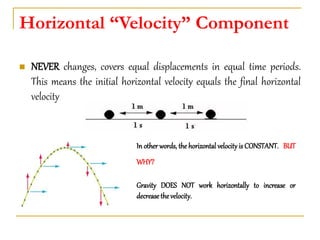
 NEVER changes, covers equal displacements in equal time periods.
This means the initial horizontal velocity equals the final horizontal
velocity
In other words, the horizontal velocity is CONSTANT. BUT
WHY?
Gravity DOES NOT work horizontally to increase or
decreasethevelocity.
Vertical “Velocity” Component
 Changes (due to gravity), does NOT cover equal displacements in
equal time periods.
Both the MAGNITUDE and DIRECTION change. As
the projectile moves up the MAGNITUDE
DECREASES and its direction is UPWARD. As it
moves down the MAGNITUDE INCREASES and the
direction is DOWNWARD.
Vertical velocity component cont…
 y- component of acceleration is constant = -g
 The projectile motion is always confined to a vertical plane
determine by the direction of initial velocity. This is because g is
purely vertical.
x
y
θ
vox
voy
Initial position: x = 0, y = 0
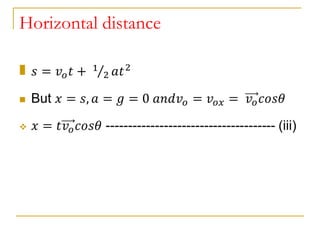
Horizontal distance

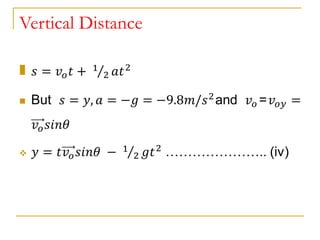
Vertical Distance

 We can analyze the projectile motion as a combination of
horizontal motion with constant velocity and vertical motion with
constant acceleration.
Combining the Components
(trajectory of the projectile
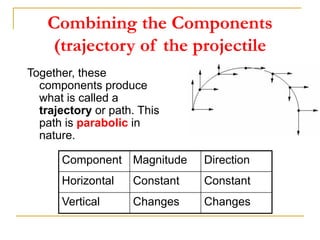
Together, these
components produce
what is called a
trajectory or path. This
path is parabolic in
nature.
Component Magnitude Direction
Horizontal Constant Constant
Vertical Changes Changes
Trajectory …

Trajectory …

Trajectory…

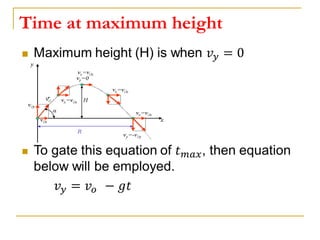
Time at maximum height


Time at which projectile reach to
the ground (T)

Maximum Height (H)
 It is the maximum height to which the projectile
rises above the launching point (origin)
 𝑦 = 𝑣0 𝑠𝑖𝑛𝛼0 𝑡 − 1
2 𝑔𝑡2
When 𝑡 = 𝑡 𝑚𝑎𝑥 = 𝑇
2 =
𝑣0 𝑠𝑖𝑛𝛼
𝑔
𝐻 = 𝑣0 𝑠𝑖𝑛𝛼0
𝑣0 𝑠𝑖𝑛𝛼
𝑔
− 1
2 𝑔
𝑣0 𝑠𝑖𝑛𝛼
𝑔
2
∴ 𝐻 =
𝑣0
2
𝑠𝑖𝑛2
𝛼
2𝑔
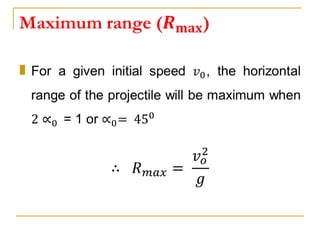
Horizontal range (R)


Example
A place kicker kicks a football with a velocity of 20.0 m/s
and at an angle of 53 degrees.
(a) How long is the ball in the air?
(b) How far away does it land?
(c) How high does it travel?
q = 53
cos
20cos53 12.04 /
sin
20sin53 15.97 /
ox o
ox
oy o
oy
v v
v m s
v v
v m s
q
q
=
= =
=
= =
Example
A place kicker kicks a
football with a
velocity of 20.0 m/s
and at an angle of 53
degrees.
(a) How long is the ball
in the air?
What I know What I want
to know
vox=12.04 m/s t = ?
voy=15.97 m/s x = ?
y = 0 ymax=?
g = - 9.8
m/s/s
2 2
2
1 0 (15.97) 4.9
2
15.97 4.9 15.97 4.9
oyy v t gt t t
t t t
t
=   = 
 =   =
= 3.26 s
Example
A place kicker kicks a
football with a
velocity of 20.0 m/s
and at an angle of 53
degrees.
(b) How far away does it
land?
What I know What I want
to know
vox=12.04 m/s t = 3.26 s
voy=15.97 m/s x = ?
y = 0 ymax=?
g = - 9.8
m/s/s
(12.04)(3.26)oxx v t=  = 39.24 m
Example
A place kicker kicks a
football with a velocity
of 20.0 m/s and at an
angle of 53 degrees.
(c) How high does it
travel?
CUT YOUR TIME IN HALF!
What I know What I want
to know
vox=12.04 m/s t = 3.26 s
voy=15.97 m/s x = 39.24 m
y = 0 ymax=?
g = - 9.8
m/s/s
2
2
1
2
(15.97)(1.63) 4.9(1.63)
oyy v t gt
y
y
= 
= 
= 13.01 m
example

Assignment 1


Projectile Motion

  • 1.
    PROJECTILE MOTION Peter Huruma Mammba Departmentof General Studies DODOMA POLYTECHNIC OF ENERGY AND EARTH RESOURCES MANAGEMENT (MADINI INSTITUTE) –DODOMA peter.huruma2011@gmail.com
  • 2.
  • 3.
    What is projectile? -Is any body that is given an initial velocity and then follows a path determined entirely by the effects of gravitational acceleration and air resistance.
  • 4.
    Limitations  The freefall acceleration is constant over the range of motion and is directed downward. i.e. g is constant in magnitude and direction.  Air resistance is neglected.
  • 5.
    Projectiles move inTWO dimensions Since a projectile moves in 2- dimensions, it therefore has 2 components just like a resultant vector.  Horizontal and Vertical
  • 6.
    Projectile motion in2D (x and y Co-ordinate.
  • 7.
    Horizontal “Velocity” Component NEVER changes, covers equal displacements in equal time periods. This means the initial horizontal velocity equals the final horizontal velocity In other words, the horizontal velocity is CONSTANT. BUT WHY? Gravity DOES NOT work horizontally to increase or decreasethevelocity.
  • 8.
    Vertical “Velocity” Component Changes (due to gravity), does NOT cover equal displacements in equal time periods. Both the MAGNITUDE and DIRECTION change. As the projectile moves up the MAGNITUDE DECREASES and its direction is UPWARD. As it moves down the MAGNITUDE INCREASES and the direction is DOWNWARD.
  • 9.
    Vertical velocity componentcont…  y- component of acceleration is constant = -g  The projectile motion is always confined to a vertical plane determine by the direction of initial velocity. This is because g is purely vertical.
  • 10.
  • 11.
  • 12.
  • 13.
     We cananalyze the projectile motion as a combination of horizontal motion with constant velocity and vertical motion with constant acceleration.
  • 14.
    Combining the Components (trajectoryof the projectile Together, these components produce what is called a trajectory or path. This path is parabolic in nature. Component Magnitude Direction Horizontal Constant Constant Vertical Changes Changes
  • 15.
  • 16.
  • 17.
  • 18.
    Time at maximumheight 
  • 19.
  • 20.
    Time at whichprojectile reach to the ground (T) 
  • 21.
    Maximum Height (H) It is the maximum height to which the projectile rises above the launching point (origin)  𝑦 = 𝑣0 𝑠𝑖𝑛𝛼0 𝑡 − 1 2 𝑔𝑡2 When 𝑡 = 𝑡 𝑚𝑎𝑥 = 𝑇 2 = 𝑣0 𝑠𝑖𝑛𝛼 𝑔 𝐻 = 𝑣0 𝑠𝑖𝑛𝛼0 𝑣0 𝑠𝑖𝑛𝛼 𝑔 − 1 2 𝑔 𝑣0 𝑠𝑖𝑛𝛼 𝑔 2 ∴ 𝐻 = 𝑣0 2 𝑠𝑖𝑛2 𝛼 2𝑔
  • 22.
  • 23.
  • 24.
    Example A place kickerkicks a football with a velocity of 20.0 m/s and at an angle of 53 degrees. (a) How long is the ball in the air? (b) How far away does it land? (c) How high does it travel? q = 53 cos 20cos53 12.04 / sin 20sin53 15.97 / ox o ox oy o oy v v v m s v v v m s q q = = = = = =
  • 25.
    Example A place kickerkicks a football with a velocity of 20.0 m/s and at an angle of 53 degrees. (a) How long is the ball in the air? What I know What I want to know vox=12.04 m/s t = ? voy=15.97 m/s x = ? y = 0 ymax=? g = - 9.8 m/s/s 2 2 2 1 0 (15.97) 4.9 2 15.97 4.9 15.97 4.9 oyy v t gt t t t t t t =   =   =   = = 3.26 s
  • 26.
    Example A place kickerkicks a football with a velocity of 20.0 m/s and at an angle of 53 degrees. (b) How far away does it land? What I know What I want to know vox=12.04 m/s t = 3.26 s voy=15.97 m/s x = ? y = 0 ymax=? g = - 9.8 m/s/s (12.04)(3.26)oxx v t=  = 39.24 m
  • 27.
    Example A place kickerkicks a football with a velocity of 20.0 m/s and at an angle of 53 degrees. (c) How high does it travel? CUT YOUR TIME IN HALF! What I know What I want to know vox=12.04 m/s t = 3.26 s voy=15.97 m/s x = 39.24 m y = 0 ymax=? g = - 9.8 m/s/s 2 2 1 2 (15.97)(1.63) 4.9(1.63) oyy v t gt y y =  =  = 13.01 m
  • 28.
  • 29.