EXPLAIN
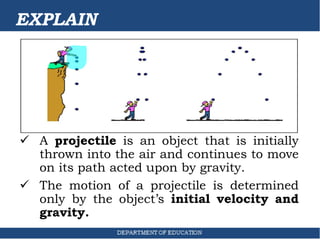
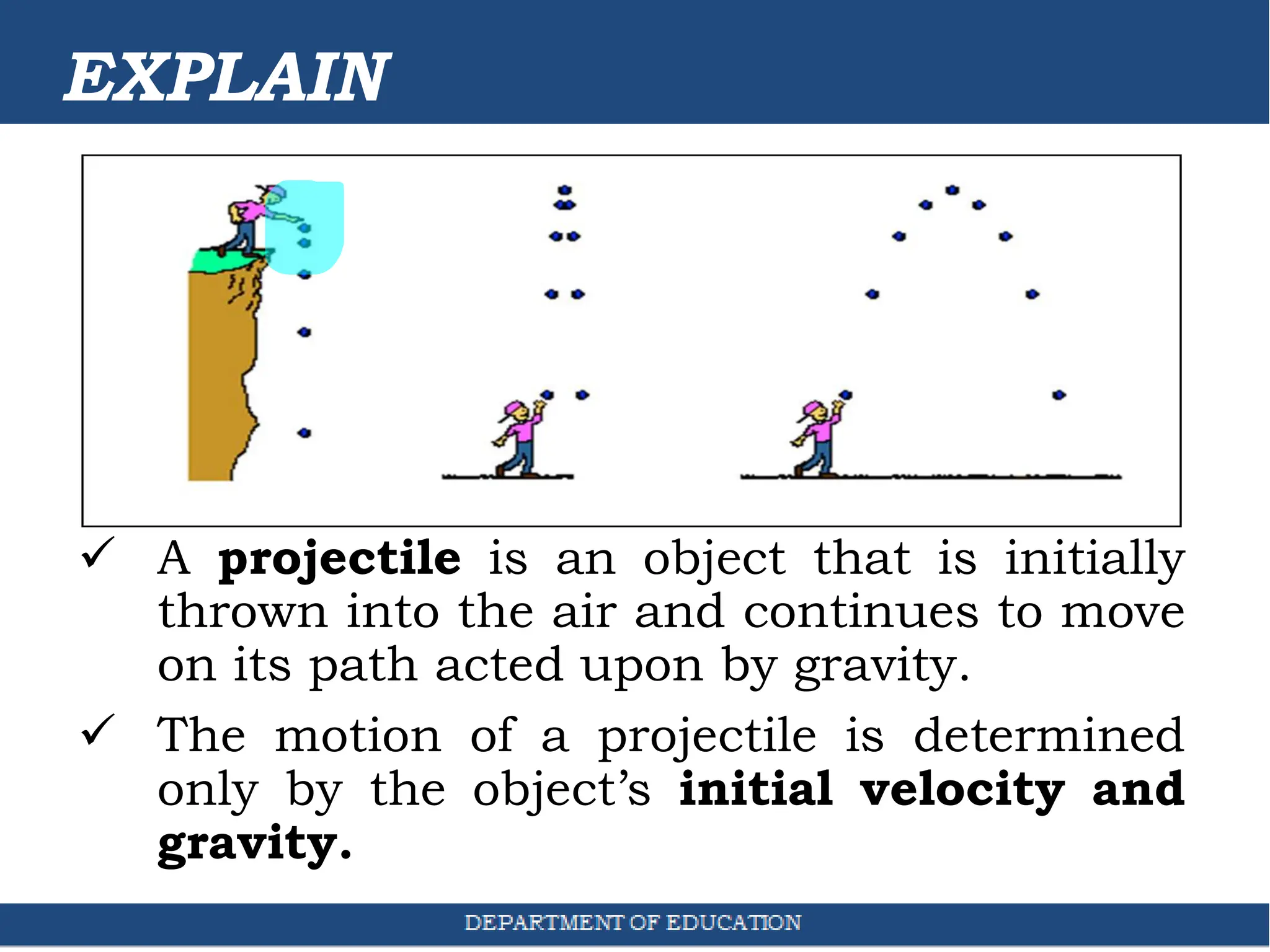
✓ A projectile is an object that is initially
thrown into the air and continues to move
on its path acted upon by gravity.
✓ The motion of a projectile is determined
only by the object’s initial velocity and
gravity.
EXPLAIN
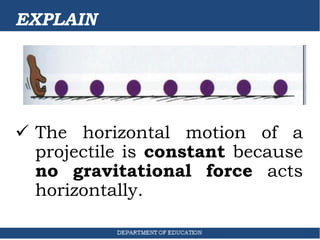
✓ The horizontal motion of a
projectile is constant because
no gravitational force acts
horizontally.
EXPLAIN
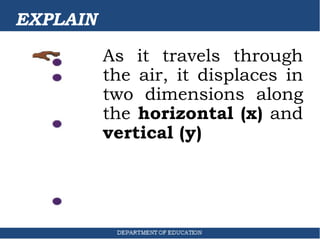
As it travels through
the air, it displaces in
two dimensions along
the horizontal (x) and
vertical (y)
EXPLAIN
✓ The horizontal motion of a
projectile is constant because
no gravitational force acts
horizontally.
✓ The vertical motion is nothing
more than a free fall with a
constant acceleration due to
gravity.
EXPLAIN
✓ Trajectory is the path
followed by a projectile.
✓ Height (ymax) is the maximum
vertical displacement of a
projectile.
✓ Range (R) is the maximum
horizontal displacement of a
projectile.
EXPLAIN
ELABORATE
PROJECTILES MOVE IN TWO
DIMENSIONS
HORIZONTAL “VELOCITY” COMPONENT
➢ It NEVER changes. It covers equal displacements in
equal time periods. This means the initial
horizontal velocity equals the final horizontal
velocity
Meaning, the horizontal velocity is CONSTANT.
Meaning Gravity DOES NOT work horizontally to
increase or decrease the velocity.
ELABORATE
PROJECTILES MOVE IN TWO
DIMENSIONS
VERTICAL “VELOCITY” COMPONENT
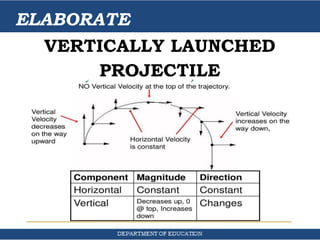
➢ Changes (due to gravity), does NOT cover equal
displacements in equal time periods.
Both the MAGNITUDE and DIRECTION change. As the
projectile moves up the MAGNITUDE DECREASES and
its direction is UPWARD. As it moves down the
MAGNITUDE INCREASES and the direction is
DOWNWARD.
ELABORATE
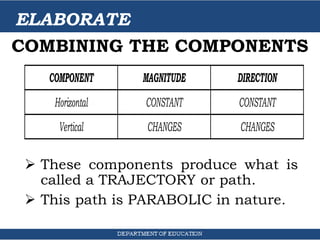
COMPONENT MAGNITUDE DIRECTION
Horizontal CONSTANT CONSTANT
Vertical CHANGES CHANGES
COMBINING THE COMPONENTS
➢ These components produce what is
called a TRAJECTORY or path.
➢ This path is PARABOLIC in nature.
ELABORATE
HORIZONTALLY LAUNCHED
PROJECTILE
➢ Projectiles which have NO upward
trajectory and NO initial VERTICAL
velocity.
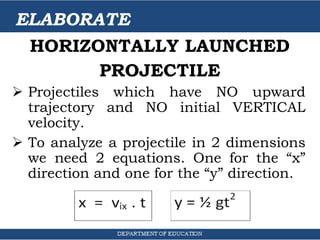
➢ To analyze a projectile in 2 dimensions
we need 2 equations. One for the “x”
direction and one for the “y” direction.
ELABORATE
Example:
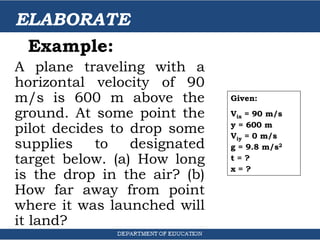
A plane traveling with a
horizontal velocity of 90
m/s is 600 m above the
ground. At some point the
pilot decides to drop some
supplies to designated
target below. (a) How long
is the drop in the air? (b)
How far away from point
where it was launched will
it land?
Given:
Vix = 90 m/s
y = 600 m
Viy = 0 m/s
g = 9.8 m/s2
t = ?
x = ?
ELABORATE
Example:
A plane traveling with a
horizontal velocity of 110
m/s is 500 m above the
ground. At some point the
pilot decides to drop some
supplies to designated
target below. (a) How long
is the drop in the air? (b)
How far away from point
where it was launched will
it land?
ELABORATE
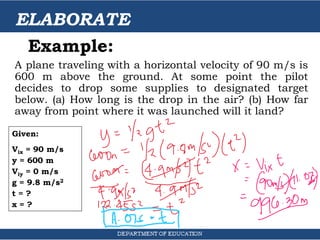
Example:
A plane traveling with a horizontal velocity of 90 m/s is
600 m above the ground. At some point the pilot
decides to drop some supplies to designated target
below. (a) How long is the drop in the air? (b) How far
away from point where it was launched will it land?
Given:
Vix = 90 m/s
y = 600 m
Viy = 0 m/s
g = 9.8 m/s2
t = ?
x = ?
ELABORATE
VERTICALLY LAUNCHED
PROJECTILE
ELABORATE
VERTICALLY LAUNCHED
PROJECTILE
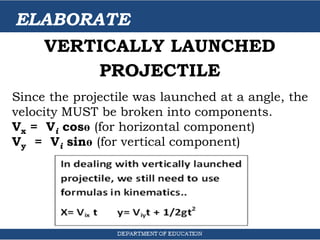
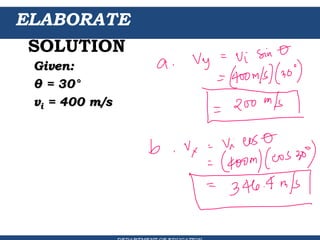
Since the projectile was launched at a angle, the
velocity MUST be broken into components.
Vx = Vi cosɵ (for horizontal component)
Vy = Vi sinɵ (for vertical component)
ELABORATE
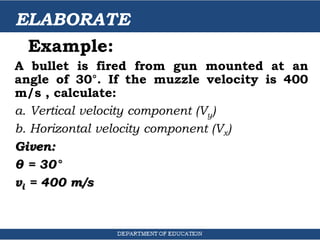
Example:
A bullet is fired from gun mounted at an
angle of 30°. If the muzzle velocity is 400
m/s , calculate:
a. Vertical velocity component (Vy)
b. Horizontal velocity component (Vx)
Given:
θ = 30°
vi = 400 m/s
ELABORATE
SOLUTION
Given:
θ = 30°
vi = 400 m/s
ELABORATE
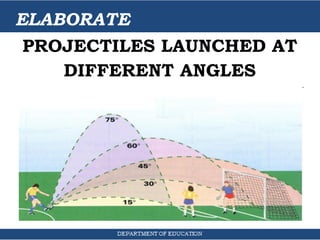
PROJECTILES LAUNCHED AT
DIFFERENT ANGLES
ELABORATE
PROJECTILES LAUNCHED AT
DIFFERENT ANGLES
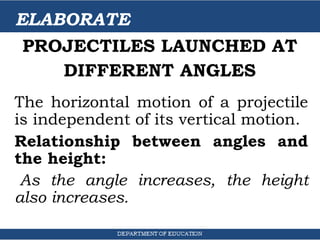
The horizontal motion of a projectile
is independent of its vertical motion.
Relationship between angles and
the height:
As the angle increases, the height
also increases.
ELABORATE
PROJECTILES LAUNCHED AT
DIFFERENT ANGLES
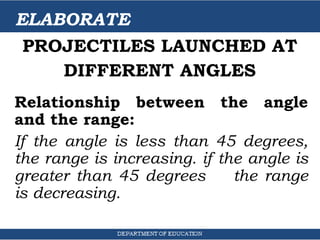
Relationship between the angle
and the range:
If the angle is less than 45 degrees,
the range is increasing. if the angle is
greater than 45 degrees the range
is decreasing.
ELABORATE
PROJECTILES LAUNCHED AT
DIFFERENT ANGLES
Relationship between the angle
and the time:
As the angle increases, the time also
increases.
Maximum range is achieved if the
projectile is fired at an angle of 45
degrees.

PROJECTILE MOTION, VERTICAL AND HORIZAONTAL COMPONENT

  • 1.
    EXPLAIN ✓ A projectileis an object that is initially thrown into the air and continues to move on its path acted upon by gravity. ✓ The motion of a projectile is determined only by the object’s initial velocity and gravity.
  • 2.
    EXPLAIN ✓ The horizontalmotion of a projectile is constant because no gravitational force acts horizontally.
  • 3.
    EXPLAIN As it travelsthrough the air, it displaces in two dimensions along the horizontal (x) and vertical (y)
  • 4.
    EXPLAIN ✓ The horizontalmotion of a projectile is constant because no gravitational force acts horizontally. ✓ The vertical motion is nothing more than a free fall with a constant acceleration due to gravity.
  • 5.
    EXPLAIN ✓ Trajectory isthe path followed by a projectile. ✓ Height (ymax) is the maximum vertical displacement of a projectile. ✓ Range (R) is the maximum horizontal displacement of a projectile.
  • 6.
  • 7.
    ELABORATE PROJECTILES MOVE INTWO DIMENSIONS HORIZONTAL “VELOCITY” COMPONENT ➢ It NEVER changes. It covers equal displacements in equal time periods. This means the initial horizontal velocity equals the final horizontal velocity Meaning, the horizontal velocity is CONSTANT. Meaning Gravity DOES NOT work horizontally to increase or decrease the velocity.
  • 8.
    ELABORATE PROJECTILES MOVE INTWO DIMENSIONS VERTICAL “VELOCITY” COMPONENT ➢ Changes (due to gravity), does NOT cover equal displacements in equal time periods. Both the MAGNITUDE and DIRECTION change. As the projectile moves up the MAGNITUDE DECREASES and its direction is UPWARD. As it moves down the MAGNITUDE INCREASES and the direction is DOWNWARD.
  • 9.
    ELABORATE COMPONENT MAGNITUDE DIRECTION HorizontalCONSTANT CONSTANT Vertical CHANGES CHANGES COMBINING THE COMPONENTS ➢ These components produce what is called a TRAJECTORY or path. ➢ This path is PARABOLIC in nature.
  • 10.
    ELABORATE HORIZONTALLY LAUNCHED PROJECTILE ➢ Projectileswhich have NO upward trajectory and NO initial VERTICAL velocity. ➢ To analyze a projectile in 2 dimensions we need 2 equations. One for the “x” direction and one for the “y” direction.
  • 11.
    ELABORATE Example: A plane travelingwith a horizontal velocity of 90 m/s is 600 m above the ground. At some point the pilot decides to drop some supplies to designated target below. (a) How long is the drop in the air? (b) How far away from point where it was launched will it land? Given: Vix = 90 m/s y = 600 m Viy = 0 m/s g = 9.8 m/s2 t = ? x = ?
  • 12.
    ELABORATE Example: A plane travelingwith a horizontal velocity of 110 m/s is 500 m above the ground. At some point the pilot decides to drop some supplies to designated target below. (a) How long is the drop in the air? (b) How far away from point where it was launched will it land?
  • 13.
    ELABORATE Example: A plane travelingwith a horizontal velocity of 90 m/s is 600 m above the ground. At some point the pilot decides to drop some supplies to designated target below. (a) How long is the drop in the air? (b) How far away from point where it was launched will it land? Given: Vix = 90 m/s y = 600 m Viy = 0 m/s g = 9.8 m/s2 t = ? x = ?
  • 14.
  • 15.
    ELABORATE VERTICALLY LAUNCHED PROJECTILE Since theprojectile was launched at a angle, the velocity MUST be broken into components. Vx = Vi cosɵ (for horizontal component) Vy = Vi sinɵ (for vertical component)
  • 16.
    ELABORATE Example: A bullet isfired from gun mounted at an angle of 30°. If the muzzle velocity is 400 m/s , calculate: a. Vertical velocity component (Vy) b. Horizontal velocity component (Vx) Given: θ = 30° vi = 400 m/s
  • 17.
  • 18.
  • 19.
    ELABORATE PROJECTILES LAUNCHED AT DIFFERENTANGLES The horizontal motion of a projectile is independent of its vertical motion. Relationship between angles and the height: As the angle increases, the height also increases.
  • 20.
    ELABORATE PROJECTILES LAUNCHED AT DIFFERENTANGLES Relationship between the angle and the range: If the angle is less than 45 degrees, the range is increasing. if the angle is greater than 45 degrees the range is decreasing.
  • 21.
    ELABORATE PROJECTILES LAUNCHED AT DIFFERENTANGLES Relationship between the angle and the time: As the angle increases, the time also increases. Maximum range is achieved if the projectile is fired at an angle of 45 degrees.