Cross-cultural adaptation:
Communication,
adaptation and
transformation
Yamith José Fandiño
BA in Spanish, English, and French
La Salle University
Introduction
 Although unique in individual circumstances and varied in scope,
intensity, and duration, all strangers in a new and unfamiliar
environment embark on the common project of establishing and
maintaining a relatively stable and reciprocal relationship with the
environment (Kim, 2012, p. 229).
Historical overview (Kim, 2012, pp.
229-230)
Academic enquiry into the phenomenon of cross-cultural adaptation has been
vast and varied across social science disciplines.
30’s: The Social Science Research Council
Acculturation: Those phenomena which result when groups of individuals
have different cultures and come into first-hand contact with subsequent
changes in the original pattern of either or both groups (Kim, 2012, p. 229).
 Anthropologists: the acculturation phenomenon largely at the level of
cultural groups, focusing on the dynamics of change in traditional cultures.
 Sociologists: focused on group-level issues within and across generations.
 Psychologists and communicators: individual-level approaches (Kim, 2012,
p. 230).
Long-term adaptation: strain, change,
strategy (Kim, 2012, p. 230).
- The psychological and social strain immigrants and other settlers experience in
response to their cultural uprooting and dislocation.
- The most dominant issue in long-term adaptation studies: the cumulative
nature of adaptive change that takes place over time.
- A common assumption: long-term settlers who live and work in a new
environment need, and want to be better adapted to the local language and
cultural practices.
- The bidimensional model of acculturation proposed by Berry (1980, 1990)
 The theory is built on two central issues that immigrants confront: (1) cultural
maintenance; and (2) contact and participation in the host society and its
culture. Four ‘acculturation strategies’ are identified: ‘integration’,
‘assimilation’, ‘separation’ and ‘marginality’.
Short-term adaptation: culture shock, U-
curve and W-curve (Kim, 2012, p. 231).
‘Culture shock’ to describe ‘the anxiety that results from losing all our familiar signs
and symbols of social intercourse’ (Oberg, 1960) ---- Most sojourners eventually
achieve satisfactory adjustment.
U-curve (Oberg, 1960): four stages of a U-curve leading to an eventual satisfactory
adjustment: a ‘honeymoon’ phase, followed by a period of crisis, a period of
adjustment, integration and enjoyment of the new environment.
The W-curve (Gullahorn and Gullahorn, 1963): The U-curve hypothesis has been
extended further to the ‘W-curve’ by adding the re-entry (or return-home) phase,
during which the sojourner once again goes through a similar process.
Culture shock should not be viewed as a ‘disease for which adaptation is the cure, but
is at the very heart of the cross-cultural learning experience, self-understanding, and
change (Adler, 1972, 1987).
Factors explaining the level of cross-cultural
adaptation (Kim, 2012, pp. 231-232).
Factors identified in such models range widely from country of origin, pre-departure
expectations and preparedness, personality characteristics and psychological
orientations , communication patterns/skills to demographic characteristics.
- Complexity of sojourners’ perception of members of the host society.
- Linguistic acculturation
- Uncertainty and anxiety.
- The patterns of mass media usage in relation to degrees of change in cultural values.
- Psychological adaptation (good mental health).
- Sociocultural adaptation (the quality of relationships between individuals and their
sociocultural contexts).
The level of psychological and sociocultural adaptation is a result of outcomes of
societal-level and individual-level factors.
An integrative communication
approach (Kim, 2012, pp. 232).
With respect to individual-level adaptation across cultures, a variety of concepts
and models have been employed to investigate specific types and aspects of the
phenomenon – from long-term, cumulative–progressive adaptive changes to the
experience of culture shock and short-term psychological adaptation.
Integration of terms
Human beings: Self-organizing living systems equipped with the capacity to
maintain integrity in the face of instability caused by the environment.
This integrity derives from their capability to adapt, that is, develop new forms
of relating to a given milieu.
Between the person and the environment, adaptation is a communication
process that occurs as long as the individual remains in contact with a given
environment.
An integrative communication
approach (Kim, 2012, p. 233).
‘Cross-cultural adaptation’ is defined as the phenomenon in which individuals who,
upon relocating to an unfamiliar cultural environment, strive to establish and
maintain a relatively stable, reciprocal and functional relationship with the
environment.
- Phenomenon that occurs subsequent to the process of childhood ‘enculturation’ of
individuals into recognizable members of a given cultural community.
- All individuals entering a new and unfamiliar culture undergo some degree of new
cultural learning, that is, the acquisition of the native cultural patterns and practices.
These re-socialization activities are the very essence of ‘acculturation .
- acculturation is not a process in which new cultural elements are simply added to
prior internal conditions. As new learning occurs, ‘deculturation’ (or unlearning) of
some of the old cultural habits has to occur.
- As the interplay of acculturation and deculturation continues, the individual
undergoes an internal transformation in the direction of ‘assimilation’, a state of the
highest degree of acculturation and deculturation theoretically possible.
An integrative communication
approach (Kim, 2012, pp. 233-234).
Kim’s integrative communication theory addresses two central questions:
(1) what is the essential nature of the adaptation process individual settlers undergo
over time?;
and
(2) why are some settlers more successful than others in attaining a level of
psychosocial fitness in the host environment?
The first question is addressed in the form of a process model – a process of personal
evolution towards increased functional fitness and psychological health and a gradual
emergence of intercultural identity.
The second question is addressed by a structural model in which key dimensions of
factors that facilitate or impede the adaptation process are identified and their
interrelationships specified.
An integrative communication
approach (Kim, 2012, pp. 234).
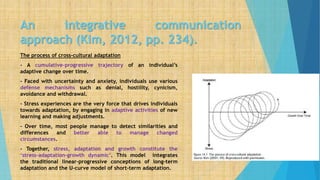
The process of cross-cultural adaptation
- A cumulative–progressive trajectory of an individual’s
adaptive change over time.
- Faced with uncertainty and anxiety, individuals use various
defense mechanisms such as denial, hostility, cynicism,
avoidance and withdrawal.
- Stress experiences are the very force that drives individuals
towards adaptation, by engaging in adaptive activities of new
learning and making adjustments.
- Over time, most people manage to detect similarities and
differences and better able to manage changed
circumstances.
- Together, stress, adaptation and growth constitute the
‘stress–adaptation–growth dynamic’. This model integrates
the traditional linear–progressive conceptions of long-term
adaptation and the U-curve model of short-term adaptation.
An integrative communication
approach (Kim, 2012, pp. 234-235).
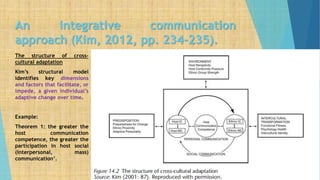
The structure of cross-
cultural adaptation
Kim’s structural model
identifies key dimensions
and factors that facilitate, or
impede, a given individual’s
adaptive change over time.
Example:
Theorem 1: the greater the
host communication
competence, the greater the
participation in host social
(interpersonal, mass)
communication’.
An integrative communication approach (Kim,
2012, pp. 235-236).
Communication factors
1. Host communication competence: Capacity to decode and encode information according to the host cultural
communication practices.
1.1 Cognitive competence: Knowledge of the host language, culture and rules of interpersonal conduct.
1.2 Affective competence: Emotional and motivational capacity to deal with living in the host environment.
1.3 Operational competence: Capacity to operate/function verbally and nonverbally according to the social
transactions of the host environment.
Host communication competence is linked to participation in the communication processes of the host society through
interpersonal and mass communication channels.
2. Host interpersonal communication activities: Cultural native people offer opportunities for ‘corrective exchanges’
with respect to the use of the host communication system.
3. Host mass communication’ activities: Communication systems (radio, television, newspaper, magazine, movie, art,
literature, music and drama) help expand cultural learning beyond one’s immediate social context.
Non-natives’ social communication activities involve co-ethnics or co-nationals and home cultural experiences
as well.
4. Ethnic interpersonal communication’ activities (ethnic mutual aid or self-help organizations) + ‘ethnic mass
communication activities (ethnic newspapers, radio stations and television programs).
An integrative communication approach (Kim,
2012, pp. 236-237).
Environment factors: The conditions of the host environment.
Three key factors are identified in Kim’s theory as significant with respect to an individual’s
adaptation process:
(1) host receptivity: the degree to which the receiving environment welcomes and accepts
strangers into its interpersonal networks and offers them various forms of informational,
technical, material and emotional support.
(2) host conformity pressure: the extent to which the host environment challenges strangers,
implicitly or explicitly, to act according to the normative patterns of the host culture; and
(3) ethnic group strength: the status of a particular ethnic group in the context of the surrounding
host society.
An integrative communication approach (Kim,
2012, pp. 237-238).
Predisposition factors: Set of backgrounds that determine how strangers relate to the new
environment and their own subsequent adaptive changes.
(1) preparedness: the level of readiness to undertake the process of cross-cultural adaptation
by developing host communication competence and participating in host social communication
activities.;
(2) ethnic proximity/distance: the extent to which the ethnicity of an individual immigrant or
sojourner plays a role in the cross-cultural adaptation process by serving as a certain level of
advantage or handicap; and
(3) personality predisposition: the extent to which a set of traits of sensibilities facilitates
adaptation process.
3.1. Openness: an internal posture that is receptive to new information;
3.2 Strength: the quality of resilience, patience, hardiness and persistence; and
3.3 Positivity, an affirmative and optimistic outlook
Three facets of intercultural tramsformation (Kim,
2012, p. 238).
The process of cross-cultural adaptation unfolds thanks to :
- Personal and social communication, and
- The environment and of the individual’s backgrounds.
There are three interrelated facets of adaptive change and intercultural transformation of the
individual that emerge in the adaptation process:
(1) increased functional fitness in carrying out daily transactions: Accomplish effective functional
relationships with the host environment;
(2) improved psychological health in dealing with the environment: Enjoying a sense of fulfilment
and efficacy by acquiring a high-level host communication competence and actively participating
in host social processes. and
(3) emergence of an intercultural identity orientation: An orientation towards self and others that
is no longer rigidly defined by identity to the ‘home’ culture or the host culture.
Reference
Kim, Y. (2012). Beyond cultural categories: Communication, adaptation and transformation. In J.
Jackson (Ed.), The Routledge Handbook of Language and Intercultural Communication (pp. 229-
243). USA: Routledge.

Cultural adaptation

  • 1.
    Cross-cultural adaptation: Communication, adaptation and transformation YamithJosé Fandiño BA in Spanish, English, and French La Salle University
  • 2.
    Introduction  Although uniquein individual circumstances and varied in scope, intensity, and duration, all strangers in a new and unfamiliar environment embark on the common project of establishing and maintaining a relatively stable and reciprocal relationship with the environment (Kim, 2012, p. 229).
  • 3.
    Historical overview (Kim,2012, pp. 229-230) Academic enquiry into the phenomenon of cross-cultural adaptation has been vast and varied across social science disciplines. 30’s: The Social Science Research Council Acculturation: Those phenomena which result when groups of individuals have different cultures and come into first-hand contact with subsequent changes in the original pattern of either or both groups (Kim, 2012, p. 229).  Anthropologists: the acculturation phenomenon largely at the level of cultural groups, focusing on the dynamics of change in traditional cultures.  Sociologists: focused on group-level issues within and across generations.  Psychologists and communicators: individual-level approaches (Kim, 2012, p. 230).
  • 4.
    Long-term adaptation: strain,change, strategy (Kim, 2012, p. 230). - The psychological and social strain immigrants and other settlers experience in response to their cultural uprooting and dislocation. - The most dominant issue in long-term adaptation studies: the cumulative nature of adaptive change that takes place over time. - A common assumption: long-term settlers who live and work in a new environment need, and want to be better adapted to the local language and cultural practices. - The bidimensional model of acculturation proposed by Berry (1980, 1990)  The theory is built on two central issues that immigrants confront: (1) cultural maintenance; and (2) contact and participation in the host society and its culture. Four ‘acculturation strategies’ are identified: ‘integration’, ‘assimilation’, ‘separation’ and ‘marginality’.
  • 5.
    Short-term adaptation: cultureshock, U- curve and W-curve (Kim, 2012, p. 231). ‘Culture shock’ to describe ‘the anxiety that results from losing all our familiar signs and symbols of social intercourse’ (Oberg, 1960) ---- Most sojourners eventually achieve satisfactory adjustment. U-curve (Oberg, 1960): four stages of a U-curve leading to an eventual satisfactory adjustment: a ‘honeymoon’ phase, followed by a period of crisis, a period of adjustment, integration and enjoyment of the new environment. The W-curve (Gullahorn and Gullahorn, 1963): The U-curve hypothesis has been extended further to the ‘W-curve’ by adding the re-entry (or return-home) phase, during which the sojourner once again goes through a similar process. Culture shock should not be viewed as a ‘disease for which adaptation is the cure, but is at the very heart of the cross-cultural learning experience, self-understanding, and change (Adler, 1972, 1987).
  • 6.
    Factors explaining thelevel of cross-cultural adaptation (Kim, 2012, pp. 231-232). Factors identified in such models range widely from country of origin, pre-departure expectations and preparedness, personality characteristics and psychological orientations , communication patterns/skills to demographic characteristics. - Complexity of sojourners’ perception of members of the host society. - Linguistic acculturation - Uncertainty and anxiety. - The patterns of mass media usage in relation to degrees of change in cultural values. - Psychological adaptation (good mental health). - Sociocultural adaptation (the quality of relationships between individuals and their sociocultural contexts). The level of psychological and sociocultural adaptation is a result of outcomes of societal-level and individual-level factors.
  • 7.
    An integrative communication approach(Kim, 2012, pp. 232). With respect to individual-level adaptation across cultures, a variety of concepts and models have been employed to investigate specific types and aspects of the phenomenon – from long-term, cumulative–progressive adaptive changes to the experience of culture shock and short-term psychological adaptation. Integration of terms Human beings: Self-organizing living systems equipped with the capacity to maintain integrity in the face of instability caused by the environment. This integrity derives from their capability to adapt, that is, develop new forms of relating to a given milieu. Between the person and the environment, adaptation is a communication process that occurs as long as the individual remains in contact with a given environment.
  • 8.
    An integrative communication approach(Kim, 2012, p. 233). ‘Cross-cultural adaptation’ is defined as the phenomenon in which individuals who, upon relocating to an unfamiliar cultural environment, strive to establish and maintain a relatively stable, reciprocal and functional relationship with the environment. - Phenomenon that occurs subsequent to the process of childhood ‘enculturation’ of individuals into recognizable members of a given cultural community. - All individuals entering a new and unfamiliar culture undergo some degree of new cultural learning, that is, the acquisition of the native cultural patterns and practices. These re-socialization activities are the very essence of ‘acculturation . - acculturation is not a process in which new cultural elements are simply added to prior internal conditions. As new learning occurs, ‘deculturation’ (or unlearning) of some of the old cultural habits has to occur. - As the interplay of acculturation and deculturation continues, the individual undergoes an internal transformation in the direction of ‘assimilation’, a state of the highest degree of acculturation and deculturation theoretically possible.
  • 9.
    An integrative communication approach(Kim, 2012, pp. 233-234). Kim’s integrative communication theory addresses two central questions: (1) what is the essential nature of the adaptation process individual settlers undergo over time?; and (2) why are some settlers more successful than others in attaining a level of psychosocial fitness in the host environment? The first question is addressed in the form of a process model – a process of personal evolution towards increased functional fitness and psychological health and a gradual emergence of intercultural identity. The second question is addressed by a structural model in which key dimensions of factors that facilitate or impede the adaptation process are identified and their interrelationships specified.
  • 10.
    An integrative communication approach(Kim, 2012, pp. 234). The process of cross-cultural adaptation - A cumulative–progressive trajectory of an individual’s adaptive change over time. - Faced with uncertainty and anxiety, individuals use various defense mechanisms such as denial, hostility, cynicism, avoidance and withdrawal. - Stress experiences are the very force that drives individuals towards adaptation, by engaging in adaptive activities of new learning and making adjustments. - Over time, most people manage to detect similarities and differences and better able to manage changed circumstances. - Together, stress, adaptation and growth constitute the ‘stress–adaptation–growth dynamic’. This model integrates the traditional linear–progressive conceptions of long-term adaptation and the U-curve model of short-term adaptation.
  • 11.
    An integrative communication approach(Kim, 2012, pp. 234-235). The structure of cross- cultural adaptation Kim’s structural model identifies key dimensions and factors that facilitate, or impede, a given individual’s adaptive change over time. Example: Theorem 1: the greater the host communication competence, the greater the participation in host social (interpersonal, mass) communication’.
  • 12.
    An integrative communicationapproach (Kim, 2012, pp. 235-236). Communication factors 1. Host communication competence: Capacity to decode and encode information according to the host cultural communication practices. 1.1 Cognitive competence: Knowledge of the host language, culture and rules of interpersonal conduct. 1.2 Affective competence: Emotional and motivational capacity to deal with living in the host environment. 1.3 Operational competence: Capacity to operate/function verbally and nonverbally according to the social transactions of the host environment. Host communication competence is linked to participation in the communication processes of the host society through interpersonal and mass communication channels. 2. Host interpersonal communication activities: Cultural native people offer opportunities for ‘corrective exchanges’ with respect to the use of the host communication system. 3. Host mass communication’ activities: Communication systems (radio, television, newspaper, magazine, movie, art, literature, music and drama) help expand cultural learning beyond one’s immediate social context. Non-natives’ social communication activities involve co-ethnics or co-nationals and home cultural experiences as well. 4. Ethnic interpersonal communication’ activities (ethnic mutual aid or self-help organizations) + ‘ethnic mass communication activities (ethnic newspapers, radio stations and television programs).
  • 13.
    An integrative communicationapproach (Kim, 2012, pp. 236-237). Environment factors: The conditions of the host environment. Three key factors are identified in Kim’s theory as significant with respect to an individual’s adaptation process: (1) host receptivity: the degree to which the receiving environment welcomes and accepts strangers into its interpersonal networks and offers them various forms of informational, technical, material and emotional support. (2) host conformity pressure: the extent to which the host environment challenges strangers, implicitly or explicitly, to act according to the normative patterns of the host culture; and (3) ethnic group strength: the status of a particular ethnic group in the context of the surrounding host society.
  • 14.
    An integrative communicationapproach (Kim, 2012, pp. 237-238). Predisposition factors: Set of backgrounds that determine how strangers relate to the new environment and their own subsequent adaptive changes. (1) preparedness: the level of readiness to undertake the process of cross-cultural adaptation by developing host communication competence and participating in host social communication activities.; (2) ethnic proximity/distance: the extent to which the ethnicity of an individual immigrant or sojourner plays a role in the cross-cultural adaptation process by serving as a certain level of advantage or handicap; and (3) personality predisposition: the extent to which a set of traits of sensibilities facilitates adaptation process. 3.1. Openness: an internal posture that is receptive to new information; 3.2 Strength: the quality of resilience, patience, hardiness and persistence; and 3.3 Positivity, an affirmative and optimistic outlook
  • 15.
    Three facets ofintercultural tramsformation (Kim, 2012, p. 238). The process of cross-cultural adaptation unfolds thanks to : - Personal and social communication, and - The environment and of the individual’s backgrounds. There are three interrelated facets of adaptive change and intercultural transformation of the individual that emerge in the adaptation process: (1) increased functional fitness in carrying out daily transactions: Accomplish effective functional relationships with the host environment; (2) improved psychological health in dealing with the environment: Enjoying a sense of fulfilment and efficacy by acquiring a high-level host communication competence and actively participating in host social processes. and (3) emergence of an intercultural identity orientation: An orientation towards self and others that is no longer rigidly defined by identity to the ‘home’ culture or the host culture.
  • 16.
    Reference Kim, Y. (2012).Beyond cultural categories: Communication, adaptation and transformation. In J. Jackson (Ed.), The Routledge Handbook of Language and Intercultural Communication (pp. 229- 243). USA: Routledge.