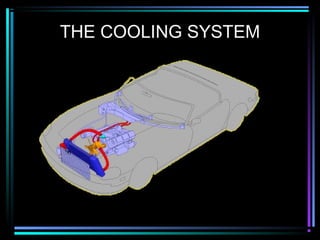
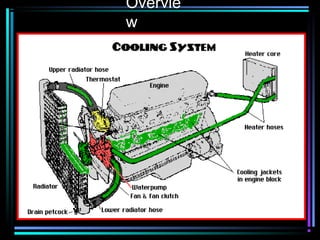
THE COOLING SYSTEM
Purpose
• To regulate the engines internal
temperature
• To remove excess heat from the engine
• To provide heat to the passenger
compartment
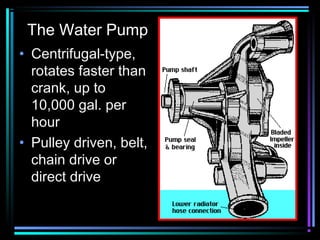
The Water Pump
• Centrifugal-type,
rotates faster than
crank, up to
10,000 gal. per
hour
• Pulley driven, belt,
chain drive or
direct drive
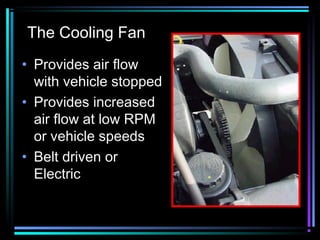
The Cooling Fan
• Provides air flow
with vehicle stopped
• Provides increased
air flow at low RPM
or vehicle speeds
• Belt driven or
Electric
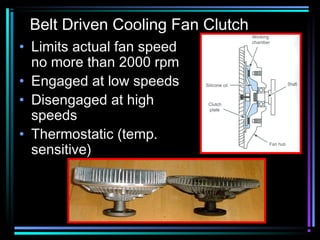
Belt Driven Cooling Fan Clutch
• Limits actual fan speed
no more than 2000 rpm
• Engaged at low speeds
• Disengaged at high
speeds
• Thermostatic (temp.
sensitive)
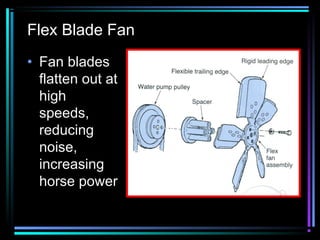
Flex Blade Fan
• Fan blades
flatten out at
high
speeds,
reducing
noise,
increasing
horse power
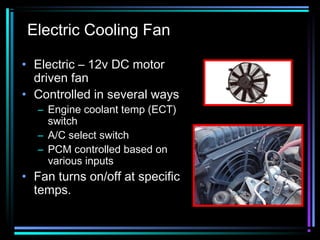
Electric Cooling Fan
• Electric – 12v DC motor
driven fan
• Controlled in several ways
– Engine coolant temp (ECT)
switch
– A/C select switch
– PCM controlled based on
various inputs

• Fan turns on/off at specific
temps.
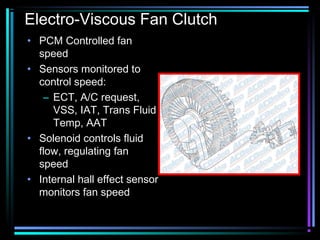
Electro-Viscous Fan Clutch
• PCM Controlled fan
speed
• Sensors monitored to
control speed:
– ECT, A/C request,
VSS, IAT, Trans Fluid
Temp, AAT
• Solenoid controls fluid
flow, regulating fan
speed
• Internal hall effect sensor
monitors fan speed
The Radiator
• Transfers heat from coolant to the
atmosphere
• Two types – Vertical & cross flow
• Aluminum, brass, copper core; brass,
copper or plastic tanks
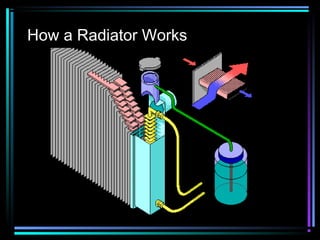
• Air movement through radiator created
by a mechanical fan or by vehicle
movement (ram air) dissipates heat
How a Radiator Works
Radiator Pressure Cap
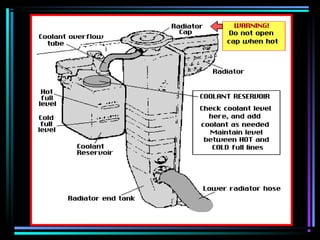
• Regulates pressure in the cooling
system
• Rated in psi – always replace with same
rating
• Pressure valve – allows liquid or vapor
to escape
• Vacuum valve – as system cools,
coolant can reenter the system
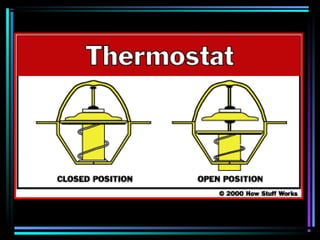
The Thermostat
• Regulates engine coolant temperature
• Rated in degrees – 195 degrees most
common
• Solid Expansion design – wax pellet
expands as temp increases, valve
begins opening at rating & is completely
open within 20 degrees
Coolant
• Provides freeze & boil over protection,
corrosion prevention & good heat
transfer
• Ethylene Glycol based – recommended
50/50 mixture with water, poisonous
• Dex-Cool – used by GM, 5 year
150,000 mile protection, doesn’t contain
silicate & phosphate additives
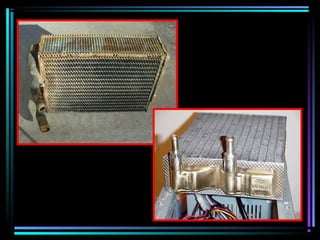
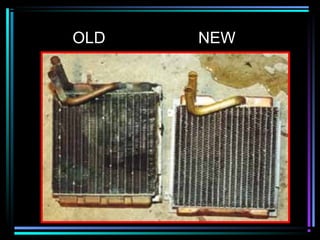
The Heater Core
• Small size radiator located in the dash,
coolant circulates through it. A blower
motor passes fresh air over it, heat
transfers to the cooler air and into the
cabin
• Many vans & SUV have rear heating
units
OLD

NEW
Overvie
w
SUBMITTED BY:ASHU RANJAN
ROLL NO

Cooling system ppt

  • 1.
  • 2.
    Purpose • To regulatethe engines internal temperature • To remove excess heat from the engine • To provide heat to the passenger compartment
  • 3.
    The Water Pump •Centrifugal-type, rotates faster than crank, up to 10,000 gal. per hour • Pulley driven, belt, chain drive or direct drive
  • 4.
    The Cooling Fan •Provides air flow with vehicle stopped • Provides increased air flow at low RPM or vehicle speeds • Belt driven or Electric
  • 5.
    Belt Driven CoolingFan Clutch • Limits actual fan speed no more than 2000 rpm • Engaged at low speeds • Disengaged at high speeds • Thermostatic (temp. sensitive)
  • 6.
    Flex Blade Fan •Fan blades flatten out at high speeds, reducing noise, increasing horse power
  • 7.
    Electric Cooling Fan •Electric – 12v DC motor driven fan • Controlled in several ways – Engine coolant temp (ECT) switch – A/C select switch – PCM controlled based on various inputs • Fan turns on/off at specific temps.
  • 8.
    Electro-Viscous Fan Clutch •PCM Controlled fan speed • Sensors monitored to control speed: – ECT, A/C request, VSS, IAT, Trans Fluid Temp, AAT • Solenoid controls fluid flow, regulating fan speed • Internal hall effect sensor monitors fan speed
  • 9.
    The Radiator • Transfersheat from coolant to the atmosphere • Two types – Vertical & cross flow • Aluminum, brass, copper core; brass, copper or plastic tanks • Air movement through radiator created by a mechanical fan or by vehicle movement (ram air) dissipates heat
  • 10.
  • 11.
    Radiator Pressure Cap •Regulates pressure in the cooling system • Rated in psi – always replace with same rating • Pressure valve – allows liquid or vapor to escape • Vacuum valve – as system cools, coolant can reenter the system
  • 13.
    The Thermostat • Regulatesengine coolant temperature • Rated in degrees – 195 degrees most common • Solid Expansion design – wax pellet expands as temp increases, valve begins opening at rating & is completely open within 20 degrees
  • 15.
    Coolant • Provides freeze& boil over protection, corrosion prevention & good heat transfer • Ethylene Glycol based – recommended 50/50 mixture with water, poisonous • Dex-Cool – used by GM, 5 year 150,000 mile protection, doesn’t contain silicate & phosphate additives
  • 16.
    The Heater Core •Small size radiator located in the dash, coolant circulates through it. A blower motor passes fresh air over it, heat transfers to the cooler air and into the cabin • Many vans & SUV have rear heating units
  • 18.
  • 19.
  • 20.