BY: A B I G A I L A DA R M E
LAWS OF MOTION
NEWTON’S LAWS OF MOTION
First Law: Law of Inertia
3 types of Inertia
Inertia of Rest
Inertia of Motion
Inertia of Direction
Second Law: Law of Acceleration
Third Law: Law of Interaction
FIRST LAW OF MOTION:
LAW OF INERTIA
FIRST LAW OF MOTION: LAW OF INERTIA
A body at rest will
remain at rest, & a body
in motion will remain in
motion, unless it is
acted upon by an
external unbalanced
force.
[Two clauses and a condition]. Retrieved July 19, 2017 from
http://www.physicsclassroom.com/class/newtlaws/Lesson-1/Newton-s-First-Law
FIRST LAW OF MOTION: LAW OF INERTIA
Example:
A soccer ball will remain resting on the grass until a
force acts on it (a kick).
Once it is kicked, the soccer ball’s inertia will keep it
going because the ball RESISTS changing its motion.
If the ball doesn’t hit anything, the forces of gravity and
friction will eventually stop the ball.
FIRST LAW OF MOTION: LAW OF INERTIA
•Why does the ball resist changing its
motion?
•Why does gravity and friction eventually stop
the ball?
FIRST LAW OF MOTION: LAW OF INERTIA
Why does the ball resist changing its
motion?
•Because of INERTIA
INERTIA
•The resistance of any physical object to any change
in its state of motion.
•It is proportional to the mass of the object.
•Big masses resist changing their motion more than
small masses.
Objects at rest remain at rest unless acted on by a net force.
A lot of inertia! The large train resists
changing its motion.
Very little inertia. The small baby carriage
has very little resistance to changes in
motion.
Since the train is so huge, it is difficult to
change its speed. In fact, a large net force
is required to change its speed or
direction.
Since the baby carriage is so small, it is
very easy to change its speed or direction.
A small net force is required to change its
speed or direction.
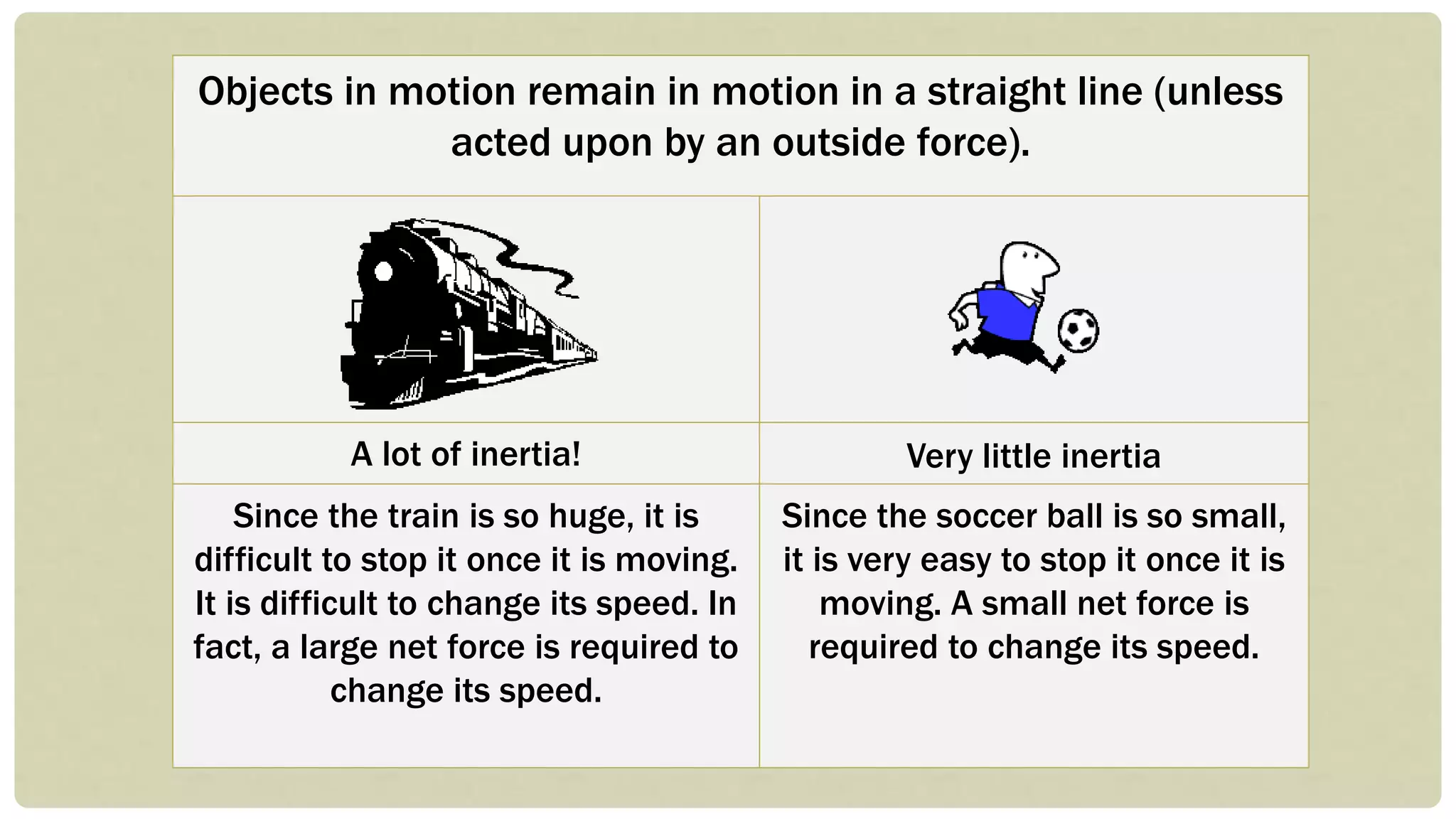
Objects in motion remain in motion in a straight line (unless
acted upon by an outside force).
A lot of inertia! Very little inertia
Since the train is so huge, it is
difficult to stop it once it is moving.
It is difficult to change its speed. In
fact, a large net force is required to
change its speed.
Since the soccer ball is so small,
it is very easy to stop it once it is
moving. A small net force is
required to change its speed.
3 TYPES OF INERTIA
Inertia of Rest
Inertia of Motion
Inertia of Direction
INERTIA OF REST
The inability of a
body to change by
itself its state of
rest.
INERTIA OF MOTION
The inability of a
body to change by
itself its state of
uniform motion
INERTIA OF DIRECTION
The inability of a body to change by itself
its direction of motion
FIRST LAW OF MOTION: LAW OF INERTIA
Why does gravity and friction eventually stop
the ball?
•Because on Earth, gravity and friction are
UNBALANCED forces that often change an
object’s motion.
FIRST LAW OF MOTION: LAW OF INERTIA
Weight (Fw)
• Pull of Earth’s gravity on an object
• Obtained by the product of mass
of an object (m) and the
acceleration due to gravity (g =
9.8 m/s2)
Fw = m ∙ g
FIRST LAW OF MOTION: LAW OF INERTIA
Friction
• The force that resists sliding motion
• Two conditions in order to have friction between two
objects:
1. Objects must have surfaces in contact
2. Objects must be sliding along the surface of contact, or at least
there must be an external force that is trying to slide the object
SECOND LAW OF MOTION:
LAW OF ACCELERATION
SECOND LAW OF MOTION: LAW OF ACCELERATION
The force acting on
an object is equal to
the mass of that
object times its
acceleration.
SECOND LAW OF MOTION: LAW OF ACCELERATION
F = m ∙ a
Where:
F = net force
m = mass
a = acceleration
SECOND LAW OF MOTION: LAW OF ACCELERATION
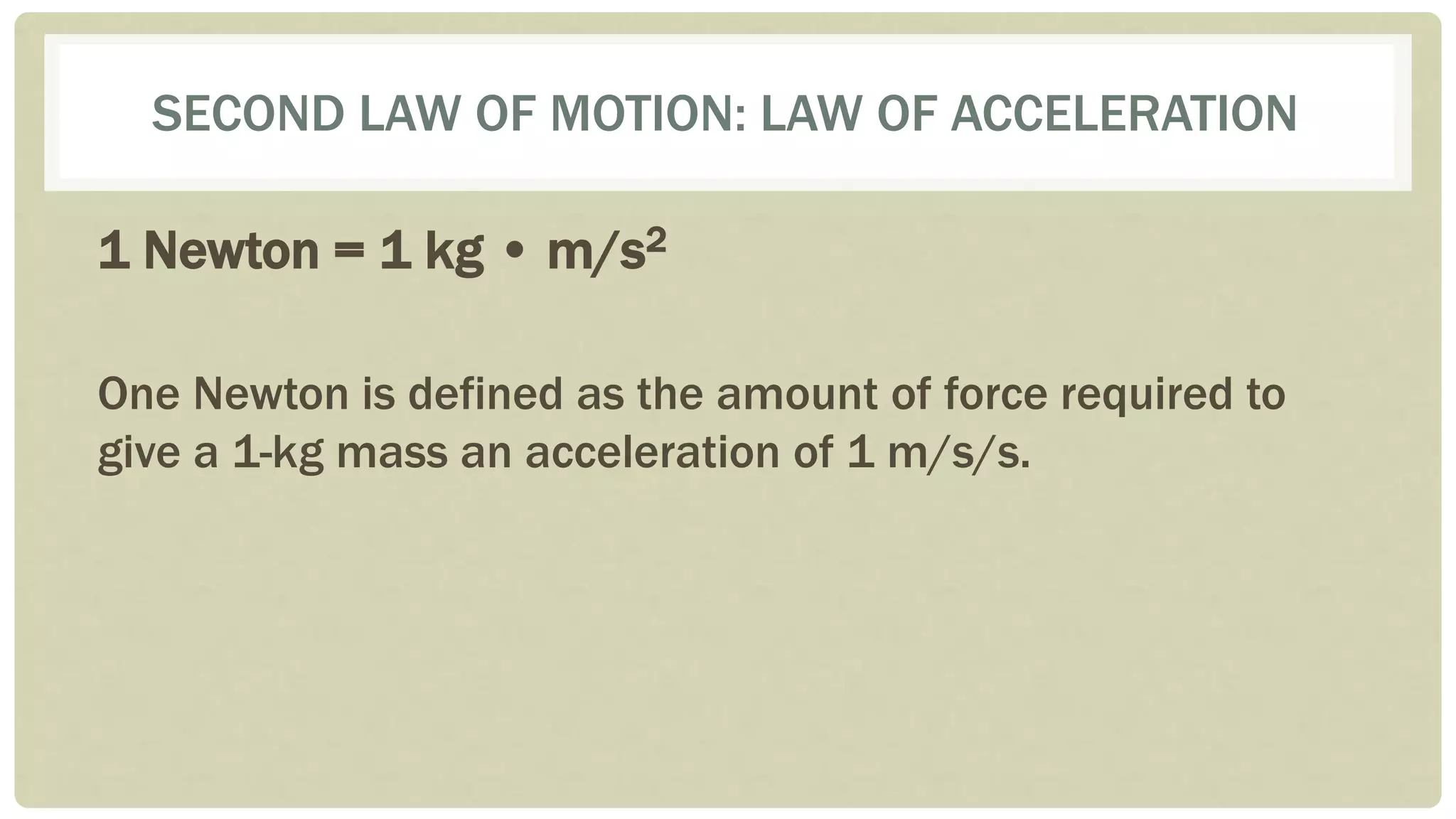
1 Newton = 1 kg • m/s2
One Newton is defined as the amount of force required to
give a 1-kg mass an acceleration of 1 m/s/s.
SECOND LAW OF MOTION: LAW OF ACCELERATION
Weight vs Mass
Weight – the force of gravity acting on an object
Mass – how much matter makes up an object
A person will have the same mass no matter where in the
universe it is measured. However, a person’s weight will be
different depending on the force of gravity where it is being
measured.
SECOND LAW OF MOTION: LAW OF ACCELERATION
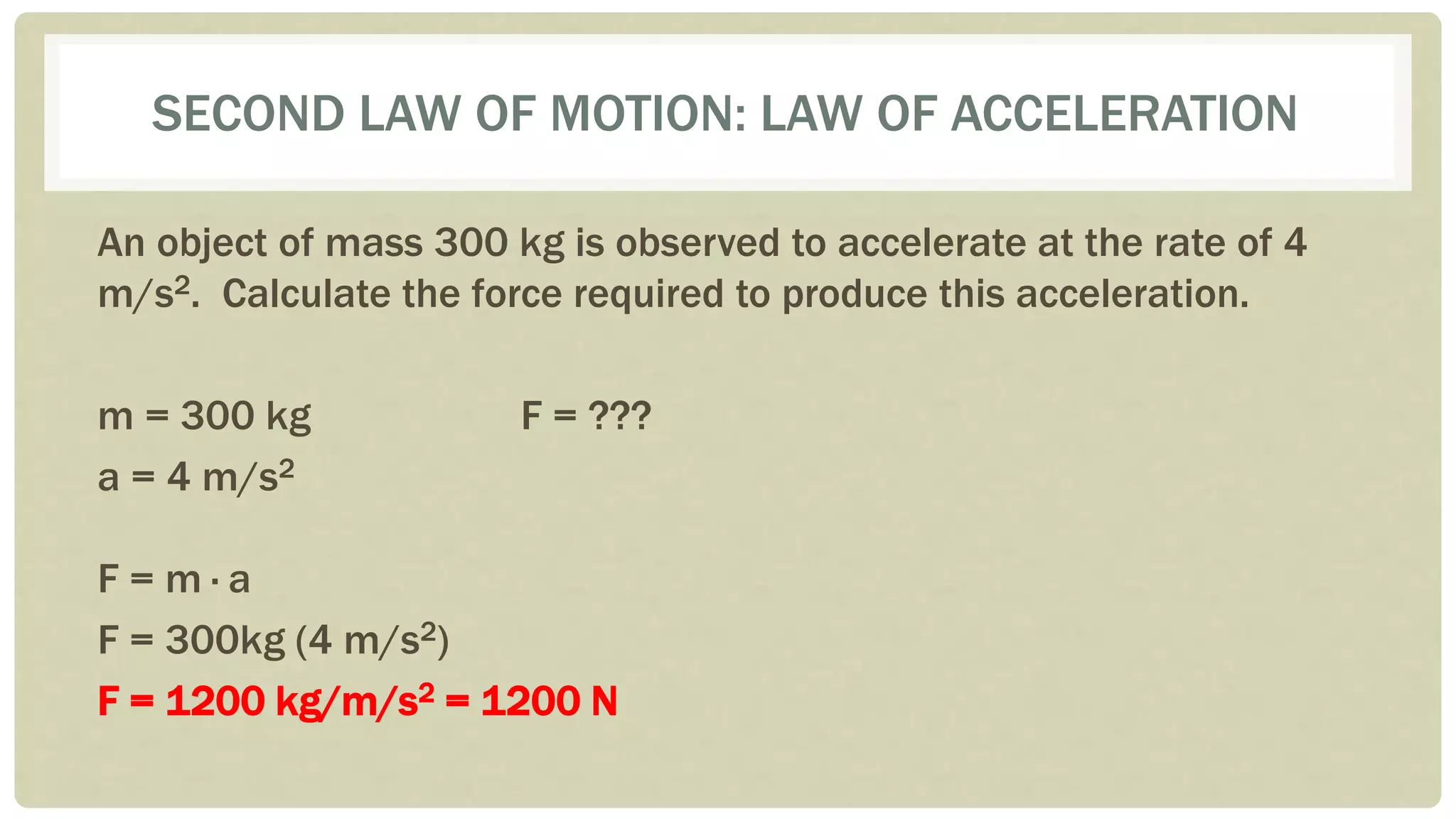
An object of mass 300 kg is observed to accelerate at the rate of 4
m/s2. Calculate the force required to produce this acceleration.
m = 300 kg F = ???
a = 4 m/s2
F = m ∙ a
F = 300kg (4 m/s2)
F = 1200 kg/m/s2 = 1200 N
THIRD LAW OF MOTION:
LAW OF INTERACTION
THIRD LAW OF MOTION: LAW OF INTERACTION
For every action, there is an equal and
opposite reaction.
Action–reaction pairs
•Equal in magnitude
•Opposite in direction
•Act on two different objects
THIRD LAW OF MOTION: LAW OF INTERACTION
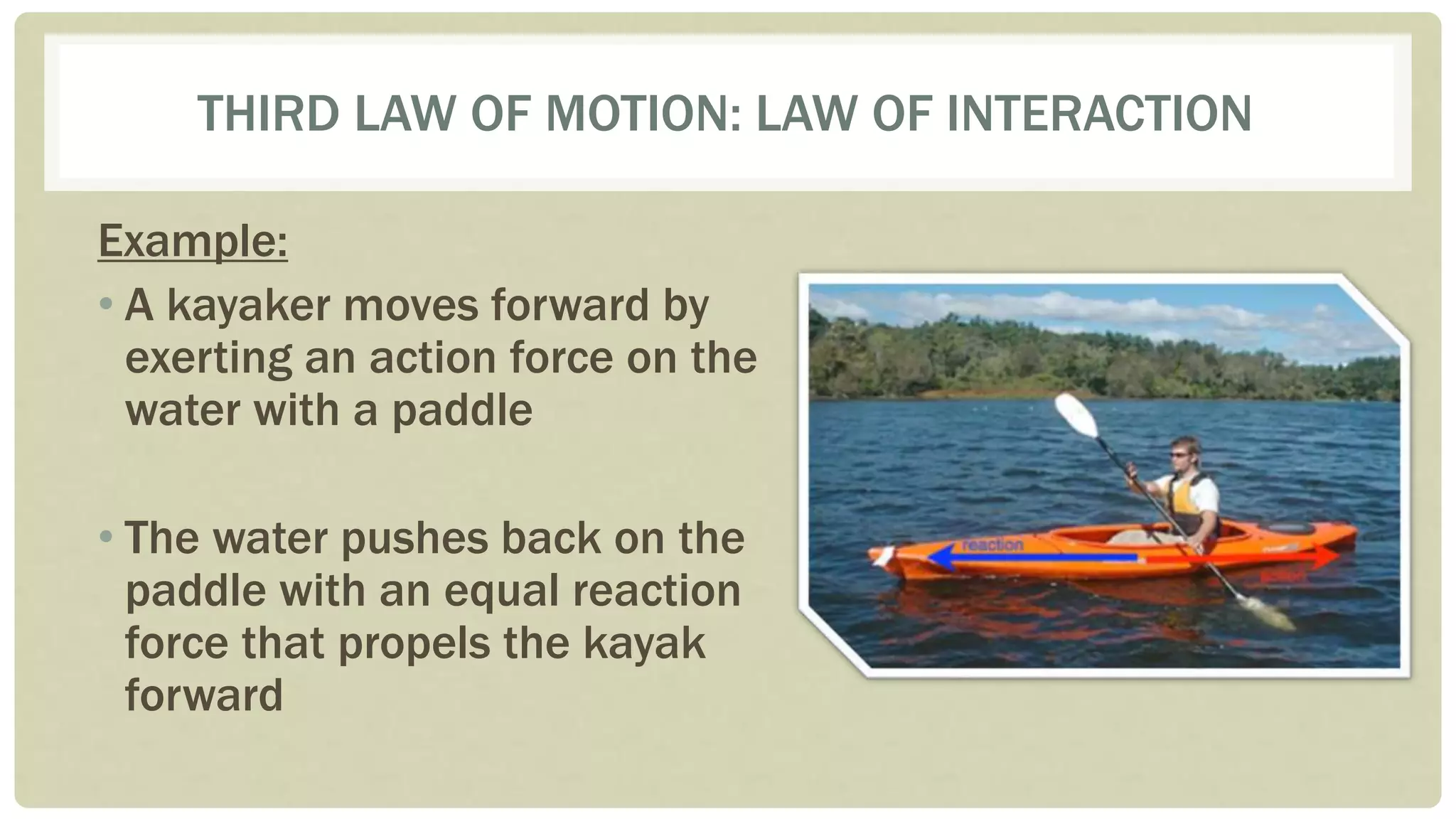
Example:
• A kayaker moves forward by
exerting an action force on the
water with a paddle
• The water pushes back on the
paddle with an equal reaction
force that propels the kayak
forward
THIRD LAW OF MOTION: LAW OF INTERACTION
• Are two forces with
an equal
magnitude and
opposite directions,
action-reaction
pairs?
• Do action-reaction
pairs cancel each
other out?
SUMMARY
Three Laws of Motion
Law of Inertia
Law of Acceleration
Law of Interaction
Inertia
Inertia of Rest
Inertia of Motion
Inertia of Direction
ACTIVITY – TRUE OR FALSE
1. A less massive object has more inertia than a more
massive object.
2. The only way to slow down a moving object is to apply a
net force to it.
3. A stationary object has no forces acting on it.
4. Weight and mass are the same and can be used
interchangeably in equations.
5. Law of interaction involves two forces acting on only one
object.
THANK YOU FOR LISTENING!
THE END

Laws of Motion

  • 1.
    BY: A BI G A I L A DA R M E LAWS OF MOTION
  • 2.
    NEWTON’S LAWS OFMOTION First Law: Law of Inertia 3 types of Inertia Inertia of Rest Inertia of Motion Inertia of Direction Second Law: Law of Acceleration Third Law: Law of Interaction
  • 3.
    FIRST LAW OFMOTION: LAW OF INERTIA
  • 4.
    FIRST LAW OFMOTION: LAW OF INERTIA A body at rest will remain at rest, & a body in motion will remain in motion, unless it is acted upon by an external unbalanced force. [Two clauses and a condition]. Retrieved July 19, 2017 from http://www.physicsclassroom.com/class/newtlaws/Lesson-1/Newton-s-First-Law
  • 5.
    FIRST LAW OFMOTION: LAW OF INERTIA Example: A soccer ball will remain resting on the grass until a force acts on it (a kick). Once it is kicked, the soccer ball’s inertia will keep it going because the ball RESISTS changing its motion. If the ball doesn’t hit anything, the forces of gravity and friction will eventually stop the ball.
  • 6.
    FIRST LAW OFMOTION: LAW OF INERTIA •Why does the ball resist changing its motion? •Why does gravity and friction eventually stop the ball?
  • 7.
    FIRST LAW OFMOTION: LAW OF INERTIA Why does the ball resist changing its motion? •Because of INERTIA
  • 8.
    INERTIA •The resistance ofany physical object to any change in its state of motion. •It is proportional to the mass of the object. •Big masses resist changing their motion more than small masses.
  • 9.
    Objects at restremain at rest unless acted on by a net force. A lot of inertia! The large train resists changing its motion. Very little inertia. The small baby carriage has very little resistance to changes in motion. Since the train is so huge, it is difficult to change its speed. In fact, a large net force is required to change its speed or direction. Since the baby carriage is so small, it is very easy to change its speed or direction. A small net force is required to change its speed or direction.
  • 10.
    Objects in motionremain in motion in a straight line (unless acted upon by an outside force). A lot of inertia! Very little inertia Since the train is so huge, it is difficult to stop it once it is moving. It is difficult to change its speed. In fact, a large net force is required to change its speed. Since the soccer ball is so small, it is very easy to stop it once it is moving. A small net force is required to change its speed.
  • 11.
    3 TYPES OFINERTIA Inertia of Rest Inertia of Motion Inertia of Direction
  • 12.
    INERTIA OF REST Theinability of a body to change by itself its state of rest.
  • 13.
    INERTIA OF MOTION Theinability of a body to change by itself its state of uniform motion
  • 14.
    INERTIA OF DIRECTION Theinability of a body to change by itself its direction of motion
  • 15.
    FIRST LAW OFMOTION: LAW OF INERTIA Why does gravity and friction eventually stop the ball? •Because on Earth, gravity and friction are UNBALANCED forces that often change an object’s motion.
  • 16.
    FIRST LAW OFMOTION: LAW OF INERTIA Weight (Fw) • Pull of Earth’s gravity on an object • Obtained by the product of mass of an object (m) and the acceleration due to gravity (g = 9.8 m/s2) Fw = m ∙ g
  • 17.
    FIRST LAW OFMOTION: LAW OF INERTIA Friction • The force that resists sliding motion • Two conditions in order to have friction between two objects: 1. Objects must have surfaces in contact 2. Objects must be sliding along the surface of contact, or at least there must be an external force that is trying to slide the object
  • 18.
    SECOND LAW OFMOTION: LAW OF ACCELERATION
  • 19.
    SECOND LAW OFMOTION: LAW OF ACCELERATION The force acting on an object is equal to the mass of that object times its acceleration.
  • 20.
    SECOND LAW OFMOTION: LAW OF ACCELERATION F = m ∙ a Where: F = net force m = mass a = acceleration
  • 21.
    SECOND LAW OFMOTION: LAW OF ACCELERATION 1 Newton = 1 kg • m/s2 One Newton is defined as the amount of force required to give a 1-kg mass an acceleration of 1 m/s/s.
  • 22.
    SECOND LAW OFMOTION: LAW OF ACCELERATION Weight vs Mass Weight – the force of gravity acting on an object Mass – how much matter makes up an object A person will have the same mass no matter where in the universe it is measured. However, a person’s weight will be different depending on the force of gravity where it is being measured.
  • 23.
    SECOND LAW OFMOTION: LAW OF ACCELERATION An object of mass 300 kg is observed to accelerate at the rate of 4 m/s2. Calculate the force required to produce this acceleration. m = 300 kg F = ??? a = 4 m/s2 F = m ∙ a F = 300kg (4 m/s2) F = 1200 kg/m/s2 = 1200 N
  • 24.
    THIRD LAW OFMOTION: LAW OF INTERACTION
  • 25.
    THIRD LAW OFMOTION: LAW OF INTERACTION For every action, there is an equal and opposite reaction. Action–reaction pairs •Equal in magnitude •Opposite in direction •Act on two different objects
  • 26.
    THIRD LAW OFMOTION: LAW OF INTERACTION Example: • A kayaker moves forward by exerting an action force on the water with a paddle • The water pushes back on the paddle with an equal reaction force that propels the kayak forward
  • 27.
    THIRD LAW OFMOTION: LAW OF INTERACTION • Are two forces with an equal magnitude and opposite directions, action-reaction pairs? • Do action-reaction pairs cancel each other out?
  • 28.
    SUMMARY Three Laws ofMotion Law of Inertia Law of Acceleration Law of Interaction Inertia Inertia of Rest Inertia of Motion Inertia of Direction
  • 29.
    ACTIVITY – TRUEOR FALSE 1. A less massive object has more inertia than a more massive object. 2. The only way to slow down a moving object is to apply a net force to it. 3. A stationary object has no forces acting on it. 4. Weight and mass are the same and can be used interchangeably in equations. 5. Law of interaction involves two forces acting on only one object.
  • 30.
    THANK YOU FORLISTENING! THE END