Name Enrollment No.
Harshal Bhatt 150950119504
Chintan Dave 150950119507
Vaibhavraj Chavda 150950119508
Smeet Gandhi 150950119511
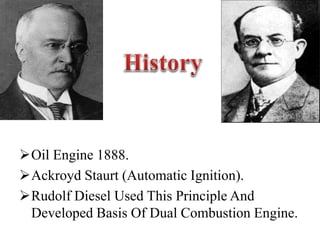
Oil Engine 1888.
Ackroyd Staurt (Automatic Ignition).
Rudolf Diesel Used This Principle And
Developed Basis Of Dual Combustion Engine.
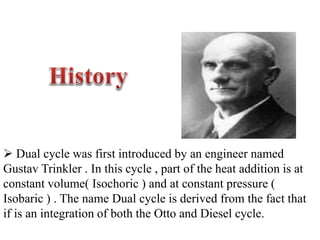
 Dual cycle was first introduced by an engineer named
Gustav Trinkler . In this cycle , part of the heat addition is at
constant volume( Isochoric ) and at constant pressure (
Isobaric ) . The name Dual cycle is derived from the fact that
if is an integration of both the Otto and Diesel cycle.
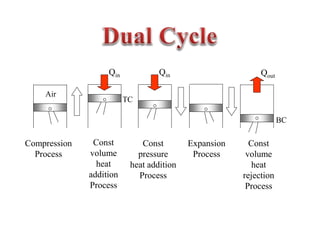
Air
TC
BC
Compression
Process
Const
pressure
heat addition
Process
Expansion
Process
Const
volume
heat
rejection
Process
Const
volume
heat
addition
Process
Qin QoutQin
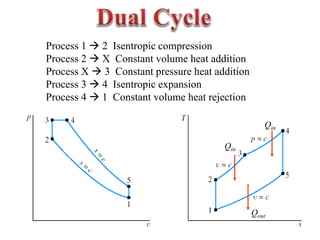
Process 1  2 Isentropic compression
Process 2  X Constant volume heat addition
Process X  3 Constant pressure heat addition
Process 3  4 Isentropic expansion
Process 4  1 Constant volume heat rejection
Qin
Qin
Qout
It is an internal combustion four stroke
engine.
“Dual” Because Combustion Takes Place In
Two Parts First At Constant Pressure And
Second At Constant Volume.
This makes it better than diesel engine’s
cycle.
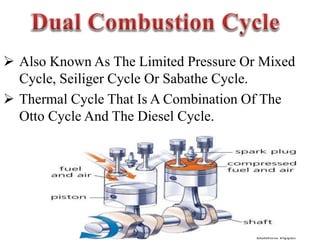
 Also Known As The Limited Pressure Or Mixed
Cycle, Seiliger Cycle Or Sabathe Cycle.
 Thermal Cycle That Is A Combination Of The
Otto Cycle And The Diesel Cycle.
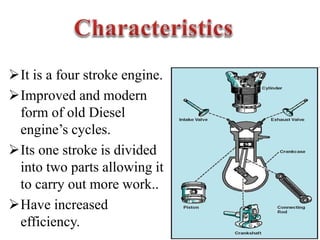
It is a four stroke engine.
Improved and modern
form of old Diesel
engine’s cycles.
Its one stroke is divided
into two parts allowing it
to carry out more work..
Have increased
efficiency.
 Each Cycle Of Piston Consists Of Two Opposite
Motions:
 There Is A Motion In One Direction, And Then A
Motion Back In The Opposite Direction. Each Of
These Is Called A Stroke
 Stroke Is The Action Of A Piston Travelling The
Full Length Of Its Locomotive Cylinder Or Engine
Cylinder In One Direction.
The dual cycle consists of following
operations:
Adiabatic compression
Addition of heat at constant volume.
Addition of heat at constant pressure.
Adiabatic expansion.
Rejection of heat at constant volume.
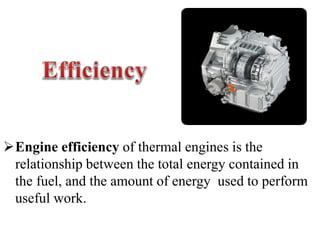
Engine efficiency of thermal engines is the
relationship between the total energy contained in
the fuel, and the amount of energy used to perform
useful work.
From first law of thermodynamics
Q = ∆U + W
And..
 ∆W = Q1 – Q2
The efficiency of engine is defined as
ƞ = Output / input
Continued..
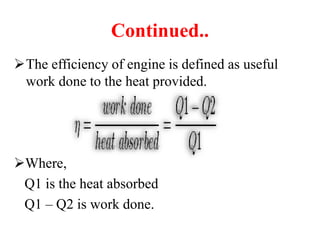
The efficiency of engine is defined as useful
work done to the heat provided.
Where,
Q1 is the heat absorbed
Q1 – Q2 is work done.
The analysis of cycle is as follows:
The heat is supplied In two stages. hence
Qin = mcp(T4 – T3) + mcv(T3 – T2)
 The heat rejected is
Qout = mcv(T5 – T1)
 The thermal efficiency may be found as
follows:
ƞ = 1 – Qout/ Qin
= 1 – mcv(T5 – T1)/ mcv(T3 -T2)+mcp(T4 – T3)
=1 – (T5 – T1)/ (T3 – T2) +ϒ(T4 – T3)
Dual combustion engines are most commonly used
for mobile propulsion in vehicles and portable
machinery.
In mobile equipment, dual combustion is
advantageous since it can provide high power-to-
weight ratios.
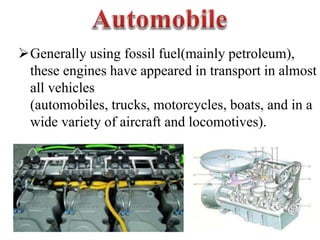
Generally using fossil fuel(mainly petroleum),
these engines have appeared in transport in almost
all vehicles
(automobiles, trucks, motorcycles, boats, and in a
wide variety of aircraft and locomotives).
Very high power-to-weight ratios are required,
dual combustion engines appear in the form
of gas turbines. These applications include jet
aircraft, helicopters, large ships and electric
generators.
 There is a role for Dual Combustion engines
for future energy use, because
– Dual combustion engine has high power to
weigh ratio.
– Relatively low cost.
– Flexible fuel use.
– Established manufacturing investment.
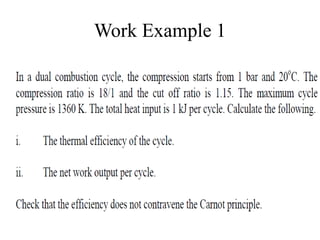
Work Example 1
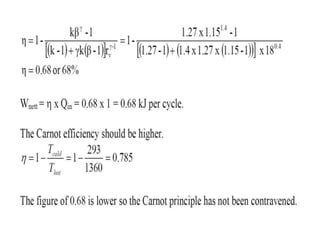
SOLUTION
Thank you for your time....

Dual cycle

  • 1.
    Name Enrollment No. HarshalBhatt 150950119504 Chintan Dave 150950119507 Vaibhavraj Chavda 150950119508 Smeet Gandhi 150950119511
  • 2.
    Oil Engine 1888. AckroydStaurt (Automatic Ignition). Rudolf Diesel Used This Principle And Developed Basis Of Dual Combustion Engine.
  • 3.
     Dual cyclewas first introduced by an engineer named Gustav Trinkler . In this cycle , part of the heat addition is at constant volume( Isochoric ) and at constant pressure ( Isobaric ) . The name Dual cycle is derived from the fact that if is an integration of both the Otto and Diesel cycle.
  • 5.
  • 6.
    Process 1 2 Isentropic compression Process 2  X Constant volume heat addition Process X  3 Constant pressure heat addition Process 3  4 Isentropic expansion Process 4  1 Constant volume heat rejection Qin Qin Qout
  • 7.
    It is aninternal combustion four stroke engine. “Dual” Because Combustion Takes Place In Two Parts First At Constant Pressure And Second At Constant Volume. This makes it better than diesel engine’s cycle.
  • 8.
     Also KnownAs The Limited Pressure Or Mixed Cycle, Seiliger Cycle Or Sabathe Cycle.  Thermal Cycle That Is A Combination Of The Otto Cycle And The Diesel Cycle.
  • 9.
    It is afour stroke engine. Improved and modern form of old Diesel engine’s cycles. Its one stroke is divided into two parts allowing it to carry out more work.. Have increased efficiency.
  • 11.
     Each CycleOf Piston Consists Of Two Opposite Motions:  There Is A Motion In One Direction, And Then A Motion Back In The Opposite Direction. Each Of These Is Called A Stroke  Stroke Is The Action Of A Piston Travelling The Full Length Of Its Locomotive Cylinder Or Engine Cylinder In One Direction.
  • 12.
    The dual cycleconsists of following operations: Adiabatic compression Addition of heat at constant volume. Addition of heat at constant pressure. Adiabatic expansion. Rejection of heat at constant volume.
  • 13.
    Engine efficiency ofthermal engines is the relationship between the total energy contained in the fuel, and the amount of energy used to perform useful work.
  • 14.
    From first lawof thermodynamics Q = ∆U + W And..  ∆W = Q1 – Q2 The efficiency of engine is defined as ƞ = Output / input
  • 15.
    Continued.. The efficiency ofengine is defined as useful work done to the heat provided. Where, Q1 is the heat absorbed Q1 – Q2 is work done.
  • 16.
    The analysis ofcycle is as follows: The heat is supplied In two stages. hence Qin = mcp(T4 – T3) + mcv(T3 – T2)  The heat rejected is Qout = mcv(T5 – T1)
  • 17.
     The thermalefficiency may be found as follows: ƞ = 1 – Qout/ Qin = 1 – mcv(T5 – T1)/ mcv(T3 -T2)+mcp(T4 – T3) =1 – (T5 – T1)/ (T3 – T2) +ϒ(T4 – T3)
  • 18.
    Dual combustion enginesare most commonly used for mobile propulsion in vehicles and portable machinery. In mobile equipment, dual combustion is advantageous since it can provide high power-to- weight ratios.
  • 19.
    Generally using fossilfuel(mainly petroleum), these engines have appeared in transport in almost all vehicles (automobiles, trucks, motorcycles, boats, and in a wide variety of aircraft and locomotives).
  • 20.
    Very high power-to-weightratios are required, dual combustion engines appear in the form of gas turbines. These applications include jet aircraft, helicopters, large ships and electric generators.
  • 22.
     There isa role for Dual Combustion engines for future energy use, because – Dual combustion engine has high power to weigh ratio. – Relatively low cost. – Flexible fuel use. – Established manufacturing investment.
  • 23.
  • 24.
  • 27.
    Thank you foryour time....