




Name Enrollment
No:
Harshal Bhatt 150950119504
INTRODUCTION
INTRO
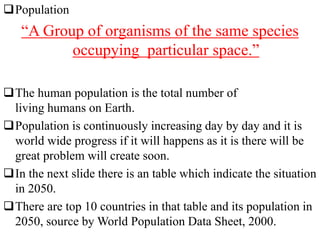
Population
“A Group of organisms of the same species
occupying particular space.”
The human population is the total number of
living humans on Earth.
Population is continuously increasing day by day and it is
world wide progress if it will happens as it is there will be
great problem will create soon.
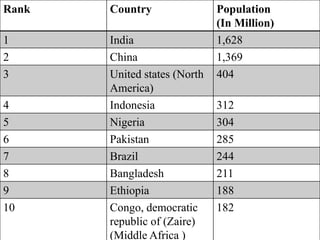
In the next slide there is an table which indicate the situation
in 2050.
There are top 10 countries in that table and its population in
2050, source by World Population Data Sheet, 2000.
Rank Country Population
(In Million)
1 India 1,628
2 China 1,369
3 United states (North
America)
404
4 Indonesia 312
5 Nigeria 304
6 Pakistan 285
7 Brazil 244
8 Bangladesh 211
9 Ethiopia 188
10 Congo, democratic
republic of (Zaire)
(Middle Africa )
182
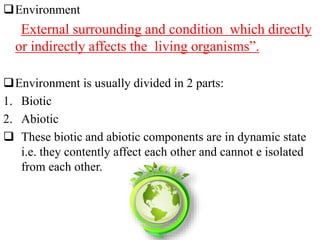
Environment
External surrounding and condition which directly
or indirectly affects the living organisms”.
Environment is usually divided in 2 parts:
1. Biotic
2. Abiotic
 These biotic and abiotic components are in dynamic state
i.e. they contently affect each other and cannot e isolated
from each other.
Population Growth and
Its Variation
Causes
 Our global human population, 6 billion at present.
 Increase in production per capita of agricultural produce at a
global level ceased during the 1980’s.
 Only 15% of the world’s population in the developed world is
earning 79% of income!
 In some countries, food shortage has become a permanent
feature.
 Two of every three children in South Africa are underweight.
 In other regions famines due to drought have become more
frequent.
 Present development strategies have not been able to
successfully address these problems related to hunger and
malnutrition.
 Change in population over time and can be quantified as the
change in number of individuals in a population using per unit
time for measurement.
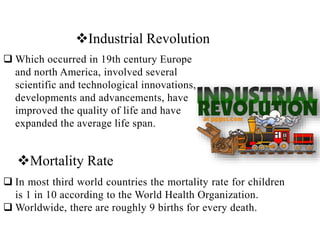
Industrial Revolution
 Which occurred in 19th century Europe
and north America, involved several
scientific and technological innovations,
developments and advancements, have
improved the quality of life and have
expanded the average life span.
Mortality Rate
 In most third world countries the mortality rate for children
is 1 in 10 according to the World Health Organization.
 Worldwide, there are roughly 9 births for every death.
Food Production
 Since the mid-19th century, many agricultural innovations
have enabled farmers to dramatically increase and improve
food production.
 For instance, between 1950 and 1984, the total amount of
grain harvested worldwide increased from 631 million tons
to 1.65 billion tons.
Public health
 By 1990, technological advancements facilitating cleaner
cities, efficient sewage systems, nutritional knowledge and
adequate homes have also lowered death rates.
Disease
 Scientific discoveries and technological advancements that
help prevent infections, cure illnesses and enable people to
survive diseases have significantly promoted population
growth.
 Vaccines have reduced the rate of infections such as
smallpox, influenza, rubella and polio.
Education Level
 The level of education a woman reaches may have an
influence on the number of children she has.
 An example of this appears within the 2007 population of
Honduras women and the number of children born.
Effects
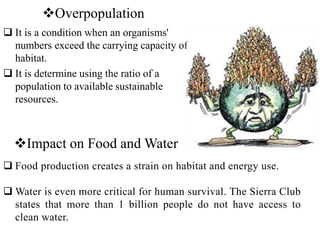
Overpopulation
 It is a condition when an organisms'
numbers exceed the carrying capacity of
habitat.
 It is determine using the ratio of a
population to available sustainable
resources.
Impact on Food and Water
 Food production creates a strain on habitat and energy use.
 Water is even more critical for human survival. The Sierra Club
states that more than 1 billion people do not have access to
clean water.
Forest Cover
 More than 16 million hectares are cleared annually.
 Forest cover is linked not only to biodiversity issues but
also to the preservation of freshwater ecosystems,
groundwater supplies, and reducing the amount of
greenhouse gases, which cause climate change
Fossil Fuels
 Fossil fuels for automobiles requiring all humans to
develop alternative forms of transportation
 Burning coal for electricity, will continue to increase the
amount of greenhouse gases in the atmosphere.
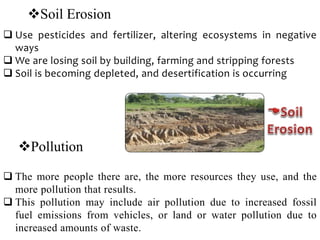
Soil Erosion
 Use pesticides and fertilizer, altering ecosystems in negative
ways
 We are losing soil by building, farming and stripping forests
 Soil is becoming depleted, and desertification is occurring
Pollution
 The more people there are, the more resources they use, and the
more pollution that results.
 This pollution may include air pollution due to increased fossil
fuel emissions from vehicles, or land or water pollution due to
increased amounts of waste.
Public Health Concerns
 Unchecked population growth may lead to public health
problems
 For example, in many developing countries, populations do
not have access to clean water sources. Water pollution,
caused by a lack of proper sanitation, can easily lead to the
spread of disease.
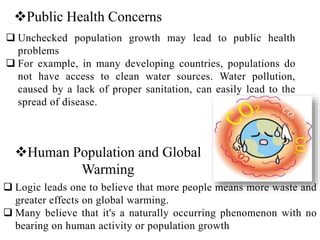
Human Population and Global
Warming
 Logic leads one to believe that more people means more waste and
greater effects on global warming.
 Many believe that it's a naturally occurring phenomenon with no
bearing on human activity or population growth
Population explosion
 It is the very great and continuing increase in human population in
modern times
 It can lead to depletion of resources
 Severe competition for food and space
 Increase in psychological stress and strain
 Rapid pollution of environment
 Large scale unemployment
 forests are cut, oceans are exploited and the entire natural
equilibrium gets disturbed
 A growth human population first faces the problem of food, shelter
and socio-economic problems
Thank you for your time....

Human Population And Environment by Harshal bhatt

  • 1.
  • 3.
  • 4.
    Population “A Group oforganisms of the same species occupying particular space.” The human population is the total number of living humans on Earth. Population is continuously increasing day by day and it is world wide progress if it will happens as it is there will be great problem will create soon. In the next slide there is an table which indicate the situation in 2050. There are top 10 countries in that table and its population in 2050, source by World Population Data Sheet, 2000.
  • 5.
    Rank Country Population (InMillion) 1 India 1,628 2 China 1,369 3 United states (North America) 404 4 Indonesia 312 5 Nigeria 304 6 Pakistan 285 7 Brazil 244 8 Bangladesh 211 9 Ethiopia 188 10 Congo, democratic republic of (Zaire) (Middle Africa ) 182
  • 6.
    Environment External surrounding andcondition which directly or indirectly affects the living organisms”. Environment is usually divided in 2 parts: 1. Biotic 2. Abiotic  These biotic and abiotic components are in dynamic state i.e. they contently affect each other and cannot e isolated from each other.
  • 7.
  • 8.
  • 9.
     Our globalhuman population, 6 billion at present.  Increase in production per capita of agricultural produce at a global level ceased during the 1980’s.  Only 15% of the world’s population in the developed world is earning 79% of income!  In some countries, food shortage has become a permanent feature.  Two of every three children in South Africa are underweight.  In other regions famines due to drought have become more frequent.  Present development strategies have not been able to successfully address these problems related to hunger and malnutrition.  Change in population over time and can be quantified as the change in number of individuals in a population using per unit time for measurement.
  • 10.
    Industrial Revolution  Whichoccurred in 19th century Europe and north America, involved several scientific and technological innovations, developments and advancements, have improved the quality of life and have expanded the average life span. Mortality Rate  In most third world countries the mortality rate for children is 1 in 10 according to the World Health Organization.  Worldwide, there are roughly 9 births for every death.
  • 11.
    Food Production  Sincethe mid-19th century, many agricultural innovations have enabled farmers to dramatically increase and improve food production.  For instance, between 1950 and 1984, the total amount of grain harvested worldwide increased from 631 million tons to 1.65 billion tons. Public health  By 1990, technological advancements facilitating cleaner cities, efficient sewage systems, nutritional knowledge and adequate homes have also lowered death rates.
  • 12.
    Disease  Scientific discoveriesand technological advancements that help prevent infections, cure illnesses and enable people to survive diseases have significantly promoted population growth.  Vaccines have reduced the rate of infections such as smallpox, influenza, rubella and polio. Education Level  The level of education a woman reaches may have an influence on the number of children she has.  An example of this appears within the 2007 population of Honduras women and the number of children born.
  • 13.
  • 14.
    Overpopulation  It isa condition when an organisms' numbers exceed the carrying capacity of habitat.  It is determine using the ratio of a population to available sustainable resources. Impact on Food and Water  Food production creates a strain on habitat and energy use.  Water is even more critical for human survival. The Sierra Club states that more than 1 billion people do not have access to clean water.
  • 15.
    Forest Cover  Morethan 16 million hectares are cleared annually.  Forest cover is linked not only to biodiversity issues but also to the preservation of freshwater ecosystems, groundwater supplies, and reducing the amount of greenhouse gases, which cause climate change Fossil Fuels  Fossil fuels for automobiles requiring all humans to develop alternative forms of transportation  Burning coal for electricity, will continue to increase the amount of greenhouse gases in the atmosphere.
  • 16.
    Soil Erosion  Usepesticides and fertilizer, altering ecosystems in negative ways  We are losing soil by building, farming and stripping forests  Soil is becoming depleted, and desertification is occurring Pollution  The more people there are, the more resources they use, and the more pollution that results.  This pollution may include air pollution due to increased fossil fuel emissions from vehicles, or land or water pollution due to increased amounts of waste.
  • 17.
    Public Health Concerns Unchecked population growth may lead to public health problems  For example, in many developing countries, populations do not have access to clean water sources. Water pollution, caused by a lack of proper sanitation, can easily lead to the spread of disease. Human Population and Global Warming  Logic leads one to believe that more people means more waste and greater effects on global warming.  Many believe that it's a naturally occurring phenomenon with no bearing on human activity or population growth
  • 18.
    Population explosion  Itis the very great and continuing increase in human population in modern times  It can lead to depletion of resources  Severe competition for food and space  Increase in psychological stress and strain  Rapid pollution of environment  Large scale unemployment  forests are cut, oceans are exploited and the entire natural equilibrium gets disturbed  A growth human population first faces the problem of food, shelter and socio-economic problems
  • 20.
    Thank you foryour time....