ME3451 -Thermal Engineering
Presentation by
M. VINOTH KUMAR
Assistant Professor/Mechanical
MOUNT ZION COLLEGE OF ENGINEERING AND TECHNOLOGY
DEPARTMENT OF MECHANICAL ENGINEERING
UNIT I- THERMODYNAMIC CYCLE
OBJECTIVE
• To learn the concepts and laws of thermodynamics to
predict the operation of thermodynamic cycles and
performance of Internal Combustion(IC) engines and Gas
Turbines.
• To analyzing the performance of steam nozzle, calculate
critical pressure ratio
• To Evaluating the performance of steam turbines through
velocity triangles, understand the need for governing and
compounding of turbines
• To analyzing the working of IC engines and various
auxiliary systems present in IC engines
• To evaluating the various performance parameters of IC
engines.
Monday, April 14, 2025 MECH/IV/ME3451/TE/I 2
EXPECTED OUTCOME
Students will be able to
 To Apply thermodynamic concepts to different air
standard cycles and solve problems.
 To solve problems in steam nozzle and calculate critical
pressure ratio.
 Explain the flow in steam turbines, draw velocity
diagrams, flow in Gas turbines and solve problems.
 Explain the functioning and features of IC engine,
components and auxiliaries.
 Calculate the various performance parameters of IC
engines
Monday, April 14, 2025 MECH/IV/ME3451/TE/I 3
THERMAL ENGINEERING
MECH/IV/ME3451/TE/I 4
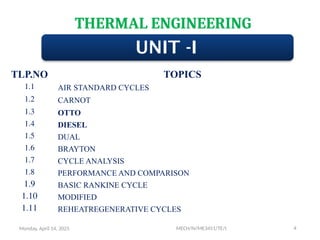
UNIT -I
TLP.NO TOPICS
1.1 AIR STANDARD CYCLES
1.2 CARNOT
1.3 OTTO
1.4 DIESEL
1.5 DUAL
1.6 BRAYTON
1.7 CYCLE ANALYSIS
1.8 PERFORMANCE AND COMPARISON
1.9 BASIC RANKINE CYCLE
1.10 MODIFIED
1.11 REHEATREGENERATIVE CYCLES
Monday, April 14, 2025
Previous Class: Today’s Class:
MECH/IV/ME3451/TE/I 5
• 1.3 OTTO
1.4 DIESEL
THERMAL ENGINEERING
Monday, April 14, 2025
Monday, April 14, 2025 MECH/IV/ME3451/TE/I 6
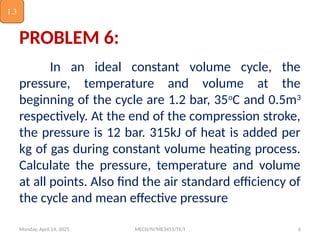
PROBLEM 6:
In an ideal constant volume cycle, the
pressure, temperature and volume at the
beginning of the cycle are 1.2 bar, 35o
C and 0.5m3
respectively. At the end of the compression stroke,
the pressure is 12 bar. 315kJ of heat is added per
kg of gas during constant volume heating process.
Calculate the pressure, temperature and volume
at all points. Also find the air standard efficiency of
the cycle and mean effective pressure
1.3
Monday, April 14, 2025 MECH/IV/ME3451/TE/I 7
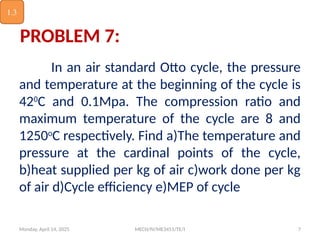
PROBLEM 7:
In an air standard Otto cycle, the pressure
and temperature at the beginning of the cycle is
420
C and 0.1Mpa. The compression ratio and
maximum temperature of the cycle are 8 and
1250o
C respectively. Find a)The temperature and
pressure at the cardinal points of the cycle,
b)heat supplied per kg of air c)work done per kg
of air d)Cycle efficiency e)MEP of cycle
1.3
Monday, April 14, 2025 MECH/IV/ME3451/TE/I 8
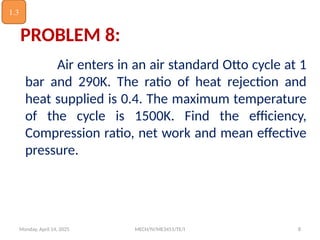
Air enters in an air standard Otto cycle at 1
bar and 290K. The ratio of heat rejection and
heat supplied is 0.4. The maximum temperature
of the cycle is 1500K. Find the efficiency,
Compression ratio, net work and mean effective
pressure.
PROBLEM 8:
1.3
Monday, April 14, 2025 MECH/IV/ME3451/TE/I 9
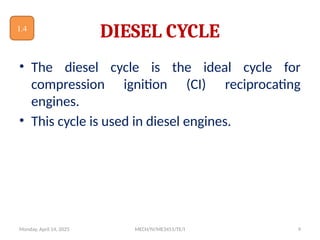
DIESEL CYCLE
• The diesel cycle is the ideal cycle for
compression ignition (CI) reciprocating
engines.
• This cycle is used in diesel engines.
1.4
Monday, April 14, 2025 MECH/IV/ME3451/TE/I 10
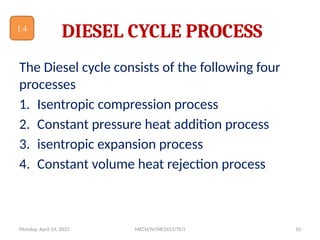
DIESEL CYCLE PROCESS
The Diesel cycle consists of the following four
processes
1. Isentropic compression process
2. Constant pressure heat addition process
3. isentropic expansion process
4. Constant volume heat rejection process
1.4
Monday, April 14, 2025 MECH/IV/ME3451/TE/I 11
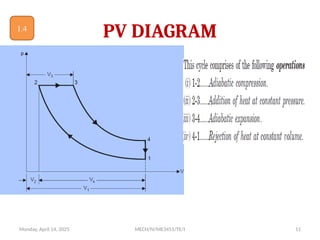
PV DIAGRAM
1.4
Monday, April 14, 2025 MECH/IV/ME3451/TE/I 12
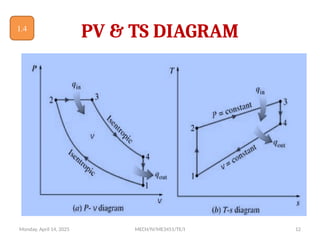
PV & TS DIAGRAM
1.4
Monday, April 14, 2025 MECH/IV/ME3451/TE/I 13
Process 1-2: Isentropic Compression
In this process the piston moves from BDC to TDC and compression
of air takes place is entropically. It means that during compression
the entropy remains constant and there is no flow of heat out of
the cylinder walls (non-conductors) happens. Here the air is
compressed so the pressure increases from P1 to P2, volume
decreases from V1 to V2, Temperature increases from T1 to T2 and
entropy remains constant ( i.e. S1 = S2).
Process 2-3: Constant Volume Heat Addition
In this process the, the hot body is kept in contact with the cylinder
and heat addition to the air takes place at constant pressure.
During this process, the piston rest for a moment at TDC. The
pressure remains constant (i.e. P2 = P3), volume increases from V2
to V3, temperature increases from T2 to T3, entropy increases from
S2 to S3.
1.4
Monday, April 14, 2025 MECH/IV/ME3451/TE/I 14
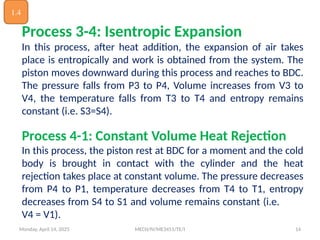
Process 3-4: Isentropic Expansion
In this process, after heat addition, the expansion of air takes
place is entropically and work is obtained from the system. The
piston moves downward during this process and reaches to BDC.
The pressure falls from P3 to P4, Volume increases from V3 to
V4, the temperature falls from T3 to T4 and entropy remains
constant (i.e. S3=S4).
Process 4-1: Constant Volume Heat Rejection
In this process, the piston rest at BDC for a moment and the cold
body is brought in contact with the cylinder and the heat
rejection takes place at constant volume. The pressure decreases
from P4 to P1, temperature decreases from T4 to T1, entropy
decreases from S4 to S1 and volume remains constant (i.e.
V4 = V1).
1.4
Monday, April 14, 2025 MECH/IV/ME3451/TE/I 15
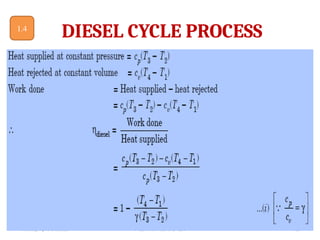
DIESEL CYCLE PROCESS
1.4
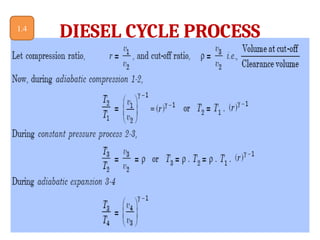
Monday, April 14, 2025 MECH/IV/ME3451/TE/I 16
DIESEL CYCLE PROCESS
1.4
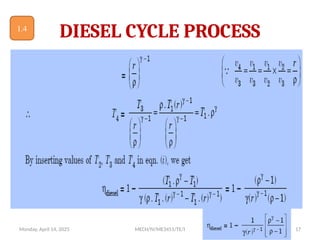
Monday, April 14, 2025 MECH/IV/ME3451/TE/I 17
DIESEL CYCLE PROCESS
1.4
Monday, April 14, 2025 MECH/IV/ME3451/TE/I 18
1.4
Monday, April 14, 2025 MECH/IV/ME3451/TE/I 19
1.4
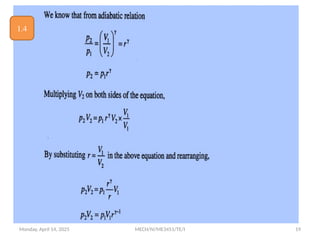
Monday, April 14, 2025 MECH/IV/ME3451/TE/I 20
1.4
Monday, April 14, 2025 MECH/IV/ME3451/TE/I 21
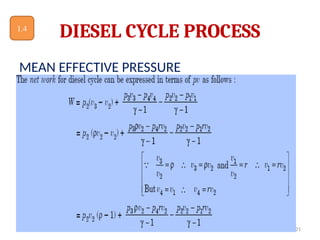
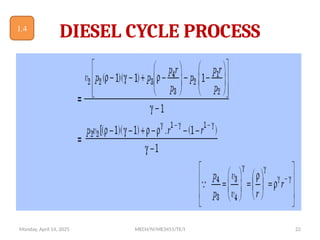
DIESEL CYCLE PROCESS
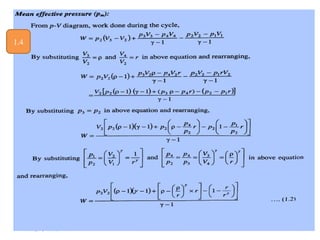
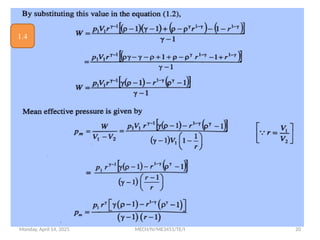
MEAN EFFECTIVE PRESSURE
1.4
Monday, April 14, 2025 MECH/IV/ME3451/TE/I 22
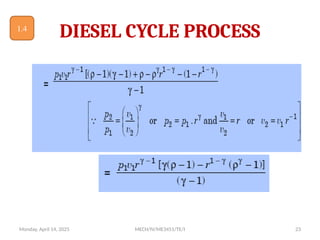
DIESEL CYCLE PROCESS
1.4
Monday, April 14, 2025 MECH/IV/ME3451/TE/I 23
DIESEL CYCLE PROCESS
1.4
Monday, April 14, 2025 MECH/IV/ME3451/TE/I 24
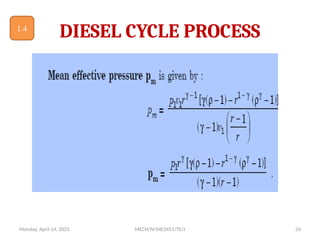
DIESEL CYCLE PROCESS
1.4
Monday, April 14, 2025 MECH/IV/ME3451/TE/I 25
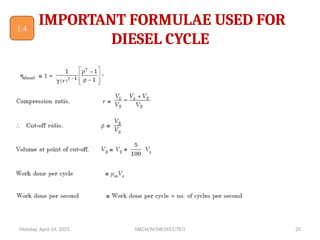
IMPORTANT FORMULAE USED FOR
DIESEL CYCLE
1.4
Monday, April 14, 2025 MECH/IV/ME3451/TE/I 26
PROBLEM 1:
A diesel engine operating on an air
standard diesel cycle has 20cm bore and 30cm
stroke. The clearance volume is 420cm3
. If the
fuel is injected at 5% of the stroke, find the air
standard efficiency.
1.4
Monday, April 14, 2025 MECH/IV/ME3451/TE/I 27
PROBLEM 2:
The following data refers to a compression
ignition engine which is working on diesel cycle.
Diameter of cylinder=100mm, Stroke=125mm
and clearance volume is 1/15th
of stroke.
Calculate the air standard efficiency when the
heat received by the engine during 1/18th
of the
stroke.
1.4
SUMMARY
• Studied about the Diesel cycle .
Monday, April 14, 2025 28
MECH/IV/ME3451/TE/I
1.4
REFERENCE
1. Mahesh. M. Rathore, “Thermal Engineering”, 1st Edition, Tata McGraw
Hill, 2010.
2. Ganesan.V, " Internal Combustion Engines" 4th Edition, Tata McGraw
Hill, 2012.
Monday, April 14, 2025 29
MECH/IV/ME3451/TE/I
1.4

1.3 & 1.4.pptx Thermal Engineering Unit 1

  • 1.
    ME3451 -Thermal Engineering Presentationby M. VINOTH KUMAR Assistant Professor/Mechanical MOUNT ZION COLLEGE OF ENGINEERING AND TECHNOLOGY DEPARTMENT OF MECHANICAL ENGINEERING UNIT I- THERMODYNAMIC CYCLE
  • 2.
    OBJECTIVE • To learnthe concepts and laws of thermodynamics to predict the operation of thermodynamic cycles and performance of Internal Combustion(IC) engines and Gas Turbines. • To analyzing the performance of steam nozzle, calculate critical pressure ratio • To Evaluating the performance of steam turbines through velocity triangles, understand the need for governing and compounding of turbines • To analyzing the working of IC engines and various auxiliary systems present in IC engines • To evaluating the various performance parameters of IC engines. Monday, April 14, 2025 MECH/IV/ME3451/TE/I 2
  • 3.
    EXPECTED OUTCOME Students willbe able to  To Apply thermodynamic concepts to different air standard cycles and solve problems.  To solve problems in steam nozzle and calculate critical pressure ratio.  Explain the flow in steam turbines, draw velocity diagrams, flow in Gas turbines and solve problems.  Explain the functioning and features of IC engine, components and auxiliaries.  Calculate the various performance parameters of IC engines Monday, April 14, 2025 MECH/IV/ME3451/TE/I 3
  • 4.
    THERMAL ENGINEERING MECH/IV/ME3451/TE/I 4 UNIT-I TLP.NO TOPICS 1.1 AIR STANDARD CYCLES 1.2 CARNOT 1.3 OTTO 1.4 DIESEL 1.5 DUAL 1.6 BRAYTON 1.7 CYCLE ANALYSIS 1.8 PERFORMANCE AND COMPARISON 1.9 BASIC RANKINE CYCLE 1.10 MODIFIED 1.11 REHEATREGENERATIVE CYCLES Monday, April 14, 2025
  • 5.
    Previous Class: Today’sClass: MECH/IV/ME3451/TE/I 5 • 1.3 OTTO 1.4 DIESEL THERMAL ENGINEERING Monday, April 14, 2025
  • 6.
    Monday, April 14,2025 MECH/IV/ME3451/TE/I 6 PROBLEM 6: In an ideal constant volume cycle, the pressure, temperature and volume at the beginning of the cycle are 1.2 bar, 35o C and 0.5m3 respectively. At the end of the compression stroke, the pressure is 12 bar. 315kJ of heat is added per kg of gas during constant volume heating process. Calculate the pressure, temperature and volume at all points. Also find the air standard efficiency of the cycle and mean effective pressure 1.3
  • 7.
    Monday, April 14,2025 MECH/IV/ME3451/TE/I 7 PROBLEM 7: In an air standard Otto cycle, the pressure and temperature at the beginning of the cycle is 420 C and 0.1Mpa. The compression ratio and maximum temperature of the cycle are 8 and 1250o C respectively. Find a)The temperature and pressure at the cardinal points of the cycle, b)heat supplied per kg of air c)work done per kg of air d)Cycle efficiency e)MEP of cycle 1.3
  • 8.
    Monday, April 14,2025 MECH/IV/ME3451/TE/I 8 Air enters in an air standard Otto cycle at 1 bar and 290K. The ratio of heat rejection and heat supplied is 0.4. The maximum temperature of the cycle is 1500K. Find the efficiency, Compression ratio, net work and mean effective pressure. PROBLEM 8: 1.3
  • 9.
    Monday, April 14,2025 MECH/IV/ME3451/TE/I 9 DIESEL CYCLE • The diesel cycle is the ideal cycle for compression ignition (CI) reciprocating engines. • This cycle is used in diesel engines. 1.4
  • 10.
    Monday, April 14,2025 MECH/IV/ME3451/TE/I 10 DIESEL CYCLE PROCESS The Diesel cycle consists of the following four processes 1. Isentropic compression process 2. Constant pressure heat addition process 3. isentropic expansion process 4. Constant volume heat rejection process 1.4
  • 11.
    Monday, April 14,2025 MECH/IV/ME3451/TE/I 11 PV DIAGRAM 1.4
  • 12.
    Monday, April 14,2025 MECH/IV/ME3451/TE/I 12 PV & TS DIAGRAM 1.4
  • 13.
    Monday, April 14,2025 MECH/IV/ME3451/TE/I 13 Process 1-2: Isentropic Compression In this process the piston moves from BDC to TDC and compression of air takes place is entropically. It means that during compression the entropy remains constant and there is no flow of heat out of the cylinder walls (non-conductors) happens. Here the air is compressed so the pressure increases from P1 to P2, volume decreases from V1 to V2, Temperature increases from T1 to T2 and entropy remains constant ( i.e. S1 = S2). Process 2-3: Constant Volume Heat Addition In this process the, the hot body is kept in contact with the cylinder and heat addition to the air takes place at constant pressure. During this process, the piston rest for a moment at TDC. The pressure remains constant (i.e. P2 = P3), volume increases from V2 to V3, temperature increases from T2 to T3, entropy increases from S2 to S3. 1.4
  • 14.
    Monday, April 14,2025 MECH/IV/ME3451/TE/I 14 Process 3-4: Isentropic Expansion In this process, after heat addition, the expansion of air takes place is entropically and work is obtained from the system. The piston moves downward during this process and reaches to BDC. The pressure falls from P3 to P4, Volume increases from V3 to V4, the temperature falls from T3 to T4 and entropy remains constant (i.e. S3=S4). Process 4-1: Constant Volume Heat Rejection In this process, the piston rest at BDC for a moment and the cold body is brought in contact with the cylinder and the heat rejection takes place at constant volume. The pressure decreases from P4 to P1, temperature decreases from T4 to T1, entropy decreases from S4 to S1 and volume remains constant (i.e. V4 = V1). 1.4
  • 15.
    Monday, April 14,2025 MECH/IV/ME3451/TE/I 15 DIESEL CYCLE PROCESS 1.4
  • 16.
    Monday, April 14,2025 MECH/IV/ME3451/TE/I 16 DIESEL CYCLE PROCESS 1.4
  • 17.
    Monday, April 14,2025 MECH/IV/ME3451/TE/I 17 DIESEL CYCLE PROCESS 1.4
  • 18.
    Monday, April 14,2025 MECH/IV/ME3451/TE/I 18 1.4
  • 19.
    Monday, April 14,2025 MECH/IV/ME3451/TE/I 19 1.4
  • 20.
    Monday, April 14,2025 MECH/IV/ME3451/TE/I 20 1.4
  • 21.
    Monday, April 14,2025 MECH/IV/ME3451/TE/I 21 DIESEL CYCLE PROCESS MEAN EFFECTIVE PRESSURE 1.4
  • 22.
    Monday, April 14,2025 MECH/IV/ME3451/TE/I 22 DIESEL CYCLE PROCESS 1.4
  • 23.
    Monday, April 14,2025 MECH/IV/ME3451/TE/I 23 DIESEL CYCLE PROCESS 1.4
  • 24.
    Monday, April 14,2025 MECH/IV/ME3451/TE/I 24 DIESEL CYCLE PROCESS 1.4
  • 25.
    Monday, April 14,2025 MECH/IV/ME3451/TE/I 25 IMPORTANT FORMULAE USED FOR DIESEL CYCLE 1.4
  • 26.
    Monday, April 14,2025 MECH/IV/ME3451/TE/I 26 PROBLEM 1: A diesel engine operating on an air standard diesel cycle has 20cm bore and 30cm stroke. The clearance volume is 420cm3 . If the fuel is injected at 5% of the stroke, find the air standard efficiency. 1.4
  • 27.
    Monday, April 14,2025 MECH/IV/ME3451/TE/I 27 PROBLEM 2: The following data refers to a compression ignition engine which is working on diesel cycle. Diameter of cylinder=100mm, Stroke=125mm and clearance volume is 1/15th of stroke. Calculate the air standard efficiency when the heat received by the engine during 1/18th of the stroke. 1.4
  • 28.
    SUMMARY • Studied aboutthe Diesel cycle . Monday, April 14, 2025 28 MECH/IV/ME3451/TE/I 1.4
  • 29.
    REFERENCE 1. Mahesh. M.Rathore, “Thermal Engineering”, 1st Edition, Tata McGraw Hill, 2010. 2. Ganesan.V, " Internal Combustion Engines" 4th Edition, Tata McGraw Hill, 2012. Monday, April 14, 2025 29 MECH/IV/ME3451/TE/I 1.4