RAI SAHEB BHANWAR SINGH
COLLEGE,
TOPIC:-
SUBMITTED BY:-
Dolly Rajput
SUBMITTED TO:-
MR. GYANRAO DHOTE SIR
* Properties of D and E
* Relation between D, E and P
Three Electric Vectors
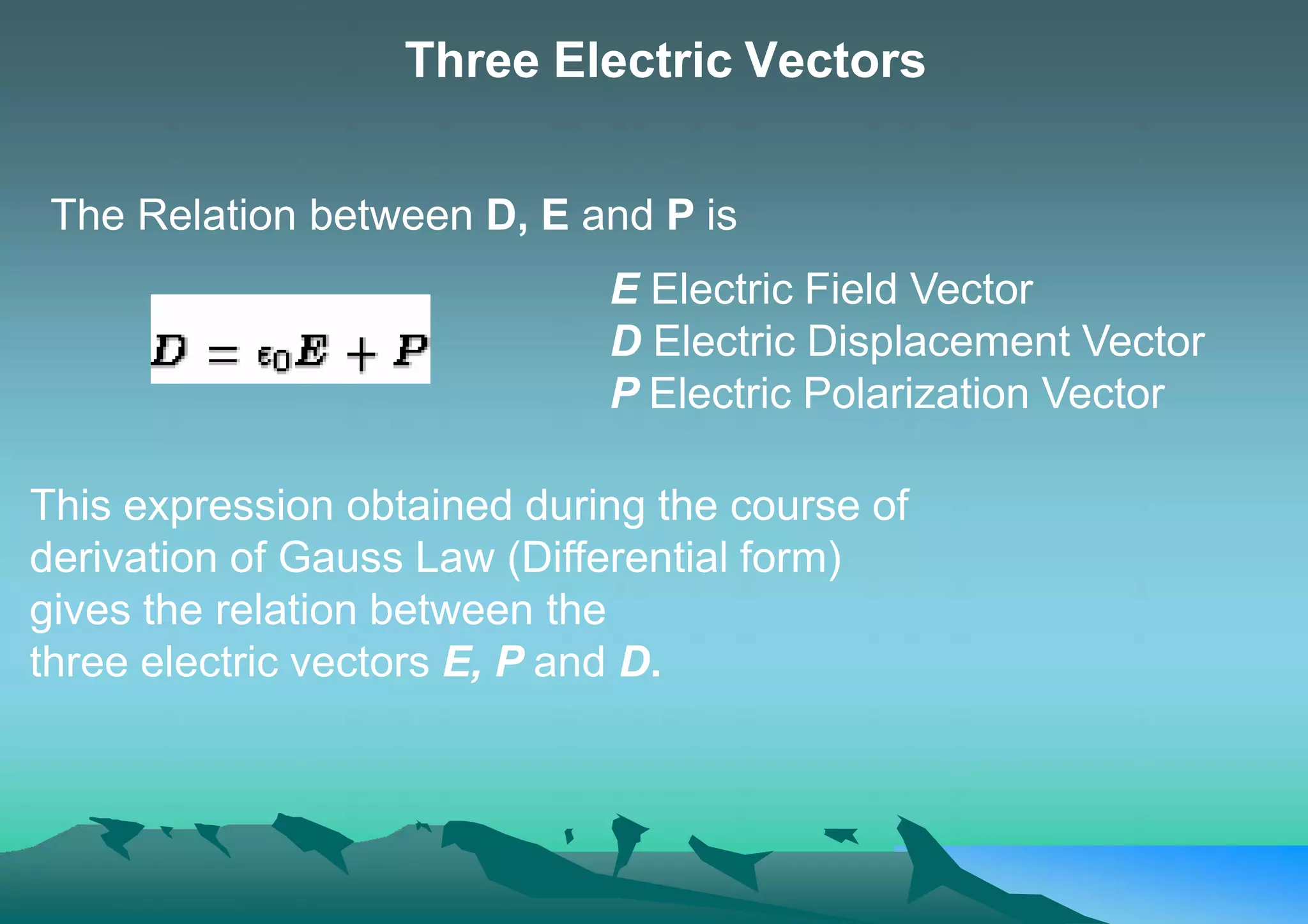
The Relation between D, E and P is
E Electric Field Vector
D Electric Displacement Vector
P Electric Polarization Vector
This expression obtained during the course of
derivation of Gauss Law (Differential form)
gives the relation between the
three electric vectors E, P and D.
Electric Displacement Vector D
D is an electric vector that represents
the component of an electric field associated solely
with the presence of separated free electric charges,
purposely excluding the contribution of
any bound electric charges in neutral atoms or molecules.
Electric Displacement Vector D
If a slab of insulating material
is inserted between the charged plates,
the shift of charge, or polarization,
reduces the value of the applied electric field E
that was present prior to inserting the insulation.
Electric Displacement Vector D
The average value of the electric field E, has components
P that depends on the bound polarization charges and
D Electric Displacement, that depends on free charges
without reference to
the dielectric properties of the surrounding medium
Electric Displacement Vector D
The electric displacement field is a vector field defined as
in metre-kilogram-second (mks) or SI system
D = E+ 4πP.In the centimetre-gram-second (cgs) system
D is measured in coulombs per square meter.
Quantity D is convenient for various calculations e.g.
D enables to write Gauss’ Law for dielectric material
Electric Displacement Vector D
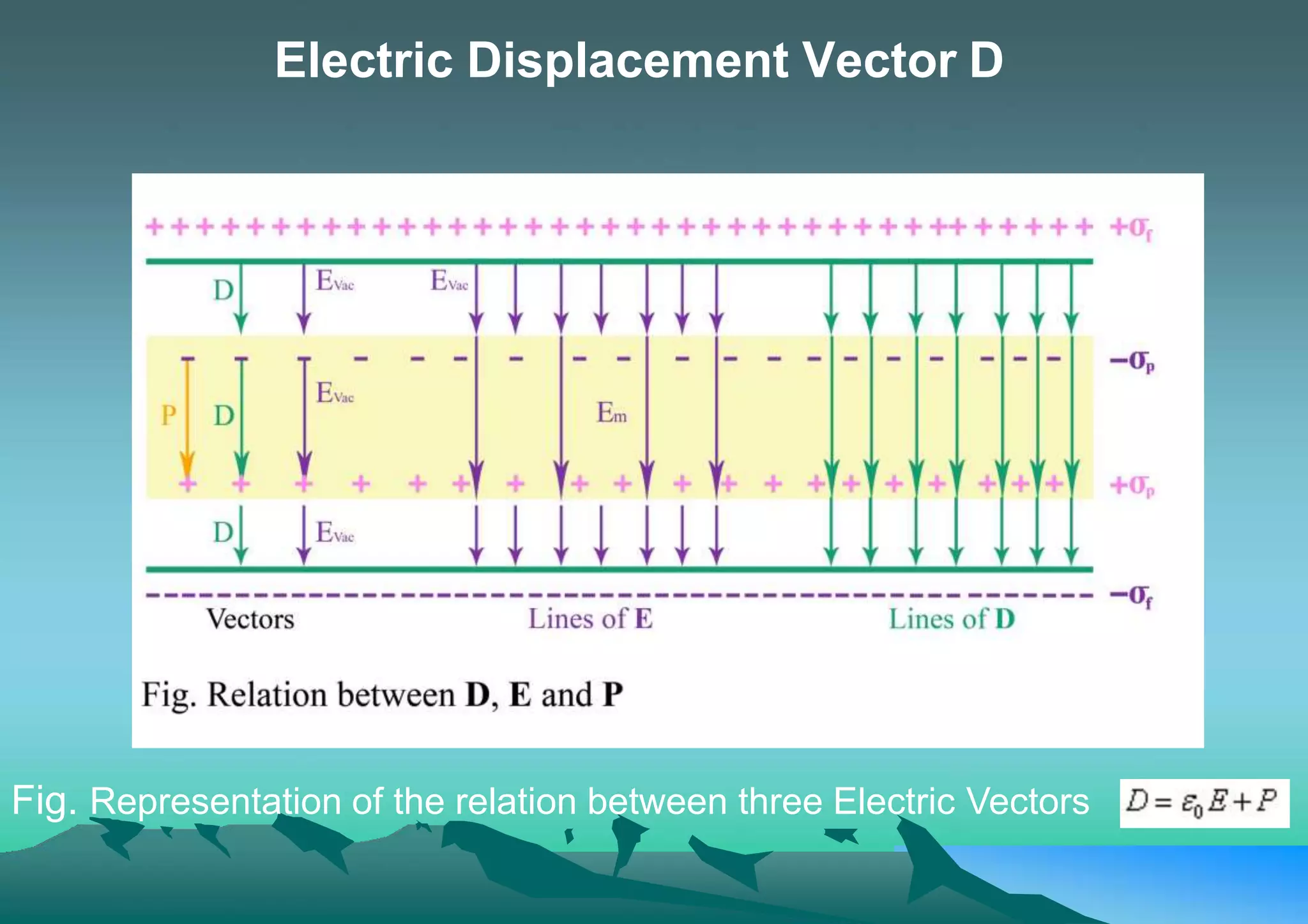
Fig. Representation of the relation between three Electric Vectors
E, D and P,the three Electric Vectors have properties as
1.E is connected with all charges
that are actually present, whether free or bound.
The lines of E indicate the presence of both kinds of charge
2. D is connected with free charge only, so that
it is not altered by the introduction of the dielectric.
Three Electric Vectors
3. P is connected with the polarization charge only.
It is also possible to represent P by vector field by lines.
The electric polarization P may also be defined
in terms of Electric Displacement vector D.
P the difference between
the electric fields D (induced) and
E (imposed) in a dielectric
due to bound and free charges,
respectively as follows.
in CGS
Three Electric Vectors
Thanks For
Your
Attention

RELATION BETWEEN DE AND P VECTORS Dolly rajput

  • 1.
    RAI SAHEB BHANWARSINGH COLLEGE, TOPIC:- SUBMITTED BY:- Dolly Rajput SUBMITTED TO:- MR. GYANRAO DHOTE SIR
  • 2.
    * Properties ofD and E * Relation between D, E and P
  • 3.
    Three Electric Vectors TheRelation between D, E and P is E Electric Field Vector D Electric Displacement Vector P Electric Polarization Vector This expression obtained during the course of derivation of Gauss Law (Differential form) gives the relation between the three electric vectors E, P and D.
  • 4.
    Electric Displacement VectorD D is an electric vector that represents the component of an electric field associated solely with the presence of separated free electric charges, purposely excluding the contribution of any bound electric charges in neutral atoms or molecules.
  • 5.
    Electric Displacement VectorD If a slab of insulating material is inserted between the charged plates, the shift of charge, or polarization, reduces the value of the applied electric field E that was present prior to inserting the insulation.
  • 6.
    Electric Displacement VectorD The average value of the electric field E, has components P that depends on the bound polarization charges and D Electric Displacement, that depends on free charges without reference to the dielectric properties of the surrounding medium
  • 7.
    Electric Displacement VectorD The electric displacement field is a vector field defined as in metre-kilogram-second (mks) or SI system D = E+ 4πP.In the centimetre-gram-second (cgs) system D is measured in coulombs per square meter. Quantity D is convenient for various calculations e.g. D enables to write Gauss’ Law for dielectric material
  • 8.
    Electric Displacement VectorD Fig. Representation of the relation between three Electric Vectors
  • 9.
    E, D andP,the three Electric Vectors have properties as 1.E is connected with all charges that are actually present, whether free or bound. The lines of E indicate the presence of both kinds of charge 2. D is connected with free charge only, so that it is not altered by the introduction of the dielectric. Three Electric Vectors
  • 10.
    Three Electric Vectors 3.P is connected with the polarization charge only. It is also possible to represent P by vector field by lines. The electric polarization P may also be defined in terms of Electric Displacement vector D.
  • 11.
    P the differencebetween the electric fields D (induced) and E (imposed) in a dielectric due to bound and free charges, respectively as follows. in CGS Three Electric Vectors
  • 12.