Seedless Plants
• Eukaryotic
• Photosynthetic
• Adapted to land:
– Waxy cuticle: prevents water loss
– Vascular tissue: transports water and nutrients
• Reproduction still requires water (no seeds)
Alternation of Generations
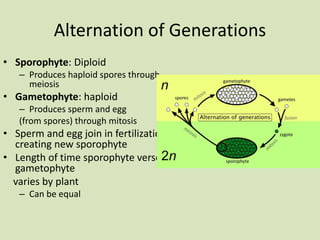
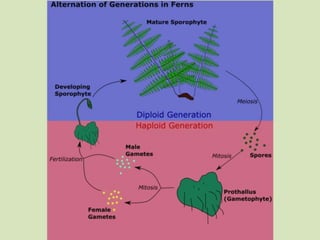
• Sporophyte: Diploid
– Produces haploid spores through
meiosis
• Gametophyte: haploid
– Produces sperm and egg
(from spores) through mitosis
• Sperm and egg join in fertilization
creating new sporophyte
• Length of time sporophyte verses
gametophyte
varies by plant
– Can be equal
Nonvascular Plants
• Mosses (Bryophyta) and liverworts
• Observe prepared slides of gametophyte and
sporophyte
• Also view live moss specimen
• No liverwort specimens
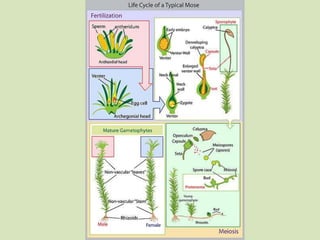
• Separate male and female gametophytes
– Male antheridia produces sperm
– Female archegonia produces egg
Seedless Vascular Plants
• Club mosses, wisk ferns, horsetails, ferns
• Sporophyte dominant
• Adapted to living on land
– Vascular tissue
– Windblown spores
• Just fern (Pterophyta) examples today
– Very diverse group
– Look at preserved slides and specimens
Fern Life Cycle
Fern terms
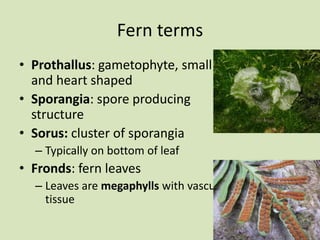
• Prothallus: gametophyte, small
and heart shaped
• Sporangia: spore producing
structure
• Sorus: cluster of sporangia
– Typically on bottom of leaf
• Fronds: fern leaves
– Leaves are megaphylls with vascular
tissue

Seedless plants BIO II Slides

  • 1.
    Seedless Plants • Eukaryotic •Photosynthetic • Adapted to land: – Waxy cuticle: prevents water loss – Vascular tissue: transports water and nutrients • Reproduction still requires water (no seeds)
  • 2.
    Alternation of Generations •Sporophyte: Diploid – Produces haploid spores through meiosis • Gametophyte: haploid – Produces sperm and egg (from spores) through mitosis • Sperm and egg join in fertilization creating new sporophyte • Length of time sporophyte verses gametophyte varies by plant – Can be equal
  • 3.
    Nonvascular Plants • Mosses(Bryophyta) and liverworts • Observe prepared slides of gametophyte and sporophyte • Also view live moss specimen • No liverwort specimens • Separate male and female gametophytes – Male antheridia produces sperm – Female archegonia produces egg
  • 5.
    Seedless Vascular Plants •Club mosses, wisk ferns, horsetails, ferns • Sporophyte dominant • Adapted to living on land – Vascular tissue – Windblown spores • Just fern (Pterophyta) examples today – Very diverse group – Look at preserved slides and specimens
  • 6.
  • 7.
    Fern terms • Prothallus:gametophyte, small and heart shaped • Sporangia: spore producing structure • Sorus: cluster of sporangia – Typically on bottom of leaf • Fronds: fern leaves – Leaves are megaphylls with vascular tissue

Editor's Notes

  • #3 "Alternation of generations simpler" by Alternation of generations.svg: Peter coxheadderivative work: Peter coxhead (talk) - This file was derived from: Alternation of generations.svg:. Licensed under Public Domain via Wikimedia Commons - https://commons.wikimedia.org/wiki/File:Alternation_of_generations_simpler.svg#/media/File:Alternation_of_generations_simpler.svg
  • #5 By LadyofHats (Own work) [Public domain], via Wikimedia Commons, https://upload.wikimedia.org/wikipedia/commons/1/10/Lifecycle_moss_svg_diagram.svg
  • #7 „Alternation of generations in ferns“ von Jeffrey Finkelstein - I created this diagram using Inkscape.. Lizenziert unter CC BY-SA 3.0 über Wikimedia Commons - https://commons.wikimedia.org/wiki/File:Alternation_of_generations_in_ferns.svg#/media/File:Alternation_of_generations_in_ferns.svg
  • #8 Top Image: "Dixonia prothallus". Licensed under Public Domain via Wikimedia Commons - https://commons.wikimedia.org/wiki/File:Dixonia_prothallus.jpg#/media/File:Dixonia_prothallus.jpg Bottom Image: "Large Sori (fern)" by JP Smith - Author. Licensed under Public Domain via Wikimedia Commons - https://commons.wikimedia.org/wiki/File:Large_Sori_(fern).JPG#/media/File:Large_Sori_(fern).JPG