Sexual
Reproduction in
Flowering plants.
D.Sreekanth. M.Sc.,NET, TS/AP-SET, (Ph.D)
Department of Botany,
Osmani University,
Hyderabad.
Email id: shreekanthdasari@gmail.com
Lesson Outline
 Introduction: Sexual Reproduction
 Flowering Plants
 Post fertilization: structures and events
 Double fertilization
 Post fertilization: structures and events.
Reproduction
 Reproduction is the creation of “new
individuals” from existing individuals.
Two Types of Reproduction
 Sexual – involves sex cells (egg, sperm)
 Asexual – does not involve sex cells
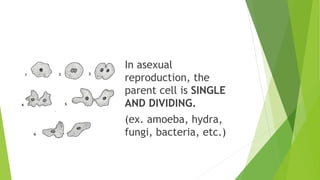
In asexual
reproduction, the
parent cell is SINGLE
AND DIVIDING.
(ex. amoeba, hydra,
fungi, bacteria, etc.)
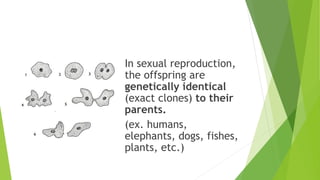
In sexual reproduction,
the offspring are
genetically identical
(exact clones) to their
parents.
(ex. humans,
elephants, dogs, fishes,
plants, etc.)
Sexual Reproduction
 Involves union of gametes
 Gametes = sperm (male) +
egg (female)
 Trivia: The egg is the largest
cell in the human body
while the sperm is the
smallest.
Sexual Reproduction
 Sperm – mobile and small
 Egg – immobile and large
 During fertilization, they
unite (n + n) to form a
diploid (2n) zygote
(fertilized egg)
Flowering Plants
 Comprises 90% of plant species
 Classified as either:
1. Angiosperms – have seeds enclosed in
ovary
2. Anthophytes – plants that produce flowers.
They have an ovary that’s part of the
flower
Pre fertilisation
Fertilisation
Post fertilisation
Sexual Reproduction
Pre fertilization
What is the
Reproductive organ
in plants..?
Flowers
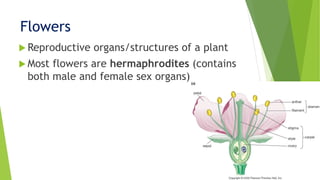
 Reproductive organs/structures of a plant
 Most flowers are hermaphrodites (contains
both male and female sex organs)
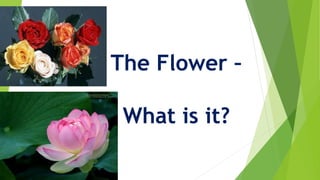
The Flower –
What is it?
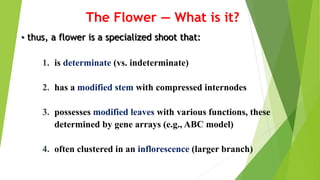
• thus, a flower is a specialized shoot that:
1. is determinate (vs. indeterminate)
2. has a modified stem with compressed internodes
3. possesses modified leaves with various functions, these
determined by gene arrays (e.g., ABC model)
4. often clustered in an inflorescence (larger branch)
The Flower — What is it?
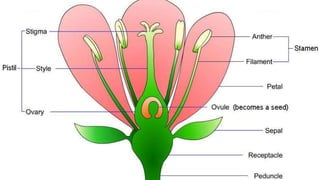
Parts of a Flower
 Corolla
 Calyx
 Stamen (male)
 Pistil (female)
 Receptacle
 Peduncle
(Be sure to be able to memorize and label each part)
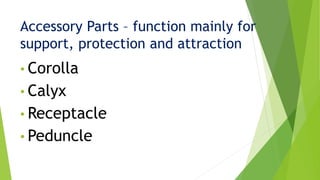
Accessory Parts – function mainly for
support, protection and attraction
• Corolla
• Calyx
• Receptacle
• Peduncle
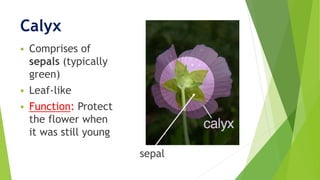
Calyx
 Comprises of
sepals (typically
green)
 Leaf-like
 Function: Protect
the flower when
it was still young
sepal
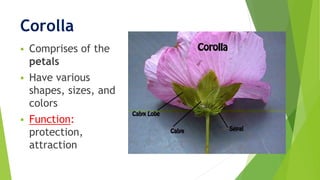
Corolla
 Comprises of the
petals
 Have various
shapes, sizes, and
colors
 Function:
protection,
attraction
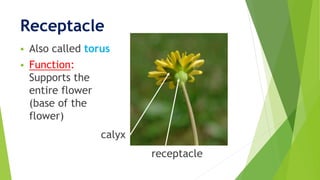
Receptacle
 Also called torus
 Function:
Supports the
entire flower
(base of the
flower)
receptacle
calyx
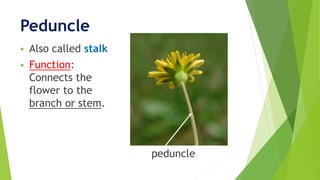
Peduncle
 Also called stalk
 Function:
Connects the
flower to the
branch or stem.
peduncle
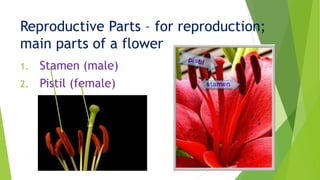
Reproductive Parts – for reproduction;
main parts of a flower
1. Stamen (male)
2. Pistil (female)
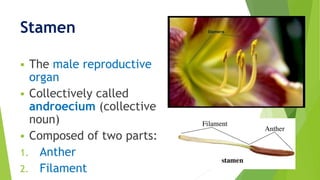
Stamen
 The male reproductive
organ
 Collectively called
androecium (collective
noun)
 Composed of two parts:
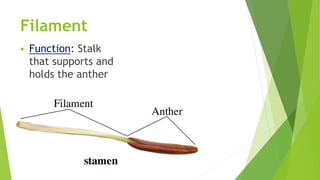
1. Anther
2. Filament
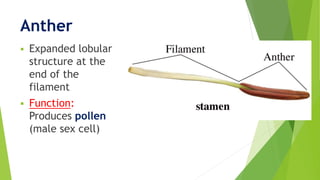
Anther
 Expanded lobular
structure at the
end of the
filament
 Function:
Produces pollen
(male sex cell)
Filament
 Function: Stalk
that supports and
holds the anther
 Bilobed
 Dithecous
 longitudinal groove
 four-sided
(tetragonal)
 four microsporangia
(pollen sacs)
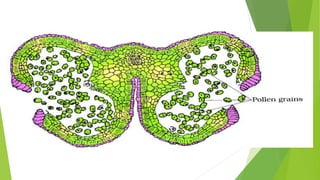
Anther: Structure
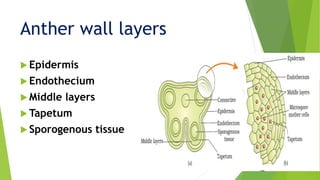
four microsporangia
 Epidermis
 Endothecium
 Middle layers
 Tapetum
 Sporogenous tissue
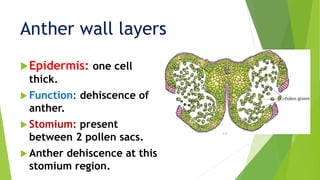
Anther wall layers
Epidermis: one cell
thick.
 Function: dehiscence of
anther.
 Stomium: present
between 2 pollen sacs.
 Anther dehiscence at this
stomium region.
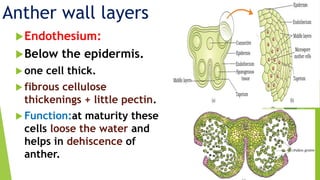
Anther wall layers
Endothesium:
Below the epidermis.
 one cell thick.
 fibrous cellulose
thickenings + little pectin.
 Function:at maturity these
cells loose the water and
helps in dehiscence of
anther.
Anther wall layers
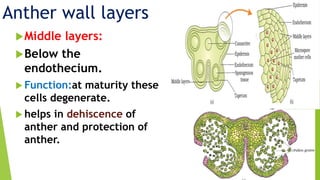
Middle layers:
Below the
endothecium.
 Function:at maturity these
cells degenerate.
 helps in dehiscence of
anther and protection of
anther.
Anther wall layers
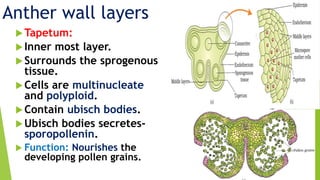
Tapetum:
Inner most layer.
Surrounds the sprogenous
tissue.
Cells are multinucleate
and polyploid.
Contain ubisch bodies.
Ubisch bodies secretes-
sporopollenin.
 Function: Nourishes the
developing pollen grains.
Anther wall layers
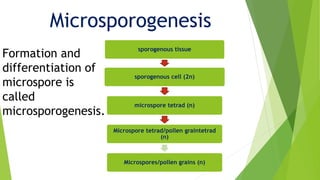
Microsporogenesis
sporogenous tissue
sporogenous cell (2n)
microspore tetrad (n)
Microspore tetrad/pollen graintetrad
(n)
Microspores/pollen grains (n)
Formation and
differentiation of
microspore is
called
microsporogenesis.
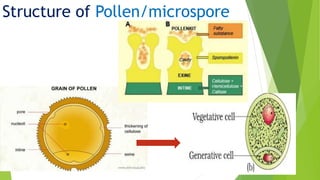
Structure of Pollen/microspore
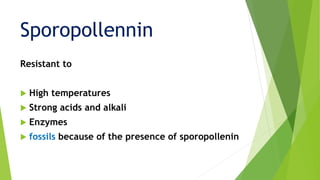
Resistant to
 High temperatures
 Strong acids and alkali
 Enzymes
 fossils because of the presence of sporopollenin
Sporopollennin
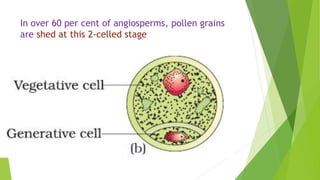
In over 60 per cent of angiosperms, pollen grains
are shed at this 2-celled stage
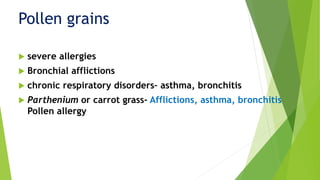
 severe allergies
 Bronchial afflictions
 chronic respiratory disorders– asthma, bronchitis
 Parthenium or carrot grass- Afflictions, asthma, bronchitis
Pollen allergy
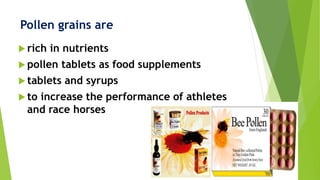
Pollen grains
 rich in nutrients
 pollen tablets as food supplements
 tablets and syrups
 to increase the performance of athletes
and race horses
Pollen grains are
 pollen grains of a large number of species are
stored for years in liquid nitrogen (-196ºC)…
through cryopreservation.
Pollen banks
41
Structure of a Pollen grain
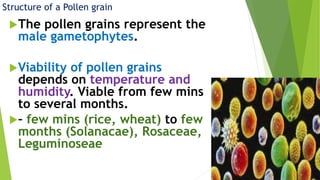
The pollen grains represent the
male gametophytes.
Viability of pollen grains
depends on temperature and
humidity. Viable from few mins
to several months.
– few mins (rice, wheat) to few
months (Solanacae), Rosaceae,
Leguminoseae
The female
reproductive
organ/Unit (Pistil)
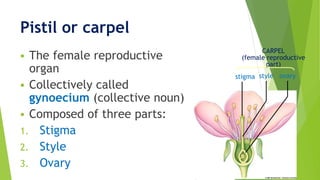
Pistil or carpel
 The female reproductive
organ
 Collectively called
gynoecium (collective noun)
 Composed of three parts:
1. Stigma
2. Style
3. Ovary
ovarystyle
CARPEL
(female reproductive
part)
stigma
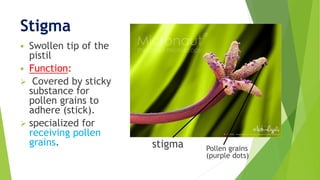
Stigma
 Swollen tip of the
pistil
 Function:
 Covered by sticky
substance for
pollen grains to
adhere (stick).
 specialized for
receiving pollen
grains. stigma Pollen grains
(purple dots)
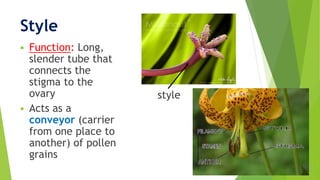
Style
 Function: Long,
slender tube that
connects the
stigma to the
ovary
 Acts as a
conveyor (carrier
from one place to
another) of pollen
grains
style
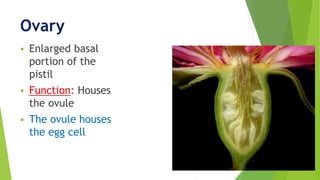
Ovary
 Enlarged basal
portion of the
pistil
 Function: Houses
the ovule
 The ovule houses
the egg cell
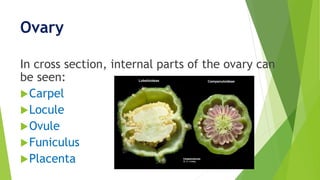
Ovary
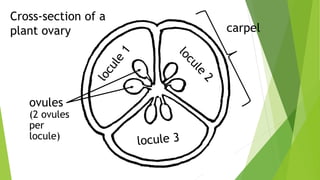
In cross section, internal parts of the ovary can
be seen:
Carpel
Locule
Ovule
Funiculus
Placenta
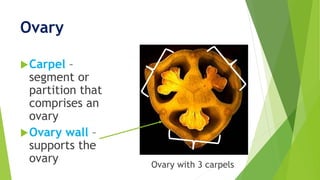
Ovary
Carpel –
segment or
partition that
comprises an
ovary
Ovary wall –
supports the
ovary Ovary with 3 carpels
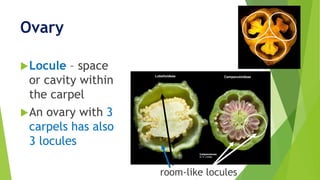
Ovary
Locule – space
or cavity within
the carpel
An ovary with 3
carpels has also
3 locules
room-like locules
ovules
(2 ovules
per
locule)
Cross-section of a
plant ovary carpel
Ovary
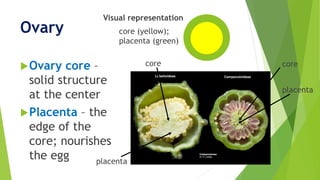
Ovary core –
solid structure
at the center
Placenta – the
edge of the
core; nourishes
the egg
core (yellow);
placenta (green)
Visual representation
core
placenta
placenta
core
Ovary
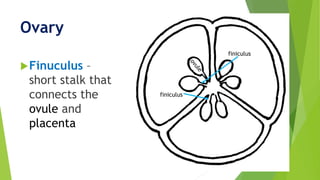
Finuculus –
short stalk that
connects the
ovule and
placenta
finiculus
finiculus
Ovary
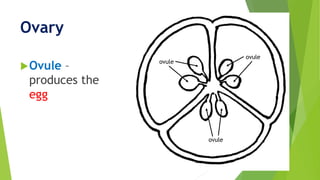
Ovule –
produces the
egg
ovule
ovule
ovule
Types in carpel
3 examples
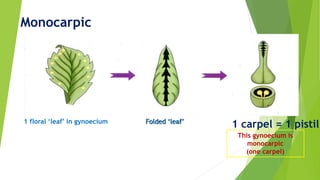
Carpels not fused
1. Monocarpic
2.
MULTICARPELLARY.
a.Apocarpic.
b.Syncarpic
1 floral ‘leaf’ in gynoecium
This gynoecium is
monocarpic
(one carpel)
Folded ‘leaf’
1 carpel = 1 pistil
Monocarpic
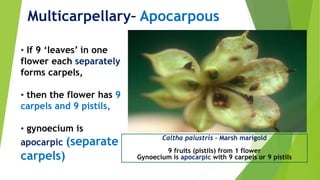
• If 9 ‘leaves’ in one
flower each separately
forms carpels,
• then the flower has 9
carpels and 9 pistils,
• gynoecium is
apocarpic (separate
carpels)
Caltha palustris - Marsh marigold
9 fruits (pistils) from 1 flower
Gynoecium is apocarpic with 9 carpels or 9 pistils
Multicarpellary– Apocarpous
3 floral ‘leaves’ in
gynoecium fuse
This gynoecium is
syncarpic
This gynoecium is
syncarpic
Multicarpellary----Syncarpic
3 carpels = 1 pistil
3 styles
3 carpels = 1 pistil
1 style
Structure of ovule..
Ovule
(Megasporangium)
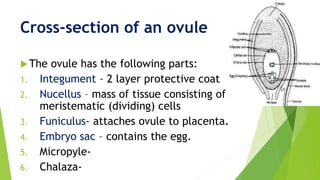
Cross-section of an ovule
The ovule has the following parts:
1. Integument - 2 layer protective coat
2. Nucellus – mass of tissue consisting of
meristematic (dividing) cells
3. Funiculus- attaches ovule to placenta.
4. Embryo sac – contains the egg.
5. Micropyle-
6. Chalaza-
types of
ovules..
61
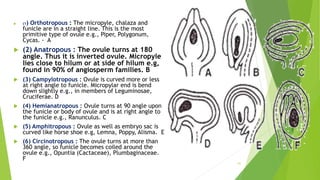
 (1) Orthotropous : The micropyle, chalaza and
funicle are in a straight line. This is the most
primitive type of ovule e.g., Piper, Polygonum,
Cycas. - A
 (2) Anatropous : The ovule turns at 180
angle. Thus it is inverted ovule. Micropyle
lies close to hilum or at side of hilum e.g,
found in 90% of angiosperm families. B
 (3) Campylotropous : Ovule is curved more or less
at right angle to funicle. Micropylar end is bend
down slightly e.g., in members of Leguminosae,
Cruciferae. D
 (4) Hemianatropous : Ovule turns at 90 angle upon
the funicle or body of ovule and is at right angle to
the funicle e.g., Ranunculus. C
 (5) Amphitropous : Ovule as well as embryo sac is
curved like horse shoe e.g, Lemna, Poppy, Alisma. E
 (6) Circinotropous : The ovule turns at more than
360 angle, so funicle becomes coiled around the
ovule e.g., Opuntia (Cactaceae), Plumbaginaceae.
F
Development of Gametophytes
(Egg) Two Stages
1. Megasporogenesis (genesis = beginning/creation) –
creation of megaspores
2. Megagametogenesis – creation of the gametes (egg)
Development of Gametophytes
(Egg)
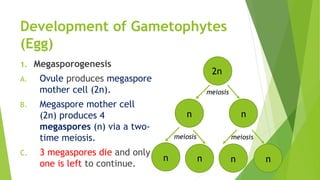
1. Megasporogenesis
A. Ovule produces megaspore
mother cell (2n).
B. Megaspore mother cell
(2n) produces 4
megaspores (n) via a two-
time meiosis.
C. 3 megaspores die and only
one is left to continue.
2n
n n
meiosis
n n
meiosis
n n
meiosis
Development of Gametophytes
(Egg)
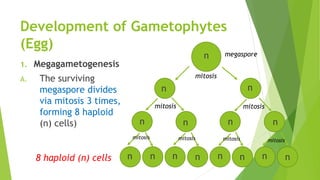
1. Megagametogenesis
A. The surviving
megaspore divides
via mitosis 3 times,
forming 8 haploid
(n) cells)
n megaspore
n n
n n n n
nnnnnnnn
mitosis
mitosis mitosis
mitosismitosismitosismitosis
8 haploid (n) cells
Egg Development in Ovule
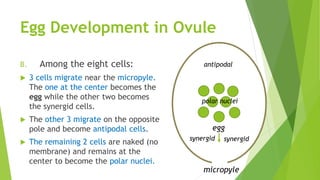
B. Among the eight cells:
 3 cells migrate near the micropyle.
The one at the center becomes the
egg while the other two becomes
the synergid cells.
 The other 3 migrate on the opposite
pole and become antipodal cells.
 The remaining 2 cells are naked (no
membrane) and remains at the
center to become the polar nuclei.
micropyle
egg
synergidsynergid
antipodal
polar nuclei
Egg (Embryosac)Development in
Ovule
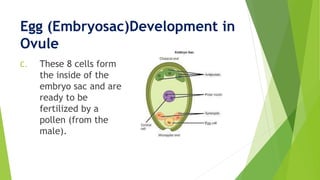
C. These 8 cells form
the inside of the
embryo sac and are
ready to be
fertilized by a
pollen (from the
male).
67
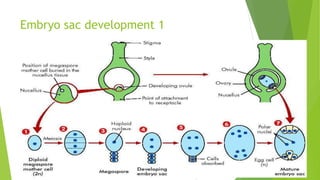
Embryo sac development 1
68
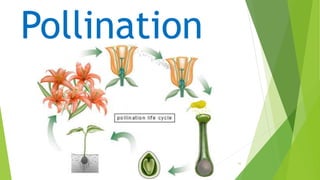
Pollination
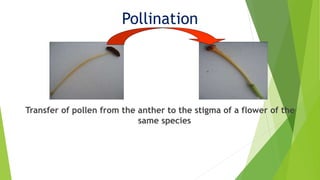
Pollination
Transfer of pollen from the anther to the stigma of a flower of the
same species
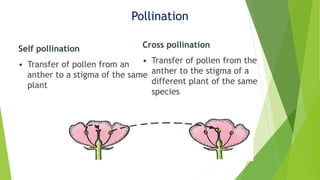
Pollination
Self pollination
• Transfer of pollen from an
anther to a stigma of the same
plant
Cross pollination
• Transfer of pollen from the
anther to the stigma of a
different plant of the same
species
71
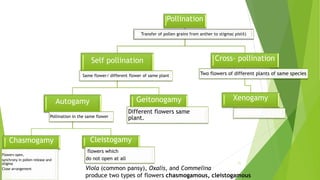
Pollination
Transfer of pollen grains from anther to stigma( pistil)
Self pollination
Same flower/ different flower of same plant
Autogamy
Pollination in the same flower
Chasmogamy
Flowers open,
synchrony in pollen release and
stigma
Close arrangement
Cleistogamy
flowers which
do not open at all
Geitonogamy
Different flowers same
plant.
Cross- pollination
Two flowers of different plants of same species
Xenogamy
Viola (common pansy), Oxalis, and Commelina
produce two types of flowers chasmogamous, cleistogamous
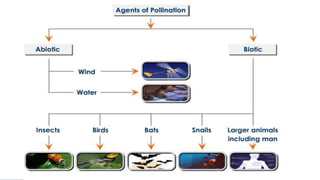
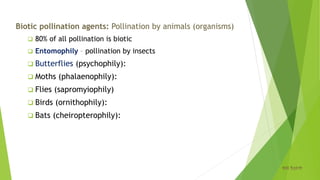
Biotic pollination agents: Pollination by animals (organisms)
 80% of all pollination is biotic
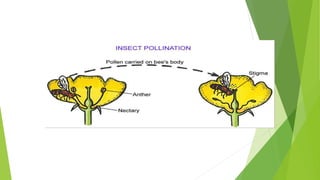
 Entomophily – pollination by insects
 Butterflies (psychophily):
 Moths (phalaenophily):
 Flies (sapromyiophily)
 Birds (ornithophily):
 Bats (cheiropterophily):
Pollination
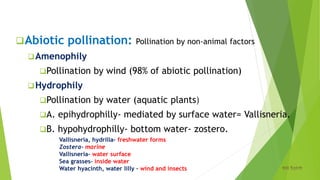
Abiotic pollination: Pollination by non-animal factors
Amenophily
Pollination by wind (98% of abiotic pollination)
Hydrophily
Pollination by water (aquatic plants)
A. epihydrophilly- mediated by surface water= Vallisneria.
B. hypohydrophilly- bottom water- zostero.
Pollination
Vallisneria, hydrilla- freshwater forms
Zostera- marine
Vallisneria- water surface
Sea grasses- inside water
Water hyacinth, water lilly – wind and insects
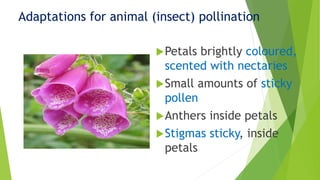
Petals brightly coloured,
scented with nectaries
Small amounts of sticky
pollen
Anthers inside petals
Stigmas sticky, inside
petals
Adaptations for animal (insect) pollination
 light
 non-sticky
 well-exposed stamens
 large often-feathery stigma
 single ovule in each ovary
 Inflorescence
 common in grasses
Wind pollination
 limited to about 30 genera
 mostly monocotyledons
 distribution is limited because of the need for water for transport of male gametes
 Vallisneria, hydrilla- freshwater forms
 Zostera- marine
 Vallisneria- water surface
 Sea grasses- inside water
 Water hyacinth, water lilly – wind and insects
 long, ribbon like pollen
 Pollen grains have mucilaginous covering
 not colourful
 Do not produce nectar
Water pollination
Colour and/fragrance
foul odours
Nectar and pollen grains-floral rewards
providing safe places to lay eggs
Amorphophallus
moth and the Yucca relationship
Animal pollination
Outbreeding
Devices
 To overcome inbreeding depression
 Pollen release and stigma receptivity not
synchronized
 Anther and stigma placed at different
positions
 Self incompatibility
 Production of unisexual flowers
 Monoecious/dioecious condition
Outbreeding Devices
 Outbreeding devices:
 The following six types of devices promote and ensure outbreeding
through cross pollination:
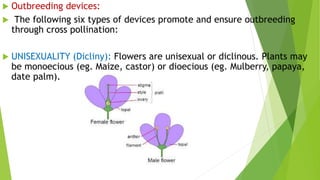
 UNISEXUALITY (Dicliny): Flowers are unisexual or diclinous. Plants may
be monoecious (eg. Maize, castor) or dioecious (eg. Mulberry, papaya,
date palm).
 Outbreeding devices:
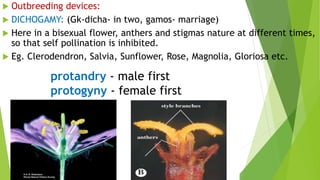
 DICHOGAMY: (Gk-dicha- in two, gamos- marriage)
 Here in a bisexual flower, anthers and stigmas nature at different times,
so that self pollination is inhibited.
 Eg. Clerodendron, Salvia, Sunflower, Rose, Magnolia, Gloriosa etc.
protandry - male first
protogyny - female first
 Outbreeding devices:
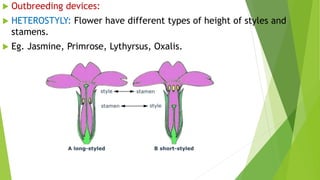
 HETEROSTYLY: Flower have different types of height of styles and
stamens.
 Eg. Jasmine, Primrose, Lythyrsus, Oxalis.
 Outbreeding devices:
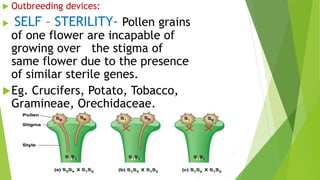
 SELF – STERILITY- Pollen grains
of one flower are incapable of
growing over the stigma of
same flower due to the presence
of similar sterile genes.
Eg. Crucifers, Potato, Tobacco,
Gramineae, Orechidaceae.
 Outbreeding devices:

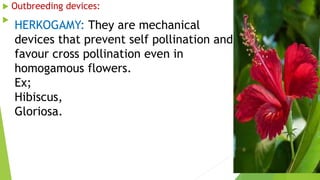
HERKOGAMY: They are mechanical
devices that prevent self pollination and
favour cross pollination even in
homogamous flowers.
Ex;
Hibiscus,
Gloriosa.
Outbreeding devices:
PREPOTENCY: Pollen grains of one flower grow more rapidly
over the stigma of another flower as compared to the same
flower.
 Eg. Apple, Grape.
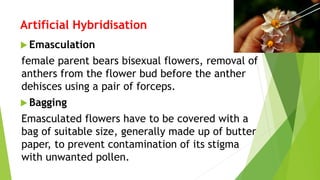
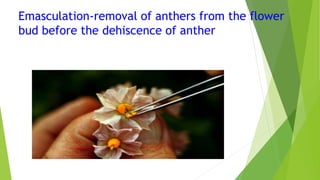
 Emasculation
female parent bears bisexual flowers, removal of
anthers from the flower bud before the anther
dehisces using a pair of forceps.
 Bagging
Emasculated flowers have to be covered with a
bag of suitable size, generally made up of butter
paper, to prevent contamination of its stigma
with unwanted pollen.
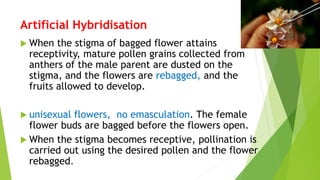
Artificial Hybridisation
 When the stigma of bagged flower attains
receptivity, mature pollen grains collected from
anthers of the male parent are dusted on the
stigma, and the flowers are rebagged, and the
fruits allowed to develop.
 unisexual flowers, no emasculation. The female
flower buds are bagged before the flowers open.
 When the stigma becomes receptive, pollination is
carried out using the desired pollen and the flower
rebagged.
Artificial Hybridisation
Emasculation-removal of anthers from the flower
bud before the dehiscence of anther
Pollen- Pistil
Interaction:
Pollen- Pistil Interaction:
a continuous dialogue between pollen grain and the pistil
mediated by chemical components of the pollen and the
pistil.
 wrong type (incompatible).
Suitable type (compatible) of pollen
compatible pollen grains germinate on the stigma
pollen tube through germ tube
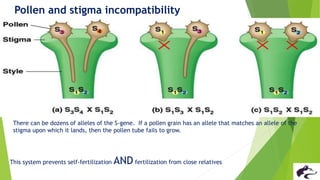
Pollen and stigma incompatibility
There can be dozens of alleles of the S-gene. If a pollen grain has an allele that matches an allele of the
stigma upon which it lands, then the pollen tube fails to grow.
This system prevents self-fertilization AND fertilization from close relatives.
94
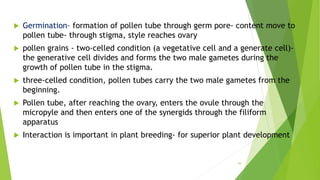
 Germination- formation of pollen tube through germ pore- content move to
pollen tube- through stigma, style reaches ovary
 pollen grains - two-celled condition (a vegetative cell and a generate cell)-
the generative cell divides and forms the two male gametes during the
growth of pollen tube in the stigma.
 three-celled condition, pollen tubes carry the two male gametes from the
beginning.
 Pollen tube, after reaching the ovary, enters the ovule through the
micropyle and then enters one of the synergids through the filiform
apparatus
 Interaction is important in plant breeding- for superior plant development
The end
pre fertilization structures.