LESSON 3 - EMPIRICISM
Presented by:
Arnel O. Rivera
LPU-Cavite
Based on the presentation of:
Mr. Alexander Rodis
EMPIRICISM
 It is the view that all knowledge of reality is derived
form sense experience.
 There are so many sorts of experience, but here
experience means “sense experience” that is
perceptions derived from five senses: sight, sound,
touch, taste and smell.
 Empiricists deny that any ideas or even intellectual
structure is inscribed on the mind from birth- the mind
at birth is a blank tablet, devoid even of watermarks.
The implication is that anything “written” on the
tablet is written by five senses.
ARISTOTLE
 Like Plato, Aristotle believed that knowledge
necessarily involves general or universal ideas – man,
dog, table, chair, etc.
 Aristotle believed that our knowledge of the general
comes from our experience of particular men, tables,
chairs, dogs, oceans etc.
THE PROBLEM:
 How do we arrived at universal ideas on the basis of our
limited and fluctuating experience of particular things?
 Aristotle’s answer is that the universal and necessary
elements of knowledge- the foundations of all subsequent
reasoning - are built up in the mind through INDUCTION.
 This means, that a wider and wider generalization is
derived from repeated experiences of particular things
until a general or universal concept is established in the
mind: and the universal ideas become the tools and
building blocks of all reasoning.
EMPIRICISM OF ST. TOMAS AQUINAS
 St. Thomas expresses the same empiricist idea with the word:
“Nihil in intellectu quod prius non fuerit in sensu” or
“Nothing in an intellect which was not first in the senses”
 For St. Tomas, the essences of things are locked inside the
particular things of which they are the essences - individual
human beings, animals, tables, chairs, dogs and cats, etc.
 The intellect is able to liberate the essence in particular things
and thus to “see” the universal idea of their common, essential
nature: human, animal, table, chair, dog, and cat.
 The intellectual faculty by which the essential or formal or
universal element of particular by which the essential element of
particular things is unlocked and “seen” by then mind is called
ABSTRACTION.
ABSTRACTION
 It is the process of removing or separating something from
something else.
 In epistemology, what is being abstracted is a common
nature, and that from which it is being abstracted are the
particular and varying instances of it.
PROCESS
 We begin with the particular things we encounter in the
sensible world and from this we derived universal concepts
and principles.
 With our universal concepts and principles, we are enabled
to return to the sensible world and speak of it, think about
it, and know it:
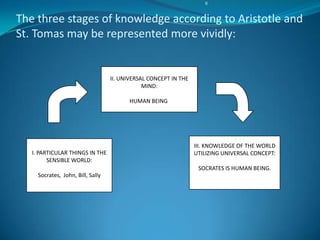
The three stages of knowledge according to Aristotle and
St. Tomas may be represented more vividly:
in the mind
II. UNIVERSAL CONCEPT IN THE
MIND:
HUMAN BEINGi
Particular things in the sensible world:
I. PARTICULAR THINGS IN THE
SENSIBLE WORLD:
Socrates, John, Bill, Sally
Knowledge of the world utilizing universal concept:
III. KNOWLEDGE OF THE WORLD
UTILIZING UNIVERSAL CONCEPT:
SOCRATES IS HUMAN BEING.
II
MODERN EMPIRICISM OF JOHN LOCKE
 He rejected the innateness of both “speculative” and
“practical” principles (reality and morality)
 Locke emphasized what is called epistemological dualism.
This is the view that there are two factors involved in
knowing:
a. mind, which does the knowing; and
b. ideas, which are the known.
 The mind has no other immediate object but its own ideas
 But there is a third factor, the object in the external world that is
known by means of ideas.
 Locke believed that our ideas represent those objects, and
therefore really inform us about the external world.
 Thus we have also what is sometimes called representative
perception, the theory that our ideas correspond to and faithfully
represent objects in the external world.
The initially empty room of the mind is
furnished with ideas of two sorts:
 first, by sensation we obtain ideas of things we
suppose to exist outside us in the physical world;
example, "hard," "red," "loud," "cold," "sweet," and
"aromatic" are all ideas of sensation,
 second, by reflection we come to have ideas of our
own mental operations.
while "perceiving," "remembering," "abstracting," and
"thinking" are all ideas of reflection.
 Everything we know, everything we believe, every
thought we can entertain is made up of ideas of
sensation and reflection and nothing else.
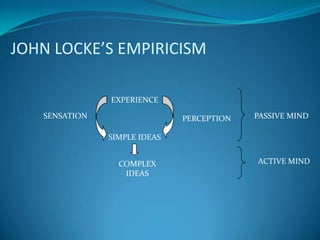
JOHN LOCKE’S EMPIRICISM
EXPERIENCE
SIMPLE IDEAS
COMPLEX
IDEAS
SENSATION PERCEPTION PASSIVE MIND
ACTIVE MIND
 He distinguished between simple and complex ideas
and acknowledged that we often employ our mental
capacities in order manufacture complex ideas by
conjoining simpler components
Example: my idea of "unicorn” may be compounded
from the ideas of "horse" and "single spiral horn," and
these ideas in turn are compounded from less complex
elements.
 What Locke held was that every complex idea can be
analyzed into component parts and that the final
elements of any complete analysis must be simple
ideas, each of which is derived directly from
experience
POWERS OF MIND
PASSIVE POWER OF MIND
Perception of ideas through the senses and retention of
ideas in memory beyond our direct voluntary control
and heavily dependent on the material conditions of
the human body.
ACTIVE POWERS OF MIND
Include distinguishing, comparing, compounding, and
abstracting. It is by employing these powers.
TYPES OF COMPLEX IDEAS
Locke supposed, that we manufacture new, complex ideas from the simple elements
provided by experience. The resulting complex ideas are of three sorts:
 MODES are complex ideas that combine simpler
elements to form a new whole that is assumed to
be incapable of existing except as a part or feature
of something else.
The ideas of "three," "seventy-five," and even
"infinity," for example, are all modes derived
from the simple idea of "unity." We can
understand these ideas and know their
mathematical functions, whether or not there
actually exist numbers of things to which they
would apply in reality.
TYPES OF COMPLEX IDEAS
 SUBSTANCES are the complex ideas of real
particular things that are supposed to exist
on their own and to account for the unity
and persistence of the features they exhibit.
The ideas of "my only son," "the largest
planet in the solar system," and "tulips," for
example, are compounded from simpler
ideas of sensation and reflection. Each is
the idea of a thing (or kind of thing) that
could really exist on its own.
TYPES OF COMPLEX IDEAS
 RELATIONS are complex ideas of the ways
in which other ideas may be connected with
each other, in fact or in thought.
The ideas of "younger," "stronger," and
"cause and effect," for example, all involve
some reference to the comparison of two
or more other ideas.
THE EGOCENTRIC PREDICAMENT
Some philosophers claim that all we can
know is our own ideas. But on this view, we
are trapped in the world of our own egos (or
selves) and ideas. We could never get
outside ourselves to verify whether ideas
correspond to anything in the external
world.

L3 empiricism

  • 1.
    LESSON 3 -EMPIRICISM Presented by: Arnel O. Rivera LPU-Cavite Based on the presentation of: Mr. Alexander Rodis
  • 2.
    EMPIRICISM  It isthe view that all knowledge of reality is derived form sense experience.  There are so many sorts of experience, but here experience means “sense experience” that is perceptions derived from five senses: sight, sound, touch, taste and smell.  Empiricists deny that any ideas or even intellectual structure is inscribed on the mind from birth- the mind at birth is a blank tablet, devoid even of watermarks. The implication is that anything “written” on the tablet is written by five senses.
  • 3.
    ARISTOTLE  Like Plato,Aristotle believed that knowledge necessarily involves general or universal ideas – man, dog, table, chair, etc.  Aristotle believed that our knowledge of the general comes from our experience of particular men, tables, chairs, dogs, oceans etc.
  • 4.
    THE PROBLEM:  Howdo we arrived at universal ideas on the basis of our limited and fluctuating experience of particular things?  Aristotle’s answer is that the universal and necessary elements of knowledge- the foundations of all subsequent reasoning - are built up in the mind through INDUCTION.  This means, that a wider and wider generalization is derived from repeated experiences of particular things until a general or universal concept is established in the mind: and the universal ideas become the tools and building blocks of all reasoning.
  • 5.
    EMPIRICISM OF ST.TOMAS AQUINAS  St. Thomas expresses the same empiricist idea with the word: “Nihil in intellectu quod prius non fuerit in sensu” or “Nothing in an intellect which was not first in the senses”  For St. Tomas, the essences of things are locked inside the particular things of which they are the essences - individual human beings, animals, tables, chairs, dogs and cats, etc.  The intellect is able to liberate the essence in particular things and thus to “see” the universal idea of their common, essential nature: human, animal, table, chair, dog, and cat.  The intellectual faculty by which the essential or formal or universal element of particular by which the essential element of particular things is unlocked and “seen” by then mind is called ABSTRACTION.
  • 6.
    ABSTRACTION  It isthe process of removing or separating something from something else.  In epistemology, what is being abstracted is a common nature, and that from which it is being abstracted are the particular and varying instances of it. PROCESS  We begin with the particular things we encounter in the sensible world and from this we derived universal concepts and principles.  With our universal concepts and principles, we are enabled to return to the sensible world and speak of it, think about it, and know it:
  • 7.
    The three stagesof knowledge according to Aristotle and St. Tomas may be represented more vividly: in the mind II. UNIVERSAL CONCEPT IN THE MIND: HUMAN BEINGi Particular things in the sensible world: I. PARTICULAR THINGS IN THE SENSIBLE WORLD: Socrates, John, Bill, Sally Knowledge of the world utilizing universal concept: III. KNOWLEDGE OF THE WORLD UTILIZING UNIVERSAL CONCEPT: SOCRATES IS HUMAN BEING. II
  • 8.
    MODERN EMPIRICISM OFJOHN LOCKE  He rejected the innateness of both “speculative” and “practical” principles (reality and morality)  Locke emphasized what is called epistemological dualism. This is the view that there are two factors involved in knowing: a. mind, which does the knowing; and b. ideas, which are the known.  The mind has no other immediate object but its own ideas  But there is a third factor, the object in the external world that is known by means of ideas.  Locke believed that our ideas represent those objects, and therefore really inform us about the external world.  Thus we have also what is sometimes called representative perception, the theory that our ideas correspond to and faithfully represent objects in the external world.
  • 9.
    The initially emptyroom of the mind is furnished with ideas of two sorts:  first, by sensation we obtain ideas of things we suppose to exist outside us in the physical world; example, "hard," "red," "loud," "cold," "sweet," and "aromatic" are all ideas of sensation,  second, by reflection we come to have ideas of our own mental operations. while "perceiving," "remembering," "abstracting," and "thinking" are all ideas of reflection.  Everything we know, everything we believe, every thought we can entertain is made up of ideas of sensation and reflection and nothing else.
  • 10.
    JOHN LOCKE’S EMPIRICISM EXPERIENCE SIMPLEIDEAS COMPLEX IDEAS SENSATION PERCEPTION PASSIVE MIND ACTIVE MIND
  • 11.
     He distinguishedbetween simple and complex ideas and acknowledged that we often employ our mental capacities in order manufacture complex ideas by conjoining simpler components Example: my idea of "unicorn” may be compounded from the ideas of "horse" and "single spiral horn," and these ideas in turn are compounded from less complex elements.  What Locke held was that every complex idea can be analyzed into component parts and that the final elements of any complete analysis must be simple ideas, each of which is derived directly from experience
  • 12.
    POWERS OF MIND PASSIVEPOWER OF MIND Perception of ideas through the senses and retention of ideas in memory beyond our direct voluntary control and heavily dependent on the material conditions of the human body. ACTIVE POWERS OF MIND Include distinguishing, comparing, compounding, and abstracting. It is by employing these powers.
  • 13.
    TYPES OF COMPLEXIDEAS Locke supposed, that we manufacture new, complex ideas from the simple elements provided by experience. The resulting complex ideas are of three sorts:  MODES are complex ideas that combine simpler elements to form a new whole that is assumed to be incapable of existing except as a part or feature of something else. The ideas of "three," "seventy-five," and even "infinity," for example, are all modes derived from the simple idea of "unity." We can understand these ideas and know their mathematical functions, whether or not there actually exist numbers of things to which they would apply in reality.
  • 14.
    TYPES OF COMPLEXIDEAS  SUBSTANCES are the complex ideas of real particular things that are supposed to exist on their own and to account for the unity and persistence of the features they exhibit. The ideas of "my only son," "the largest planet in the solar system," and "tulips," for example, are compounded from simpler ideas of sensation and reflection. Each is the idea of a thing (or kind of thing) that could really exist on its own.
  • 15.
    TYPES OF COMPLEXIDEAS  RELATIONS are complex ideas of the ways in which other ideas may be connected with each other, in fact or in thought. The ideas of "younger," "stronger," and "cause and effect," for example, all involve some reference to the comparison of two or more other ideas.
  • 16.
    THE EGOCENTRIC PREDICAMENT Somephilosophers claim that all we can know is our own ideas. But on this view, we are trapped in the world of our own egos (or selves) and ideas. We could never get outside ourselves to verify whether ideas correspond to anything in the external world.