Environment Protection
     and Management


Presented by: Arnel O. Rivera
www.slideshare.net/ArnelLPU
What is the Ecological Solid Waste
Management Act of 2000 (RA 9003)?
• This law aims for the reduction of solid
  waste through source reduction and waste
  minimization measures, treatment and
  disposal of solid waste in accordance with
  ecologically sustainable development
  principles. (Sec. 2-C)
What is the Ecological Solid Waste
Management Act of 2000 (RA 9003)?
• It also aims to ensure the proper
  segregation, collection, transport, storage,
  treatment and disposal of solid waste
  through the formulation and adoption of
  the best environmental practice in
  ecological waste management excluding
  incineration.
What is the Ecological Solid Waste
Management Act of 2000 (RA 9003)?
             • RA 9003 considers
               “waste as a resource
               that can be recovered”,
               emphasizing on
               recycling, reuse and
               composting as methods
               to minimize waste
               problems.
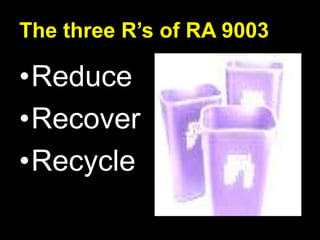
The three R’s of RA 9003

•Reduce
•Recover
•Recycle
Types of Waste According to
Source
• Household or Domestic Waste
• Commercial or Industrial
  Waste
Types of Waste According to
Classification
• Residual – waste with no commercial
  value meant for disposal
• Recycle - waste that can be reused
• Biodegradable – waste that can be
  decomposed by organisms
• Hazardous – waste that may cause or
  contribute to mortality or illness
• Toxic – waste that may cause immediate
  death or body damage.
Provisions of RA 9003

• The said act gives strong emphasis on the
  role of municipal and local government
  units (LGUs) providing for the creation of
  Solid Waste Management Communities up
  to the barangay level. This requires the
  participation of nongovernment offices,
  people’s organizations, church leaders,
  schools, businesses and community
  organizations.
Offenses under RA 9003
• Minor Offense
• Grave Offense
• Major Offense
Grave Offense
Punishable by any/all of the
  following:
• Fine: 1,000 – 3,000 pesos
• Imprisonment: 15 days – 6
  months
Major Offense
Punishable by any/all of the
  following:
• Fine: 5,000 – 200,000 pesos
• Imprisonment: 1 – 6 years
Examples of Philippine
Environmental Laws
Commonwealth Act No. 383
      (Anti-Dumping Law)
• Effective September 5, 1938
• Prohibits the dumping into rivers of refuse
  waste matter or substance of any kind.
• Punishment of imprisonment of not more
  than six months or by a fine of not more
  than P200 or both.
Presidential Decree 825
• Effective November 7, 1975
• Penalizes improper disposal of garbage
  and other forms of being dirty. Violators
  may be imprisoned for not less than five
  days or more than a year or pay a fine or
  not less that P100 or more than P2,000 or
  both.
Republic Act 6969 (Toxic Substances
  And Hazardous And Nuclear Waste
             Control Act)
• Effective 1990
• Mandates the control and management of
  the
  import, manufacture, processing, distributi
  on, use, transport, treatment and disposal
  of toxic substances and hazardous and
  nuclear wastes in the country.
Republic Act 7160 (Local
       Government Code)
• Effective 1991
• Mandates local government units to
  exercise powers, functions and
  responsibilities in providing basic services
  and facilities related to general hygiene,
  sanitation, beautification and solid waste
  collection, transport and disposal.
Presidential Degree 984
     (Pollution Control Law)
• The implementation is specified in DENR
  Administrative Order 24 (series of 1990)
  for water usage and water quality criteria
  and DENR Administrative Order 35 (series
  of 1990) on effluent regulations
• Penalty will be P5,000/day but higher for
  juridical positions who violated this act.
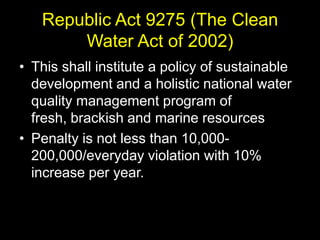
Republic Act 9275 (The Clean
       Water Act of 2002)
• This shall institute a policy of sustainable
  development and a holistic national water
  quality management program of
  fresh, brackish and marine resources
• Penalty is not less than 10,000-
  200,000/everyday violation with 10%
  increase per year.
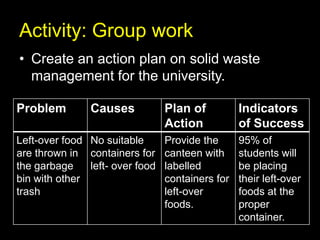
Activity: Group work
• Create an action plan on solid waste
  management for the university.

Problem        Causes            Plan of          Indicators
                                 Action           of Success
Left-over food No suitable       Provide the      95% of
are thrown in containers for     canteen with     students will
the garbage    left- over food   labelled         be placing
bin with other                   containers for   their left-over
trash                            left-over        foods at the
                                 foods.           proper
                                                  container.
Solid waste management

Solid waste management

  • 2.
    Environment Protection and Management Presented by: Arnel O. Rivera www.slideshare.net/ArnelLPU
  • 3.
    What is theEcological Solid Waste Management Act of 2000 (RA 9003)? • This law aims for the reduction of solid waste through source reduction and waste minimization measures, treatment and disposal of solid waste in accordance with ecologically sustainable development principles. (Sec. 2-C)
  • 4.
    What is theEcological Solid Waste Management Act of 2000 (RA 9003)? • It also aims to ensure the proper segregation, collection, transport, storage, treatment and disposal of solid waste through the formulation and adoption of the best environmental practice in ecological waste management excluding incineration.
  • 5.
    What is theEcological Solid Waste Management Act of 2000 (RA 9003)? • RA 9003 considers “waste as a resource that can be recovered”, emphasizing on recycling, reuse and composting as methods to minimize waste problems.
  • 6.
    The three R’sof RA 9003 •Reduce •Recover •Recycle
  • 7.
    Types of WasteAccording to Source • Household or Domestic Waste • Commercial or Industrial Waste
  • 8.
    Types of WasteAccording to Classification • Residual – waste with no commercial value meant for disposal • Recycle - waste that can be reused • Biodegradable – waste that can be decomposed by organisms • Hazardous – waste that may cause or contribute to mortality or illness • Toxic – waste that may cause immediate death or body damage.
  • 9.
    Provisions of RA9003 • The said act gives strong emphasis on the role of municipal and local government units (LGUs) providing for the creation of Solid Waste Management Communities up to the barangay level. This requires the participation of nongovernment offices, people’s organizations, church leaders, schools, businesses and community organizations.
  • 10.
    Offenses under RA9003 • Minor Offense • Grave Offense • Major Offense
  • 11.
    Grave Offense Punishable byany/all of the following: • Fine: 1,000 – 3,000 pesos • Imprisonment: 15 days – 6 months
  • 12.
    Major Offense Punishable byany/all of the following: • Fine: 5,000 – 200,000 pesos • Imprisonment: 1 – 6 years
  • 13.
  • 14.
    Commonwealth Act No.383 (Anti-Dumping Law) • Effective September 5, 1938 • Prohibits the dumping into rivers of refuse waste matter or substance of any kind. • Punishment of imprisonment of not more than six months or by a fine of not more than P200 or both.
  • 15.
    Presidential Decree 825 •Effective November 7, 1975 • Penalizes improper disposal of garbage and other forms of being dirty. Violators may be imprisoned for not less than five days or more than a year or pay a fine or not less that P100 or more than P2,000 or both.
  • 16.
    Republic Act 6969(Toxic Substances And Hazardous And Nuclear Waste Control Act) • Effective 1990 • Mandates the control and management of the import, manufacture, processing, distributi on, use, transport, treatment and disposal of toxic substances and hazardous and nuclear wastes in the country.
  • 17.
    Republic Act 7160(Local Government Code) • Effective 1991 • Mandates local government units to exercise powers, functions and responsibilities in providing basic services and facilities related to general hygiene, sanitation, beautification and solid waste collection, transport and disposal.
  • 18.
    Presidential Degree 984 (Pollution Control Law) • The implementation is specified in DENR Administrative Order 24 (series of 1990) for water usage and water quality criteria and DENR Administrative Order 35 (series of 1990) on effluent regulations • Penalty will be P5,000/day but higher for juridical positions who violated this act.
  • 19.
    Republic Act 9275(The Clean Water Act of 2002) • This shall institute a policy of sustainable development and a holistic national water quality management program of fresh, brackish and marine resources • Penalty is not less than 10,000- 200,000/everyday violation with 10% increase per year.
  • 20.
    Activity: Group work •Create an action plan on solid waste management for the university. Problem Causes Plan of Indicators Action of Success Left-over food No suitable Provide the 95% of are thrown in containers for canteen with students will the garbage left- over food labelled be placing bin with other containers for their left-over trash left-over foods at the foods. proper container.