Rationalism
ByBy
Bushra TabassumBushra Tabassum
University Of GujratUniversity Of Gujrat
Rationalism
Rationalism is an epistemological position in
which reason is said to be the primary source of
all knowledge, superior to the senses.
In general, rationalists believe that abstract
reasoning can produce undeniable, absolutely
certain truths about nature, existence, and the
whole of reality.
Cont…
These truths are called a priori,
or innate, ideas – because they
are discovered independently of
experience, without empirical
observation or experimentation.
Descartes stands not only as the
“father of modern philosophy,”
but as the original archetype of
the modern rationalist.
What is Philosophy of
Rationalism?
Encompasses several strands of thought
all of which usually share the conviction
that REALITY is actually rationale in
nature and that making the proper
deductions is essential in achieving
knowledge.
Latin word ratio, meaning reason-point of
view that states that reason plays the
main role in understanding the world and
obtaining knowledge.
What is Philosophy of
Rationalism?
 is “any view appealing to reason as a
source of knowledge or justification.”
in which the criterion of the truth is
not sensory but intellectual and
deductive.
 The philosophical view that regards
reason as the chief source and test of
knowledge. Holding the reality itself
has an inherent logical structure
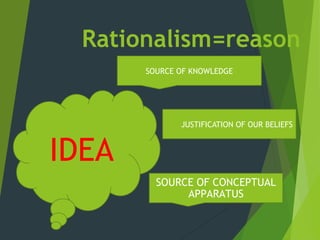
Rationalism=reason
JUSTIFICATION OF OUR BELIEFS
IDEA
SOURCE OF KNOWLEDGE
SOURCE OF CONCEPTUAL
APPARATUS
Rationalism and Empiricism
Empiricism: All knowledge of
the world comes from
experience
Rationalism: Some knowledge
of the world is independent of
experience— that is, some
knowledge is inborn (innate)
Concept Rationalism
Concept rationalism: There are
innate concepts
Leibniz: “. . . can it be denied
that there is much that is innate
in our mind, since we are, so to
speak, innate to ourselves, and
since in ourselves there are
being, unity, substance,
duration, change, activity,
perception, pleasure and a
thousand other objects of our
intellectual ideas?
Three main claims
Rationalists adopt at least one
of three main claims:
Intuition/Deduction:
Innate Knowledge: We have
knowledge of some truths as part of
our innate rational nature.
Experiences may trigger a process by
which we bring this knowledge
to consciousness, but the experiences
do not provide us with the knowledge
itself,
Cont…
Some rationalists also claim, in
addition to the claims above, that
the knowledge we gain by intuition
and deduction, as well as the ideas
and instances of knowledge that are
innate to us, are indispensible and
could not have been gained through
sense experience, and/or that
reason is superior to experience as
a source of knowledge.
Judgment Rationalism
Judgment rationalism: There
are synthetic a priori truths
We can learn something about
the world independently of
experience— from reason alone
Standard of Truth
Descartes proposed that only those
things we can accept as “clear and
distinct” should be accepted as true.
“Clear” he defined as “that which is
present and apparent to an attentive
mind.”
“Distinct” he defined as “that which is so
precise and different from all other
objects that it contains within itself
nothing but what is clear.”
Innate ideas
• “Some ideas are present from birth.”
• Ideas that do not require the proof or
suggestion of sense experience, are
concept which are present from birth.
• It could be theoretically be discovered or
brought out from within the mind of each
individual.
• Example is Descartes arguments for the
existence of God.
Objections to Rationalism
How can we have knowledge in
our minds if we are not aware
of it?
Isn’t to know something to
believe it?
How can we believe something
without being aware of it?

Rationalism

  • 1.
  • 2.
    Rationalism Rationalism is anepistemological position in which reason is said to be the primary source of all knowledge, superior to the senses. In general, rationalists believe that abstract reasoning can produce undeniable, absolutely certain truths about nature, existence, and the whole of reality.
  • 3.
    Cont… These truths arecalled a priori, or innate, ideas – because they are discovered independently of experience, without empirical observation or experimentation. Descartes stands not only as the “father of modern philosophy,” but as the original archetype of the modern rationalist.
  • 4.
    What is Philosophyof Rationalism? Encompasses several strands of thought all of which usually share the conviction that REALITY is actually rationale in nature and that making the proper deductions is essential in achieving knowledge. Latin word ratio, meaning reason-point of view that states that reason plays the main role in understanding the world and obtaining knowledge.
  • 5.
    What is Philosophyof Rationalism?  is “any view appealing to reason as a source of knowledge or justification.” in which the criterion of the truth is not sensory but intellectual and deductive.  The philosophical view that regards reason as the chief source and test of knowledge. Holding the reality itself has an inherent logical structure
  • 6.
    Rationalism=reason JUSTIFICATION OF OURBELIEFS IDEA SOURCE OF KNOWLEDGE SOURCE OF CONCEPTUAL APPARATUS
  • 7.
    Rationalism and Empiricism Empiricism:All knowledge of the world comes from experience Rationalism: Some knowledge of the world is independent of experience— that is, some knowledge is inborn (innate)
  • 8.
    Concept Rationalism Concept rationalism:There are innate concepts Leibniz: “. . . can it be denied that there is much that is innate in our mind, since we are, so to speak, innate to ourselves, and since in ourselves there are being, unity, substance, duration, change, activity, perception, pleasure and a thousand other objects of our intellectual ideas?
  • 9.
    Three main claims Rationalistsadopt at least one of three main claims: Intuition/Deduction: Innate Knowledge: We have knowledge of some truths as part of our innate rational nature. Experiences may trigger a process by which we bring this knowledge to consciousness, but the experiences do not provide us with the knowledge itself,
  • 10.
    Cont… Some rationalists also claim,in addition to the claims above, that the knowledge we gain by intuition and deduction, as well as the ideas and instances of knowledge that are innate to us, are indispensible and could not have been gained through sense experience, and/or that reason is superior to experience as a source of knowledge.
  • 11.
    Judgment Rationalism Judgment rationalism:There are synthetic a priori truths We can learn something about the world independently of experience— from reason alone
  • 12.
    Standard of Truth Descartesproposed that only those things we can accept as “clear and distinct” should be accepted as true. “Clear” he defined as “that which is present and apparent to an attentive mind.” “Distinct” he defined as “that which is so precise and different from all other objects that it contains within itself nothing but what is clear.”
  • 13.
    Innate ideas • “Someideas are present from birth.” • Ideas that do not require the proof or suggestion of sense experience, are concept which are present from birth. • It could be theoretically be discovered or brought out from within the mind of each individual. • Example is Descartes arguments for the existence of God.
  • 14.
    Objections to Rationalism Howcan we have knowledge in our minds if we are not aware of it? Isn’t to know something to believe it? How can we believe something without being aware of it?