John Locke Saad  Nikki Mohit
Rationalist or Empiricist Locke believed that we gain knowledge by experience, this is called empiricism Locke agreed with Aristotle that we are not born with innate ideas, and that we  learn through experience
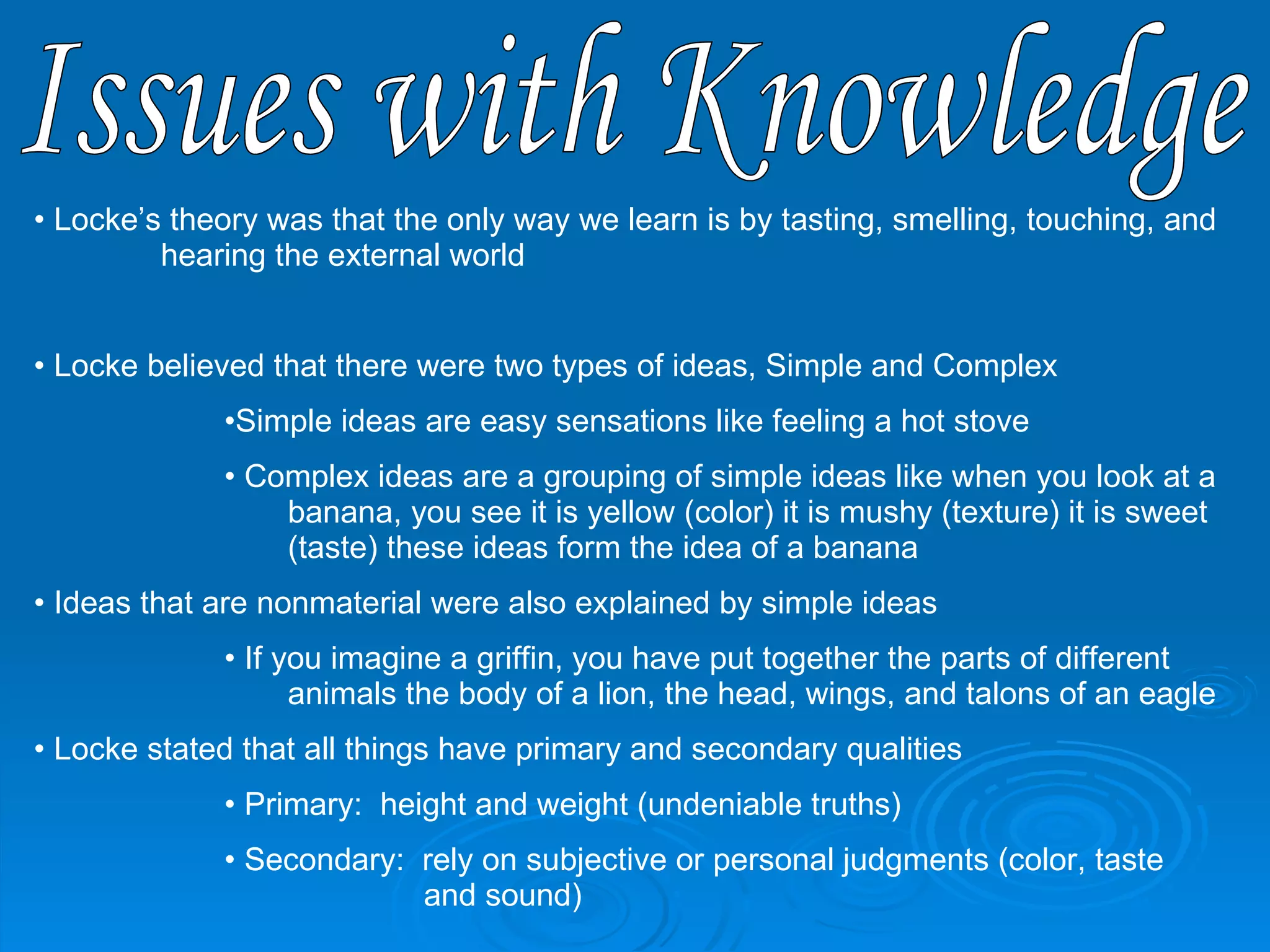
Issues with Knowledge Locke’s theory was that the only way we learn is by tasting, smelling, touching, and  hearing the external world Locke believed that there were two types of ideas, Simple and Complex Simple ideas are easy sensations like feeling a hot stove Complex ideas are a grouping of simple ideas like when you look at a  banana, you see it is yellow (color) it is mushy (texture) it is sweet  (taste) these ideas form the idea of a banana Ideas that are nonmaterial were also explained by simple ideas If you imagine a griffin, you have put together the parts of different  animals the body of a lion, the head, wings, and talons of an eagle Locke stated that all things have primary and secondary qualities Primary:  height and weight (undeniable truths)  Secondary:  rely on subjective or personal judgments (color, taste     and sound)
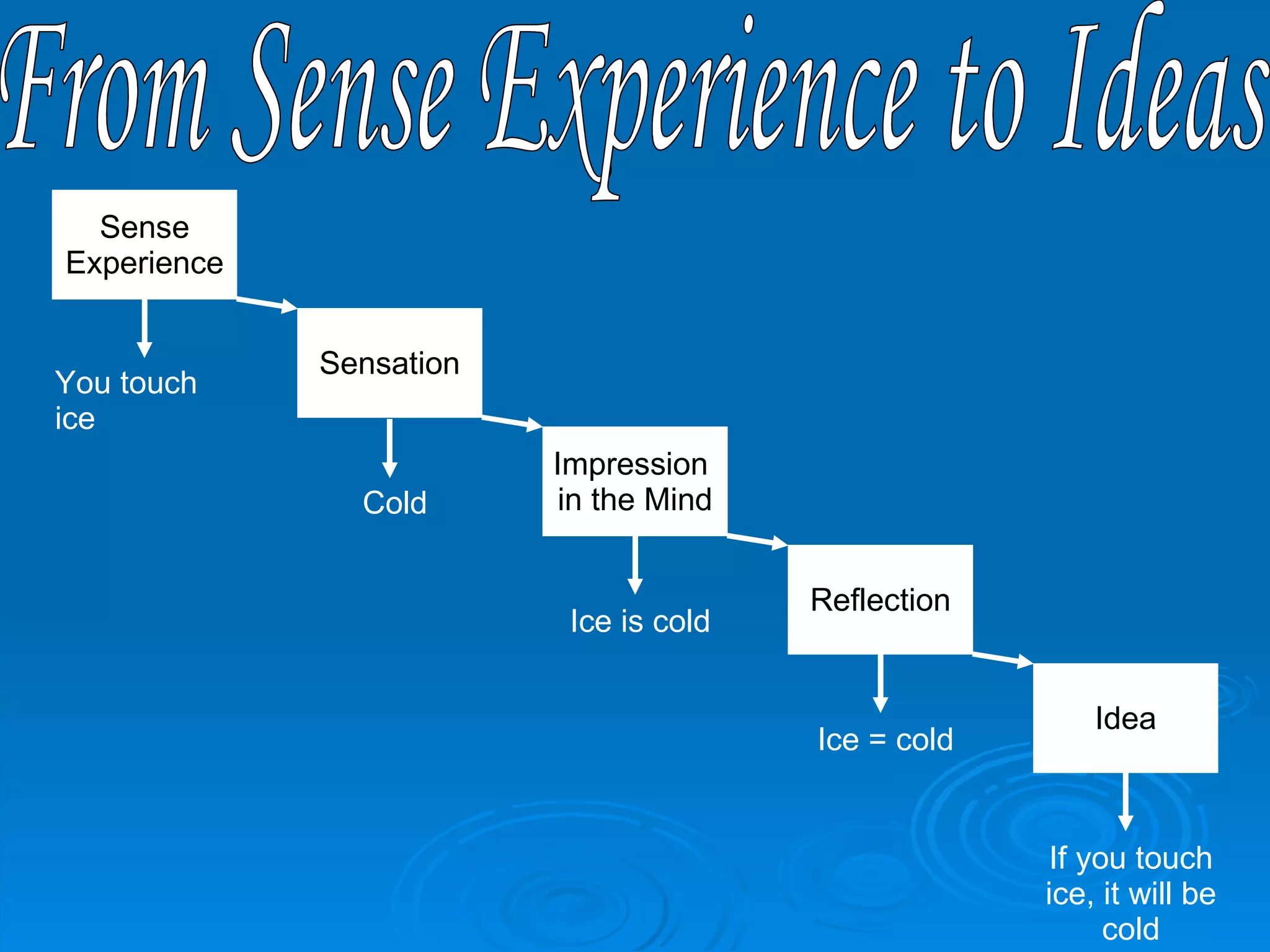
From Sense Experience to Ideas Sense Experience Sensation Impression  in the Mind Reflection Idea You touch ice Cold Ice is cold Ice = cold If you touch ice, it will be cold
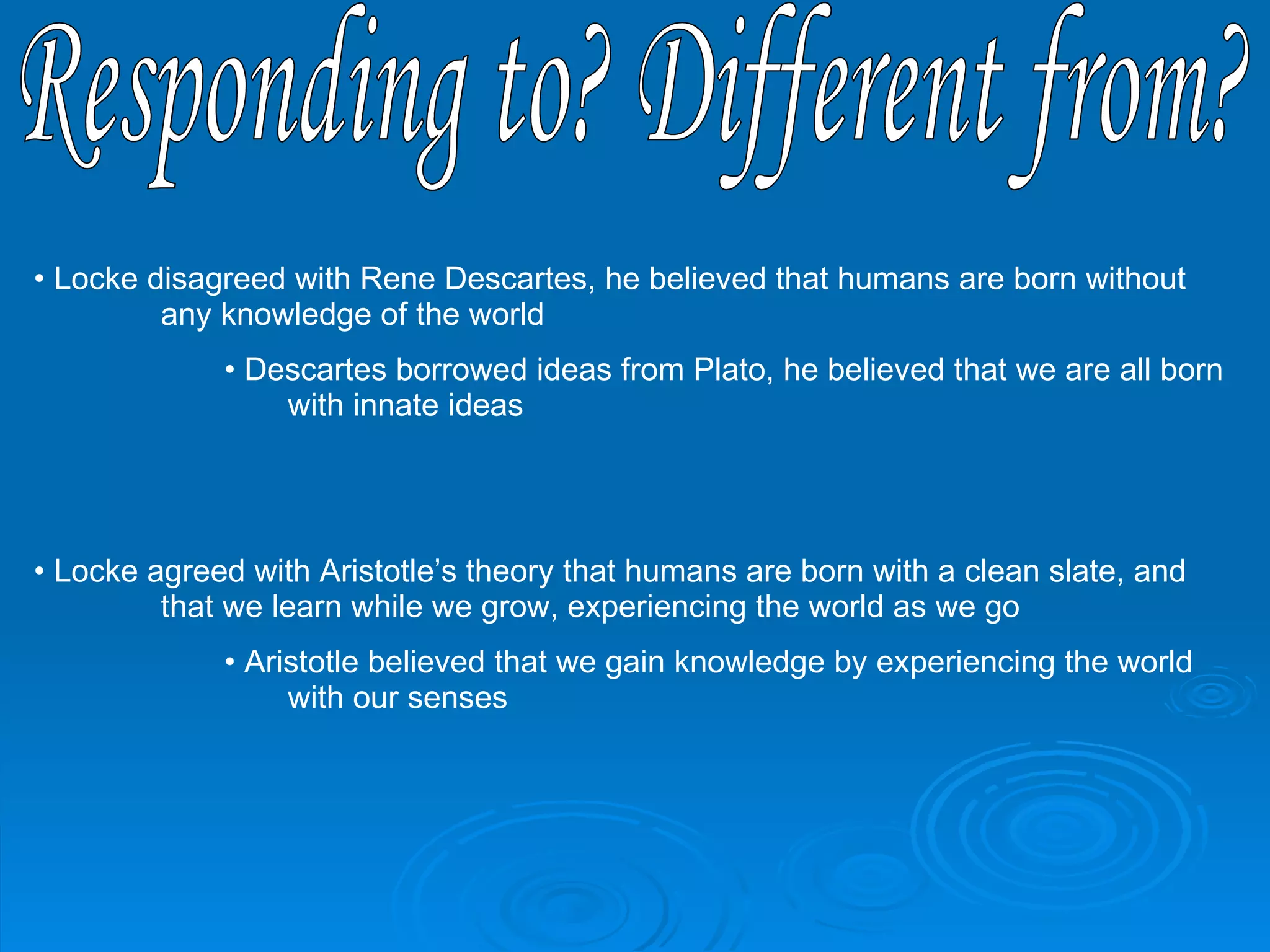
Responding to? Different from? Locke disagreed with Rene Descartes, he believed that humans are born without  any knowledge of the world Descartes borrowed ideas from Plato, he believed that we are all born  with innate ideas Locke agreed with Aristotle’s theory that humans are born with a clean slate, and  that we learn while we grow, experiencing the world as we go Aristotle believed that we gain knowledge by experiencing the world  with our senses
Vocabulary SENSE:  Sight, hearing, smell, taste, or touch SENSATION:  The operation or function of the senses; perception or awareness      of stimuli through the senses  REFLECTION:  Thinking about what you experienced, processing the information IMPRESSION:  The first and immediate effect of an experience or perception upon the    mind  QUALITIES:  Essential or distinctive characteristic, property, or attribute

John Locke Philosophy

  • 1.
    John Locke Saad Nikki Mohit
  • 2.
    Rationalist or EmpiricistLocke believed that we gain knowledge by experience, this is called empiricism Locke agreed with Aristotle that we are not born with innate ideas, and that we learn through experience
  • 3.
    Issues with KnowledgeLocke’s theory was that the only way we learn is by tasting, smelling, touching, and hearing the external world Locke believed that there were two types of ideas, Simple and Complex Simple ideas are easy sensations like feeling a hot stove Complex ideas are a grouping of simple ideas like when you look at a banana, you see it is yellow (color) it is mushy (texture) it is sweet (taste) these ideas form the idea of a banana Ideas that are nonmaterial were also explained by simple ideas If you imagine a griffin, you have put together the parts of different animals the body of a lion, the head, wings, and talons of an eagle Locke stated that all things have primary and secondary qualities Primary: height and weight (undeniable truths) Secondary: rely on subjective or personal judgments (color, taste and sound)
  • 4.
    From Sense Experienceto Ideas Sense Experience Sensation Impression in the Mind Reflection Idea You touch ice Cold Ice is cold Ice = cold If you touch ice, it will be cold
  • 5.
    Responding to? Differentfrom? Locke disagreed with Rene Descartes, he believed that humans are born without any knowledge of the world Descartes borrowed ideas from Plato, he believed that we are all born with innate ideas Locke agreed with Aristotle’s theory that humans are born with a clean slate, and that we learn while we grow, experiencing the world as we go Aristotle believed that we gain knowledge by experiencing the world with our senses
  • 6.
    Vocabulary SENSE: Sight, hearing, smell, taste, or touch SENSATION: The operation or function of the senses; perception or awareness of stimuli through the senses REFLECTION: Thinking about what you experienced, processing the information IMPRESSION: The first and immediate effect of an experience or perception upon the mind QUALITIES: Essential or distinctive characteristic, property, or attribute