2-14 rationalism vs. empiricism
rationalism to be a rationalist is to adopt at least one of three claims the intuition/deduction thesis the innate knowledge thesis the innate concept thesis
intuition/deduction thesis some propositions in a particular subject area, s, are knowable by us by intuition alone; still others are knowable by being deduced from intuited propositions  intuition is a form of rational insight.  it allows us to just “see” the truth of some proposition once we have this piece of knowledge we are able to deduce other pieces of knowledge from it all knowledge gained in this way is  a priori  and gained independently from sense experience examples might be something like mathematics or even metaphysical claims, e.g. free will, God exists, substance dualism
innate knowledge thesis we have knowledge of some truths in a particular subject area, s, as part of our rational nature  knowledge is not the result of intuition or deduction.  it is just part of our nature that we have it. the way we gained this knowledge could be by way of God, natural selection, or some other means
innate concept thesis we have some of the concepts we employ in a particular subject area, s, as part of our rational nature  differs slightly from innate knowledge thesis in that we can deduce knowledge from innate concepts, but are not knowledge as such examples could be perfect geometric shapes, e.g. triangles, squares, etc.
other important notions there are other notions which are important to most rationalists.  although it is not necessary to hold them to qualify as a rationalist, most do. indispensability of reason thesis the knowledge we gain in subject area, s, by intuition and deduction, as well as the ideas and instances of knowledge in s that are innate to us, could not have been gained by us through sense experience  superiority of reason thesis the knowledge we gain in subject area s by intuition and deduction or have innately is superior to any knowledge gained by sense experience
descartes was a rationalist claimed that  a priori  knowledge was superior to  a posteriori  knowledge in that the former is indubitable while the latter is open to error used methodic doubt to get down to what could not be doubted grasped the  cogito  by way of intuition and deduced all other knowledge from this foundation
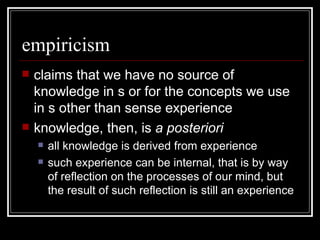
empiricism claims that we have no source of knowledge in s or for the concepts we use in s other than sense experience knowledge, then, is  a posteriori all knowledge is derived from experience such experience can be internal, that is by way of reflection on the processes of our mind, but the result of such reflection is still an experience
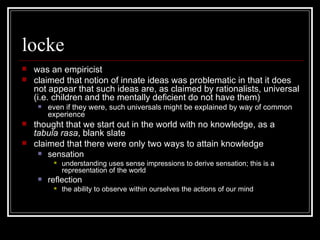
locke was an empiricist claimed that notion of innate ideas was problematic in that it does not appear that such ideas are, as claimed by rationalists, universal (i.e. children and the mentally deficient do not have them) even if they were, such universals might be explained by way of common experience thought that we start out in the world with no knowledge, as a  tabula rasa , blank slate claimed that there were only two ways to attain knowledge sensation understanding uses sense impressions to derive sensation; this is a representation of the world reflection the ability to observe within ourselves the actions of our mind
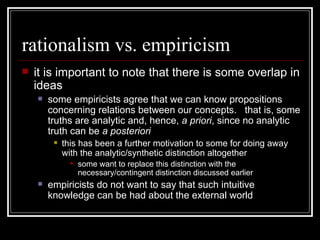
rationalism vs. empiricism it is important to note that there is some overlap in ideas some empiricists agree that we can know propositions concerning relations between our concepts.  that is, some truths are analytic and, hence,  a priori , since no analytic truth can be  a posteriori this has been a further motivation to some for doing away with the analytic/synthetic distinction altogether some want to replace this distinction with the necessary/contingent distinction discussed earlier empiricists do not want to say that such intuitive knowledge can be had about the external world

2-14

  • 1.
  • 2.
    rationalism to bea rationalist is to adopt at least one of three claims the intuition/deduction thesis the innate knowledge thesis the innate concept thesis
  • 3.
    intuition/deduction thesis somepropositions in a particular subject area, s, are knowable by us by intuition alone; still others are knowable by being deduced from intuited propositions intuition is a form of rational insight. it allows us to just “see” the truth of some proposition once we have this piece of knowledge we are able to deduce other pieces of knowledge from it all knowledge gained in this way is a priori and gained independently from sense experience examples might be something like mathematics or even metaphysical claims, e.g. free will, God exists, substance dualism
  • 4.
    innate knowledge thesiswe have knowledge of some truths in a particular subject area, s, as part of our rational nature knowledge is not the result of intuition or deduction. it is just part of our nature that we have it. the way we gained this knowledge could be by way of God, natural selection, or some other means
  • 5.
    innate concept thesiswe have some of the concepts we employ in a particular subject area, s, as part of our rational nature differs slightly from innate knowledge thesis in that we can deduce knowledge from innate concepts, but are not knowledge as such examples could be perfect geometric shapes, e.g. triangles, squares, etc.
  • 6.
    other important notionsthere are other notions which are important to most rationalists. although it is not necessary to hold them to qualify as a rationalist, most do. indispensability of reason thesis the knowledge we gain in subject area, s, by intuition and deduction, as well as the ideas and instances of knowledge in s that are innate to us, could not have been gained by us through sense experience superiority of reason thesis the knowledge we gain in subject area s by intuition and deduction or have innately is superior to any knowledge gained by sense experience
  • 7.
    descartes was arationalist claimed that a priori knowledge was superior to a posteriori knowledge in that the former is indubitable while the latter is open to error used methodic doubt to get down to what could not be doubted grasped the cogito by way of intuition and deduced all other knowledge from this foundation
  • 8.
    empiricism claims thatwe have no source of knowledge in s or for the concepts we use in s other than sense experience knowledge, then, is a posteriori all knowledge is derived from experience such experience can be internal, that is by way of reflection on the processes of our mind, but the result of such reflection is still an experience
  • 9.
    locke was anempiricist claimed that notion of innate ideas was problematic in that it does not appear that such ideas are, as claimed by rationalists, universal (i.e. children and the mentally deficient do not have them) even if they were, such universals might be explained by way of common experience thought that we start out in the world with no knowledge, as a tabula rasa , blank slate claimed that there were only two ways to attain knowledge sensation understanding uses sense impressions to derive sensation; this is a representation of the world reflection the ability to observe within ourselves the actions of our mind
  • 10.
    rationalism vs. empiricismit is important to note that there is some overlap in ideas some empiricists agree that we can know propositions concerning relations between our concepts. that is, some truths are analytic and, hence, a priori , since no analytic truth can be a posteriori this has been a further motivation to some for doing away with the analytic/synthetic distinction altogether some want to replace this distinction with the necessary/contingent distinction discussed earlier empiricists do not want to say that such intuitive knowledge can be had about the external world